
It is ten years ago this month that I first posted what has now become a regular habit – the second paragraph of the third chapter of every book that I read. (which needs a bit of wiggle room for comics, plays and most poetry.) I have found that it often gives a brief (sometimes not so brief) flavour of the book as a whole, and of course it proves that I did read beyond the first two chapters.
The very first book that I gave this treatment to was Ann Leckie’s Ancillary Justice; the second paragraph of its third chapter is:
I unrolled the bundle of clothes I had bought for her— insulated underclothes, quilted shirt and trousers, undercoat and hooded overcoat, gloves— and laid them out. Then I took her chin and turned her head toward me. “Can you hear me?”
I did it for the month of March 2014, then dropped it for two years, then picked it up again in March 2016 with Mother of Eden by Chris Beckett, the second paragraph of whose third chapter is:
I was already sitting there when my cousin Dixon came over to me. About half the Kneefolk had already arrived, and the others were coming in.
I think I must have checked the second paragraph of the third chapter of well over 2,000 books by now. I got the idea from my dear friend H, who had spontaneously adopted it as one of the data points of comparison between Lifeblood, by N.J. Cooper, and Book of Souls, by Glenn Cooper, neither of which I have personally read.
My experience is that it’s rather a variable measure in terms of getting the sense of a book. It’s more likely to work for non-fiction than for fiction, simply because with fiction books there is always the risk that the second paragraph of the third chapter will be a single word of dialogue, for instance with the Doctor Who novel Illegal Alien, by Mike Tucker and Robert Perry:
“Breakfast?”
Or The Chosen Twelve, by James Breakwell:
”Alpha.”
On the other hand, the longest I can recall, over 500 words in both English translation and the original Spanish, was from Luis Leante’s See How Much I Love You. I won’t copy it here.
Sometimes the paragraph neatly illustrates how bad the writing is; for example, The Hunt – For Allies by David Geoffrey Adams:
Anders Johannsen, captain of the first human starship, tossed and turned in bed trying to find the sleep he so desperately needed, after days of insomnia and stress. Losing the battle as the shouts of his bridge crew reverberated through his mind.
or Prophets of the Red Night, by Sophie McKeand:
REbooT// extension 31592 examine examine R3FORMAT / critical warning / critical thought processes are superseding agreed parameters. Exit thought – enter sleep. REbooT// Error close > > 56129
Where I read a book in translation, I try and dig out the original, for instance in Johanna Sinisalo’s Not Before Sundown / Troll: A Love Story:
| Se ei tunnu sairaalta, ei ollenkaan, vaikka sen turkki pölisee jatkuvasti synkeänä pilvenä Electroluxin letkussa. | He doesn’t seem ill at all, though the shreds of his coat are a dismal sight in the Electrolux [vacuum cleaner]. |
Sometimes this leads to discoveries: the English translation of Waste Tide, by Chen Qiufan (who I met in Paris in November; he has rebranded as Stanley Chen) turns out to have rearranged the text so that the second paragraph of the third chapter in the Chinese original is some way into the third chapter in English.
If there are footnotes, I like to include them as well, including all seven footnotes to the second paragraph of the third chapter of Brian Griffin’s Cycling in Victorian Ireland:
2 Thom’s Irish Almanac and Official Directory of the United Kingdom of Great Britain and Ireland: for the Year 1869 (Dublin: Alexander Thom, 1869), p.1400; Irish Cyclist, 26 March 1890.
3 Irish Wheelman, 25 September 1894.
4 Irish Cyclist, 7 May 1890.
5 Icycles, December 1880; Irish Cyclist, 21 May 1890, 2 July 1890. William Bindon Blood was the club president; William Persse Blood was its secretary, and Louis Meldon, — a solicitor, and brother of Dr Austin Meldon — was its captain.
6 Irish Cyclist, 11 June 1890. For accounts of the Dublin University Bicycle Club and of cycling at Trinity College Dublin in the nineteenth century see Kenneth Bailey, A History of Trinity College Dublin 1892-1945 (Dublin:The University Press, 1947), pp 130-33, 164; Trevor West, ‘Football, Athletics and Cycling: The Role of Trinity College, Dublin in the Evolution of Irish Sport’ in Sarah Alyn Stacey (ed), Essays on Heroism in Sport in Ireland and France (Lewiston, Queenston and Lampeter: Edwin Mellen Press, 2003), pp 141-142.
7 Bicycling News, 20 September 1878.
8 Morning Mail, 14 September
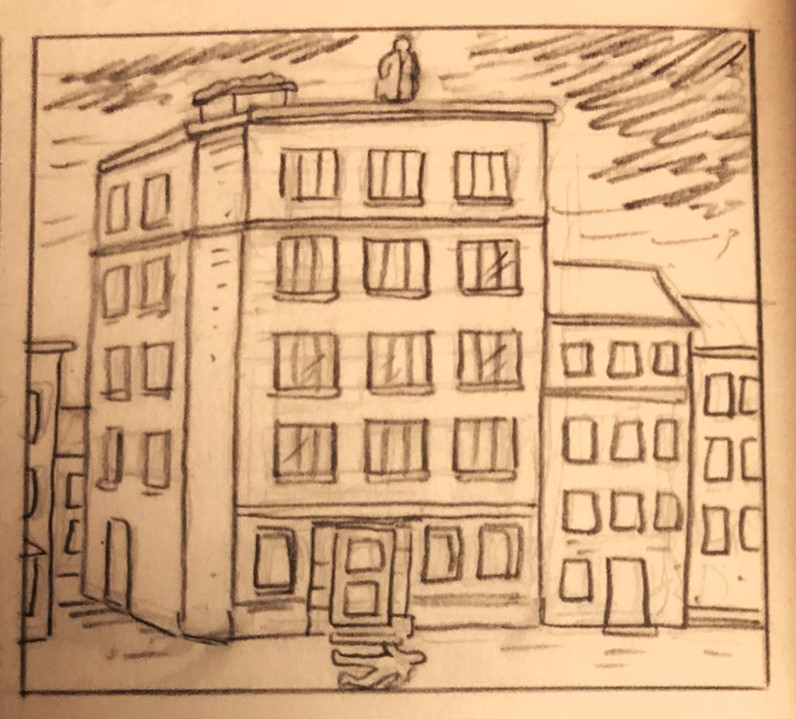
For comics, I take either the second frame of the first page of the third chapter if it’s a work with chapters, or the second frame of the third page if it’s a more unitary text. I can vary this if necessary as with Tintin au Pays de l’Or Noir where I used both the second and third frames of the third page.

With comics it’s generally a bit more hit and miss than with prose. By the third page, the story is barely getting going. Though sometimes it works; here’s the second frame of the third chapter of Jaren van de Olifant, by Willy Linthout, whose protagonist is coming to terms with his son’ suicide:
It can be difficult to make it work for poetry, but sometimes you are lucky, as with Seamus Heaney’s Death of a Naturalist:
The floor was mouse-grey, smooth, chilly concrete.
There were no windows, just two narrow shafts
Of gilded motes, crossing, from air-holes slit
High in each gable. The one door meant no draughts
Plays and scripts are much more difficult, and after some unsatisfactory initial experimentation I’m now just giving the opening of the third scene. I make an honourable exception for Christopher Marlowe, who is usually pithy, for instance in The Jew of Malta:
ABIGAIL: Now have I happily espied a time
To search the plank my father did appoint;
And here, behold, unseen, where I have found
The gold, the pearls, and jewels, which he hid.
ACHATES: Why stands my sweet Æneas thus amaz’d?
At the end of 2021 I did a roundup of the second paragraphs of the third chapters of (most of) the books I had read so far that year. I might do the same again this year (the two years in between got complicated by Clarke submissions, some of which I have yet to post notes on here). I’ll finish this post with my top C3P2 from that selection, a sad little story from A Buzz in the Meadow by Dave Goulson:
From a very young age I kept newts and common toads in tanks in my bedroom, and this went atypically well. The toads in particular made great pets, seemingly taking to captivity and providing great entertainment by hoovering up mealworms with their extending, sticky tongues. When I grew bored of them, or ran out of mealworms from the supply that I bred in a box under my bed, I could simply release the toads back into the garden. However, I longed to have some more exotic amphibians, and eventually I badgered my parents into buying me a pair of North American leopard frogs for Christmas: attractive, bright-green frogs with (as you might guess from the name) a profusion of black spots. I filled one of my glass fish tanks with piles of stones, peat, some plants and a small pond, to make an attractive home for them. It looked great and the frogs settled in well, but after just a few weeks their energetic hopping about caused one of the piles of stones to topple; I came home from school one day to find them both squashed.
Poor frogs!