Whoniversaries 22 July: Roy Herrick, Adrienne Hill, Bonnie Langford, Eric Chitty, Dead of Night

i) births and deaths

22 July 1936: birth of Roy Herrick, who was the counter-revolutionary Jean in the story we now call The Reign of Terror (First Doctor, 1964) and Parsons, a space medic in The Invisible Enemy (Fourth Doctor, 1977)

22 July 1937: birth of Adrienne Hill, who played the short-lived Katarina, a companion of the First Doctor, in the last episode of The Myth Makers and the first few episodes of The Daleks' Master Plan in 1965.

22 July 1964: birth of Bonnie Langford, who played Melanie Bush in 1986-87 alongside the Sixth and Seventh Doctors.


They are not the only two Doctor Who regulars to share the same birthday – more on that come August and October.

22 July 1977: death of Eric Chitty, who was Charles Preslin in the 1966 First Doctor story we now know as The Massacre (lost, alas) and Co-ordinator Engin in The Deadly Assassin (Fourth Doctor, 1976).

ii) broadcast anniversaries

22 July 2011: first broadcast of Dead of Night, third episode of Torchwood series 4. A new cult called the Soulless is formed, and Oswald Danes becomes more and more popular.

iii) date specified in-universe:

22 July 1912: birth of John Forester, as seen in The Gathering (Torchwood, 2011).

Posted in Uncategorised

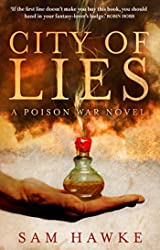
City of Lies, by Sam Hawke

Second paragraph of third chapter:

The great west road gate we stood before was closed for the funeral, but I had no idea what it could withstand. “Is there anything else that can be done to secure the gate?”

I originally bought this because I had ended up on the same panel as Sam Hawke at the Dublin 2019 Worldcon, and then counting the votes in the Hugo nominations in March, I was pleased to discover that she had made the final ballot for the newly renamed Astounding Award (formerly the John W. Campbell Award). So the book is in the Hugo voter packet, but I already had a paper copy.

I rather enjoyed it. It's a big fantasy tale, but the story is tightly focussed on a brother and sister, where the brother is a master of poison (the poison theme is run rather well through the book) and the sister has a chronic and unspecified health problem. There's a tight intersection between palace politics and territorial politics, some impressive plot twists and just enough supernatural for it to qualify as fantasy. A bit long, but I did find myself turning the pages enthusiastically. You can get it here.

Posted in Uncategorised

My tweets

Posted in Uncategorised

Whoniversaries 21 July

It's not a Whoniversary as such, but I just want to tell the rest of you that it's Belgium's National Day today, 190 years after we declared independence. (Yes, I'm Belgian; naturalised in 2008.)

i) births and deaths

Three sad notes today.

21 July 1995: death of Michael Wisher, who appeared as TV anchor Wakefield in The Ambassadors of Death (Third Doctor, 1970); factory owner Rex Farrel in Terror of the Autons (Third Doctor, 1971); Kalik in Carnival of Monsters (Third Doctor, 1973); most iconically as Davros in Genesis of the Daleks (Fourth Doctor, 1975); Magrik of the Vogans in Revenge of the Cybermen (also Fourth Doctor, 1975); Morelli in Planet of Evil (yet again, Fourth Doctor, 1975 – his third role in four stories); and Robar the ship's engineer in Shakedown (unofficial, 1994). A man of many faces, as you can see.

21 July 1998: Not quite as significant as the other two, but worth noting the death of Kenneth Watson, who played Craddock in Daleks' Invasion Earth 2150 A.D. (Cushing movie, 1966) and engineer Duggan in The Wheel in Space (Second Doctor, 1968).

21 July 2017: Death of Deborah Watling, who played the Second Doctor's companion Victoria Waterfield in 1967-8 (and also returned for the unofficial spinoff Downtime in 1998).


ii) publication date

21 July 1994: publication of the first of the Virgin Missing Adventures, Paul Cornell's tale of the Fifth Doctor and vampires, Goth Opera. I won't normally track publication dates here but this is a significant event in the development of Who books, the first spinoff book featuring a non-current Doctor.

iii) date specified in-universe

21 July 2006: UNIT locks its files on Judoon translators (and by implication Judoon torches also). See The Secret Life of Monsters (Twelfth Doctor book, 2014 – a particularly good one).

Posted in Uncategorised

EU Lobbying Handbook, by Andreas Geiger

Second paragraph of third chapter:

The art of lobbying is to achieve congruence of the diverging interests of politics, business and society.

I picked this one up in 2013 partly out of a general interest in sharpening the saw, but mainly because the author and I were on opposite sides of a particular Brussels lobbying issue at the time, and I wanted to get inside his head. Of course, I never got around to actually reading the book. Like other such books that I have read, it concentrated on being EU 101, explaining the institutional structures (now somewhat out of date, of course) and missing out on the real fun, the thrill of the chase and of seeing your cause win. (As indeed my side defeated the author's in late 2012.) There are some interesting first-person accounts from people who have been inside the system and have been the targets of lobbying, but they are poorly integrated into the narrative. (There are also a couple of first-person accounts that are not very interesting.) Up to now, the only interesting book I have read on Brussels lobbying – which combined it with Washington lobbying – is Christine Mahoney's Brussels vs the Beltway, which you can get here. If you really want to read Geiger's book, you can get it here.

This was the shortest book acquired in 2013 that I had not yet read. Next on that pile is Barcelona, Catalonia: A View from the Inside, by Matthew Tree.

Posted in Uncategorised

My tweets

Posted in Uncategorised

Whoniversaries 20 July: James Bree, Roy Skelton, Jeff Rawle, Sinead Michael, Ben and Polly, the Moon


i) births and deaths

20 July 1923: birth of James Bree, who played the Security Chief in The War Games (Second Doctor, 1969), Nefred the Decider in Full Circle (Fourth Doctor, 1980) and the Keeper of the Matrix in The Ultimate Foe (Sixth Doctor, 1986).

20 July 1931: birth of Roy Skelton, whose first voice work was for the Monoids in The Ark (First Doctor, 1966) and did Dalek voices all the way from Evil of the Daleks (Second Doctor, 1967) to The Curse of Fatal Death (alternate Doctors, 1999). He had three on-screen roles as well, Wilfred Norton in Colony in Space (Third Doctor, 1972), James the chemicals man in The Green Death (Third Doctor, 1973), a role hastily invented when another actor fell ill halfway through filming, and King Rokon of the Kastrians in The Hand of Fear (Fourth Doctor, 1976).

20 July 1951: birth of Jeff Rawle, who played leadership heir Plantagenet in Frontios (Fifth Doctor, 1984), gallery director Lionel Harding in Mona Lisa's Revenge (Sarah Jane Adventures, 2009) and early Doctor Who director Mervyn Pinfield in An Adventure in Space and Time (2013).

20 July 1998: birth of Sinead Michael, who became part of the regular cast of the Sarah Jane Adventures in its truncated final season (2010). At twelve, she is the youngest actor to have been in the regular cast of any show in the Whoniverse.

ii) broadcast anniversaries – none

iii) dates specified in canon

20 July 1966: the day that the First Doctor leaves London with Ben and Polly in The War Machines (1966) and the Second Doctor brings them back in The Faceless Ones (1967), only to find that he and Jamie need to find the stolen Tardis in Evil of the Daleks (also 1967).

20 July 1969: Neil Armstrong walks on the moon (21 July European time), an event Martha Jones says she saw four times in Blink (Tenth Doctor, 2007) and we all see it in Day of the Moon (Eleventh Doctor, 2011).

20 July 2006: forty years on from her depature and return, Polly Wright emails Sir Alastair Lethbridge-Stewart as a result of reading an article about Jo Jones (née Grant) in the first installment of The Three Companions audioplay (released in 12 monthly episodes 2009-10).

Posted in Uncategorised

TOR: Assassin Hunter, by Billy Bob Buttons

Second paragraph of third chapter:

The French commander, I see, enjoys his comforts. In the corner of the tent there’s a bed with a crowning hill of silk pillows, and just by it on a French mahogany desk there sits a bottle of Champagne: a Veuve Clicquot, 1855, a very good year. I spot a six foot candelabra cactus in a pot and on the wall, next to a world map, there is a painting of a leafy forest. A Monet by the look of it; I recognise the clumsy brushwork.

I got this on a whim at Novacon in 2013, and the author kindly autographed it. It’s the story of a counter-assassin in the aftermath of the Franco-Prussian war. My heart sank when I saw the map which is the frontispiece:

Yep, the borders on the map are (most of) those of 1990 rather than those of 1870. The anachronisms and poor use of language threw me from the start, and I don’t think I lasted twenty pages. This was the sf book that had lingered longest unread on my shelves (though TBH I am not certain that it had any sfnal elements, but the fact that I bought it at an sf convention is suggestive) and also the shortest unread book of those that I acquired in 2013.

Next on those lists respectively are Above/Below, by Stephanie Campisi and Ben Peek (which will have to wait until I have finished the unread 2013 books), and the EU Lobbying Handbook, by Andreas Geiger. You can get this miserable effort here.

My tweets

Posted in Uncategorised

Whoniversaries 19 July: John Harvey, Sirens of Time, Lady Jane Grey, The Cleansing, Tanya moves up

When I first did these posts ten years ago, I actually skipped 19 July because I couldn't see anything interesting about it. I now think that was a bit unfair. It's no 23 November, but the anniversary of The Sirens of Time is surely worth noting (and there are a couple of others as well).

i) births and deaths

19 July 1982: Death of John Harvey, who played Professor Brett in The War Machines (First Doctor, 1966) and Officia in The Macra Terror (Second Doctor, 1967)

ii) broadcast aniversaries etc

19 July 1999: release of the very first Big Finish audio, The Sirens of Time, featuring Peter Davison, Colin Baker and Sylvester McCoy. I have quite literally lost track of Big Finish's output – masses of material, including books as well as audio plays, reflecting all eras of the show and many spinoffs. More power to them.

iii) dates specified in-universe

19 July 1553: Rani finds herself in the court of Lady Jane Grey, and is appointed a Lady-In-Waiting, just as the army of Mary Tudor arrives to overthrow her, as seen in Lost in Time (Sarah Jane Adventures, 2010)

19 July 1843: date of the Cleansing, the point of departure for the alternate timeline in the Eighth Doctor novel Reckless Engineering.

19 July 2013: Tanya Adeola is informed by Coal Hill School that she can move forward three years due to her "truly extraordinary academic capability", as seen in flashback at the beginning of Nightvisiting, for my money the best single episode of Class (2016).

Posted in Uncategorised

April 2007 books

I totally failed to note in the previous month the hiring of my first intern in the new job. J was an intelligent young woman who had tried various career options which didn't work out, and was prepared to give working in international politics a fling. I'm glad to say that she caught the bug and is now a British diplomat. It also turned out that her elder brother was friends with their neighbour Rebecca Nation, the daughter of Terry Nation who wrote a lovely book for her, and J had played with real Daleks as a child. (For certain values of "real".)

This month I went to the Political Studies Association conference in Bath to do a panel debate on Europe, and travelled back to London talking to the journalist Tim Sebastian, which was fun.

In family news, my brother and his wife welcomed their new daughter. Also I turned 40, but I don't seem to have done much in the way of celebration; B's behaviour at home was getting very difficult, and we just didn't have the energy.

I read 21 books in April 2007.

Non-fiction 5 (YTD 24)
In Search of the Dark Ages, by Michael Wood
Field of Bones: An Irish Division in Gallipoli, by Philip Orr
After Dinner Speaking, by Fawcett Boom
A Short History of Nearly Everything, by Bill Bryson
800 Years of Women's Letters, edited by Olga Kenyon (did not finish)

Non-genre 2 (YTD 8)
The Way By Swann's, by Marcel Proust
The Search For Roots: a personal anthology, compiled by Primo Levi

sf 9 (YTD 26)
The Book of Imaginary Beings, compiled by Jorge Luis Borges
Temeraire, by Naomi Novik
Glasshouse, by Charles Stross
Rainbows End, by Vernor Vinge
Blindsight, by Peter Watts
Eifelheim, by Michael Flynn
Narn i Chîn Húrin: the Tale of the Children of Húrin, by J.R.R. Tolkien
Blindness, by José Saramago
The Way to Babylon, by Paul Kearney

Comics 3 (YTD 9)
The Last Temptation, by Neil Gaiman
Alias vol. 1, by Brian Michael Bendis
Alias vol 2: Come Home, by Brian Michael Bendis

Doctor Who 2 (YTD 13)
Made of Steel, by Terrance Dicks
Doctor Who and the Carnival of Monsters, by Terrance Dicks

5,900 pages (YTD 24,700)
2/21 by women (YTD 19/80)
none by PoC (YTD 2/80)

Best of the month: Tolkien's Children of Húrin, which you can get here, and Saramago's Blindness, which you can get here. Worst by far: Fawcett Boom's pointless guide to After Dinner Speaking, which you can get here.


Posted in Uncategorised

Origin of the Ardennes

Etymology while driving through the Ardennes: the name must derive from a local Celtic cognate of Welsh ardd, Irish/Manx ard, Scots Gaelic àrd which all mean “high”.

This comes from Proto-Indo-European *h₃r̥dʰ-wó-s, also the root of Latin arduus, “steep” and delightfully of Greek ὀρθός, “straight/upright”, root of orthodox, orthogonal, orthodontics etc.

Also Sanskrit ऊर्ध्व (ūrdhvá) “high” and Ossetian уырды́г (wyrdýg) “upright”. (I love the chance to use Ossetian! Nothing in Farsi or Dari, or in any Germanic language for that matter).

A closely related Indo-European root *h₃r̥dʰ-ō-s gives us a high plant in Latin arbor/arbōs, “tree”.

The second element of “Ardennes” is thought to be the Celtic root *windos “white/fair”, which becomes Welsh gwyn (feminine gwen, as in the white enchantress, Gwenhwyfar/Guinevere) and Irish fionn (Fiona, or the fair field Finaghy where I grew up). Not totally convinced, myself!

Going back, the PIE root *h₃erdʰ- comes from the verb stem *h₃er- which also gives us the Latin verb orior “to rise”, from which we get origin, orient and adore; also Greek : όρος “mountain” and ἔρις “quarrel”, which brings us to Slavic рать/рат, “war”.

If it’s war it must be serious, so we get the Germanic root *ernustuz, Dutch ernst, German Ernst, English earnest and the name Ernest. But now I am out of time.

That’s kept me going through the Ardennes. Next time you are passing, look at the fair heights, and ponder the linguistic millennia.

Posted in Uncategorised

My tweets

Posted in Uncategorised

Whoniversaries 18 July: Robert Sloman, Alan Bennion, Paul Cornell, David Maloney, The Sensorites #4

i) births and deaths

18 July 1926: birth of Robert Sloman, who co-wrote The Dæmons (1971), and was sole author of The Time Monster (1972), The Green Death (1973), and Planet of the Spiders (1974) – the season finales for all but the first of the Pertwee years.

18 July 1930: birth of Alan Bennion, who appeared as Ice Lord Slaar in The Seeds of Death (Second Doctor, 1969), Ice Lord Izlyr in The Curse of Peladon (Third Doctor, 1972) and Ice Lord Azaxyr in The Monster of Peladon (Third Doctor, 1974).

18 July 1967: birth of Paul Cornell, who wrote televised stories Father's Day (2005) and Human Nature / The Family of Blood (2007), the latter based on one of his eight Who novels, and the webcast alternative Ninth Doctor story The Scream of the Shalka (2003), as well as four-and-a-bit Big Finish audios, contributing to The Discontinuity Guide, and editing one of the Short Trips anthologies. I took the picture below at Gallifrey One last February, with fellow writers Matt Fitton, L.M.. Myles and Una McCormack. If you're reading this, happy birthday, Paul!

18 July 2006: death of David Maloney, who was one of the great directors of the classic series: The Mind Robber (1968), The Krotons (1968-69), The War Games (1969), Frontier in Space (1963), Planet of the Daleks (1963), Genesis of the Daleks (1975), Planet of Evil (1975), The Deadly Assassin (1976), and The Talons of Weng-Chiang (1977) all benefited from his talents.

ii) broadcast and production anniversaries

18 July 1964: broadcast of 'A Race Against Death', the fourth episode of what we now call The Sensorites. The Doctor is trying to save Ian, and tracks down the poison in the city's water supply to its source. But something 'orrible lurks in the tunnels…

18 July 2004: the very first filming of New Who, the scene in Aliens of London (Ninth Doctor, 2005) with the Doctor, the pig and Toshiko Sato.

iii) dates specified in-universe

18 July 2004: Setting of the first half of the rather good 2003 Sixth Doctor/Seventh Doctor crossover audio Project: Lazarus.

18 July 1699: Date of the final scenes of the 1998 First Doctor novel The Witch Hunters, most of which is set a few years earlier during the Salem witch trials.

Posted in Uncategorised

Tooth & Claw, by Jo Walton

Second paragraph of third chapter:

Selendra came in in some confusion. At one moment she was flushed almost pink, at the next, she went pale, paler even than Haner’s accustomed delicate gold. She closed the door behind her and stood a moment with her tail to her family.

A hilarious and also slightly grim comedy of manners, riffing off Anthony Trollope in a society of cannibalistic dragons. It's well imagined, and of course in today's context of querying the roots of Victorian prosperity it seems rather appropriate to highlight the violent foundations of the entire nineteenth-century social system. Not a lot more to say than that: good fun, respectful of the source material and also a decent creation in its own right. You can get it here.

This was my top unread book acquired in 2019, my top unread sf book and my top unread book by a woman. Next on the first two of those lists is SS-GB by Len Deighton, and on the third Shadow Scale by Rachel Hartman.

Posted in Uncategorised

My tweets

Posted in Uncategorised

Whoniversaries 17 July: Hugh David, The Time Meddler #3, Damaged Goods, fictional film releases

i) births and deaths

17 July 1925: birth of Hugh David, who directed The Highlanders (Second Doctor, 1966-67) and Fury from the Deep (Second Doctor, 1968). As an actor, he was one of those approached about playing the role of the Doctor back in 1963, but turned it down.

ii) broadcast anniversaries

17 July 1965: broadcast of 'Battle of Wits', third episode of the First Doctor story that we now call The Time Meddler. The Monk is luring the Viking fleet to attack; and Steven and Vicki discover, to their amazement, that he has his own Tardis.

iii) dates specified in-universe:

17 July 1987: In the first chapter of the 1996 Seventh Doctor novel Damaged Goods, by Russell T. Davies (later the first showrunner of New Who), Simon Jenkins, known as the Capper (because, it was said, he first kneecapped someone at the tender age of fourteen) sets fire to himself and dies. But he does not stay dead.

17 July 2006 (?) was the release date of both The Pink Panther and Date Movie, at least according to advertisements in a Cardiff supermarket in the 2006 Torchwood episode Out of Time, which is odd because the episode is explicitly set in December.

Posted in Uncategorised

Thursday reading

Current
Our Mutual Friend, by Charles Dickens
The Overstory, by Richard Powers
Guban, by Abdi Latif Ega

Last books finished
The Wicked + The Divine vol 9: "Okay", by Kieron Gillen etc
Doctor Who and the Cybermen, by Gerry Davis
“Houston, Houston, do you read?” by James Tiptree Jr
The Complete Secret Army: An Unofficial and Unauthorised Guide to the Classic TV Drama Series by Andy Priestner
The 1945 Retro Hugo finalists for Best Graphic Story or Comic
The Ruin of Kings, by Jenn Lyons
“The Bicentennial Man” by Isaac Asimov

Next books
George Eliot, by Tim Dolin
Yugoslavia's Implosion: The Fatal Attraction of Serbian Nationalism, by Sonja Biserko

Posted in Uncategorised

My tweets

Posted in Uncategorised

Whoniversaries 16 July: Robert Banks Stewart, Mark Tonderai, Trevor Baxter, War Machines #4, C-Day

i) births and deaths

16 July 1924: birth of Robert Banks Stewart, author of both Terror of the Zygons (Fourth Doctor, 1975) and The Seeds of Doom (Fourth Doctor, 1976).

16 July 1974: birth of Mark Tonderai, director of The Ghost Monument and Rosa (both Thirteenth Doctor, 2018). He was the first black director of a Doctor Who story (though not the first person of colour – that would be Waris Hussein back at the very beginning).

16 July 2017: death of Trevor Baxter, who was only in one TV story, The Talons of Weng Chiang (Fourth Doctor, 1977) but reprised the role of Professor George Litefoot in literally dozens of Big Finish audios.

ii) broadcast anniversary

16 July 2018: announcement of Jodie Whittaker as the Thirteenth Doctor. Still sends shivers down my spine.

ii) and iii) broadcast anniversary and date specified in-universe

16 July 1966 was that day that the last episode of The War Machines, which was also the last episode of the original third season, was broadcast. The Doctor invents a way of neutralising the War Machines, defeats WOTAN, learns that Dodo is staying in England, and takes off with new companions Ben and Polly unintentionally on board.

16 July is also specified in the script of The War Machines as "C-Day", the day when all the computers in the world are to be linked (and then WOTAN will rule supreme). The problem is, Sir Charles Summers specifies very clearly in Episode 1 that C-Day will be on Monday 16 July; and 16 July 1966 was, obviously since Doctor Who was on telly that evening, a Saturday – the next Monday 16 July was in 1973 (and the previous one, in 1962, is impossible because the Post Office Tower had not yet been built). For reasons we shall explore in a couple of days, this creates other problems. I prefer to think that Sir Charles misspoke and meant Saturday, or the 18th, and the journalists at the press conference were too polite to correct him. This would make them rather unusual journalists, but Doctor Who is a show about unusual people.

Posted in Uncategorised

The Room Where It Happened: A White House Memoir, by John Bolton

Second paragraph of third chapter (it's a long 'un, forgive me):

Even the simple task of preparing Trump for Abe’s visit turned out to be arduous, and a sign of things to come. We arranged two briefings, one largely on North Korea and security issues, and one on trade and economic issues, corresponding to the schedule of meetings between Abe and Trump. Although the first Abe-Trump meeting was on political matters, our briefing room was filled with trade-policy types who, having heard there was a briefing, wandered in. Trump was late, so I said we would have a brief discussion on trade and then get to North Korea. It was a mistake. Trump, set off by a comment that we had no better ally than Japan, jarringly complained about Japan’s attack on Pearl Harbor. Things went downhill from there. Before long, Abe arrived, and the session ended. I pulled Kelly aside to discuss the fruitless “briefing,” and he said, “You’re going to be very frustrated in this job.” I answered, “No, I’m not, if there are minimal rules of order. This is not a Trump problem; this is a White House staff problem.” “I don’t need a lecture from you,” Kelly shot back, and I replied, “I’m not lecturing you, I’m telling you the facts, and you know it’s true.” Kelly paused and said, “It was a mistake to let them [the trade people] in,” and we agreed to fix the problem next time. But in truth, Kelly was right and I was wrong. It was a Trump problem, and it never got fixed.

There have been a lot of White House memoirs in the last three and a half years. This is the only one I have read. I've been aware of John Bolton for a long time, as a particularly hardline (and reputedly unpleasant) activist on the Right of US foreign policy debates, who briefly served as UN ambassador under the junior Bush; and of course I've been in and out of the various Washington foreign policy institutions for years, but less so in the most recent period. This book, as if you didn't know, is Bolton's own account of his 17 months as National Security Adviser to President Trump.

I found it fascinating. I've seen a lot of reviews complaining that it is badly written. I disagree. I would say that Bolton takes no hostages – he assumes that the reader is already familiar with the ins and outs of US foreign policy, and with the detail of what Trump had done in his first two years in office (and what Obama did before him). Bolton barely even explains his own thinking on some of the crucial issues – he makes it clear that he hates the Iran deal and the Paris climate treaty, but only offers snippets of analysis in passing. So I felt some frustration about what is not there.

But what is there is fascinating. Bolton clearly kept good contemporaneous notes of all of his meetings and conversations, obviously with the intention of writing this book. (Trump even jokes with him about that at one point.) It's a dreadful picture of presidential disorganisation and ego, of decision systems which do not work because Trump himself refuses to be managed, of years of careful diplomacy up-ended by a single volatile outburst, and of opportunities lost. One does not have to sympathise with Bolton's political goals to sympathise with his frustration.

There are some very good set-piece accounts as well. The account of the NATO Brussels summit deserves to be made into a theatrical farce; very few details would need to be changed. The accounts of Trump's relations with North Korea are spine-chilling. The sections on Russia and China are very enlightening. The chapter on Venezuela is a record of a failure of US power projection, which Bolton attriubutes to mistakes largely made by Trump, but frankly from his own account it seems at least as important that the actors who the US supported on the ground were unable to deliver.

The chapter on Trump's last-minute decision in June 2019 to cancel a planned retaliation strike on Iran, with the title "Trump loses his way, and then his nerve", is particularly interesting because it actually shows a rather good side of Trump (which Bolton deeply disparages) – he doesn't actually like the idea of killing people, and the information that the US could be about to cause 150 Iranian deaths caused him to change his mind on authorising the strike. Bolton is of course right that the process of reaching the final decision was chaotic and wasteful of political capital, but I give Trump credit for his squeamishness. (Of course, this was motivated by the bad publicity that the casualites would generate, rather than any human sympathy for the potential victims, but we will take what we can get.)

Another specific point where (to my surprise) I found myself closer to Trump than to Bolton was the question of the planned Nord Stream 2 gas pipeline from Russia to Germany through the Baltic. It seems to me that this project dangerously increases Russian influence in the EU's energy market, and that there are many questions to be asked about it. Trump's hostility to it is more visceral, but comes from a similar suspicion of Russia (he is not as pro-Russian as some like to depict him, at least from Bolton's account). Bolton doesn't spell out his own position, but makes it clear that he disapproves of the extent to which Trump's attitude to Germany and to Angela Merkel is driven by this one issue.

I had hoped to see some discussion of a situation where I know Bolton's views are closer to mine than either of us is to the mainstream of EU and US foreign policy – the Western Sahara, where he worked with James Baker at the time when he came close to solving the comflict with Morocco. I had heard through the grapevine that he was exerting some pressure on Morocco at the time, but this may have been wishful thinking – there is no mention of it in the book, which suggests both that Bolton has moved on and that he did nothing about it when in the NSC, let alone bring it to Trump's attention.

Bolton ends by going into some detail on the impeachment process (which happened after he resigned in September 2019). Both left and right have attacked him for his behaviour here (he did not offer evidence to the House, but made himself available to the Senate, which did not avail itself of the offer). I found it difficult to get excited about the impeachment at the time – it was always clear that a supine Senate was going to acquit Trump, and truth be told the case was not as solid as it would have needed to be even in less partisan times. I also found it difficult to get excited by Bolton's account except to observe that his conscience clearly does trouble him, otherwise he would not have written at such length (and comparatively less lucidly than the rest of the book).

I'm not going to put an Amazon link here as I usually do, because I did not pay for my own copy of the book and I don't especially enourage others to do so. But it is an interesting read, at least for those who are as wonkish as I am about international politics.

Posted in Uncategorised

My tweets

  • Wed, 10:45: RT @JohnScottTynes: Lovecraft’s racism is baked into his storytelling, his philosophy, his letters, and his life experience. As is his elit…
  • Wed, 11:07: RT @tconnellyRTE: Breaking: Apple and Ireland have won their appeal against the European Commission’s €13.1 billion ruling: The General C…

Posted in Uncategorised

Whoniversaries 15 July: Edmund Warwick, Angus McKay, Geoffrey Burgon, Miles Richardson, Rendition

i) births and deaths

15 July 1907: birth of Edmund Warwick, who played Darrius in The Keys of Marinus (First Doctor, 1964) and the Doctor’s robot double in The Chase (First Doctor, 1965).

15 July 1926: birth of Angus McKay, who played Cardinal Borusa in The Deadly Assassin (Fourth Doctor, 1976) and Sellick the headmaster in Mawdryn Undead (Fifth Doctor, 1982). (NB: Embarrassingly, I originally posted the wrong Borusa here. Now corrected.)

15 July 1941: birth of Geoffrey Burgon, who composed the memorable incidental music for Terror of the Zygons and The Seeds of Doom, and also the music for Monty Python's Life of Brian and much else besides.

15 July 1963: birth of Miles Richardson. I don’t usually note actors who have only appeared in Big Finish, but this is a special case, as suave exiled timelord Irving Braxiatel is such a core figure to the audio branch of the Who mythos. In one story, In Living Memory, Braxiatel is brainwashed into believing that he is an actor called Miles Richardson…

ii) broadcast anniversary

15 July 2011: broadcast of Rendition, second of the fourth series of Torchwood. Jack and Gwen are unwillingly transported to America, and Jack survives poisoning.

Posted in Uncategorised

2020 Hugo finalists and 1945 Retro Hugo finalists for Best Short Story

One interesting point that jumped out at me from reading this year's Hugo finalists in this category, and comparing with the 1945 Retro Hugo finalists: the protagonists of the stories on the 2020 ballot are all women, and the protagonists of the stories on the 1945 ballot are all men.

Admittedly this is a sweeping statement that has to be qualified a little, but only a little. "As the Last I May Know" is about the peculiar relationship between a young girl and a much older man, but it's clearly her story more than his; and “Ten Excerpts from an Annotated Bibliography on the Cannibal Women of Ratnabar Island” doesn't have protagonists as such but is rather obviously about women. And although the narrator of “I, Rocket”, by Ray Bradbury, is the rocket (which doesn't apparently have gender), the protagonist is Captain Lamb, a man.

All of the 2020 finalists do at least have male characters (five out of six have male characters with names, the exception being “A Catalog of Storms”, which features an unnamed fisherman, the Mayor and the Mayor's unnamed son). As for 1945, in "And the Gods Laughed", Hilda Race, "who loved little flowers and was a botanist, egad!" is part of the crew and the first to fall victim to the aliens' plans. She is referred to as "Hilda", while the men on the crew are referred to by their surnames. "Desertion" features Miss Stanley, "the best qualified conversion operator in the solar system". In the other Simak story, "Huddling Place", the protagonist's mother puts in an appearance on the third page and is not heard from again. "I, Rocket" has a cute Martian girl, Yrela, off-stage. "Far Centaurus" has a cute but unnamed Earth girl off-stage. "The Wedge" has no visible women at all.

Anyway, here they all are, with links to the original publications in all cases.

2020 Best Short Story Hugo finalists

“And Now His Lordship Is Laughing”, by Shiv Ramdas

Second paragraph of third section:

Every so often, slowly, gingerly, she runs her tongue along the inside of her gums, wincing a bit. Her teeth and mouth hurt all the time now, why she doesn’t know. From the force-feeding? Or maybe that’s merely the part of her that was being eaten from the inside out when the soldiers returned to the bungalow.

Magic doll wreaks revenge for the Bengal famine.

“As the Last I May Know”, by S.L. Huang

Second paragraph of third section:

The snow falls over nothing.
I beg three small graves to place incense
But echos have no tombs.

War, and the story of a young girl whose death is (a bit implausibly) the key to victory.

“Blood Is Another Word for Hunger”, by Rivers Solomon

Second paragraph of third section:

“With all the accoutrements gone, this place doesn’t feel like much of a home at all,” said Ziza as she helped set the table for supper. She’d invited herself to stay. “Looks like a tomb in here.”

Slavery, murder, magic and birth.

“A Catalog of Storms”, by Fran Wilde

Second paragraph of third section:

We go up there a lot to poke around now that we’re older.

Parenthood, family and weather.

“Do Not Look Back, My Lion”, by Alix E. Harrow

Second paragraph of third section:

“They do not need you,” Eefa tells Talaan. “Even Ukhel herself went home to her husband in the early months, to rest and grow her daughter strong.” Talaan nods, but there is a slight vertical line between her brows.

Love, birth and death in a matriarchal gynocratic warrior society.

“Ten Excerpts from an Annotated Bibliography on the Cannibal Women of Ratnabar Island”, by Nibedita Sen

Second paragraph of third section:

“It’s not for no reason that women have, historically, been burdened with the duties of food preparation. Or that it is women, not men, who are called upon to limit their appetites, shrink themselves, rein in their ambitions. A hungry woman is dangerous. [ . . . ] Men are arbiters of discourse, women the dish to be consumed. And the Ratnabari, in the exercising of their transgressive appetites, quite literally turn the tables on their oppressors.”

Vivid, briefly expressed story about cannibalism and oppression.

1945 Best Short Story Retro Hugo finalists:

“And the Gods Laughed”, by Fredric Brown

Second paragraph of third section:

I said, “But of course with animals like that, you never know whether they’re dangerous until you’ve been around them for a while. You can’t judge by size or looks. Like if you’d never seen a snake, you’d never guess that a little coral snake was dangerous, would you? And a Martian zeezee looks for all the world like an overgrown guinea-pig. But without a gun — or with one, for that matter — I’d rather face a grizzly bear or a — ”

Interesting alien invasion and body-horror story, with a well-executed final twist.

“Desertion”, by Clifford D. Simak

Second paragraph of third section:

The tractors, combing the nearby terrain, found no trace of him, unless the skulking thing reported by one of the drivers had been the missing Earthman in Loper form.

Doomed astronauts are being sent on a mission. The most senior one takes his dog, with interesting consequences.

“Far Centaurus”, by A. E. van Vogt

Second paragraph of third section:

A great sadness came to me. Poor, brave Pelham. Inventor of the Eternity drug that had made the great plunge into interstellar space possible, he lay dead now from his own invention.

Hibernating astronauts travel to Alpha Centauri. When they get there, they find that they are too late.

“Huddling Place”, by Clifford D. Simak

Second paragraph of third section:

For long minutes after the shape was gone he stood there, hands gripping the railing in front of him, eyes still staring up into the steel-like blue.

An agoraphobic protagonist has the chance to carry out a politically important medical procedure. What does the robot butler understand to be his real priorities?

“I, Rocket”, by Ray Bradbury

Second paragraph of third section:

The moon, and after the moon a thousand dark meteors crashing by, silent. Tides of space itself, indescribable, and the urge of stars and planets. And then a thing called momentum when my jets were cut and I moved without breathing or trying to move.

Space politics and shifting missions, told unusually from the rocket’s point of view.

“The Wedge”, by Isaac Asimov

Second paragraph of third section:

His fingers moved on either side, and the line of armed men backed away to form a passage, along which Devers strode to the foot of the Chair of State.

The smart Foundation guys outsmart the locals. (The theme of a lot of Foundation stories.)

Posted in Uncategorised

My tweets

Posted in Uncategorised

Pushing back against fake news – a personal story

In April and October last year, the Spanish online newspaper OK Diario published two stories including completely false statements about me, in particular about my alleged contacts with Spanish prime minister Pedro Sanchez – I have never met Pedro Sanchez, or communicated with him at all.

I complained to the Spanish Comisión de Arbitraje, Quejas y Deontología, which has now published its official decision on the matter, finding completely in my favour and against OK Diario. Sometimes it’s worth pushing back to set the record straight.

Posted in Uncategorised

Whoniversaries 14 July: Christopher Priest, Margot van der Burgh, Set Piece

i) births and deaths

14 July 1943: birth of Christopher Priest, apart from Douglas Adams the only famous science fiction writer to write stories for Old Who. Both of his scripts were in the end rejected, in famously acrimonious circumstances. Seen here in 2016 with me and Nina Allan, at a pub in deepest Somerset. Happy birthday, Chris!

14 July 2008: death of Margot van der Burgh, who plays the First Doctor's fiancée Cameca in The Aztecs (1964) and Nyssa's stepmother Katura in The Keeper of Traken (Fourth Doctor, 1981).

ii) broadcast anniversaries

None.

iii) dates specified in-universe

14 July 1993: The Seventh Doctor meets up with Ace, now aged 37, in Sydney Australia, in Kate Orman's New Adventures novel Set Piece.

Posted in Uncategorised

2020 Hugo finalists and 1945 Retro Hugo finalists for Best Graphic Story or Comic

One of the problems with this Hugo category (which has, thank heavens, been renamed to include the crucial word "Comic" – after extraordinary struggle) is that we are not always comparing like with like. For this year, we have two standalone stories, two finalists that are the concluding installments of long series, and a middle volume and a first volume. It's very good to see that the publishers of all three established series included all previous volumes in the Hugo Packet – in two of the three cases, I already had the previous volumes as well, but it certainly made a difference for me in the third case. In the end if we are going to have just one Hugo category covering comics, we're always going to have these situations (and I don't think we need another Hugo category of any kind). Anyway, here are this year's finalists and what I thought of them.

Die, Volume 1: Fantasy Heartbreaker, by Kieron Gillen and Stephanie Hans, letters by Clayton Cowles

Second frame of third chapter:

First volume of what promises to be an ongoing serial. Our protagonists were sucked into a parallel dimension while playing an RPG twenty-five years ago, and were returned to the real world, scarred and damaged; now they are sucked back into the parallel universe. Good art and nicely executed symbolism; but I didn't really engage with the characters, and it's pretty bleak in tone. You can get it here.

LaGuardia, written by Nnedi Okorafor, art by Tana Ford, colours by James Devlin

Second frame of third chapter:

I rather bounced off Okorafor's Binti novellas, but very much liked her earlier novel Lagoon, and I'm glad to say that this story is in the Lagoon universe, or one closely related to it. Aliens have landed some time ago; some of the countries of the world are adapting well to integrating this new source of diversity, others are not, and our pregnant heroine is navigating the human/alien encounter inside her own body as well as in her dealings with society in New York and Nigeria. Well done and realised. Slightly inconclusive. You can get it here.

Monstress, Volume 4: The Chosen, written by Marjorie Liu, art by Sana Takeda

Second frame of third chapter (Chapter 21)

The first three volumes of Monstress won the last three Hugos in this category; will it be four out of four? Myself I find the art and world-building truly extraordinary, but am squicked by the graphic violence (OK, there's less of it this time) and am getting a bit lost in the overall storyline (perhaps I should go back and reread the first three volumes, kindly included in the Hugo voter packet). You can get the four volumes here, here, here and here.

Mooncakes, by Wendy Xu and Suzanne Walker, letters by Joamette Gil

Second frame of third chapter:

This was the surprise in the Hugo final ballot – the one finalist from a smaller publisher (four of the other five are from Image, and LaGuardia is from Dark Horse). It's a YA romance story of Chinese-Americans in rural New England, where our heroine, a young witch, teams up with her  beloved, a non-binary werewolf, to overcome evil and bring about a better world (at least for them). Very sweet. You can get it here.

Paper Girls, Volume 6, written by Brian K. Vaughan, drawn by Cliff Chiang, colours by Matt Wilson, letters by Jared K. Fletcher

Second frame with dialogue in from the third chapter of each of the six volumes:

Volume 1 (originally in issue #3)

Volume 2 (originally in issue #8)

Volume 3 (originally in issue #13)

Volume 4 (originally in issue #18)

Volume 5 (originally in issue #23)

Volume 6 (originally in issue #28)

I've already written about this, in October last year. I said then:

This is the story of four 12-year-olds delivering newspapers in 1988 in Cleveland, Ohio, all from different ethnic backgrounds, who get swept up into a mysterious time war which takes them to the future and past, both near and far. Unlike with some comics compilations, each of the sic volumes has its own arc, though I don't think you could describe them as completely self-contained; I definitely would have benefited from reading Volume 2 before Volume 3.

It's awfully well done. The four girls are Erin (Asian), Mac (tomboy), KJ (Jewish and gay) and Tiffany (African-American and the most nerdy). Each of them gets to confront different versions of their own future – I think the best bit is in Volume 2, where the girls meet Erin's 40-year-old future self in 2016 Cleveland.

The art is great throughout. There is a particularly strong part in Volume 6 where the four girls are scattered into different timelines and we follow each of them on her own line across the pages, like a musical score. One is never in any danger of getting confused between the main characters, and when people turn up at different ages, they remain recognisable.

I haven't seen Stranger Things (apart from one episode which I watched for the 2017 Hugos) but I understand it's along the same lines, and that if you like one, you'll probably like the other. I found this immensely satisfying. You can get the six volumes here, here, here, here, here and here.

This is one of the two cases where the last volume of the series is on the ballot, but it's impossible to make a fair judgement of its impact without having read the previous five volumes, so it's just as well that the publisher has made those available.

The Wicked + The Divine, Volume 9: “Okay”, by Kieron Gillen and Jamie McKelvie, colours by Matt Wilson, letters by Clayton Cowles

Second frame from the third chapter in each of the nine volumes:

Volume 1 (originally in issue #3)

Volume 2 (originally in issue #8)

Volume 3 (originally in issue #14)

Volume 4 (originally in issue #20)

Volume 5 (originally in issue #25)

Volume 6 (originally in issue #31)

Volume 7 (originally in issue #36)

Volume 8 (originally in 1831 issue)

Volume 9 (originally in issue #42)

I was very interested to read this – I had seen it bubbling around the threshold for the Hugo ballot in previous years (volume 7 missed last year by only 3.38 points, and volumes 3 and 5 both came in ninth place in 2016 and 2017). Volume 9 concludes the story of twelve gods who return to earth, incarnated as young people, every few decades to live for two years and then die. In the meantime they possess divine powers and become objects of popular fascination and cultlike devotion. Reading volume 9 on its own left me frankly pretty confused; the publishers' decision to give Hugo voters access to the previous 8 volumes as well was very helpful and clarified some of what was going on. I still didn't find the characters all that engaging, I must admit. (Also for narrative purposes you can skip Vol 8 which comprises sidelines to the main story.) But you can get the nine volumes here, here, here, here, here, here, here, here and here.

I may have been a bit snarky in a couple of cases above, but I enjoyed reading all of these.

1945 Retro Hugo for Best Graphic Story or Comic

The same applies as for this year: we are not really comparing like with like here. Three of the finalists are daily or weekly newspaper strips; the other three are standalone stories. But we are where we are. Worth noting that the Buck Rogers and Flash Gordon stories draw heavily on the wartime environment. Ian's guide to the 1945 Retros has useful pointers to where you can read the comics, thanks to Art Lortie.

Buck Rogers: “Hollow Planetoid”, by Dick Calkins, available here.

Second frame of third installment:

Our hero is marooned in space with the wrong girl. 150 daily strips, but well-plotted, with women characters showing some agency (though also motivated by mutual jealousy) and a real sensawunda glowing from the fairly basic illustrations.

Donald Duck: “The Mad Chemist”, by Carl Barks, available here.

Second frame of third page:

The Mad Chemist of the title is Donald Duck himself, who invents a new explosive and flies to the moon and back, to the consternation of the nephews Huey, Dewey and Louie.

Flash Gordon: “Battle for Tropica”, by Don Moore & Alex Raymond, available here.

Second frame of third installment:

Another serial story, with 30 weekly installments, which I felt slightly lacking a clear beginning or end, though some of the middle is pretty good.

Flash Gordon: “Triumph in Tropica”, by Don Moore & Alex Raymond, available here.

Second frame of third installment:

I actually found this a lot more coherent than the previous Flash Gordon strip, as our heroes, having penetrated the city of Tropica, do their best to overthrow the dictator from within.

The Spirit: “For the Love of Clara Defoe”, by Manly Wade Wellman, Lou Fine and Don Komisarow, available here.

Second frame of third page:

The Spirit protects an actress and also deters the Commissioner's daughter from a career on the stage. Nicely drawn but didn't seem to me to have any sfnal element (the acid, perhaps?) which means I bump it down my list a bit.

Superman: “The Mysterious Mr. Mxyztplk”, by Jerry Siegel and Joe Shuster, available here.

Second frame of third page:

First appearance of what would become a regular recurring character in the Superman universe, now spelt Mxyzptlk, an intruder from another dimension with awesome supernatural powers. Interesting to challenge Superman with a superior force, which he eventually defeats with a ruse straight out of the 1001 Nights.

I feel the Retro Hugo in this category is coming into its own – we are seeing a consistent set of interesting finalists, which are admittedly of their time, but do point towards the future of the genre. It's a shame that only one comic originally published in a language other than English has ever made the final ballot though. (Hergé's The Secret of the Unicorn, last year.)

Posted in Uncategorised

My tweets

Posted in Uncategorised

Whoniversaries 13 July: Joe Lidster, Carey Blyton, Little Hodcombe, Whatever Happened to Sarah Jane?

i) births and deaths

13 July 1977: birth of Joe Lidster, writer of A Day in the Death (Torchwood, 2008), The Mark of the Berserker (Sarah Jane Adventures, 2008), The Mad Woman in the Attic (Sarah Jane Adventures, 2009) and The Nightmare Man (Sarah Jane Adventures, 2010) as well as lots of other spinoff literature and audios. I find him one of the best New Who writers, and am a bit surprised that he has not yet written for the main show. Recently we have been bantering on Twitter about the 1970s series Secret Army, whose first episode was shown eight weeks after he was born. (I'm a bit older.)

13 July 2002: death of Carey Blyton, composer of incidental music for Doctor Who and the Silurians (Third Doctor, 1970), Death to the Daleks (Third Doctor, 1974) and Revenge of the Cybermen (Fourth Doctor, 1975). Nephew of the more famous Enid.

ii) webcast/performance anniversaries

13 July 2001: release of the pilot webcast episode of Death Comes To Time, the weirdly canon-violating and very long Seventh Doctor story, basically an audio with animation.

13 July 2013: First performance of that year's 2013 Doctor Who at the Proms.

iii) dates specified in-universe

13 July 1643: the battle of Little Hodcombe, and surrounding time-travel events involving the Fifth Doctor, as shown in The Awakening (Fifth Doctor, 1984).

13 July 1964: the events of the earlier phase of Whatever Happened To Sarah Jane? (Sarah Jane Adventures, 2008) – was it Andrea or Sarah who drowned? The best of the first series of SJA for my money.

It is an interesting historical footnote that in July 1964, as the fictional Andrea and Sarah are reading about the Beatles playing Brighton, the real-life Jane Asher, who plays the grownup Andrea of 2008 (on the right in the picture above), was Paul McCartney's real-life girlfriend. For comparison, pictures of her then and of Francesca Miller playing the young Andrea:

13 July 1977: birth of Nina Rogers, protagonist of the short story "Consequences" in the (excellent) Torchwood anthology of the same name. Not terribly surprising that she shares a birthday with the story's author, Joe Lidster.

13 July 2029: The Sixth Doctor and his companion Constance (played by Miranda Raison) arrive in Arizona for the events of 2015 Big Finish audio Shield of the Jötunn (by Ian Edgington, directed by Louise "Leela" Jameson).

Posted in Uncategorised