
- Can You Speak Commission?
The Brussels dialect of the young folk!
July Books 6) So Vile a Sin, by Ben Aaronovitch and Kate Orman
So, poor old Roz, eh? Having done due service to the Seventh Doctor for 18 books, she dies in battle defending her high-powered family, one of whom is an even closer relative than she first seems, against a peculiar shape-shifting alien threat. I’m afraid the plot rambled a bit too much for me, but I did like the lifting of the veil to Roz’s background – rather as we were told about Turlough back in 1984, only done better this time. Not one of the great New Adventures unfortunately, but an important building block of the (soon to be completed) series.
July Books 5) The Lacuna, by Barbara Kingsolver
I very much got into this story of a young American in Mexico who ends up working for Diego Rivera and Frida Kahlo, is present at the murder of Trotsky, moves to the USA (where in fact he has not previously lived) and gets caught in the web of McCarthyism. Lots of good description and acute personal observation. Not quite as gripping as The Poisonwood Bible, but perhaps a bit more circumstantially convincing.
Links I found interesting for 24-07-2014
- Alastair Campbell – why I love Jacques Brel
@campbellclaret shows good taste.
- Behind the Scenes in Putin’s Court
Excellent piece by Ben.
- Flight MH17: Putin’s disasters
Another piece by Ben.
- The Spanish government must find a positive message for Catalonia if it is to reduce support for Catalan independence
Good advice; not being followed.
Asquith’s notes, 24 July 1914
At 3.15 we had a cabinet, where there was a lot of talk about Ulster, but the real interest was Grey’s statement of the European situation, which is about as bad as it could be. Austria has sent a bullying and humiliating ultimatum to Servia, who cannot possibly comply with it, and demands an answer in 48 hours – failing which she will march. This means almost inevitably that Russia will come on the scene in defence of Servia, and if so it is difficult both for Germany and for France to refrain from lending a hand. So that we are within measurable distance of a real Armageddon.
Wednesday reading
Current
The Vanishing Act of Esme Lennox, by Maggie O’Farrell
The Lies of Locke Lamora, by Scott Lynch
Last books finished
η1
[Doctor Who] So Vile a Sin, by Ben Aaronovitch and Kate Orman
How Languages are Learned, by Patsy M. Lightbown and Nina Spada
Brussel in Beeldekes: Manneken Pis en andere sjarels, ed. Marc Verhaegen
Plastic Jesus, by Wayne Simmons
[Doctor Who] The Book of the Still, by Paul Ebbs
Doctor Who: Cybermen Monster File
Crash, by J.G. Ballard
ι1
Ireland Under The Tudors vol 3, by Richard Bagwell
Last week’s audios
[Doctor Who] Destroy the Infinite, by Nicholas Briggs
current: [Bernice Summerfield] The Revolution, by Nev Fountain
Next books
Rogue Queen, by L. Sprague de Camp
334, by Tom Disch
Billionaire Boy, by Davd Walliams
July Books 4) De Sterrensteen, by “Willy Vandersteen” [Peter Van Gucht & Luc Morjaeu]
After my sampling of Suske en Wiske last month, young F was anxious that I should get a decent impression of the more recent stories in the series, and lent me this one from 2008 in which our heroes fly to the newly established Belgian base in Antarctica to investigate strange goings on there (the story is therefore in part advance publicity for the actual base, which opened for business in 2009). As with De Apenkermis forty years earlier, the core sf element is meteoric radiation which causes animals to acquire human intelligence and makes them conspire to take over the world; as with Het Aruba-dossier, poor aunt Sidonia is sidelined from the story from the beginning and doesn’t get to travel. Indeed, Suske and Wiske themselves are almost left behind and have to smuggle themselves into Antarctica. (This gives rise to one of several metatextual moments in the book, when Suske indignantly asks whose names are on the front cover anyway; at another point it is so cold that the speech bubbles freeze as they leave the characters’ mouths.) I do admit that it is a bit cleverer and actually funnier than the other volumes I read, though the entire problem could have been solved pretty quickly by Jerome working to Professor Barabas’s orders, with Suske, Wiske and especially Lambik just getting in the way (when Lambik gets hit by meteoric radiation, he suffers an explicitly Hulk-like transformation and gets in the way even more). The Suske en Wiske line doesn’t look to be in immediate danger of fading away.
Links I found interesting for 23-07-2014
- Who is to blame for Iraq’s problems?
In case you’d forgotten.
- How the Israel-Palestine Peace Deal Died
Excellent reportage.
- Dutch Foreign Minister on MH17 crash
“Did they look each other in the eyes one last time in a wordless goodbye?”
- Migration Stereotypes
Looking at the facts.
July Books 3) Beowulf, tr. J.R.R. Tolkien, ed. Christopher Tolkien
There are sometimes diminishing returns in publishing material that a long-dead writer never saw fit for publication; sometimes, when the work is put away in a drawer for the rest of the creator's life, it is the right decision. Adam Roberts has written of his disappointment with this publication of Tolkien's translation of Beowulf, though I actually found there was enough here to keep me entertained. As well as a 200-page prose translation of the poem itself – which did give me some new insights, in particular in that Tolkien is not at all shy about the Christian content – we get Tolkien's lecture notes on the first two-thirds of it, which are full of fascinating and wide-ranging Anglo-Saxon speculation (Scyld Scefing's name points to ancient corn cults, for instance).
We also get "Sellic Spell", a reworking of the Beowulf story by Tolkien to get nearer what he would have liked the original version to be – a very interesting riff on ancient tales, which I think is in the same respectful spirit of innovation as, say, the 2005 Icelandic version starring Gerald Butler, or the 2007 Robert Zeleckis animated version whose script was co-written by Neil Gaiman. It's an interesting insight into how Tolkien conceived of story-telling, and a snapshot, or a series of snapshots, of his own take on the poem that inspired his best known academic work and clearly lay behind his writing.
Let's be clear, Seamus Heaney's 1999 translation is far superior, but also veers a little further from the original meaning, if creatively so. Here's a good example from lines 286-289 of the original, where the watchman on the beach resiles with dignity from his initially hostile reaction to Beowulf's arrival:
Weard maþelode, ðær on wicge sæt,
ombeht unforht: "æghwæþres sceal
scearp scyldwiga gescad witan,
worda ond worca, se þe wel þenceð."
Heaney's translation:
Undaunted, sitting astride his horse,
The coast-guard answered, "Anyone with gumption
And a sharp mind will take the measure
Of two things: what’s said and what’s done.["]
Tolkien:
The watchman spake, sitting there upon his steed, fearless servant of the king: ["]A man of keen wit who takes good heed will discern the truth in both words and deeds[."]
Tolkien's lecture notes, recasting the spoken sentence:
"A man of acumen, who considers things properly, will naturally show discernment in judging words and deeds."
Note the differences:
- Tolkien's translation is potentially ambiguous as to whether the watchman or the steed is the fearless servant of the king! His "fearless" is anyway not as good as Heaney's "undaunted", in that the original "unforht" clearly refers to the relationship between the speaker and Beowulf; Heaney's coast-guard is standing up to a suspicious bunch of armed men, Tolkien's watchman is just generally not frightened. And the king, mentioned by Tolkien, is not mentioned in this part of the original, though I guess he's implied as the employer of an "ombeht"; Heaney takes it as read that we understand who the coast-guard works for. (I am tickled by the link to Dutch "ambtenaar", meaning "civil servant", which comes from "ambacht", which now means something different but was originally the same word as "ombeht".)
- Tolkien is consciously archaic: "spake" instead of "answered"; "steed" instead of "horse". Heaney uses the good colloquial word "gumption" rather than "keen wit" or "acumen" to translate the standard that the coastguard sets himself.
- In both the translation and the lecture notes, Tolkien dissipates the force of the final line's "worda ond worca" – "words and deeds" is not bad in English, but doesn't have the same ring as "what's said and what's done"; more importantly, the fact that the sentence starts with "æghwæþres" flags that there's a choice involving two things coming up (yeah, I am simplifying a bit), and Tolkien's "both words and deeds" tagged on at the end loses that emphasis, whereas Heaney builds up to it and delivers a punchline.
Of course, it's deeply unfair to make the comparison. Heaney produced this towards the end of a long career, shortly after winning the Nobel prize; Tolkien knocked this off as a teaching aid in the 1920s, years before he started on his best known writing, and with no intention of ever publishing it. We Tolkien completists will not be too disappointed by it.
Links I found interesting for 22-07-2014
- Competing J.R.R. Tolkien Biopics
Out next year, perhaps.
July Books 2) Millennium Shock, by Justin Richards
A decent enough story of the Fourth Doctor meeting up with an older Harry Sullivan at the end of 1999, to prevent aliens exploiting fears of the Millennium Bug to Conquer The Earth. The Fourth Doctor does need a female companion, though, it’s not quite the same just with Harry (who misses Sarah; don’t we all). Justin Richards is this generation’s Terrance Dicks, in that he’s written more Who novels than anyone else (indeed, than anyone except Dicks if my count is correct); this is a case of him doing a decent job.
July Books 1) Napoleon Bonaparte for Little Historians, by Bou Bounoider
We picked this up at the commemoration of the Battle of Wavre. It's pretty awful; not just a case of the English being an imperfect translation from the French, but I suspect the French original is as poorly structured and rambling as the English version. Readers will, for instance, be startled to learn that "Wellington was an Englishman, a bit like Paddington Bear." None of those things is quite like the other. Wellington was born in Ireland, and Paddington Bear was a) from Peru and b) a bear. The book is aimed at the 6-12 age group, and they will like the illustrations but may not learn much from the text.
June Books 28) The Goblin of Tara, by Oisin McGann
A competent retelling for today’s younger audience of the story of Aillén the Burner from the Boyhood Deeds of Finn MacCool, enlivened by McGann’s own illustrations.
June Books 27) The Memoirs of Elizabeth Frankenstein, by Theodore Roszak
Won the 1995 Tiptree Award. I wasn't quite sure what to expect; it's not terribly closely related to Shelley's own Frankenstein (and I'm baffled by the numerous online reviews whining that it's not a "sequel" – most of the book is set before the action of the original novel, so if anything it would be a prequel; but in reality it is an extended meditation on the character of Elizabeth Frankenstein and what might have shaped her life and Victor's to their date with destiny. It provides an unexpected background of the creation of the monster in the obsession of the senior Baroness Frankenstein with alchemy, and her manipulation of Elizabeth (who is presented as Victor's adopted sister, as well as his eventual wife) and Victor as part of her own grand plan, which inevitably grinds to a halt against Victor's interest in science rather than alchemy, though he shares the goal of creating a new form of life (and indeed is more successful). Poor Elizabeth is nastily manipulated by everyone, though I was amused by the outraged scholarly apparatus purportedly provided by an older Robert Walton (who, as everyone forgets, is the narrator of the framing story in Shelley). Inevitably one must compare with Mists of Avalon, which is the same sort of book (reframing of familiar legendary material through perspective of an alternative, more female-centred and largely fictional belief system). I think Roszak is a bit more disciplined than Bradley, but is also drawing on a smaller canvas which may make that easier.
June Books 26) Dawn, by Octavia E. Butler
I thought this was a fascinating and gripping book, with Butler exploring symbiosis and slavery – topics she often returned to – in the context of renewing humanity after future disaster and alien intervention. In particular, her portrayal of human/alien intimacy, both physical and emotional, is pretty vivid without being titillating. Also commendably short. First of a trilogy; will look out for the other two.
Facebook friends map
Using the methodology here, but using Gephi's newer Force Atlas 2 generator:

Interesting that the Balkans are so far from science fiction; and that my year group at school are so clearly differentiated from the year below (and likewise for CUSU). "FH" = Fisher House (Cambridge Catholic chaplaincy); "dip" = postal diplomacy players of the 1980s; "ALDE" = European liberals; "NDI", "ICG" and "ID" are previous and current employers; "TRNC" = northern Cyprus.
Being on television (locked)
A lot of you were surprised to see me on the news last night –
This is how it happened. My office is right next to Associated Press’s office in Brussels. Normally this has the practical effect that we get access to the kitchen at the end of the corridor, which is technically part of their lease, and occasionally they are receptive to taking stories from us. The AP office has diminished sadly in my time in the building, and though I am never quite sure how many people work there it’s certainly fewer than it used to be.
Bishr Al Touni, one of their journalists, popped into my office on Tuesday to say that there was a Dutch court case about Srebrenica coming to judgement Wednesday morning. Did I feel I could say a couple of words about it? We obviously didn’t know the verdict now, but they wanted to get a reaction from me as soon as the verdict was out. I had a fairly clear calendar for Wednesday morning – just a lunch engagement which as it turned out didn’t even happen – so I agreed.
Ten years ago, in my previous job, I would in fact have been the automatic choice for anyone in Brussels wanting to film a quick talking head about Bosnia. My job then was much more one of being a public intellectual and commentator than it is now, and my work had a Bosnia focus which it now lacks. However, my former employers have abandoned Bosnia in some confusion, and there’s almost nobody left in Brussels in a position to say anything about the place; the receding tide of interest has left me exposed after some time of being safely under the surface.
Anyway, AP came across the corridor just after the verdict was announced, filmed me apparently working (actually writing an email to Anne) and then asked me to turn to camera to give an off-the-cuff reaction, where I don’t think I did more than state the bleeding obvious. The final piece is a pretty standard news story – film of the event, archive film of the event to which it refers, cut to expert commentary who is in a sense the voice of the informed viewer, saying the thing that people will mutter over coffee or in the pub. I knew my role and I played it, shook hands with Bishr and his colleague Sylvain, and got on with work. (Which then consumed me for the rest of the day.)
I spotted the piece on EuroNews mid-afternoon and linked it from facebook and Twitter, and just at that point a visitor arrived in the office and stayed until hometime; when I got home I was feeling queasy from lunch and went straight to bed after dinner without checking the internets. (Feeling better now.) So I woke up to find numerous messages on Facebook about it –
Well done to AP for putting together a marketable package so swiftly after the verdict came out. Presumably, EuroNews, BBC, ABC, Terzake, TA3 and all the others will have paid them a significant chunk for the piece. (I haven’t seen a penny of it, and I don’t really expect to.) It’s a bit shameful that the BBC didn’t have their own talking head available; I can think of at least five people in London who I would defer to on this subject.
But bear this in mind when you are watching news items like this: the talking head chappie (or chappess), who looks like the reasonable person in a confusing story, may simply have been roped in from across the corridor at the last moment. Broadcast media, for a piece like that, are much more interested in getting a piece that looks good and makes an impression on the viewer than they are in the content. It’s always worth questioning why we are being show this particular image or person or soundbite; news doesn’t just happen, it is constructed by journalists.
Wednesday reading
Current
[Doctor Who] So Vile a Sin, by Ben Aaronovitch and Kate Orman
η1
How Languages are Learned, by Patsy M. Lightbown and Nina Spada
Last books finished
[Doctor Who] Millennium Shock, by Justin Richards
ε1
Beowulf, tr. J.R.R. Tolkien, ed. Christopher Tolkien
ζ1
De Sterrensteen, by “Willy Vandersteen” [Peter Van Gucht & Luc Morjaeu]
The Lacuna, by Barbara Kingsolver
Ireland Under The Tudors vol 2, by Richard Bagwell
Last week’s audios
[Doctor Who] Second Chances, by John Dorney
Current: [Doctor Who] Destroy the Infinite, by Nicholas Briggs
Next books
Ireland Under The Tudors vol 3, by Richard Bagwell
Brussel in Beeldekes
Crash, by J.G. Ballard
[Doctor Who] The Book of the Still, by Paul Ebbs
Links I found interesting for 15-07-2014
- Why the next climate treaty is vital for my country to survive
Marshall Islands Foreign Minister Tony de Brum explains.
- The Fourier transform lets you have your cake and understand it
Integrating for fun and profit.
- When Fandom Falls Apart: DashCon Edition
The symbolism of the ball pit!
June Books 25) The Lives of Tao, by Wesley Chu
The last of the novels in the Hugo voter packet, included for the John W. Campbell award. I’m sorry to say that I wasn’t all that impressed. Apparently every historical achievement of humanity was really done with the help of alien psychic symbiotes, which I find a rather depressing concept. There is a visit to Dublin with absolutely no credible local coloration. The writing was competent enough, but I have problems with the basic concept and the detail.
Links I found interesting for 14-07-2014
Hugo for Best Pro Artist 2014 – correction
I foolishly omitted Fiona Staples from my write-up yesterday as her work is not in the Best Pro Artist folder in the Hugo voter packet; however, it is in the Best Graphic Story folder, and basically you should go buy it anyway. Thanks to
June Books 24) Nexus, by Ramez Naam
How did this happen? I was almost all caught up with bookblogging, and then slacked off for a week or so; and I’m still half a dozen books behind for June. I guess last week’s fairly frenzied attempts to meet with new and returning MEPs didn’t help. This coming week is a Strasbourg week which will give me a bit more slack.
Anyway, diligent blogging is the answer. (Also the fact that it’s now 13 July and I’ve only read three bloggable books so far this month will also help.)
Nexus is a rather interesting update of a classic cyberpunk theme, the upgrade to humanity which is being developed and helped by our heroes and blocked by The Man. It reminded me a lot of Neal Stephenson, except much shorter and with rather more rounded characters. I was particularly impressed by the in-your-face portrayal of the EU/USA as the bad guys in terms of constraining the new technology, though perhaps a little less convinced by the relatively benign portrayal of the Chinese government in that regard.
I had heard of Nexus because it was nominated for the Arthur C. Clarke Award this year, and scored rather well on Goodreads, with almost as many readers and a higher average rating than this year’s star novel, Ancillary Justice. (It did less well, but still decently enough, on LibraryThing.) I found it good though not quite as good as Ancillary Justice
Going viral
Twice in the last few months I’ve had the (pleasant) experience of a post going viral on social media. back in November, my extract from an interview with Tom Baker in Big Finish’s Vortex magazine picked up over a thousand direct retweets and perhaps half as many again indirect retweets. This week, as I was watching the disappointing Argentina-Netherlands match, I spotted a picture of the current Pope and his predecessor on Twitter, each apparently praying for their country to win. Amusing, I thought, but premature; the match wasn’t over yet. But I saved the image anyway, and the second that Maxi Rodriguez thumped the ball into the back of the net, I retweeted the original tweet where I’d found it, and as an afterthought also posted it to Facebook without comment.

Sometimes one just happens to hit the Zeitgeist. Of those 439 shares, only 33 (as far as I can tell) are people who are actually friends of mine on Facebook. That means that on average each of those 33 shares gave rise to another dozen or so. No doubt there will be many others who, like me, saved the image locally and reposted it.
It’s a bit embarrassing because I have no idea where the original image came from, unless the original tweeter made it herself (and it doesn’t really seem like her style). So my profound and sincere apologies and gratitude to the artist, if he or she should ever read this.
Lessons from this for attempting a viral tweet or Facebook post:
1) Strong visuals are key. The Tom Baker story is just a block of text, but it tells a very moving tale in a few words. The picture of the popes has no text at all, but hangs on a very few very recognisable images – the popes themselves, the flags.
2) Timing is everything. The Tom Baker post came just a week before the Whonivesary, at a time when attention on Doctor Who was possibly the greatest it has ever been, and Tom Baker’s unexpected return to the screen boosted the post even more. And you can’t do much better than post a joke about the World Cup final in the first few seconds after it has been decided who is playing in it.
3) It’s very difficult to plan ahead. Both of these were whims posted just before I went to sleep. I have put a lot of stuff online, and most of it is my own content rather than page-grabs from magazines of other people’s memes. Very little of it gets this sort of attention. I deliberately followed both the above rules with my posts about Sarajevo three weeks ago; but with much more modest effect. Sometimes it’s just a matter of good luck; though of course it can also be true that the harder you try, the luckier you get.
The Hugo and Retro Hugo artists
I always feel slightly incompetent at discussing art; I know what I like, but have some difficulty articulating why. However, I'm not going to let that stop me from giving my views on the finalists for this year's Hugo for Best Pro Artist and Best Fan Artist, and for the 1939 Retro Hugo for Best Pro Artist.
To begin at the beginning:
1939 Retro for Best Pro Artist
1) Margaret Brundage.

It's all variations on the same theme (see Weird Tales covers here, here, here, here, and here) but there's a great use of colour and characterisation. You feel that these imperilled women all had interesting lives before the story began, and if they are lucky will continue to have interesting lives after it ends.


2) Virgil Finlay.

Similar stuff to Brundage (see here and here) but less of it to choose from, so I give Brundage the edge.
3) Alex Schomburg.

There's something refreshingly honest about Schomburg's line drawings (more in the Retro Hugo voter packet). They may not be Great Art but they tell a story.
4) Frank R. Paul.

In narrative terms this is a decent enough illustration of Kuttner's story (which is a finalist for the Best Novella category), but I find it a bit lacking technically. A bit disappointing – Paul was deeply influential on the field but this is not his best year.
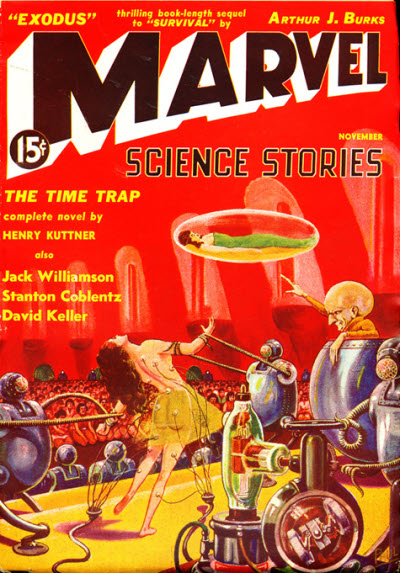
5) H.W. Wesso.

The human figures are good enough, but he doesn't really seem to be trying with the more sfnal elements of the art. (See more here, here and here.)


2014 Hugo for Best Fan Artist
1) Sarah Webb.

I must say that Webb's folder of art, in the Hugo voter packet, really quite took my breath away. It’s as good as the material submitted by the Pro artists. Apparently she is only 19. (Confusingly, there seem to be at least two older artists with the same name – see here and here.)
2) Mandie Manzano.

Manzano may lose out from not having her work in the voter packet, but her website is here and well worth a look. I assume that it's not actually stained glass, but she has got that effect rather well, making her figures very expressive even without facial features.
3) Brad Foster.

This comes back to the more traditional fanzine / fanac illustrations, always quirky and eye-catching.
4) Steve Stiles.

Similar to Foster, not making any great claims for itself but entertaining enough.
5) Spring Schoenhuth.
I voted her much higher previously, but we have very little to go on this year – website under construction, and just a couple of pieces on the Loncon site. So it’s impossible to form a good judgement.
2014 Hugo for Best Pro Artist
I found this a particularly difficult category. All the finalists have submitted excellent work to the voter package.
Edited to add: That is, with the exception of Fiona Staples, whose work on Saga is in another category. I had forgotten that she was nominated, so have re-ordered my votes accordingly.
1) Fiona Staples.

I’m not sold on the plot of Saga, but I am sold on Staples’ superb art. I hope she wins.
1) 2) Don dos Santos.

I love the characterisation of his figures, and the art is uncluttered and clear. Just shades into my top second spot.
2) 3) Julie Dillon.

Brilliant use of colour and shade. Very tough call between her and Dos Santos for me.
3) 4) John Picacio.

A series of intriguing, not-quite-human figures.
4) 5) Galen Dara.

Technically accomplished, just the colour/line combination didn;t really work for me.
5) 6) John Harris.

Almost no human figures, as compared to the other nominees, so one really is judging chalk and cheese here. In a set of artworks which only included other grand landscapes, I might well have ranked it higher; I liked the pieces a lot, I just liked the other finalists a little more.
So that’s what I think. But reasonable people can disagree.
You can vote in this year’s Hugos, and the 1939 Retro Hugos, by joining Loncon 3 at http://www.loncon3.org/memberships .
2014: Best Novel | Best Novella | Best Novelette | Best Short Story | Best Related Work | Best Graphic Story | Best Dramatic Presentation (Short Form) | Best Professional Artist | Best Fan Artist
1939: Best Novel | Best Novella | Best Novelette | Best Short Story | Best Dramatic Presentation (Short Form) | Best Professional Artist
Links I found interesting for 10-07-2014
- This is what happened when I drove my Mercedes to pick up food stamps
No comment.
- Brazil World Cup humiliation by Germany should serve as a call to arms
The Guardian’s take – sane but detailed.
- The Most Shocking Result in World Cup History
Nate Silver crunches the numbers.
- How Germany destroyed Brazil
Blow by blow, from the BBC.
Wednesday reading
Current
The Lacuna, by Barbara Kingsolver
Beowulf, tr. J.R.R. Tolkien, ed. Christopher Tolkien
[Doctor Who] Millennium Shock, by Justin Richards
Ireland Under The Tudors vol 2, by Richard Bagwell
ε1
Last books finished
γ1
Napoleon Bonaparte for Little Historians, by Bou Bounoider
δ1
Last week’s audios
Masquerade, by Stephen Cole
Next books
Ireland Under The Tudors vol 3, by Richard Bagwell
How Languages are Learned, by Patsy M. Lightbown
Brussel in Beeldekes
Crash, by J.G. Ballard
[Doctor Who] So Vile a Sin, by Ben Aaronovitch and Kate Orman
Books acquired in last week
Napoleon Bonaparte for Little Historians, by Bou Bounoider
My Real Children, by Jo Walton
Links I found interesting for 09-07-2014
- We go forward
*sniff*
Links I found interesting for 07-07-2014
- “To My Fellow Filthy Rich Americans: The Pitchforks Are Coming”
A man who almost gets it.
- This Summer’s Most Unread Book
Piketty. Sort of.
- Caitlin Moran: my sex quest years
Hilarious!
The Battle of Wavre
Most weekday mornings I pass through Wavre by train; I usually get the southbound service from our local station, and then change at Ottignies for the inbound train from Namur/Luxembourg/Switzerland, which conveniently stops just outside my office.
For military historians, Wavre is also the location of the other battle on 18 June 1815, the same day as the Battle of Waterloo. Here 17,000 Prussians held down twice as many French and succeeded in letting Blücher’s troops cross the Dyle farther north in time to reach the main affair 16 km to the west. The Battle of Wavre ended on the morning of the 19th with a tactical French victory, but by then they had lost the war. The Prussian commander’s chief of staff was Carl von Clausewitz; he started writing On War the following year.
With the 200th anniversary coming up next year, the re-enactors are out in force. Most weekends they congregate around Waterloo (understandably – it was more important and is easier for most people to get to), but this weekend they were in Wavre. I’m not hugely into wargaming these days, but this was an important sidebar to one of the most important battles of European history, so F and I went down to have a look this morning. Although the battle actually ranged between Limal to the south-west and Basse-Wavre to the north-east, a front of about 5 km altogether in length, the re-enactors sensibly constrained themselves to a couple of fields just beside the Walibi amusement park.

One has to be impressed by the care that has been taken to reproduce the uniforms, from the cavalry officers riding well-trained horses (there are a lot of very loud bangs) to the chaps sitting around a campfire with authentic-looking cooking implements.

Having said that, not all of the uniforms on display appeared to be Napoleonic:

I did get a strong sense that the participants – who had bravely bivouacked out the night before, despite thunderstorms – included a fair contingent from France, and indeed the French ambassador to Belgium made a speech at the opening of the event. The commentator also mentioned participants from the Netherlands and the Czech Republic. (Though not Germany, whose troops crashed over the Dyle again less than a century after 1815, and again in 1940.)
I also spotted (but failed to photograph) two people toting Scottish bagpipes; I’m not aware that these were used by either the Napoleonic or Prussian armies, so I guess they may have been re-enactors who normally bring them to Waterloo of a summer weekend, given that the Scots were pretty visible there.
Anyway, I imagine there will be a lot more of this sort of thing happening in the run-up to the bicentennial next year.