The Last Unicorn, and Two Hearts, by Peter S. Beagle

“Two Hearts” was next in my list of joint Hugo and Nebula winning fiction, having taken the Hugo for Best Novelette in 2006 and the Nebula in the same category in 2007 (though that was the Nebula for 2006). Before reading it, I thought, well, I had not actually read Peter S. Beagle’s The Last Unicorn before, so maybe I should read it first and see what I thought?

The second paragraph of the third chapter of The Last Unicorn is:

The unicorn was gray and still. “There is magic on me,” she said. “Why did you not tell me?”

Reader, I hated it. I found it the worst kind of sentimental glurge. The dissonance of calling the wizard Schmendrick is one more false step on top of the teeth-grinding saccharinity of the rest of the story. I lasted not much more than fifty pages. I’m sorry, I know it’s a much-loved classic, and perhaps I am a bitter ageing man, but I could not take it.

“Two Hearts” does not have internal sections, so here is the third paragraph.

But it didn’t ever eat children, not until this year.

When the awards were first being voted on in 2006, I put “Two Hearts” at the top of my Hugo ballot.

Back in 1968, Beagle published his classic fantasy novel, The Last Unicorn. I have never read it, nor have I seen the film made some time back (apparently very successful, though Beagle did not profit much from it) and so I expected this follow-up novella (written almost four decades later!) to leave me pretty cold. In fact, it had entirely the opposite effect: I was totally captured by the lyrical and moving story of a king’s last quest, told through the eyes of a young girl, in a fantasy world where Bad Things Happen but you can hope for Good to have a partial victory at the end. Perhaps I am just getting sentimental in my old age, but I loved it.

Again, I must be getting bitter as I get older, because I really didn’t like it this time. Perhaps my teeth were still on edge from reading The Last Unicorn.

You can get The Last Unicorn here, and you can get “Two Hearts” in a sequel collection here.

Next up in this sequence is “The Merchant and the Alchemist’s Gate” by Ted Chiang, which I hope has aged better.

Mother Ross: An Irish Amazon, by G.R. Lloyd

Second paragraph of third chapter:

The estates of “The Wild Geese” were seized and sold or given to Protestants, and penal laws were introduced forbidding Catholics to hold office or to serve in the armed forces. Father’s land at Leixlip had only been rented of course, but the new tenants seized our stock and equipment and I was reduced once more to buying malt to keep the brewery going.

A few years ago I wrote about Christian Davies, commonly call’d Mother Ross, who was born in 1667 and lived as a woman in Leixlip and Dublin until her husband was conscripted into the army, and then herself joined up, living as a man for many years, until she was eventually discovered and became a bit of a celebrity. This is not a terribly good novelisation of the story (indeed, the original account that we have supposedly received from Christian herself is something of a novelisation), but I was on a long plane flight and short of other things to read, so I pursued it to the end.

A couple of beats that I really felt were missed: the author has rather a tin ear for the dynamics of the relationship of southern Irish Protestants to the United Kingdom, and I winced several times as his characters simply got it wrong. And from Christian’s own memoirs, it’s pretty clear that she had several enjoyable relationships with girlfriends while living as a man and ostensibly still looking for her husband; Lloyd simply doesn’t take her there, and instead invents a back-story of sexual assault in Ireland. Not really recommended. You can get Mother Ross here.

About the author: “Geoff Lloyd was born in 1928, served on the lower deck in the Royal Navy (postwar), spent most of his career in the UK Civil Service, moving around the British Isles. He travelled widely in Eastern Europe, Turkey, Iran, Afghanistan, Pakistan, and India and retired to Portugal. His interests include music, history, and travel. He has written eighteen novels, three plays, short stories, etc.” I won’t be seeking out more of his work, but I admire his energy, if he is still with us.

This was the non-fiction book that had lingered longest unread on my shelves. Next on that pile is The Partition, by Charles Townshend.

The best known books set in each country: Ecuador

See here for methodology. Books are disqualified if less than 50% of them is set in Ecuador. 

These numbers are crunched by hand, not by AI.

TitleAuthorGoodreads
raters
LibraryThing
owners
GalápagosKurt Vonnegut Jr.87,3178,121
Wish You Were HereJodi Picoult281,5212,100
Through Gates of SplendorElisabeth Elliot31,6973,556
The Old Man Who Read Love StoriesLuis Sepúlveda29,2511,780
ShippedAngie Hockman71,391555
Shadow of the AlmightyElisabeth Elliot11,2002,245
End of the SpearSteve Saint12,3081,078
Natural SelectionElin Hilderbrand61,553126

This week’s winner, Vonnegut’s Galápagos, is one of four books on the list which are set on or around the eponymous islands. Unlike Wish You Were Here, Shipped and Natural Selection, it is not a contemporary novel about relationships, but a gloomy post-apocalyptic reflection on the end of humanity. Wish You Were Here, which is far ahead on Goodreads but well behind on LibraryThing, is set during the pandemic and so has a certain post-apocalyptic element too. Notable that Shipped and Natural Selection score really well on Goodreads and much less well on LibraryThing.

Three of the other four books on the list are about the life and legacy of Jim Elliott, an American missionary who was killed by annoyed indigenous people in 1956. The two by his widow score particularly well on LibraryThing, less so on Goodreads. Luis Sepúlveda is from Chile, so unfortunately none of the top eight is by an Ecuadorean writer. The top book by an Ecuadorean author set in Ecuador is Jawbone, by Mónica Ojeda.

I disqualified four books. The Inheritance of Orquídea Divina, by Zoraida Córdova, gave me the most trouble, but in the end I concluded that more than half of it is set in the USA where Orquídea’s four children live. As we have seen previously, The Old Patagonian Express, by Paul Theroux, covers several countries. The Undocumented Americans, by Karla Cornejo Villavicencio, is about the immigrant experience in the USA. Everything Here Is Beautiful, by Mira T. Lee, is set in the USA and Switzerland (one of the main characters has an Ecuadorean boyfriend).

Coming next: Cambodia, Zimbabwe, Guinea (Conakry) and Benin – we’ll be back in Africa for a bit.

Asia: India | China | Indonesia | Pakistan | Bangladesh (revised) | Russia | Japan | Philippines (revised) | Vietnam | Iran | Türkiye | Thailand | Myanmar | South Korea | Iraq | Afghanistan | Yemen | Uzbekistan | Malaysia | Saudi Arabia | Nepal | North Korea | Syria | Sri Lanka | Taiwan | Kazakhstan | Cambodia | Jordan | UAE | Tajikistan | Israel
Americas: USA | Brazil (revised) | Mexico | Colombia | Argentina | Canada | Peru | Venezuela | Guatemala | Ecuador | Bolivia | Haiti | Dominican Republic | Honduras | Cuba
Africa: Nigeria | Ethiopia (revised) | Egypt | DR Congo | Tanzania | South Africa | Kenya | Sudan | Uganda | Algeria | Morocco | Angola | Mozambique | Ghana | Madagascar | Côte d’Ivoire | Cameroon | Niger | Mali | Burkina Faso | Malawi | Zambia | Chad | Somalia | Senegal | Zimbabwe | Guinea | Benin | Rwanda | Burundi | Tunisia | South Sudan | Togo
Europe: Russia | Türkiye | Germany | France | UK | Italy | Spain | Poland | Ukraine | Romania | Netherlands | Belgium | Sweden | Czechia | Azerbaijan | Portugal | Greece | Hungary
Oceania: Australia | Papua New Guinea

Behind Frenemy Lines, by Zen Cho

Second paragraph of third chapter:

I could hot desk in the open plan area, as Arthur had suggested, but then I wouldn’t have such luxuries as shelves for my client files, or a permanent noticeboard, or a drawer to keep spare pens and Post-it notes in. Even sharing with Kawan Baik was better than that.

Another contemporary romance (following on from The Friend Zone Experiment), this has two young British Asian lawyers in London gradually figuring out their destiny, while also navigating the perils of white patriarchy in their profession and the ethics of dodgy political assignments. There are some glorious moments, including a particularly gruesome wedding chapter. The ending surprised me; I didn’t expect the characters to go (literally) there. Again, you know where the story is likely to end up emotionally from roughly page 3, but the journey is gripping and very entertaining. You can get Behind Frenemy Lines here.

Doctor Who: Lux, by James Goss

Second paragraph of third chapter:

Belinda stepped outside the time machine, feeling her pumps scrape against a pavement that her feet did not belong on.

The episode that this novelisation is based on was broadcast on Easter Sunday this year, and I wrote:

Lux was the episode shown at Easter and I watched it with other fans in Belfast. The basic concept of yet another ancient deity emerging – which turns out to be rather easily defeated – didn’t appeal to me, and the acknowledgement of segregation felt a bit by-the-numbers, but I loved the episode’s fanservice, reminiscent of The Girl Who Loved Doctor Who. Everyone’s favourite episode is Blink, right?

James Goss has picked this up and run with it, and turned in another cracking novelisation (following City of Death, The Pirate Planet and The Giggle). It’s a story with several epic shifts of scale – the small-minded tableau of a Florida town, the big imaginative expanse of the fans’ cramped living room, and the superhuman struggle between the Doctor and a rogue god. The fourth-wall-breaking scenes of the Doctor and Belinda with the fans, Hasan, Robyn and Lizzie, are really excellent, and I found I had something in my eye at the end. As usual with this writer, recommended. You can get Doctor Who: Lux here.

J.R.R. Tolkien and Dorothy L. Sayers

Bumping this up from a social media post I made a couple of weeks ago: I came across a fascinating article, “Tolkien, Sayers, Sex and Gender”, by David Doughan, which looks at the possible reasons why Tolkien disliked the work of Dorothy L. Sayers. He says in a letter of 31 May 1944 to his son Christopher:

I could not stand Gaudy Night. I followed P. Wimsey from his attractive beginnings so far, by which time I conceived a loathing for him (and his creatrix) not surpassed by any other character in literature known to me, unless by his Harriet. The honeymoon one (Busman’s H.?) was worse. I was sick . . .

Doughan says, in the abstract of his paper:

Tolkien’s expressed “loathing” for Dorothy Sayers and her novels Gaudy Night and Busman’s Honeymoon is remarkable considering that Sayers is generally considered to belong to the same milieu as the Inklings. Possible reasons for this are the contrast between the orthodox Catholic Tolkien’s view of male sexuality as inherently sinful, requiring “great mortification”, and Sayers’s frankly hedonistic approach. Another reason may be Sayers’s depiction of an independent Oxford women’s college getting by successfully without men, and her representation of marriage as a source of intellectual frustration for creative women.

Indeed, Sayers was very friendly with Tolkien’s friends C.S. Lewis and Charles Williams, and is sometimes seen as an honorary member of the Inklings. But there is no evidence that she and Tolkien ever met, even though they graduated from Oxford in the same year (1915) and were both first published in the same volume of Oxford Poetry (also 1915).

In fairness to Tolkien, he doesn’t say that he hates all of the Lord Peter Wimsey books; he says that he particularly hated Gaudy Night and Busman’s Honeymoon, the last two books of the thirteen, but that the series had “attractive beginnings”. People who are bigger Wimsey fans than me tell me that they also hate Busman’s Honeymoon, so it’s a point of view which reasonable people can take. (For a counter perspective, Busman’s Honeymoon has the highest reader approval rating of any of the individual Wimsey novels on Goodreads, with Gaudy Night second.)

Doughan speculates that Tolkien’s dislike of Gaudy Night is because it showed a successful Oxford college run by women, and that Tolkien felt uncomfortable about such a scenario. Personally, without having gone into the details, I think this argument fails on two grounds. I have not read Gaudy Night myself, but again people who are bigger Wimsey fans than me tell me that it’s very much about internal rivalries and poisonous academic politics, rather than portraying the women’s college as a feminist utopia. I think it’s more likely that Sayers’ satire of the collegiate snakepit hit too close to home for Tolkien, and made him uncomfortable.

A very stupid person told me on social media (in a comment now deleted) that Tolkien simply hated and feared women. This is just rubbish. On women’s education, Tolkien’s record is actually rather good. A few years back, I came across this fascinating snippet in John D. Rateliffe’s essay, “The Missing Women: J. R. R. Tolkien’s Lifelong Support for Women’s Higher Education”:

A vivid glimpse into Tolkien as a teacher of women can be found in the biography of Mary Challans, better known by her pen name, Mary Renault. Renault’s biographer notes that Tolkien had tutored women from St. Hugh’s while working at the OED and describes the impact of Tolkien’s return from Leeds on Renault and her fellow students at St. Hugh’s in these terms:

the women at St. Hugh’s […] had every reason to be grateful for his return. He was a conscientious lecturer, offering al-most double the statutory hours in order to ensure that his students, female as well as male, covered the entire subject. Indeed, he was unusual in being notably sympathetic to women undergraduates.

We don’t have any contemporary references by Challans to Tolkien during her undergraduate days (1925–28), although we know she was obsessed with all things medieval at the time and that long afterward her letters exchanged with her old college roommate, Kasia Abbott, make “frequent references to their old teacher Tolkien”. And that, when asked about him more than sixty years later, Kasia described him to Renault’s biographer as “darling Tolkien”. We don’t have any correspondence between Tolkien and Renault, unfortunately, but we know that Tolkien and Renault admired each other’s fiction; he singles out The King Must Die and The Bull from the Sea for special praise and mentions receiving “a card of appreciation” from Renault, describing it as the piece of fan mail that had pleased him the most.

Considering just how much reader correspondence Tolkien received, to single out the postcard from Mary Renault / Challans as “perhaps the piece of ‘Fan-mail’ that gives me most pleasure” is a very strong statement indeed.

A couple of people suggested to me that perhaps Tolkien and Sayers had had an unsuccessful romantic encounter as students at Oxford, which then poisoned his perception of her forever. I think this is unlikely for several reasons. First of all, Tolkien actually says that he liked the earlier Wimsey books, and that his aversion to both books and writer developed later, possibly even as late as Gaudy Night; so he was not carrying an old grudge over three decades. Second, it’s totally plausible that Tolkien and Sayers, at different colleges and studying different subjects, would simply never have had occasion to meet as undergraduates.

Third, Tolkien was (as far as we know) obsessed with Edith Bratt throughout his Oxford years, and Dorothy L. Sayers’ not entirely successful love life as an undergraduate is also well chronicled in her own records. Of course, that doesn’t exclude some unrecorded disastrous attempted flirtation – or even a non-romantic yet enduringly bitter exchange of very different intellectual and/or political views – but Sayers in particular was pretty open about her past life, and doesn’t ever seem to have mentioned Tolkien in correspondence, even when he became famous (which was long after she did).

Sometimes people just don’t get on with each other, even if they have friends and interests in common, and sometimes later analysts can learn from the interaction, and sometimes there is not much there there; and I tend to feel this is one of the latter cases.

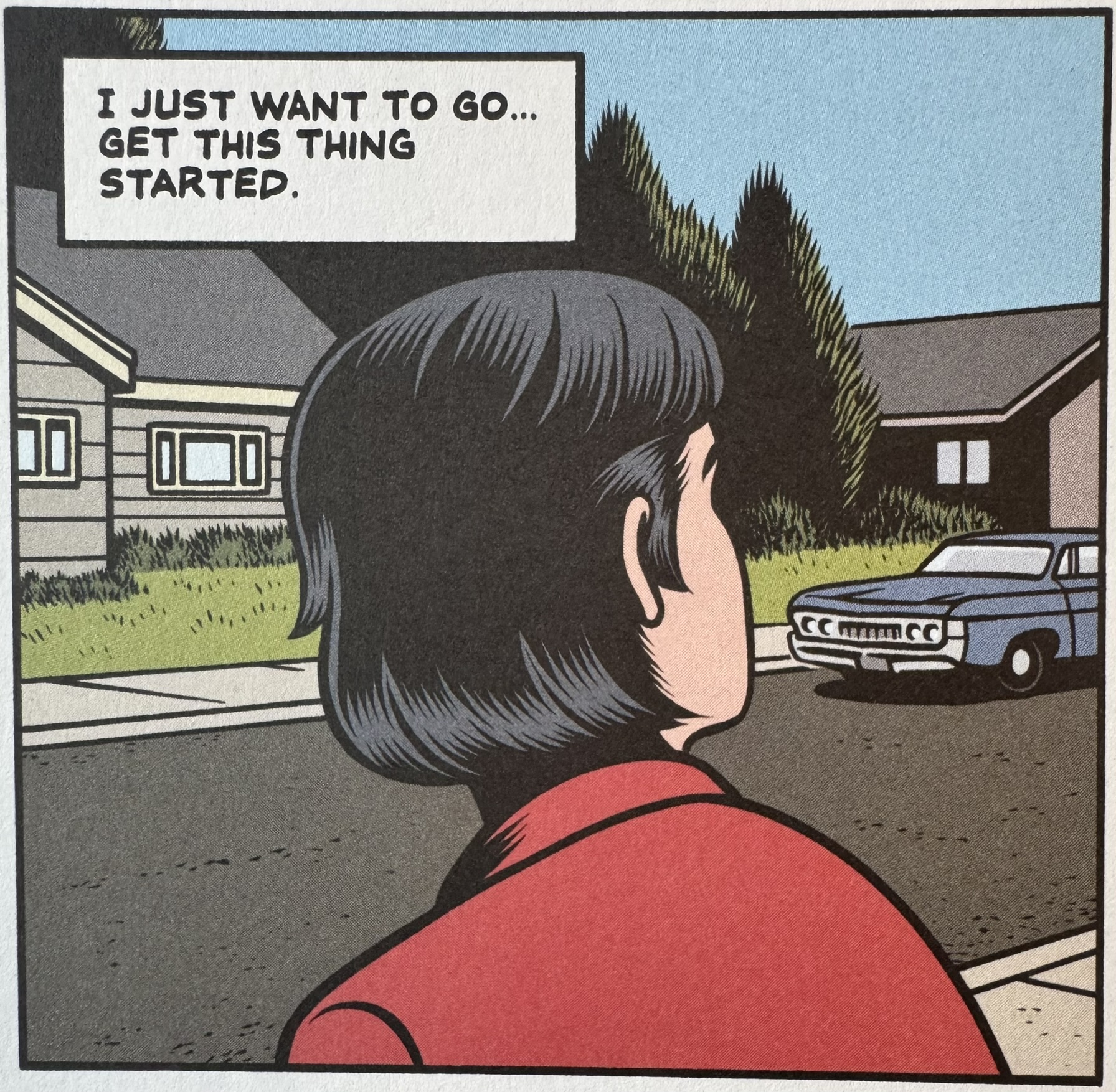
Final Cut, by Charles Burns

Second frame of third section:

Brian (narrating): I just want to go… get this thing started.

I’ve really enjoyed Burns’ weird stories in the past, and I’m sorry to say that I didn’t find this one as much to my taste, perhaps because it is not as weird. Brian, the protagonist, is a teenager who is obsessed with classic films such as Invasion of the Body Snatchers and The Last Picture Show, and also with his friend Laurie. He stumbles around rocky outcrops, both physical and emotional, and doesn’t quite manage to get where he needs to go. It’s OK as a coming of age story, but I wanted a bit more. You can get Final Cut here.

Next on my pile of unread comics in English is Ness: A Story from the Ulster Cycle, by Patrick Brown.

Omega, by Mark Griffiths and John Ridgway

Second frame of part three:

“And my cells won’t renew in space. What would be the point? I’d only suffocate all over again.”

Another in Cutaway Comics’ explorations of unseen parts of Doctor Who history, this goes behind the backdrop of both The Three Doctors and more importantly Underworld. It is about the difficulties of the Minyan princess Malika, who tries to prevent Omega from destroying the planet Minyos and then leads a further attack on him from the planet Draktria in the fourth of four parts. I found it a rather right-wing narrative; Malika and her family have been elevated against the common people of Minyos by superior technology supplied by the Time Lords, and the rebellion of the Minyans against their oppressive rulers is stoked by Omega and an evil populist politician. The Draktria chapter is straight from the playbook of great powers recruiting loyal but doomed native troops from the colonies. The writer does not seem conscious of the tropes that he has put into the story… The art is generally good but Ridgway doesn’t always get his characters’ faces consistent.

You can get Omega here, along with a DVD and an audio version starring Brian Blessed; unfortunately I don’t have those as I bought it from the Cutaway stall at Gallifrey One.

Wednesday reading

Current
The Letters of J. R. R. Tolkien: Revised and Expanded Edition
The Partition: Ireland Divided, 1885-1925, by Charles Townshend

Last books finished 
Jerusalem, Part 1, by Selma Lagerlöf
Silence: A Christian History, by Diarmaid MacCulloch (did not finish)
The Casuarina Tree, by W. Somerset Maugham
The Irish Assassins: Conspiracy, Revenge and the Murders that Stunned an Empire, by Julie Kavanagh
The House of Doors, by Tan Twan Eng 
The New Machiavelli, by Jonathan Powell

Next books
The Twist, by George Mann et al
Burning Brightly: 50 Years of Novacon, by Ian Whates
East of Eden, by John Steinbeck

Science(ish): The Peculiar Science Behind the Movies, by Rick Edwards & Dr Michael Brooks

Second paragraph of third chapter:

[Rick Edwards:] No it doesn’t. In 1979, French astrophysicist Jean-Pierre Luminet used a punch-card computer to work out what one [a blackhole] would look like. He didn’t have a printer, so he drew the result of his computations by hand – and it looks quite like Interstellar‘s black hole, Gargantua.

This is a popular science book, aimed perhaps at the older end of the teenage market. It takes ten well-known films – The Martian, Jurassic Park, Interstellar, Planet of the Apes, Back to the Future, 28 Days Later, The Matrix, Gattaca, Ex Machina and Alien – and hangs a series of short reflections off them about the state of play in real science of the concepts developed in each film. It is breezily presented as a dialogue between the two podcast hosts. I found the sidebar sections a little annoying, and would have preferred them to be integrated into the main text, but otherwise it is harmless enough. Of the films I have not seen, Gattaca sounds the most interesting. You can get Science(ish) here.

This was my top unread book acquired in 2021. Next on that pile is The Irish Assassins: Conspiracy, Revenge and the Murders that Stunned an Empire, by Julie Kavanagh.

’Salem’s Lot, by Stephen King

Second paragraph of third chapter (a long ‘un):

4:00 AM
The Griffen boys – Hal, eighteen, and Jack, fourteen – and the two hired hands had begun the milking. The barn was a marvel of cleanliness, whitewashed and gleaming. Down the center, between the spotless runways which fronted the stalls on both sides, a cement drinking trough ran. Hal turned on the water at the far end by flicking a switch and opening a valve. The electric pump that pulled water up from one of the two artesian wells that served the place hummed into smooth operation. He was a sullen boy, not bright, and especially irked on this day. He and his father had had it out the night before. Hal wanted to quit school. He hated school. He hated its boredom, its insistence that you sit still for great fifty-minute chunks of time, and he hated all his subjects with the exceptions of Woodshop and Graphic Arts. English was maddening, history was stupid, business math was incomprehensible. And none of it mattered, that was the hell of it. Cows didn’t care if you said ain’t or mixed your tenses, they didn’t care who was the Commander in Chief of the goddamn Army of the Potomac during the goddamn Civil War, and as for math, his own for chrissakes father couldn’t add two-fifths and one half if it meant the firing squad. That’s why he had an accountant. And look at that guy! College-educated and still working for a dummy like his old man. His father had told him many times that book learning wasn’t the secret of running a successful business (and dairy farming was a business like any other); knowing people was the secret of that. His father was a great one to sling all that bullshit about the wonders of education, him and his sixth-grade education. He never read anything but Reader’s Digest and the farm was making $16,000 a year. Know people. Be able to shake their hands and ask after their wives by name. Well, Hal knew people. There were two kinds: those you could push around and those you couldn’t. The former outnumbered the latter ten to one.

This is the top book published in 1975 as rated by Goodreads users and owned by LibraryThing users – the second place goes to Tuck Everlasting, by Natalie Babbitt, of which I confess I know nothing.

This was King’s second book, after Carrie, and like Carrie it is tremendous. It leans on Bram Stoker’s Dracula, not so heavily as to be ripping it off, but enough that you can see the footprints. It also lays the ground for many future vampire stories, and in particular it sets up a lot of the lore for Buffy, which can only be a good thing.

Of course, what makes it a great novel is the combination of 1) the detailed mapping of the people of a small Maine town, with the arrivals of the struggling writer who is the main viewpoint character and of the sinister strangers who, spoiler, turn out to be vampires, and; and 2) the delicious ramping up of tension and then release, as we know that something horrible is going to happen and then it does. At the other end of New England, H.P. Lovecraft at his best was a master of this sort of thing, and King clearly drank from the same wells.

It has its problems; there is only one significant female character, and I didn’t like the way her storyline ended; and the means and motivation of the vampires are not quite as internally consistent as I would have liked. But I really enjoyed the book as a whole, and sometimes I had to just pause for a moment and admire the writing.

The telephone wires make an odd humming on clear, cool days, almost as if vibrating with the gossip that is transmitted through them, and it is a sound like no other – the lonely sound of voices flying over space. The telephone poles are gray and splintery, and the freezes and thaws of winter have heaved them into leaning postures that are casual. They are not businesslike and military, like phone poles anchored in concrete. Their bases are black with tar if they are beside paved roads, and floured with dust if beside the back roads. Old weathered cleat marks show on their surfaces where linemen have climbed to fix something in 1946 or 1952 or 1969. Birds – crows, sparrows, robins, starlings – roost on the humming wires and sit in hunched silence, and perhaps they hear the foreign human sounds through their taloned feet. If so, their beady eyes give no sign. The town has a sense, not of history, but of time, and the telephone poles seem to know this. If you lay your hand against one, you can feel the vibration from the wires deep in the wood, as if souls had been imprisoned in there and were struggling to get out.

My Kindle copy came with an Afterword written twenty-five years later, in 1999, and also with two short stories, “One for the Road” which is a post-epilogue postscript for the novel, and King’s early story “Jerusalem’s Lot”, which is set in the 1850s and about witchcraft rather than vampires (and leans a bit more heavily on Lovecraft). It also includes a number of deleted or edited scenes from the book, most of which I found rather good, though I agree with King and his editors that the final text of the book was better without them. So that’s a nice bit of extra value.

You can get ’Salem’s Lot here.

This was the top unread sf book on my shelves, and the top book I acquired this year. Having recently inherited some of my father’s library, the next two on those piles respectively are East of Eden, by John Steinbeck, and If on a Winter’s Night a Traveller, by Italo Calvino.