All in the Middle City stood the Temples of the city’s priests, and hither came all the people of Mlideen to bring them gifts, and there it was the wont of the City’s priests to carve them gods for Mlideen. For in a room apart in the Temple of Eld in the midst of the temples that stood in the Middle City of Mlideen there lay a book called the Book of Beautiful Devices, writ in a language that no man may read and writ long ago, telling how a man may make for himself gods that shall neither rage nor seek revenge against a little people. And ever the priests came forth from reading in the Book of Beautiful Devices and ever they sought to make benignant gods, and all the gods that they made were different from each other, only their eyes turned all upon Mlideen.
I did a lot of work on Lord Dunsany’s uncle, Sir Horace Plunkett, for my PhD research many years ago, but have only limited familiarity with the nephew’s copious output of fantasy writing. (I read The Gods of Pegāna ten years ago.) This is a selection of his short fiction assembled in 1970 by Lin Carter, as part of his ongoing efforts to cash in on the success of The Lord of the Rings, with some interesting biographical detail of how and when each set of stories was written.
If you’ve read one Dunsany story, to be honest, you’ve read them all. The descriptions are good and the use of language very effective. But nothing very much happens; there are few surprises or moments of tension, and no memorable characters or grand themes beyond exalted whimsy. That was my prejudice before reading the collection, and I’m sorry to say that it was confirmed.
Dunsany was clearly an influence on both H.P. Lovecraft and J.R.R. Tolkien, and thus on all of their successors, but I think that both were better writers. Dunsany evokes your sensawunda, and makes you feel that there is a magical world just around the corner, out of sight; but both Lovecraft and Tolkien did the same and added a lot more depth and structure to their respective mythologies. With Dunsany, you feel that he is just telling you another story; Lovecraft and Tolkien take you into the depths of their detailed imaginary worlds. Lovecraft also adds horror, and Tolkien moral courage, to give extra dimensionality to the narrative.
Don’t get me wrong, Dunsany is a good writer, but he paved the way for better. (See also, “Lord Dunsany: The Geography of the Gods”, by Vernon Hyles, in More Real Than Reality: The Fantastic in Irish Literature and the Arts, edited by Donald E. Morse and Csilla Bertha.)
You can get this collection here. This was my top unread book acquired in 2016; next on that pile is The Number Mysteries: A Mathematical Odyssey Through Everyday Life, by Marcus Du Sautoy.
President Trump and his allies prepared their own fake slates of electoral college electors in seven States that President Trump lost: Arizona, Georgia, Michigan, Nevada, New Mexico, Pennsylvania, and Wisconsin. And on December 14, 2020—the date when true, certified electors were meeting to cast their electoral votes for the candidate who had won the popular vote in each of those States—these fake electors also met, ostensibly casting electoral votes for President Trump, the candidate who had lost.
Like the rest of you, I was utterly appalled by the extreme right wing attack on the Capitol on 6 January 2021, a direct attempt to overturn the 2020 election result by violence. What was not clear on the evening, but has now been made very clear by the labours of the Select Committee set up by the House of Representatives to look into the events, is the extent to which this was a part of a premeditated and criminal plan by Trump to illegally remain in power.
The evidence is clear. Most of those who testified to the Select Committee were Republicans, a number of them working directly for Trump in the White House. I myself said on the record to Bloomberg News, the day after the election, that there was little chance of the election result being overturned in the Supreme Court because there was no case. Eight leading conservative American lawyers have reported clearly and succinctly on the justified failure of all of Trump’s legal challenges. Nobody who has looked into it can seriously maintain, in good faith, that there is any doubt about the legitimacy of Biden’s win in the election.
Bad faith is a different matter, and the Report lays out how Trump cast aside the sensible lawyers and started to take advice from those who told him what he wanted to hear, culminating in the massive effort on 6 January to intimidate Vice-President Mike Pence into breaking the law and disqualifying enough valid votes for Biden to enable Trump to remain in office. I must admit that Pence comes out of it rather well, sticking to his position even when the mob came within a few metres of the office were he was being protected.
The Republican National Committee does not come out looking as good. They supported Trump’s hopeless legal challenges to the election results in the states, and also legitimised his shameless and aggressive personal bullying towards election workers – some senior state officials, some just ordinary folks who happened to attract the president’s ire. They also benefited from the fraudulent fund-raising to “Stop the Steal”, which continued long after the result was beyond any doubt. It is sickening that the mayhem and deaths of 6 January were instrumentalised as a marketing tool.
The National Guard also comes out looking bad. Although there had been internal discussion of how to use them in support of public order, delays in the command chain meant that by the time they got authorisation to assist the hard-pressed police, the riot was over because the President had called it off. There are also constitutional ambiguities about Trump’s role as commander-in-chief, but the report is clear that this was not the problem on the day.
But it all comes back to Trump. There is no smoking gun demonstrating that he had operational command and control over the mob. But there is plenty of evidence that they thought they were taking orders from him. For three hours they rampaged through the Capitol while friends, allies and family begged Trump to speak out against the violence; and as soon as he told them to disperse and go home, they did. The evidence from White House staffers who were there on the day is particularly chilling.
Anyone who defends Trump, let alone the rioters, over 6 January 2021 is not worth listening to. He decided that he did not like the election results; he desperately looked for legal ways to overturn the vote, and did not find any; and he attempted to use mob violence to cling to power. He is not fit for office, and nor is anyone who supports him.
Last books finished υ2 Lucy Wilson & the Bledoe Cadets, by Tim Gambrell φ2 Wild Cards: Deuces Down, ed. John J. Miller χ2 (did not finish) Pale Fire, by Vladimir Nabokov ψ2 (did not finish)
Next books Timelash, by Phil Pascoe Peculiar Lives, by Philip Purser-Hallard Madam Secretary, by Madeleine Albright
One of the things that lurks at the back of my genealogical / DNA research is the question of how rapidly lines of descent can be expected to increase.
My Murray grandfather had nine children by two marriages, seven of whom are still living; I am the oldest of his twenty-two grandchildren; between us we have I think twenty-eight great-grandchildren; and the first two of the next generation arrived in the last couple of years.
Me and the first of my grandfather’s great-great-grandchildren.
My Hibbard great-great-grandparents had five children, of whom one died young and another never married; ten grandchildren, five of whom have living descendants; sixteen great-grandchildren, ten of whom have descendants (and two are still living); and twenty-three great-great-grandchildren, including me and Sally Seaver.
It can go the other way of course. While my Hibbard great-great-grandfather has many living descendants, more than half of them are from his oldest surviving child (who also married early and thus got ahead of the game); his younger son’s living descendants are me, my two siblings and our five children, a total of eight after four generations.
These things are of course very dependent on time, place and social class, but I am hoping for a metric which would at least allow a rough comparison of rates of increase. One of the best chronicled lines of descent over the past 180 years, albeit of very rich white Europeans, is that of Queen Victoria and Prince Albert. Allan Raymond has a fantastic website investigating this, which appears to be complete up to early 2019. Vic and Al had nine children, all but one of whom had kids themselves; 42 grandchildren, 87 great-grandchildren and 142 great-great-grandchildren.
I’ve plotted the increase in both total and living descendants on a log scale in the graph above. Their first child, and therefore first descendant, was “Vicky“, the Princess Royal and later briefly Empress of Germany, born on 21 November 1840, nine and a half months after her parents’ wedding on 10 February. She had eight children, born between 1859 and 1872, and died on 5 August 1901, aged 61 (outliving her mother by less than a year).
Victoria and Albert’s tenth descendant was the first grandchild born after their nine children together, none other than Emperor Wilhelm II of Germany, the son of Princess Victoria and the short-lived Emperor Frederick III. He was born on 27 January 1859, a year after his parents’ wedding. He had seven children between 1882 and 1892, ruled Germany from 1888 to 1918 and died on 4 June 1941 aged 82.
Victoria and Albert’s hundredth descendant was born on 2 July 1903 as Prince Alexander of Denmark, though that is not how he is known to history. He was the only child of Princess Maud, the fifth of the six children of King Edward VII, and Prince Carl of Denmark. In 1905, Norway became independent and elected Prince Carl as the country’s new king; he ruled as King Haakon VIII until his death in 1957 at the age of 85. His son then ruled as King Olav V of Norway until his death in 1991 at the age of 87. (King Olav’s son, Harald V, inherited the throne and is still living; he turns 86 later this month.)
But in 1903, a number of Vic and Al’s descendants had already died, so the moment when Victoria and Albert’s living descendants exceeded a hundred was when Princess Ileana of Romania was born on 5 January 1909 (23 December 1908 by the old calendar). Her mother, Queen Marie of Romania, was the daughter of Prince Alfred, the second son of Victoria and Albert. Ileana was the fifth of Queen Marie’s six children. She had six children with Archduke Anton of Austria, born between 1932 and 1942. Ileana was exiled from Romania with the rest of the royal family after the Second World War, and died aged 82 in January 1991 in Youngstown, Ohio.
Victoria and Albert’s thousandth descendant is King Olav V’s great-grandson, Prince Sverre Magnus of Norway, born on 3 December 2005. Under Norwegian law his older sister Ingrid Alexndra is ahead of him in line to the throne, as is his father. By my calculation, extrapolating from Allan Raymond’s lists, the number of living descendants of Vic and Al will surpass a thousand later this year (2023) or early next year (2024).
Total descendants
Living descendants
Time interval 1st to 10th
18.2 years
18.2 years
Time interval 10th to 100th
44.5 years
50.0 years
Time interval 100th to 1000th
102.4 years
~115 years
I conclude two things from this. The first is that the rate of increase slows down dramatically after the first couple of generations. The second is that factors of ten are probably too blunt an scale to get a really good feel for the numbers.
Here’s the same graph, redrawn to powers of 2, with the 1st, 2nd, 4th, 8th, 16th, 32nd, 64th, 128th, 256th, 52th and 1024th descendants indicated, both living and total.
There are a few familiar names there. (And some unfamiliar ones: you may not have heard of Prince Alfred of Edinburgh and Saxe-Coburg Gotha, Vic and Al’s fourth child and second son, or his own unfortunate son, another Prince Alfred.) There’s also a small accounting issue – the birth of Tatiana Mountbatten in 1917 brought the number of living descendants of Victoria and Albert over 128, but it was almost immediately sharply reduced when the Russian imperial family were killed in the aftermath of the revolution, so it was not until the birth of Prince Philip of Greece, Tatiana’s first cousin, in 1921 that the number went permanently over 128.
Endogamy is not really an issue here. There have been only 22 marriages where both partners were descended from Victoria and Albert, and only three in the last 50 years (compared to seven such marriages in the 1930s when the pool of descendants was a lot smaller). I previously calculated that about a quarter of Vic and Al’s living descendants have more than one line of ancestry going back to them, but this proportion has been fairly stable for decades. So I don’t think it has a big impact on the growth rate.
If we do the same table as before, tracking the moments when the number of descendants doubled, we can see that it has slowed in recent decades.
Just to grimly reflect that three of the above died by violence: Elizabeth of Hesse killed by Bolsheviks, the younger Prince Alfred probably as the result of a self-inflicted gunshot, and Alfonso of Spain accidentally shot by his brother (who later became King Juan Carlos).
To finish up with one more graph, this tracks the average annual increase in the number of descendants since 1900, both living and total. It is interesting that there is a visible cycle of higher and lower rates of increase; and the most recent years appear to show a continuing deceleration, with the lowest growth for a century. But I think it is unlikely that the number of living descendants will ever decrease, and of course it is impossible that the total number of descendants can ever do so.
Moonlight famously won the 2016 Best Picture Oscar, despite a mistake during the ceremony when La La Land was incorrectly announced as the winner. That was the year that I was the administrator of the Hugo Awards for the first time, and we immediately took steps to minimise the risk of that happening during the ceremony in Helsinki. (In fact, one of the presenters did open the wrong envelope on the night, but the slip was caught before most people noticed.)
Moonlight won two other Oscars, Mahershala Ali as Best Supporting Actor (for Juan, the father figure in the first section) and also for Best Adapted Screenplay. Usually when an Oscar-winning film is adapted from another source I try to read it for comparison, but Tarell Alvin McCraney’s play In Moonlight Black Boys Look Blue doesn’t seem to have been published.
The other contenders for Best Picture were Arrival, which won the Hugo, and Hidden Figures, also a Hugo finalist; and Fences, Hacksaw Ridge, La La Land, Lion and Manchester by the Sea, which I haven’t seen. La La Land won the most Oscars that year (six).
Again, I have seen very few films from 2016 – I think none at all apart from the Hugo finalists. Moonlight is a very different film, and it’s difficult to give a comparative ranking, but I would put it at least equal with Arrival. IMDB users rate it only 18th and 29th on the two rankings, which are topped by La La Land and Deadpool, with Arrival and ten other films ahead of Moonlight on both lists.
Here is a trailer.
None of the actors had been in previous Oscar, Hugo or Nebula/Bradbury winning films. In fact, it’s striking how few of them had any film track record at all – IMDB lists this as the first screen appearance for more than half of the 25 named cast, and most of them have done little else. There are a couple of exceptions; Mahershala Ali as Juan is one of them, and so is the fantastic Janelle Monáe as his girlfriend Teresa. (Both were also in Hidden Figures the same year.)
Set mostly in Miami but with a few scenes in Atlanta, this is not the first Oscar winner with a Florida or Georgia setting, but it is the first to be filmed on the real locations – the outdoor scenes of It Happened One Night are rather obviously filmed in California, and the Georgia of Gone With the Wind is mostly in the studio.
It’s the story of a young gay black man growing up in Miami, told in three parts with three different actors playing the protagonist (10-year-old Alex R. Hibbert, 20-year-old Ashton Sanders and 25-year-old Trevante Rhodes). Adjusting for inflation, it is apparently the Oscar winning film that had the lowest production budget ever ($1.5 million at 2015 prices).
I thought it was very good. My biggest complaint is that despite its relative brevity (111 minutes, 16th shortest of 95 winners) it actually moves rather slowly at times. The story is a simple one told well. Although it’s fundamentally about the protagonist and the men in his life, the women get decent screen time too and Noemie Harris got an Oscar nomination as the protagonist’s mother.
I raised an eyebrow at first at the choice of music – a mix of classical-style orchestral and contemporary including rap – as I’ve seen other films get a bit unstuck by relying too heavily on the violins. But in fact I concluded that the balance is good. The fact that the orchestral music was composed specially for the film probably helps.
The first of the three sections is outstanding, while the other two are merely very good. We begin with bullied little boy Chiron being informally adopted by Juan and Teresa while neglected by his mother. There’s a particularly charming scene where Juan teaches Chiron to swim – apparently Alex Hibbert, playing Chiron, really could not swim so he is barely acting.
The middle section sees a teenage Chiron seduced and then betrayed by his childhood friend Kevin, and the end has the two of them meeting again after a decade and getting some closure. The whole thing is beautifully filmed and staged, and the cast, despite their inexperience, are entirely convincing. Definitely glad I got to this one.
I’m ranking Moonlight a quarter of the way down my table of Oscar winners, just below Gandhibut ahead of Amadeus. Next up is one that I have already seen, but will rewatch for the sake of context: The Shape of Water, which will take me up to ninety.
Second paragraph of third chapter of The Chosen and the Beautiful, by Nghi Vo:
When I mentioned Gatsby in Daisy’s own house, in front of her own husband, there was nothing in my mind that connected him with Lieutenant Jay Gatsby. That man was fresh out of Camp Taylor with a commission purchased with the very last of his money from Dan Cody and only one pair of decent shoes. The eager young lieutenant had a wondering hungry eye, and the beautiful man in the lavender suit pin-striped in gray had obviously never been hungry a day in his life.
I’m more than a little dubious about the Hugo Award for Best Editor, Long Form. It seems to me that most Hugo voters, as readers, are not well placed to judge the extent and value of an editor’s contribution; if a nominee happens to have edited a lot of good books last year, is that luck or judgement? Be that as it may, last year’s Hugo packet included this as part of the credentials for Ruoxi Chen, who went on to (relatively narrowly) win the award; I didn’t read it then but I have read it now.
Folks, it is a real treat. I had no idea. It’s a re-telling of The Great Gatsby from the point of view of Jordan Parker, the #2 female character in the original, just as the original story is told from the point of view of Nick Carraway, who is definitely the #2 male character in the story. But it’s not quite Gatsby as we know it. Jordan and Daisy are still from Lousiville, Kentucky, but Jordan is an adoptee from Vietnam. Everyone (well, every main character) is queer and polyamorous. And magic works; not everyone can do it, but Jordan can, critically altering some of the key moments in the book.
I don’t know Gatsby well, but I found myself compelled to have it to hand to read in parallel with The Chosen and the Beautiful to enjoy even more what Vo has done with such a classic text. The overall arc is the same – it’s almost surprising how little the emotional dynamics are affected once you know for sure that everyone is shagging, rather than merely suspecting it – but it’s very pleasing, very moving and very nicely done. If you didn’t save it from the Hugo packet last year, you can get it here.
I went back and reread The Great Gatsby, properly as well. The second paragraph of the third chapter is:
Every Friday five crates of oranges and lemons arrived from a fruiterer in New York—every Monday these same oranges and lemons left his back door in a pyramid of pulpless halves. There was a machine in the kitchen which could extract the juice of two hundred oranges in half an hour if a little button was pressed two hundred times by a butler’s thumb.
[A] very good short novel, with the setting of 1920s New York and Long Island vividly described, including barely surreptitious widespread use of alcohol and a surprising amount of promiscuity, but overlying this a much more interesting story of personal aspiration. Strongly recommended.
ObBalkans: Gatsby had a war medal awarded to him by the King of Montenegro
I enjoyed it again. It is very digestible, and the emotional arcs of young(-ish) people hurtling into a new age are tremendously convincing. You can get it here.
Since reading it first time around, I’ve been getting acquainted with my American grandmother’s early life; she was three years younger than Fitzgerald, and so almost exactly the same age as the fictional Daisy Buchanan and Jordan Parker. In fact Fitzgerald knew and corresponded with my grandmother’s step-brother, Van Wyck Brooks, though they were on somewhat different literary wavelengths, and Edmund Wilson even wrote an imaginary conversation between them for The New Republic in 1924, the year before Gatsby was published..
Browsing Fitzgerald’s biography, I was struck by a familiar chord in a mention of his colonial-era ancestors in Maryland. (He himself was born in St Paul, Minnesota and was always conscious of his Mid-Western origins.) A little digging, and I worked out that we were in fact fifth cousins three times removed, both of us descended from Philip Key (1696-1764), who emigrated from London around 1720, and his first wife Susanna Gardiner (1705-1742) whose ancestors had been in Maryland since the 1630s. F. Scott’s Fitzgerald’s full name was Francis Scott Key Fitzgerald; he was named after the composer of “The Star-Spangled Banner”, who was his second cousin three times removed and my second cousin six times removed – we are all descended from different sons of Philip and Susanna.
I doubt that either my grandmother or her step-brother, let alone Fitzgerald, were aware of the genealogical connection. According to his daughter, Fitzgerald was not very interested in his Maryland ancestry. On our side, the link was through my great-grandmother, who had died when my grandmother was six, before my great-grandfather married Van Wyck Brooks’ mother (who had also been widowed). My grandmother was brought up to a certain extent by her dead mother’s sisters, who would certainly not have approved of Gatsby (either the character or the book) and anyway she lived in Europe and Asia for most of her adult life.
But sometimes it’s a small world, isn’t it?
The Chosen and the Beautiful was my top unread book by a writer of colour. Next on that list is The All-Consuming World, by Cassandra Khaw.
This is the latest post in a series I started in late 2019, anticipating the twentieth anniversary of my bookblogging at the end of October 2023. Every six-ish days, I’ve been revisiting a month from my recent past, noting work and family developments as well as the books I read in that month. I’ve found it a pleasantly cathartic process, especially in recent circumstances. If you want to look back at previous entries, they are all tagged under bookblog nostalgia.
I started the month with a Bulgarian TV interview about Brexit, which had just happened:
With no idea of what was to come, I did a lot of travelling in February 2020; a work trip to the FAO headquarters in Rome, right beside the Circus Maximus;
with a statue sculpted by Gina Lollobrigida, who died last month:
And went to another convention the next weekend in Brussels, where I slightly crossed the streams by going as a Ghostbuster but getting Doctor Who photos with Paul McGann, Alex Kingston and the Paternoster Gang:
And finally a trip to England at the end of the month, finishing at a friend’s birthday party. Little did I realise, as I fell asleep in Cambridge on 29 February, that it would be almost five months until I next left Belgium.
Ruth Winters looked up from reading a report; her lips pressed tightly together, her eyes narrowed.
Another in the sequence of Lethbridge-Stewart novels where the Brigadier and two of his friends have had their consciousnesses sent wandering back along their timeline. This was not one of the better ones. A surviving Dominator from earlier in the series is mixed up with organised crime and Nazis in 1973 London, while the events of The Silurians and Ambassadors of Death take place elsewhere. Really annoyed me by misspelling a couple of German names – Bormann becomes “Boorman”, the Ahnenerbe becomes the “Annenerbe”; I think putting Nazis into a 1970s spinoff Doctor Who story is lazy anyway, but not getting the German words right is positively indolent. Anyway, you can get it here, and I look forward to the end of this rather disappointing subsequence in what has generally been a good series.
The sound of water. Light up on Boa Island. Craig rests, smoking. Pyper enters. Craig: Well? Pyper: Good. Good place. Craig: I hoped you’d like it. Pyper: You rowed out here every day? Craig: When I had the chance and I wanted to be on my island. Pyper: Your island? Craig: Sorry. Boa Island. I stand corrected. I meant when I wanted to be on my own. Pyper: Nobody ever comes here? Craig: Very few. Pyper: Strange. Craig: This place? Yes. Pyper: The place is definitely strange, but strange too, people shouldn’t come. Craig: Why should they come here? Pyper: The carvings. Craig: What are they? Pyper: Signs.
This play won the Christopher Ewart-Biggs Prize in 1986, and I was lucky enough to see it thirty years later, at the Abbey Theatre for the 2016 production commemorating the centenary of the Battle of the Somme. Reading the script now can’t really do justice to the memory of the theatre production, which starred Donal Gallery as Pyper, and crucially used the space of the stage to make the story come alive.
It’s a reflection on eight soldiers recruited to the Ulster Division during the First World War, exploring their understanding of the universe, life, love and loyalty. The narrative is bookended by Pyper in old age reflecting on how he survived and his friends did not (so the fact that seven of the eight die is signalled early on).
I find the third act the most effective, the eight characters back home on leave and split into four pairs, two on Boa island, two at a church, two at the Carrick-a-Rede rope bridge, and two at the Field where Orange marches finish (which historically was at Finaghy, close to where I grew up, though I do not know if that was the case in 1915 or 1916). It gives the men a chance to explain themselves to each other, a sympathetic but informed audience.
By the lakeside in Fermanagh, Pyper and Craig make love, which must have been rather shocking in 1985 and was still a bit unexpected in 2016. (Also the weather must have been very good that day.) All of the characters reflect on the place of Ulster in Ireland, in Britainm in Europe and in the empire. There are some very good lines:
Old Pyper: Those I belonged to, those I have not forgotten, the irreplaceable ones, they kept their nerve, and they died. I survived. No, survival was not my lot. Darkness, for eternity, is not survival.
McIlwaine: The whole of Ulster will be lost. We’re not making a sacrifice. Jesus, you’ve seen this war. We are the sacrifice.
Younger Pyper: I have seen horror Elder Pyper: Ulster Younger Pyper: They kept their nerve and they died. Elder Pyper: Ulster Younger Pyper: There would be and there will be, no surrender. Elder Pyper: Ulster Younger Pyper: The house has grown cold, the province has grown lonely. Elder Pyper: Ulster Younger Pyper: You’ll always guard Ulster. Elder Pyper: Ulster. Younger Pyper: Save it Elder Pyper: Ulster Younger Pyper: The temple of the Lord is ransacked. Elder Pyper: Ulster. (Pyper reaches toward himself) Younger Pyper: Dance in this deserted temple of the Lord. Elder Pyper: Dance (Darkness)
This was the non-sf fiction book that had lingered longest on my unread shelves. Next in that pile is The Various Lives of Keats and Chapman, by Flann O’Brien, but it will have to wait until I have finished my 2016 books.
When the TV story The Fires of Pompeii was first shown in 2008, I wrote:
I must have been one of the few kids of my generation who voluntarily did Latin O-level. There were two of us in the class; our teacher was from Achill Island, and had studied classics in Galway through the medium of Irish (which she also taught at our school). However we used the Ecce Romani books, not the Cambridge Latin Course, so missed out on that particular set of in-jokes.
But I loved the Doctor’s shifty acknowledgement of responsibility for the Great Fire of Rome, and my Big Finish sympathies were satisfied with the fact that there was no explicit contradiction with what Seven and Mel were up to on the other side of town. I also liked the new take on the Tardis translation effect – “Look you!” – and the way in which the Doctor accepts responsibility for causing the eruption. There was that one moment reminiscent of the “You lucky bastard!” scene from Life of Brian, and I am aware that volcanoes on the whole do not contain such conveniently located corridors, but I was willing to take the ride.
It was also one of the lockdown rewatches organised by Emily Cook (who deserves a medal from the wider Who community).
Also during the 2020 lockdown, James Moran wrote a webcast sequel with descendants of the Pompeiians in today’s Britain:
It was great fun to rewatch it for this post, especially now that we know we’ll see Peter Capaldi and Karen Gillan again. (Karen Gillan is the first of the soothsayers to appear, in an episode filmed ten weeks before her 20th birthday.) The Tenth Doctor / Donna dynamic is fantastic – they are just friends, but very good friends even though this is only their third adventure together.
(Though Anne said, after I showed her an episode of Galaxy Four soon after rewatching The Fires of Pompeii, “Wasn’t it great when they didn’t feel that they had to emote all the time?”)
The second paragraph of the third chapter of James Moran’s novelisation is:
The villa was a big, open-plan design, with a large atrium and living area leading off to smaller alcoves. Four large hypocaust grilles in the floor constantly pumped out thick gusts of hot steam. There were vases, plants, busts, statues and gaudy chunks of decorative marble everywhere. Caecilius was a man who liked art, the fancier the better. But there was something about this blue box that intrigued him more than anything. He’d always admired modern art, especially the way it was occasionally hard to tell what was actually art and what was just a weird lump of material. It was a matter of will, sometimes. If you said something was art, and said it loudly enough, people would believe it, even if it looked like a child had made it; especially so in some cases. Plenty of modern art was undeniably beautiful, of course, but it was all subjective in the end. As long as you liked something, and it gave you pleasure, then it was art, and nobody could tell you otherwise.
This is great fun, with the episode script faithfully delivered to the page and more detail added, including that Caecilius and Metella’s son Quintus is gay and the following jewel about Donna’s life:
In the Temple of Sibyl, Donna was not in a good mood. It was fair to say this was probably the worst mood she’d been in all year.
And she’d had a pretty spectacularly bad few months, even before reconnecting with the Doctor. In any other year, being hunted down by a lunatic alien nanny and lumps of living fat would have been the worst thing ever – but this year, that barely scraped the top five. There was the disastrous night out chasing a taxi driver she thought was an alien in disguise, which resulted in her online taxi app somehow dropping her passenger rating to below zero. That was quite an achievement; the company actually sent her a certificate. Cancelled her account, of course, but they were still impressed. Then there was the Bad Haircut Incident of February, which her friends and family were ordered to NEVER mention again, even though it had grown out since and she had deleted all photos of the offending barnet. And then there was the speed-dating evening her mum had forced her to go on, during which she had slapped three men, punched two, and been barred from an entire street. And those were just the top three bad things to happen. There were so many others she wished she could forget, too, including the event everyone simply referred to in hushed tones as KebabGate.
But none of them had ended with her tied to a sacrificial altar, in a creepy secret temple, with some sort of spooky druids standing around chanting and waving knives. So this pipped them all to the top spot. By some considerable distance. She just hoped she would live to tell the tale.
I complimented the author on this and he was good enough to reply.
Ha, thank you! I really liked that bit. In fact all of Donna’s stuff, she’s so fun to write for.
It’s exactly what you want from a novelisation – captures the fun of the original TV episode and adds a bit more characterisation and background. (Except for the Pyroviles.) You can get it here.
Last books finished Complexity: A Very Short Introduction, by John H. Holland The World Set Free: A Fantasia of the Future, by H.G. Wells ρ2 Agent Provocateur, by Gary Russell et al σ2 (did not finish) The Number Mysteries: A Mathematical Odyssey Through Everyday Life, by Marcus Du Sautoy τ2 Roadside Picnic, by Arkadii and Boris Strugatsky Doctor Who: The Eaters of Light, by Rona Munro
Next books Lucy Wilson & the Bledoe Cadets, by Tim Gambrell Wild Cards: Deuces Down, ed. John J. Miller Pale Fire, by Vladimir Nabokov
A mathematical curiosity that I have been thinking about.
You have probably noticed that 12², in base 10, is 144. (Actually the square of the number 12 in any base from 5 upwards is always 144 in that base, for fairly obvious reasons.) You might not have noticed that 38², in base 10, is 1,444. I did notice this and wondered if it’s possible to find squares with ever increasing numbers of 4’s at the end.
The short answer is no. The long answer is that, apart from the obvious case of square numbers ending in 0, if you are sticking to base 10 the most repeated digits you can have at the end is three 4’s, as in 38². All square numbers in base 10 ending in 1 have an even number in the tens column. (01, 81, 121, 361…) All square numbers in base 10 ending in 9 have an even number in the tens column. (09, 49, 169, 289…) All square numbers in base 10 ending in 5 have a 2 in the tens column. (25, 225, 625…)
All square numbers in base 10 ending in 4, however do have an even number in the tens column (04, 64, 144, 324…) so one in five of them will have two 4’s at the end. Square numbers in base 10 ending in …44 can have either an odd or an even number in the hundreds column, and it’s not much work to show that any number in base 10 of the form 500n ± 38 (where n is an integer) will have a square that ends in …444. However that is the end of the story, as the number in the thousands column will always be odd: 38² = 1,444; 462² = 213,444; 538² = 289,444; 962² = 925,444 and so on.
That’s in base 10. Other bases are a different matter. (Though again, in every case, you can always get square numbers which end in increasing 0’s.) In base 2, all odd squares end in ..001, so there is no chance of repeated digits at the end other than 0. In base 4, all odd squares end either in …01 or …21.
For odd numbers, however, there seems to be no limit. In base 3, for instance, the number 121 (base 10) the square of 11 (base 10) is 11,111 in base 3 (81+27+9+3+1). In base 5 and above, square numbers that end in 1 can be multiplied by 4 to get more square numbers that end in 4.
And larger even numbers may offer more flexibility too. In base 16 (hexadecimal), the square of 497 (1175 in base 10) is 15,111 (1,380,625 in base 10); the square of DC5 (3,525 in base 10) is BD9,999 (12,425,625 in base 10).
My current routine for this blog is that I try and do Saturday posts about culture and Sunday posts about other things, with book reviews the rest of the week and also (until November) my regular look back at previous months of blookblogging every six days or so.
So today I’m doing a quick look at two things we’ve enjoyed a lot recently, both featuring young women in the title role of kickass heroine. To be honest I’m a bit under the weather today, so this is just mild squee rather than deep analysis.
Wednesday, in case you don’t know, is an eight part series from Netflix about the daughter of the iconic Addams family, with Tim Burton as executive producer. Wednesday Addams (played by Jenna Ortega) is sent to Vermont (played by Romania) to attend a boarding school for magical kids. Magical boarding schools go a long way back – there are echoes of Roke as well as Hogwarts – so some of the story writes itself; there are also interesting bits of tension between town and gown (a theme that goes back at least to Chaucer) and the persecution of the Other.
Ortega really makes Wednesday watchable, as a girl who doesn’t care what the hell anyone else thinks. There’s one scene near the end which I thought went too far, where she is particularly nasty to a fellow student. But otherwise you hardly care about the plot, you wonder what she is going to do next. The high point is her dance at the school ball, which apparently was choreographed by Ortega herself.
Similar and yet also different, we had watched Enola Holmes a few months ago, and have now got to Enola Homes 2, in which Sherlock’s younger sister (played by Millie Bobby Brown, who is also one of the producers; she turns 19 later this month) uncovers sinister industrial secrets in a match factory and ends up instigating the 1888 match girls’ strike. It’s not in the same league as Wednesday, but it’s very entertaining to see the Sherlock Holmes mythos subverted in this way, and ignore the historical inaccuracies. Oddly enough this too has a memorable dance scene, though it’s more of a distraction from the plot.
Anyway, just to say that we enjoyed both of these a lot.
This is the latest post in a series I started in late 2019, anticipating the twentieth anniversary of my bookblogging at the end of October 2023. Every six-ish days, I’ve been revisiting a month from my recent past, noting work and family developments as well as the books I read in that month. I’ve found it a pleasantly cathartic process, especially in recent circumstances. If you want to look back at previous entries, they are all tagged under bookblog nostalgia.
We had no idea what was coming in that fateful month of January 2020. I went to London for work in the first week; went to the first Glasgow 2024 planning weekend in the middle of the month…
Non-fiction: 6 Under Another Sky: Journeys in Roman Britain, by Charlotte Higgins Roots and Wings: Ten Lessons of Motherhood that Helped Me Create and Run a Company, by Margery Kraus Backstop Land, by Glenn Patterson About Writing, by Gareth L. Powell The Lost Worlds of 2001, by Arthur C. Clarke (in fact this is mostly SF but the non-fiction framing is key) In Praise of Disobedience: The Soul of Man Under Socialism and Other Writings, by Oscar Wilde (mostly non-fiction but includes several fantasy stories)
sf (non-Who): 17 Exhalation, by Ted Chiang Seraphina, by Rachel Hartman Land of Terror, by Edgar Rice Burroughs Demon in Leuven, by Guido Eekhaut “Home is the Hangman”, by Roger Zelazny The Last Days of New Paris, by China Mieville Miss Shumway Waves a Wand, by James Hadley Chase Distaff: A Science Fiction Anthology by Female Authors, eds. Rosie Oliver & Sam Primeau Sirius, by Olaf Stapledon The Raven Tower, by Ann Leckie Once Upon a Parsec: The Book of Alien Fairy Tales, ed. David Gullen The Testaments, by Margaret Atwood This Is How You Lose The Time War, by Amal El-Mohtar and Max Gladstone 2001: A Space Odyssey, by Arthur C. Clarke The True Queen, by Zen Cho To Be Taught, If Fortunate, by Becky Chambers The Ten Thousand Doors of January, by Alix E. Harrow
Doctor Who: 2 Doctor Who and the Giant Robot, by Terrance Dicks Doctor Who and the Ark in Space, by Ian Marter
Desperately trying to get some study done and the puppy has learnt to bark at everything – and she has just pulled the wireless router off the shelf…
I have not read the first volume of this, but I don’t think it matters; Trevor and Liz chronicle the daily circumstances of life running an occult shop in Glastonbury, along with Liz’s wider engagement in science fiction activism – the book covers her time as a judge for the Arthur C. Clarke Award, and participation in various conventions and other meetings, with lots of appearances from people who I know. There are a lot of interesting characters and funny moments in their lives, as you might expect from Glastonbury, and that includes their dogs. You can get it here.
This was the non-fiction book that had lingered longest unread on my shelves. Next on that pile is Representing Europeans, by Richard Rose.
Last in the series of Ninth Doctor comics from Titan, this has the Doctor dealing with a creature constructed from his id, a bit of Jack’s back story, Rose called on to save the day and only a small role for the promising UNIT companion Tara. There’s also a bit of commentary on social media. I thought the first story would have made a great TV episode if there had been a second Ninth Doctor series, and enjoyed the rest though it was a bit uneven in places. You can get it here.
Next up in this sequence: Revolutions of Terror, by Nick Abadzis et al.
I have logged 45 books this month, my second highest ever monthly total since I started keeping track in November 2003. A lot of them were very short; a lot were Clarke submissions that I have put aside after fifty or a hundred pages and will get back to some time; also as the new year dawned I had almost finished several books which automatically boosted the total. I’ve also had a high page count, not quite the highest ever but I think in the top five since November 2003. I doubt if the whole year will be like this, but there’s an awfully large pile of Clarke submissions to get through…
Non-fiction 9 God is No Thing: Coherent Christianity, by Rupert Shortt Diary of a Witchcraft Shop 2, by Trevor Jones and Liz Williams Final Report of the Select Committee to Investigate the January 6th Attack on the United States Capitol Horror of Fang Rock, by Matthew Guerrieri Battlefield, by Philip Purser-Hallard The Karmic Curve, by Mary I. Williams Juggle and Hide, by Sharon van Ivan Representing Europeans, by Richard Rose Complexity: A Very Short Introduction, by John H. Holland
Non-genre 2 The Great Gatsby, by F. Scott Fitzgerald λ2 (did not finish)
Plays 1 Observe the Sons of Ulster Marching Towards the Somme, by Frank McGuinness
Poetry 2 Metamorphoses, by Ovid tr. Stephanie McCarter Tales from Ovid, by Ted Hughes
SF 22 γ2 Fugue for a Darkening Island, by Christopher Priest All the Names They Used for God, by Anjali Sachdeva “The Mountains of Mourning” by Lois McMaster Bujold δ2 ε2 (did not finish) ζ2 η2 (did not finish) θ2 (did not finish) The Chosen and the Beautiful, by Nghi Vo At The Edge Of The World, by Lord Dunsany ι2 κ2 Death Draws Five, by John J. Miller μ2 ν2 ξ2 (did not finish) Baba Yaga Laid an Egg, by Dubravka Ugrešić ο2 The Perfect Assassin, by K.A. Doore π2 (did not finish) The World Set Free: A Fantasia of the Future, by H.G. Wells
Doctor Who 5 Doctor Who: Galaxy Four, by William Emms Doctor Who: The Fires of Pompeii, by James Moran Rise of the Dominator, by Robert Mammone Doctor Who and the Horror of Fang Rock, by Terrance Dicks Doctor Who: Battlefield, by Marc Platt
Comics 4 Alternating Current, by Jody Houser et al. Sin Eaters, by Cavan Scott, Adriana Melo, Cris Bolson and Marco Lesko Neptune – Épisode 1 by Leo Neptune – Épisode 2 by Leo
9,900 pages 17/45 by non-male writers (Williams, Cheney/Lofgren/Murphy/Luria, “Williams”, van Ivan, λ2, McCarter, Sachdeva, Bujold, δ2, ε2, η2, Vo, ι2, Ugrešić, Doore, Houser et al, Melo) 5/45 by a non-white writer (Thompson/Aguilar/Murphy, λ2, γ2, Sachdeva, Vo) 416 books currently tagged “unread”, 21 more than last month, with more Clarke Award submissions to come…
Reading now ρ2 The Number Mysteries: A Mathematical Odyssey Through Everyday Life, by Marcus Du Sautoy
Coming soon (perhaps) Agent Provocateur, by Gary Russell et al Doctor Who: The Eaters of Light, by Rona Munro Lucy Wilson & the Bledoe Cadets, by Tim Gambrell Doctor Who: Timelash, by Glen McCoy Timelash, by Phil Pascoe Listen, by Dewi Small Wild Cards: Deuces Down, ed. John Jos. Miller Peculiar Lives, by Philip Purser-Hallard Elizabeth I and Ireland, ed. Brendan Kane and Valerie McGowan-Doyle Roadside Picnic, by Arkady and Boris Strugatsky Pale Fire, by Vladimir Nabokov Madam Secretary, by Madeleine Albright Tales from Planet Earth, by Arthur C Clarke The Secret to Superhuman Strength, by Alison Bechdel The All-Consuming World, by Cassandra Khaw Ratlines, by Stuart Neville Redwood and Wildfire, by Andrea Hairston My Family And Other Animals, by Gerald Durrell When Christians Were Jews: The First Generation, by Paula Fredriksen Guards! Guards! by Terry Pratchett The Revolution Trade, by Charles Stross The Cider House Rules, by John Irving “Bears Discover Fire”, by Terry Bisson Partitions irlandaises, by Vincent Baily and Kris Falling to Earth, by Al Worden Love and Mr Lewisham, by H.G. Wells A Marvellous Light, by Freya Marske
Howlers aside, the broader ramifications are especially worthy of note. It is not just scientists such as Dawkins, but also many philosophers (Richard Rorty being a notable example) who fail to see that secular humanism is not a neutral standpoint. It is an alternative metaphysical vision revolving around what a more searching thinker, Charles Taylor, has called ‘images of power, or untrammelled agency, of spiritual self-possession’.¹ We will return to this vision and its very mixed legacy more than once. ¹ Cited in Christopher J. Insole, The Realist Hope: A Critique of Anti-Realist Approaches in Contemporary Philosophical Theology (Ashgate, 2006), p. 166.
One of the religion books that I have logged on my LibraryThing catalogue, even though it’s really Anne’s. I found it a lot more to my taste than most Christian apologetic works; Shortt is arguing only that there should be space in public and private for an honest appreciation of spirituality and belief, and that the New Atheists completely and deliberately miss the point. There’s a quote from Rowan Williams referencing Doctor Who. The weakest part of the (mercifully short) book is when he gets into the specifics of Christian belief, as opposed to others, but as a general defence of religion as a concept, I felt it went to a lot of the places where I find my own sympathies engaged. You can get it here.
This was the shortest unread book on my shelves acquired in 2016. Next on that pile is The Karmic Curve, by Mary I. Williams.
Current ρ2 Complexity: A Very Short Introduction, by John H. Holland The World Set Free: A Fantasia of the Future, by H.G. Wells
Last books finished Death Draws Five, by John J. Miller λ2 (did not finish) μ2 The Karmic Curve, by Mary I. Williams ν2 ξ2 (did not finish) Baba Yaga Laid an Egg, by Dubravka Ugrešić ο2 The Perfect Assassin, by K.A. Doore π2 (did not finish) Juggle and Hide, by Sharon van Ivan Representing Europeans, by Richard Rose
Next books Agent Provocateur, by Gary Russell et al The Number Mysteries: A Mathematical Odyssey Through Everyday Life, by Marcus Du Sautoy Roadside Picnic, by Arkadii and Boris Strugatsky
I’ve had a good afternoon transcribing the notes of my first cousin twice removed, Henry Morse Seaver, about his family. This is also a bit of an experiment as I have published them as pages on this WordPress site, so we’ll see how that works long term.
All very interesting slice-of-life stuff for me. Henry has one living grandson, and Walter has many living descendants – his second oldest grandchild was the actress Sally Seaver.
Charles and Sue SeaverI’m pretty sure this is the four Seaver kids, maybe taken around 1887 with the two older boys sitting down; so left to right that would be Philip (born 1881), Henry (born 1873), Alice (born 1878) and Walter (born 1870).
This is the latest post in a series I started in late 2019, anticipating the twentieth anniversary of my bookblogging at the end of October 2023. Every six-ish days, I’ve been revisiting a month from my recent past, noting work and family developments as well as the books I read in that month. I’ve found it a pleasantly cathartic process, especially in recent circumstances. If you want to look back at previous entries, they are all tagged under bookblog nostalgia.
Ach, the innocent days of late 2019! We had no idea what was around the corner. At the start of the month I took B to explore a deserted church in Wallonia, little knowing that the opportunities for such excursions were shortly to become very scarce.
That was followed by an epic trip which started in Rome, went on to London, then Belfast for general election coverage and finally giving an after-dinner speech in Oxford where I sat beside Congresswoman Linda Sánchez for the evening. An old friend captured her household’s fascination with the election coverage.
H came for Christmas, and helped us get the traditional family photo.
H and I also went to the superhero exhibition at the Brussels Jewish museum:
And we had a further expedition to Laeken Cemetery:
Non-fiction: 4 (2019 total 49) Western Sahara: War, Nationalism and Conflict Irresolution, by Stephen Zunes and Jacob Mundy The Story of the Trapp Family Singers, by Maria Augusta Trapp The Rule of the Land: Walking Ireland’s Border, by Garrett Carr I Love the Bones of You: My Father And The Making Of Me by Christopher Eccleston
Fiction (non-sf): 5 (2019 total 46) Girl, Woman, Other, by Bernardine Evaristo The Three Musketeers, by Alexandre Dumas Hild, by Nicola Griffith She Was Good-She Was Funny, by David Marusek The Widows of Malabar Hill, by Sujata Massey
sf (non-Who): 4 (2019 total 77) My Morning Glory and other flashes of absurd science fiction, by David Marusek Being Human: Bad Blood, by James Goss Being Human: Chasers, by Mark Michalowski Dragonworld, by Byron Preiss (did not finish)
Doctor Who, etc: 4 (2018 total 32) Revelation of the Daleks, by Eric Saward Revelation of the Daleks, by Jon Preddle Wildthyme Beyond!, by Paul Magrs Doctor Who: The Target Storybook, ed. Steve Cole
~4,600 pages (2019 total ~64,600) 4/16 (2019 total 88/234) by non-male writers (Trapp, Evaristo, Griffith, Massey) 3/16 (2019 total 34/234) by PoC (Dumas, Evaristo, Massey)
Several very good books here. I loved Girl, Woman, Other, by Bernardine Evaristo, which you can get here, and also really liked:
I read 234 books in 2019, the fourth lowest of nineteen years that I have been keeping count. Being Hugo Administrator ate into my reading time.
Page count for the year: 64,600 – sixth lowest of the nineteen years I have been keeping count.
Books by non-male writers in 2019: 88/234, 38% – fourth highest ever (exceeded both in 2021 and 2022).
Books by PoC in 2017: 34/234, 15% – highest percentage ever, though I have exceeded the raw number both in 2021 and 2022.
Most books by a single author: Brian K. Vaughan with 7.
Science Fiction and Fantasy (excluding Doctor Who)
77 (33%), lowest of the last few years.
My top three sf books of 2019:
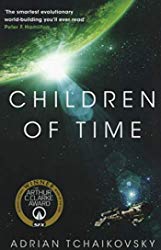
3) Children of Time, by Adrian Tchaikovsky – Great combination of loads of different SF themes – the degenerate generation starship, a very non-human civilisation; AIs pushed beyond their limits – and an intricate and well thought out plot with a satisfying ending. Won the Clarke Award in 2016. You can get it here. 2) Tess of the Road, by Rachel Hartman – A great YA novel combining elements of Tess of the d’Urbevilles, with a story of redemption from trauma and travel across a richly imagined landscape. A Lodestar finalist so I didn’t review it at the time. You can get it here. 1) Time Was, by Ian McDonald – Fantastic queer romance timeslip war story, tying in lots of lovely detail (both historical and narrative) and building to a conclusion that I didn’t quite see coming. Won the BSFA Short Fiction award. You can get it here.
The one you haven’t heard of: Cat Country, by Lao She – A very very direct satire on China of the 1930s, portrayed as a country on the planet Mars inhabited by cat people. You can get it here.
The one you can skip:Heartspell, by Blaine Anderson – A pretty rubbish example of the Celtic misht subgenre, where manly men fight battles and women do womanly druidic magic. In the very first chapter our hero is attacked by a cougar (there are no cougars in Ireland). There are tame wolves (wolves basically cannot be tamed). Ireland’s eastern coast is much more rugged than the west (it isn’t). Misspellings of Irish names abound. If you want, you can get it here.
The one you haven’t heard of: Cycling in Victorian Ireland by Brian Griffin – A short but comprehensive book about the evolution of cycling from upper-middle-class fad to a mechanism to erode patriarchal and class oppression in late nineteenth-century Ireland. You can get it here.
3) A Little Life, by Hanya Yanagihara – It’s a tough read but a very good one, about four friends, one of whom is deeply damaged. The whole scenario is delicately and sympathetically observed. You can get it here. 2) The Paying Guests, by Sarah Waters – It’s 1922. Frances and her mother take in Lilian and Leonard as lodgers; there is a restrained clash of cultures – and then romance, and then murder. Frances as the viewpoint character is tremendously sympathetic even when she does things that are fundamentally not very nice. You can get it here. 1) Girl, Woman, Other, by Bernardine Evaristo – A huge range of characters across contemporary London (with some flashbacks to earlier times and other places), almost all women, almost all black, all telling their stories from their own perspective, but often those stories intersect and overlap, and we see the same relationships from different angles. Great ending. You can get it here.
The one you haven’t heard of: In Another Light by Andrew Greig – Great novel cutting back and forth between 2004 Britain (mostly Orkney with bits of London and elsewhere) and 1930s Malaya, both of them vividly portrayed. You can get it here.
31 (12%) – then an all-time high, since exceeded in 2020 and 2021.
My top three comics of 2019:
3) The Berlin Trilogy, by Jason Lutes – A tremendously well-done story of Berlin from 1928 to 1933, seen by just a few people caught up in the wider politics of the times. You can get volume 1 here, volume 2 here, volume 3 here, and (my recommendation) the whole lot here. 2) Paper Girls, by Brian K. Vaughan and Cliff Chiang – An everyday story of four 12-year-olds delivering newspapers in 1988 in Cleveland, Ohio, all from different ethnic backgrounds, who get swept up into a mysterious time war which takes them to the future and past, both near and far. You can get the six volumes here, here, here, here, here and here. 1) Saga, vol. 9, by Brian K. Vaughan (again) and Fiona Staples. I’ve been following this story of angel-girl and devil-boy In Space for years, and the latest novel brings us to a spectacular climax, at least for now. I understand that the authors are pausing before the next one, which is frustrating but understandable. You can get it here.
32 (14%) – same number and slightly higher % than the previous year, pretty low because I had now read almost all of the Doctor Who books that there are to read.
The one you haven’t heard of:In Time, ed. Xanna Eve Chown, the last to date of the Bernice Summerfield spinoff books from Big Finish, this one an anthology with some very good stories (which, alas, will be mostly lost on those not familiar with Benny’s continuity). You can get it here.
I’ve seen some rather negative reviews of this online, but I really enjoyed it – another story of the Tenth and Thirteenth Doctors coming together, with a parallel timeline where Rose Tyler is leading human resistance to the Sea Devils, and also a return to the more recent story Nikola Tesla’s Night of Terror. Houser catches a lovely dynamic between the two Doctors, in general it’s well realised by the artists, and I thought it was a lot of fun. You can get it here.
This was my top unread comic in English. Next on that pile is The Secret to Superhuman Strength, by Alison Bechdel.
The interior of the pavilion was shady and cool after the glare outside. It was furnished with comfortable old chairs and tables, one of which bore the remains of a noble breakfast—Miles mentally marked two lonely-looking oil cakes on a crumb-scattered tray as his own. Miles’s mother, lingering over her cup, smiled across the table at him.
Next in my sequence of joint Hugo and Nebula winners, this is an old favourite of mine. If you don’t know Bujold’s Vorkosigan saga, I urge you to give it a try. Most of the stories are about Miles, a nobleman from a conservative planetary empire which is only just re-engaging with the rest of the galaxy and with modernisation, who suffers from restricted growth and brittle bones in a society where disability is abhorred.
In “The Mountains of Mourning”, one of the earlier stories in the sequence, Miles investigates and judges a case of infanticide in the impoverished back-country of his ancestral fiefdom. It’s about change to an ancient way of living, and poisonous family dynamics, and about disability in society. Every character is credibly, in some cases agonisingly, drawn. I think I first read it when I was getting to grips with my own family’s situation, and it has a special place in my heart for that reason. I think also it would be a very good place to start your journey into the Vorkosigan saga. You can get it here and here as a standalone, and here as part of a larger collection.
I’d also note that apart from the “truth drug” which Miles and his henchmen use to discover the identity of the murderer, the story could be perfectly well set in other times and places, with no sfnal elements at all.
It is interesting that the cover by Alan Gutierrez for the original publication in the May 1989 Analog, and for the later Arc Manor publication (artist not known to me), both concentrate on Miles as the focal point; whereas Ron Miller’s cover for Bujold’s own version concentrates on the empty cradle.
Also on both Hugo and Nebula ballots for Best Novella were “Tiny Tango”, by Judith Moffett, and “A Touch of Lavender”, by Megan Lindholm. The other Hugo finalists were The Father of Stones, by Lucius Shepard, and “Time-Out”, by Connie Willis. The other Nebula finalists were A Dozen Tough Jobs, by Howard Waldrop; “Great Work of Time”, by John Crowley; and “Marîd Changes His Mind”, by George Alec Effinger. I can’t recall having read any of them.
The Hugo for Best Novel that year went to Hyperion, by Dan Simmons, and the Nebula to The Healer’s War, by Elizabeth Ann Scarborough. The Hugo for Best Novelette went to “Enter a Soldier. Later: Enter Another”, by Robert Silverberg, and the Nebula to “At the Rialto”, by Connie Willis. The Hugo for Best Short Story went to “Boobs”, by the late Suzy McKee Charnas, and the Nebula to “Ripples in the Dirac Sea”, by Geoffrey A. Landis. And the Hugo for Best Dramatic Presentation went to Indiana Jones and the Last Crusade.
The following year there were two joint winners of both Hugo and Nebula, “Bears Discover Fire” by Terry Bisson and “The Hemingway Hoax” by Joe Haldeman, so I’ll get to them next.
He went to stand beside Terri, who was bent over a park map, nodding her head seriously as a ranger drew his finger along various possible routes.
I don’t know how I picked this up, but I am very glad that I did. These are nine tremendously varied and uniformly excellent stories. There’s John Milton, there’s a man with glass in his lungs, there’s a mermaid, there’s a girl who vanishes; more than half of them are on the sff side of the divide, and all of them are pretty magical. I usually find it difficult to write up short fiction collections, and this is no exception, but I really recommend it. You can get it here.
This waas my top unread book by a writer of colour. Next on that pile is The Chosen and the Beautiful, by Nghi Vo.
Working methodically, by midday I had filled two haversacks with canned food and had stolen for future barter three road maps from abandoned cars. I did not see the other man, Rafiq, again during the morning.
This was one of Christopher Priest’s first books, published over half a century ago in 1972, depicting a near-future Britain with a populist right-wing government, over-run with refugees from African conflicts, and the consequent disintegration of the social order. It’s told through the viewpoint of Alan Whitman (“White man”?) who is frankly unpleasant; he cheats on his wife and on his travelling companions, not for the sake of any grand strategy but because he’s just that kind of guy.
Since the book was published, the topic of migration and refugee flows has become considerably more toxic than it was then. Priest is clear that the two things he had in mind while writing were the early days of the Troubles in Northern Ireland, which saw the biggest forced population movement in Western Europe since the second world war, and the expulsion of Asians from Uganda, many of whom came (and as it turned out integrated well) to the UK. Those were different times, and for us it’s impossible to read the book now outside the context of the 2015 migration crisis and the poisonous and dishonest rhetoric of recent years.
It’s not what Priest was getting at; he was looking at the disintegration of his own society under the shock of the future, a sort of It Can’t Happen Here, and mapping the disintegration of his protagonist’s household and family onto this social crisis. His target is not the refugees but the corrupt right-wing government that presides over the chaos. The narrative itself is disjointed, three different timelines (as a fugue has three different themes) jumping between several different phases of the crisis as things get worse.
I read this as a teenager and wondered how it would hold up. It’s all grimly credible from a 1971 viewpoint, but of course the world has moved on, and Priest revised the novel in 2011 to smoothe some of the parts that had aged less well. This is not one of his better known books – tenth on LibraryThing, fourteenth on Goodreads – but it was an interesting return. You can get it here.
This was my top unread book acquired in 2016 (kindly given to me by the author, who signed it for me). Next on that pile is At the Edge of the World, by Lord Dunsany.
This is the latest post in a series I started in late 2019, anticipating the twentieth anniversary of my bookblogging at the end of October 2023. Every six-ish days, I’ve been revisiting a month from my recent past, noting work and family developments as well as the books I read in that month. I’ve found it a pleasantly cathartic process, especially in recent circumstances. If you want to look back at previous entries, they are all tagged under bookblog nostalgia.
November 2019 was the month that I started doing these posts rounding up monthly reading, beginning with November 2003 when I started bookblogging.
This was also the month of my infamous Ghostbusters cosplay at a work event in France.
The month had started with a trip to Washington, New York and Boston, where I caught up with an old college friend, the musician Nicholas White. (Yes, I know, confusing.)
Current Death Draws Five, by John J. Miller λ2 The Perfect Assassin, by K.A. Doore
Last books finished Neptune – Épisode 1, by Leo At The Edge Of The World, by Lord Dunsany ι2 Neptune – Épisode 2, by Leo Doctor Who: Battlefield, by Marc Platt κ2 Battlefield, by Philip Purser-Hallard
Next books The Karmic Curve, by Mary I. Williams Baba Yaga Laid an Egg, by Dubravka Ugrešić
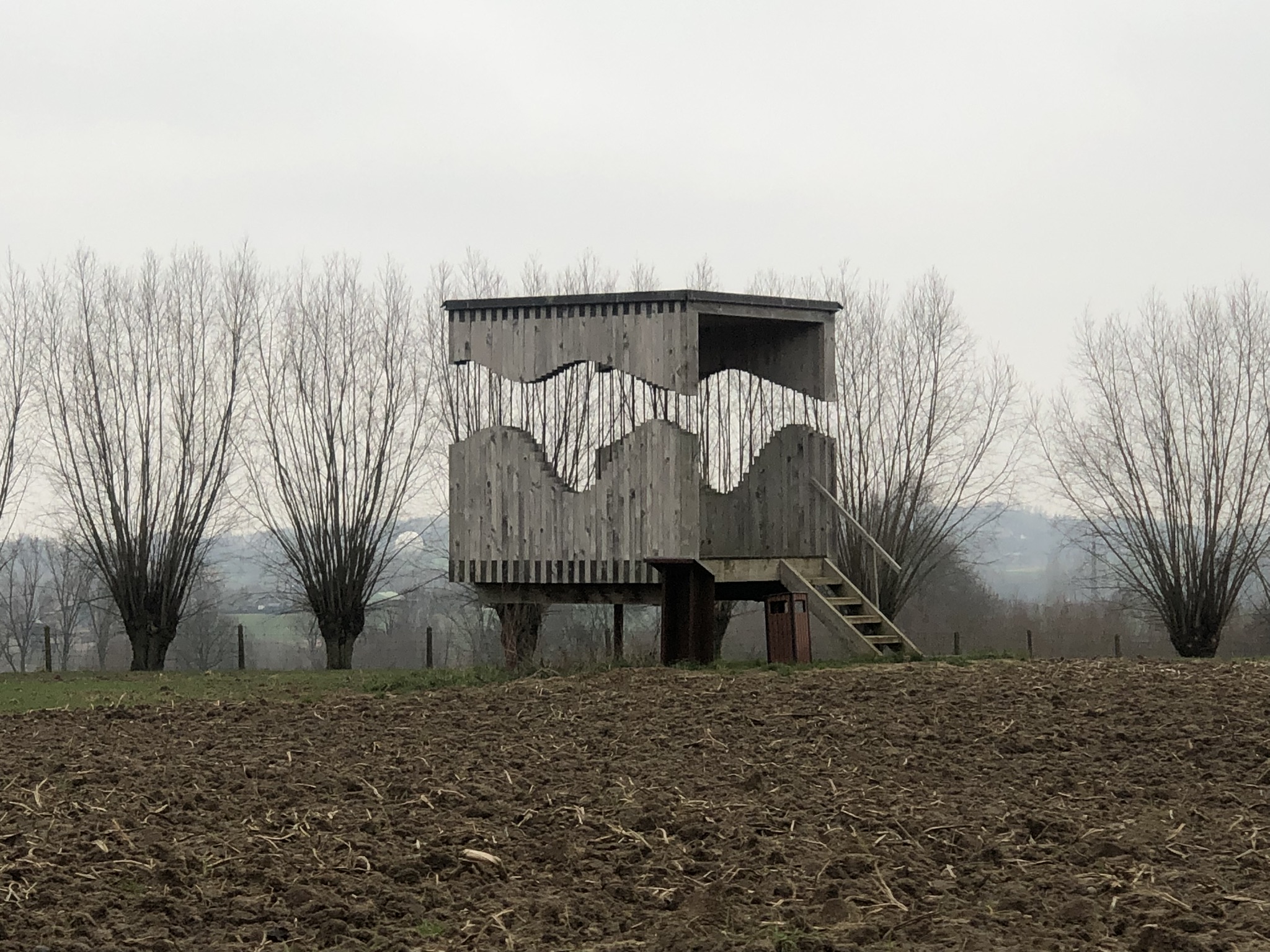
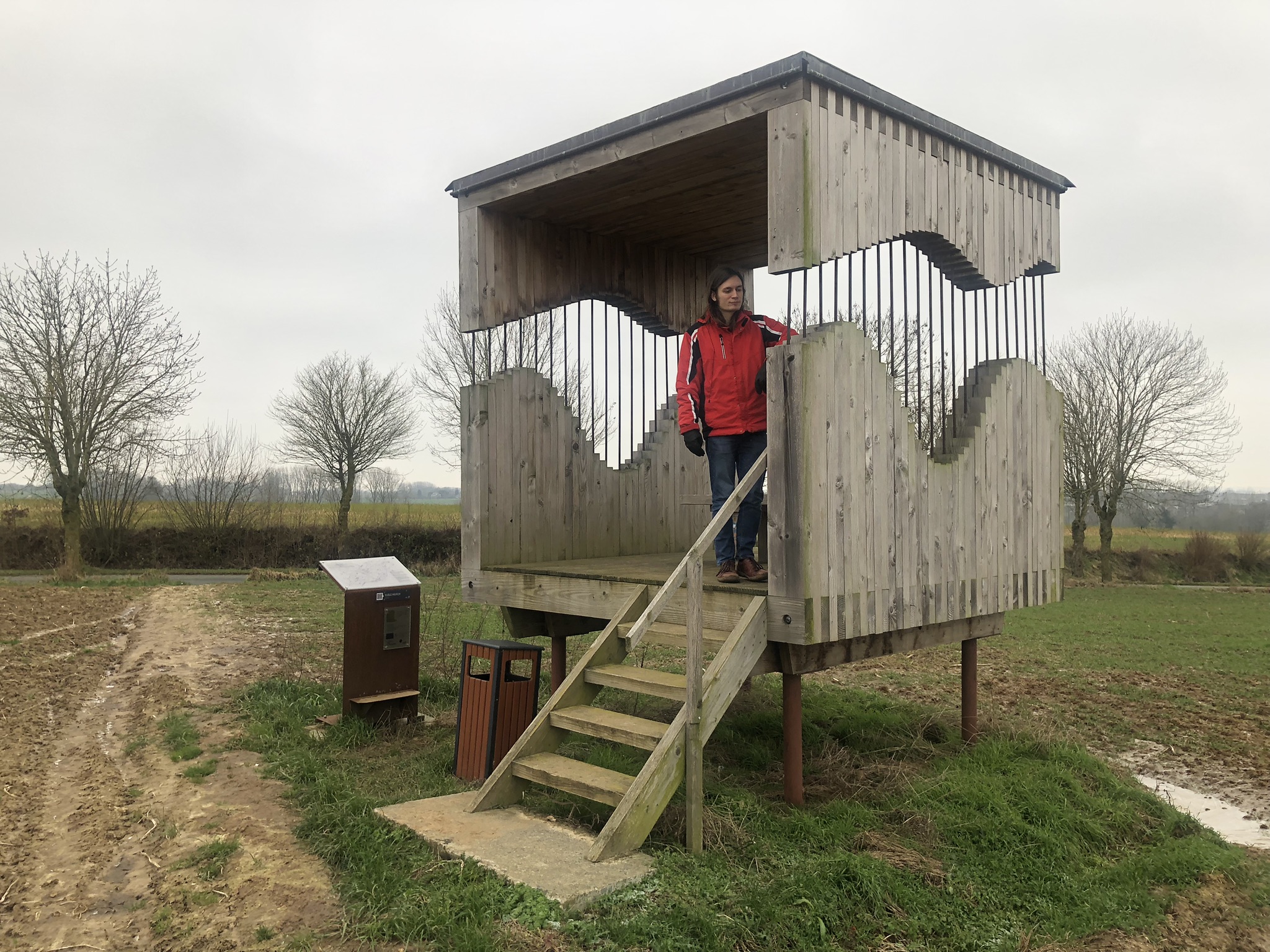
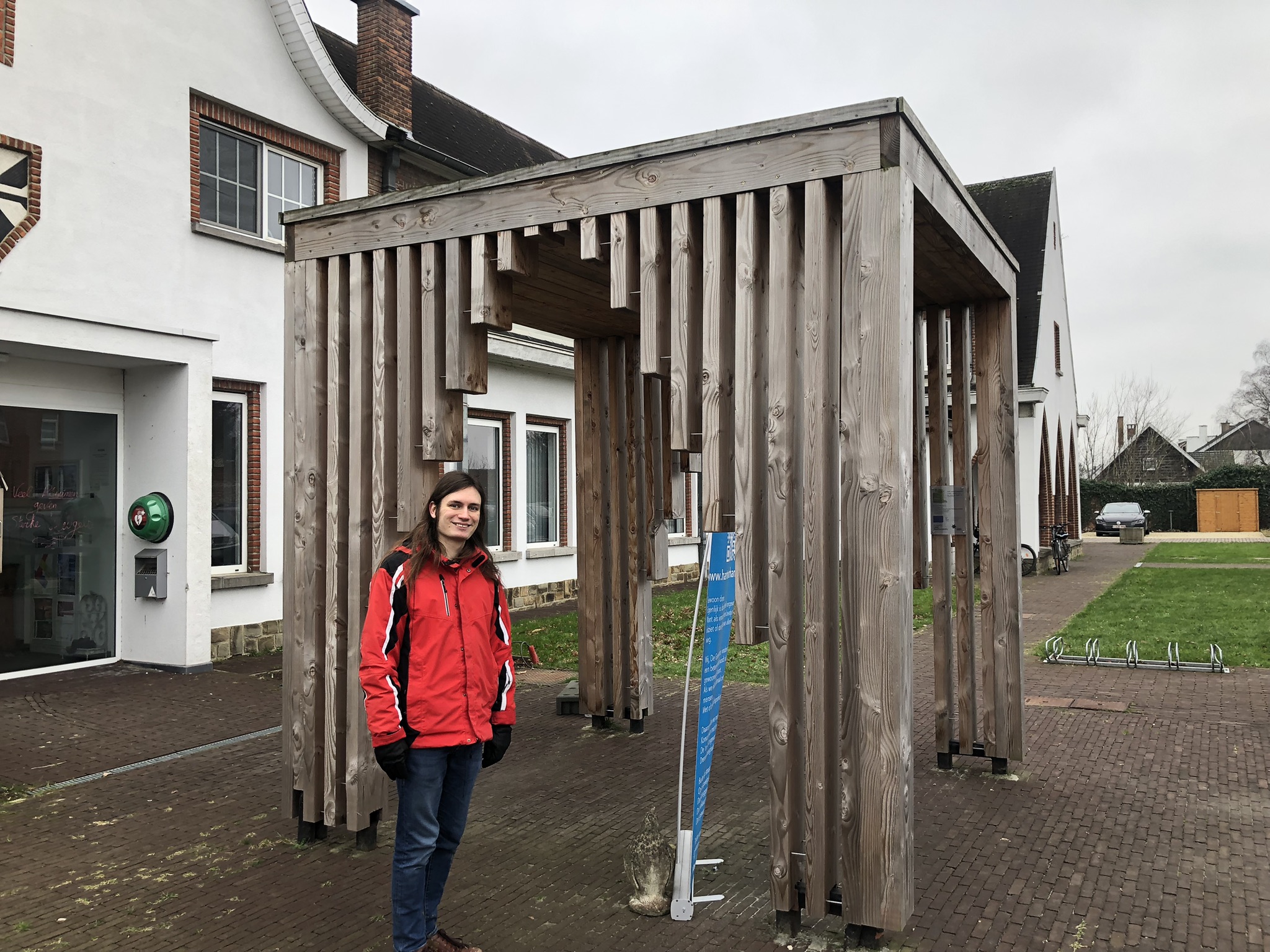
For Christmas, I got F a book called De Gekste Plek van België, a list of 111 weird and wonderful places in this country, which is after all the home of surrealism; and this weekend I offered him his choice of place to visit for a day trip. He picked one of the Cubes of Herne – only one is mentioned in the book, but it turns out that there are five altogether. Belgian public art has its moments, and this is one of them.
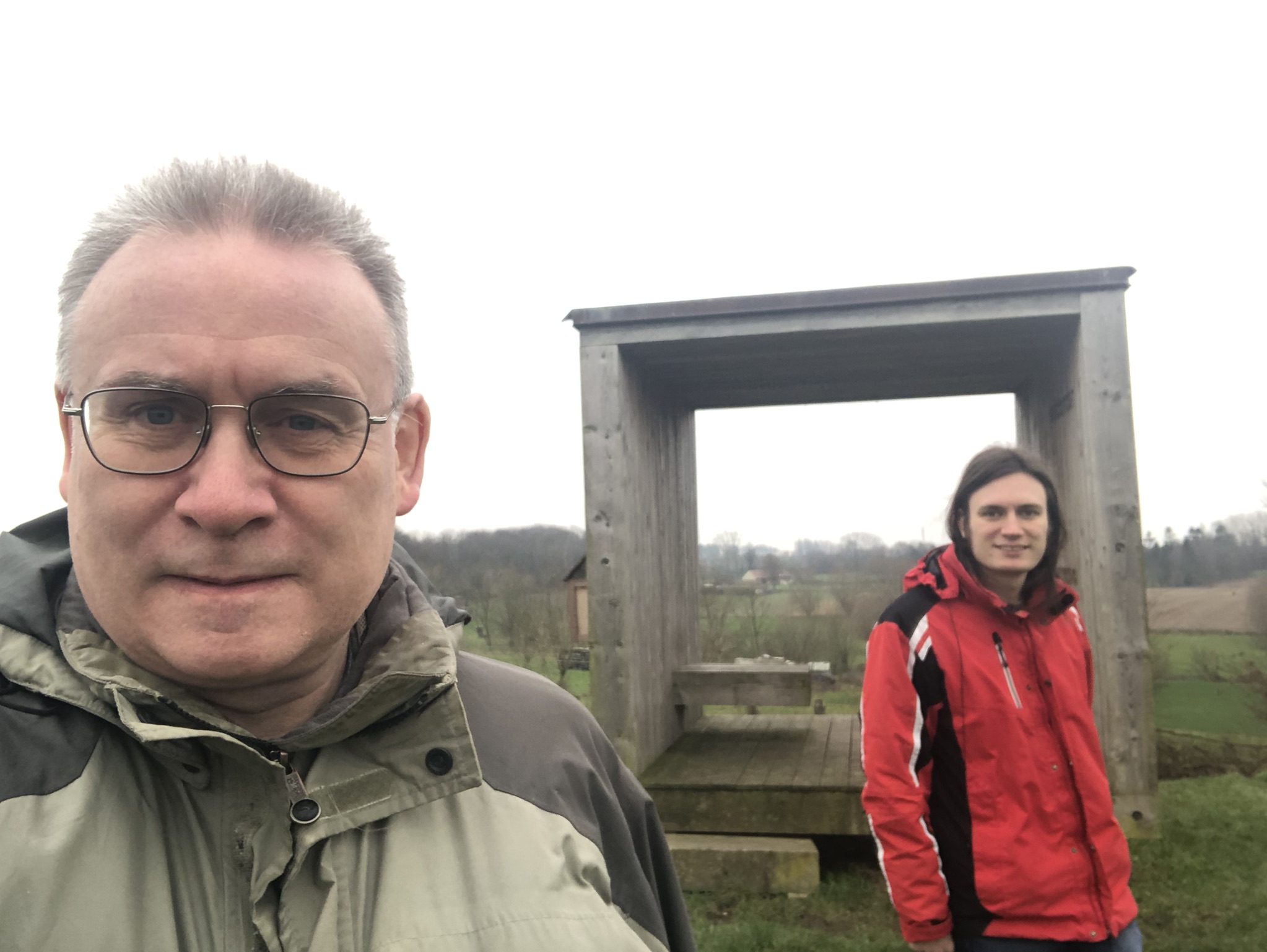
Herne is about an hour’s drive from us, as far on one side of Brussels as we are on the other. A few years ago, local campaigners persuaded various funders (mostly taxpayers) to support the construction of the wooden cubes. They are all open in one way or another, all embrace the landscape and the surroundings, and four of the five celebrate the painter Pieter Brueghel the Elder, who among other things painted Flemish landscapes, though I am not aware of any that have been specifically tied to Herne.
The first cube (at 50.73154, 4.03759) commemorates Brueghel himself. Like all of them, it’s 3m x 3m x 3m. There’s a Little Free Library outside.
It’s a straightforward open box, with the words “connected”, “resilient”, “respectful” and “authentic” inscribed on one wall.Someone on Facebook asked when our album is gonna drop.
Thought to be a self-portrait of Brueghel.
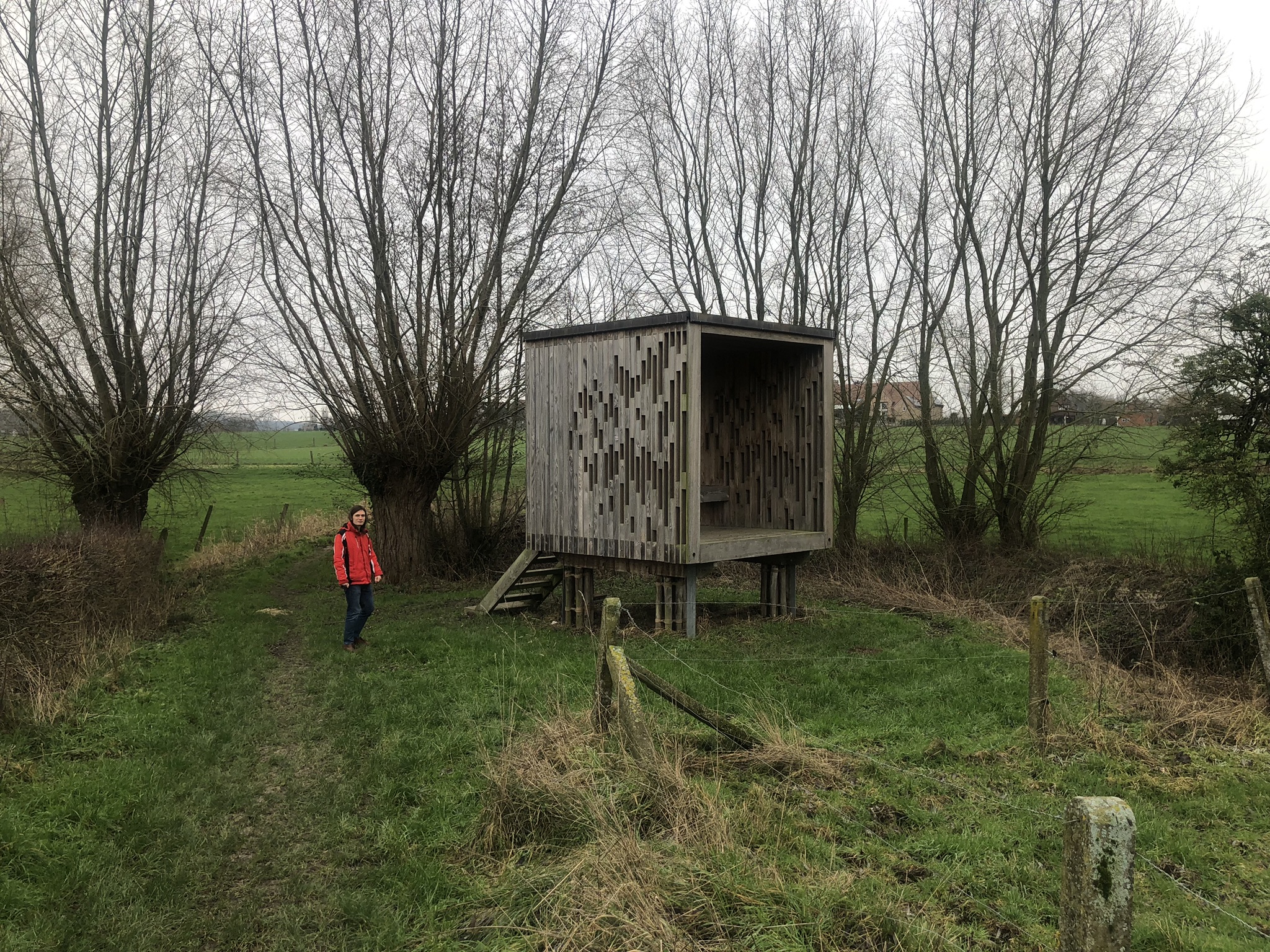
The second cube (50.71373, 4.06526) commemorates Brueghels’ famous painting, “The Fall of Icarus”. (Some sources, including the information boards by the cubes themselves, have the identities of the second and third cubes the other way round; but checking local information I think this is Icarus and the next is Mayke.)
It sits in a river valley, with a pattern of open slats on the sides, maybe making you think of a catastrophic fall which leaves the surroundings untouched? Or possibly echoing the shapes of the original picture?
Icarus’ feet.
According to Brueghel when Icarus fell it was spring
a farmer was ploughing his field the whole pageantry
of the year was awake tingling near
the edge of the sea concerned with itself
sweating in the sun that melted the wings’ wax
unsignificantly off the coast there was
a splash quite unnoticed this was Icarus drowning
Landscape with the Fall of Icarus, William Carlos Williams
The third cube, “Mayken”, is named after Brueghel’s wife, Maria or Mayken Coeck. We have no records of what she looked like. She is said to have been a painter too, but no identified works have survived. The cube sits on a hill (at 50.74158, 4.10979) with good views of the surrounding countryside; it’s a long way from the centre of Herne.
We came seriously unstuck visiting the fourth cube (at 50.71207, 3.99217). It is named “Dulle Griet” after the woman in Flemish folklore who raided Hell, and is the subject of a very Boschian painting by Brueghel.
Perhaps the shape of the cube reflects the opening of Hell, a place of transition? But then why is it aligned with a distant church steeple?
It turns out that our gallant steed is not well suited for off-road action, and it managed to dig an impressive hole in the mud, attracting much scorn from passers by (including a club of elderly hunters with rifles). But a man came with a long cable and a thick accent and got us out of it.
Finally, the fifth cube, so far unnamed, sits outside a Dominican convent just north of the linguistic frontier (at 50.7009, 4.03758), welcoming visitors.
You could visit all the cubes as a long day’s walk (as this couple did), but my recommendation would be to do it by bike, starting and finishing at Herne and Enghien. We discovered the hard way that you cannot drive all the way up to some of them.
I was in London this week, and my originally booked return train on Thursday evening was cancelled due to a general strike in France (protesting Macron’s outrageous plans to raise the retirement age from 62 to 64). So I had an unexpected evening free in the Great Wen.
I had a browse of the last-minute tickets available for the West End. I have not been to many West End shows – the last was Hamilton, almost exactly five years ago – so it was about time to do it again. There’s actually a lot of good stuff there – I wonder if theatres are not yet back up to full capacity post-pandemic? I was tempted by Six, of which my brother is a big fan and it’s also conveniently between office and hotel; but then I spotted that Noises Off, by Michael Frayn, and starring Felicity Kendal, was actually opening that very evening; and decent tickets were available for a mere £20. Well, that was an easy decision.
It wasn’t the first night of the show – it has been touring for several months, starting in Bath (which of course is ironic because it’s about a touring play) – but it was the first night in the Phoenix Theatre on Charing Cross Road. Here’s a trailer.
In case you don’t know, it’s a play about a play, a farce about a farce; the actors and crew are performing a sex comedy while at the same time feuding with each other behind the scenes. It was first written in 1982 – this was a fortieth anniversary tour – and filmed in 1992; we’ll get to that.
I’ve been mildly obsessed with Felicity Kendal since The Good Life (which started when I was seven). She gets top billing as the veteran actress Dotty, who plays the housekeeper, Mrs Clackett; she is a sprightly 76 these days, and was a bit hoarse on Thursday night but still has what it takes, doing all the physical stuff with gusto but also not particularly hogging the limelight.
I thought that everyone was good, but that there were two standout performances. Tracy-Ann Oberman, who I know from her Doctor Who performance as the head of Torchwood who gets turned into a Cyberman, really shines as Belinda, the actress who plays Flavia, the female half of the older of the two couples in the play-within-the-play. It’s not necessarily scripted that way, but she magnetically attracts our attention as the grownup in the room trying to make sense of a crazy world.
And I had not previously seen Joseph Millson, as Garry, who plays Roger, the male half of the younger of the two couples. He has great physical presence, and in particular has a very impressive tumble down the stairs towards the end. He is 48; I don’t think I would have felt able to do that at half his age.
Given that it was the play’s first night in London, two lines in particular drew laughs, both spoken by Alexander Hanson as the director Lloyd Dallas, a role originally played by Paul Eddington:
Think of the first night as a dress rehearsal.
and
We all know you’ve worked in very classy places up in London where they let you make the play up as you go along, but we don’t want that kind of thing here, do we?
On the downside, I thought that the script does few favours to the two junior women characters, Brooke who plays Roger’s girlfriend Vicky (Sasha Frost here), and stage hand Poppy (Pepter Lunkuse, the one PoC on the stage). The humour of the play is a bit uncomfortable anyway, which is after all the point, but here it veers into having women characters who are funny because they are stupid, and shagging the men. The film version has a plot twist at the end about Vicky’s true mission, but if that was in the play, I missed it.
I am not complaining about the performers, who made the most of what they were given; and the staging and direction are all very tightly and credibly done. There are a couple of great sight gags with the theatre curtain itself.
The show finished just before 10, which gave me six hours of sleep before my 4.30 start for the 6.15 Eurostar on Friday morning. As I got back into my hotel, I chatted to the older couple who were sharing the lift with me, and it turned out that they too had been to the same play. We all agreed that Tracy-Ann Oberman was particularly impressive.
For an encore, F and I watched the 1992 film version last night. (Anne is away so we are experiencing a few days of bachelor life.) I had seen it years ago, but it was really interesting to watch it again with the stage show so fresh in my memory. Here’s a clip from the first act.
The dynamics of the film are completely different, even if the words are mostly the same. Michael Caine, the biggest star in the film, gets a whole framing narrative to himself. Denholm Elliot, who died of AIDS soon afterwards, is a more sympathetic Selsdon (the old alcoholic actor who plays the burglar) than was Matthew Kelly on stage, though there is a size thing here too, Kelly being much bigger physically than Elliott was.
To my surprise, Christopher Reeve seems rather miscast in the film as Frederick, who plays Philip, the male half of the older couple; Jonathan Coy, who I don’t think I had seen before in anything, seemed much more comfortable in the role on stage. And Julie Hagerty, who I generally think is great, is wasted as Poppy in the film. Reeve at 39 also seems a bit too young for his role, and Hagerty at 36 maybe a bit too old for hers; by contrast, Jonathan Coy is 68 and Pepter Lunkuse 32 (and playing it younger).
I was interested to note that the film script is a bit more risqué than the stage show; some of the humour has been toned down for 2023. Sorry, I can’t recall any specific examples, but I felt that the stage show had cut or softened some of the lines unnecessarily; though there is more use of the word “fucking”. Also, as noted above, Vicky in the film (played by Nicolette Sheridan) turns out to have a secret role which I don’t recall from the stage show, and which gives her character (though not Brooke’s) a bit more oomph.
And perhaps it was just my state of mind after a short night and a long journey, but I found the film less effective as comedy, in the second and third acts. I had expected that the camera following the various bits of slapstick closely would highlight them better for the viewer than is possible for a stage audience who have to pay attention to the whole tableau, but in fact I found myself losing track of the action. I admit that this may have just been my fatigue; F laughed his head off throughout.
Anyway, the show was well worth the twenty quid I paid for the ticket, and I think I must do this a bit more often.
My normal practice is to give you the second paragraph of the third chapter of the books I read. Here there is a problem because the second paragraph of Liber III of the Metamorphoses is a bit meaningless out of context, and also not translated by Hughes; whereas the second paragraph of the third of Hughes’ extracts from Ovid is an interpolation by him with no original Latin text to compare it to. So instead, here is the third paragraph of Liber I, starting with the original and the McCarter translation, part of the passage on the Creation:
Sic ubi dispositam quisquis fuit ille deorum congeriem secuit sectamque in membra coegit, principio terram, ne non aequalis ab omni parte foret, magni speciem glomeravit in orbis. tum freta diffundi rapidisque tumescere ventis iussit et ambitae circumdare litora terrae; addidit et fontes et stagna inmensa lacusque fluminaque obliquis cinxit declivia ripis, quae, diversa locis, partim sorbentur ab ipsa, in mare perveniunt partim campoque recepta liberioris aquae pro ripis litora pulsant. iussit et extendi campos, subsidere valles, fronde tegi silvas, lapidosos surgere montes, utque duae dextra caelum totidemque sinistra parte secant zonae, quinta est ardentior illis, sic onus inclusum numero distinxit eodem cura dei, totidemque plagae tellure premuntur. quarum quae media est, non est habitabilis aestu; nix tegit alta duas; totidem inter utramque locavit temperiemque dedit mixta cum frigore flamma.
When he (whichever god it was) had carved that now neat heap and shaped it into parts, he next, to make it equal all around, sculpted the earth till it became a sphere. He poured out seas, then ordered them to swell with gales and wrap the shores of circled land. He added springs, great lakes, and ponds. He shut the sloping rivers in meandering banks— some of these are absorbed by earth, while others flow to the deep and, welcomed in its vast expanse of water, pound not banks but shores. He ordered fields to spread, valleys to sink, leaves to enshroud the woods, and peaks to rise. And as two zones divide the sky’s right side and two the left, the middle fifth one warmer, just so the god partitioned earth within, imprinting it with tracts of this same number.⁹ The middle zone is far too hot for life, the outer two too deep with snow. He placed two more between, a blend of heat and cold.
⁹48 tracts of this same number: The earth is divided into five zones: the middle equatorial zone (too hot for life), the two outer polar zones (too cold for life), and, between these, the two temperate zones (conducive to life).
Ted Hughes’ translation of the same passage:
When the ingenious one Had gained control of the mass And decided the cosmic divisions He rolled earth into a ball. Then he commanded the water to spread out flat, To lift itself into waves According to the whim of the wind, And to hurl itself at the land’s edges. He conjured springs to rise and be manifest, Deep and gloomy ponds, Flashing delicious lakes. He educated Headstrong electrifying rivers To observe their banks – and to pour Part of their delight into earth’s dark And to donate the remainder to ocean Swelling the uproar on shores. Then he instructed the plains How to roll sweetly to the horizon. He directed the valleys To go deep. And the mountains to rear up Humping their backs. Everywhere he taught The tree its leaf. Having made a pattern in heaven – Two zones to the left, two to the right And a fifth zone, fierier, between – So did the Wisdom Divide the earth’s orb with the same: A middle zone uninhabitable Under the fire, The outermost two zones beneath deep snow, And between them, two temperate zones Alternating cold and heat.
Way way back 40 years ago, I studied Latin for what were then called O-levels, and one of the set texts was a Belfast-teenager-friendly translation of Ovid’s Metamorphoses. I loved it. If you don’t know, it’s a narrative poem in fifteen books re-telling classical legends, concentrating in particular on those where there is a change of shape – usually humans turned into animals, vegetables or minerals, though with other variations too. It’s breezy, vivid and sometimes funny, and it’s been a store of easily accessible ancient lore for centuries.
I’d always meant to get back to it properly, and it finally popped up on my list of books that I owned but had not yet blogged here. However, my 40-year-old copy is safely in Northern Ireland, so I acquired both the latest Penguin translation, by Stephanie McCarter, and Ted Hughes’ selection of twenty-four choice chapters, and read them – I took the McCarter translation in sequence, and then jumped across to read the relevant sections if Hughes had translated them, though he put them in a different order.
I do find Ovid fascinating. In some ways he speaks to the present day reader very directly – a lot of the emotions in the Ars Amatoria could be expressed by lovers two thousand years later. But here he’s taking material that was already very well known, the Greek and Roman classical legendarium, and repackaging it for a sophisticated audience in the greatest city in the world. The book ends (McCarter’s translation):
Where Roman power spreads through conquered lands, I will be read on people’s lips. My fame will last across the centuries. If poets’ prophecies can hold any truth, I’ll live.
And he did. I have been particularly struck by Ovid’s popularity among the patrons of my favourite 17th-century stuccador, Jan Christiaan Hansche. A number of his most interesting ceilings feature stories from Ovid, some of them well known, some less so. Sixteen centuries after Ovid laid down his pen, his work was still part of the standard canon of literature known to all educated Western Europeans.
So. The two translations are different and serve different purposes. McCarter’s mandate was to translate the whole of the Metamorphoses into iambic pentameter in English. She is necessarily constrained to giving us an interpretation of Ovid’s text, with all of its limitations, and confining her own original thoughts to footnotes and other supporting material.
In a very interesting introduction, she is clear about the many scenes of rape in the story. But she also makes it clear that Ovid has a lot more active female characters than are in his sources, and they get more to do. She gives some telling examples of previous translators projecting later concepts of femininity onto Ovid’s fairly unambiguous original words.
Given the contemporary debate, it’s also interesting that Ovid has several examples of gender fluidity – not really presented as a standard part of everyday life, but nonetheless as a phenomenon that happens. For Ovid, we must simply accept that someone’s current gender may not be the one that they were born with.
Ted Hughes, on the other hand, was translating favourite bits of Ovid because he had reached the stage of his career where he could do what he wanted. He could leave out all the bits he found boring (I haven’t counted, but I think he translates about only 40% of Ovid’s text), and he could add his own flourishes at will. Inevitably this makes for a more satisfactory reading experience, though it is incomplete.
Both translations bring to life Ovid’s vivid imagery, which really throws you into the narrative. For a compare and contrast passage, here is the beginning of their treatment of the story of Phaethon, the son of the Sun who crashed to disaster trying to drive his father’s chariot (a favourite topic for Hansche). I think that the differences speak for themselves:
McCarter
Hughes
The Sun’s child Phaethon equaled him in age and mind. But Epaphus could not endure his boasts, his smugness, and his arrogance that Phoebus was his father and declared, “You crazily trust all your mother says! Your head is swollen by a phony father!” Phaethon blushed as shame repressed his wrath. He took these taunts to Clymene, his mother, and told her, “Mother, to upset you more, although I am free-spoken and quick-tempered, I could not speak, ashamed these insults could be uttered and that I could not refute them. If I am truly born of holy stock, give me a sign and claim me for the heavens!” Wrapping his arms around his mother’s neck, he begged—by his life, Merops’ life, his sisters’ weddings—that she give proof of his true father.
When Phaethon bragged about his father, Phoebus The sun-god, His friends mocked him. ‘Your mother must be crazy Or you’re crazy to believe her. How could the sun be anybody’s father?’ In a rage of humiliation Phaethon came to his mother, Clymene. ‘They’re all laughing at me, And I can’t answer. What can I say? It’s horrible. I have to stand like a dumb fool and be laughed at. ‘If it’s true, Mother,’ he cried, ‘if the sun, The high god Phoebus, if he is my father, Give me proof. Give me evidence that I belong to heaven.’ Then he embraced her. ‘I beg you, ‘On my life, on your husband Merops’ life, And on the marriage hopes of my sisters, Only give me proof that the sun is my father.’
I think I’d recommend that a reader unfaniliar with Ovid start with Hughes and then go on to McCarter to get the full story. You can get the McCarter translation here and Hughes here.
This was the top book on my shelves that I had read but not yet blogged. Next on that list is rather different – The Cider House Rules, by John Irving. It’s also right at the end of my 2023 books queue so it will be a while before you hear about it.


![B004UJ260O.01._SX175_SY250_SCLZZZZZZZ_[1].jpg](https://i0.wp.com/fromtheheartofeurope.eu/wp-content/uploads/2022/03/1598949_original.jpg?w=584&ssl=1 "B004UJ260O.01._SX175_SY250_SCLZZZZZZZ_[1].jpg")