Murder in Mesopotamia, by Agatha Christie

Second paragraph of third chapter:

Mrs. Kelsey was settling into her house at Alwiyah, and I was glad to be able to take a few things off her shoulders.

This came up in conversation a couple of weeks ago, and I realised that I have it in my vast store of unread Agatha Christies, and pulled it out to see for myself. It was not one of the Christies that I had consumed as a teenager. It’s mainly remembered for the story behind the story; the first murder victim is based strongly on the real-life Lady Katherine Woolley, wife of Sir Leonard Woolley who led the 1930s excavation at Ur where Agatha Christie met her second husband, Sir Max Mallowan.

Massive spoilers: The various European and American characters in the book are vividly drawn. But the murder part of the plot is frankly ridiculous. It requires the first victim to have forgotten crucial details of her own previous marriage, and also requires that she remains strangely silent at the crucial moment of being murdered. The second murder is very poorly planned and could easily have failed. The murderer is very lucky that they actually off their victims. They are unlucky that Poirot is there to catch them out.

Despite my frustrations with the narrative, I found the context really fascinating. It’s a thoroughly racist book – Iraq was basically under British military occupation at the time, and the Arabs get barely a mention – and certainly not a positive one – in the narrative.

It was the workmen that made me laugh. You never saw such a lot of scarecrows – all in long petticoats and rags, and their heads tied up as though they had toothache. And every now and then, as they went to and fro carrying away baskets of earth, they began to sing – at least I suppose it was meant to be singing – a queer sort of monotonous chant that went on and on over and over again. I noticed that most of their eyes were terrible – all covered with discharge, and one or two looked half blind. I was just thinking what a miserable lot they were when Dr. Leidner said, “Rather a fine-looking lot of men, aren’t they?”

I was struck by a couple of other points too. The narrator’s name is Amy Leatheran; that surname simply doesn’t exist in real life. (She pops up again in the 1970 Agatha Christie novel Passenger to Frankfurt, nursing the narrator’s great-aunt, but does not appear to have aged 35 years in the meantime.) I’m wondering what significance the name has. If you swap “leather” for “mallow”, you get A. Mallowan, which was Agatha Christie’s married name, but maybe that’s stretching a bit.

I love lists of books, and here Poirot looks at the victim’s bookshelves and draws some drastic conclusions:

“In her bedroom I noticed the following books on a shelf: Who Were the Greeks? Introduction to Relativity, Life of Lady Hester Stanhope, Back to Methuselah, Linda Condon, Crewe Train.
“She had, to begin with, an interest in culture and in modern science – that is, a distinct intellectual side. Of the novels Linda Condon, and in a lesser degree Crewe Train, seemed to show that [the victim] had a sympathy and interest in the independent woman – unencumbered or entrapped by man. She was also obviously interested by the personality of Lady Hester Stanhope. Linda Condon is an exquisite study of the worship of her own beauty by a woman. Crewe Train is a study of a passionate individualist. Back to Methuselah is in sympathy with the intellectual rather than the emotional attitude to life. I felt that I was beginning to understand the dead woman.”

I thought it worth seeing which of these books, familiar to a fictional 1930s Belgian detective, has stood the test of time, and apply my usual test of Goodreads and LibraryThing users. It turns out to be about half and half. (I’m assuming that Max Born’s book on relativity is meant, rather than any other.)

TitleAuthorGR ratersLT owners
Back to MethuselahGeorge Bernard Shaw291352
Crewe TrainRose Macaulay323216
Einstein’s Theory of RelativityMax Born157308
Linda CondonJoseph Hergesheimer716
Who Were the Greeks?Sir John Linton Myres23
Life and Letters of Lady Hester StanhopeThe Duchess of Cleveland11

Anyway, it’s a book of its time and you can get it here.

Bechdel pass – the narrator is a woman and has been hired to look after a woman, and their first conversation is mainly about the latter’s health (the husband is mentioned a couple of times but he is not the main subject).

Agatha Christie:
The Mysterious Affair at Styles | The Secret Adversary | The Murder on the Links | The Man in the Brown Suit | The Murder of Roger Ackroyd | The Big Four | The Mystery of the Blue Train | The Murder at the Vicarage | Murder on the Orient Express | The A.B.C. Murders | Murder in Mesopotamia | Cards on the Table | Death on the Nile | Appointment With Death | Hercule Poirot’s Christmas | And Then There Were None | Evil Under the Sun | The Body in the Library | Five Little Pigs | A Murder Is Announced | 4.50 from Paddington | Hallowe’en Party

Yellowface, by R.F. Kuang

Second paragraph of third chapter:

Hear me out.

This is a grim and also funny book about the lifestyle of a bestselling author. The protagonist, June Hayward, watches her successful writer friend Athena Liu die in an accident in the first chapter, then takes her unpublished manuscript and successfully sells it as her own. June makes some awful decisions and is repeatedly confronted with the consequences of her actions; there’s also some wickedly vicious commentary on the perception of Chinese culture and especially Chinese history in today’s America (and I don’t think that other Western countries would be very different). It’s a short but compulsive read; you can’t quite believe that June has got herself into a position where her career success depends on a gruesome lie, but you can absolutely believe the contortions that follow. You can get it here.

For some bizarre reason this book was on the BSFA Long List for Best Novel. It has no sfnal content. June thinks that she sees Athena a couple of times after her death, but I don’t think we are meant to think that it is “really” her. If it is on the BSFA short list, I will not vote for it, even though I think it is a brillliant book.

Easy Bechdel pass – in the very first chapter, before Athena dies, she and June are talking to each other about their writing and men are barely mentioned.

This was my top unread non-genre book. Next on that pile, on a rather different level, is Moonraker’s Bride by Madeleine Brent.

Tristram Shandy, by Laurence Sterne

Second paragraph of third chapter:

—My mother, who was sitting by, look’d up,—but she knew no more than her backside what my father meant,—but my uncle, Mr. Toby Shandy, who had been often informed of the affair,—understood him very well.

So, my local interest in Tristram Shandy is this. (Actually, it’s very respectful to the spirit of the book to start my review in the middle, as it were. The whole point is not to get to the point too quickly.) My daughters live close to the small village of Neerwinden, which is the site of the battle usually known as the Battle of Landen which took place in 1693. Tristram Shandy’s Uncle Toby’s manservant, Corporal Trim (pay attention there in the back) was wounded in the knee at that battle and exclaims in Chapter 19 of Book 8:

Your honour remembers with concern, said the corporal, the total rout and confusion of our camp and army at the affair of Landen; every one was left to shift for himself; and if it had not been for the regiments of Wyndham, Lumley, and Galway, which covered the retreat over the bridge Neerspeeken, the king himself could scarce have gained it – he was press’d hard, as your honour knows, on every side of him.

Neerspeken is obviously a mistake for Neerhespen, which I often drive through when I take my oldest back from a visit to the Beemden nature reserve in Landen. We usually stop off at the Chapel of the Holy Cross. (In the spirit of Tristram Shandy, I should record that I usually go to Landen by the more southern route via Eliksem and Laar.)

I first read Tristram Shandy when I was 23, more than thirty years ago, and still have the slightly mildewed paperback that I picked up off a Cambridge bookstall one day in late 1990. I can’t honestly tell you what happens in it; I can’t find any particular lines that resonate or are very quotable; the most memorable moment is when our hero’s penis gets caught in the windowframe in Book 5 Chapter 17. (Sorry for the spoiler.)

And yet somehow I love it. It’s rambling, self-indulgent, full of references to things I know nothing about; and at the same time the stream-of-consciousness narrative, the refusal to make many concessions to the reader who wants to know what is actually going on, are part of the charm. It’s clearly an inspiration for Joyce, Woolf, and lots of the modernist writers who I really like; but it’s a book of its own time, requiring friendly engagement and repaying that engagement with warmth and humour. You can get it here.

Total Bechdel fail. The most prominent female character, Tristram’s mother, spends most of the book giving birth to him, so her conversation is necessarily about her motherhood. The other women are all defined by their relationships with the male characters.

This was my top book acquired last year; next on that pile is Emily Wilson’s translation of The Odyssey.

Attack on Thebes, by M.D. Cooper

Second paragraph of third chapter:

“Tanis and Sera are due back on the ship in another day,” she said. “Their negotiations with Scipio are over, we’re preparing to leave the Bosporus system.”

I think I bought this by accident. It is the fifth book in a series of thirteen, and I found it impossible to get into the space opera plot. I put it down after 60 pages. You can get it here.

Easy Bechdel pass, as the very first chapter has two women characters debating the politics of the empire with each other.

This was the sf book that had lingered longest unread on my shelves. Next on that pile is SFerics 2017, edited by Roz Clarke.

Blackpool Revisited, by John Collier

Second paragraph of third chapter:

As the show itself was transforming on screen so the exhibition began to blossom as a tourist attraction. Peripheral events such as the switching on of the illuminations in 1975 and the Blackpool Centenary celebrations in 1976 helped to cement the exhibition’s place as an exciting and worthwhile visitor destination.

A 600-page sequel to the Blackpool Remembered volume, also going back to memories of the Doctor Who exhibition in Blackpool which ran from 1974 to 1984, but this time also with material on the Doctor Who museum that was open in the same town from 2004 to 2009, and an account of some of the spinoff merchandise that was available to fans in the Good Old Days.

Like the previous volume, it’s a beautifully assembled set of photos with literate commentary. Every corner of both the earlier exhibition (again) and David Boyle’s Doctor Who Museum is described in loving detail. There is a feature on Boyle’s life and career, including some very sad photos from his final years of ill health. He was also the maker of the Dapol models which were the authorised miniatures of characters from the TV series. Short sections also look at Jon Pertwee’s Whomobile, and at Maginty, the Blackpool double of the Doctor’s car Bessie. Again, the perspective is very male and white, which is unfortunate; but it’s a labour of love, and there’s a lot of love here. You can download it for free from here (600 pages, 140ish MB).

The Dark Queens, by Shelley Puhak

Second paragraph of third chapter:

From the upper windows of the Golden Court, Brunhild saw not just the river Moselle and the bridge spanning it. She could also see straight down into a small amphitheatre inside the city walls. Gladiator games had long been outlawed, but exotic animal hunts and bear baiting were still held there. These, sadly, seemed to be the main entertainment. The new queen quickly discovered that even what luxuries the Merovingian courts offered left something to be desired. There were mimes and actors in residence for instance – predecessors of the minstrels and jesters later found in medieval courts – but mostly, these performers recited long-winded national epics.

This is a book about two queens of the sixth century, both probably born in the early 540s: Fredegund of Neustria (died 597) and Brunhilda of Austrasia (died 613). You may not have heard of Neustria or Austrasia; these were old kingdoms of the pre-Charlemagne era, the tail end of the Merovingian dynasty founded by Clovis, King of the Franks, in the late 5th century. This is a period which we learned nothing at all about at school in Belfast, and if your native language is not French, Dutch or German, you’re probably in the same boat. My previous exposure to it amounted to a 2021 exhibition of Merovingian metalwork in Mariemont, off to the south of Belgium.

Neither of the two queens was in fact a Merovingian by birth, but they married two brothers, grandsons of Clovis, who ruled between them large chunks of what are now northern France, central Germany, Belgium, Luxembourg and parts of the Netherlands, with Burgundy also in the mix at various times.

Brunhilda was a Visigothic princess from Spain, who married Sigebert of Austrasia (the eastern bit) in 567. He was murdered, probably on her orders, in 575 and she ruled in Metz off and on, in her own right and as regent for the next generation, for four decades. Fredegund was a slave girl from the western chunk, Neustria, ruled from Soissons; she caught the eye of Chilperic, the local overlord, and replaced his wife (Brunhilda’s sister) as queen.

Brunhilda and Fredegund feuded bitterly until Fredegund’s death in 597, but eventually in 613 Chilperic and Fredegund’s son Clotaire managed to conquer both kingdoms, and Brunhilda (who must have been well into her 60s at this point) was executed by a gruesome method which remains obscure but definitely involved horses.

Both women have been largely written out of history. Clotaire emphasised his own legitimate descent from Clovis, not his usurping aunt or indeed his low-born mother. No men wanted to commemorate women who had survived and ruled for many years. The major contemporary witness, Gregory of Tours, is very partisan and clearly incomplete. Fredegund’s tomb has an image of her whose face has been erased. Brunhilda’s tomb has been lost, apart from two chunks of marble.

Shelley Puhak has done an entertaining job of pulling together the threads of history and legend to tell the story of the two women. She occasionally falters under the weight of detail, and at other times is forced to adopt a very chatty style to compensate for the absence of reliable sources, but one feels that she has done her best with what is available. I got what I wanted from The Dark Queens; you can get it here.

The largest menhir in Belgium is known as the Pierre Brunehaut; I visited it in February 2021. It is near to one of the many old roads known as chaussées Brunehaut in northern France and southern Belgium.

The Pierre Brunehaut near Tournai, which I visited in February 2021 with my friend J, who gives it a sense of scale.

Some speculate that the chaussées Brunehaut are the paths supposedly taken by the horses participating in her execution, but there are too many roads for that; I prefer to think that in her many years as queen, she dedicated state resources to the upkeep of the transport infrastructure, and (rather like Mussolini making the trains run on time) this has been dimly remembered by local lore. There are worse possible memorials.

Anthro-Vision: How Anthropology Can Explain Business and Life, by Gillian Tett

Second paragraph of third chapter:

[Chris] Whitty had reason to be worried. Some months earlier a highly infectious disease called Ebola had started to sweep through Britain’s former colony of Sierra Leone and neighboring Liberia and Guinea. Groups such as the World Health Organization and Medecins Sans Frontieres had rushed to halt the contagion. So had the UK, French, and American governments, Barack Obama’s American administration had even sent four thousand troops to Liberia. The world’s best medical experts at places such as Harvard were hunting for a vaccine, and computer scientists were using Big Data tools to track it.

Gillian Tett and I were contemporaries as undergraduates at Clare College, Cambridge, in the 1980s; she studied archaeology and anthropology, and I studied natural sciences (specialising in astrophysics in the end). We did not know each other well, though we lived on the same staircase in our first year. I’ve seen her precisely twice since then, when she gave a presentation on the causes of the 2008 crisis in Brussels in 2009 and when we caught up at a college reunion in 2022 and found we had both been working on Ukraine. She is now the Provost of King’s College, next door.

Before becoming a Financial Times journalist, Tett was an anthropology student whose doctorate examined Islam and Communism in rural Tajikistan. I came to anthropology a bit later in my life – for bureaucratic reasons, my PhD, which was in the history of science, was administered in the Social Anthropology department at the Queen’s University of Belfast. I developed a deep respect for that discipline, and I’ve written about this here in the context of the House of Lords and, er, England. In my day job as a public affairs consultant in Brussels, it seems to me that I get a much better understanding of what is going on and what is likely to happen by applying anthropological analysis of human behaviour and organisational culture than by the traditional methods of political science, let alone philosophy.

Tett doesn’t make quite such grand claims for her discipline in her book Anthro-Vision. She argues merely that it would be good to take an anthropological perspective into account in making important decisions, as well as the legal, economic, political etc points of view that already are well represented around the table. Among the topics she examines are the response to the 2013-14 Ebola outbreak in West Africa; the failure of bankers to spot the risks in their own behaviour that caused the 2008 financial crisis; the appeal of Donald Trump; the difference between remote and office working; and the intriguing rise of environmental, social, and corporate governance as a serious concern in the top boardrooms of the private sector.

I think that she undersells the case for anthropology. As I said above, I think it is actually superior as an analytical framework, perhaps precisely because it is insufficiently used. On the other hand, she also frames herself as a feminist outsider who has a healthy scepticism about the claims of capitalists; but can a Financial Times journalist truly be a mere observer of the world of high finance? With that slight pinch of salt, I strongly recommend the book as a refreshingly different look at what is really going on in the world, and how important (and often bad) decisions get made. You can get it here.

The Beautiful Cassandra, by Jane Austen

Third chapter, in full:

The first person she met, was the Viscount of——a young Man, no less celebrated for his Accomplishments & Virtues, than for his Elegance & Beauty. She curtseyed & walked on.

There’s not really much here!

Bechdel pass (if being generous) in the very last chapter (it is specifically stated that she does not have a conversation with either of two women characters mentioned earlier):

She entered it & was pressed to her Mother’s bosom by that worthy Woman. Cassandra smiled & whispered to herself ‘This is a day well spent.’

This was the shortest of the unread books that I had acquired in 2018. Next on that list is SFerics 2017, edited by Roz Clarke.

January 2024 books

Non-fiction 7
Fatal Path, by Ronan Fanning
Rule of Law: A Memoir, by Glynnis Breytenbach
Anthro-Vision, by Gillian Tett
The Dark Queens, by Shelley Puhak
Blackpool Revisited, by John Collier
Vincent and the Doctor, by Paul Driscoll
The Talons of Weng-Chiang, by Dale Smith

Non-genre 4
The Beautifull Cassandra, by Jane Austen
Tristram Shandy, by Laurence Sterne
Yellowface, by R.F. Kuang
Murder in Mesopotamia, by Agatha Christie

Plays 2
The Talons of Weng-Chiang, by Robert Holmes, edited by John McElroy
Three Plays, by George S. Kaufman and Moss Hart

SF 5
The Future, by Naomi Alderman
Attack on Thebes, by M.D. Cooper (did not finish)
Babel, by R.F. Kuang
“The New Mother”, by Eugene Fischer
“Georgia on my Mind”, by Charles Sheffield

Doctor Who 1
Doctor Who and the Talons of Weng-Chiang, by Terrance Dicks

Comics 2
A Fairytale Life, by Lilah Sturges et al
Strawberry and the Soul Reapers, by Tite Kubo

5,600 pages 
9/21 by non-male writers (Breytenbach, Tett, Puhak, Austen, Christie, Alderman, Cooper, Kuang, Sturges)
3/21 by a non-white writer (Kuang x2, Kubo)
5/21 rereads (Tristram Shandy, The Talons of Weng-Chiang (script), “The New Mother”, “Georgia on my Mind”, Doctor Who and the Talons of Weng-Chiang)
305 books currently tagged unread, down 7 from last month

Reading now
The Dawnhounds, by Sasha Stronach
The Odyssey, by Homer, tr Emily Wilson
A Life in Questions, by Jeremy Paxman
Tintin au Pays de l’Or Noir, by Hergé

Coming soon (perhaps)
After Life, by Al Ewing et al 
David Whitaker in an Exciting Adventure with Television, by Simon Guerrier
Kill the Moon, by Darren Mooney
Doctor Who and the Sunmakers
, by Terrance Dicks
The Sunmakers, by Lewis Baston
The Unsettled Dust, by Robert Aickman
Sferics 2017, ed. Roz Clarke
The Smile on the Face of the Tiger, by Douglas Hurd and Andrew Osmond
Bletchley Park Brainteasers, by Sinclair McKay
Notes from the Burning Age, by Claire North
Short Fiction of Flann O’Brien
The Wheels of Chance, by H.G. Wells
Confusion, by Elizabeth Jane Howard
Moonraker’s Bride, by Madeleine Brent
Parable of the Sower, by Octavia E. Butler
When the Moon Was Ours, by Anna-Marie McLemore
How Democracies Die, by Steven Levitsky and Daniel Ziblatt
Foxglove Summer, by Ben Aaronovitch
The Pragmatic Programmer, by David Thomas and Andrew Hunt
The Unsettled Dust, by Robert Aickman
Small Gods, by Terry Pratchett
Doctor Zhivago, by Boris Pasternak
Land of the Blind, by Scott Gray
L’Affaire Tournesol, by Hergé
The Sol Majestic, by Ferrett Steinmetz

Rule of Law: a Memoir, by Glynnis Breytenbach

Second paragraph of third chapter:

My parents had limited opportunities when they were young. Neither of them went to university. They weren’t stupid, but their frame of reference was very limited. They didn’t read particularly widely or well. Their lives were work, home, television. My dad played tennis, too, before he retired. They weren’t very well educated, and they hadn’t travelled either. Their horizons were quite narrow and neither was particularly adventurous. When I travelled, they really didn’t get it. They thought it was marvellous that I could go to Greece, but it never occurred to them that they could have gone too. The first time they ever went overseas was in 1996 or 1997, when I sent them on a holiday.

I was encouraged to get this book, then newly published, when I visited South Africa in 2017 as a guest of the Democratic Alliance. Breytenbach is a former state prosecutor who is now one of the DA’s parliamentary stars. Her autobiography is a frank account of service to the judicial system of South Africa, punctuated by politically motivated interference (a disciplinary procedure and a criminal prosecution, both of which exonerated her). The story is told in 27 beathless chapters, full of picturesque South African slang (I am still not sure if “oke” is pejorative), punctuated also by comments from friends and colleagues.

To be honest, it is not a brilliant book. It is assumed that the reader is already super-familiar with South Africa and also with the high points of its recent criminal and judicial history. Many pages are devoted to the evils of Jacob Zuma, who was then the president of the country; in fact he was forced out of office six months after this book was published, so those sections became instantly out of date. One gets the sense that Breytenbach makes few concessions in her professional life; that’s certainly also true of her approach to her readers here. For South Africanists only, I think, but you can get it here.

This was the very last book acquired in 2017 that I got around to reading, five months after I finished the last book that I acquired in 2016.

Last book acquired in 2017, read in January 2024 (Rule of Law: A Memoir)
Last book acquired in 2016, read in August 2023 (Autism Spectrum Disorders Through the Lifespan)
Last book acquired in 2015, read in November 2022 (Rauf Denktaş, a Private Portrait)
Last books acquired in 2014, read in October 2021 (The Empire of Time and Crashland)
Last book acquired in 2013, read in October 2020 (Helen Waddell)
Last book acquired in 2012, read in May 2020 (A Sacred Cause: The Inter-Congolese dialogue 2000-2003)
Last book acquired in 2011, read in October 2019 (Luck and the Irish)
Last book acquired in 2010, read in January 2019 (Heartspell)
Last book acquired in 2009, read in December 2016 (Last Exit to Babylon)

The 2018 pile is not so big and I am confident that I’ll get through it in a few months too, starting with:

  • The shortest book I acquired that year – The Beautifull Cassandra, by Jane Austen
  • The unread sf book that has lingered longest on my shelves – Attack on Thebes, by M.D. Cooper
  • The unread non-genre book that has lingered longest on my shelves – Three Plays, by George S. Kaufman and Moss Hart
  • The unread non-fiction book that has lingered longest on my shelves – A Life in Questions, by Jeremy Paxman
  • The top unread book that I acquired in 2018 – The Unsettled Dust, by Robert Aickman.

Fatal Path: British Government and Irish Revolution 1910-1922

Second paragraph of third chapter:

Balfour’s Irish experience was rooted in his years as chief secretary for Ireland from 1887 to 1891 when his repressive policies had earned him the nickname of ‘Bloody Balfour’ among Irish nationalists. His deep-seated Unionism was the rock on which the efforts to establish a bipartisan policy on the Irish problem had foundered in 191o. In 1920 Balfour was the cabinet minister arguing most forcefully for Ulster’s right to remain a fully integrated part of the United Kingdom. In November 1921 he remained so sceptical of negotiating with Irish republicans in the aftermath of the truce that ended the Irish war of independence that Lloyd George sent him to head the British delegation at the Washington Naval Conference lest his presence in London disrupt the negotiations that led to the establishment of the Irish Free State. Arthur Balfour was at once the most cultivated, the most cynical and the most cerebral of prime ministers. The trouble with Arthur, a colleague observed, is that he knows there has been one Ice Age and he thinks there’s going to be another. Who better, then, to share Balfour’s enjoyment at Shaw’s lampooning of the conduct of well-meaning English liberals in Ireland than the two Liberal leaders who were to follow him into 10 Downing Street?

I did not know Ronan Fanning well; we met a few times and I certainly admired his work. Although this book came late in his life, published in 2013, four years before he died, big chunks are apparently taken from his PhD thesis of 1968. I guess history doesn’t necessarily change that much.

The subject is Westminster attitudes to Ireland at the time of independence, focussing especially on the two Prime Ministers, Asquith and Lloyd George, and also on the leading Conservative politicians and the other Liberals, Winston Churchill in particular. My own PhD thesis concentrated on almost exactly the same period, and I thought I had done a pretty exhaustive dive into the last two decades of British administration in Ireland. So I was pleasantly surprised by just how much I learned from this book. Fanning concentrates on policy rather than administration, and on the debate in London rather than what was happening on the ground in Ireland – the Easter Rising, for instance, gets barely a page, but the British response gets most of a chapter. This is not a criticism – Fanning was entitled to write the book he wanted to write, and he was entirely correct to see a huge gap in the historiography of the period.

Things that I learned, roughly in order:

The Liberals from 1905 until the House of Lords crisis in 1909-10 were not just apathetic to Irish Home Rule, the leadership were actively hostile to the concept, and would not have ever legislated for it if they had not been backed into a corner by John Redmond and the Irish Nationalists (one of the latter’s few strategic successes).

At the same time, the Liberal government in 1912-14 knew that Home Rule could not be implemented in large parts of Ulster. Lloyd George and Churchill proposed excluding Ulster from home rule as early as February 1912. This was copper-fastened by the disloyal and treacherous actions of senior army officers, in particular Sir Henry Wilson and the brothers Hubert and Johnnie Gough, who undermined the elected government by conspiring with the opposition and with the military garrison in Ireland to provoke the Curragh mutiny in March 1914.

Therefore the counterfactual idea that, if there had been no 1916 Rising or War of Independence, a Home Rule Ireland would have eventually evolved into a Dominion-like status, is wrong. The only decisive factor affecting British policy, apart from the personal prejudices of political leaders, was violence or the threat of violence. The British folded on Ulster in 1914, and on independence for the rest of the island in 1921, purely because of the balance of coercive force. The British government’s own use of coercive force was poorly planned and disastrously implemented.

When it came to the Treaty negotiations on 1921, the British got entirely what they expected (apart from a late concession on tariffs). The Irish delegation were thoroughly unprepared, particularly on the issue of partition. Michael Collins then planned to destabilise and attempt to take control of Northern Ireland, but was distracted by the Civil War, and after that he was dead. London did nothing to protect Catholics in the North in the 1922-25 period (or for that matter Protestants in the South, though they were in less danger). The Boundary Commission, to which Fanning devotes an interesting epilogue, was designed to achieve nothing, and did so.

In general, both Asquith and Lloyd George were motivated (on Ireland at least) not by ideology but by the need to stay in power by satisfying their coalition partners, successively the Irish Nationalists and then the Conservatives. (Also Asquith was fundamentally a procrastinator who did not want to actually do anything.) The Conservatives were more ideologically Unionist than the Liberals; so too was the fledgling Labour party. Andrew Bonar Law, who actually became Prime Minister briefly in 1922-3, was Canadian by birth but an Ulster Presbyterian by background; however, once he came to power his first decision was to get the last stages of the Treaty enacted, just to get it over with.

There’s not a lot about women here, but a key figure is Frances Stevenson, Lloyd George’s secretary and lover. The smartest officials, notably General Macready who was the person who advised the British in 1921 that the military campaign in Ireland was lost, knew that Lloyd George never read his own paperwork and wrote to Stevenson instead. Not everyone knew this trick. Lloyd George and his key male adviser, Tom Jones, often had crucial conversations in Welsh, which nobody else in Downing Street understood.

The whole thing is eloquently written. It’s not short (361 pages) and it’s not for beginners (knowledge of the broad thrust of events is assumed) but it’s really interesting.

I found the account of the bitterly divided 1912-14 government, publicly committed to a policy goal that had been wished on it from outside, and that few of its leaders really believed in, very reminiscent of the Brexit period. But the wider lesson, that most British prime ministers spend most of their political energy on simple day-to-day survival, has much broader relevance, and not just in the UK.

Anyway, this was a tremendously good read. You can get it here.

Doctor Who: A Fairytale Life, by Lilah Sturges, Kelly Yates and Brian Shearer

Second frame of third part:

Having finished the IDW Tenth Doctor comics last month, I’m into the Eleventh Doctor run; and rather than start at the beginning of a long narrative, I picked up this one-shot album from 2011 for a sample. The author, Lilah Sturges, is best known for collaboration with Bill Willingham on the Fables series and spinoffs; I was really into that, ten years ago or so, but drifted off once the main narrative ended.

This is an enjoyable enough fantasy-world-actually-a-theme-park story, with the Doctor and Amy liberating the oppressed. The art by Kelly Yates is seriously below par though, with Amy much more freckled than the real Karen Gillan and the Doctor often looking like someone else entirely. This was early in the Eleventh Doctor era, so perhaps the lead characters’ images were not well communicated to the artist, but it’s a barrier to enjoyment. There are some nice covers by Bill Willingham though. You can get it here.

Bechdel pass: Amy and Aurelia battle an evil robot together on page 48, and then review progress on page 56.

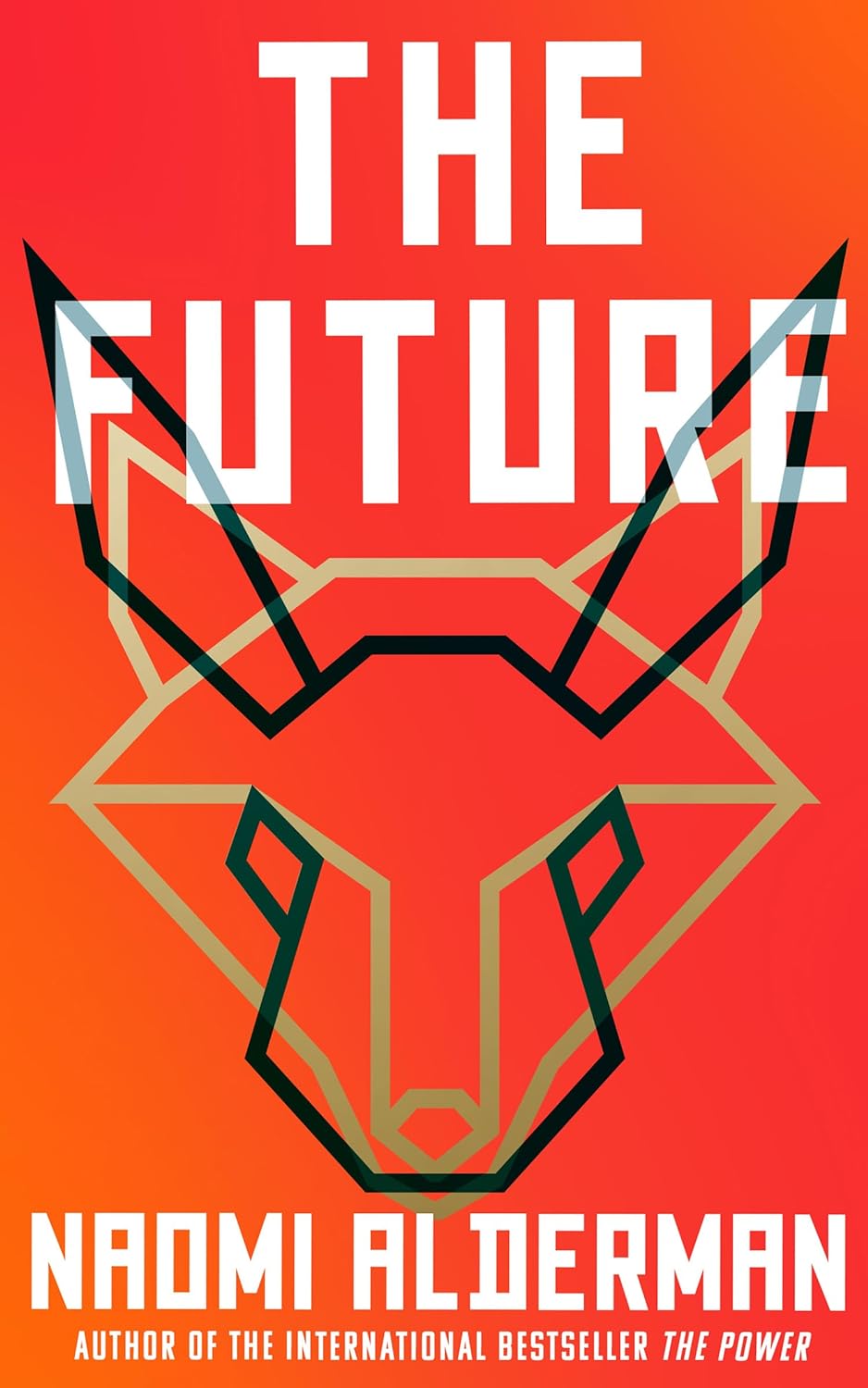
The Future, by Naomi Alderman

Second paragraph of third chapter:

Will, her late husband, sat in the wooden chair facing the lake view, watching her. He said: Tough decision?

I’m a fan of Alderman’s previous novels (The Power, Disobedience and a Doctor Who book, Borrowed Time), so was looking forward to this, a story of tech zillionnaires, apocalypse and survival. To be honest I was a little disappointed; I’m not especially interested in the cults of personality around Musk, Zuckerberg, etc, and a large part of the story evolves around equivalent characters and their entourages. There’s also an AI that is just smart enough to carry the plot forward, and a rather silly dénouement. But there are also some vivid character moments and strong descriptions of setting. So it’s entertaining, if not quite up to Alderman’s previous work. You can get it here.

Definite Bechdel pass, as two of the main characters are women in an on-off relationship with each other.

This was the very first book that I finished this year! So this is my first review to have the ‘bookblog 2024’ tag.