
Second paragraph of third daily entry:
| Depuis dix mois, à sa [Juncker’s] demande, je suis le conseiller spécial du président de la Commission pour les questions de défense et de sécurité. Ces sujets m’ont toujours intéressé et j’avais même, en 2002, présidé le groupe de travail de la Convention européenne sur la défense. Ce qui à l’époque avait été proposé par mon groupe pour renforcer la coopération en matière de défense au sein de l’Union européenne se retrouve aujourd’hui dans le traité. Tout y est : le rôle renforcé du haut représentant pour les affaires étrangères et la politique de sécurité, l’Agence européenne de défense, la clause de solidarité et la possibilité pour un groupe de pays de partir en «éclaireurs» au moyen d’une «coopération structurée». | For the past ten months, at the Commission President’s request, I have been his special adviser on defence and security policy. These are issues that have always been of interest to me; indeed, in 2002 I chaired the European Convention’s Working Group on Defence. My group’s suggestions at the time for strengthening defence cooperation within the EU have now been incorporated into the Treaty. It’s all in there: a stronger role for the High Representative for Foreign Affairs and Security Policy, a European Defence Agency, the solidarity clause and the possibility for a group of countries to set out as ‘pathfinders’ by way of ‘structured cooperation’. |
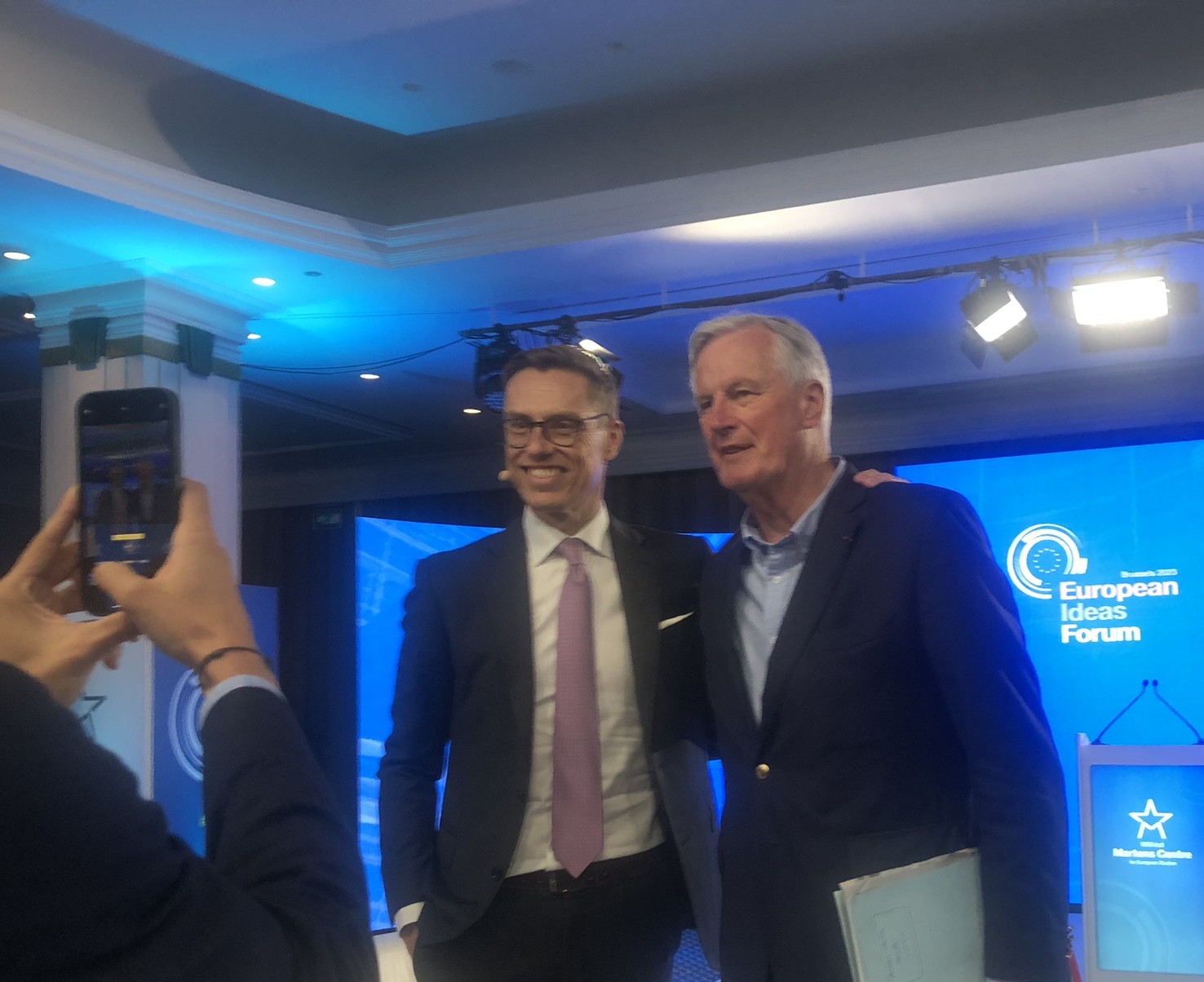
I have personally encountered Michel Barnier I think on three occasions. Way back in about 2002, he was one of the speakers at the opening of the Northern Ireland representative office in Brussels, as the then European Commissioner for Regional Policy. He made quite a good speech, but he made it in French, which was increasingly unusual even then. Fast forward to 2018 when Alexander Stubb was running against Manfred Weber to be the EPP’s lead candidate for the European Commission (and lost); I was leafletting incoming delegates at the EPP convention in Helsinki on Stubb’s behalf and happened to encounter Barnier, who muttered (in fluent English) that he would have to maintain his neutrality. And at the end of 2023, I caught him and Stubb chatting (again in English) at a Brussels conference we were all attending. Everyone else was taking pictures of them too, and indeed in the following year, 2024, Stubb was elected President of Finland and Barnier was briefly Prime Minister of France.
I wrote, blogged and tweeted (remember Twitter?) extensively about Brexit before, during and after the period when Barnier was the EU’s chief negotiator with the UK. My perceptions, as a fairly well-informed Brussels bubble-er, are not very different from his. There was never any intention in Brussels or the rest of the EU to sneakily reverse the decision of the UK to leave; there was however a determination that the subsequent relationship would not unduly favour the Brits. The key points that Barnier makes about the dynamics of the negotiations are conclusions that I had already drawn, but it is reassuring to see them supported here.
The most important point is that there had to be full transparency among all stakeholders on the EU side, to make sure that all 27 governments, and the European Parliament, and the European Commission (which was Barnier’s immediate paymaster), had confidence that Barnier was representing their point of view. This approach locked the whole EU into support for Barnier as negotiator, because they believed that he was supporting them. It meant that British efforts to detach EU governments from Barnier were inevitably futile, because they were always going to have more confidence in the guy who they were talking to regularly and who claimed to understand their situations, rather than the shifty Brits, who could not even agree their own line at home.
Indeed, Barnier’s main frustration in the first phase was that Theresa May failed to articulate or decide what the UK actually wanted; a fatal and unforced disadvantage for the British – if you do not know what you want, you are unlikely to get it. In the second phase, under Boris Johnson, David Frost seemed clearly to have instructions to run out the clock and force a last-minute decision which the UK (wrongly) thought would break in their favour. The British perception was that the EU was desperate to avoid a no-deal Brexit, but in fact contingency planning for that on the EU side had started as soon as the referendum results came in, and the Brits (as usual) were way behind the curve.
I was interested in a couple of Barnier’s personal observations, which need to be tempered by the obvious fact that he has massaged his diary notes for publication. Reading between the lines, he clearly regarded David Davis as convivial company, but fundamentally very stupid, which is pretty much how Davis came across at the time and comes across now. There is a ‘lost hero’ narrative believed by some on the Tory right, that Davis was astutely negotiating for British interests until May sneakily entrusted Olly Robbins with doing the deal behind his back. In fact, Davis did nothing but occasionally visit TV studios to muddy the waters.
Second, the one person on his own side who Barnier does regard with suspicion and annoyance is Martin Selmayr, who on a couple of occasions tried to bypass or minimise Barnier’s role, purely for the sake of bureaucratic turf-warring; there was no ideological difference between them. On these occasions, Barnier went straight to Juncker, who corrected the situation quickly. Juncker himself comes across as somewhat disengaged, but engaged enough to be supportive of Barnier’s work.
I was also interested to note that about twenty people who I know personally crop up in the narrative, usually in complimentary terms – including even Diane Dodds of the DUP! Barnier felt that he knew Northern Ireland a bit – as noted above, my own first encounter with him was at a Northern Ireland event – and while I don’t think he knew it quite as intimately as he perhaps believed, he certainly displayed more knowledge and sympathy than anyone in the British Conservative government (I’ll make an honourable exception for the six months of Julian Smith in 2019-20).
There is an argument in some EU and British circles that Barnier created problems by negotiating too successfully and putting the UK in a worse position at the end than it needed to be. I must say I think that the blame for the UK doing badly in the negotiations does not, in my view, rest with the other side. I found this a useful though not a challenging read. You can get My Secret Brexit Diary here.

