
A very nicely done Companion Chronicle, with William Russell doing his impressions of Maureen O'Brien's Vicki and William Hartnell's Doctor, plus a little bit of himself and Barbara, in a story of a city of shared and potentially fatal dreams. John Banks plays an intelligence agent interrogating Ian about his travels with the Doctor after his return home, and several other roles as well. Excellent twist at the end.
Monthly Archives: March 2014
Descendants, common ancestors, and intermarriage
Almost exactly four years ago, I posted my analysis of the descendants of Queen Victoria and Prince Albert. At that time, there were 836 of them living; now, my source, Allan Raymond, lists 875, but hasn't updated since May last year. It's not that I find the Royals terribly interesting; but I think they provide useful evidence in favour of the fascinating findings of Rohde et al that the most recent common ancestor of all living humans lived only a few thousand years ago, probably in south-east Asia. (One can debate whether this also applies to apparently isolated populations like the North Sentinelese, but they may not be quite as isolated as reporters like to claim, and also are actually in south-east Asia.) A related statement, which I think is strongly supported by all the available evidence, is that all of us with European or part-European ancestry are descended from Charlemagne. (A paper published last year finds it probably that all Europeans share common ancestors from within the last 1000 years; Charlemagne died in 814.)
One point that was made in discussion of my previous post was that the number of marriages between relatives must surely slow down the overall rate at which one's ancestors increase going back in time, or descendants increase going forward. Examples were given such as the Grand Dauphin, who had only four great-grandparents rather than the usual eight, his parents being first cousins and his grand-parents being two pairs of siblings. But these cases are very unusual. I revisited the Victoria and Albert data, and found that while indeed about a quarter of their living descendants can trace more than one line of descent back to them, this ratio has not increased much over the last forty years. This graph shows the overall trend in multiply-descended individuals as a percentage of all individuals descended from Victoria and Albert since the birth of Prince Waldemar of Prussia in 1889:

As you can see, it starts rather low, then zooms from about 5% in 1933 to about 23% in 1970, rising rather more gradually in the decades since – actually falling at the end of the last century, before picking up to the current 27%. I note that in my previous post, I had the average rate of annual increase of descendants at 2.6%, but the rate since 1970 at around 1.9% only, as if a quarter of the overall rate of increase had disappeared; it's interesting that this decrease is close to the overall ratio of multiply-descended individuals. The 900-odd current descendants of Victoria and Albert may represent up to 1200 possible lines of descent.
I suspect that the ratio will never again rise as quickly as it did from the 1930s to 1970. The era of such dynastic intermarriages is basically over. There have been 21 marriages between descendants of Victoria and Albert, including Liz and Phil, and the king and queen of Spain, but the most recent was in 1981 (Prince Andreas of Leiningen and Princess Alexandra of Hanover). Only two others have taken place in the last fifty years (King Constantine II of Greece and Princess Anne-Marie of Denmark in 1964, Prince Franz Wilhelm of Prussia and Grand Duchess Marie of Russia in 1976). This compares to seven such marriages in the 1930s, when the overall pool of descendants was only one-seventh its current size.
Just as the Grand Dauphin is a bit of an outlier among dynastic practices, the inter-war royals were much more likely to intermarry than their post-war children and grandchildren, and I suspect much more likely to intermarry than the general population at any time. Given that the intermarriage factor has failed to slow down the growth in the total number of V&A descendants by much, despite the flurry of marriages between cousins in the 1930s, I think it's pretty clear that this does very little to change the likely date of a most recent common ancestor for Europeans, or indeed for humanity as a whole.
March Books 6) The Assassination of the Prime Minister, by David Hanrahan
The second paragraph from Chapter 3:
Spencer Perceval was not the first member of his family to die a violent death. On 5 June 1677 an ancestor of Perceval's fell victim to a murderer's knife. This young man, Robert Perceval, who was about 20 years of age, was in London studying law unde his uncle, Sir Robert Southwell. Ironically, he had told his uncle some days earlier about a bloody premonition of his death that he had experienced in his sleep. Robert was, it seems, not averse to conflict, as he had already been involved in, and survived, nineteen duels. On the night of his murder Robert noticed that he was being followed from place to place as he went around town on his night's entertainment. At each establishment he visited, he saw the same man waiting in the porch for him to emerge. He decided to approach the stranger and ask him what he wanted, only to be told by the man that he was attending to his own business. When Robert informed his friends bout this, they wanted to send a footman to accompany him, but he declined the offer [and was found stabbed to death in the Strand later than night; the murder was never solved].
This short book caught my eye at the Boekenfestijn down the road from us the other day, retailing at a mere €2.99, which is about right; it's a workmanlike retelling of all the contemporary historical details of how John Bellingham, blaming the government for failing to come to his aid when a business dispute landed him in a Russian prison for several years, decided that he would kill the British Prime Minister to make his point; and duly did so. He was arrested at the scene, and tried, convicted and executed only a few days later.
There's not a lot to write about an incident which lasted only a few seconds, even if it ended two men's lives. Hanrahan does his best and gives us all that is known about both assassin and victim. Perceval was a rather rigid anti-Catholic politician, who had however shown some skill in navigating the implementation of the Regency, and had also backed Wellesley/Wellington to the hilt during the crucial phases of the Peninsular War. (My father, who was a historian, once remarked that had it not been for the manner of his untimely end, Spencer Perceval would probably be the most forgotten of British prime ministers; as it is he must compete with Viscount Goderich and Bonar Law.) Perceval, who was 49, left twelve children, six boys and six girls, most of whom survived to adulthood; Bellingham, who was 35, had three children who have disappeared from history.
A lot of this story has been told before, and Hanrahan misses some turns where a fresh eye might have turned up new material – what, for instance, do today's Russian historians make of Bellingham's travails in St Petersburg? What actually happened to Bellingham's wife and children? (Hanrahan has her reverting to her maiden name, but Wikipedia says she remarried.) There is a lovely new theory that Bellingham was unwittingly put up to the crime by two merchants who wanted to be able to resume trade wth the continent by getting the restrictive Orders in Council withdrawn (as indeed they were after Perceval's death). None of that here. Hanrahan also incorrectly abbreviates Sir Francis Burdett to "Sir Burdett" and Sr James Mansfield to "Sir Mansfield".
The most interesting intellectual discussion is of the attempt of Bellingham's defence lawyers to plead insanity and avert his execution. It is obvious in any case that Bellingham did not get a fair trial – his defence lawyers were appointed the night before, and did not get a proper chance to talk to him before the trial began; two defence witnesses arrived only after the trial was over; the judge, summing up for the jury, wept openly as he spoke of his own friendship with the victim – but even with the most impartial of proceedings, could Bellingham possibly have been saved from execution for a crime which he freely admitted (though pleading not guilty) and which was committed in front of dozens of witnesses? Bellingham clearly sincerely believed that as a result of his killing the Prime Minister, his grievances against the government would be redressed. He was wrong, of course; but does that make him deluded? And if deluded on that one point, but sane on all others (as he really appears to have been) is that sufficient to excuse him from criminal responsibility for murder?
I had always thought that a useful standard was that proposed by Robertson Davies' narrator, David Staunton, in his wonderful novel The Manticore (the middle chunk of the Deptford Trilogy): "If a policeman had been standing at your elbow, would you have acted as you did?" (But I can't find that anywhere else, so I guess Davies made it up.) Clearly Bellingham's answer (unlike Staunton's in the novel) would have been "yes"; even though there were no policemen as such in England at the time, there were a lot of people with equivalent roles right beside him when he fired the fatal shot. But I'm not at all sure that that is what the law says; and I'm really not sure what the law ought to say. The law on these questions was poorly developed in 1812, and I suspect that it is not a lot better now.
BSFA Best Art
There are only three entries shortlisted for the BSFA's Best Art award this year. All three of them involve tall buildings; all also have central human figures (two emphasise the human, one the buildings); one is a book cover, one a magazine illustration for a short story, and one a poster for a 1927 film. All three are by men. As I've said before, I may not know much about art, but I know what I like, and found it not too time-consuming to make up my mind.
 1) Kevin Tong's poster for Metropolis uses greyscale and ominous red highlighting to hint at the story within: the transformation of robot to Maria and back is hinted at in the main image, and vignettes convey both the industrial hell of the undercity and the isolation of the towering homes of the elite. I think it says a lot and does so very economically, and it has my vote.
 2) Richard Wagner's illustration for "The Angel at the Heart of the Rain", from Interzone. The figure of the angel itself is pretty striking: Asian angels are rare in art, so the viewer immediately has to question why this is, and why it matters. Yet the bystander, perhaps a commuter waiting for a bus, is looking the other way as far as we can tell; for him or her it's a perfectly normal part of the world. If, that is, the angel is visible at all from the commuter's viewpoint; I felt not entirely happy with the perspective between the angel's plinth and the bus shelter – the visual cues are a bit confusing as to their relative scale, height and distance, and this marked it down for me.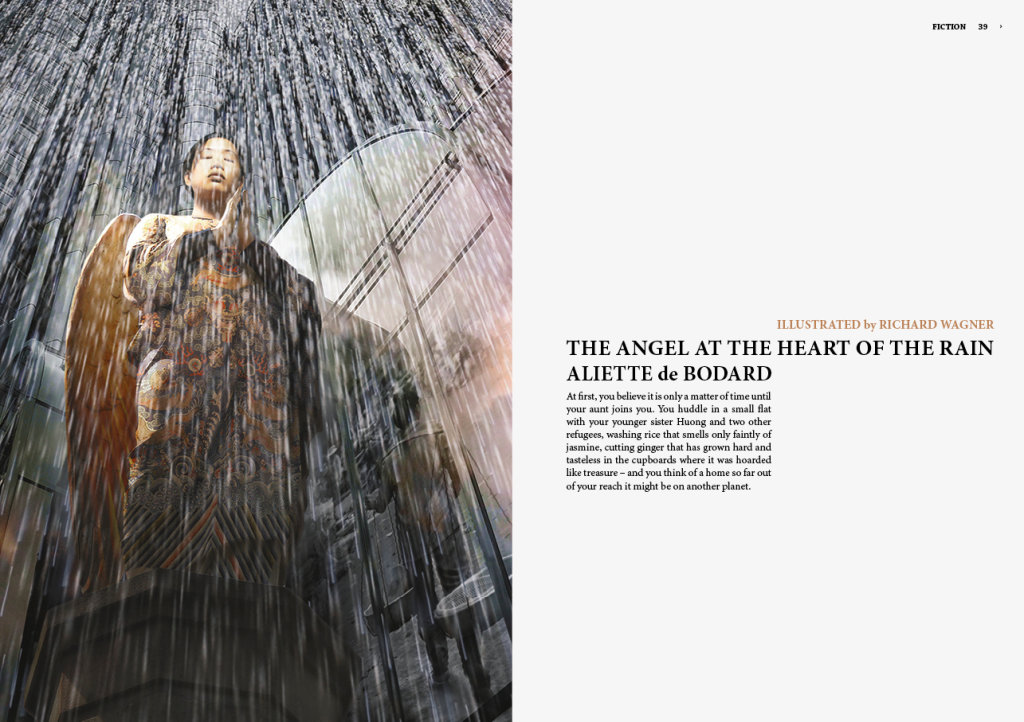
 3) Finally, Joey Hi-Fi's cover for Tony Ballantyne's Dream London. Like Kevin Tong's Metropolis poster, greyscale with red highlights; a red-coated man on a wooden jetty looks away from us, across the Thames to a jumble of tall buildings from London and elsewhere, some of which are ornamented by ominous red tentacular things (plants? dragons? Can't really see clearly). I am sure that there is good reason for jamming all these buildings together away from their geographical homes, but it jars my sense of location; the human figure seems a bit clichéd; and I'm putting this last. I note also that reviews suggest that in the book, London is reverting in some ways to the Victorian era; this is not really signalled by the cover, but I think we should judge it in itself as a work of art.
Non-fiction coming soon.
Links I found interesting for 15-03-2014
- The eleven tests of cake
@major_clanger explains.
March Books 5) Animal Farm, by George Orwell
The second paragraph from Chapter 3:
Sometimes the work was hard; the implements had been designed for human beings and not for animals, and it was a great drawback that no animal was able to use any tool that involved standing on his hind legs. But the pigs were so clever that they could think of a way round every difficulty. As for the horses, they knew every inch of the field, and in fact understood the business of mowing and raking far better than Jones and his men had ever done. The pigs did not actually work, but directed and supervised the others. With their superior knowledge it was natural that they should assume the leadership. Boxer and Clover would harness themselves to the cutter or the horse-rake (no bits or reins were needed in these days, of course) and tramp steadily round and round the field with a pig walking behind and calling out "Gee up, comrade!" or "Whoa back, comrade!" as the case might be. And every animal down to the humblest worked at turning the hay and gathering it. Even the ducks and hens toiled to and fro all day in the sun, carrying tiny wisps of hay in their beaks. In the end they finished the harvest in two days' less time than it had usually taken Jones and his men. Moreover, it was the biggest harvest that the farm had ever seen. There was no wastage whatever; the hens and ducks with their sharp eyes had gathered up the very last stalk. And not an animal on the farm had stolen so much as a mouthful.
What is there to say about Animal Farm that hasn't already been said? I read it first as a teenager, back when the Soviet Union still existed; it still packs just as powerful an impact now, with the awful fate of Boxer the horse a superb emotional climax of betrayal. As in Nineteen Eighty-Four, the most shocking passages are the perversion of truth and history by Squealer (we've all met people like him), where the writer's ability to convey to the reader precisely the opposite of what the words on paper ostensibly mean is on top form.
What struck me most on this reading is Orwell's deep sympathy for the ideals of equality and community. His scorn is not directed at socialism as such, but at the Soviet leaders for perverting it to their own profit, to the point where in the final confrontation between pig and man, "it was impossible to say which was which". The awful thing is that he offers no solution; the animals have been duped and betrayed, and are now worse off than they were. (Did he write any books with happy endings?)
And I wonder what happened to the cat?
March Books 4) Doctor Who – The Paradise of Death, by Barry Letts
The second paragraph from Chapter 3:
And it was all so unfair. He’d [“he” = Billy Grebber, who will be bumped off soon] always tried to keep his nose clean. Well, more or less. What was the point of making a pile of dosh, if you were looking over your shoulder all the time for the fuzz – or worse? And as for duffing up the opposition, or having a ruck with every geezer who tried it on, well, leave it out. Look at Tel, who’d ended up splattered all over a car park in Bethnal Green for coming the old soldier with that tearaway from Brum. Or Tel’s brother for that matter, going slowly crazy in Parkhurst.
I actually thought that I had read all of the Target novelisations, but I had forgotten about this, the last of them, published in 1994 just after the broadcast of the Pertwee/Sladen/Courtney radio series on which it was based. I thought the original story was pretty poor
The euro coins in my pocket
Latest in a series of occasional surveys:
Belgian: 16 (36%)
German: 10 (23%)
Italian: 6 (14%)
French: 5 (11%)
Dutch: 3 (7%)
Austrian: 2 (5%)
Spanish: 2 (5%)
(the last time that I set foot in a euro zone country outside Belgium was Germany, in November.)
Wednesday reading
Current
Essays on Time-based Linguistic Analysis, by Charles-James N. Bailey
[Doctor Who] Mad Dogs and Englishmen, by Paul Magrs
Last books finished
Animal Farm, by George Orwell
The Assassination of the Prime Minister: John Bellingham and the Murder of Spencer Perceval, by David Hanrahan
[Doctor Who] Christmas on a Rational Planet, by Lawrence Miles
Sigurd and Gudrún, by J.R.R. Tolkien
The Big Finish Companion v1, by Richard Dinnick
The Amber Spyglass, by Philip Pullman
Last week’s audios
[Doctor Who] The Sleeping City, by Ian Potter
[Blake’s 7] The Turing Test, by Simon Guerrier
[Blake’s 7] Solitary, by Nigel Fairs
Current: [Blake’s 7] Counterfeit, by Peter Anghelides
Next books
Brick Lane, by Monica Ali
Best Served Cold, by Joe Abercrombie
[Doctor Who] Tales of Trenzalore, by Justin Richards, George Mann, Paul Finch and Mark Morris
Books acquired in last week
[Doctor Who] Salt of the Earth, by Trudi Canavan
The Redbreast, by Jo Nesbø
The Assassination of the Prime Minister: John Bellingham and the Murder of Spencer Perceval, by David Hanrahan
The Last Man, by Mary Wollstonecraft Shelley
Family Britain, 1951-1957, by David Kynaston
Spin, by Nina Allan
Unearthed, eds. John J. Johnston and Jared Shurin
March Books 3) Dominion, by C.J. Sansom
The second paragraph from Chapter 3:
They [Sarah and her sister Irene] went to the Gaumont in Leicester Square to see the new Marilyn Monroe comedy from America. Before the big feature the B film was the usual frothy German musical, and between the films they had to sit through one of the government-commissioned Pathe newsreels. The lights always came up then, to discourage Resistance supporters from booing if any Nazi leaders came on. First came a report of a European eugenics conference in Berlin: Marie Stopes talking with German doctors in a pillared hall. The next item was a vision of a snow-covered landscape, an old woman swathed in ragged clothes weeping and shouting in Russian outside the smoking ruins of a hut, a German soldier in helmet and greatcoat trying to comfort her. Bob Danvers-Walker’s voice turned stern: ‘In Russia, the war against communism continues. Soviet terrorists continue to commit fearful atrocities not just against Germans but against their own people. Outside Kazan a cowardly group of so-called partisans, skulking safely in the forests, fire a Katyusha rocket into a village whose inhabitants had dared to sell German soldiers some food.’ The camera panned outwards, from the ruined hut to the smashed and broken village. ‘Some Russians have chosen to forget what Germany rescued them from: the secret police and forced labour of Stalin’s regime; the millions dumped in Arctic concentration camps.’ There followed familiar grainy footage of one of the camps discovered by the Germans in 1942, skeletal figures lying in deep snow, barbed wire and watchtowers. Sarah looked away from the horrible scenes. The newsreader’s voice deepened: ‘Never doubt Europe’s eventual victory over this evil Asian doctrine. Germany beat Stalin and it will beat his successors.’ As a reminder, there followed the famous shots of Stalin after his capture when Moscow was taken in October 1941: a little man with a thick moustache, pockmarked, grey hair dishevelled, scowling at the ground while his arms were held by laughing German soldiers. Later he had been hanged publicly in Red Square. Next there was footage of the new, giant German Tiger 4 tanks with their eighteen-foot guns smashing through a birch forest on a hunt for partisans, knocking over young trees like match-sticks while helicopters clattered overhead. Then came the launch of a V3 rocket, the camera following the huge pointed cylinder with its tail of fire as it rose into the sky on its way to the far side of the Urals. Optimistic martial music played. Then the newsreel switched to an item on Beaverbrook opening a shiny new television factory in the Midlands, before the lights finally dimmed again and the main feature opened with a clash of music and a bright wash of Technicolor.
As this paragraph makes clear, this is rather an impressive version of the “Hitler Wins” sub-sub-genre of stories: quite a well-imagined defeated England in 1952, with Lord Beaverbrook leading a collaborationist government with Enoch Powell and Oswald Mosley, Adlai Stevenson about to take over from the two-term Taft jr across the water, and Hitler on his deathbed. The actual plot concerns some resistance fighters and other activists (led the elderly Churchill in hiding and uncomfortably allied with the Communists) who get caught up in the struggle to prevent a nuclear weapons secret, which has been accidentally obtained by a mad scientist in Birmingham, from falling into Nazi hands. The details are meticulously realised, but the actual McGuffin didn’t really convince me, and the ending was a bit too pat as well. Still, interesting to see an author with Sansom’s profile dabbling in alternate history.
March Books 2) The Other Hand (aka Little Bee), by Chris Cleave
The second paragraph from Chapter 3:
In your country, if you are not scared enough already, you can go to watch a horror film. Afterward you can go out of the cinema into the night and for a little while there is horror in everything. Perhaps there are murderers lying in wait for you at home. You think this because there is a light on in your house that you are certain you did not leave on. And when you remove your makeup in the mirror last thing, you see a strange look in your own eyes. It is not you. For one hour you are haunted, and you do not trust anybody, and then the feeling fades away. Horror in your country is something you take a dose of to remind yourself that you are not suffering from it.A book about the intersecting lives of a young woman from Nigeria, who flees the violent destruction of her village and family, and the English woman whose life gets intertwined with hers. There are some graphic and moving descriptions of the horrors of Little Bee’s life in a British refugee detention centre; I think the story goes a bit astray in equating the problems of the English protagonist with those of her Nigerian counterpart, but I suppose its heart is in the right place.
Interesting to read this at the same time as Dominion by C.J. Sansom; both novels feature Englishwomen in rocky marriages whose young sons are called Charlie; in both cases their world is upset before the start of the story by a death caused by falling.
The Brood of Erys, by Andrew Smith
Another audio with Colin Baker’s Sixth Doctor and Lisa Greenwood as feisty young companion Flip. This has two very effective concepts – the eponymous Brood, who call themselves the Drachee, horrible malevolent childlike aliens; and the woman who has amnesia, engineered so that she does not know the role she plays in the history of the planet Erys (which itself turns out to have some unexpected secrets). Smith of course wrote Adric’s debut Full Circle back in the day, and has done a couple more Big Finish stories since; I think this is the best of them.
BSFA Best Novel
I found it pretty easy to rank the nominees this year, in this order:
- Ancillary Justice, by Anne Leckie
- Evening’s Empires, by Paul J. McAuley
- Ack-Ack Macaque, by Gareth L. Powell
- God’s War, by Kameron Hurley
- The Adjacent, by Christopher Priest
They were all very good, mind you, and I may well nominate them all for the Hugo.
March Books 1) Ancillary Justice, by Anne Leckie
manjushra has given me the idea of looking at the second paragraph of the third chapter of each book I read as a useful point of comparison. I shall try it out for this month.
The second paragraph from Chapter 3 of Ancillary Justice:
I unrolled the bundle of clothes I had bought for her— insulated underclothes, quilted shirt and trousers, undercoat and hooded overcoat, gloves— and laid them out. Then I took her chin and turned her head toward me. “Can you hear me?”
This book draws from a lot of sources – the quoted paragraph makes it clear that there is a debt to The Left Hand of Darkness, but I felt there was a lot of Iain M. Banks and some C.J. Cherryh there too – but really takes it all to a whole different level. Lots of big ideas here, of which the two biggest are that almost all characters are referred to by female pronouns, reflecting the narrator’s perception, and that the narrator herself is one remaining human-shaped unit of a former spaceship-sized collective consciousness which controlled dozens of mentally conjoined bodies. There’s stuff here about love, and colonialism, and some vivid set-piece descriptions of planets and incidents. I love Brian Aldiss’s Philip K. Dick’s description from thirty years ago of good sf being stories which are not about “What if?” but about “My God, what if…?!” and Ancillary Justice ticks that box. It is all carried off with tremendous assurance and control, and the fact that this is a first novel makes it all the more impressive.
It has already won the Golden Tentacle award for best first novel from the Kitschies, and certainly my vote will be one of those supporting it for the BSFA Award; and I don’t think that will be the end of it.
Arthur C. Clarke Award winners:
The Handmaid’s Tale | The Sea and Summer | Unquenchable Fire | The Child Garden | Take Back Plenty | Synners | Body of Glass | Vurt | Fools | Fairyland | The Calcutta Chromosome | The Sparrow | Dreaming in Smoke | Distraction | Perdido Street Station | Bold as Love | The Separation | Quicksilver | Iron Council | Air | Nova Swing | Black Man | Song of Time | The City & the City | Zoo City | The Testament of Jessie Lamb | Dark Eden | Ancillary Justice | Station Eleven | Children of Time | The Underground Railroad | Dreams Before the Start of Time | Rosewater | The Old Drift | The Animals in that Country | Deep Wheel Orcadia | Venomous Lumpsucker | In Ascension | Annie Bot
Fragments of a larger pattern
82
205
902
2,009
5,002
10,004
20,008
February Books 19) The Unfolding of Language, by Guy Deutscher
I love reading about linguistics – it’s one of those intellectual paths not taken for me, but as long as I can remember I’ve been fascinated by the relationships between words and especially words and grammar in different languages. Here, Deutscher runs through the basics about where we think languages have come from and how words and sentences are constructed – though even there there is some new information for me, I had not realised the importance of the 1927 discovery of Hittite with respect to Saussure’s 1878 theory of Indo-European pharyngeals – and then turns his attention to how grammar changes over time.
Deutscher’s approach to linguistic change was all new to me and quite fascinating. It is a given that people writing about their own language at every point of recorded history bemoan the fact that in modern days it’s not spoken or written as well as it used to be; also linguistic reconstructions of extinct languages always seem to generate the impression that they were better ordered and more complex than their descendants today. Yet we also see new linguistic structures developing at the same time – he looks for instance at the future tense in French, at the use of “gonna” and “got” in English, and in considerable depth at the historical development of tense markers in Semitic verbs – mainly Arabic, but also Hebrew which has changed a lot in only the last century. In the end he makes a very good case that there is basically an equilibrium between language speakers unconsciously eroding old grammatical structures out of sheer laziness, but then being compelled to invent new elements to cover nuances of meaning that are needed – and these new elements emerge only gradually, so that “going to” shifts quite imperceptibly from only indicating movement to becoming an equivalent marker for “shall/will”.
This was voted top of the non-fiction section of my 2014 unread books poll by you guys. Good call.
SFF books by women which I have read in the last year
The Left Hand of Darkness, by Ursula Le Guin
Four How to Train Your Dragon books, by Cressida Cowell
Three Hugo nomiees for Best novella
Blackout, by “Mira Grant”
Magic of the Angels, by Jacqueline Rayner
Catching Fire, by Suzanne Collins
EarthWorld, by Jacqueline Rayner
Something Borrowed, by Richelle Mead
The Ripple Effect, by Malorie Blackman
Mockingjay, by Suzanne Collins
Far North, by Sara Maitland
The Crown of Dalemark, by Diana Wynne Jones
Royal Assassin, by Robin Hobb
The Queen’s Bastard, by C.E. Murphy
The Year of Intelligent Tigers, by Kate Orman
Returning My Sister’s Face, by Eugie Foster
Mortal Clay, Stone Heart, by Eugie Foster
SLEEPY, by Kate Orman
Long Time Dead, by Sarah Pinborough
Two unpublished novels
Patternmaster, by Octavia Butler
City of the Dead, by Lloyd Rose
Walk to the End of the World and Motherlines, by Suzy McKee Charnas
Grimm Reality, by Simon Bucher-Jones and Kelly Hale
The Death Pit, by A.L. Kennedy
God’s War, by Kameron Hurley
Into the Nowhere, by Jenny T. Colgan
Ancillary Justice, by Anne Leckie
(Combining the themes of International Women’s Day today and World Book Day yesterday.)
February Books 18) The Adjacent, by Christopher Priest
Next up for my read of BSFA nominations, this is an intricate juxtaposition of narrative segments set in different worlds and time streams, a lot of which draws from Priest’s own earlier work. Several chapters are set in a near-future Islamic Republic of Great Britain, rather reminiscent of the Darkening Island of his first book; we revisit the archipelago of The Islanders; and magicians and twins and alternate Second World Wars pop up too.
It didn’t quite come off for me. There are a lot of good ideas here, but the Islamic Republic is a bad one; and I had hoped for some actual plot resolution at the end, rather than just being expected to admire the pretty pattern of the bits of story put next too each other. (Oddly enough, The Islanders, on its face a more discontinuous text, worked better in that regard.) So I fear that my vote will put it at the end of what is a very good shortlist.
February Books 17) Keeping Up With the Joneses, by Nick Harkaway
Another of this year’s series of Doctor Who ebooks by well-known authors – this time one of the surprisingly numerous alumni of Clare College who have gone into the sff field (China Miéville, Marcel Theroux, Rebecca Levene, going a bit further back Peter Ackroyd). It’s an extended story largely consisting of Tenth Doctor stream of consciousness, the Tardis having hit a Time Mine left over from the war and come to rest in, or possibly on, a Welsh village where everyone is called Jones except for Lady Christina de Souza. Not quite as good as the sum of its parts, but there is a lovely reference to Iain Banks near the end.
Links I found interesting for 08-03-2014
- Riek Machar and the prophet’s rod
The return of the sacred dang in 2009.
- Interactive Map: Four Ways to Look at Carbon Footprints
14 nations and Europe account for 80% of greenhouse gas emissions.
February Books 16) The Kindness of Strangers, by Kate Adie
This is a gratifyingly entertaining book, starting with a chapter on student visits to Germany and Sweden in the late 1960s, and then going through Adie’s career as a BBC journalist who ended up specialising in conflict zones. The chapters on 1970s Northern Ireland and wartime Bosnia rang very true to me; the chapter on Libya was horrifying, especially given what has happened since; the chapter on Tian-an-Men Square moved me to tears. Adie has an eye for the telling detail in he writing as well as in her broadcast reportage.
I did wonder a bit about the ideology of reporting. Adie claims firmly to aspire to be partly a conduit conveying what is happening on the ground to the viewer, and also a first emotional responder as it were, giving the viewers her own reaction. Yet that’s a little to modest; her emotional response inevitably shapes the viewer’s response, it’s not that they have a range of different options to choose from; and the stories that she finds, or is allowed to find, shape the popular narrative for the events that she is describing. I would have liked a little reflection on the role of the journalist as creator rather than mere reporter.
But basically the sheer thrill and horror of experiencing these events, be it desperate attempts to find anything reportable in the Durham countryside or flight through the back streets of Beijing under live fire, makes for a very readable book.
February Books 15) Into the Nowhere, by Jenny T. Colgan
A short Who ebook, based around two arresting concepts: a world of living skeletons, and the bloke in the control room behind it all, with the Eleventh Doctor and Clara arriving unexpectedly and trying to sort things out. Rather beautifully written. It’s sad that there won’t be a lot of Eleven/Clara books – the only other one so far is Shroud of Sorrow, by Tommy Donbavand.
Links I found interesting for 07-03-2014
- Here’s The Best Advice From A Single Guy Who Spent A Year Interviewing Couples
Analysing love.
- How ‘Midnight Rider’ Victim Sarah Jones Lost Her Life
The camera assistant killed by a train.
- Where Did the Marshall Islands Just Go?
The tide is rising ever higher.
- Secret tunnel in Carrickfergus Castle
I think we all have times when we want one.
- Three Men in a Boat and Soggy Ophelia
Conrad’s historical reconstruction makes sense.
My Shelfies – a post for World Book Day

At home (1): non-fiction

At home (2): fiction (not sf):

At home (3): science fiction:

At home (4): Doctor Who books and comics:

At home (5): random books in the spare room:

At home (6): the unread books shelf:

February Books 14) The Snowman, by Jo Nesbø
A police procedural, somewhere between Inspector Rebus and Lisbeth Salander (which is only appropriate given the Norwegian setting); a very vivid evocation of ordinary people in a small, cold country trying to grapple with extraordinary and awful things. I hadn’t realised that this was the fourth novel in a series, so in fact the protagonist, Harry Hole, comes with some baggage from previous books which here comes back to bite him. The killer is horribly violent, and the plot has plenty of twists, though none of them feels unfair to the reader. As good as I had hoped.
February Books 13) The Forever Trap, by Dan Abnett
This is the last of the Tenth Doctor era audiobooks that I’ve got to (though only the second produced), and it’s good to finish on a high note. Catherine Tate is the narrator, beautifully carrying off Donna and also the Tennant Doctor, in a plot that beings rather like the later TV story The God Complex, with a bunch of characters from different places yanked together unexpectedly in one big building, but takes off in quite a different direction, both funny and serious, with some very neat ideas (the spamming AI at the beginning is just the start). Dead Air is still my favourite Tenth Doctor audiobook, but this comes a close second.
Links I found interesting for 06-03-2014
- A rail postcard from Liège
When Belgian and German trains don’t communicate. @NBMS @SNCF @DB_bahn
- 25 Tips For Speaking To Other Humans On The Internet
Sane and sensible.
- Greg’s Cable Map
An even better map of the internet cables (thanks, @K_dPage !)
- Marshall Islands says climate change behind floods
1050 homeless in Majuro.
- Storms and how they start
Neil Gaiman on recent events
February Books 12) Ack-Ack Macaque, by Gareth L. Powell
Another of this year’s BSFA nominees, a rollicking yarn of an uplifted monkey who is the hero of the most popular computer game of a steampunkish 2059 (where the UK, France and Norway are celebrating a centenary of political union, the Chinese are a threat and the Germans and Russians seem to have disappeared). Lots of fun Stuff Happening here, especially the sinister transhumanists plotting to destroy the world and the royal prince who discovers he is both more and less than he thought; the set-piece battles on giant linked zeppelins are pretty impressive too. It didn’t quite tick enough of my boxes to go ahead of Evening’s Empires; but it’s entertaining.
February Books 11) The Adventuress of Henrietta Street, by Lawrence Miles
A remarkable Eighth Doctor adventure, rather horrible and misjudged in some places, striking and memorable in others; set in 1783; the Doctor gets married to a Tantric courtesan, slightly foreshadowing River Song; there are dubious scenes with Caribbean zombies and other cult practices; the Master makes a cryptic appearance; the whole thing is told in the tone of an excited but somewhat baffled historical researcher; Phil Sandifer’s parodic review is a better and quicker read.
Wednesday reading
Current
Sigrid and Gudrun, by J.R.R. Tolkien
The Amber Spyglass, by Philip Pullman
[Doctor Who] Christmas on a Rational Planet, by Lawrence Miles
The Big Finish Companion v1, by Richard Dinnick
Last books finished
Ancillary Justice, by Anne Leckie
The Other Hand, by Chris Cleave
Dominion, by C.J. Sansom
Doctor Who – The Paradise of Death, by Barry Letts
Last week’s audios
Current: The Sleeping City, by Ian Potter
Next books
Brick Lane, by Monica Ali
Essays on Time-based Linguistic Analysis, by Charles-James N. Bailey
[Doctor Who] Mad Dogs and Englishmen, by Paul Magrs
Books acquired in last week
1913, by Charles Emmerson
Doctor Who: The Eleventh Hour, ed. Andrew O’Day
Behind the Sofa, ed. Steve Berry