Sleeper (1973) and The Sleeper Awakes (1899/1910)

Sleeper was the first film to win both Hugo and Nebula for Best Dramatic Presentation, for 1974 in both cases. (I am informed that the eligibility period for the 1974 Nebula was December 1973 to November 1974.) The Hugo finalists were Genesis II, which has a similar plot to Sleeper, Soylent Green, which had already won the 1973 Nebula, Westworld and The Six Million Dollar Man. The other two Nebula finalists were new to me – a Czech animated film, Divoká planeta (Fantastic Planet), and a TV version of Frankenstein.

Very loosely based on the H.G. Wells novel 1910 The Sleeper Awakes (revised from the 1899 text, When The Sleeper Wakes), the protagonist (Miles, played by Woody Allen who also co-wrote the script) wakes from a 200-year sleep to find that America has become an incompetently led police state, where people have forgotten how to have good sex. He and his girl (Luna, played by Diane Keaton) become involved with the rebel movement to overthrow the state. IMDB users rate it 18th and 50th of the films of 1973. Here’s a trailer, in the form of a spoof interview with Woody Allen.

There are a number of actors who have appeared in previous Oscar and Hugo-winning films. The big name is Diane Keaton, who we saw last year as Al Pacino’s second wife in The Godfather. There she was the audience viewpoint character, in a way. Here she is again the protagonist’s main love interest; it’s a less interesting character but she seems more energised.


Jessica Rains, the daughter of Claude Rains (see Lawrence of Arabia and Casablanca) is the woman that Miles sees in the mirror when shaving. She was also the secretary in the Western Union office in The Sting, earlier this year (did the best I could to find a decent shot of her face).


Also John McLiam (Dr Agon) had a very small part in My Fair Lady, which I won't bother to track down.

To start with my old favourites, race and sex. There are several black extras in the film, but I don't think any of them speaks and certainly none is credited. And I have to say that I was startled by Sleeper’s misogyny. When introducing himself to Luna, Miles says, “I'm a nice person. I have healthy life drives. I'm as good as gold. I don't drink. I don't smoke. I would never force myself sexually on a blind person.” Perhaps the joke is meant to be that a sighted person wouldn’t let him get close enough to try. But it’s frankly a very creepy line.

He then kidnaps her, tying her up and gagging her – and she becomes a convert to his cause, perhaps in a reference to Patty Hearst. In the climactic scene as Miles and Luna are pretending to be surgeons cloning the dictator in front of an audience of loyal scientists, he twice shuts her up by grabbing her face and forcing her mouth shut. One could say that it hasn't aged well, but I'm surprised that this was considered acceptable even in 1973.

I'm not particularly familiar with Woody Allen's films – I think literally the only one I've seen in the cinema was Hannah and her Sisters, shortly after it came out – and I must say I had expected a bit more intellectual depth. Sleeper depends very much on slapstick humour, rooted in the early days of Hollywood, with an edge of (very gentle) satire. It's mostly funny, but it's not very profound. Soylent Green, which lost to Sleeper for the Hugo, is the better film. There were some very funny lines, I miust admit.

Dr. Melik: This morning for breakfast he requested something called "wheat germ, organic honey and tiger's milk."
Dr. Aragon: [chuckling] Oh, yes. Those are the charmed substances that some years ago were thought to contain life-preserving properties.
Dr. Melik: You mean there was no deep fat? No steak or cream pies or… hot fudge?
Dr. Aragon: Those were thought to be unhealthy… precisely the opposite of what we now know to be true.
Dr. Melik: Incredible.

You can get it here.

Sleeper is very loosely based on H.G. Wells' The Sleeper Awakes, the 1910 revision of his 1899 When The Sleeper Wakes. The second paragraph of the third chapter is:

What a wonderfully complex thing! this simple seeming unity — the self! Who can trace its reintegration as morning after morning we awaken, the flux and confluence of its countless factors interweaving, rebuilding, the dim first stirrings of the soul, the growth and synthesis of the unconscious to the subconscious, the subconscious to dawning consciousness, until at last we recognise ourselves again. And as it happens to most of us after the night’s sleep, so it was with Graham at the end of his vast slumber. A dim cloud of sensation taking shape, a cloudy dreariness, and he found himself vaguely somewhere, recumbent, faint, but alive.

I had read this as an undergraduate, but it was interesting to return to it in the light of Woody Allen and also Adam Roberts, whose work on Wells was nominated for the BSFA Award this year and two years ago. As with Sleeper, Wells' protagonist wakes after 200 years to find himself embroiled in a revolutionary conspiracy to overthrow the dictatorial system which has grown up in the meantime. In Wells' novel, Graham the Sleeper, discovers that due to complex inheritance procedures and careful investments by his trustees, the whole world is now being run as his property in his name. He teams up with the rebel Ostrog to take real power, and then discovers that Ostrog is as bad a dictator as the old regime; the book ends with Graham leading a dramatic air battle against Ostrog's forces.

It is lucidly written, and the Sleeper's fish-out-of-water experience of the future, and his gradual realisation (twice over) of the flaws of the system are well drawn. But there is precisely one named female character (and apparently Wells took out the romance sub-plot between 1899 and 1910; he also renamed the flying machines in the book for the 1910 text, since aeroplanes had been invented in the meantime). The ultimate demonstration of Ostrog's evil is that he suppresses revolt in Paris with security forces from Africa, and plans to do the same to England. Wells thought of himself (and was thought of by many) as the epitome of progressive thought in his day. To put it mildly, he had his blind spots as well. Still, you can get it here.

Posted in Uncategorised

My tweets

Posted in Uncategorised

Soylent Green (1973) and Make Room! Make Room! (1966)

Soylent Green won the first Nebula Award for Best Dramatic Presentation, for 1973. (This particular Nebula category has a complex history, but this is the first time it was given under any name.) It was also on the Hugo Ballot for 1974, but was beaten by Sleeper which also won the 1974 Nebula. More on that anon. The other 1973 Nebula finalists were Westworld, Steambath (a TV play) and Catholics (a British TV play starring Martin Sheen). I haven't seen any of them, and I hadn't seen Soylent Green before either.

It's the story of New York in the year 2022, where overpopulation and climate change are making the city into an awful place to live. Our protagonist is tasked with investigating the murder of a wealthy industrialist, and discovers much worse things about his society. IMDB users rank it 7th and 12th on the two rankings of 1973 films, with The Exorcist, The Sting, Disney's Robin Hood and American Graffiti ahead of it on both lists.

Here's a trailer:

To start with, the list of returning actors from previous Hugo or Oscar-winning films has one very big name: Charlton Heston, here playing the police detective protagonist Frank Thorn, previously in the title role of Ben-Hur, 14 years ago, and the manager of The Greatest Show on Earth, 21 years ago.


I didn't spot any others, though worth noting that this was the last film of Edward G. Robinson's long career, and that the big secret is revealed to his character by Carole Lovesky, who played the original T'Pau on Star Trek. And the murder victim is Joe Cotton, protagonist of The Third Man.

The film is about a white male hero and his older white mentor (though coded Jewish); the women are all in supporting roles, but we are invited to see that as one of the future society's flaws. Leigh Taylor-Young certainly glows as Shirl, part of the "furniture" in the murder victim's apartment. When we meet her, she is playing the very first video game ever seen in a Hollywood movie:


There are several strong if subsidiary black roles – Brock Peters as police chief Hatcher, Paula Kelly as Martha (like Shirl, a concubine) and Lincoln Kilpatrick as the priest. It is striking that the Taiwanese/Chinese elements of the book have been completely removed from the film.


It's a memorable film in several respects. The future claustrophobic and overcrowded New York is realised in great and convincing detail. Thirty-seven years on, New York may not have grown to 40 million, but it's still a city whose infrastructure cannot cope with a pandemic. The euthanasia scene, and Charlton Heston's final scramble through the Soylent factory to discover its awful secret, are also very well done. And the scenes of police brutally clearing up a riot hit very close to home right now. You can get it here.

I had not previously read Make Room! Make Room!, the novel by Harry Harrison on which the film is loosely based. The second paragraph of the third chapter is:

Mike gave a deep, throaty gargle, a startling sound when you weren’t used to it, but Shirl had heard it often enough. When he snored like that it meant he was really sound asleep – maybe she could take a shower without his knowing it! Her bare feet were noiseless on the rug and she closed the bathroom door so slowly that it never made a click. There! She switched on the fluorescents and smiled around at the plastmarble interior and the gold-colored fixtures with highlights glinting everywhere. The walls were soundproof but if he wasn’t really deeply asleep he might hear the water knocking in the pipes. A sudden fear hit her and she gasped and stood on tiptoe to look at the water meter. Yes, her breath escaped in a relaxed sigh, he had turned it on. With water costing what it did Mike turned it off and locked it during the day, the help had been stealing too much, and he had forbidden her to take any more showers. But he always took showers and if she sneaked one once in a while he couldn’t tell from the dial.

I read a lot of Harrison's funnier novels when I was younger – the Stainless Steel Rat books, Star Smashers of the Galaxy Rangers, The Men from P.I.G. and R.O.B.O.T. and Bill, the Galactic Hero. None of them is terribly deep. So I was really surprised by how much I got out of Make Room! Make Room! – the future New York (in 1999, rather than 2022) is just as convincingly realised on the page; if anything a bit more so, and the plot is frankly more interesting. Harrison's New York is a more diverse place that Soylent Green's, but just as desperate; Shirl is more fully realised as a character; the initial murder is an burglary gone wrong rather than a conspirracy; the state is less inhuman, but society is worse. There was a real heart and soul to Harrison's writing that was completely new to me from this author, and I might look out for some of his other more serious books. It made the (very long) first ballot for the 1966 Nebula for Best Novel; that was won by Delany's Babel-17 and Keyes' Flowers for Algernon. You can get it here

Posted in Uncategorised

My tweets

Posted in Uncategorised

Eighty days of lockdown, and the end is in sight

Hugely important news came today: the foundation where our daughters live has let us know that we should be able to visit (under certain strict conditions) from 13 June, and U will be able to come home again for short stays as she had done before. We are still working out exactly how we will approach it, but basically we should be able to get together again as a family some time this month.

When I first posted about the restrictions being imposed in March, I was too upset to realise that the picture I used was from Christmas 2017, rather than last Christmas. This is the one I meant to use.

It’s good news all round, with restaurants, bars and cafes in Belgium opening again on Monday, and travel in and out of the country getting more relaxed from the 15th. I realise that not every country has been as lucky – in particular, I feel for British and American friends and relatives, who are going to have to endure the situation for some time longer; and our summer holiday plans are still very much up in the air. But the end is in sight.

We’ll still have the threat of the virus with us. There will still be outbreaks from time to time. It will be a while before large gatherings are possible again. Many lives have been lost, and many more have been changed. The USA is burning with the legacy of festering racism. But just today, I’m celebrating a small uptick in my personal circumstances.

Posted in Uncategorised

September 2006 books

September 2006 was a momentous month for me: ploughing through unread emails in Budapest on the evening of the 1st, I found a message from Independent Diplomat, with whom I had been in communication for about eighteen months, inviting my application for the position of director of their not-yet-established Brussels office. I applied, was interviewed later in September, and got offered the job early in October. Apart from my trip to London for the interview, I also went to Washington DC and New York for networking and to Athens for a conference during the month.

With all that travel, I read a reasonably large number of books.

Non-fiction 7 (YTD 50)
What If? Alternative Views of Twentieth-Century Ireland, by Diarmaid Ferriter (listing as non-fiction rather than sf, because very few of the essays were genuinely counterfactual)
Girl with a One-track Mind: Confessions of the Seductress Next Door, by "Abby Lee" [Zoe Margolis] (presented as autobiography, though I’m sure it is somewhat fictionalised)
Peace at Any Price: How the World Failed Kosovo, by Iain King and Whit Mason
Indefensible: One Lawyer's Journey into the Inferno of American Justice, by David Feige
31 Days: The Crisis That Gave Us the Government We Have Today, by Barry Werth
Kosovo's Endgame: Sovereignty and Stability in the Western Balkans, by Aristotle Tziampiris
The Prince, by Niccolò di Bernardo dei Machiavelli

Non-genre 8 (YTD 24)
A Game With Sharpened Knives, by Neil Belton
The Last Word and other stories, by Graham Greene (NB two of the stories are actually set in the near future, so they could qualify as sf)
Mrs Dalloway, by Virginia Woolf
Esprit de Corps: Sketches from Diplomatic Life, by Lawrence Durrell
The Brothers Karamazov, by Fyodor Dostoevsky
Persuasion, by Jane Austen
The God of Small Things, by Arundhati Roy
Beloved, by Toni Morrison

SF 5 (YTD 54)
A Time of Changes, by Robert Silverberg
The Terminal Experiment, by Robert J. Sawyer
Rite of Passage, by Alexei Panshin
The Year's Best Science Fiction: Twenty-Third Annual Collection, ed. Gardner Dozois
Epic, by Conor Kostick

Doctor Who 1 (YTD 11)
Short Trips: Past Tense, ed. Ian Farrington

Comics 1 (YTD 5)
The 9/11 Report: A Graphic Adaptation, by Sid Jacobson and Ernie Colon

6,900 pages (YTD 43,100)
5/22 (YTD 25/144) by women
2/22 (YTD 7/144) by PoC

Two New York tales topped my personal list for the month: my old friend David Feige's autobiographical account of the American justice system, which you can get here, and the graphic version of the 9/11 Commission report, which you can get here. The worst book of the month was Nebula-winning The Terminal Experiment, which was not quite as bad as I had expected, but my expectations were low; you can get it here.

Posted in Uncategorised

My tweets

Posted in Uncategorised

Normal People

I've been writing this week about the lockdown TV that I have been enjoying – see notes on Derry Girls, Unorthodox and The Good Place. I'm still in the second series of Secret Army, but earlier in the week I finished Normal People, a twelve-part series based on the book by Sally Rooney which I really enjoyed earlier this year.

This is one of those exceptionally rare cases where the screen adaptation actually improves on the book. The director, Hetty MacDonald, also directed the single best episode of New Who, Blink. The book is told through Sally Rooney's own intense yet slightly detached voice, all in tight-third present tense. The TV series takes different perspectives, the characters as they see each other and as they might appear to us. It adds depth and richness to how we experience the story.

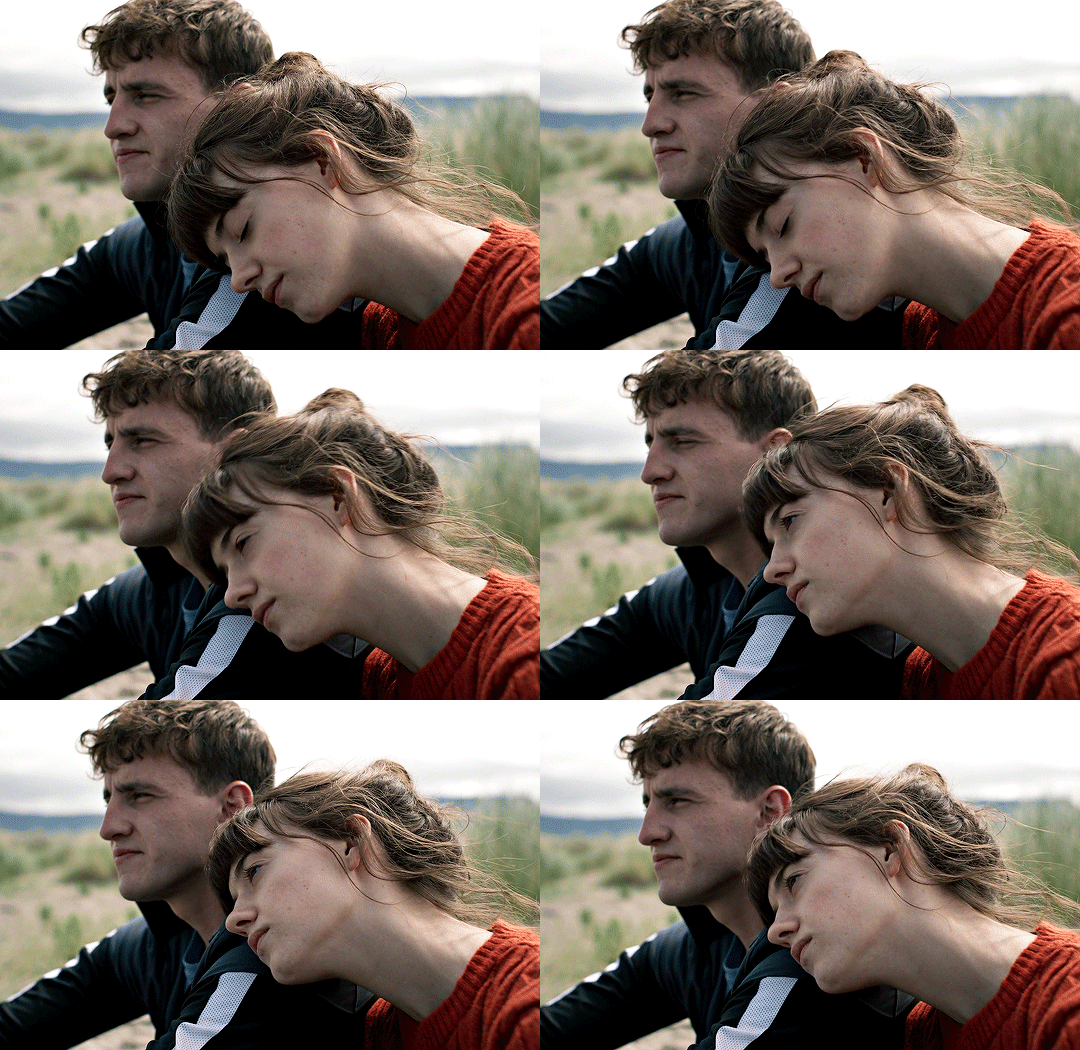
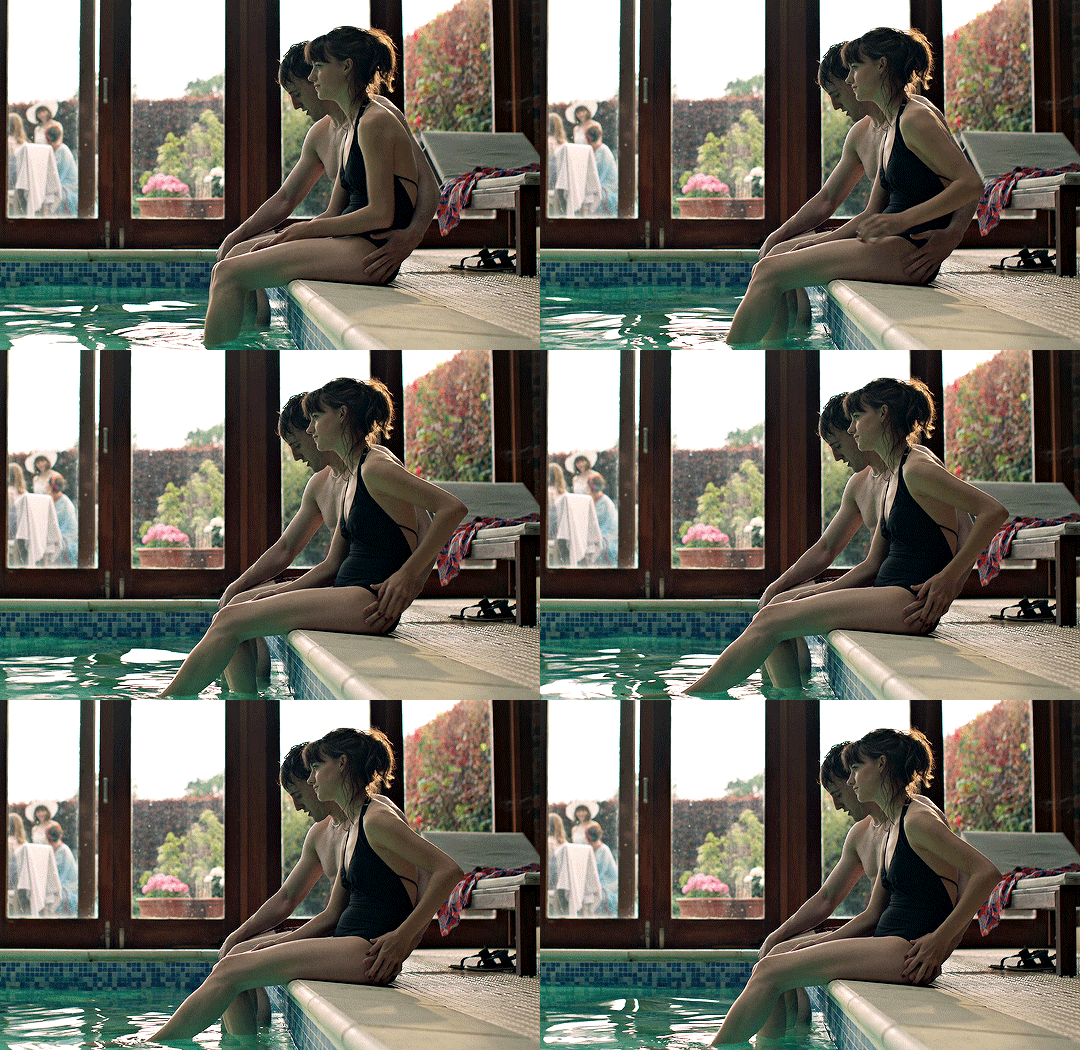
Of course, it is carried by Paul Mescal and Daisy Edgar-Jones as the protagonists Connell and Marianne. Neither overshadows the other; both have painful journeys to make. At school in Sligo, Connell is the popular one, Marienne is the loner, but they have a secret affair and then both get into Trinity College Dublin where Marianne becomes the popular one and Connell is left struggling. (There is a minority view that his real problem in Dublin is not playing enough GAA.) They observe each other's love lives and then eventually resolve their own relationship. It warmed my heart (though there are some pretty bleak moments along the way).

We get perhaps a little more into Connell's head, but we see Marianne's soul as well. It's a love story, of course, but set in a place and time that I know well enough for it to really grab me. Thanks to gownegirl on tumblr for these GIFs.


“She closes her eyes. He probably won’t come back, she thinks. Or he will, differently. What they have now they can never have back again. But for her the pain of loneliness will be nothing to the pain that she used to feel, of being unworthy. He brought her goodness like a gift and now it belongs to her. Meanwhile his life opens out before him in all directions at once. They’ve done a lot of good for each other. Really, she thinks, really. People can really change one another. You should go, she says. I’ll always be here. You know that.”

NORMAL PEOPLE (2020)

Anyway, another one that was well worth watching, and only twelve 25-minute episodes. What have you got to lose?

Posted in Uncategorised

Thursday reading

Current
The Complete Secret Army: An Unofficial and Unauthorised Guide to the Classic TV Drama Series by Andy Priestner
Our Mutual Friend, by Charles Dickens
The Queen’s Agent: Sir Francis Walsingham and the Rise of Espionage in Elizabethan England, by John Cooper
The Ode Less Travelled: Unlocking the Poet Within, by Stephen Fry
The Wicked + The Divine vol 2: Fandemonium, by Kieron Gillen etc

Last books finished
The Tiger's Wife, by Tea Obreht
Make Room! Make Room!, by Harry Harrison
The Sleeper Awakes, by H.G. Wells
Local Hero, by David Benedictus
The Wicked + The Divine vol 1: The Faust Act, by Kieron Gillen etc

Next books
Modern China: A Very Short Introduction, by Rana Mitter
Yugoslavia's Implosion: The Fatal Attraction of Serbian Nationalism, by Sonja Biserko

Posted in Uncategorised

My tweets

Posted in Uncategorised

The Good Place

So, we binged the NBC series The Good Place sedately over the last few weeks, at the rate of one or two episodes a night. I had already seen the episodes that ended up on the Hugo final ballot last year and the year before, two of which lost and two of which won. The two that lost, in my view, were rather difficult to understand if you saw them out of context – these were "Michael's Gambit", the first season finale, and "Jeremy Bearimy", from the third season. The two that won worked relatively well as standalones – the second series episode "The Trolley Problem", whose core plot is a graphic illustration of a classical ethics dilemma, and the third series episode "Janet(s)", which features D'Arcy Carden as the show's artificial intelligence, Janet, also acting the personas of most of the other key cast. This year, only one episode, "The Answer", made the Hugo ballot; I think it is the emotional climax of the fourth and final season, but let's see if voters respond to it.

The initial setup of The Good Place is that the protagonist Eleanor, played by Kristen Bell, has died and ended up in an afterlife, a part of The Good Place, designed and controlled by Michael, who looks weirdly like Ted Danson from Cheers aged seventy, because he is in fact played by Ted Danson aged seventy. Bell and Danson were both very well established stars; the rest of the regular cast includes William Jackson Harper as ethics philosopher Chidi, Jameela Jamil as posh British socialite Tahani, Manny Jacinto as Floridian stoner Jason, and as noted above D'Arcy Carden as the AI, Janet. Here's the trailer for the first series which will give you an idea.

The show's central narrative takes a sudden zigzag at the end of that first series, which creates sufficient space to keep the plot going throughout the rest of the 52 episodes. The scripts are witty and, though I think the pace flags a bit in the middle of the run, the episodes are short enough that you enjoy them for what they are. Apart from the main ensemble there are a host of recurring characters, of whom my favourite is probably Maribeth Monroe's Mindy St Claire, condemned to a limbo which is neither the Good Place nor the Bad Place, and obsessed with orgasms and cocaine.

The show finishes on rather a contemplative note; what, after all, would eternity in the Good Place actually look like, and would it be worth it? The moral of the tale is nicely illustrated by trueloveistreacherous on tumblr:


That sequence sadly doesn't feature D'Arcy Carden's Janet, so here she is to finish off with, thanks to rocktheholygrail on tumblr.


Well worth watching – thought-provoking without being too taxing.

Posted in Uncategorised

My tweets

Posted in Uncategorised

Unorthodox

I wrote yesterday about Derry Girls as one of the shows I have been enjoying during lockdown. Another, Unorthodox, is also a Netflix show: in an internal poll of my Brussels colleagues, it came out the clear winner, so we gave it a go, and we thoroughly enjoyed it.

It's the story of Etsy, from an ultra-Orthodox community in Brooklyn, who flees a bad marriage in Brooklyn to try and find her mother in Berlin, and ends up finding much more than she expected; meanwhile her husband Janky and his disreputable cousin Moishe go to Berlin to try and find her and bring her back. There are plenty of flashbacks to the life in Brooklyn that she has fled. Most of the dialogue is in Yiddish, with some English and some German; I think that even native German speakers will need the subtitles for Yiddish. Here's the trailer.

The show is carried by Shira Haas as Etsy, always very watchable, combining waiflike vulnerability with an inner steel. We don't know what choice she is going to make, when the moment comes to choose, but we understand her motivations very clearly. There is a killer moment early on, when she and her new Berlin friends (one of whom is Israeli) go to the Wannsee (where of course the Holocaust was plotted, later fatal frontier territory between East and West) and she takes off her wig and bathes in the water (gifs from here):


The other crucial moment is when, having finally got an audition at the music academy, she sings her heart out:

I found it immensely gripping from start to finish, and it's not very long – only four episodes, each less than an hour. It's based loosely on the true story of Deborah Feldman who did indeed escape her ultra-Orthodox background to start a new life. But actually I think that any of us who grew up in a more conservative culture than the one we have chosen live in can relate to the adjustments that Etsy has to make. For people like me who love Berlin, there's the added attraction of seeing a new angle on an old friend.

As mentioned above, Shira Haas carries the show, but there are great performances from several others – Amit Rahav as her estranged husband Janky, Jeff Wilbusch as cousin Moshe, Alex Reid as Etsy's mother and Aaron Alteras as Robert, on whom she develops a crush. The whole thing is nicely shown and nicely observed.


When I posted enthusiastically about the first episode on Facebook, an interesting discussion ensued. Most people, similar to me, simply enjoyed it very much. One German friend felt it was unrealistically positive about Berlin and Germany. Two of my more religious Jewish friends politely said that it is not as good as Shtisel, another series about ultra-Orthodox community but set in Jerusalem rather than New York. An Irish friend chimed in and said that both Unorthodox and Shtisel are "brilliant". Not sure how much more Serious TV I can bear, but Unorthodox was very much worth watching,

Posted in Uncategorised

My tweets

Posted in Uncategorised

Derry Girls

This week I'm going to write about the media we've been watching during lockdown. First off, Derry Girls, whose two series so far are set in the early and mid 1990s, and feature five girls (one of whom is actually a boy) attending a Catholic school run by nuns in Derry, at the tail end of the Troubles. It hit home very hard for me. I went to a Catholic school run by nuns, and I am about ten years older than the Derry Girls, but that moment in the mid 1990s was an important one for me – I moved back to Belfast after five years in Cambridge in 1991, two years later my English girlfriend moved there as well to marry me, and I was on the fringes of the peace process as a minor functionary of a smaller political party until I moved to Bosnia in early 1997.

Derry and Belfast coexist in somewhat dynamic tension – one of my best friends in Belfast married a Derry chap in 1994, and we get a strong sense of the relationship between the two cities every time we see them. (Yes, I know you two are reading this. Your children are reading this too.) So I had a slight prejudice going in of what's-so-special-about-Derry. But of course the best humour is universal, and the charm of the show is combining teenage angst with extraordinary circumstances – a bit like Buffy, but with fewer vampires and more British soldiers. In case you need convincing, here is a highlights reel from Season 2:

And the absolute best character of the series is Sister Michael, the headmistress of the school:


The moment that really ripped my heart out was the very last scene of Series 1, where the girls come out in support of Orla, whose presentation at the talent show is crashing and burning; meanwhile at home, Erin’s parents and Orla’s mother watch horrified as news comes of a major atrocity, and Grandpa Joe, who hates his son-in-law with a deep loathing, actually reaches out to him for mutual comfort as Dolores O’Riordan provides the soundtrack.

Twelve episodes of 45-50 minutes; it’s on Netflix, and I think for free elsewhere as well. Strongly recommended.


…what has already been described as one of the worst atrocities of the Northern Irish conflict. At least twelve people are thought to be dead, and many more wounded. Emergency services are urging anyone with medical training to come to the scene immediately. The device was detonated at 3pm this afternoon. The RUC said no warning was given.
(Images from https://tiffanyachings.tumblr.com/post/190756068426/what-has-already-been-described-as-one-of-the)
Posted in Uncategorised

My tweets

Posted in Uncategorised

May books

Only 18 books this month, as the absence of my usual commute hits my reading habits…

Non-fiction: 5 (YTD 26)
The Hunt for Vulcan: …And How Albert Einstein Destroyed a Planet, Discovered Relativity, and Deciphered the Universe, by Thomas Levenson
Joanna Russ, by Gwyneth Jones
A Sacred Cause: The Inter-Congolese Dialogue 2000-2003, by P. E. Winter
Roger of Hereford’s Judicial Astrology: England’s First Astrology Book?, by Chris Mitchell
A border too far: the Ilemi triangle yesterday and today, by Philip Winter

Fiction (non-sf): 2 (YTD 12)
The Godfather, by Mario Puzo
The Accident, by Ismail Kadarë

sf (non-Who): 9 (YTD 65)
Riverland, by Fran Wilde
In an Absent Dream, by Seanan McGuire
The Forever War, by Joe Haldeman
Black Wine, by Candas Jane Dorsey
Arthur C. Clarke's Venus Prime 1: Breaking Strain, by Paul Preuss
Slaughterhouse 5, by Kurt Vonnegut
The Nightmare Stacks, by Charles Stross
The Tiger's Wife, by Tea Obreht
Make Room! Make Room!, by Harry Harrison

Comics: 2 (YTD 15)
Peanuts: A Tribute to Charles M. Schulz, ed. Shannon Watters
The Wicked + The Divine vol 1: The Faust Act, by Kieron Gillen etc

5,000 pages (YTD 33,500)
6/18 (YTD 43/124) by non-male writers (Jones, Wilde, McGuire, Dorsey, Olbreht, Walters)
0/18 (YTD 13/124) by PoC
3/18 rereads (YTD 16/124) – The Godfather, The Forever War, Slaughterhouse-Five.

Currently reading
The Complete Secret Army: An Unofficial and Unauthorised Guide to the Classic TV Drama Series by Andy Priestner
Our Mutual Friend, by Charles Dickens
Local Hero, by David Benedictus
The Queen’s Agent: Sir Francis Walsingham and the Rise of Espionage in Elizabethan England, by John Cooper

Current
The Complete Secret Army: An Unofficial and Unauthorised Guide to the Classic TV Drama Series by Andy Priestner
Our Mutual Friend, by Charles Dickens
Local Hero, by David Benedictus
The Queen's Agent: Sir Francis Walsingham and the Rise of Espionage in Elizabethan England, by John Cooper
The Ode Less Travelled: Unlocking the Poet Within, by Stephen Fry

Coming soon (perhaps)
Modern China: A Very Short Introduction, by Rana Mitter
Yugoslavia's Implosion: The Fatal Attraction of Serbian Nationalism, by Sonja Biserko
The Ghost of Lily Painter by Caitlin Davies
Heaven's War by David S Goyer
Laatste schooldag, by J. G Siebelink
Dreaming In Smoke, by Tricia Sullivan
The Master and Margarita, by Mikhail Afanasevich Bulgakov
De dag waarop de bus zonder haar vertrok, by Beka
The Overstory, by Richard Powers
Tooth & Claw, by Jo Walton
Gaze of the Medusa, by Gordon Rennie, Emma Beeby and Brian Williamson
“The Bicentennial Man” by Isaac Asimov
Listen to the Moon by Michael Morpurgo
Jerusalem, by Alan Moore
East West Street, by Philippe Sands
Beren and Luthien, by J.R.R. Tolkien
Darwin's Island: The Galapagos in the Garden of England, by Steve Jones
Exiled to Nowhere: Burma's Rohingya, by Greg Constantine

Posted in Uncategorised

My tweets

Posted in Uncategorised

The Sting

The Sting won the Oscar for Best Picture of 1973, and picked up another six – Best Director (George Roy Hill), Best Writing, Original Screenplay (David S. Ward), Best Art Direction-Set Decoration, Best Costume Design, Best Film Editing and Best Music, Scoring Original Song Score and/or Adaptation. Robert Redford lost Best Actor to Jack Lemmon in Save the Tiger (which I admit I haven’t heard of), and The Sting was also nominated for Best Cinematography and Best Sound, losing to The Exorcist and Cries and Whispers respectively. Worth noting that Julia Phillips was the first woman to collect the Oscar for Best Picture (in the 46th Oscar ceremony).

The other nominees for Best Picture were American Graffiti, Cries and Whispers, The Exorcist and A Touch of Class. I have not seen any of them. IMDB users rank The Sting 2nd or 8th of the films of 19732, depending on the system. The Exorcist is above it on both rankings. The other 1972 films I have seen are an odd assortment: Nebula winner Soylent Green, Live and Let Die, The Day of the Jackal, Jesus Christ Superstar, The Three Musketeers (the version where Spike Milligan is married to Raquel Welch), Charlotte’s Web (the original animated version – accept no substitutes) and The Golden Voyage of Sinbad (the one with Tom Baker before he was Doctor Who). I haven’t yet seen Sleeper, which won both Hugo and Nebula. I think The Sting is the best of those that I have seen. Here’s a trailer.

Criminality continues at the Oscars, as this is the seventh Best Picture winner in eight years to be centred around law-breaking (stretching a point for A Man for All Seasons). Robert Redford (as Johnny Hooker) and Paul Newman (as Henry Gondorff) are hustlers in 1936 Chicago who set out to defraud a major crime boss from New York. I like it a lot, and I’m ranking it just behind last year’s The Godfather and ahead of Ben-Hur, in the top third (but just outside the top quarter) of my league table. In particular I should note that I rather bounced off last year’s Hugo winner, Slaughterhouse Five, which was had the same director, George Roy Hill, but I really like The Sting. (I had seen both previous to my current award-winner project.)

A couple of returning faces to note from previous Oscar-winning films. Robert Shaw is Doyle Lonnegan, the New York crime boss who is the mark of the eponymous sting. Seven years ago, he was Henry VIII in A Man for All Seasons.

Ray Walston is J.J. Singleton, one of the key oeprators of the sting here; twelve years ago he was one of Jack Lemmon’s clients in The Apartment.

A less prominent character, Larry D. Mann is the train conductor here and was the racist councillor Watkins in In the Heat of the Night.

I did not spot any crossovers with Hugo-winning films, or with Doctor Who.

As noted above, I enjoyed this. It looks very good, and I’m certainly not familiar enough with either Illinois or California to spot which locations from the latter are pretending to be the former. The feeling of small spaces – on the train, in the bars or apartments, and finally in the fake betting shop – is very well conveyed.

Going through my usual list, it’s actually not bad on representation of women and people of colour. Even though fundamentally it’s a story about the three white men played by Newman, Redford and Shaw, it’s notable that the Chicago scenes show a more diverse team behind the sting, with Eileen Brennan’s Billie in a key (if supporting) roles; and there is the subplot of Dimitra Arliss’s Loretta, which ends with a very unexpected twist.

Two key plot developments are driven by Hooker’s loyalty to his partner Luther Coleman (as played by Robert Earl Jones, father of James Earl Jones). The sting itself is vengeance for Coleman’s death, and Hooker’s collaboration with the FBI is driven by their threats against Coleman’s widow. The fact that a white guy might be instinctively loyal to a black friend and his family is depicted as in no way problematic (perhaps beyond realism). I note also that the early visit to the Colemans’ home is the only portrayal of normal family life in the film; the white people are too busy engaging in crime (and that includes the white women). Unfortunately we don’t see much of the Colemans after Luther is killed, 23 minutes into a 129-minute film. We do hear a lot of ragtime music.

The narrative is carried by Newman and Redford, who are great individually and an even better double act. Both of them have to take on different identities during the film, as their main characters pretend to be other people. Redford is particularly watchable as the more action-oriented of the two.

On first time of watching, I was genuinely shocked by the ending, which I had not seen coming at all; it’s one of the greatest twists I can think of in movie history. The second time round, even knowing what was to come, I was on the edge of my seat. The story is actually a bit far-fetched – it requires Hooker and Gondorff and their team to execute a complex plan with split-second timing – but the film is clear that this may not actually work and that the stakes are very high.

But the best remembered features of the film are the music and the title cards that introduce each narrative section. Every child of my age who attempted to learn the piano either foundered on the rocks of The Entertainer (as I did) or used it as a fundamental stepping stone to greater things.

The use of ragtime in the film is iconic and also anachronistic. The Entertainer was written in 1902; The Sting is set in 1936; but thanks to the film it’s impossible for me to dissociate ragtime from the 1930s. (Incidentally, more time has passed since The Sting was made – 48 years – than had elapsed between the setting and the making of the film – 36 years.) Here’s the full soundtrack – well worth a listen in the background of whatever you are doing next after you read this.

Well, that was fun. Next Oscar-winning film is The Godfather II, which I saw once before, long ago; before then I’ll write up Soylent Green and Sleeper. You can get The Sting here.

Winners of the Oscar for Best Picture

1920s: Wings (1927-28) | The Broadway Melody (1928-29)
1930s: All Quiet on the Western Front (1929-30) | Cimarron (1930-31) | Grand Hotel (1931-32) | Cavalcade (1932-33) | It Happened One Night (1934) | Mutiny on the Bounty (1935, and books) | The Great Ziegfeld (1936) | The Life of Emile Zola (1937) | You Can’t Take It with You (1938) | Gone with the Wind (1939, and book)
1940s: Rebecca (1940) | How Green Was My Valley (1941) | Mrs. Miniver (1942) | Casablanca (1943) | Going My Way (1944) | The Lost Weekend (1945) | The Best Years of Our Lives (1946) | Gentleman’s Agreement (1947) | Hamlet (1948) | All the King’s Men (1949)
1950s: All About Eve (1950) | An American in Paris (1951) | The Greatest Show on Earth (1952) | From Here to Eternity (1953) | On The Waterfront (1954, and book) | Marty (1955) | Around the World in 80 Days (1956) | The Bridge on the River Kwai (1957) | Gigi (1958) | Ben-Hur (1959)
1960s: The Apartment (1960) | West Side Story (1961) | Lawrence of Arabia (1962) | Tom Jones (1963) | My Fair Lady (1964) | The Sound of Music (1965) | A Man for All Seasons (1966) | In the Heat of the Night (1967) | Oliver! (1968) | Midnight Cowboy (1969)
1970s: Patton (1970) | The French Connection (1971) | The Godfather (1972) | The Sting (1973) | The Godfather, Part II (1974) | One Flew Over the Cuckoo’s Nest (1975) | Rocky (1976) | Annie Hall (1977) | The Deer Hunter (1978) | Kramer vs. Kramer (1979)
1980s: Ordinary People (1980) | Chariots of Fire (1981) | Gandhi (1982) | Terms of Endearment (1983) | Amadeus (1984) | Out of Africa (1985) | Platoon (1986) | The Last Emperor (1987) | Rain Man (1988) | Driving Miss Daisy (1989)
1990s: Dances With Wolves (1990) | The Silence of the Lambs (1991) | Unforgiven (1992) | Schindler’s List (1993) | Forrest Gump (1994) | Braveheart (1995) | The English Patient (1996) | Titanic (1997) | Shakespeare in Love (1998) | American Beauty (1999)
21st century: Gladiator (2000) | A Beautiful Mind (2001) | Chicago (2002) | The Lord of the Rings: The Return of the King (2003) | Million Dollar Baby (2004, and book) | Crash (2005) | The Departed (2006) | No Country for Old Men (2007) | Slumdog Millionaire (2008) | The Hurt Locker (2009)
2010s: The King’s Speech (2010) | The Artist (2011) | Argo (2012) | 12 Years a Slave (2013) | Birdman (2014) | Spotlight (2015) | Moonlight (2016) | The Shape of Water (2017) | Green Book (2018) | Parasite (2019)
2020s: Nomadland (2020) | CODA (2021) | Everything Everywhere All at Once (2022) | Oppenheimer (2023)

My tweets

Posted in Uncategorised

August 2006 books

We started August 2006 in Northern Ireland as usual (heaven knows if it will be possible this year), and I attended MeCon 9 in Belfast where the guests included Ian McDonald, Hal Duncan, Ken MacLeod, Leah Moore, and John Reppion. I thought I had pictures from it, but in fact they seem to be from the following year, and I'm not in anyone else's that I can find. I remember having a lot of fun.

We also had a family excursion to the Legananny Dolmen and the Finnis Souterrain:

A mid-holiday work trip to London was unexpectedly extended by a day when I arrived at Heathrow to get a morning flight back to Belfast, and found myself in the immediate aftermath of the 2006 airport plot. I got the train to Liverpool and the overnight ferry, arriving not quite 24 hours after originally planned.

We published a report on Moldova mid-month (must have been just before I got back, in fact), and I ended the month in Budapest speaking at a conference in the rather splendid parliament building there.

I profited from the holiday to read a lot.

Non-fiction 9 (YTD 43)
Lost Railways of Co. Down and Co. Armagh, by Stephen Johnson
Inside the Tardis: The Worlds of Doctor Who, by James Chapman
Doctor Who, by Kim Newman

Salonica: City of Ghosts – Christians, Muslims and Jews 1430-1950, by Mark Mazower
The Independent Irish Party 1850-9, by J.H. Whyte
Sixteenth Century Ireland, by Colm Lennon
H.P. Lovecraft: Against the World, Against Life, by Michel Houellebecq
A Rulebook for Arguments, by Anthony Weston
Critical Reasoning: An Introduction, by Anne Thomson

Non-genre 4 (YTD 16)
Tropic of Capricorn, by Henry Miller
The Warden, by Anthony Trollope
The Warden's Niece, by Gillian Avery
The Brightfount Diaries, by Brian Aldiss

SF 7 (YTD 49)
The Healer's War, by Elizabeth Anne Scarborough
The Wreck of The River of Stars, by Michael Flynn
Stations of the Tide, by Michael Swanwick
October the First is Too Late, by Fred Hoyle
Southern Fire, by Juliet McKenna
Year's Best SF 11, ed. David Hartwell and Kathryn Cramer
Winter Moon, by Mercedes Lackey, Tanith Lee and C.E. Murphy

Doctor Who 3 (YTD 10)
Short Trips: Companions, ed. Jacqueline Rayner
Short Trips: A Universe of Terrors, ed. John Binns

The Empire of Glass, by Andy Lane

Comics 2 (YTD 4)
Ghost World, by Daniel Clowes
Preacher: Gone to Texas, by Garth Ennis and Steve Dillon

6,400 pages (YTD 36,200)
6/25 by women (YTD 20/122)
None by PoC (YTD 5/122)

Best of these, and the one which still sticks with me, is The Wreck of The River of Stars, by Michael Flynn; you can get it here. I also gave The Healer's War, by Elizabeth Anne Scarborough, an enthusiastic write-up, but can't remember as much about it. You can get it here. I found Tropic of Capricorn, by Henry Miller, thoroughly unpleasant, but you can get it here.

Posted in Uncategorised

My tweets

Posted in Uncategorised

Thursday reading

Current
The Complete Secret Army: An Unofficial and Unauthorised Guide to the Classic TV Drama Series by Andy Priestner
Our Mutual Friend, by Charles Dickens
The Tiger's Wife, by Tea Obreht

Last books finished
A border too far: the Ilemi triangle yesterday and today, by Philip Winter
Slaughterhouse 5, by Kurt Vonnegut
The Nightmare Stacks, by Charles Stross

Next books
The Queen's Spymaster, by John Cooper
The Ode Less Travelled: Unlocking the Poet Within, by Stephen Fry

Posted in Uncategorised

My tweets

Posted in Uncategorised

Arthur C. Clarke’s Venus Prime 1: Breaking the Strain, by Paul Preuss

Second paragraph of third chapter:

She’d garnered valuable information from the Snark before–in that split second when it had paused, hovering motionless inches above the ground, computing new coordinates–she’d jumped clear and sent it on its unprotected way. Precisely where she was. Precisely what day, month, and year it was. That last had come as a shock. Memories had been swarming more thickly with every passing minute, but now she knew that even the most recent of them was more than a year old. And in the hours since she’d jumped, while she’d been trudging through the snow, she’d contemplated the burgeoning strangeness of her sense of herself.

This was part of a Humble Bundle that I got in 2016 because of various Zelazny-related items. It’s an expansion of “Breaking Strain“, a 1949 story by Arthur C. Clarke, and the first in a series of six volumes by Preuss featuring the mysterious Sparta, whose memories of her own origin are unclear and unreliable, and gets mixed up with a very weird plot involving the transport of a first edition of Seven Pillars of Wisdom to the planet Venus. It started a bit clunky but developed well enough and kept my attention to the end; not Great Literature but a step or two ahead of the pulp stories which it is rooted in. You can get it here. I’m not inspired to get the rest of the series though.

This was my top unread book acquired in 2016. Next on that list is Alan Moore’s Jerusalem.

Posted in Uncategorised

My tweets

Posted in Uncategorised

The Accident, by Ismail Kadarë

Second paragraph of third chapter:

There was no way of knowing why the state of Serbia and Montenegro should take an interest in the accident, but it soon became clear that this country had kept the two victims under surveillance for a long time.

I have generally enjoyed Kadarë's work, but I'm afraid this left me rather unexcited and confused. The story is about an Albanian couple who dies in a freak car accident; we explore what they know about each other, and the woman's other loves; perhaps it's all a metaphor for the international flirtations of post-Communist Albania, but if so it's a bit clumsy and also not all that apt (post-Communist Albania has been pretty firm in its affections). If you want to try it anyway, you can get it here.

This was my top unread book acquired in 2014 (I could not find Sleepers of Mars, by John Wyndham, and anyway it turns out that The Accident has overtaken it). Next on that list is Sleepers of Mars, if I can find it, or Listen to the Moon by Michael Morpurgo, if I can't.

Seventy days of lockdown, and Dominic Cummings

Ten weeks ago today, the Brussels St Patrick's Day reception was due to take place in the BOZAR. It's always a grand occasion, and this time was going to be particularly special; the evening was not only a celebration of Ireland's national day, but also a farewell to the Irish ambassador to the EU, Declan Kelleher, who played a key if under-reported role in ensuring that Dublin and Brussels remained tightly connected during the Brexit negotiations. Of course, there was no reception.

We've been thinking about the last bits of normality before it all hit. My last international travel was a visit to London at the end of February, finishing with a birthday party in Cambridge on the 29th and coming home on 1st March. This is surely the first time that I have spent thirteen consecutive weeks in Belgium since we moved here in 1999. (I don't think it will be another thirteen – but it may be another four or five.) The last reception I attended was the opening of an exhibition about the Croatian architect Vjenceslav Richter on Wednesday 4 March. (It's open again, if you want to go – rather good, I thought.) My last networking lunch was with a former Swiss ambassador on Friday 13 March. (An inauspicious date!) On 17 March, the last full day in the office, eight of our usual complement of forty-something were in, and we ordered a socially distant lunch. (I note that the seven colleagues in the picture below are from seven different countries, and none shares a nationality with me.)

The numbers are subsiding slowly. I noted ten days ago that the number of patients in hospitals and in intensive care were about halfway between those for 22 and 23 March. Today's numbers are just below those for 21 March. So we are heading in the right direction, but slowly – it seems to take five or six days to make up for each day of the initial surge (and of course we're now at the equivalent of the point where that surge was going really fast). Cafes and restaurants will be able to open next week, but it's not clear that it will be worth their while. Hairdressers opened last week, and I took advantage:

The issue of the day is, of course, Dominic Cummings. I will be clear – I despise the man and everything he stands for. This is the person who sabotaged Britain's participation in the largest peace project in history, and thought nothing of colluding in wicked lies in the process (the claim that the UK paid the EU £350 million a week, and the further claim that this money would go to the National Health Service if the country voted for Brexit). I wish him nothing but failure in his political career and ambitions.

It is however impossible to read his full statement and not feel some sympathy for someone in a high-pressure job facing a family crisis. Even so, it's not good enough. Most of Western Europe had to deal with lockdown, and most of us did so by respecting what we thought were the rules. We just received a note from the home where our daughters live to say that normal visiting will remain impossible until further notice. (That’s been the case since 13 March). Our experience is sad but not as awful as many others have gone through.

British senior scientific advisers Neil Ferguson and Catherine Calderwood were forced to resign for what on the face of it were rather less egregious violations of the UK's "Stay home" mantra than Cummings’ driving 425 km to Durham (and then back again to London). And his admission that he decided to test his own eyesight by getting into his car and driving another 100 km from Durham to Barnard Castle and back is, well, startling and not exactly in line with the usual guidance about eyesight and driving. Many people made agonising personal sacrifices for the greater good, and they now see Cummings having breached the spirit of the rules, and probably the letter as well, and getting away with it.

(This is much less important in the scheme of things, but Cummings also appears to have edited his own past blog entries to look as if he was more prescient about pandemics than he actually was.)

The Spectator is keeping a running tally of Conservative MPs who have called for Cummings to resign or be sacked; you can add the Chief Executive of blog site Conservative Home to the list. These are not the usual bunch of people like me who already hated Cummings’ politics. The government is visibly spinning desperately to control the damage.

This feels like an inflection point. John Major’s government was holed below the waterline by Black Wednesday in 1992, five months and seven days after he won a general election. It is five months and fourteen days today since the 2019 election. History never exactly repeats itself, but past events are often the best guidance to what will happen next.

Posted in Uncategorised

My tweets

Posted in Uncategorised

Roger of Hereford’s Judicial Astrology: England’s First Astrology Book?, by Chris Mitchell

For reasons which will swiftly become obvious, I am quoting the first paragraph of the third chapter rather than the second which is my usual practice:

As discussed in Chapter One, the last analysis of Roger’s Judicial Astrology was Nicholas Whyte’s MPhil dissertation, published in 1991. Whyte relied primarily on two manuscripts from Cambridge University Library, with some additional material from a Bodleian Library manuscript (although he identified several more), while French, who also analysed some aspects of the text, relied primarily on a transcript he had made of one of the Cambridge manuscripts.1 In what follows all twenty-two known extant manuscripts containing all or part of Roger’s Judicial Astrology have been examined, and are summarised below, and are listed in order of relevance to this thesis; A is the oldest extant manuscript and is used as the exemplar in this thesis where possible. A few folios are missing from A, and for those folios, B, which is complete, is used instead. C is also complete, and features in some of the discussions relating to analysing the manuscript. D, E, F, and G are all thirteenth-century copies and are relevant to the development of the stemma codicum discussed later. Remaining manuscripts are listed in order of completeness. A full analysis of the palaeography of the manuscripts is beyond the scope of this thesis, but a brief palaeographical analysis has been undertaken in order to identify, tentatively, the possible location and date of the earlier manuscripts and in order to identify those manuscripts that might be considered to be as close as possible to Roger’s non-extant original. In addition, those manuscripts that contain Roger’s prologue and introduction have a number of tables, some of which contain errors. Examining the manuscripts to see where errors have been copied also provides a route to determining which manuscripts are likely to be closer to the original source. Professor Erik Kwakkel of the University of British Columbia very kindly narrowed down dates for some of the manuscripts for which a palaeographical analysis had been undertaken. These analyses are covered in a later section of this chapter. Finally, an examination of the contents of the manuscripts, together with a brief survey of other texts bound within the same codex, provides some possible information about the reception of Roger’s Judicial Astrology.
1 Whyte, ‘Roger of Hereford’, p.55. Whyte made use primarily of Cambridge, University Library, Ii 1.1, ff.40r-59r and Cambridge, University Library, Gg 6.3, ff.139r-153r with additional material from Oxford, Bodleian Library, Selden Supra 76, ff.3f-19v. French had apparently transcribed Cambridge Ii 1.1, which Whyte referred to.

Long, long ago (well, the summer of 1991) I picked up a lovely project as my M Phil thesis: Roger French, a senior lecturer at the Cambridge Department of History and Philosophy of Science had transcribed a manuscript written by his namesake and ancient neighbour, the 12th-century scholar Roger of Hereford, and wanted to do something with it. I had better knowledge of astronomy than he did, and the basics of Latin, so I picked it up for analysis. It was the most intellectually fascinating thing I have ever done, particularly at the end when I was convinced that Roger had included in the text a birth chart for Eleanor of Aquitaine. But my life moved on from medieval astrology rather rapidly after 1991, and I still regret that to an extent. Not that the other challenges I have faced have not had their points of interest, but there was something peculiarly fascinating about research which wasn’t so much pushing back the frontiers of knowledge as mapping more accurately where they used to be.

So I was delighted when a random Twitter search a few years ago turned up the information that Chris Mitchell was writing up the same book by Roger of Hereford as his PhD at Leicester University. You can download his finished thesis from here; and I did, and was happily returned to the summer of 1991 when Roger was my constant companion. There’s a bit of a revival of Roger at the moment – the German scholar Alfred Lohr has recently edited his Computus (on the calculation of Easter). One of my ambitions is to give the same treatment to Roger’s other work, an explanation of the Ptolemaic planetary theory. But that will have to wait.

Mitchell makes the argument that Roger’s Judicial Astrology (as he calls it, and I think it’s better terminology than I used in 1991) should be understood as a teaching manual, pulling together astrological lore from various sources and presenting it for students to learn from. He makes the point that the book is really rather widespread in British manuscript collections, and also to an extent in Europe, so it must have been popular among scholars. (Modern technology means that he was able to order scanned copies of the manuscripts from various European libraries without having to go there himself.)

He very thoroughly identifies the texts whose material Roger synthesised – mostly Arabic originals, which had been translated into Latin only in the late 11th or early 12th centuries. He courteously disagrees with me on several points of analysis, and I’m not going to insist that I got everything right almost 30 years ago when I was 24; his arguments are well structured and convincing in almost every case.

But I think he misses a really relevant question about the importance or otherwise of Roger’s work. How important was astrology in the late medieval period? I’m a bit sceptical. There’s very little evidence of astrology entering the mainstream of politics or of scholarly discourse in England or northwestern Europe more generally (except when people condemn it). One of the few examples is the fuss around the Great Conjunction of 1186, but Mitchell doesn’t mention it. Where are the records of other astrological practitioners? How do they compare with records of, say, medical pr mathematical writers? I’d have liked a bit more context.

And while I agree with all of Mitchell’s other points of correction to my 1991 research, I stand by my identification of Eleanor of Aquitaine’s natal horoscope. Mitchell argues that the horoscope provided by Roger is only a theoretical exercise, not meant to be linked to any real-life planetary alignment. I would counter that it’s a lot of trouble to go to for a fictional example; if Roger was really a practitioner of astrology, he would have had plenty of worked examples to hand; and sure, in theory one might be meant to cast a horoscope for the moment when a question is asked rather than the nativity of the person asking it, but I’m not at all sure how that would work out in practice.

So, more things to pursue when I have time. (Whenever that may be.) But I’m very glad that someone else has picked up the trail of Roger of Hereford, and run much further with it than I was able to.