
A lovely illustrated short history of Ireland for younger readers, starting with prehistory and running up to (almost) the present day. Hits most of the highlights that you would expect in less than 100 pages, and I think does it in a way that would encourage kids to find out more and to relate to other things they knew about. A nice winner from my old friends at O’Brien Press.
Monthly Archives: January 2016
Get A Movie On: Episode 3 of Here Come The Double Deckers
Episode 3: Get A Movie On
First shown: 26 September 1970 (US), 15 January 1971 (UK)
Director: Harry Booth
Writers: Harry Booth and Melvyn Hayes
Appearing apart from the Double Deckers:
Melvyn Hayes as Albert the Street Cleaner
Norman Vaughan as the TV Compere
Plot
The gang decide to enter a film-making competition, using Doughnut's new camera, with Scooper directing, Doughnut starring and Albert as the stunt man in a Western. Brains screws up the editing process and it looks disastrous when it is shown. But they are given a consolation prize for being funny.
Soundtrack
"Good Day at Yellowrock", by Ivor Slaney and Michael Begg, performed by the main cast.
Three episodes in and we get the first song of the series, a good-humoured dance number which is supposed to be part of the Western. Later songs shift gradually to being Billie and her backing singers, but here she takes roughly equal credit with Spring and Scopper, with the others not far behind.
Glorious moments
I don't have a lot to say about this one because it's just fun to watch.
Three episodes in and we get the first song of the series, a good-humoured dance number which is supposed to be part of the Western that the gang are making. Later songs shift gradually to being Billie and her backing singers, but here she takes roughly equal credit with Spring and Scooper, with the others not far behind.

Again there are some well done slapstick scenes, and one's sympathy for Melvyn Hayes as Albert should be tempered with the realisation that he actually co-wrote the script.

The badly edited final cut of the film is also rather glorious, and the kids' expressions are approriately mortified. NB that after two episodes where Brains has managed pretty spectacular inventions, the editing screw-up here is very definitely all his fault and nobody else's.
Less glorious moments
Sticks rather blatantly converts £5,000 to $12,000 dollars in his head, for the benefit of the American audience. (That is a pretty large prize for a children's amateur contest; one online inflation calculators gives £5,000 in 1970 as equal to £74,000 today, and another intriguingly gives $12,000 as equal to $74,000 today. Either way it's a lot.)
What's all this then?
Not for the last time, we get a show-within-a-show, which (as with the Ring of Gyges) goes back at least to Plato. If you've got kids who are actually attending stage school, then getting them to do a performance about performing is a fairly obvious thing to do – see basically every single episode of Fame! (and its more recent cousins).
It's odd to look back at the 1960s now and realise just how ubiquitous Westerns were. Three of the top 20 Westerns of all time in this list came out in 1969 alone (The Wild Bunch, True Grit and Butch Cassidy and the Sundance Kid); the decade started with The Magnificent Seven and also included the Dollars Trilogy, Cat Ballou and The Man Who Shot Liberty Valance. Perhaps more importantly, Rawhide and Gunsmoke had both been extraordinarily successful on both British and American TV. So it was an easy and familiar set of tropes to hang a story on. (NB that even Doctor Who did a Western story – a musical no less – in 1966.)
Doughnut's request for milk at the bar is a clear reference to the Milky Bar Kid, who'd been around since 1961. I'm not a big expert on Westerns; I'm someone more familiar with the genre than me would have a lot of fun spotting the references here.
The compere is addressed as “Mr Andrews”, if my ears do not deceive me. Is Eamonn Andrews intended?
Where's that?
All filmed in studio.
Who's that?
Here Come The Double Deckers was the peak of the acting career of Michael Audreson, who plays Brains. He was one of two survivors from the first two series of The Magnificant Six and a Half, a set of cinema short films which were made by much the same crew as Double Deckers. He had a handful more TV appearances in the 1970s, inclduing in two 1978 episodes of The Tomorrow People. Since then he has been mainly running a medical foundation, but has made a couple of films as director and writer.
Norman Vaughan (the compere) had made his name as compere of Sunday Night at the London Palladium in the early 1960s, and had also had his own TV show, so he was an obvious choice for this role. He went on to invent the darts/quiz game show Bullseye, and died aged 79 in 2002. During the second world war he appeared in army shows with Spike Milligan and Harry Secombe, who went on to the Goon Show.
See you next week…
…for Starstruck.
BSFA Best Non-Fiction Award
There are 25 candidates on the BSFA Best Non-Fiction long list (the shortest of the four long lists); I nominated three of them myself – Space Helmet for a Cow, Letters to Tiptree and Companion Piece. (My fourth nomination, The Story of Kullervo, appears to have been disqualified.) Of the other 21, ten are available online (nine blog posts/articles and one collection of articles), one is an article in a magazine I don't subscribe to (Interzone), and the remaining eleven are books. I had already read one of these (Rave and Let DieLois McMaster Bujold, by Edward James; "Perilous And Fair: Women in the Works and Life of JRR Tolkien", eds. Janet Brennan Croft and Leslie A. Donovan; and Baptism of Fire: the Birth of the Modern British Fantastic in World War I, ed. Janet Brennan Croft. I make no apology for this; my time is limited and I'd rather read stuff that I am interested in.
Before I get onto those three books, a word about the blog posts. In general I accept that blog posts have a place in the awards ecosystem, and have even voted for them occasionally in the past. But my personal bar is high. I found it impossible to work up the motivation to read through a set of posts even on as interesting a subject as the history of epic fantasy, knowing that they have not been through the refining and mediating process of preparation for professional publication. Still less am I likely to endorse 56,000 words of second-rate fisking (actually I did read it all the way through when it was first published, but did not gain much enlightenment). Three of the other pieces did stand out for me: Erin Horáková's review of Over the Garden Wall, a fascinating review of a TV show I must admit I hadn't previously heard of, and two linked pieces, Jonathan McCalmont's "What Price, Your Critical Agency" and Maureen Kincaid Speller's "{and then} – a writing life beyond reviews". But in the end, none of them appealed to me as much as the books that I nominated or that I am going to vote for in the second round.
The three non-fiction nominees which I bought for the purpose of this exercise were all academic works, one a monograph and the other two themed collections of essays.
Either the author is too modest or I've been hiding under a rock, because I hadn't heard about this until it popped up on the BSFA list. It's one of a series on Modern Masters of Science Fiction by the University of Illinois Press, featuring books about six men and one woman by six men and one woman. (Another five books are forthcoming, one of which will be about Connie Willis.)
It's a jolly good and fairly short read, looking at Bujold's sf and fantasy work (arguing in passing that the Sharing Knife books are really sf rather than fantasy), and also looking at her treatment of culture, characterisation, disability / genetic modification, women / sexuality and war, leadership, and honor. It's a text in dialogue with a lot of other work, including The Vorkosigan Companion, A Reader's Companion to A Civil Campaign, Jo Walton and the author herself. It's always nice when an author you like writes a book you like about a subject you like.
James finishes his introduction: "The subject of my next book died in a.d. 594." Gregory of Tours, I presume? Look forward to it.
The relative invisibility of women in Tolkien's works is perhaps the most jarring aspect of them to a twenty-first century reader. As Una McCormack points out in the last of these essays, quoting an unnamed conference participant, there are more named horses than named women in The Lord of the Rings. These essays prove that you can write thought-provoking stuff about the flaws in the work you love. Though the case for Tolkien's defence can be made robustly, and John Rateliffe recounts his career of being considerably more active and enthusiastic about educating women (including Mary Renault) than was the norm for his day, C.S. Lewis being a sad counter example. There are a number of other very interesting essays, of which I particularly enjoyed Una McCormack's closing piece on fan fiction and Cami Agan's thoughts on Lúthien and bodily desire. I'm afraid there are a couple of silly pieces as well, one about Valkyries and the other about Éowyn, Twelfth Night and Carnival, but the majority of these are very interesting. (And the last footnote to Robin Reid's introductory bibliographic essay is heart-breaking.)
We are in the midst of the centenary of the Great War, as it was called at the time, and the essays in this book make that argument that as for so much else in European life, it was a crucial moment for British fantasy writing. Six and a half of the sixteen essays are about Tolkien, which is only fair given his importance in the field, the demonstrable importance of the war in his life, and the large amounts of supporting material to investigate the relationship between them. Verlyn Flieger and John Garth are (rightly) frequently invoked. I found all of them thought-provoking, especially the first, Michael Livingstone's "The Shell-shocked Hobbit: The First World War and Tolkien’s Trauma of the Ring ", which convincingly diagnoses Frodo with PTSD. I have to admit that when I first read the book at the age of ten or so, I wasn't convinced by the apparently magical way Frodo's injuries return to cause a physical illness on their anniversaries after his return to the Shire; now that I'm older and I've seen that happen to people in real life, I'm impressed by the understated way Tolkien describes it.
Of the other essays, two and a half are about C.S. Lewis, who said and wrote much less about his was experience: serving in the trenches and getting blown up with permanent injury to his left hand was less traumatic than his experiences at boarding school or the death of his mother. Still, there is war in Narnia, and interesting comparisons and contrasts to be made between the real and fictional variety – most notably, as pointed out by Brian Melton in "The Great War and Narnia: C. S. Lewis as Soldier and Creator", what happens to the bodies of those killed at the various battles? They seem to disappear almost before the fighting is over.
The other authors treated here are Owen Barfield, G.K. Chesterton, Lord Dunsany, Sylvia Townsend Warner, E.R. Eddison (twice) and T.H. White. I really read only the last of these, Ashley Pfeiffer's "T. H. White and the Lasting Influence of World War I: King Arthur at War ", and also Nick Milne's fascinating "The Door We Never Opened: British Alternate History Writing in the Aftermath of World War I ", as I am not familiar with the relevant works of the others (though clearly I should remedy that situation). Anyway, a very solid set of essays with some real revelations for me.
Conclusion
In past years, I have sometimes expressed disappointment with the quality and relevance of shortlisted works for the BSFA award for Best Non-Fiction. If the shift to a two-round process for the BSFA awards is to prove its value, this is one category where I would hope to see a positive impact demonstrated fairly readily. I think in fact it has done so. I'm still deciding which four books I will nominate in the second round, but a short list with one or two of Space Helmet for a Cow, Letters to Tiptree, Companion Piece, Rave and Let Die, Lois McMaster Bujold, Perilous and Fair and Baptism of Fire will be a decently strong short list. And I’m considering all of these as Hugo nominations for Best Related Work.
Bételgeuse, v 3 : L’Expédition, by Leo
Continues Kim’s exploration of the planet of Betelgeuse, as the young head of a fractious team which disintegrates over the course of the story. The art as usual is gorgeous, and we have a couple of asides to other places where the extended plot is happening. Having said that, it is very much a middle book whose purpose is to get Kim from place A to place B.
Friday reading
Current
Watership Down, by Richard Adams (a chapter a week)
Uprooted, by Naomi Novik
Dry Pilgrimage, by Paul Leonard and Nick Walters
Touch, by Claire North
Last books finished
Wylding Hall, by Elizabeth Hand
Ms. Marvel Volume 2: Generation Why, by G. Willow Wilson
Travelling Light, by Tove Jansson
Lois McMaster Bujold, by Edward James
Sex Criminals, Vol. 2: Two Worlds, One Cop, by Matt Fraction and Chip Zdarsky
Relative Dementias, by Mark Michalowski
Bételgeuse, tome 3 : L’Expédition by Leo
Thor Volume 1: Goddess of Thunder, by Jason Aaron
Perilous and Fair: Women in the Works and Life of J. R. R. Tolkien, eds. Janet Brennan Croft and Leslie A. Donovan
Baptism of Fire: The Birth of the Modern British Fantastic in World War I, ed. Janet Brennan Croft
The Story of Ireland by Brendan O'Brien
Last week’s audios
[Second Doctor] The Black Hole, by Simon Guerrier
[Torchwood] Fall to Earth, by James Goss
[Torchwood] Forgotten Lives, by Emma Reeves
[UNIT – Extinction] Vanguard, by Matt Fitton
[UNIT – Extinction] Earthfall, by Andrew Smith
[UNIT – Extinction] Bridgehead, by Andrew Smith
Next books
Streetlethal by Steven Barnes
The Love of a Good Woman by Alice Munro
Books acquired in last week
The Double Deckers, by Glyn Jones
Baptism of Fire: The Birth of the Modern British Fantastic in World War I, ed. Janet Brennan Croft
Perilous and Fair: Women in the Works and Life of J. R. R. Tolkien, eds. Janet Brennan Croft and Leslie A. Donovan
Relative Dementias, by Mark Michalowski
There are no Doctor Who books, other than novelisations of the TV stories, featuring the Seventh Doctor and Mel Bush. (Though there are eight Big Finish audios starring McCoy and Langford.) I think Season 24 is the only season of the entire history of the show with no spinoff novel set within its continuity.
So my internal chronology order reading of the PDAs and Telos novellas featuring the Seventh Doctor starts with this 2002 novel, set immediately after Battlefield, involving alien invasions, UNIT and an old people’s home. There is a decently complex alien behind it all, and a nifty bit of timey-wimey manoeuvring at the end, but I felt it was fairly average. The Seventh Doctor / Ace relationship is nicely reset to the Season 25 status, this after years of development through the Virgin New Adventures. It was Michalowski’s first novel – I’ve enjoyed his later work more.
Oddly enough I was reading this at the same time as listening to the new Torchwood audio, Forgotten Lives by Emma Reeves, which is also set in an old people’s home but is much better.
The next Seventh Doctor book in internal chronology is The Hollow Men by Keith Topping and Martin Day, but I read it in 2010, so I will skip ahead to Dave Stone’s Telos novella Citadel of Dreams.
Thor Volume 1: Goddess of Thunder, by Jason Aaron
Another graphic novel that I bought as a potential Hugo nominee, in particular given that it's a first volume and had attracted some commentary when it first came out. It didn't really grab me, I'm afraid; I'm not hugely invested in the concept of Thor in the first place, and so am not that bothered if Thor is male or female, especially if all she or he does is go around biffing things.
Links I found interesting for 14-01-2016
- Gendered merchandising: A rant
@liwella calls out the @sciencemuseum’s lack of women’s T-shirts.
- This is what makes Republicans and Democrats so different
Repubs believe in (wrong!) ideas, Dems in people.
- Why are Pluto and Charon so different?
Pluto stole Charon’s atmosphere!
- Private messages at work can be read by European employers
@LilianEdwards is quoted.
- When Video-Game Worlds End
Experiencing online apocalypse.
Sex Criminals, Vol. 2: Two Worlds, One Cop, by Matt Fraction and Chip Zdarsky
Another comic which is the 2015 volume of a series which was nominated for last year’s Hugos, this one about Jon and Suzy who have discovered that time stands still for them when they orgasm. Actually I really enjoyed this (though I cringed at the title); in the world of the story, there are sinister police, rival activists and personal ghosts to deal with. My biggest complaint is that it ends on a cliff-hanger, and so isn’t a complete story. But I am keeping it on my list of potential Best Graphic Story nominations.
Travelling Light, by Tove Jansson
A collection of short stories by the great Finnish writer, a surprising number of which are about psychological manipulation and trauma – something I picked up also in her novel, The True Deceiver
Ms. Marvel Vol 2: Generation Why, by G. Willow Wilson
I voted for the first volume of this series for last year's Hugos, along with 1728 others, so I had reasonably high hopes for this which weren't quite realised. In particular, once we've got past the rather different background of Kamala Khan as superhero, we're down to fairly standard sorts of adventure in the sewers and streetscapes of New Jersey, and a crossover adventure with Wolverine (well-known, but not to me). I also found the shift between two different artists mid-story very jarring. I still liked it well enough, and it will probably get one of my Hugo nominations, but I'm still much more likely to vote for either The Thrilling Adventures of Lovelace and Babbage or The Sculptor.
Double Deckers in Bristol, 24 January
Any friends in or near Bristol able to go to a Here Come The Double Deckers event on Sunday morning, 24 January, with Gill Bush-Bailey (Billie) and Debbie Russ (Tiger)?
I would be very interested to hear reports!
Youngest head of Northern Ireland government takes office (also first woman)
Prime Ministers
1921 Sir James Craig (later Lord Craigavon), age 50
1940 J.M. Andrews, age 69
1943 Sir Basil Brooke (later Lord Brookeborough), age 54
1963 Terence O’Neill, age 48
1969 James Chichester-Clark, age 46
1971 Brian Faulkner, age 50
First Ministers
1998 David Trimble, age 53
2007 Ian Paisley, age 81
2008 Peter Robinson, age 59
2016 Arlene Foster, age 45
Only one of the 19 Secretaries of State for Northern Ireland was appointed at a younger age than Arlene Foster is today – the incumbent, Teresa Villiers, who was 44 when she was appointed in 2012. Peter Mandelson was her youngest predecessor, appointed ten days before his 46th birthday in 1999.
Links I found interesting for 11-01-2016
- Why David Cameron’s four-year benefits plan won’t reduce EU migration
…if he gets it, that is.
- @Forbes forces readers to turn off ad blockers, promptly serves malware
Crazy.
- Missouri bill defines sex between lobbyists and lawmakers as a gift
There is such a thing as too much transparency.
- The EU did not cause the floods in Britain
In case you were wondering.
J.R.R. Tolkien taught Mary Renault; they were fans of each other’s work
Reading Perilous and Fair: Women in the Works and Life of J. R. R. Tolkien, eds. Janet Brennan Croft and Leslie A. Donovan, I came across this fascinating snippet in John D. Rateliffe’s essay, “The Missing Women: J. R. R. Tolkien’s Lifelong Support for Women’s Higher Education”:


The exact quote is that Renault’s card was “perhaps the piece of ‘Fan-mail’ that gives me most pleasure”. Considering how much fan mail he must have had, that is a very strong statement indeed.
The Just City and The Philosopher Kings, by Jo Walton
I first read both of these two years ago, before publication, and am duly acknowledged in the afterwords; I have read them both again, now that they are eligible for this year’s Hugos (and The Just City is also on the BSFA long list). I had been wondering whether the two might together be a single nomination, as with the Connie Willis Blackout / All Clear duo which won both Hugo and Nebula. But on reflection, I don’t think they are; The Philosopher Kings is set twenty years after The Just City, with a slightly different set of characters and a completely different set of problems. So I shall treat the two books separately for award voting purposes.
The Just City is about time-travellers attempting to set up a society modelled along the lines of Plato’s Republic by taking children whose destiny otherwise would have been slavery to a purpos-built city on Thera before the explosion. This is a world where the Greek gods (and others) exist, and one of the viewpoint characters is a secretly incarnate Apollo. The basic concept is of course brilliant, and I think this is the most detailed version I’ve seen of it. The grand plan is disturbed by many things, including the gadfly questions of Socrates, and the rise of the city’s robots, from off their knees, disturbing the narrative in a manner very slightly reminiscent of the Mule’s disruption of Seldon’s Plan. The intellectual problem and the emotional arcs of the main characters – particularly the very tricky case of Apollo – are very nicely done, and the denouement is satisfying while also creating space for the sequel.
I enjoyed The Philosopher Kings as well, but not quite as much. There’s a great riff on the adaptation of Christianity to a Platonic society, mirroring the adaptation of Plato to Christianity in our timeline; the ending is also a good conclusion for both books. But we lose a favourite character at the beginning of the book, and another engages in a pretty horrific act in the middle of the story (though in fairness it is well-rooted in mythology); also the whole plot is based on the notion that the traumatic events of the end of the first book would have resulted in a complete loss of contact between some key characters for two decades, which given the geography seemed improbable to me.
So I think The Just City is likely to make my Hugo list, but The Philosopher Kings is not; however I still recommend them both.
BSFA Best Art award
Thanks to the new two-round system of nominations for the British Science Fiction Association's awards, we have a long list of 30 pieces of art from which we can nominate up to four to create the eventual shortlist of five. There were a couple that didn't really seem to me to belong – there isn't a BSFA award for graphic stories, and not much point in pretending that there is – but the others all seemed legitimate and attractive to me. With some difficulty, and my usual doubt in my own taste, I've drilled down to my personal shortlist of four, in rough order of preference (top to bottom):

Vlada Monakhova, illustration for "Utrechtenaar" in Strange Horizons

Vincent Sammy, illustration for "Songbird" in Interzone
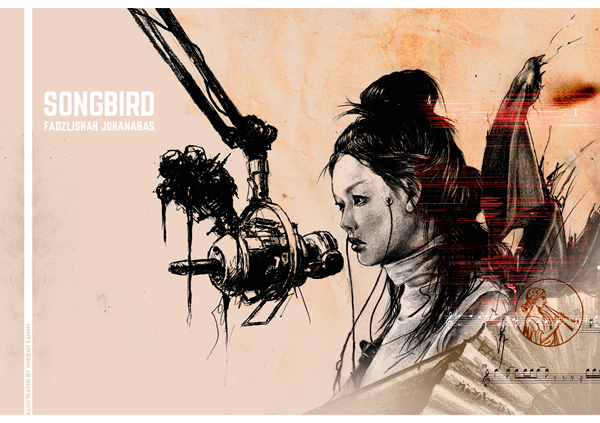

Jeffrey Alan Love, cover for Fabulous Beasts

Jim Burns, cover of Pelquin's Comet
As usual, I found it very difficult to choose between very different styles of art, and I expect that others will find the same.
BSFA short fiction and Hugo nominations
Thanks to the BSFA’s new two-round nomination system, we have a long list of 41 stories in the Best Short Fiction category, from we we can choose four to be aggregated into the eventual shortlist of five. This is actually quite tough, because four of the stories of the 41 are there because I nominated them, and so I am reading the others in competition with the vote I cast in the first round. Of course, these are all also eligible for the Hugos, so I also read with a view to augmenting my Hugo nominations for this year.
I was able to get almost all of the stories – not quite dedicated enough to buy back issues of Interzone or anthologies with only one entry of interest, but the rest I was able to access reasonably easily. In contrast to some of the other categories, I didn’t detect much gratuitous log-rolling (compare the Best Novel contenders with zero following on Goodreads or LibraryThing). And my conclusion is
- “Utrechtenaar” (Strange Horizons), by Paul Evanby
- “The New Mother” (Asimov’s Apr/May 2015), by Eugene Fischer
- Wylding Hall (PS Publishing), by Elizabeth Hand and
- “Wooden Feathers” (Uncanny Magazine), by T Kingfisher / Ursula Vernon.
Wylding Hall is actually 43,000 words in length, but the BSFA has ruled it into the short fiction category. If that ruling should change, my backup nomination is:
- “A Short History of Migration in Five Fragments of You” (Omenana), by Wole Talabai.
Of those, Wylding Hall (which is just over the Hugo novella word limit), “Wooden Feathers (a short story) and “A Short History of Migration in Five Fragments of You” (also a short story) are new to my Hugo list. However, the following also hit me sufficiently hard to be added to my expanding list of Hugo potential nominees:
- “Liminal Grid” (Strange Horizons), by Jaymee Goh (short story)
- “The Game of Smash and Recovery” (Strange Horizons), by Kelly Link (short story)
- A Day In Deep Freeze (Aqueduct Press), by Lisa Shapter (novella) and
- “Everything Beneath You” (Beneath Ceaseless Skies), by Bonnie Jo Stufflebeam (short story).
My list of short stories in particular is getting congested…
The Case of the Missing Doughnut: Episode 2 of Here Come The Double Deckers
Episode 2: The Case of the Missing Doughnut
First shown: 19 September 1970 (US), 8 January 1971 (UK)
Director: Harry Booth
Writer: Peter Miller
Appearing apart from the Double Deckers:
Melvyn Hayes as Albert the Street Cleaner
Julian Orchard as the Toy Shop Owner
Roy Evans as the Baker
Jack Haig as Harvey the Toy Shop Assistant
Plot
Brains is working on a new experimental gloop. Doughnut, who has just been chucked out of the neighbourhood toyshop and the bakery, eats it and becomes invisible. He takes his revenge on the toy shop owner and assistant, and the baker, but the gang trick him by pretending that he is still invisible after it wears off and watching in glee as he returns to the toyshop one last time. And then he wakes up; for it was all a dream.
Glorious moments
Let's face it, this is probably the single episode of Here Come The Double Deckers
which has weathered the test of time least well. Still, Bruce Clark as Sticks gets a very good shock-horror reaction to Doughnut's apparent invisibility; the special effects of the invisble boy are good; and the second scene in the bakery is almost the definition of slapstick.
Also another great Brains/Tiger exchange:
Brains: Skepticism didn't get the Americans to the moon, now did it?
Tiger: No. It was a rocket!
Less glorious moments
Er, most of it.
What's all this then?
The story of a person who becomes invisible and uses that power for evil goes all the way back to Plato's fable of the Ring of Gyges, in which he argues that the man who uses the ring to become invisible will use that power to satisfy his appetites because he does not have to worry about the consequences. OK, seducing the queen, killing the king and usurping the throne isn't quite the same as disrupting a toy shop and a bakery, but you see what I'm getting at. I will admit that a more likely influence was the 1957 film The Invisible Boy, in which the eponymous boy uses his power to play tricks such as interrupting his parents embracing in their bedroom. (Not to mention H.G. Wells, or the 1959-59 ITV series starring Deborah Watling as the invisible man's niece.)
There's also a little more (though only a little more) to Doughnut's role as the show's clown than meets the eye. Clowns are often linked to magic, as were medieval jesters before them, and so if you are going to make one character invisible, it may as well be the clown. A Clown is also a Fool, and the Fool's role is often wish fulfilment for the audience, who may well want to have a free run of local toy shops and bakeries, or more generally to defy authority without consequence.
Where's that?
All filmed in studio.
Who's that?
Douglas Simmonds, who played Doughnut, did one other TV appearance in 1971 and then became a real scientist, working in medicine, physics and computing. He died suddenly in 2011, aged only 52.
Julian Orchard (the Toy Shop Owner) was one of the typical rep actors doing vaguely posh or stuck-up comedy parts. At the time this was made, he was regularly appearing as sidekick to Harry Secombe in The Harry Secombe Show, Jimmy Edwards in Whack-O!, and Spike Milligan in The World of Beachcomber. He died in 1979, aged only 49.
Roy Evans (the Baker) was another actor who turned up in the background of everything – he was in Doctor Who three times, most notably as Trantis in The Daleks' Master Plan (1965-66) but also as Bert in The Green Death (1973) and another unnamed miner in The Beast of Peladon (1974). He was born in 1930 and appears to have last worked in 2004, which is fair enough.

Jack Haig (Harvey the Toyshop Assistant) was already in his late 50s, and had done many comedy support roles for many years without quite hitting the big time. His heyday was yet to come: from 1982 until shortly before his death aged 76 in 1989, he played Roger LeClerc in 'Allo! 'Allo!, memorable for his catchphrase, "It is I, LeClerc!"

Peter Miller wrote four Double Deckers episodes; the other three are all better than this. His biggest hit before this was a sitcom about a vicar called Our Man at St Marks, which ran for four seasons in 1963-66, starring first Leslie Phillips and then Donald Sinden along with Joan Hickman; he wrote all 46 episodes. After Double Deckers he became a producer on the revisionist 1972-73 series Arthur of the Britons, and both produced and wrote a short-lived 1980 sitcom called The Square Leopard. His credits peter out in the mid-1980s.
See you next week…
…for Let's Get A Movie On.
Links I found interesting for 09-01-2016
- How to Cultivate the Art of Serendipity
Or, how to be brilliant.
- Bird-Watching, Patriotism and the Oregon Standoff
From my sister-in-law.
- DWP fit-to-work assessments cost more money than they save, report reveals
Waging war on the poor – and losing!
- Searching for the ‘Armenian Lobby’
Azerbaijan’s paranoid propaganda, by @ArzuGeybulla.
Celebrity, and England of the welcomes
I had a quick visit to London last week, and unusually flew to Heathrow because the Belgian trains were on strike and Eurostar was going only as far as Lille. The flight over was very slow boarding; a lot of passengers were clearly transferring from an African flight, and their visa status was being checked with what seemed to several of them to be deliberate lack of speed.
I was hailed in the queue by a fellow passenger, an Ulsterman living in Slough, who recognised me from my BBC election broadcasts. He was returning to England with his Ugandan wife from Christmas with her family. It seems that there is no longer a direct flight from Heathrow to Entebbe (which I find extraordinary) so the best way is to take the Brussels flight that starts in Kigali and takes on more passengers after a short hop east.
We chatted about Northern Irish politics (I imagine he doesn’t find many fellow enthusiasts for that subject in Slough, let alone Uganda) and then parted company as we boarded; he had to wait for the rest of his family to get through. At the end of the short flight, we were told that the UK Border Agency would be waiting for us at the door and would check every passenger’s passport as we disembarked. They did not check mine, and it was fairly obvious why not.
Friday reading
Current
Watership Down, by Richard Adams
Travelling Light, by Tove Jansson
Relative Dementias, by Mark Michalowski
Ms. Marvel Volume 2: Generation Why, by G. Willow Wilson
Wylding Hall, by Elizabeth Hand
Last books finished
Saga vol 5, by Brian Vaughan and Fiona Staples
Zodiac ed Jacqueline Rayner
Jews vs Aliens, eds Lavie Tidhar and Rebecca Levene
A Day In Deep Freeze, by Lisa Shapter
Rupert Wong: Cannibal Chef, by Cassandra Khaw
The Philosopher Kings, by Jo Walton
Last week’s audios
The Yes Men, by Simon Guerrier
The Forsaken, by Justin Richards
The Black Hole, by Simon Guerrier
Next books
Dry Pilgrimage by Paul Leonard
Bételgeuse, tome 3 : L’Expédition by Leo
Books acquired in last week
Wylding Hall, by Elizabeth Hand
Rupert Wong: Cannibal Chef, by Cassandra Khaw
A Day In Deep Freeze, by Lisa Shapter
Doctor Who Short Trips [1]: Zodiac, ed Jacqueline Rayner
This was the first of 29 anthologies of stories featuring the first eight Doctors published by Big Finish between 2002 and 2009. This takes the dubious proposition that astrology as developed on Earth might somehow be relevant to Gallifrey, and asks twelve writers to write stories based on signs of the Zodiac. The results are variable; the one that particularly grabbed me was Ian Potter’s Third Doctor / Brigadier / Liz Shaw story “Still Lives”, though I did not really see its relevance to the sign of the Crab which it supposedly represents. Also noted for one of my other lists, Joseph Lidster’s “I Was a Monster!!!”, representing Capricorn, which is set in Dublin.
I’ll be reading these in order, but skipping those I have previously read, including the next two in the series which I read back in 2006.
Saga vol 5, by Brian Vaughan and Fiona Staples
Latest in the excellent and entertaining series by Vaughan and Staples, though I feel a bit less enthused than by some previous volumes – most of the fun characters have now been introduced, some have been removed from the scene, and there is a bit of shuffling the pieces around the story board to get them into the right place. It will probably get one of my Hugo nominations, but probably not my vote.
Links I found interesting for 08-01-2016
- Space Debris: 1957 – 2015
Brilliant visualisation.
- The Developer Formerly Known as FreeBSDGirl
Failing to deal with harassment.
- Open Carry Gun Laws Make It Harder to Protect the Public, Police Chiefs Say
Indeed.
- State Papers: Disapproval of gardaí retaining maiden names
1985 – a different time!
- Researchers create genetic map of the British Isles
Fascinating.
- The Rise and Decline of Wikipedia
How it repels users.
- Ten Things 2015 Showed Us About Diplomacy
The Naked Diplomat writes.
- Predictability is going through some unpredictable changes.
The Future No Longer Works the Way We Thought It Did
- A Farewell to Istanbul
@Hugh_Pope reflects on his 28 years in the city.
- Britain, immigration and Brexit
@SimonTilford nails it.
- Medieval Gothic Graffiti from the Crimea.
Hooray!
- Our Absurd Fear of Fat
A little extra can be good for you.
- A day out in Calais
The shame of the Jungle.
- Why Saturn Is the Best Planet
@TheAtlantic eats its words.
- Twitter is not broken, and they should stop trying to fix it
Amen.
- Comic-book festival bows to pressure over all-male award shortlist
Good.
- Curtin University meteorite discovery could hold clues to solar system creation
Dug out of the ground with their bare hands.
- Thirteen trends for 2016
@ecfr looks ahead.
- Happy Birthday Roy Batty! Or would that be Happy Incept Day for a Blade Runner replicant?
8 January 2015 in sf history.
Jews vs Aliens and Jews vs Zombies, ed. Rebecca Levene and Lavie Tidhar
These are two short charity anthologies of short stories published last year, doing more or less exactly what their titles promise. They caught my eye in particular because of the co-editors – I’ve enjoyed Tidhar’s alternate history treatments of Osama Bin Laden and Adolf Hitler, and Levene has been a friend of mine since 1987 – though as it turns out neither of them has contributed fiction to either volume. Both books, of course, are filled with Hugo-eligible stories.
Jews vs Zombies is the easier concept to grasp (there are fewer varieties of zombie than of alien). It struck me on reading the stories that both Jewish historical experience and zombie stories tend to converge on urban environments. There’s an obvious part-way cross-over with the golem, which one or two of the writers explicitly invoke. The one that particularly grabbed me was the final story, Adam Roberts’ “Zayinim”, about a young girl fighting off zombies while thinking about philosophy.
In the foreword to Jews vs Aliens, Lavie Tidhar points out that “The alien in science fiction, it is often said, stands in for the Other in all its myriad forms… To [John W.] Campbell, of course, the Jews were the aliens – but what happens when the roles are reversed?” Another theme that came through to me here more than in the other book was the military tradition of aggressive defence; Roseanne Rabinovitz’s story “The Matter of Meroz” combines the two very effectively.
I approached these with some trepidation, as the last time I read a themed anthology of Jewish sf I was unimpressed. There are one or two awful or incomprehensible stories in each of these anthologies, but in general they are very much worth reading.
Rave and Let Die: The SF and Fantasy of 2014, by Adam Roberts
This was a book I picked up on the basis that it was likely to be on the BSFA long list (as indeed it is), and also because the bulk of it consists of Roberts’ reviews of sf and fantasy books published in 2014, many of which I also read for the Arthur C. Clarke Award (Roberts was also a juror for two of the Kitschies’ awards). We agree more often than I had expected, but where Roberts’ opinion differs from mine it is always entertainingly so.
The reviews, of course, cannot be separated from the wider context. As Roberts says,
…to cast a cold eye over the landscape of SF and Fantasy as it appeared in 2014 is surely to be struck by how polarised, how ideologically and aesthetically divided it has grown.
He goes on to say many interesting things about awards, and the landscape of the genre, and though (of course) I completely disagree with his views on the Hugos, it’s a well-presented argument, and I intend to frustrate him by casting a nominating ballot for this book this year. (I suspect he will somehow live with that frustration.)
Moon Over Soho, by Ben Aaronovitch
I still have a few 2015 books to write up (though finished the first of 2016 this morning).
Moon over Soho is second in the Peter Grant series of novels about an occult policeman in London, of which I very much enjoyed the first a few months ago. I liked this one a lot too; I had hoped for more adventures with the personified London rivers, but I am happy to settle for jazz-loving brain-eating monsters. The narrator gets very convincingly grasped in the clutches of the bad guys without realising it. The ending is suitably downbeat and signals a narrative for at least the next book. Much enjoyed.
BSFA Award: second round stats
The BSFA has announced the opening of Round 2 of this year's BSFA Awards. This time round, nominations were accepted in all categories to the end of December; we now have January to winnow down the candidates to a final four in each case. As usual, the list of Best Novel options gives me grist for my statistical mill: here they are, listed in descending order of aggregate popularity on Goodreads and LibraryThing (the number in each case is the number of users who own each book).
| Goodreads | Librarything | |
| Naomi Novik, Uprooted | 85515 | 625 |
| Kate Atkinson, A God in Ruins | 62857 | 682 |
| VE Schwab, A Darker Shade of Magic | 99311 | 386 |
| NK Jemisin, The Fifth Season | 26490 | 236 |
| Terry Pratchett, The Shepherd's Crown | 13091 | 415 |
| Ann Leckie, Ancillary Mercy | 12878 | 357 |
| Kim Stanley Robinson, Aurora | 16482 | 262 |
| Natasha Pulley, The Watchmaker of Filigree Street | 16307 | 217 |
| Ken Liu, The Grace of Kings | 12166 | 219 |
| Jo Walton, The Just City | 10570 | 251 |
| Zen Cho, Sorcerer to the Crown | 10791 | 245 |
| Joe Abercrombie, Half a War | 12996 | 165 |
| Laura van den Berg, Find Me | 12705 | 131 |
| Elizabeth Bear, Karen Memory | 7652 | 179 |
| Claire North, Touch | 9449 | 138 |
| Cixin Liu, The Dark Forest | 8077 | 138 |
| Becky Chambers, The Long Way to a Small Angry Planet | 8318 | 105 |
| Aliette de Bodard, The House of Shattered Wings | 6649 | 129 |
| Sarah Lotz, Day Four | 7580 | 87 |
| David Wong, Futuristic Violence and Fancy Suits | 6994 | 61 |
| Ian McDonald, New Moon | 4341 | 90 |
| Sarah Pinborough, The Death House | 4667 | 45 |
| Frances Hardinge, The Lie Tree | 3176 | 52 |
| Kate Elliott, Black Wolves | 3854 | 40 |
| Peter Newman, The Vagrant | 4710 | 32 |
| Chris Beckett, Mother of Eden | 1767 | 60 |
| Kai Ashante Wilson, The Sorcerer of the Wildeeps | 2007 | 46 |
| Karen Lord, The Galaxy Game | 1630 | 53 |
| Adam Christopher, Made to Kill | 2165 | 38 |
| Paul McAuley, Something Coming Through | 1305 | 42 |
| Adrian Tchaikovsky, Children of Time | 1884 | 24 |
| Gary Russell, Doctor Who: Big Bang Generation | 1187 | 37 |
| Tim Lebbon, The Silence | 1243 | 31 |
| Alexis Wright, The Swan Book | 927 | 29 |
| Rhonda Mason, The Empress Game | 1294 | 20 |
| Matthew De Abaitua, If Then | 731 | 30 |
| Adrian Tchaikovsky, Guns of the Dawn | 1158 | 18 |
| Anne Charnock, Sleeping Embers of an Ordinary Mind | 1253 | 16 |
| Edward Cox, The Relic Guild | 912 | 20 |
| Justina Robson, Glorious Angels | 586 | 27 |
| A.L. Kennedy, Doctor Who: The Drosten's Curse | 734 | 20 |
| Al Robertson, Crashing Heaven | 730 | 19 |
| Dave Hutchinson, Europe at Midnight | 310 | 22 |
| Mark Latham, The Lazarus Gate | 945 | 6 |
| Ian Whates, Pelquin's Comet | 159 | 29 |
| Oliver Langmead, The Dark Star | 332 | 9 |
| Gareth Powell, Macaque Attack | 145 | 15 |
| Adam Roberts, The Thing Itself | 343 | 6 |
| Ian Sales, All that Outer Space Allows | 63 | 14 |
| Sophia McDougall, Space Hostages | 94 | 5 |
| Stephanie Saulter, Regeneration | 72 | 3 |
| Naomi Foyle, Rook Song | 19 | 2 |
| HL Burke, Lands of Ash | 674 | 0 |
| Guy T Martland, The Scion | 3 | 0 |
| Tony Franks, The Daganhoyt Saga | 0 | 0 |
| Deborah Sanderson, The Wonder Turner | 0 | 0 |
It becomes painfully clear that Goodreads has about 80 times as many users as LibraryThing!
I'm baffled by the one book which has hundreds of Goodreads owners, but none at all on LibraryThing as far as I can see. Sure, it's self-published (and you'll spot some similar patterns on the list), but that skew is extraordinary.
The Helliconia Trilogy, by Brian Aldiss
Regular readers will know that Brian Aldiss is one of my favourite writers, and the Helliconia trilogy is one of his core works: three novels set centuries apart on Helliconia, a planet whose orbit brings it from freezing winter to hot summer over the centuries, and whose two major races (humans and horned furry Pharos) are under constant observation from Earth. Aldiss himself promoted it at the time as a major breakthrough, and I think it was – for him, as it was his first really long fiction, and for the genre, in that he caught the wave of Gaia-style ecology but managed to wear his (extensive) research pretty lightly while hanging interesting stories on the context.
Reading Helliconia Spring when it first came out in 1982, when I was 15, was tremendously exciting. I last reread it, along with the other two, on holiday in Croatia in 1996, I think. I'm glad to say that it pretty much stands the test of time. It is in two parts, the first being the short tale of Yuli, who escapes the (vividly drawn) theocratic underground city of Pannoval (I was sorry that we saw no more of it) to bring new expertise to the town which becomes known as Oldorando, and the second, many generations later, being the story of how the people of Oldorando adapt to the coming of Spring. We readers are told what is going on in terms of climate change, but the characters are in the situation of their world gradually (and sometimes suddenly) changing out of all recognition.
Helliconia Spring popped up on my reading list again thanks to having won the BSFA Award in 1983 (beating a pretty tough field: Little, Big, Nebula-winning No Enemy But Time, Philip K. Dick's The Divine Invasion and Gene Wolfe's The Sword of the LictorFoundation's Edge). It also won the Campbell Memorial Award (again beating No Enemy But Time).
Helliconia Summer also still worked for me – the twist here is that the Earth observation satellite sends a volunteer from its crew to the surface of Helliconia, where he knows he will not survive long due to a lack of immunity from local diseases, but gets very much mixed up in a complex dynastic / political / gendered dispute among local rulers. Aldiss plays the theme of technologically advanced individual failing to impress a much more medieval civilisation very nicely. It didn't win any awards, the BSFA going that year to Tik-Tok.
On the other hand, Helliconia Winter didn't work for me anything like as well as the first two. I found the plot meandering, the gender politics pretty unpleasant, and the Earth observation sections taken in unwelcome and not very interesting directions. I may be in a minority; it also won the BSFA award, though I must say I have not heard of three of its four opponents – Free Live Free by Gene Wolfe, Kiteworld by Keith Roberts and The Warrior Who Carried Life, by Geoff Ryman, though of course I know other work by all three authors. The other BSFA nominee that year was The Anubis Gates, by Tim Powers, which I read and loved when it came out. The Hugo and Nebula that year both went to Neuromancer. None of the BSFA shortlist was on either the Hugo or Nebula ballots.
Anyway, a refreshing return to an old favourite.