
- Sun, 13:11: What if we re-run the Boundary Commission for 650 MPs, 18 in Northern Ireland? https://t.co/RCBQOFXCCq
- Sun, 16:05: Tales from the Coffeeshop: A PR disaster of nuclear proportions https://t.co/a00qKzjMuP My favourite Cypriot commen… https://t.co/XKu2c8ggqq
- Sun, 19:33: RT @MatinaStevis: #BREAKING: #Iran announces complete withdrawal from nuclear deal https://t.co/vFCABeU0vC via @NYTimes
- Sun, 20:48: How Rose Hudson-Wilkin Became Britain’s First Black Female Bishop And A Chaplain To The Queen https://t.co/1vZTzht1iE Interesting profile.
- Mon, 10:45: How did Africa get its name? https://t.co/x1B0t787Co or rather, names.
What if we re-run the Boundary Commission for 650 MPs, 18 in Northern Ireland?
Rumours started last week suggesting that the newly re-elected British government now plans to drop the current Boundary Commission proposals to cut the House of Commons to 600 MPs, and to start a new revision process which would keep the number of MPs at 650. It was always going to be a stretch to get 50 MPs to vote for their own abolition, so I am not at all surprised that this is where we will end up. Remember that the orignal plans to cut the number of seats by 50 were killed by a disagreement between the then coalition parties, and that the current proposals got mired in the general Brexit malaise, as well as a particular Northern Ireland wrinkle that I'll discuss briefly below.
There is no particularly good historical reason for Welsh over-representation. No policy decision was ever made for that purpose. It happened because successive Boundary Commissions found their maps easier to draw with more seats, and then one thing led to another. The effect is to help the Labour Party, a little, in that its MPs represent seats with an average electorate of 72,180, while Conservative MPs have an average electorate of 74,621. (Since you asked, for other parties with more than one seat: Lib Dems 68,218; SNP 69,678; Plaid Cymru 50,095; DUP 71,839; SF 72,547; SDLP 72,165. Smaller GB parties, apart from the Greens, also benefit from the status quo.)
So the four Boundary Commissions will likely be tasked to ensure that all seats should in principle be within 5% of the UK average (apart from the Isle of Wight and the two Scottish island constituencies). There is some extra wiggle room allowed for Northern Ireland, given the small number of seats and limited space, so seats can vary by 5% of the Northern Ireland average even if this takes them outside the limit of 5% of the UK average, if the Commission finds it necessary.
A quick aside on this point: I personally urged the Commission not to be shy about invoking this extra flexibility for the last round of revisions, in order to make its own work easier. The Commission did so for both its revised proposals and its final report, but this was challenged by an anonymous litigant in the courts through judicial review. The judge found that the Commission was not wrong to invoke the lower limit, but could have explained itself better. (See here, paragraph 48. The judge also found that the Commission should have taken responses in the final stage of consultation more seriously than it did, but did not strike down the final proposals, so they stand until parliament rejects them.) The numbers were particularly brutal last time – this time round, if we are working from December 2019 electorate figures or anything like them, it may well be possible to draw a map that does not need the extra flexibility that is permitted.
(There is a not very interesting discussion to be had about whether electoral boundaries should take account of the number of registered voters or the total population. Worldwide, about a third of countries allocate seats on the basis of the number of voters, and about half on the basis of total population. Personally I incline a bit towards basing them on the number of voters, which in the UK is just as easy, if not easier, to track, and also I don't really see why areas with larger non-voting populations – children and non-citizens – necessarily deserve greater representation. But I am not especially bothered.)
Coming back to the main point, what are the likely consequences for Northern Ireland if the government does proceed to direct the Boundary Commissions as described above? The first thing to note is that there is already a big problem with the sizes of the 18 constituencies. If we take the figures for electorate of each seat from the December 2019 election, we can see that East Antrim votes are worth 1.29 as much as Upper Bann votes (coincidentally, the same ratio as for Wales and England). NB that both East Antrim and Upper Bann are held by the DUP; looking at the five largest and five smallest seats, in both cases three are held by the DUP and two by SF, so this isn't especially a party political issue.
I should add a caveat that we don't have exactly the right figures to calculate with, so everything below needs to be taken with a pinch of salt. The Electoral Office has published the parliamentary electorate for the existing 18 seats and for the old electoral wards from which they are constructed; and the seats will be drawn to match the parliamentary rather than local government voters. British, Irish and Commonwealth citizens can vote in all elections; citizens of the other 24 EU countries can vote in local and Assembly elections, at least for now; expat voters can vote for Westminster elections, but not local or Assembly elections.
However the new seats will be drawn on the new wards, and the electoral office has published only the local government electorate for those wards, which will be larger than the parliamentary electorate. In some cases there are very big differences. Several of the old Dungannon wards recorded between 20% and 35% of local government voters who do not have parliamentary votes, a total of 2,600 voters; these were presumably mostly EU citizens connected with Moy Park.
Looking at the quota for the UK as a whole (the average electorate for the 647 seats apart from than the three island constituencies) we can see that eleven of Northern Ireland's 18 constituencies deviate from it by more than 5%. The UK-wide quota would be 73,290, so in principle each seat should have no less than 69,626 voters and no more than 76,954. Under the rules, Northern Ireland is allowed extra wiggle room, if necessary, taking the lower limit down to 68,293. (Which would mean that East Londonderry is actually OK; but I think the geography of West Tyrone means that it will have to change anyway.) This map shows the divergence from the UK-wide quota of each of the 18 Northern Ireland seats, and the table gives the same figures and also the number of voters by which each seat exceeds or falls short of the permissible size (including also the potential lower margin for Northern Ireland).

(Maps above and below adapted from the one on the Northern Ireland Assembly website.)
| Constituency | Dec 2019 Electorate |
% of UK quota | difference from upper/lower limit |
held by |
| East Antrim | 64,830 | 89% | -4,796 (-3,643) | DUP |
| Belfast West | 65,644 | 90% | -3,982 (-2,649) | SF |
| Belfast East | 66,245 | 91% | -3,381 (-2,048) | DUP |
| West Tyrone | 66,259 | 91% | -3,367 (-2,034) | SF |
| Strangford | 66,928 | 91% | -2,698 (-1,365) | DUP |
| North Down | 67,099 | 92% | -2,527 (-1,194) | Alliance |
| East Londonderry | 69,246 | 95% | -380 (OK) | DUP |
| Belfast South | 69,984 | 96% | OK | SDLP |
| Mid Ulster | 70,449 | 96% | OK | SF |
| South Antrim | 71,711 | 98% | OK | DUP |
| Belfast North | 72,225 | 99% | OK | SF |
| Fermanagh and South Tyrone | 72,848 | 100% | OK | SF |
| Foyle | 74,346 | 102% | OK | SDLP |
| Lagan Valley | 75,735 | 103% | OK | DUP |
| North Antrim | 77,134 | 105% | +180 | DUP |
| South Down | 79,175 | 108% | +2,221 | SF |
| Newry and Armagh | 81,226 | 111% | +4,272 | SF |
| Upper Bann | 82,887 | 113% | +5,933 | DUP |
| Total | 1,293,971 |
The good thing about this from the Boundary Commission's point of view is that there are a number of seats which will hardly have to change at all. There will have to be some smoothing at the edges, because the map of electoral wards, which are the building blocks for the constituencies, has been drastically changed and there is no seat whose boundaries exactly match the new ward boundaries. But if we colour in the under-quota seats in red, the over-quota seats in blue, and the within-quota seats in green, we can see that the question resolves into three distinct geographical challenges.

First of all, West Belfast is an isolated undersized constituency, at 10.3% below the quota. But it borders Lagan Valley, which is 3.5% above the quota. If 4,000-6,000 Lagan Valley voters could be found, conveniently located on the border with West Belfast, they could be moved in, keeping both seats within limits. The two wards of Derryaghy and Lambeg are conveniently located on the border with West Belfast, and together they have 5,440 local government voters (the number of Westminster voters will be a bit less), so I would not be surprised to see West Belfast being extended further south (as was proposed by the Boundary Commission for the 17-seat map).
That leaves two broad zones to consider. First, the south-eastern belt of six seats, three of them contiguous and over-sized (Newry and Armagh, Upper Bann and South Down) and three of them contiguous and undersized (East Belfast, North Down and Strangford). If the neighbouring seats of Fermanagh and South Tyrone, Lagan Vally and South Belfast are left largely alone due to already being the right size (apart from straightening out the boundaries for the new wards, and the adjustment to the Lagan Valley/West Belfast border mentioned above), there aren't a lot of solutions. I could see the following emerge:
- Upper Bann takes Tandragee and Loughgall, with upwards of 7,000 voters, from Newry and Armagh, which puts Newry and Armagh at the right number;
- Upper Bann then cedes Banbridge and Loughbrickland, with around 18,000 voters, to South Down, which puts Upper Bann in the zone;
- at the other end, North Down gives East Belfast the two western wards, Holywood and Loughview, with 6,400 voters, which sets East Belfast right;
- North Down must take the entire Ards Peninsula (once you've taken one ward you have to go all the way), with 18,000 voters, from Strangford, which puts it in the zone;
- Strangford now needs at least another 21,000 voters, and South Down needs to lose about the same number, and that means the seven or eight wards comprising Downpatrick and its immediate hinterland get transferred from South Down to Strangford (which really should be renamed East Down at that rate).
The northern belt of four constituencies is probably the most difficult to resolve. West Tyrone is 9.5% under the quota; East Londonderry 5.4% under; North Antrim 5.4% over and East Antrim, the smallest constituency, 11.4% under. There aren't enough voters there for four seats with at least 95% of the UK quota each (there are, just about, if we take the special lower limit for Northern Ireland, but even then I don't think the geography of the wards makes it possible). It's also difficult to justify much tinkering with the boundaries of the neighbouring seats, and even if we could, the wiggle room on their numbers is limited. My best guess would be that:
- a nibble is taken from Foyle to help the numbers – perhaps Eglinton ward, with 2,800 voters, annexed to East Londonderry, though it could be Slievekirk, with 2,600, added to West Tyrone;
- West Tyrone expands northwards by a couple of wards (certainly Park, with 2,600 voters, and either Slievekirk as noted above or Claudy with another 2,600) – it would probably have to be renamed Sperrin due to too much non-Tyrone territory;
- East Londonderry needs another 3,000-5,500 voters now,and that probably means Giant's Causeway and Kinbane, with 5,100 between them; that takes it almost to Ballycastle, so East Londonderry would probably get renamed Causeway Coast;
- North Antrim is now OK, on numbers, but cannot give any more ground to East Antrim;
- Neither South Antrim nor North Belfast has a lot to give, but I guess if all the necessary ward boundary adjustments are resolved in East Antrim's favour, it may only need another ward or two from one or both of its southern neighbours (Jordanstown from South Antrim? Carnmoney Hill from North Belfast?) to get the numbers to come out.
The changes to East Londonderry and West Tyrone/Sperrin in particular will look striking on the map, but actually will not involve all that many people owing to the sparse population of the areas concerned. The biggest single shift of voters would be in the south-eastern corner of Northern Ireland with Downpatrick moving from South Down to Strangford/East Down.
That's also the biggest political shift. Strangford/East Down certainly gets enough Nationalist voters for them to elect a Nationalist to the Assembly, and to give the DUP's opponents at Westminster elections a tactical boost; South Down on the other hand certainly loses a Nationalist seat at Assembly level. The Ards Peninsula moving into North Down at the cost of more favourable territory in Holywood certainly makes life interesting for Stephen Farry of the Alliance Party, but it's far from a killer blow. Those who feel that they may have something to lose from the process will of course have plenty of time and opportunity to make their voices heards.
This will be a lot less painful than the proposed maps when we were looking at a reduction in the number of seats from 18 to 16 or 17, and frankly I hope that something like this goes through. I think the 5% variation in constituency size is way too tight – worldwide, only the notoriously contested redistricting of the seats of the U.S. House of Representatives has a tighter margin – but I also think that we will probably need to see a couple of revisions go through with that unrealistic restriction before the powers that be catch themselves on and it gets changed. (I have been told that the Conservatives were originally looking at a 2% rather than 5% variation in constituency size, back in 2008; that really would have been difficult and painful to implement, and would certainly have meant breaching ward boundaries all over the place.)
So there we go. Of course, if the government sticks to the 600-seat commitment, rather than returning to 650 seats, the above speculation will be largely irrelevant. And if the 5% wiggle room is made more flexible, more imaginative solutions may be possible. In the end, rearranging boundaries for 18 seats is a lot less painful than chopping one, let alone two, from the map.
My tweets
- Sat, 15:28: A Man for All Seasons (1966) https://t.co/v6BQIBiser
- Sat, 20:10: This Video Was Made from 400,000 Photos of Comet 67p Taken by Rosetta https://t.co/MwY7S0esP1 Just amazing. Take th… https://t.co/tfxGLFPvQ7
- Sat, 22:47: Crumbs. https://t.co/7s4CqdlbWP
- Sun, 06:38: RT @CoNZealand: Nominations for the 2020 Hugo Awards, 1945 Retro Hugo Awards, Lodestar Award for Best Young Adult Book, and Astounding Awar…
A Man for All Seasons (1966)
A Man for All Seasons won the Oscar for Best Picture of 1966, and picked up another five: Best Director (Fred Zinnemann), Best Actor (Paul Scofield), Best Adapted Screenplay (Robert Bolt), Best Cinematography – Color and Best Costume Design – Color. Robert Shaw was nominated as Best Supporting Actor for Henry VIII, and Wendy Hiller as Best Supporting Actress for Alice More, but were beaten by Walter Matthau and Sandy Dennis respectively.

The other Best Picture nominees were Alfie, The Russians Are Coming, the Russians Are Coming, The Sand Pebbles and Who’s Afraid of Virginia Woolf? – I have seen none of them. The IMDB rankings have A Man for All Seasons ranked 9th by one system and 20th by the other; the clear winner among IMDB voters, top of both lists, is The Good, the Bad and the Ugly. Other films ranked ahead of it on both systems are Persona, Blow Up, Andrei Rublev, Who’s Afraid of Virginia Woolf?, Fahrenheit 451, The Battle of Algiers, and Manos: The Hands of Fate. The only one of those I have seen is The Good, the Bad and the Ugly, which is one of my favourite films (and did not get a single Oscar nomination). Other 1966 vintage films that I have seen include A Funny Thing Happened on the Way to the Forum, One Million Years BC, Carry On Screaming, and Daleks Invasion Earth 2015 AD. I will agree with IMDB voters that A Man for All Seasons is better than any of them except The Good, the Bad and the Ugly. Here’s a trailer (post-Oscars):
I liked this a lot. It’s the story of Sir Thomas More, author of Utopia, and Chancellor of England under Henry VIII. The King assumes power over the Church in order to facilitate his marriage with Anne Boleyn; More cannot approve, and is tried and executed. The script is witty and also moving, and a big story is told without a huge budget (at $2 million, $16 million in today’s prices, less than any Oscar winner since Marty). I’m putting it in my top ten, at #7 as the list stands, below The Bridge on the River Kwai but above West Side Story.
I don’t think there are any actors returning from previous Oscar-winning films. The closest is Wendy Hiller, who was Eliza in the 1938 Pygmalion I watched recently, and is Alice More here.


However, I also like to track crossovers with Doctor Who, and we have a pretty big one: Richard Rich, the bad guy who betrays More, is played by John Hurt, who played the War Doctor forty-seven years later. It’s the only case of a TV Doctor with a speaking role in an Oscar-winning film (Patrick Troughton and Peter Cushing are both in Olivier’s 1948 Hamlet, but Troughton doesn’t speak and Cushing wasn’t a TV Doctor).


There are a few more. Cyril Luckham is Archbishop Cranmer here, and went on to play the White Guardian in Doctor Who:


David Collings is a King’s Messenger; he was in Doctor Who three times, in the Fourth Doctor stories Return of the Cybermen, heavily made up as the Vogan leader Vorus, and The Robots of Death, less heavily made up, as the homicidal Poul; and also heavily made up again as the title character of the Fifth Doctor story Mawdryn Undead. (He’s also Blake’s new sidekick in the very last episode of Blake’s 7.)


The Tower of London is full of Who; the jailer on the left is John Nettleton, who much later is the Reverend Ernest Matthews in the surreal Seventh Doctor story Ghost Light, and the Governor of the Tower is Martin Boddey, who plays the awful British civil servant Walker in the Third Doctor story The Sea Devils a couple of years later


There are several others who I wasn’t able to get a decent shot of from the film – Eric Mason is the executioner (but we don’t see his face), Graham Leaman and Trevor Baxter are extras, and probably I have missed some. There are also a lot of actors who I know from 1970s and 1980s TV as well – most obviously Leo McKern as Cromwell, but also Nigel Davenport, Corin Redgrae, Colin Blakeley and not forgetting Orson Welles as Wolsey.
I’m going to acquit the film of my usual charge of whitewashing. Thanks to the work of Onyeka and Miranda Kaufmann, we now know that there were a lot of black people around in Tudor London; but in 1966 this was not common knowledge. (John Blanke was identified in an academic journal as a royal trumpeter for Henry VII and Henry VIII in 1960, but I can forgive the film-makers for not being regular readers of the Bulletin of the John Rylands Library.)
It’s a rather male story (indeed, it’s a rather Thomassy story – More, Cranmer, Norfolk and Cromwell all shared the same first name). But the two major women are both very well drawn and portrayed. I’ve mentioned Wendy Hiller above; I’m developing a real crush on my aunt’s friend Susannah York; we saw her in Tom Jones a couple of years back, and here she is great again as More’s daughter Margaret.

And let’s not forget Yootha Joyce, later to achieve fame as Mildred of George and Mildred, who is the sinister petitioner Averil Machin.

The film is dominated by Paul Scofield as More, fully deserving of his Oscar. I see that he did surprisingly few films for an actor of his stature. I do remember him from Quiz Show as the father of the dodgy contestant, but I had forgotten that he was also the French king in Branagh’s Henry V.

He gets most of the good lines here. And they are good and memorable lines, applicable to the present day as much as to 1530.
Roper: So, now you give the Devil the benefit of law!
More: Yes! What would you do? Cut a great road through the law to get after the Devil?
Roper: Yes, I’d cut down every law in England to do that!
Sir Thomas More: Oh? And when the last law was down, and the Devil turned ’round on you, where would you hide, Roper, the laws all being flat? This country is planted thick with laws, from coast to coast, Man’s laws, not God’s! And if you cut them down, and you’re just the man to do it, do you really think you could stand upright in the winds that would blow then? Yes, I’d give the Devil benefit of law, for my own safety’s sake!Wolsey: You’re a constant regret to me, Thomas. If you could just see facts flat-on, without that horrible moral squint… With a little common sense you could have made a statesman.
More: Why Richard, it profits a man nothing to give his soul for the whole world… but for Wales?
More is a very attractive heroic figure. I suspect that the story was tremendously influential on the parents of the people I used to hang around with at Fisher House as an undergraduate: telling the story of genteel resistance to the Reformation on a point of principle. A Man for All Seasons is far from the first theatrical treatment of the story – William Shakespeare contributed a scene to a 1590s script which was not performed until 1964. Here’s the key speech, urging compassion for refugees, which has chilling resonances for today:
Much more recently, Jeremy Northam’s portrayal of More in TV’s The Tudors has generated a host of fanvids.
I should finish by noting the excellent cinematography of the film. As noted above, it was made on a virtual shoestring, and the various localtions do a lot of work, economically put together to make the visuals propely compliment the story. Georges Delerue’s music doesn’t quite rise to the level of being a star in its own right, but that’s not necessarily a bad thing.
It’s the third Oscar winner in five years to be set in Merrie Englande (after Tom Jones and My Fair Lady). Next up is In The Heat Of The Night, of which I know nothing at all. It’s less than two hours long, so I’ll hope to watch it on Eurostar next week. After that it’s back to Merrie Englande with Oliver!.
Winners of the Oscar for Best Picture
1920s: Wings (1927-28) | The Broadway Melody (1928-29)
1930s: All Quiet on the Western Front (1929-30) | Cimarron (1930-31) | Grand Hotel (1931-32) | Cavalcade (1932-33) | It Happened One Night (1934) | Mutiny on the Bounty (1935, and books) | The Great Ziegfeld (1936) | The Life of Emile Zola (1937) | You Can’t Take It with You (1938) | Gone with the Wind (1939, and book)
1940s: Rebecca (1940) | How Green Was My Valley (1941) | Mrs. Miniver (1942) | Casablanca (1943) | Going My Way (1944) | The Lost Weekend (1945) | The Best Years of Our Lives (1946) | Gentleman’s Agreement (1947) | Hamlet (1948) | All the King’s Men (1949)
1950s: All About Eve (1950) | An American in Paris (1951) | The Greatest Show on Earth (1952) | From Here to Eternity (1953) | On The Waterfront (1954, and book) | Marty (1955) | Around the World in 80 Days (1956) | The Bridge on the River Kwai (1957) | Gigi (1958) | Ben-Hur (1959)
1960s: The Apartment (1960) | West Side Story (1961) | Lawrence of Arabia (1962) | Tom Jones (1963) | My Fair Lady (1964) | The Sound of Music (1965) | A Man for All Seasons (1966) | In the Heat of the Night (1967) | Oliver! (1968) | Midnight Cowboy (1969)
1970s: Patton (1970) | The French Connection (1971) | The Godfather (1972) | The Sting (1973) | The Godfather, Part II (1974) | One Flew Over the Cuckoo’s Nest (1975) | Rocky (1976) | Annie Hall (1977) | The Deer Hunter (1978) | Kramer vs. Kramer (1979)
1980s: Ordinary People (1980) | Chariots of Fire (1981) | Gandhi (1982) | Terms of Endearment (1983) | Amadeus (1984) | Out of Africa (1985) | Platoon (1986) | The Last Emperor (1987) | Rain Man (1988) | Driving Miss Daisy (1989)
1990s: Dances With Wolves (1990) | The Silence of the Lambs (1991) | Unforgiven (1992) | Schindler’s List (1993) | Forrest Gump (1994) | Braveheart (1995) | The English Patient (1996) | Titanic (1997) | Shakespeare in Love (1998) | American Beauty (1999)
21st century: Gladiator (2000) | A Beautiful Mind (2001) | Chicago (2002) | The Lord of the Rings: The Return of the King (2003) | Million Dollar Baby (2004, and book) | Crash (2005) | The Departed (2006) | No Country for Old Men (2007) | Slumdog Millionaire (2008) | The Hurt Locker (2009)
2010s: The King’s Speech (2010) | The Artist (2011) | Argo (2012) | 12 Years a Slave (2013) | Birdman (2014) | Spotlight (2015) | Moonlight (2016) | The Shape of Water (2017) | Green Book (2018) | Parasite (2019)
2020s: Nomadland (2020) | CODA (2021) | Everything Everywhere All at Once (2022) | Oppenheimer (2023)
My tweets
- Fri, 12:56: RT @MattSingh_: THREAD ON BOUNDARY CHANGES: Guido Fawkes is reporting that boundary changes will not now involve cutting the number of seat…
- Fri, 18:09: Western Sahara: War, Nationalism and Conflict Irresolution, by Stephen Zunes and Jacob Mundy https://t.co/eOsUt5k1nf
- Fri, 20:41: RT @bbcdoctorwho: On this day 50 years ago we first met the Third Doctor. Hai! #DoctorWho https://t.co/dgzCa1hdLu
Western Sahara: War, Nationalism and Conflict Irresolution, by Stephen Zunes and Jacob Mundy
Second paragraph of third chapter (and it's a long one, sorry):
The background to this logic is simple enough. There has long been a fear among French and U.S. strategists that without the monarchy, Morocco could slide into chaos or be taken over by elements that might not ensure continuity of Western interests. During the Cold War, left-wing nationalists were the threat. Now it is political Islam. The Moroccan monarchy has been more than willing to play up its alleged vulnerabilities—"apres moi, le deluge!"—to win over support. Although the popular Moroccan political imaginaire is not as limited as the West fears, the country's pivotal location at the mouth of the Mediterranean prioritizes stability over all other considerations. Considering the histories involved and the geopolitical context of the mid-1970s, it is clear that France and the United States were already predisposed to support Morocco's takeover of Spanish Sahara in 1975. Analyzing the intractability of the Western Sahara conflict, one group of scholars compare it with the equally deadlocked situation in Cyprus, where "mediation exercises tend to become embedded in broader geopolitical policies." In the case of Western Sahara, they note that "neither the United States nor France, the most important external powers in Maghrebi politics, has been prepared to make the fate of the Sahrawis the defining touchstone of its relations with Algeria and Morocco" (Crocker, Hampson, and Aall 2004, 33). Yet these authors do not go far enough. In this chapter, we show how the actions of the U.S. and French governments have profoundly determined the conflict's overall contours to such an extent, we believe, that one can hardly understand the past and present of Western Sahara without first incorporating this crucial dimension.
In my last job I did quite a lot of work on Western Sahara, advising the Frente POLISARIO on diplomatic strategy, and so this was a welcome return to one of the most fascinating dossiers I have worked on. In fact it takes the story only as far as 2008, so I particularly recall only the last couple of years here as I started working on it at the start of 2007.
Zunes and Mundy give a comprehensive account of how the Western Sahara conflict came to be. In a nutshell, Morocco elevated the annexation of the territory into a manifest destiny (which also incidentally includes the Spanish cities of Ceuta and Melilla, most of Mauretania and parts of Algeria). In the wake of a 1975 International Court of Justice ruling that Morocco (and Mauretania) had no serious claim to the territory, Spain none the less withdrew unilaterally, allowing Morocco and Mauretania to take over without a legal basis. The indigenous Saharawis had different ideas, and (with Algerian aid) defeated Mauretania and fought Morocco to a stalemate in 1991. The Moroccans have broken the promise to hold a delf-determination referendum, on which the ceasefire was based, and continue to colonise the coastal areas which they hold; meanwhile the Sahrawi Arab Democratic Republic (SADR) controls around 20% of Western Sahara's territory, is recognised dipomatically by dozens of states and has full membership of the African Union. It is the largest territory outside Antarctica whose sovereignty is in dispute.
Morocco, however, has a fait accompli in occupying most of the territory (especially the useful bits) and also the full backing of the United States and France. The Western Sahara issue is tied very closely to the survival of the Moroccan regime (which has failed to deliver for its people in most other areas), and the Great Powers do not want to risk chaos at the mouth of the Mediterranean. Moroccan propaganda has it that the whole thing is cooked up by the Algerians; Zunes and Mundy demonstrate that the roots and substance of the Saharawi identity run much deeper, and that in any case continued support for the Saharawis is a strategic no-brainer for Algeria. It's a comprehensive account which also looks at the difficulties of finding a solution. You can get it here.
The depressing thing is that very little has changed in the meantime. Morocco's legal position with respect to the EU has been weakened by a ruling of the European Court of Justice, but the EU's own lawyers have been finding ways of wriggling around it. A brief moment of optimisim, weirdly enough, was President Trump's appointment of John Bolton as his National Security Adviser; Bolton had been chief of staff to James Baker when he was the UN's chief negotiator on the issue, and took a more nuanced and dynamic view of the situtation than was the American orthodoxy. However, Bolton's seventeen months in the Trump adminiistration were not exactly crowned with success. (My suspicion is that at present, US foreign policy on any place that the President hasn't heard of – in other words, most places – sits with Congress, which is thoroughly influenced by Morocco.)
This was the non-fiction book which had lingered longest unread on my shelves. Next on that pile is (gulp) The Critique of Pure Reason, by Immanuel Kant.

My tweets
- Thu, 13:02: RT @levarburton: I’ve been thinking a lot lately about the state of race relations in America. One thing I learned from the success of ROOT…
- Thu, 13:10: RT @BBCArchive: #OnThisDay 1981: Carry On Thermocoupling: Kenneth Williams was a guest presenter on Tomorrow’s World. https://t.co/u0mlLnCZ…
- Thu, 18:53: Must-read thread. https://t.co/BJ1yoSFtS6
- Thu, 18:57: Wildthyme Beyond!, by Paul Magrs https://t.co/oawj7ZnzR1
- Thu, 21:19: RT @Hugo_Book_Club: Deciding not to gatekeep what it means to be a fan is what defines real Star Wars fans. https://t.co/Ci7dQAcSBH
- Thu, 21:19: RT @KeohaneDan: Stunned, a broadcasting legend. RIP https://t.co/so3J2oWZJt
- Thu, 21:30: RT @EmGusk: “The Wonder Years aired from 1988 and 1993 and depicted the years between 1968 and 1973. When I watched the show, it felt like…
- Thu, 21:39: RT @JacobOller: Asimov also sexually harassed hundreds of women. I spoke to author @nevalalee about it here https://t.co/oqBGagJDXG https:/…
- Thu, 21:44: RT @PennyRed: My relationship to #DoctorWho is not like other shows. It’s more like supporting a sports team. I don’t watch it because it’s…
- Fri, 10:45: Collector finds rare templates used to print first edition 1860s Alice In Wonderland books in a garage https://t.co/dfrvbQvJab Amazing!
- Fri, 11:39: RT @IFAD: “With the increased income, I am able to pay for my younger sister’s secondary studies. I save half of my income for my tomorrow …
Wildthyme Beyond!, by Paul Magrs
Second paragraph of chapter 3:
The other servants at Wherewithal House said, 'Don't be ridiculous, Mary. The girl is a beast, a frightful creature. She is spoiled and savage, the very worst combination possible.'
I wasn't really aware of the Iris Wildthyme books, another series that I obviously need to get to grips with for completeness, and picked this up at a book sale earlier in the year. It's the middle volume of a trilogy published in 2011, 2012 and 2013, and so I missed out on both the set-up and the conclusion. It's interesting enough that I will seek out the others; the concept is that Iris and her peculiar friends are trapped in a parallel universe while on our Earth fans and pro writers of her adventures are uneasily interacting with each other and with her story. You can get it here.

My tweets
- Wed, 15:40: Hild, by Nicola Griffith https://t.co/zSQDhBTiwQ
- Wed, 17:50: RT @Storiestobe: First, I want to reiterate that I am with Courtney and that I have resigned my #RWA membership. This entire thing is horri…
- Wed, 18:53: RT @0tralala: Of no interest to anyone, but the last time an episode of #DoctorWho was first broadcast on a Wednesday was The Time of the D…
- Wed, 19:47: RT @bbcdoctorwho: TEN MINUTES TO GO! #DoctorWho https://t.co/ImURAQIMo7
- Thu, 10:14: RT @lowflyingrocks: 2020 AD, 10m-22m in diameter, just passed the Earth at 16km/s, missing by 895,000km. https://t.co/yuuuEPVOUT
- Thu, 10:45: A Weapon With a Will of Its Own: How Tolkien Wrote the One Ring as a Character https://t.co/MTsqwcdOQ9 Well put.
Hild, by Nicola Griffith
Second paragraph of third chapter:
“It would have been a girl, my king,” said Breguswith. “It would have been your peaceweaver.”
I start the year with ten books which I read last month but have not yet blogged. Will clear that backlog over the next week or so.
First up is Hild, by Nicola Griffith, a fictionalised account of the childhood of St Hilda of Whitby. There are no fantasy elements – Hild is treated as a seer by her king and his household, but in fact she is just very observant and smart. Griffith really brings seventh-century Britain (especially what's now North-East England) vividly to life, with convincingly depicted cultures, languages, religions, and people. Hild grows from little girl to young woman in an intensely political and violent society, which is turning from paganism to Christianity and also evolving from tribalism to some new destination. The pace is quite slow, but that just gives you time to appreciate the detail. You can get it here.
This was my top unread book by a woman and my top unread non-genre fiction book. Next on those piles are Seraphina, by Rachel Hartman, and Unsheltered, by Barbara Kingsolver.

My tweets
- Tue, 12:56: Andre & Anor v Clydesdale Bank Plc [2013] https://t.co/BPc1YxxShY A long read but fascinating: the case of the miss… https://t.co/dDRuRFE5An
- Tue, 15:26: Tuesday and December books roundup https://t.co/rTXHgY7N6b
- Tue, 16:07: My 2019 books https://t.co/NvC4hFouTC
- Tue, 16:44: The best books that I read in 2019, in five sections and eight tweets. i) Science Fiction and Fantasy 3) _Childre… https://t.co/LGll6PSalQ
- Tue, 17:11: A thought as the year ends: 學而不思則罔,思而不學則殆。 Xué ér bù sī zé wǎng, sī ér bù xué zé dài. Confucius: Learning witho… https://t.co/bQBjzOwBEj
- Tue, 20:29: 2019 books poll https://t.co/5cnku35tHi
- Tue, 20:48: RT @barry_shep: Townlands in Ireland containing ‘Bally’. https://t.co/n1k6mBC8iy
- Tue, 22:16: *jaw drop* https://t.co/mWaXf9HMIM
- Tue, 22:19: RT @dduane: The phrase “In accordance with our bylaws and policies” is ringing increasingly hollow… https://t.co/ZZTUTTJTvI
- Wed, 11:25: RT @JohannShiel: @pmdfoster @duponline @IrishTimes @GerryMoriartyIT @BorisJohnson @LeoVaradkar @simoncoveney @theresa_may An economically-u…
2019 books poll
My 2019 books
I read 234 books this year, the fourth lowest of fifteen years that I have been keeping count. (Full numbers: 262 in 2018, 238 in 2017, 212 in 2016, 290 in 2015, 291 in 2014, 237 in 2013, 259 in 2012, 301 in 2011, 278 in 2010, 342 in 2009, 374 in 2008, 235 in 2007, 207 in 2006, 137 in 2005). Being Hugo Administrator ate into my reading time. I am Deputy Hugo Administrator next year, so expect similar.
Page count for the year: 64,600 – third lowest of the nine years where I have kept count (71,600 in 2018, 60,500 in 2017; 62,300 in 2016; 80,100 in 2015; 97,100 in 2014; 67,000 in 2013; 77,800 in 2012; 88,200 in 2011)
Books by non-male writers in 2019: 88/234, 38% – second highest ever, partly thanks to Hugo ballots. (102/262 [39%] in 2018, 64/238 [27%] in 2017, 65 [31%] in 2016, 86 [30%] in 2015, 81 [28%] in 2014, 71 [30%] in 2013, 65 [25%] in 2012, 22% in 2011, 23% in 2010, 20% in 2009, 12% in 2008)
Books by PoC in 2017: 34/234, 15% – a record high, partly but not only due to the Hugo ballots. (26/262 [10%] in 2018, 17/238 [7%] in 2017, 14 [7%] in 2016, 20 [7%] in 2015, 11 [5%] in 2014, 12 [5%] in 2013, 5% in 2011, 9% in 2010, 5% in 2009, 2% in 2008)
Most-read author this year: I read 7 books by Brian K. Vaughan, 6 of which were co-authored with Cliff Chiang (previous winners: Tove Jansson and Marcel Proust in 2018, Colin Brake and Leo in 2017, Christopher Marlowe in 2016, Justin Richards in 2015 and 2014, Agatha Christie in 2013, Jonathan Gash in 2012, Arthur Conan Doyle in 2011, Ian Rankin in 2010, William Shakespeare in 2009 and 2008, Terrance Dicks in 2007, Ian Marter in 2006, Charles Stross in 2005).
NB that book titles below mainly link to my reviews, and book covers link to Amazon.co.uk pages if you want to buy the book from them (and kick a wee bit back to my Amazon credit).
| 2019/ | 2018/ | 2017/ | 2016/ | 2015/ | 2014/ | 2013/ | 2012/ | 2011/ | 2010/ | 2009/ |
| 77 | 108 | 68 | 80 | 130 | 124 | 65 | 62 | 78 | 73 | 78 |
| 33% | 41% | 29% | 38% | 45% | 43% | 27% | 24% | 26% | 26% | 23% |
Lower than last year, still squarely in the middle of the historical ranking.
My top three sf books of 2019:
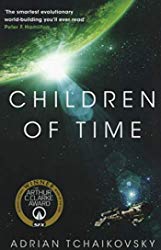
3) Children of Time, by Adrian Tchaikovsky – Great combination of loads of different SF themes – the degenerate generation starship, a very non-human civilisation; AIs pushed beyond their limits – and an intricate and well thought out plot with a satisfying ending. Won the Clarke Award in 2016. You can get it here.
2) Tess of the Road, by Rachel Hartman – A great YA novel combining elements of Tess of the d'Urbevilles, with a story of redemption from trauma and travel across a richly imagined landscape. A Lodestar finalist so I didn't review it at the time. You can get it here.
1) Time Was, by Ian McDonald – Fantastic queer romance timeslip war story, tying in lots of lovely detail (both historical and narrative) and building to a conclusion that I didn't quite see coming. Won the BSFA Short Fiction award. You can get it here.


The one you haven't heard of: Cat Country, by Lao She – A very very direct satire on China of the 1930s, portrayed as a country on the planet Mars inhabited by cat people. You can get it here.

The one you can skip: Heartspell, by Blaine Anderson – A pretty rubbish example of the Celtic misht subgenre, where manly men fight battles and women do womanly druidic magic. In the very first chapter our hero is attacked by a cougar (there are no cougars in Ireland). There are tame wolves (wolves basically cannot be tamed). Ireland's eastern coast is much more rugged than the west (it isn't). Misspellings of Irish names abound. If you want, you can get it here.

| 2019/ | 2018/ | 2017/ | 2016/ | 2015/ | 2014/ | 2013/ | 2012/ | 2011/ | 2010/ | 2009/ |
| 49 | 50 | 57 | 37 | 47 | 48 | 46 | 53 | 69 | 66 | 88 |
| 21% | 19% | 24% | 17% | 16% | 16% | 19% | 20% | 23% | 24% | 26% |
Again, squarely in the middle of the historical range.
My top three non-fiction books of 2019:
3) Berlin Calling: A Story of Anarchy, Music, The Wall, and the Birth of the New Berlin, by Paul Hockenos – It's always good when someone you like writes a book you like about a subject you like. This is about West and East Berlin before the fall of the Wall, and the early years of reunification, and music. You can get it here.
2) Astounding: John W. Campbell, Isaac Asimov, Robert A. Heinlein, L. Ron Hubbard, and the Golden Age of Science Fiction, by Alec Nevala-Lee – Great book about the men who made the Golden Age of science fiction, warts and all; a Hugo finalist which I therefore didn't review. You can get it here.
1) Alarums and Excursions: Improvising Politics on the European Stage, by Luuk van Middelaar – A tremendously lucid look at the weaknesses of the EU's internal architecture, and the possible ways forward. You can get it here.


The one you haven't heard of: Cycling in Victorian Ireland by Brian Griffin – A short but comprehensive book about the evolution of cycling from upper-middle-class fad to a mechanism to erode patriarchal and class oppression in late nineteenth-century Ireland. You can get it here.

The one you can skip: Adventures in Kate Bush and Theory by Deborah M. Withers – A jargon-filled PhD thesis which makes a fascinating subject dull. If you want, you can get it here.

| 2019/ | 2018/ | 2017/ | 2016/ | 2015/ | 2014/ | 2013/ | 2012/ | 2011/ | 2010/ | 2009/ |
| 45 | 36 | 26 | 28 | 42 | 41 | 44 | 48 | 48 | 50 | 57 |
| 19% | 14% | 11% | 13% | 14% | 14% | 19% | 19% | 16% | 18% | 18% |
Quite a high percentage, swelled by hitting the non-genre fiction part of various TBR piles.
My top three non-genre fiction books of 2019:
3) A Little Life, by Hanya Yanagihara – It's a tough read but a very good one, about four friends, one of whom is deeply damaged. The whole scenario is delicately and sympathetically observed. You can get it here.
2) The Paying Guests, by Sarah Waters – It's 1922. Frances and her mother take in Lilian and Leonard as lodgers; there is a restrained clash of cultures – and then romance, and then murder. Frances as the viewpoint character is tremendously sympathetic even when she does things that are fundamentally not very nice. You can get it here.
1) Girl, Woman, Other, by Bernardine Evaristo – A huge range of characters across contemporary London (with some flashbacks to earlier times and other places), almost all women, almost all black, all telling their stories from their own perspective, but often those stories intersect and overlap, and we see the same relationships from different angles. Great ending. You can get it here.


The one you haven't heard of: In Another Light by Andrew Greig – Great novel cutting back and forth between 2004 Britain (mostly Orkney with bits of London and elsewhere) and 1930s Malaya, both of them vividly portrayed. You can get it here.

The one you can skip: Alina by Jason Johnson – A badly written book about unpleasant people in Northern Ireland and Romania. If you want, you can get it here.

| 2019/ | 2018/ | 2017/ | 2016/ | 2015/ | 2014/ | 2013/ | 2012/ | 2011/ | 2010/ | 2009/ |
| 31 | 28 | 29 | 27 | 18 | 19 | 30 | 21 | 27 | 18 | 28 |
| 13% | 11% | 12% | 13% | 6% | 7% | 13% | 8% | 9% | 6% | 8% |
An all-time high, partly due to Hugos and Retro Hugos, partly also because of more Doctor Who comics coming through the system, and a couple of re-reading projects which are detailed below.
My top three comics of 2019:
3) The Berlin Trilogy, by Jason Lutes – A tremendously well-done story of Berlin from 1928 to 1933, seen by just a few people caught up in the wider politics of the times. You can get volume 1 here, volume 2 here, volume 3 here, and (my recommendation) the whole lot here.


2) Paper Girls, by Brian K. Vaughan and Cliff Chiang – An everyday story of four 12-year-olds delivering newspapers in 1988 in Cleveland, Ohio, all from different ethnic backgrounds, who get swept up into a mysterious time war which takes them to the future and past, both near and far. You can get the six volumes here, here, here, here, here and here.


1) Saga, vol. 9, by Brian K. Vaughan (again) and Fiona Staples. I've been following this story of angel-girl and devil-boy In Space for years, and the latest novel brings us to a spectacular climax, at least for now. I understand that the authors are pausing before the next one, which is frustrating but understandable. You can get it here.

The one you haven't heard of: Animate Europe +, by David Shaw, Marta Okrasko, Juliana Penkova, Bruno Cordoba and Paul Rietzl – Shortlisted entries from this year's International Comics Competition on European themes, run by the Brussels office of the Friedrich Naumann Stiftung. You can get it here (for free).

The one you can skip: Frédégonde, La sanguinaire, by Virginie Greiner and Alessia de Vincenzi – In fairness, the first volume is fine, but the second is poorly paced and most crucially fails to finish telling the story. You can get get vol 1 here and vol 2 here, but only in French (I think there is a Dutch translation, but not English).


| 2019/ | 2018/ | 2017/ | 2016/ | 2015/ | 2014/ | 2013/ | 2012/ | 2011/ | 2010/ | 2009/ |
| 32 | 32 | 51 | 39 | 43 | 59 | 72 | 75 | 80 | 71 | 70 |
| 14% | 12% | 21% | 18% | 15% | 20% | 30% | 29% | 27% | 26% | 19% |
Same number of Who books as last year, but a higher percentage because fewer books overall. Basically I have read almost all the Who books that there are – just a few spinoff lines to catch up with.
My top Doctor Who books of 2019, including non-fiction:
3) The autobiographies, and one biography – of John Leeson (buy), Mary Tamm (v1 review, buyv2 review, buy), Robert Holmes (buy), Matthew Waterhouse (buy), Peter Davison (buy), Andrew Cartmel (buy), and Christopher Eccleston (buy). That's roughly the increasing order of quality and interest, Eccleston's being much the best (not yet reviewed here) – not that Leeson's is terrible, mind you.


2) Two particularly gorgeous handbooks from 2010 and 2014 respectively, The TARDIS Handbook by Steve Tribe and The Secret Lives of Monsters by Justin Richards. A lot of thought and effort has gone into these, and it shows. You can get The Tardis Handbook here and The Secret Lives of Monsters here.


1) I haven't reviewed this yet online, but The Target Storybook, edited by Steve Cole with stories by Joy Wilkinson, Simon Guerrier, the much-missed Terrance Dicks, Matthew Sweet, Susie Day, Matthew "Adric" Waterhouse, Colin "Sixth Doctor" Baker, Mike Tucker, Cole himself, George Mann, Una McCormack, Jenny T Colgan, Jacqueline Rayner, Beverly Sanford and Vinay Patel is a total delight. You can get it here.

The one you haven't heard of: In Time, ed. Xanna Eve Chown, the last to date of the Bernice Summerfield spinoff books from Big Finish, this one an anthology with some very good stories (which, alas, will be mostly lost on those not familiar with Benny's continuity). You can get it here.

The one you can skip: Eric Saward's novelisation of Resurrection of the Daleks. For completists only. If you want, you can get it here.

Pygmalion, by George Bernard Shaw, is much much better than Faustus Kelly, by Flann O'Brien. You can get Pygmalion here and Faustus Kelly here.


My Book of the Year
No hesitation at all in naming my Best New Book of 2019 as Girl, Woman, Other, by Bernardine Evaristo. It won the Man Booker Prize jointly with Margaret Atwood's The Testaments, which is also high on my reading list for 2020. But I also enjoyed revisiting The Dispossessed, by Ursula K. Le Guin.

2003 (2 months): The Separation, by Christopher Priest.
2004: The Lord of the Rings, by J.R.R. Tolkien (reread).
– Best new read: Samuel Pepys: The Unequalled Self, by Claire Tomalin
2005: The Island at the Centre of the World, by Russell Shorto
2006: Lost Lives: The stories of the men, women and children who died as a result of the Northern Ireland troubles, by David McKittrick, Seamus Kelters, Brian Feeney, Chris Thornton and David McVea
2007: Fun Home, by Alison Bechdel
2008: The Diary of a Young Girl: The Definitive Edition, by Anne Frank (reread)
– Best new read: Vanity Fair: A Novel without a Hero, by William Makepeace Thackeray
2009: Hamlet, by William Shakespeare (had seen it on stage previously)
– Best new read: Persepolis 2: the Story of a Return, by Marjane Satrapi (first volume just pipped by Samuel Pepys in 2004)
2010: The Bloody Sunday Report, by Lord Savile et al.
2011: The Decline and Fall of the Roman Empire, by Edward Gibbon (started in 2009!)
2012: The Tenant of Wildfell Hall, by Anne Brontë
2013: A Room of One's Own, by Virginia Woolf
2014: Homage to Catalonia, by George Orwell
2015: collectively, the Arthur C. Clarke Award shortlist, in particular the winner, Station Eleven, by Emily St John Mandel. However I did not actually blog about these, being one of the judges at the time.
– Best book I actually blogged about: The Life and Death of Mary Wollstonecraft, by Claire Tomalin
2016: Alice in Sunderland, by Bryan Talbot
2017: Common People: The History of an English Family, by Alison Light
2018: Factfulness, by Hans Rosling
Tuesday and December books roundup
Current
Seraphina, by Rachel Hartman
Exhalation, by Ted Chiang
Last books finished
The Widows of Malabar Hill, by Sujata Massey
Doctor Who: The Target Storybook, ed. Steve Cole
Dragonworld, by Byron Preiss (did not finish)
The Story of the Trapp Family Singers, by Maria Augusta Trapp
The Rule of the Land: Walking Ireland’s Border, by Garrett Carr
I Love the Bones of You: My Father And The Making Of Me by Christopher Eccleston
December Books
Non-fiction: 4 (2019 total 49)
Western Sahara: War, Nationalism and Conflict Irresolution, by Stephen Zunes and Jacob Mundy
The Story of the Trapp Family Singers, by Maria Augusta Trapp
The Rule of the Land: Walking Ireland’s Border, by Garrett Carr
I Love the Bones of You: My Father And The Making Of Me by Christopher Eccleston


Fiction (non-sf): 5 (2019 total 46)
Girl, Woman, Other, by Bernardine Evaristo
The Three Musketeers, by Alexandre Dumas
Hild, by Nicola Griffith
She Was Good-She Was Funny, by David Marusek
The Widows of Malabar Hill, by Sujata Massey


Theatre: 0 (2019 total 2)
sf (non-Who): 4 (2019 total 77)
My Morning Glory and other flashes of absurd science fiction, by David Marusek
Being Human: Bad Blood, by James Goss
Being Human: Chasers, by Mark Michalowski
Dragonworld, by Byron Preiss (did not finish)


Doctor Who, etc: 4 (2018 total 32)
Revelation of the Daleks, by Eric Saward
Revelation of the Daleks, by Jon Preddle
Wildthyme Beyond!, by Paul Magrs
Doctor Who: The Target Storybook, ed. Steve Cole


Comics: 0 (2019 total 31)
~4,600 pages (2019 total ~64,600)
4/16 (2019 total 88/234) by non-male writers (Trapp, Evaristo, Griffith, Massey)
3/16 (2019 total 34/234) by PoC (Dumas, Evaristo, Massey)
2/16 (2019 total 29/218) rereads (The Three Musketeers, Preddle's Revelation of the Daleks)
Coming soon (perhaps):
Demon in Leuven, by Guido Eekhaut
Auguria, Tome 1: Ecce signum, by Peter Nuyten
As Time Goes By, by Joshua Hale Fialkov
"Home is the Hangman", by Roger Zelazny
The Last Days of New Paris, by China Mieville
The Idea of Justice, by Amartya Sen
Unsheltered, by Barbara Kingsolver
The Critique of Pure Reason, by Immanuel Kant
Arc of the Dream, by A. A. Attanasio
A Popular History of Ireland, by Thomas D’Arcy McGee
Hex, by Thomas Olde Heuvelt
Babayaga, by Toby Barlow
Red Notice, by Bill Browder
Excession, by Iain M. Banks
Prophet of Bones, by Ted Kosmatka
A Prayer for Owen Meany, by John Irving
Oathbringer, by Brandon Sanderson
The First Men in the Moon, by H. G. Wells
Small Island, by Andrea Levy
My tweets
- Mon, 12:56: 12 ways that life in Brussels has changed in 10 years https://t.co/pgZWPeQy1s Had you noticed? (Actually, most of t… https://t.co/zME79EcNrI
- Mon, 15:47: July 2004 books https://t.co/IdZj9zapuM
- Mon, 16:05: Children’s fantasy literature of the Oxford School must be read critically. https://t.co/9YBn6fUoxs The connection… https://t.co/CNeAr9FXur
- Mon, 17:11: RT @ProfHansNoel: Knowledge is knowing that there was no year 0, so technically, the new decade begins Jan. 1, 2021, not 2020. Wisdom is…
- Mon, 17:40: Good news for Northern Ireland election fans: the website has now been updated with #GE19 results.… https://t.co/iCaUI93ctW
- Mon, 19:45: RT @andrewirelandHE: I’ll always remember 2019 for Mission to the Unknown. Fab experience – working with @BriggsNicholas, @purves_peter, @J…
- Mon, 20:05: RT @apcoworldwide: The 2020 US presidential election won’t be the only important vote to take place in new year. APCO’s @nwbrux previews fo…
- Mon, 20:09: This comment, from the Advocate General at the Court of Justice of the European Union, should kill any more silly s… https://t.co/3KsLw6uGaJ
- Mon, 20:48: Thread. https://t.co/YqOckq0bkZ
- Mon, 22:13: *jaw drops” RWA latest.
- Mon, 22:41: RT @BamaWriter: i’m not an RWA member, but i *do* have experience in PR & crisis management (and RWA *is* in crisis right now). They need 4…
- Tue, 10:45: RT @juliamacfarlane: One of the greatest privileges of my life was that I was on shift on BBC World that day – this was our show. Behind th…
July 2004 books
July 2004 began and ended with travels for me – beginning with an epic journey by train to Paris, then flying to Berlin, and then Belgrade, then driving from Belgrade to Pristina and Skopje before flying home again via Budapest, a total of six countries in ten days. It was particularly significant because one of my co-speakers at the conference I attended while in Kosovo was to become my next boss two and a half years later; of course neither of us knew that at the time. I also got to London for a day, and was appointed to the Advisory Board of the South East European Research Centre in Thessaloniki (the centre is still going strong, not sure about the board). My intern A, half Slovene, half Geordie, left the Brussels office but went on to do some work for us in the Balkans later in the year. (Her replacement arrived only in August.) And on the last two days of the month we did our usual summer holiday drive to Northern Ireland via Kidderminster. F celebrated his fifth birthday with schoolfriends – the first time we had had a kids' birthday party, which was nice. I don’t seem to have any pictures of the party, but here’s B up a tree in our back garden, and F and U with me on a visit to Mini-Europe.


Non-fiction 5 (YTD 26)
Saki: A Life of Hector Hugh Munro, with six short stories never before collected, by A. J. Langguth
A Narrative About War And Freedom: Dialog with the commander Ramush Haradinaj, by Bardh Hamzaj
J.R.R. Tolkien: Author of the Century, by Tom Shippey
The Politics of Serbia in the 1990s, by Robert Thomas
The Story of Alice, by Mavis Batey
SF 6 (TYD 41)
The Holy Machine, by Chris Beckett
Newton's Wake, by Ken MacLeod
The Human Abstract, by George Mann
Cartomancy, by Mary Gentle
The Door into Summer, by Robert A. Heinlein
River of Gods, by Ian McDonald
Comics 1 (YTD 2)
The Complete Maus, by Art Spiegelman
3,700 pages (YTD 26,900)
2/12 by women (YTD 19/78)
none by PoC (YTD 1/78)
Links above to my reviews, links below to Amazon.
My two top books of the month are Spiegelman's classic Holocaust comic Maus, which you can get here, and Shippey's brilliant book on Tolkien, which you can get here. At the other end, I am not a fan of George Mann's writing anyway, and The Human Abstract, which you can get here, is my least favourite of his books.


My tweets
- Sun, 12:56: Alan Bennett’s 2019 Diary https://t.co/5Xa1TFwS0Q Glorious as ever.
- Sun, 14:48: Obituary: Fleet Street veteran Paul Eccleston, 1951-2019 https://t.co/AdQAXiJnns Christopher Eccleston’s uncle, who… https://t.co/dDDilHyjJv
- Sun, 16:05: RT @andrewteale: I much enjoyed this review of The Sound of Music, which goes into a bit of detail about the film’s unseen character: the C…
- Sun, 20:48: RT @RomancingNope: To recap #IStandWithCourtney: 1) Sue Grimshaw liked a bunch of real racist shit on Twitter. Some romance authors notice…
- Mon, 09:47: Another must-read thread from @pmdfoster. https://t.co/SUj4Q1kRJT
- Mon, 10:45: Awww!!! https://t.co/V1Zx3Mb7qA
My tweets
- Sat, 15:39: The Sound of Music (1964) and The Story of the Trapp Family Singers (1949) https://t.co/HWzryENJvZ
- Sat, 15:50: The Three Musketeers, by Alexander Dumas https://t.co/9fjM70puxa
- Sat, 16:14: RT @ChuckTingle: folks say they know chuck. part of this is making up clever story (all not true and all very rude) to say ‘chuck is not ca…
- Sat, 16:47: RT @rmc28: When I read this back in April I bought a book by every named author of colour in it, on the assumption they were going to get b…
- Sat, 18:11: “She Was Good-She Was Funny”, and My Morning Glory etc, by David Marusek https://t.co/4xjNKqfFKw #bookblog2019
- Sat, 19:49: RT @MandaCollins: Just a reminder we’re in this whole RWA mess b/c WOC called out a publisher, 1 of her writers, and an editor for racism &…
- Sat, 20:01: My week on Twitter : 18 Mentions, 11.2K Mention Reach, 166 Likes, 37 Retweets, 174K Retweet Reach. See yours with… https://t.co/HDFdMSqgEa
- Sat, 20:48: America Is Still Living in the 2000s https://t.co/PUD0F7PgY5 And I can’t blame anyone for that.
- Sun, 00:03: I’m not sure which bit of the RWA kerfuffle is crazier: That a writers association took action *against* a writer… https://t.co/K3ELQPo0lK
- Sun, 08:09: RT @neilhimself: When Chuck Tingle calls you out, you’ve been called out… https://t.co/o6nPz0kkwG
- Sun, 10:45: RT @SportIsARight: So if I read the stats right, only 0.27% of trans people ‘de-transition,’ and 95% of THOSE only did so because of social…
- Sun, 11:04: I just published Why ћ and ħ are different from ℏ https://t.co/RrtJQKLi4O
“She Was Good-She Was Funny”, and My Morning Glory etc, by David Marusek
Third para of "She Was Good-She Was Funny":
In the meantime there was plenty to do. Walt hauled water uphill by sled from a hole he had chopped in the lake. He split and stacked firewood. He shoveled snow from his rather lengthy driveway. He taught himself to cross-country ski and visited his few and odd neighbors.
Second para of third story in My Morning Glory and other flashes of absurd science fiction:
“My man,” he says, sliding into the booth. “Where’s Vera?”
Two very short collections by David Marusek (who I met when we were room-mates for the 2004 Worldcon in Glasgow). "She Was Good-She Was Funny" is a Playboy short story about a guy in Alaska (where Marusek lives) who has a fight with his neighbour about a girl; OK but not remarkable. You can get it here.
The three very short pieces in My Morning Glory and other flashes of absurd science fiction are all sparkling, though – each takes a single sf idea and just develops it for a few pages. They were all originally published in Nature. You can get them here.
These were the shortest books on my pile acquired in 2012. Next, if I can find it, the 2012 Doctor Who Annual.
The Three Musketeers, by Alexander Dumas
Second and third paragraphs of third chapter:
— Athos ! Porthos ! Aramis !
Les deux mousquetaires avec lesquels nous avons déjà fait connaissance et qui répondaient aux deux derniers de ces trois noms, quittèrent aussitôt les groupes dont ils faisaient partie et s’avancèrent vers le cabinet, dont la porte se referma derrière eux dès qu’ils en eurent franchi le seuil. Leur contenance, bien qu’elle ne fût pas tout-à-fait tranquille, excita cependant, par son laisser-aller à la fois plein de dignité et de soumission, l’admiration de d’Artagnan, qui voyait dans ces hommes des demi-dieux, et dans leur chef un Jupiter olympien armé de toutes ses foudres.“Athos! Porthos! Aramis!”
The two musketeers whose acquaintance we have already made, and who answered to the last two of these three names, immediately left the groups they were part of and advanced towards the office, the door of which closed behind them the moment they not entirely calm, still aroused d’Artagnan’s admiration by its casualness, which was at once full of dignity and of submission. He saw these men as demigods and their chief as an Olympian Jupiter armed with all his thunderbolts.
Well, this was a welcome revisiting of a past favourite. I first read it aged about eight, in an abridged version with all the sex taken out (which makes some of the plot twists even less comprehensible), and came back to it as an undergraduate in a more complete version. It's full of exciting fights and journeys, to England, to the siege of La Rochelle, to the palaces of the King and Queen and the Cardinal, and D'Artagnan, our hero, and the three musketeers of the title are all well enough delineated, cardboard with some decent background colour.
The big flaw is in the background and fate of Milady de Winter, the chief villainess. Aged only 22, she has already married Athos and (as far as he knows) been killed by him in retribution of dishonour, and yet also managed to marry de Winter's brother and become a trusted agent of the Cardinal despite her criminal record. It's a bit reminiscent of Patrick Ward in the Bloody Sunday Report. On top of this, the poor woman is subjected to summary execution by three men who she has wronged (two of whom have already tried to kill her), a deadly act given legitimacy by Porthos and Aramis, with the plausible deniability of actually beheading her in Belgium rather than France. I mean, she's not a nice person – the attempted poisoning of our heroes is a nasty thing to do – but one cannot really feel that she has been given justice. (I do like the transgender theory.)
And D'Artagnan's love life is barely coherent. He spent most of the book longing for Constance Bonacieux, who he has met about twice. He manages to deceive Milady into thinking he is the Comte des Wardes (how can she possibly make this mistake?) and his only really successful liaison with with Milady's maid Kitty, where they obviously have raucously glorious sex, even though he is using her for access to her boss (and she knows this deep down). It's a bit unpleasant to be honest, but also not all that convincing.
Still, the book really does succeed in evoking a complex political society in which young men thrash about violently and the real power-brokers try to shape their impulses to political ends. It has its internal inconsistencies but in the end it is generally great fun. You can get it here.
I think I've seen two versions of it on film – the 1973 one with Spike Milligan as Bonacieux
and the 1993 one with Tim Curry as the Cardinal.
This was the top book on my shelves that I had not already reviewed online. Next up is A Prayer for Owen Meany, by John Irving.
The Sound of Music (1965) and The Story of the Trapp Family Singers (1949)
The Sound of Music won the Oscar for Best Picture of 1965, and picked up another four: Best Director (Robert Wise), Best Music (Irwin Kostal), Best Sound Recording and Best Film Editing. Doctor Zhivago also won five Oscars that year, beating The Sound of Music for three of them.

The other Best Picture nominees were Darling, Doctor Zhivago, Ship of Fools and A Thousand Clowns, none of which I have seen. For once, IMDB users agree with the Oscar voters, with The Sound of Music on top of one ranking and second to For A Few Dollars More on the other. I haven’t seen For A Few Dollars More, but I have seen a half-dozen other films from 1964: Thunderball, Help!, The Ipcress File, Those Magnificent Men in their Flying Machines, Dr Who and the Daleks and The Monkey’s Uncle (mostly from Saturday TV in the olden days). I must say I am aligned with both the Oscar voters and IMDB users; The Sound of Music is the best of the lot. In the improbable case that you are not familiar with it, here’s a trailer.
You know what it’s about, but I’ll remind you anyway. Julie Andrews plays trainee nun Maria, who is sent as governess to Captain von Trapp (who has some surprisingly mature children for a man of his apparent age). She erodes his gritty reserve and they fall in love. Then, in a swerve from family drama to global affairs, Nazi Germany annexes their country, von Trapp escapes conscription into the Third Reich navy and they flee across the mountains to Switzerland.
And, well, it’s just brilliant (such a relief after I found that My Fair Lady had aged rather badly). There’s one minus point that I will come to, but in general I loved rewatching it. It’s going right to the top of my list – well, in second place behind Casablanca, which is also about resisting the Nazis and has a more compelling plot, but ahead of An American in Paris, which despite the lovely music, doesn’t do much for its women characters. In particular, I appreciated the emancipatory lyrics of “Climb Ev’ry Mountain”, not a revolutionary song, but still one which calls for self-belief and personal ambition. It is the climax of the film, of course, but it’s introduced by the Reverend Mother challenging Maria to live for herself.
https://www.youtube.com/watch?v=RKuqySkqhHw
(The Liberal Democrats have a version of this which applies to election campaigns.)
We have two returnees from previous Oscar-winning films. Anna Lee, who played Bronwen in How Green Was My Valley twenty-three years ago, is Sister Margarethe here. (She has barely changed!)


And Norma Varden, whose husband got pickpocketed in Casablanca twenty-one years ago, returns as Frau Schmidt, the Captain’s housekeeper.


One important returner who we have not in fact previously seen is Marni Nixon, who dubbed the principals in both West Side Story and My Fair Lady, but here is allowed to appear in the flesh (because Julie Andrews did not need to be dubbed).

I mentioned that there is one negative point. I’m afraid it’s our old friend whitewashing. To my surprise, the original book recalls a very friendly encounter between the von Trapp family while they were still in Austria and the great American singer Marian Anderson. OK, the film considerably truncates the family’s singing career in Austria, but it should be noted that one of the elements of the story that was thus excised was an actual meeting with a black woman musician. (More than half of the book is about their lives in America, and they have plenty of encounters with people of colour.)
But otherwise, it’s sheer joy. I’m going to give a particular shout-out to Charmian Carr, aged 22 and playing 16-year-old Liesl, who is by far the best performer of the kids but lets the others all get their turn, apart of course from her own song.
Incidentally the real eldest daughter, whose name was Agathe not Liesl, was gay and ran a kindergarten in Maryland for many years with her partner.
And there’s the completely bonkers “Lonely Goatherd”, which certainly gave me as a child the completely false idea that you could knock together a puppet show perfomance in a wet afternoon.
The settings of Salzburg and the Alps are mercilessly exploited. Here’s the picnic scene in Do-Re-Mi (where the kids are wearing clothes that Maria has whipped up from curtains ovenight):
The best songs get repeated in a slightly different context. “My Favourite Things” marks both turning points for Maria’s relationship with the children, when she bonds with them and when she comes back.
The songs can also distract from just how well the film is directed and acted. I give you the dance of Maria and the Captain (my friend points out that Maria is the only one at the party who doesn’t have a full-length dress), illustrating also the talents of Julie Andrews and Christopher Plummer in the lead roles:
And “Something Good”, a less memorable song, gets some memorable cinematography:
And I must say that my curmudgeonly cynical soul was moved to tears at the moment when the Captain’s heart is melted by his children’s singing.
It’s all fantastic, really.
The Sound of Music has totally permeated our culture. Here’s a flashmob at Antwerp Central station perfoming Do-Re-Mi to the bemusement of commuters:
Here’s Lady Gaga with an extraordinary performance of selections from The Sound of Music at the 2015 Oscars – particularly worth it for the moment at 4:29 just after she finishes, looks into the wings and realises what’s happening next.
Also in 2015, infamous Slovenian industrial rock group Laibach performed two concerts in North Korea, including mostly songs from The Sound of Music, which is used for teaching English in the DPRK. There is of course an album, and several songs are available on Youtube (including the title song and “Lonely Goatherd”). The littlest of the girls in their “So Long, Farewell” is the daughter of a friend of mine (she’s also in “My Favourite Things”).
Well. My next Oscar-winning film takes me back to Merrie England with A Man for All Seasons. I don’t anticipate it being as much fun.
Maria von Trapp’s relationship with the movie was complex and intimate. Famously, she was not invited to the premiere, even though she and two of her daughters make a brief cameo appearance in “I Have Confidence”.

However, she was sufficiently laid back to teach Julie Andrews how to yodel.
The movie was based on her book, The Story of the Trapp Family Singers, which came out in 1949. Here’s the second paragraph of the third chapter:
Desperate, I looked for help.
Actually only the first part of the book deals with their time in Austria; the rest is about their experiences in America. Neither book nor film explains much about Maria’s own background – apparently both her parents died by the time she was ten, and various other arrangements did not work out; she did get a professional teaching qualification before entering the convent.
The major change to the story is the telescoping of time. Maria and Georg married in 1927, when he was 47 and she was 22 (when the film was made, Julie Andrews was 29 and Christopher Plummer 35); over the next ten years the family became noted performers, especially when most of their money was wiped out in a bank crash and they needed the income; Maria had three more children to add to the seven from the first marriage; the turning point when they decided to flee was after they were invited to sing for Hitler on his birthday after the Anschluss, and knew that they could not bring themselves to do it but also could not stay in the Reich if they said no. And they fled to Italy, where Georg von Trapp had citizenship due to havig been born in Zara when it was Austrian (it was then Italian and is now the Croatian city of Zadar).
Most of the story about her romance with Georg von Trapp is consistent between the book and the musical/film, and a lot of the little details about life in the Trapp household are taken from the book. Maria’s rival for Trapp’s affections is described as “Princess Yvonne”, a distant cousin of the first Mrs Trapp, and by implication of Austro-Hungarian nobility. I have done a bit of detective work on this. The first Mrs Trapp was born Agatha Whitehead, into a family of British naval engineers who moved to the Austro-Hungarian coast (now in Croatia) – her grandfather invented the torpedo, and his son carried on the work. Her mother was an Austro-Hungarian aristocrat, who would have had many eligible nieces and cousins I suppose; also her father’s sister married Georg von Hoyos, her cousin was the diplomat Alexander von Hoyos, and there are plenty of candidates on that side as well (I see an Ilona who would be the right age and is almost “Yvonne”). Incidentally Georg von Trapp was a submarine captain, and personally sank eleven Allied ships in the first world war, six of them British; we don’t hear much about that.
The book is frank about the problems of impoverished gentility and very direct about the plight of refugees trying to get permanent status in the USA – it is of course inhumanly difficult now, but it wasn’t all that easy back then even for nice white people. Maria is also very up front about her personal piety and devotion to the Catholic faith – it’s entirely consistent with the story of her vocation, and it’s an element that is only alluded to as background colour in the film.
It’s a celebrity memoir, written for fans, but also I feel putting down on paper the stories that Maria had told her friends and family over many years. She finishes with reflections on the fundraising that the family had done for humanitarian relief in Austria after the war ended, an emotional but also super-organisational task, and on Georg’s death from lung cancer in 1947 on the Vermont farm that the family set up as first a refuge and then a business, and which is still run by the grandchildren. Their legacy remains strong. You can get the book here.
Winners of the Oscar for Best Picture
1920s: Wings (1927-28) | The Broadway Melody (1928-29)
1930s: All Quiet on the Western Front (1929-30) | Cimarron (1930-31) | Grand Hotel (1931-32) | Cavalcade (1932-33) | It Happened One Night (1934) | Mutiny on the Bounty (1935, and books) | The Great Ziegfeld (1936) | The Life of Emile Zola (1937) | You Can’t Take It with You (1938) | Gone with the Wind (1939, and book)
1940s: Rebecca (1940) | How Green Was My Valley (1941) | Mrs. Miniver (1942) | Casablanca (1943) | Going My Way (1944) | The Lost Weekend (1945) | The Best Years of Our Lives (1946) | Gentleman’s Agreement (1947) | Hamlet (1948) | All the King’s Men (1949)
1950s: All About Eve (1950) | An American in Paris (1951) | The Greatest Show on Earth (1952) | From Here to Eternity (1953) | On The Waterfront (1954, and book) | Marty (1955) | Around the World in 80 Days (1956) | The Bridge on the River Kwai (1957) | Gigi (1958) | Ben-Hur (1959)
1960s: The Apartment (1960) | West Side Story (1961) | Lawrence of Arabia (1962) | Tom Jones (1963) | My Fair Lady (1964) | The Sound of Music (1965) | A Man for All Seasons (1966) | In the Heat of the Night (1967) | Oliver! (1968) | Midnight Cowboy (1969)
1970s: Patton (1970) | The French Connection (1971) | The Godfather (1972) | The Sting (1973) | The Godfather, Part II (1974) | One Flew Over the Cuckoo’s Nest (1975) | Rocky (1976) | Annie Hall (1977) | The Deer Hunter (1978) | Kramer vs. Kramer (1979)
1980s: Ordinary People (1980) | Chariots of Fire (1981) | Gandhi (1982) | Terms of Endearment (1983) | Amadeus (1984) | Out of Africa (1985) | Platoon (1986) | The Last Emperor (1987) | Rain Man (1988) | Driving Miss Daisy (1989)
1990s: Dances With Wolves (1990) | The Silence of the Lambs (1991) | Unforgiven (1992) | Schindler’s List (1993) | Forrest Gump (1994) | Braveheart (1995) | The English Patient (1996) | Titanic (1997) | Shakespeare in Love (1998) | American Beauty (1999)
21st century: Gladiator (2000) | A Beautiful Mind (2001) | Chicago (2002) | The Lord of the Rings: The Return of the King (2003) | Million Dollar Baby (2004, and book) | Crash (2005) | The Departed (2006) | No Country for Old Men (2007) | Slumdog Millionaire (2008) | The Hurt Locker (2009)
2010s: The King’s Speech (2010) | The Artist (2011) | Argo (2012) | 12 Years a Slave (2013) | Birdman (2014) | Spotlight (2015) | Moonlight (2016) | The Shape of Water (2017) | Green Book (2018) | Parasite (2019)
2020s: Nomadland (2020) | CODA (2021) | Everything Everywhere All at Once (2022) | Oppenheimer (2023)
My tweets
- Fri, 15:27: The monuments of Laeken cemetery, especially those by Ernest Salu https://t.co/nf1v4n4n1c
- Fri, 18:11: Revelation of the Daleks: novelisations by Eric Saward and Jon Preddle https://t.co/V1r8pvUT5A
- Fri, 18:54: RT @kateheartfield: Overall I find Wikipedia really useful for a historical fiction writer, but last night around 2 a.m. I discovered what…
- Fri, 20:48: RT @eugenewei: The original Blade runner was set in 2019, and wow did it ever nail some predictions about life today! https://t.co/8AKCQdrx…
- Sat, 11:13: Fifty shades of white: the long fight against racism in romance novels | Books | The Guardian – published in April,… https://t.co/ZoUw7CLihD
- Sat, 11:45: RT @ChuckTingle: here is link. i am not afraid to say this is a devilman way because i am many things but writing partners is not one. damo…
Revelation of the Daleks: novelisations by Eric Saward and Jon Preddle
Second to fifth paragraphs of third chapter of Eric Saward's novelisation:
'You were mistaken,' said Grigory.
Natasha tugged at the body-bag. 'Unwrap him.'
'Are you sure you want to see this?'
'There is no other way of proving he's actually here.'
Second paragraph of third chapter of Jon Preddle's novelisation:
Grigory took a hand-scanner from his case and held it over the shrouded body. The scanner sounded a loud beep as it registered a humanoid form.
The very last of the Old Who stories to receive official novelisation treatment, Revelation of the Daleks has now been written up by its author, Eric Saward, a mere thirty-four years after its first broadcast. Fannish imagination will always fill a vacuum, and as I did with Resurrection of the Daleks a couple of months ago, I read it along with the unofficial novelisation (this time by Jon Preddle) from 1992.
This is what I wrote when I first watched Revelation of the Daleks in 2007:
When I expressed the view that none of the Sixth Doctor stories was any good at all,
, , and all recommended I try Revelation of the Daleks (with mild dissent from and ). The Dynamic Doctor Who Rankings page currently has Revelation of the Daleks at a princely 51st out of 200 stories ranked, better by far than any other Sixth Doctor story – The Two Doctors is now at 100th place, and Vengeance on Varos at 102nd, while The Twin Dilemma has rather surprisingly been shifted from last place in the list by Daleks In Manhattan and Evolution of the Daleks, presumably by voters who have not actually seen The Twin Dilemma themselves. I realised that I'm a bit out of phase with Davros' history – I have seen Genesis of the Daleks many times, and was then rather baffled by Remembrance of the Daleks (which is this month's pick on
), but have not seen either Destiny of the Daleks or Resurrection of the Daleks. I'm also not well up on the Sixth Doctor generally – I think I saw The Twin Dilemma, Vengeance on Varos and The Two Doctors when first broadcast, and this is the first of his stories I have watched since. (I must add the standard rider – "but the audio adventures are so much better" – because on the whole they are, especially the ones with companion Evelyn Smythe.) I don't think it matters. This is almost a 1985 version of the more recent "Doctor-lite" episodes, with him and Peri not really there much, and Davros playing a role which is incomprehensible given his past and future as we know it. If you can overlook the huge plot flaw of Davros feeding the entire galaxy with the corpses of a few rich people, it's very well done, with various different factions of characters motivated for different reasons. In fact it's odd to consider that this was a time when, despite the generally lousy production values, really big names wanted to appear on Doctor Who – here we have Alexei Sayle, Eleanor Bron, Clive Swift (Hyacinth's husband in Keeping Up Appearances), and William Gaunt (who I can't remember seeing in anything else, but he is very good here). Shame about Jenny Tomasin but you can't have everything.
So, basically, I liked this – not a great story, but at least a good one, and definitely under-rated.
And this is what I wrote when I rewatched it in 2011:
I do agree with those who see Revelation of the Daleks as one of the best Sixth Doctor stories. It is full of fun stuff to watch – the Kara/Vogel interaction, the Jobel / Tasambeker relationship, Grigory and Natasha, and of course the DJ. And the fundamentals of the plot are fairly sound by the standards of this period of Who; it is the first time, I think, that we have seen the Daleks attempting to propagate their race by converting humans, though Terry Nation had hinted at this in one of the Dalek Annuals. It is a bit odd that the Doctor and Peri are present for so little of the action, and someone less kind than me would say that that is one of the story's strengths.
And on first reading the Jon Preddle novelisation in 2008, I wrote this:
This is the last of the New Zealand fan-produced novelisations (apart from the one of City of Death which I haven't yet got hold of). Preddle says in his introduction that there are two ways of doing these books, the right way and the Terrance Dicks way, and he is conscious of having gone for the latter option. This isn't really fair on Terrance Dicks, who is a more than competent writer when on form, or indeed to Preddle himself, who has turned in quite a reasonable adaptation of what was a decent enough story to begin with, with extra characterisation of the Happy Repose setup (and unhampered by one particular rather weak performance).
Unlike Resurrection of the Daleks, I felt sufficient confident in my memory of the TV story to feel that I could judge the novels without rewatching it again. (Also, I was busy watching Blake's 7.) Here, for a quick comparison of the two styles, are the two versions of the cliffhanger:
Saward Preddle It was then Peri saw the statue of the Doctor starting to oscillate. At first, she thought it was a hallucination, but on closer examination she saw it was definitely sliding, swinging, swaying.
'Doctor!' she called desperately, but again he didn't hear her.
The sculpture was now on the verge of toppling.
'Doctor! Look at the statue! It's moving!'
Still the unhearing Time Lord remained transfixed.
The statue was now tilting further forward.
'DOCTOR!'
The massive stone rolled forward and under the effects of gravity collapsed onto the Time Lord.
It was sad that such a beautifully carved piece of stone had been turned into a weapon of death.Then she blinked. Had the statue moved? No, surely not. Probably just the reflection of the sun in the pond. But as she looked again, she could see that the tall stone was moving… it was tipping over – and the Doctor was standing right in its path! ‘Doctor! Look out – the statue!’ she shouted.
Her cries brought the Time Lord back to reality. He looked up to see his stone twin looming over him like an angel of death. He held up his hands to protect himself, but it was too late.
With a loud crash, the stone doppelganger claimed its victim…
Neither of these is Great Literature, but on the other hand this is a better, more coherent story than Resurrection of the Daleks (even if the plot is basically resolved by killing almost all of the other characters) and these are therefore both better novels for it. Saward for once has dialled down his writing style, and cranked up his concentration on character and giving his fictional world a bit more in-universe context, to the point that this is actually a pretty readable book. Preddle’s earlier work is also a decent effort, without the depth that Saward brings to it but perhaps a bit more emotional empathy. These are for completists only, but not too embarrassing. You can get the Saward novelisation here, and the Preddle version here.
The monuments of Laeken cemetery, especially those by Ernest Salu
The other half of yesterday’s trip was to inspect Laeken cemetery in northwestern Brussels. There is a cluster of spectacular monuments close to the church by one or other of the three generations of sculptor who shared the name Ernest Salu; the founder of the line lived from 1846-1923 and started his funerary business in the 1870s; his son lived 1885-1980 and I think must have been responsible for the best of the monuments; and the last Ernest Salu lived 1909-1987, clsoing the business in the 1980s more than a century after his grandfather had started it.
The jewel in the collection is this amazing monument to Max Pelgrims, son of the industrialist Eugène Pelgrims, killed in action at the age of 24 in the early days of the First World War (defending Aarschot, not so far from here).

It seems that Eugène Pelgrims and his wife Léonie Dailly had no other children. He survived Max by thirteen years; Léonie outlived him by another twenty.
There are a number of mourning bronze ladies, decorously draped acrodd the tombstones. My favourite is this lady commenorating Jules Denis and his wife Marie Devos. I have not been able to identify them (there is a Jules Denis who was active as an architect in Brussels in the 1880s, but that is too early). He was 47 when he died in 1919; possibly a victiom of the great flu epidemic, or of war injuries? She lived another 44 years without him.

I didn’t note the dates for this lady mourning the Duco-Netels family (of whom I was unable to discover anything else) but she’s clearly a bit more Art Deco from the style of the letters, so perhaps about ten years after the Denis-Devos tomb. Unlike most of the others, she is standing up thoughtfully.

General Storms, a leader of the brutal colonial enterprise in the Congo, was already familiar to me from his statue in the Sqaure de Meeûs around the corner from my office. This is a nice framing of what must surely be another Salu bronze.

What is this lady looking at?

It’s not just the resting place of the D’Haeyere family; she’s also right next door to one of the genuine castings of Rodin’s The Thinker. Art collector Jef Dillen bought it in 1927, after the city of Paris decided that it didn’t fit in front of the Pantheon. He ended up underneath it eight years later (he died in 1935).

Back to the Salu sculptures again. This woman with outstretched arms commemorates the Belgian composer and musician Jules-Emile Strauwen. (I’ve enhanced the picture to get the colours properly.)

And a very early Salu sculpture in marble commemorates another musician, the great pianist Marie Pleyel (I love the claws under the casket). Liszt and Berlioz were in love with her, Chopin dedicated Nocturnes to her, but she married Mr Pleyel instead; his family made the pianos on which they all depended. The marriage didn’t last, but she lived on and rests here. She dies in 1875, so must have been one of the first Ernest Salu’s very early customers.

Finally, here’s a carved tree with the title “Cycle of Life and Death”, by the contemporary sculptor Anton Klijnsmit. I’m giving you details of the two figures, presumably Life and Death respectively.


Our tactical mistake was to visit on a Thursday rather than a Saturday or Sunday, when the former workshop of the three Ernest Salus is open to the public. Something to do on a future free weekend.
My tweets
- Thu, 13:04: How to say Merry Christmas in 41 languages, mapped https://t.co/fPe7MFqjrv
- Thu, 13:41: A tale of two cities – a lunch in Brussels, and a dinner in Belfast. About a month ago I was having lunch on Place… https://t.co/FlncPWQ0pZ
- Thu, 17:27: RT @ChrisChapman81: Britbox launched its classic Doctor Who archive today and I find myself strangely proud that our Ice Warrior animation…
- Thu, 17:53: I’ve been watching the Romance Writers of America drama with horrified fascination. It’s not really my genre, but t… https://t.co/QykcJI6wyl
- Thu, 19:57: I went to the “Superheroes Never Die. Comics and Jewish Memories” exhibition at the @MJB_JMB Museum today. It was a… https://t.co/RwBQYE2Hsm
- Thu, 20:48: The Jungle Prince of Delhi https://t.co/A1VIPF5H6d Long read. An extraordinary and sad story.
- Fri, 10:00: A follow-up to yesterday’s thread. https://t.co/NOMKhauyw6
- Fri, 10:19: “Superheroes Never Die. Comics and Jewish Memories” exhibition at the Jewish Museum of Belgium https://t.co/XOMycumcSe
“Superheroes Never Die. Comics and Jewish Memories” exhibition at the Jewish Museum of Belgium
So, I went to the "Superheroes Never Die. Comics and Jewish Memories" exhibition at the Jewish Museum of Belgium yesterday. It was as good as I had hoped, linking the origins of the American comics tradition with the authors' experience of immigration and integration.
There is a particularly interesting moment from 1940 when Superman, taking Adolf Hitler captive, threatens him with "a strictly non-Aryan sock on your jaw".

It was also a bit chilling to see America's knowledge of Belgium in the first world war reflected in a comic of 1914.

There is lots of lovely art.

Also, Batman and Robin now have competition.

You have plenty of time to catch it – it's on until 26 April (my birthday). It's at Rue des Minimes 21, just off the Grand Sablon.
My tweets
- Wed, 21:21: When Salvador Dal� Created Christmas Cards That Were Too Avant Garde for Hallmark (1960) | Open Culture https://t.co/gHw1b9iGPJ
- Thu, 10:45: RT @johnb78: If the courts had declared me to be a massive bigot, I would simply spend Christmas compiling a list of the bigoted things tha…
- Thu, 11:54: RT @DavidOBowles: It’s become popular to deny that the Dual God Ometeotl was ever a thing. Many folks argue that scholar Miguel León-Portil…
My tweets
- Tue, 12:56: RT @chriscurtis94: So I have finally got around to releasing my post election research on why voters left Labour in the election. Much of…
- Tue, 13:42: RT @Julian__West: @nwbrux Still relevant today and still as an effective a rebuttal against the crude “realist” critiques of fantasy that w…
- Tue, 14:48: RT @DaveKeating: Merry Christmas to everyone celebrating. Here’s an interesting fact: Most countries in the world celebrate Christmas as…
- Tue, 15:44: Theodore van Loon’s Adoration of the Shepherds, in PARCUM’s “Silent Witness” exhibition. https://t.co/LUnDuvW0Ef https://t.co/d7wwMJpuv0
- Tue, 18:49: Tuesday reading (last of the year) https://t.co/wugK8REAkW
- Tue, 22:18: RT @Kevin_Maguire: “How Dare Holier-Than-Thou Foreign Child Tell Us What To Do” – Daily Mail. Wicked take in @PrivateEyeNews on how Briti…
- Wed, 09:00: RT @bbcdoctorwho: #MerryChristmas from #DoctorWho ❄️ https://t.co/9rNUhxakKm
- Wed, 10:45: Have a Creepy Little Christmas with These Unsettling Victorian Cards https://t.co/pYQiM6hd5m These are glorious. And strange.
Tuesday reading (last of the year)
I’ll do a reading roundup next Tuesday, but it will be for twelve months, not seven days!
Current
The Widows of Malabar Hill, by Sujata Massey
Doctor Who: The Target Storybook, ed. Steve Cole
Last books finished
Being Human: Bad Blood, by James Goss
Wildthyme Beyond!, by Paul Magrs
Western Sahara: War, Nationalism and Conflict Irresolution, by Stephen Zunes
Being Human: Chasers, by Mark Michalowski
Next books
Dragonworld, by Byron Preiss
Seraphina, by Rachel Hartman
My tweets
- Mon, 12:56: You know, if the polls had been completely wrong, this might have been a good strategy. But the polls weren’t comp… https://t.co/w445TOULIj
- Mon, 14:09: RT @DavidJonesSky: I’m so sorry to have spoiled what was such an important discussion on racism tonight. I had to intervene when Gary sugge…
- Mon, 14:33: RT @antoguerrera: Ps. Afterwards, during my interview with him, #Stormzy elaborated his opinion on racism in Britain and he expressed his n…
- Mon, 15:06: Sci-Fi Short Film “Regulation” https://t.co/me0fvSYuZK via @YouTube Excellent short sf film (12 mins) by Ryan Patch.
- Mon, 16:05: 2 great UK judgements. Chap builds extension, doesn’t tell neighbour. She sues & wins, partly because his lawyer m… https://t.co/dMSrE0YzcR
- Mon, 17:11: The 25 Best TV Episodes Of The Decade (2010 – 2019) https://t.co/4MNTJiiSv4 I had seen precisely three of these (th… https://t.co/tT3G3fpE1W
- Mon, 18:04: June 2004 books https://t.co/UakTodZPvF
- Mon, 20:48: French Executives Found Responsible for 35 Employees’ Deaths by Suicide https://t.co/DYZzi8dV5h Wow.
- Tue, 09:54: RT @MattSingh_: Now I’ve seen everything. Academics bashing the BBC for focusing on the exit poll instead of pre-election polls. Personally…
- Tue, 10:45: CS Lewis’ Response to Critics of The Lord of the Rings: The Dethronement of Power https://t.co/MrxObyoSCB “The book… https://t.co/xLmAPEvzE1