
- Fri, 12:56: RT @EURACTIV: The nine years spanning 2013-2021 all rank among the 10 hottest on record, according to an annual report a US agency released…
- Fri, 14:02: Hooray! President Ahtisaari out of hospital after his second bout with coronavirus. https://t.co/HBNvhj1Pif
- Fri, 16:05: Wordle letters https://t.co/z8hOeo773E seaoriltnducypmhgbkfwvzxjq
- Fri, 18:14: Once & Future vol. 1: The King Is Undead and vol. 2: Old English, by Kieron Gillen et al https://t.co/EWHc462unH
- Fri, 21:10: RT @MSmithsonPB: This is doing the rounds https://t.co/cM592esXJc
- Sat, 09:40: Odd, by John Wyndham https://t.co/yLJkaKPhTV
- Sat, 10:45: How interesting. https://t.co/yN57f1bkPx
Odd, by John Wyndham
And when Mr Aster was informed by Mr Fratton that under the terms of the late Sir Andrew Vincell’s will he was a beneficiary to the extent of six thousand Ordinary Shares in British Vinvinyl, Ltd, Mr Aster appeared, as Mr Fratton expressed it to a colleague later, to miss for a while on several plugs.
The relevant clause added that the bequest was made ‘in recognition of a most valuable service which he once rendered me’. The nature of this service was not specified, nor was it any of Mr Fratton’s business to inquire into it, but the veil over his curiosity was scarcely opaque.
The windfall, standing just then at 83s. 6d. per share, came at a fortunate moment in Mr Aster’s affairs. Realization of a small part of the shares enabled him to settle one or two pressing problems, and in the course of this re-ordering, the two men met several times. At length there came a time when Mr Fratton, urged on by curiosity, stepped slightly closer to the edge of professional discretion than he usually permitted himself, to remark in a tentative fashion:
‘You did not know Sir Andrew very well, did you?’
It was the kind of advance that Mr Aster could easily have discouraged had he wished to, but, in fact, he made no attempt at parry. Instead, he looked thoughtful, and eyed Mr Fratton with speculation.
‘I met Sir Andrew once,’ he said. ‘For perhaps an hour and a half.’
‘That is rather what I thought,’ said Mr Fratton, allowing his perplexity to become a little more evident. ‘Some time last June, wasn’t it?’
‘The twenty-fifth of June,’ Mr Aster agreed.
‘But never before that?’
‘No – nor since.’
Mr Fratton shook his head uncomprehendingly.
After a pause Mr Aster said:
‘You know, there’s something pretty rum about this.’
Mr Fratton nodded, but made no comment. Aster went on:
‘I’d rather like to – well, look here, are you free for dinner tomorrow?’
Mr Fratton was, and when the dinner was finished they retired to a quiet corner of the club lounge with coffee and cigars. After a few moments of consideration Aster said:
‘I must admit I’d feel happier if this Vincell business was a bit clearer. I don’t see – well, there’s something altogether off-beat about it. I might as well tell you the whole thing. Here’s what happened.’
The twenty-fifth of June was a pleasant evening in an unpleasant summer. I was just strolling home enjoying it. In no hurry at all, and just wondering whether I would turn in for a drink somewhere when I saw this old man. He was standing on the pavement in Thanet Street, holding on to the railings with one hand, and looking about him in a dazed, glassy-eyed way.
Well, in our part of London, as you know, there are plenty of strangers from all over the world, particularly in the summer, and quite a few of them look a bit lost. But this old man – well on in the seventies, I judged – was not that sort. Certainly no tourist. In fact, elegant was the word that occurred to me when I saw him. He had a grey, pointed beard, carefully trimmed, a black felt hat meticulously brushed; a dark suit of excellent cloth and cut; his shoes were expensive; so was his discreetly beautiful silk tie. Gentlemen of this type are not altogether unknown to us in our parts, but they are likely to be off their usual beat; and alone, and in a glassy-eyed condition in public, they are quite rare. One or two people walking ahead of me glanced at him briefly, had the reflex thought about his condition, and passed on. I did not; he did not appear to me to be ordinarily fuddled – more, indeed, as if he were frightened … So I paused beside him.
‘Are you unwell?’ I asked him. ‘Would you like me to call a taxi?’
He turned to look at me. His eyes were bewildered, but it was an intelligent face, slightly ascetic, and made to look the thinner by bushy white eyebrows. He seemed to bring me into focus only slowly; his response came more slowly still, and with an effort.
‘No,’ he said, uncertainly, ‘no, thank you. I – I am not unwell.’
It did not appear to be the full truth, but neither was it a definite dismissal, and, ha
ving made the approach, I did not care to leave him like that.
‘You have had a shock,’ I told him.
His eyes were on the traffic in the street. He nodded, but said nothing.
‘There is a hospital just a couple of streets away –’ I began. But he shook his head.
‘No,’ he said again. ‘I shall be all right in a minute or two.’
He still did not tell me to go away, and I had a feeling that he did not want me to. His eyes turned this way and that, and then down at himself. At that, he became quite still and tense, staring down at his clothes with an astonishment that could not be anything but real. He let go of the railings, lifted his arm to look at his sleeve, then he noticed his hand – a shapely, well-kept hand, but thin with age, knuckles withered, blue veins prominent. It wore a gold signet ring on the little finger …
Well, we have all read of eyes bulging, but that is the only time I have seen it happen. They looked ready to pop out, and the extended hand began to shake distressingly. He tried to speak, but nothing came. I began to fear that he might be in for a heart attack.
‘The hospital –’ I began again, but once more he shook his head.
I did not know quite what to do, but I thought he ought to sit down; and brandy often helps, too. He said neither yes nor no to my suggestion, but came with me acquiescently across the street and into the Wilburn Hotel. I steered him to a table in the bar there, and sent for double brandies for both of us. When I turned back from the waiter, the old man was staring across the room with an expression of horror. I looked over there quickly. It was himself he was staring at, in a mirror.
He watched himself intently as he took off his hat and put it down on a chair beside him; then he put up his hand, still trembling, to touch first his beard, and then his handsome silver hair. After that, he sat quite still, staring.
I was relieved when the drinks came. So, evidently, was he. He took just a little soda with his, and then drank the lot. Presently his hand grew steadier, a little colour came into his cheeks, but he continued to stare ahead. Then with a sudden air of resolution he got up.
‘Excuse me a moment,’ he said, politely.
He crossed the room. For fully two minutes he stood studying himself at short range in the glass. Then he turned and came back. Though not assured, he had an air of more decision, and he signed to the waiter, pointing to our glasses. Looking at me curiously, he said as he sat down again:
‘I owe you an apology. You have been extremely kind.’
‘Not at all,’ I assured him. ‘I’m glad to be of any help. Obviously you must have had a nasty shock of some sort.’
‘Er – several shocks,’ he admitted, and added: ‘It is curious how real the figments of a dream can seem when one is taken unaware by them.’
There did not seem to be any useful response to that, so I attempted none.
‘Quite unnerving at first,’ he added, with a kind of forced brightness.
‘What happened?’ I asked, feeling still at sea.
‘My own fault, entirely my own fault – but I was in a hurry,’ he explained. ‘I started to cross the road behind a tram, then I saw the one coming in the opposite direction, almost on top of me. I can only think it must have hit me.’
‘Oh,’ I said, ‘er – oh, indeed. Er – where did this happen?’
‘Just outside here, in Thanet Street,’ he told me.
‘You – you don’t seem to be hurt,’ I remarked.
‘Not exactly,’ he agreed, doubtfully. ‘No, I don’t seem to be hurt.’
He did not, nor even ruffled. His clothing was, as I have said, immaculate – besides, they tore up the tram rails in Thanet Street about twenty-five years ago. I wondered if I should tell him that, and decided to postpone it. The waiter brought our glasses. The old man felt in his waistcoat pocket, and then looked down in consternation.
‘My sovereign-case! My watch … !’ he exclaimed.
I dealt with the waiter by handing him a one-pound note. The old man watched intently. When the waiter had given me my change and left:
‘If you will excuse me,’ I said, ‘I think this shock must have caused you a lapse of memory. You do – er – you do remember who you are?’
With his finger still in his waistcoat pocket, and a trace of suspicion in his eyes, he looked at me hard.
‘Who I am? Of course I do. I am Andrew Vincell. I live quite close here, in Hart Street.’
I hesitated, then I said:
‘There was a Hart Street near here. But they changed the name – in the thirties I think; before the war, anyway.’
The superficial confidence which he had summoned up deserted him, and he sat quite still for some moments. Then he felt in the inside pocket of his jacket, and pulled out a wallet. It was made of fine leather, had gold corners, and was stamped with the initials A. V. He eyed it curiously as he laid it on the table. Then he opened it. From the left side he pulled a one-pound note, and frowned at it in a puzzled way; then a five-pound note, which seemed to puzzle him still more.
Without comment he felt in the pocket again, and brought out a slender book clearly intended to pair with the wallet. It, too, bore the initials A. V. in the lower right-hand corner, and in the upper it was stamped simply: ‘Diary – 1958.’ He held it in his hand, looking at it for quite some time before he lifted his eyes to mine.
‘Nineteen-fifty-eight?’ he said, unsteadily.
‘Yes,’ I told him.
There was a long pause, then:
‘I don’t understand,’ he said, almost like a child. ‘My life! What has happened to my life?’
His face had a pathetic, crumpled look. I pushed the glass towards him, and he drank a little of the brandy. Opening the diary, he looked at the calendar inside.
‘Oh, God!’ he said. ‘This is too real. What – what has happened to me?’
I said, sympathetically:
‘A partial loss of memory isn’t unusual after a shock, you know – in a little time it comes back quite all right as a rule. I suggest you look in there’ – I pointed to the wallet – ‘very likely there will be something to remind you.’
He hesitated, but then felt in the right-hand side of it. The first thing he pulled out was a colour-print of a snapshot; obviously a family group. The central figure was himself, five or six years younger, in a tweed suit; another man, about forty-five, bore a family resemblance, and there were two slightly younger women, and two girls and two boys in their early teens. In the background part of an eighteenth-century house was visible across a well-kept lawn.
‘I don’t think you need to worry about your life,’ I said. ‘It would appear to have been very satisfactory.’
There followed three engraved cards, separated by tissues, which announced simply: ‘Sir Andrew Vincell’, but gave no address. There was also an envelope addressed to Sir Andrew Vincell, O.B.E., British Vinvinyl Plastics, Ltd, somewhere in London ECI.
He shook his head, took another sip of the brandy, looked at the envelope again, and gave an unamused laugh. Then with a visible effort he took a grip on himself, and said, decisively:
‘This is some silly kind of dream. How does one wake up?’ He closed his eyes, and declared in a firm tone: ‘I am Andrew Vincell. I am aged twenty-three. I live at number forty-eight Hart Street. I am articled to Penberthy and Trull, chartered accountants, of one hundred and two, Bloomsbury Square. This is July the twelfth, nineteen hundred and six. This morning I was struck by a tram in Thanet Street. I must have been knocked silly, and have been suffering from hallucinations. Now!’
He re-opened his eyes, and looked genuinely surprised to find me still there. Then he glared at the envelope, and his expression grew peevish.
‘Sir Andrew Vincell!’ he exclaimed scornfully, ‘and Vinvinyl Plastics, Limited! What the devil is that supposed to mean?’
‘Don’t you think,’ I suggested, ‘that we must assume that you are a member of the firm – I would say, from appearances, one of its directors?’
‘But I told you –’ He broke off. ‘What is plastics?’ he went on. ‘It doesn’t suggest anything but modelling clay to me. What on earth would I be doing with modelling clay?’
I hesitated. It looked as if the shock, whatever it was, had had the effect of cutting some fifty years out of his memory. Perhaps, I thought, if we were to talk of a matter which was obviously familiar and important to him it might stir his recollection. I tapped the table top.
‘Well, this, for instance, is a plastic,’ I told him.
He examined it, and clicked his finger-nails on it.
‘I’d not call that plastic. It is very hard,’ he observed.
I tried to explain:
‘It was plastic before it hardened. There are lots of different kinds of plastics. This ash-tray, the covering on your chair, this pen, my cheque-book cover, that woman’s raincoat, her handbag, the handle of her umbrella, dozens of things all round you – even my shirt is a woven plastic.’
He did not reply immediately, but sat looking from one to another of these things with growing attention. At last he turned back to me again. This time his eyes gazed into mine with great intensity. His voice shook slightly as he said once more:
‘This really is 1958?’
‘Certainly it is,’ I assured him. ‘If you don’t believe your own diary, there’s a calendar hanging behind the bar.’
‘No horses,’ he murmured to himself, ‘and the trees in the Square grown so tall … a dream is never consistent, not to that extent …’ He paused, then, suddenly: ‘My God!’ he exclaimed, ‘my God, if it really is …’ He turned to me again, with an eager gleam in his eyes. ‘Tell me about these plastics,’ he demanded urgently.
I am no chemist, and I know no more about them than the next man. However, he was obviously keen, and, as I have said, I thought that a familiar subject might help to revive his memory, so I decided to try. I pointed to the ash-tray.
‘Well, this is very likely Bakelite, I think. If so, it is one of the earliest of the thermosetting plastics. A man called Baekeland patented it, about 1909, I fancy. Something to do with phenol and formaldehyde.’
‘Thermosetting? What’s that?’ he inquired.
I did my best with that, and then went on to explain what little I had picked up about molecular chains and arrangements, polymerization and so on, and some of the characteristics and uses. He did not give me any feeling of trying to teach my grandmother, on the contrary, he listened with concentrated attention, occasionally repeating a word now and then as if to fix it in his mind. This hanging upon my words was quite flattering, but I could not delude myself that they were doing anything to revive his memory.
We must – at least, I must – have talked for nearly an hour, and all the time he sat earnest and tense, with his hands clenched tightly together. Then I noticed that the effect of the brandy had worn off, and he was again looking far from well.
‘I really think I had better see you home,’ I told him. ‘Can you remember where you live?’
‘Forty-eight Hart Street,’ he said.
‘No. I mean where you live now,’ I insisted.
But he was not really listening. His face still had the expression of great concentration.
‘If only I can remember – if only I can remember when I wake up,’ he murmured desperately, to himself rather than to me. Then he turned to look at me again.
‘What is your name?’ he asked.
I told him.
‘I’ll remember that, too, if I can,’ he assured me, very seriously.
I leaned over and lifted the cover of the diary. His name was on the fly-leaf, with an address in Upper Grosvenor Street. I folded the wallet and the diary together, and put them into his hand. He stowed them away in his pocket automatically, and then sat gazing with complete detachment while the porter got us a taxi.
An elderly woman, a housekeeper, I imagine, opened the door of an impressive flat. I suggested that she should ring up Sir Andrew’s doctor, and stayed long enough to explain the situation to him when he arrived.
The following evening I rang up to inquire how he was. A younger woman’s voice answered. She told me that he had slept well after a sedative, woken somewhat tired, but quite himself, with no sign of any lapse of memory. The doctor saw no cause for alarm. She thanked me for taking care of him, and bringing him home, and that was that.
In fact, I had practically forgotten the whole incident until I saw the announcement of his death in the paper, in December.
Mr Fratton made no comment for some moments, then he drew at his cigar, sipped some coffee, and said, not very constructively:
‘It’s odd.’
‘So I thought – think,’ said Mr Aster.
‘I mean,’ went on Mr Fratton, ‘I mean, you certainly did him a kindly service, but scarcely, if you will forgive me, a service that one would expect to find valued at six thousand one-pound shares – standing at eighty-three and sixpence, too.’
‘Quite,’ agreed Mr Aster.
‘Odder still,’ Mr Fratton went on, ‘this meeting occurred last summer. But the will containing the bequest was drawn up and signed seven years ago.’ He again drew thoughtfully on his cigar. ‘And I cannot see that I am breaking any confidence if I tell you that it superseded an earlier will drawn up twelve years before, and in that will also, the same clause occurred.’ He meditated upon his companion.
‘I have given it up,’ said Mr Aster, ‘but if you are collecting oddities, you might perhaps like to make a note of this one.’ He produced a pocket-book, and took from it a cutting. The strip of paper was headed: ‘Obituary. Sir Andrew Vincell – A Pioneer in Plastics.’ Mr Aster located a passage halfway down the column, and read out:
‘ “It is curious to note that in his youth Sir Andrew foreshadowed none of his later interests, and was indeed articled at one time to a firm of chartered accountants. At the age of twenty-three, however, in the summer of 1906, he abruptly and quite unexpectedly broke his articles, and began to devote himself to chemistry. Within a few years he had made the first of the important discoveries upon which his great company was subsequently built.” ’
‘H’m,’ said Mr Fratton. He looked carefully at Mr Aster. ‘He was knocked down by a tram in Thanet Street, in 1906 you know.’
‘Of course. He told me so,’ said Mr Aster.
Mr Fratton shook his head.
‘It’s all very queer,’ he observed.
‘Very odd indeed,’ agreed Mr Aster.
Once & Future vol. 1: The King Is Undead and vol. 2: Old English, by Kieron Gillen et al
Second frame of Chapter 3:

Second frame of Chapter 9:

Having hugely enjoyed the first volume of this, I went back and reread it along with the second volume. As I said before, it's an audacious reinvention of the Matter of Britain, where King Arthur returns as an undead horror in league with present-day fascists, and our hero, together with his tough-as-nails granny, must thwart them. The whole thing moves at a cracking pace with some good set-pieces in south-west England. In the second volume, the dark forces (led by the undead Arthur and the hero's gone-to-the-dark-side mother) summon Beowulf and Grendel and Grendel's mother to their aid, with sanguinary consequences. Like a lot of second volumes, it doesn't take us a lot further than the first, but far enough that I'll certainly be getting the next in the series. You can get vol 1 here and vol 2 here.
Vol 2 was my top unread comic in English; it was also the last book that I finished reading in 2021. Next on the pile of comics is Hergé, Son of Tintin, by Benoît Peeters (may actually turn out to be prose).


My tweets
- Thu, 12:56: RT @robertshrimsley: It is not easy to oust a sitting prime minister. But increasingly Tories are wondering if the only choices left to the…
- Thu, 18:09: The Young H.G. Wells: Changing the World, by Claire Tomalin https://t.co/GqHmcKt22m
- Thu, 23:05: RT @Mij_Europe: Looks like Telegraph have abandoned their man!
The Young H.G. Wells: Changing the World, by Claire Tomalin
Second paragraph of third chapter:
Uppark was to be of crucial importance to Wells over the next eleven years. To begin with it made a large contribution to his education. Later it became a place of refuge when his health was failing, where he was nursed, seen, prescribed for and advised by a first-rate London medical man, Dr William Collins. The same doctor made sure that he was again taken to Uppark when he suffered further breakdowns, and there looked after efficiently, nursed, kept warm and well fed and able to convalesce over many weeks and months. In this way Uppark acted as hospital, convalescent home and indeed almost as a home to him; it is not too much to say that his life was effectively saved there. The Wells family could never have afforded to pay Dr Collins, and were clearly not expected to This long connection between the Fetherstonhaugh family and the housekeeper's son is a striking instance of support being given by privileged land-owners to a sick young man with very little claim on them. Their generosity was a piece of extraordinary good luck for Wells — owed, of course, to the old friendship between his mother and Frances Fetherstonhaugh.
I've read a couple of other books about Wells – David Lodge's novel A Man of Parts and Adam Roberts' H.G. Wells: A Literary Life. This is better than either of them. Tomalin goes into considerable detail on Wells' childhood and early youth, and takes the story up to roughly 1911; both Lodge and Roberts looked at the way in which Wells' love life is reflected in his novels, but Tomalin takes it in the right order, explaining the history of Wells' many relationships, and then turning to the writing to explain how he used the raw material of his own life for his fiction, most obviously in Tono-Bungay, Kipps and Ann Veronica (of the books I have read so far).
A couple of other points that jumped out at me. First, that Wells' love of reading was boosted by a couple of spells of prolonged ill-health as a teenager and young man; his parents were not bookish and didn't really understand what he was up to, but lying in bed all day for months, books gave him an escape route which he retained access to for the rest of his life.
The success of The War of the Worlds and The Time Machine was a complete game-changer. He and his wives had struggled economically until then; after that, his struggle was with maintaining his delivery on his various writing commitments. Poor Jane got to do all the typing up of his handwritten manuscripts while he went out with other women.
Tomalin comments a couple of times on the incredible energy he showed in the first decade of the twentieth century – continuing his output of fiction and non-fiction, heavy engagement in the Fabian Society and nascent Labour movement (while also cultivating friendships with Balfour and Churchill), and still pursuing numerous emotional entanglements (if we are being polite about it). Some of his behaviour was frankly foolish.
There's a lot here, with some pleasing pen and ink illustrations of the buildings where Wells lived as well as the usual clutch of photographs. I'd be hard pressed to choose a favourite of the Claire Tomalin biographies I've read (Samuel Pepys, Jane Austen, Mary Wollstonecraft) but this is certainly their equal. It has only just been published; you can get it here.

My tweets
- Wed, 17:40: RT @mattuthompson: Every so often, you remember that in April 2020, Scotland’s chief medical officer resigned because she visited her own s…
- Wed, 18:23: Barbarella, by Jean-Claude Forest, adapted by Kelly Sue DeConnick https://t.co/jJoXsHXKKZ
- Wed, 18:43: September 2014 books https://t.co/Pe671jwKvJ
- Wed, 21:46: With thanks to the member of the household who speaks Dutch best: Woordle 207 2/6 ⬜⬜
- Thu, 10:45: RT @TomMcTague: If Johnson is forced from power, it would be a political and personal failure unprecedented in modern British politics. Sin…
September 2014 books
This is the latest post in a series I started in late 2019, anticipating the twentieth anniversary of my bookblogging which will fall in 2023. Every six-ish days, I've been revisiting a month from my recent past, noting work and family developments as well as the books I read in that month. I've found it a pleasantly cathartic process, especially in recent circumstances. If you want to look back at previous entries, they are all tagged under bookblog nostalgia.
This was the month that my current employers offered me a job, and I accepted. There were a number of factors, both push and pull; to be polite and concentrate on the pull, I liked the prospect of applying my skills and knowledge to a diverse group of clients in the private sector, not just the political projects that I had been working on previously in my career (though I am still working on plenty of political projects); I wanted to work in a bigger office, after eight years of sharing what was effectively a large cubicle with a rotation of interns; and the management structure looked (and turned out to be) a lot better developed.
Speaking of the rotation of interns, English L's internship in my office ended; he has gone on to work for three different non-European diplomatic missions in Brussels, and is still with the third of them as far as I know. His replacement was also English, Z from Preston, whose family language is Gujarati though she also speaks Catalan and Arabic fluently. We only worked together briefly, but have stayed in touch; after further study in the Netherlands, she now works for a major charity in London. I myself gave notice on 14 September and worked out my month.
That was the biggest excitement of the month; otherwise I did not leave Belgium. Our village had the annual zomerfeest with art exhibition.
I read 28 books that month.
Non-fiction 2 (YTD 40)
Who's There?, by Jessica Carney
King's Inns and the Kingdom of Ireland, by Colum Kenny


Fiction (non-sf) 6 (YTD 36)
The Power and the Glory, by Graham Greene
A Sentimental Education, by Gustave Flaubert
Memoirs of Hadrian, by Marguerite Yourcenar
Rob Roy, by Sir Walter Scott
Race of Scorpions, by Dorothy Dunnett
Harlequin, by Bernard Cornwell


SF (non-Who) 12 (YTD 85)
The Mirror Empire, by Kameron Hurley
The Severed Streets, by Paul Cornell
Extinction Game, by Gary Gibson
Unwrapped Sky, by Rjurik Davidson
Word Exchange, by Alena Graedon
Barricade, by Jon Wallace
The Race, by Nina Allan
Lock-in, by John Scalzi
Moxyland, by Lauren Beukes
Marcher, by Chris Beckett
Twenty Trillion Leagues Under the Sea, by Adam Roberts
Eva, by Peter Dickinson
The Causal Angel, by Hannu Rajaniemi


Doctor Who 5 (YTD 47)
The English Way of Death, by Gareth Roberts
Eternity Weeps, by Jim Mortimore
History 101, by Mags L. Halliday
The Blood Cell, by James Goss
The Loneliness of the Long-Distance Time Traveller, by Joanne Harris


Comics 3 (YTD 17)
De Scepter van Ottakar, by Hergé
La Galère d'Obélix, by Albert Uderzo
Lost At Sea, by Bryan Lee O'Malley


~8,400 pages (YTD ~64,900)
9/28 (YTD 58/225) by women (Carney, Yourcenar, Dunnett, Hurley, Graedon, Allan, Beukes, Halliday, Harris)
1/28 (YTD 16/225) by PoC (O'Malley)
My favourite of these was Chris Beckett's Marcher, which you can get hereThe Power and the Glory, which you can get here, and Memoirs of Hadrian, which you can get here.
Some awful books too – Cornwell's Harlequin, which you can get hereLa Galère d'Obélix, which you can get here in French and here in EnglishRob Roy, which you can get here.
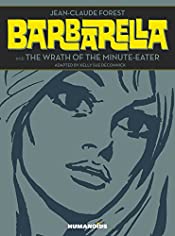
Barbarella, by Jean-Claude Forest, adapted by Kelly Sue DeConnick
Second frame of third page of first volume:

Second frame of third page of second volume:

Famous French comic of the 1960s, on which the cult film of 1968 was based. Barbarella is a leader of men and women who biffs as much as she bonks. Her clothes do have a tendency to come off, voluntarily as often as not. Kelly Sue DeConnick has now given us an updated translation, which reads a lot more smoothly and wittily than the long-standing text by Richard Seaver.
|
Seaver translation:
|
DeConnick translation:
|


It's not deep, but it is fun. You can get vol 1 here and vol 2 here.

My tweets
- Tue, 17:11: RT @RobDotHutton: Just jotting this down: Theresa May: 1,106 days Gordon Brown: 1,049 days Boris Johnson: 902 days so far.
- Tue, 17:22: OK, it’s trickier in Dutch because there are more likely to be repeated letters. (Also, in Dutch.) Woordle 206 4/6 ⬜⬜ ⬜⬜ ⬜⬜⬜ ⬜⬜
- Tue, 18:21: Jani and the Greater Game, by Eric Brown https://t.co/SDGNWRLOMk
- Tue, 19:21: A bit late, I am finally reading “The Doctor: His Lives and Times” (2013) by @gossjam and Steve Tribe. Glorious. https://t.co/9dZnuyLMDa
- Wed, 08:33: Huh. That’s not how *I* spell it. Wordle 207 5/6 ⬜⬜ ⬜ ⬜ ⬜ ⬜ ⬜ ⬜
Jani and the Greater Game, by Eric Brown
Second paragraph of third chapter:
She was still seated in the armchair she had occupied last night, though now imprisoned beneath a settee that had closed over her like a lid. To her right, through the gap between the two clasped pieces of furniture, a piercing arrow of sunlight warmed her skin.
Steampunky novel set in an alternate Raj where Britain has exploited captured extraterrestrial technology to remain Top Nation; protagonist is the daughter of an Indian government minister and his long-dead English wife; she is pursued by various miscreants who wish to overturn British rule for one reason or another; she discovers that the Raj is based on an alien power source, and there is a reckoning. You can get it here.
This was the SF book that had lingered longest unread on my shelves. Next on that pile is Indigo, by Clemens Seitz.

My tweets
- Mon, 12:56: Lithuania wins microchip windfall from Taiwan in China clash https://t.co/oUwiNkMWVg Intriguing.
- Mon, 16:05: RT @lennylaw: Matthew Parris has made no secret of his detestation of Boris and, as such, when he decides to put the shoe in, he does it wi…
- Mon, 17:11: Why Grange Hill was, to my generation, the most important and beloved show on TV https://t.co/RaB11SLglp From @MsRachelCooke. Hear hear!
- Mon, 18:17: Northern Ireland a Generation after Good Friday, C. Coulter, N. Gilmartin, K. Hayward, P. Shirlow https://t.co/4FzvVyHzAn
- Mon, 20:48: Just been fiddling around with @TheStorygraph as an alternative to @goodreads and @LibraryThing. Wow, what a terrible user interface! Can’t easily browse your own reviews, can’t find other people’s, can’t find your friends to link with them. I think I’ll stick with what I’ve got.
- Tue, 07:05: Wordle 206 3/6 ⬜ ⬜⬜⬜ ⬜ ⬜
- Tue, 09:12: RT @GavinBarwell: Let me put this politely: it is not *entirely clear* why the Prime Minister needs to wait for Sue Gray’s report to find o…
- Tue, 10:45: RT @DPhinnemore: ‘Truss has struck a warmer tone than Frost… and [promised] “constructive proposals” to break the deadlock. ‘But official…
Northern Ireland a Generation after Good Friday, C. Coulter, N. Gilmartin, K. Hayward, P. Shirlow
Second paragraph of third chapter:
Prisoner release was probably on a par with policing reform as one of the most contentious issues that arose from the Good Friday Agreement (hereafter GFA). The political representatives of conflict-related prisoners such as Sinn Fein, the Ulster Democratic Party (UDP) and the Progressive Unionist Party (PUP) had sufficient influence to argue convincingly that the release of prisoners would advance the delivery of demobilisation and disarmament. While sitting at the heart of wider Disarmament, Demobilisation and Reintegration (DDR)1 strategies at that time, the onset of decommissioning and disarmament has led to a decline in the status and influence that the prisoner community had in relation to the two governments. Holding weaponry or using violence, such as in the Canary Wharf bombing, was a reminder of such influence.2 After the ceasefires, prisoners' representatives were feted during visits to Downing Street and Leinster House, as they were consulted at nearly every turn and tweak of the then emerging peace process.
1 See United Nations Disarmament, Demobilization and Reintegration Resource Centre. Available at: http://unddr.org/iddrs.aspx. Accessed 1 February 2020.
2 The IRA's bombing of Canary Wharf in 1996 targeted London's financial district. Two years after the same organisation's ceasefire, its capacity to cause or £100 million of damage, kill two people and injure forty more was indicative of its power to force the pace of negotiations between the IRA and the British government.
An academic survey of aspects of Northern Ireland now that we are more than two decades on from the 1998 Good Friday Agreement – not quite a generation, really, but if you count the Troubles as having run from Burntollet to the IRA ceasefire, January 1969 to August 1994, it's been over longer than it lasted. Most people of course would put the start date earlier and the end later, but the point is that we are not far from that milestone one way or the other.
The book is by four academics at four different universities; the chapters are not individually signed, though knowing two of them vaguely I can guess which chapters they were more involved with. It's well structured, and I found many points of agreement as well as several of disagreement. To go through the chapters one by one:
The first chapter is a political history of the years since 1998, the rise and fall of UUP/SDLP-led power-sharing and its DUP/Sinn Féin-led successor. This betrays an authorial bias that pops up in more detail later: that all the current big Northern Irish parties are awful, and the only hope is from a resurgent Left and communities sector. One can believe one of these things without believing the other. It is telling that the narrative voice is not sure whether or not to be happy about the success of the Alliance Party in the 2019 elections.
The second chapter is a substantial and comparative look at dealing with legacy issues, providing victims of the Troubles with closure, an issue that the British government now threatens to meddle in. There is a sympathetic examination of local projects to restore and preserve memories of what happened, and a keen scrutiny of Truth and Reconciliation Commissions elsewhere in the world before concluding that they are not quite right for Northern Ireland. If there was a firm recommendation for what is right for Northern Ireland, or might be, I missed it.
The third chapter really got my blood boiling on an issue which I confess I had not thought much about before: the barriers faced by ex-prisoners and their families in integrating into the workforce. The increase of concerns about vetting employees and potential employees with regard to their legal backgrounds has the downside of pushing people with convictions and time served from decades ago out of jobs that they have done for years. There are a lot of gut-wrenching case studies here, and no prospect of positive political action being taken. One of the best chapters in the book.
The fourth chapter reviews portrayals of the Troubles in cinema and television, only two of which I had seen, Good Vibrations and Derry Girls. The analysis is interesting enough, but a bit dismissive of the two things I liked, and did not fill me with enthusiasm to try any of the others. (Maybe the first series of The Fall.)
The fifth chapter is better, on those who do not identify with either of the two communities. It's the one chapter I really wished had been longer. It's likely that last year's census will show more Catholics than Protestants in Northern Ireland; the really interesting number will be the increase in those who do not identify with either side. The mutual disengagement of most of the people in this category and the political classes is the biggest potential challenge for the Northern Irish political system. As before, the writers think that salvation will come from the Left, which has failed to provide it in the last hundred years.
The sixth chapter looks in detail at the role of women in politics and the failure of the legal system to pursue violence against women as vigorously as it does the perpetrators of political violence. While I feel sympathetic to the theme I felt that this tipped over the edge to polemic; there are a number of reasons why armed conspirators against the state get more attention from law enforcement authorities than abusive spouses. The story of women in politics is presented very much through the narrow focus of the Northern Ireland Women's Coalition, which was wound up in 2006. Rather surprisingly, the fact that all three MEPs elected in 2019 were women is not even mentioned.
The seventh chapter looks at poverty and at the effect of London-driven welfare "reform" on the Northern Ireland economy. I am sympathetic to the basic narrative – it has never made any sense to me that you can "help" people by giving them less money, and the welfare "reforms" were what prompted me to leave the Liberal Democrats in 2013. The hypocrisy of the local political parties offering all resistance to welfare reforms short of actually doing anything about it is well analysed. Again, it would have been helpful to see an alternative approach elaborated here.
The final chapter was clearly written very hastily in the middle of the pandemic, and can be skipped.
So, more good than bad here – much more good than bad – but not the final word, I think. You can get it here.

My tweets
- Sun, 12:56: Will Britain Survive? https://t.co/fkh0rewrcP Great piece (as usual) from @TomMcTague.
- Sun, 14:48: RT @CateSpice: One month since the Self-ID Bill passed in New Zealand parliament! As yet we haven’t seen a ‘breakdown of the social contra…
- Sun, 16:31: Les Mondes d’Aldébaran: L’Encyclopédie Illustrée, by Christophe Quillien https://t.co/BaYSUQhOtf
- Sun, 17:59: Since @bohemiancoast asked: two answers on counting the Hugos – EPH and Best Dramatic Presentation https://t.co/FFqApnpR7k
- Sun, 19:36: RT @MSmithsonPB: Terrible numbers for the PM in YouGov poll of CON party members. https://t.co/7CPCN7qXqk https://t.co/mCmN63C6z3
- Mon, 07:32: Wordle 205 4/6 ⬜ ⬜⬜ ⬜⬜⬜ ⬜ ⬜
- Mon, 10:45: Democracy Drinks: ‘What better way to fight for democracy than with a drink?’ | BRUZZ https://t.co/npJ3QB0k69 I am visible in the background, along with other trouble-makers!
- Mon, 11:35: Glorious. Both had great guest roles in Tom Baker era Doctor Who stories. Harriet Philpin was of course Thal leader and survivor Bettan in Genesis of the Daleks. Sheila Ruskin was Nysa’s stepmother Kassia in The Keeper of Traken, under the influence of the Melkur/Master. https://t.co/vhARwBPeYL
Since Alison asked: two answers on counting the Hugos – EPH and Best Dramatic Presentation
The latest installment of the Octothorpe podcast has a couple of points on counting Hugo nominations raised by Alison Scott, which I'd like to address here.
First off, at 18:53, Alison expresses the concern that under the counting system (known as "EPH, short for "E Pluribus Hugo"), "if I nominate anything else, it reduces the chance that the thing I love gets on the ballot. And that seems to me to be the big downside of EPH." The podcast is kind enough to link to the explanation of EPH that I wrote in 2017.
It is of course perfectly true that under the current counting system, if you love one thing, and you nominate other things as well, you reduce the chance that your vote will help the one thing you love getting on the ballot. But this was equally true of the old tallying system. It's the principle of monotonicity, as Kenneth Arrow put it in his famous Theorem. Candidate A getting more votes should not lead to her getting a worse result, and Candidate B getting fewer votes should not lead to his getting a better result. If you give an extra vote to A, you are inevitably hurting B's chances, even if you love B more. So it's not uniquely a problem with EPH, but with any system where your vote can go to several candidates simultaneously. (Preferential voting systems, where a lower preference doesn't affect the chances of your highest-placed choice, are a different matter, and in fact are sometimes criticised by their opponents for allegedly violating monotonicity, though I think this is not a reasonable criticism.)
The second point is a question raised by Liz Batty at 21:42, on which Alison calls me out by name at at 22:23. In a situation where a TV series qualifies for Best Dramatic Presentation, Long Form, and one or more episodes of it qualify for Best Dramatic Presentation, Short Form, how do administrators decide which will actually appear on the ballot?
This is of course a recent problem. but my answer is clear: if faced with a choice, administrators should choose whatever alternative gets more voters the thing they want on the vote. To go into the detail:
The Dramatic Presentation categories were only split from 2003. The first series to qualify was season 1 of Heroes, in 2008, and only one of its individual episodes even scraped onto the long list that year. It was in 2012 that the first season of Game of Thrones got 171 votes for the Long Form ballot, and individual episodes got 73 and 60 votes which would have been enough to qualify for the Short Form ballot (and another episode was runner-up with 49 votes); but the administrators decided that the series rather than the individual episodes should qualify. George R.R. Martin had anticipated this outcome several months earlier. I do not know if the showrunners were consulted. The series won the Long Form Hugo.
It's worth noting that the 171 votes for the series in Long Form are more than the sum of the votes for the two episodes that made the top five in Short Form (73+60 = 133), and of course a number of voters will have voted for both of the Short Form episodes, so the total number of voters who wanted to see either of the two on the Short Form ballot would have been much less than 133. The episode which came sixth, with 49 votes, doesn't count here, as it would never have been on the final ballot anyway.
Edited to add: A calculation I made for the other years when I first posted this, but forgot to make for 2012, is the down-ballot impact of the decisions available to the administrators. Excluding the series would have brought a film with 94 votes onto the Long Form ballot. Including the two GoT episodes would have excluded two nominees with 38 and 36 votes which ended up on the Short Form ballot in our timeline. So the administrators' decision was in line with the wishes of up to 171+38+36 = 245 voters, whereas the alternative would have satisfied a maximum of 94+73+60 = 227 voters. There would have been some overlap of supporters in the short form nominations, though more in the latter scenario than the former.
The following year, 2013, the second series of Game of Thrones got 164 votes for Long Form, and an individual episode got 95 votes for Short Form. The showrunners were consulted this time as to which should be on the ballot, and opted for the individual episode, which indeed won the Short Form Hugo. This is the only occasion of the five times the situation has arisen (2012, 2013, twice in 2020 and 2021) where the showrunners were consulted, as far as I am aware. This brought a film with 141 votes onto the Long Form ballot; otherwise an audiobook with 58 votes would have replaced the GoT episode on the Short Form ballot. So arguably more voters were satisfied with the actual ballot (141+95 = 236) than with the alternative (164+58 = 222).
The next TV series to qualify for the Long Form category was the first of Stranger Things, in 2017, my first year as Hugo Administrator. None of the episodes came close to qualifying in Short Form however, so there was no decision to make. NB that from that year on there were six finalists per category, rather than five as previously.
The most complex decision so far was in 2020, when the top six nominees for Long Form included the TV series Good Omens, with 212 votes, and Watchmen, with 81; while the top six nominees in Short Form included an individual episode of Good Omens with 104 votes, and two episodes of Watchmen with 81 and 59. I was Deputy Administrator that year, and we made our thinking pretty clear: more voters supported Good Omens being in Long Form, and more voters supported at least one of the two Watchmen episodes in Short Form, so that was the decision we made, without consulting the showrunners. (We were also, as you may remember, in the middle of a global pandemic.)
If we had instead kept the Good Omens episode on the Short Form ballot (where it actually came top) we'd have got a film with 74 votes on the Long Form ballot and lost a TV episode with 36 votes on the Short Form ballot, thus satisfying 104+74 = 178 voters rather than 212+36 = 248 voters. On the other hand, if we'd kept Watchmen on Long Form and dropped the two episodes from Short Form, the category ballots would have lost a film with 75 votes and gained two TV episodes with 34 and 35, which also clearly satisfies fewer voters, especially if the two TV episodes had supporters in common.
We followed that precedent again in 2021 (official results sheet, tidier version which I supplied too late to the convention), when I was WSFS Division Head and a member of the Hugo sub-committee at the time nominations closed; the second series of The Mandalorian got 67 votes for Best Dramatic Presentation, Long Form, and two individual episodes got 67 and 45 for Short Fom. Clearly more voters supported having at least one of the episodes in Short Form, so again without consulting the showrunners, that was the decision that we made. That brought a film onto the Long Form ballot that had got 63 votes; if we had gone the other way, two TV episodes with 28 and 25 votes would have been on the Short Form ballot. I don't need to work out the arthmetic in detail, but you can if you want; it was pretty clear what outcome better reflected the wishes of the voters.
So, in summary (I bet you're glad there's a summary), the practice of administrators has been that the wishes of voters should be given priority, if they are clear, and whichever alternative gives more voters a thing they want on the ballot is the one that should be followed. 2013 may look like an exception at first glance, but if you look at the down-ballot consequences of the decision, it's also defensible in those terms.
I would resist any move to formally throw the decision to showrunners rather than the Hugo administrators. I'm uneasy with the idea that studio execs rather than WSFS voters should get to decide what is on the Hugo ballot, and it should be added that in practice, many showrunners are not very responsive to communications from Hugo administrators (Game of Thrones was very much an honourable exception there).
I'm also opposed to further codifying existing practice in the rules. Let's concentrate on fixing the things that need fixing, in particular the Best Artist categories, and not waste time on the things that already work.
But thank you for asking, Alison!
Les Mondes d’Aldébaran: L’Encyclopédie Illustrée, by Christophe Quillien
First page of second chapter, with illustrations:
Kim Keller Lorsque s'ouvre le premier volume d'Aldébaran, Kim Keller est une jeune fille âgée de 13 ans, écolière à la basic school d'Arena Blanca. Vingt-quatre albums plus tard, à la fin du troisième tome de Retour sur Aldébaran, le temps a passé : Kim a 26 ans. Elle est devenue une femme accomplie, confrontée à un destin hors du commun et dont elle n'aurait jamais osé rêver. Au départ, rien ne laissait supposer qu elle vivrait les folles aventures dans lesquelles Leo l'a précipitée. Ce même Leo était loin de se douter que « sa » Kim serait la première humaine à avoir un enfant avec un être venu d'une autre planète, et qu un peuple extraterrestre la désignerait comme interlocutrice privilégiée. Les auteurs de bande dessinée sont parfois dépassés par leurs personnages, tels de modernes docteurs Frankenstein.
La toute première page d'Aldébaran dessine déjà le portrait de Kim Keller. Celui d'une jeune fille intelligente et curieuse de tout, fascinée par l'histoire de la Terre, rompue à l'argumentation et décidée à exprimer ses idées, même quand elles sont en contradiction avec la doctrine officielle. Dans les pages suivantes, victime d'un enchaînement d'événements dramatiques bouleversant sa vie d'adolescente, Kim fait face à la situation avec un courage et une capacité d'adaptation exemplaires, dont elle fera preuve tout au long de la saga. Ce qui ne l'empêche pas d'être aussi une ado exaspérante…
Kim Keller When the first volume of Aldebaran opens, Kim Keller is a 13-year-old girl, a schoolgirl at the Arena Blanca basic school. Twenty-four albums later, at the end of the third volume of Retour sur Aldebaran, time has passed: Kim is 26 years old. She has become an accomplished woman, faced with an extraordinary destiny that she would never have dared to dream of. Initially, nothing suggested that she would live the crazy adventures into which Leo has thrown her. Leo himself was far from suspecting that "his" Kim would be the first human to have a child with a being from another planet, and that an extraterrestrial people would designate her as their privileged interlocutor. Comic book writers are sometimes overwhelmed by their characters, like modern Dr Frankensteins.
The very first page of Aldebaran already portrays Kim Keller as a young girl, intelligent and curious about everything, fascinated by the history of the Earth, experienced in argumentation and determined to express her ideas, even when they contradict official doctrine. In the following pages, as a chain of dramatic events that changed her teenage life, Kim faces the situation with exemplary courage and adaptability, which she will demonstrate throughout the saga. Which does not prevent her from also being an infuriating teenager…

Without Maï Lan and Pad's help, I'd have lost it. I was this close to
throwing myself into the void, me and my little aquatic monster baby!

POW!

It's not easy to love a woman like Kim, Doctor…
I know, Suria, but she's worth the risk!

Am I really sure about it? Time will tell, but I'd prefer not to
have any doubt about it. I'd prefer a less complicated life.
As my regular reader knows, I have been a huge fan of the Aldebaran sequence of graphic novels by Brazilian writer Leo for years and years. (I have to thank Samantha for introducing me to them.) This is a lovely tribute to the sequence, by French comixologist Christophe Quillien, going through the planets, people, aliens and themes of Leo's fictional worlds. (The excerpt above concerns the main character, Kim Keller.)
I was particularly interested to read that Leo explicitly credits Arthur C. Clarke's Rendezvous with Rama and Robert Charles Wilson's Spin as inspirations. I love both of those books too, but I found it interesting that Leo acknowledges the Anglo-American sf tradition so firmly. Other influences mentioned are Tarkovsky's Solaris and the great Moebius.
I have only read the books in French, so I have no idea if the Cinebooks translation into English is any good, but you can get it here, here, here and here. I do know that it famously censors the female characters' breasts, giving them bras in some scenes where in the original they are topless. Also, you can get L’Encyclopédie Illustrée here.
My tweets
- Sat, 12:56: William Hartnell would have been 116 years old today. Which is remarkably young when you stop and think about it. https://t.co/LQRZFg9YbX
- Sat, 14:48: RT @jayrosen_nyu: “…It was hard not to see this as just another tiresome day of skirmishes in the ongoing fight between the Republican Pa…
- Sat, 15:51: Million Dollar Baby https://t.co/dfKtRJ4ISD
- Sat, 16:05: RT @evanewashington: some say the MCU isn’t realistic but what about in Black Panther when Killmonger wanted the richest, most advanced cou…
- Sat, 18:47: Saturday reading https://t.co/WitfR23EKM
- Sat, 20:48: It’s not just the statues, Belgium must atone for what it did in Congo https://t.co/KIgmkeC01N Princess Esmerelda: “We should remove these statues… Belgium also needs to apologise.”
- Sun, 08:47: Ah, I didn’t know about that feature… Wordle 204 5/6 ⬜⬜ ⬜⬜ ⬜ ⬜ ⬜ ⬜
- Sun, 10:45: RT @mellon_heads: Relevant https://t.co/NYmbaAY7YG
Saturday reading
Current
Twice a Stranger: How Mass Expulsion Forged Modern Greece and Turkey, by Bruce Clark
The Gift of Rain, by Tan Twan Eng
Last books finished
A Radical Romance, by Alison Light
Animal Dreams, by Barbara Kingsolver
Where Was the Room Where It Happened?: The Unofficial Hamilton – An American Musical Location Guide by BdotBarr [Bryan Barreras]
Calvin, by F. Bruce Gordon
Of the City of the Saved…, by Philip Purser-Hallard (did not finish)
Carbone & Silicium, by Mathieu Bablet
Peter Davison's Book of Alien Monsters
Peter Davison's Book of Alien Planets
The Daughters of Earth, by Sarah Groenewegen
Next books
Wandering Scholars, by Helen Waddell
Neither Unionist nor Nationalist: The 10th (Irish) Division in the Great War by Stephen Sandford
A lot this week! At the end of 2021 I had nearly finished A Radical Romance, Animal Dreams and CalvinWhere Was the Room Where It Happened? and the two Peter Davison anthologies are all very short; and I abandoned Of the City of the Saved… after a hundred pages. So I don't expect to keep up this pace for the rest of 2022.
Million Dollar Baby
Warning: this review contains massive spoilers for a film that came out in 2004
I mean it. If you have not seen Million Dollar Baby, and think you might watch it some day (and I really recommend it, one of the best Best Picture winners), stop reading now.
Anyway.
Million Dollar Baby won the Oscar for Best Picture of 2004, and three others: Clint Eastwood for Best Director, Hilary Swank for Best Actress and Morgan Freeman for Best Supporting Actor. The Aviator actually won five Oscars on the night, and I might make that my next viewing. The Oscar for Best Picture the following year was won by Crash, which was actually released before Million Dollar Baby. I don’t make the rules, I just report them. The Hugo that year went to The Incredibles, and the Nebula to the previous year’s The Lord of the Rings: The Return of the King.

The other Oscar nominees were The Aviator, Finding Neverland, Ray and Sideways, and I haven’t seen any of them. The only other films from 2004 that I have seen are The Incredibles, as noted last week; Eternal Sunshine of the Spotless Mind, though I fell asleep half way through; Harry Potter and the Prisoner of Azkaban; the brilliant death-of-Hitler film Downfall; Before Sunset, the sort of romance that I love; The SpongeBob SquarePants Movie, many many times; and the Steve Coogan / Jackie Chan Around the World in 80 Days, which is truly dismal, including Arnold Schwarzenegger as an oriental prince. IMDB users put Million Dollar Baby 4th on one ranking but only 43rd on the other, one of the weirdest splits I have seen. Personally, I would rank it alongside Downfall as my favourite film of the year, just ahead of Before Sunset. (Crash, by the way, is 16th on one ranking and 40th on the other.) Here’s a trailer, which impressively barely hints at the denouement.
There are a couple of actors from previous Oscar Winners. Clint Eastwood and Morgan Freeman are the two male leads here, as and were also the two male leads twelve years ago in Unforgiven, which like Million Dollar Baby was directed by Eastwood.


Freeman of course also drove Miss Daisy three years earlier.

A much more obscure returning face is stuntman Ted Grossman, most famously the first person killed by the shark in Jaws, who is one of the ringside doctors here, was a Peruvian porter in Raiders of the Lost Ark and a deputy sheriff in Indiana Jones and the Last Crusade. None of the shots I could get of him was much good.


The film is about a woman boxer, Hilary Swank’s Maggie, and her relationship with Eastwood’s Frankie, an embittered Irish-American boxing trainer who has lost all the women in his life, with commentary and sidekickisms from Freeman’s Scrap. Fighting really is not my thing, but I know a little about women fighters in that my old friend Rosi Sexton, who I have known since she was 16, was at one stage Britain’s leading woman Mixed Martial Artist (or cage-fighter if we want to be casual) – this after her first-class degree in maths from Cambridge and her computer science PhD. She retired from fighting in 2014 and was the runner-up in the 2020 leadership election of the Green Party of England and Wales. So any preconceptions I may have once had about professional fighting being an exclusively male preserve were long since knocked out of me by her (though not literally). Rosi was one of two women fighters profiled in a BBC documentary in 2009.
I’ll just also note that Frankie is learning Irish (“Gaelic”), which is one of the relatively few times we hear a language other than English in any Best Picture winner (having said which, we recently had Hungarian in Chicago, and Elvish in The Return of the King) and I suspect the only time we will hear Irish in any Oscar-winning film at all. However, Eastwood’s/Frankie’s pronunciation is really terrible; he seems to be learning exclusively from a book, without any coaching from people who actually speak the language; and his stage name for Maggie, “Mo Cuishle”, is wrong – it should be “Mo Chuisle”, though the “s” is indeed pronounced “sh”.

OK, now we get to the massive spoilers. You have been warned.
The first two thirds of the film are about the gradual maturing of the relationship between Frankie and Maggie as she erodes his reluctance to become her trainer and manager. It’s beautifully done. The chemistry between Eastwood and Swank is among the best depictions of a quasi-parental relationship that we have seen in one of these films. The world of boxing is shown unromantically, including through a number of subplots involving other boxers and managers, and we cheer for Maggie as she overcomes these obstacles and achieves success in various places (which, er, all look rather similar but with different decorations on the walls to try and suggest that they may be in different parts of America or Europe). If the film only consisted of the first hour and a half, it would still be a lovely character study.

But two-thirds of the way through, the story takes a massive swerve. In the most important fight of her career, Maggie’s neck is broken by a foul blow from her opponent, and she is paralysed from the neck down for the rest of her life. Frankie continues to care for her, and eventually, at her request, assists her death. The two threads here are Maggie’s courageous accommodation to her new circumstances (incluing a dramatic showdown with her deadbeat biological family), and Frankie’s internal debate about euthanasia (there’s a tremendous scene with a priest, who Frankie has been baiting throughout the film). Here in Belgium, euthanasia has been legal since 2002, but we are ahead of the game. Legal or not, this is an awful subject, and although of course a film treatment needs to sensationalise it a bit for the drama, I felt that Eastwood carried it off tactfully and well here.

I got a lot more out of Million Dollar Baby than I was expecting to, and I’m putting it in my top ten Oscar winners, just ahead of last year’s Return of the King and behind The Bridge on the River Kwai. Next up is Crash, of which I know nothing except that the screenplay is by the same writer, Paul Haggis.
The film is based on one or possibly several short stories in a book by F.X. Toole, which I have had difficulty in getting hold of – it is long out of print, and new EU import regulations complicate the process of acquiring it from most of the English-speaking world. I have ordered it, and will report back when I do read it.
Winners of the Oscar for Best Picture
1920s: Wings (1927-28) | The Broadway Melody (1928-29)
1930s: All Quiet on the Western Front (1929-30) | Cimarron (1930-31) | Grand Hotel (1931-32) | Cavalcade (1932-33) | It Happened One Night (1934) | Mutiny on the Bounty (1935, and books) | The Great Ziegfeld (1936) | The Life of Emile Zola (1937) | You Can’t Take It with You (1938) | Gone with the Wind (1939, and book)
1940s: Rebecca (1940) | How Green Was My Valley (1941) | Mrs. Miniver (1942) | Casablanca (1943) | Going My Way (1944) | The Lost Weekend (1945) | The Best Years of Our Lives (1946) | Gentleman’s Agreement (1947) | Hamlet (1948) | All the King’s Men (1949)
1950s: All About Eve (1950) | An American in Paris (1951) | The Greatest Show on Earth (1952) | From Here to Eternity (1953) | On The Waterfront (1954, and book) | Marty (1955) | Around the World in 80 Days (1956) | The Bridge on the River Kwai (1957) | Gigi (1958) | Ben-Hur (1959)
1960s: The Apartment (1960) | West Side Story (1961) | Lawrence of Arabia (1962) | Tom Jones (1963) | My Fair Lady (1964) | The Sound of Music (1965) | A Man for All Seasons (1966) | In the Heat of the Night (1967) | Oliver! (1968) | Midnight Cowboy (1969)
1970s: Patton (1970) | The French Connection (1971) | The Godfather (1972) | The Sting (1973) | The Godfather, Part II (1974) | One Flew Over the Cuckoo’s Nest (1975) | Rocky (1976) | Annie Hall (1977) | The Deer Hunter (1978) | Kramer vs. Kramer (1979)
1980s: Ordinary People (1980) | Chariots of Fire (1981) | Gandhi (1982) | Terms of Endearment (1983) | Amadeus (1984) | Out of Africa (1985) | Platoon (1986) | The Last Emperor (1987) | Rain Man (1988) | Driving Miss Daisy (1989)
1990s: Dances With Wolves (1990) | The Silence of the Lambs (1991) | Unforgiven (1992) | Schindler’s List (1993) | Forrest Gump (1994) | Braveheart (1995) | The English Patient (1996) | Titanic (1997) | Shakespeare in Love (1998) | American Beauty (1999)
21st century: Gladiator (2000) | A Beautiful Mind (2001) | Chicago (2002) | The Lord of the Rings: The Return of the King (2003) | Million Dollar Baby (2004, and book) | Crash (2005) | The Departed (2006) | No Country for Old Men (2007) | Slumdog Millionaire (2008) | The Hurt Locker (2009)
2010s: The King’s Speech (2010) | The Artist (2011) | Argo (2012) | 12 Years a Slave (2013) | Birdman (2014) | Spotlight (2015) | Moonlight (2016) | The Shape of Water (2017) | Green Book (2018) | Parasite (2019)
2020s: Nomadland (2020) | CODA (2021) | Everything Everywhere All at Once (2022) | Oppenheimer (2023)
My tweets
- Fri, 12:56: Worth reading (if you can) judgement in Hoeybrechts case. Clearly incitement to hatred of & violence against women. His defence? That he is the victim of “a well-oiled, communist-led international machine whose ultimate goal is to undermine Western states”. Rightly convicted. https://t.co/vadbdl9NUo
- Fri, 14:09: Adventures in Moominland https://t.co/EM4Aziu6k5 Five years ago today, when the world was a very different place.
- Fri, 16:05: TIL that Elizabeth Enright, author of lovely books Thimble Summer, Gone-Away Lake, & the Melendies (The Saturdays, The Four-Story Mistake, Then There Were Five, Spiderweb for Two) was the niece of architect Frank Lloyd Wright. Her mother Maginel illustrated kids’ books too.
- Fri, 17:11: Hugos Unlike Any Previous https://t.co/s6IkJ6lhLv What could happen this year.
- Fri, 18:11: The 48 Laws of Power, by Robert Greene https://t.co/0Th0Zfa41P
- Fri, 18:38: https://t.co/a1OK17ktHP
- Fri, 18:45: The Martian Chronicles, by Ray Bradbury https://t.co/SYx4rQGQ6B
- Fri, 20:48: The Sarah Jane Adventures oral history https://t.co/xEovR6a2BM Nice write-up, though would have been nice to also hear from Yasmin Paige and Tommy Knight.
- Fri, 22:24: RT @RobotArchie: I wonder if there is any chance of an English language edition of Science Fiction World (科幻世界)
- Sat, 08:35: Wordle 203 3/6 ⬜ ⬜⬜ ⬜ ⬜
- Sat, 10:45: RT @WilliamsonChris: The UK was the only western economy to see falling exports in December, according to #PMI survey data, as #Brexit exac…
- Sat, 11:18: This is rather sweet. I am not sure if I know any Belgian women aged between 16 and 19, let alone if they are interested in diplomacy, but certainly some of you reading this do know such people, so please pass it on to them. https://t.co/8vMAiMj2uN
The Martian Chronicles, by Ray Bradbury
Second paragraph of third story (“A Summer Night”):
Upon one stage a woman sang.
Gosh. I had forgotten quite how good this is. It's not a novel; it's a sequence of linked short stories, with some internal inconsistencies, about the colonisation of Mars in 1999-2005, and then a coda in 2026 after disaster strikes Earth. Of course, the stories are more about Earth (and specifically Midwestern, mid-century America) than about Mars; but they are beautifully formed parables, and often more than that. You must have read it, because it's essential reading for anyone who cares about science fiction, but if you haven't, you can get it here.
And the end of the last story, “The Million Year Picnic”, never fails to bring a lump to my throat:
They reached the canal. It was long and straight and cool and wet and reflective in the night.
“I’ve always wanted to see a Martian,” said Michael. “Where are they, Dad? You promised.”
“There they are,” said Dad, and he shifted Michael on his shoulder and pointed straight down.
The Martians were there. Timothy began to shiver.
The Martians were there–in the canal–reflected in the water. Timothy and Michael and Robert and Mom and Dad.
The Martians stared back up at them for a long, long silent time from the rippling water….
And let's take a moment (well, two minutes and forty seconds) to appreciate Rachel Bloom's tribute to the writer:
This was the top book in my library that I had previously read but not reviewed online. Next on that pile is High Fidelity, by Nick Hornby.
The 48 Laws of Power, by Robert Greene
Second paragraph of Law 3:
Over several weeks, Ninon de Lenclos, the most infamous courtesan of seventeenth-century France, listened patiently as the Marquis de Sevigné explained his struggles in pursuing a beautiful but difficult young countess. Ninon was sixty-two at the time, and more than experienced in matters of love; the marquis was a lad of twenty-two, handsome, dashing, but hopelessly inexperienced in romance. At first Ninon was amused to hear the marquis talk about his mistakes, but finally she had had enough. Unable to bear ineptitude in any realm, least of all in seducing a woman, she decided to take the young man under her wing. First, he had to understand that this was war, and that the beautiful countess was a citadel to which he had to lay siege as carefully as any general. Every step had to be planned and executed with the utmost attention to detail and nuance.
A well-wisher gave this to F a couple of months ago, and it bubbled rapidly to the top of my reading list. I read the first three chapters and put it down with no intention of resuming. (Actually, that's not the full story. I couldn't find the paper copy, was sufficiently irritated with myself to buy a Kindle version from Amazon, struggled through the first three chapters, gave up, got a refund from Amazon and then found the paper copy.)
I thought it was a repulsive book. It claims to be a self-help book about how to gain Power and be Powerful, illustrated by case studied of people who Obeyed or Transgressed the Laws of Power in history. Most of the self-help books that I have read at least pay lip service to becoming a better person, wanting to make the world a better place by your existence, finding and fulfilling your personal mission, that kind of thing. Greene is just interested in Power; he does not define it, just assumes that you want it too; there is no ethical framework here. It's rather sickening, and the worrying thing is that a lot of people seem to have bought and liked the book. I suspect that his historical analysis is bunk as well, but cannot be bothered to check any of the examples. If you really want to, you can get it here.
This was my top book acquired this year, and my top unread non-fiction book,. Next on those piles are respectively Animal Dreams, by Barbara Kingsolver, and Why I Write, by George Orwell.

My tweets
- Thu, 12:56: Tolkien, the Mob, and the Demagogue – Henry T. Edmondson III https://t.co/cvzjUFeLrO
- Thu, 17:05: Boosted! https://t.co/6UvpdWtHHF
- Thu, 17:50: RT @davidallengreen: The acquittal of the Colston Four is the sound of a working constitution Me at @prospect_uk https://t.co/BsW7b6C0EJ…
- Thu, 18:43: A Little Gold Book of Ghastly Stuff, by Neil Gaiman https://t.co/d2JqKKmtKO
- Thu, 19:08: 660 days of plague: the boosted notes https://t.co/EwqyxRhFoT
- Thu, 20:48: RT @pmdfoster: It’s out!! The first Britain after #Brexit briefing of 2022 – pondering what @trussliz will need to score from Brussels to c…
- Thu, 21:45: RT @bjhbfs: I love the idea of St Malachy’s Old Boys being a hotbed of radical dissent.
- Thu, 21:47: RT @AndyKimNJ: A year later, the most vivid memory I have of Jan 6 is the moment I returned to the House chamber after the riot had been qu…
- Thu, 21:48: RT @MdRisette: I have literally admitted three patients with post-COVID pulmonary emboli in the past 7 hours. This seems far more prevalen…
- Fri, 10:45: RT @BarristerSecret: NEW BLOGPOST: Do the verdicts in the trial of the Colston 4 signal something wrong with our jury system? 10 things you…
660 days of plague: the boosted notes
No ill effects yet, though I am braced for an uncomfortable night and morning.
The omicron variant is zooming here, as elsewhere, with a massive 82% increase in infections reported today; I would not be surprised if we burst through the delta variant peak in the next few days. (Today: 11778. Record, reported 2 December: 17917.)
But hospital numbers have not been rising as rapidly as in previous waves. Yes, they are up a bit but really not a lot, all things considered. And ICU numbers are actually sill decreasing. We’ll need another couple of days o be sure, but I think the theoty that omicron may be more infectious but less serious is looking fairly credible.
With all of that, the government solemnly met today and decided not to change anything. There were rumours that they had been advised to shift back to 100% teleworking, but in the end they decided to wait and see. So for now I’ll be going into the office on Wednesdays. (If anyone in Brussels wants to meet for lunch, or a pint after work, on a Wednesday, do give me a shout.)
I’m going to divert a bit and talk about career development in pandemic times. I had lunch yesterday with a friend a couple of years older than me who was recently let go from the non-profit job he had had for two decades. Under Belgian law, he still gets paid a month for every year he worked there, so he’s not under economic pressure until late 2023, but of course he is looking around. I mentioned a few possibilities that seemed obvious to me from his CV, and then at the end of the conversation he started talking about one of his hobbies; and his eyes lit up with an enthusiasm that had been absent when we were talking about political work. For heaven’s sake, I said, build yourself a small business working in that hobby (a niche area with lots of fans and certain high-value items and consequently immense transaction fees). I hope he does that. The current situation makes us all more reliant on existing channels of communication, and deters people (well, deters me at least) from setting up new links in the casual way that was possible in the olden times.
This morning I had two separate conversations with two different 21-year-old women who both graduated with their first degrees last summer, one from Northern Ireland, one from Luxembourg (both daughters of old friends). They have had very different university experiences from anyone older than them. Both were really clear about the policy areas that they were really interested in, which of course is really helpful in terms of thinking about where they could look for future employment, so I think I was able to make some concrete suggestions in both cases. But I thought afterwards, in olden times, I could have recommended conferences for them to attend and meet other people with their specific interests, and so that they could make a good impression as potential future hires. It’s much more difficult now, and it’s going to stay difficult for a while.
Stay well, everyone, and get boosted as soon as you can.
A Little Gold Book of Ghastly Stuff, by Neil Gaiman
Second paragraph of third piece ("Jerusalem", a short story):
He was glad to be out of it.
A collection of mostly minor stories, essays and speeches by Gaiman, including his first ever fiction publication in Imagine issue 14, which came out in May 1984, so I must have bought it at the time without realising its historical importance. A couple of these were already familiar to me, including the famous George R.R. Martin is not your bitch blogpost which I saw when it was first published. There were a surprising number of typos (especially in that first story). Can be safely skipped; I got it as part of the Humble Bundle, and it seems to be otherwise out of print.
Despite its rarity, this was the most popular book that I had acquired in 2015 but not yet read. Next on that pile is Twice a Stranger, by Bruce Clark.

My tweets
- Wed, 12:56: So which European city was partly occupied by Japanese forces for almost five years in the 20th century?
- Wed, 16:05: RT @anneapplebaum: I mean, who could have predicted there would be so many costs and so few benefits to leaving the world’s most integrated…
- Wed, 18:27: The Idiot Brain: A Neuroscientist Explains What Your Head is Really Up To, by Dean Burnett https://t.co/DQzxFRZhOj
- Wed, 19:10: August 2014 books https://t.co/Wq8TXL0WtB
- Wed, 19:56: RT @archivetvmus71: The first episode of The Hitch-Hiker’s Guide to the Galaxy was originally broadcast on this day in 1981. https://t.co/s…
- Thu, 00:06: The answer is Constantinople (now İstanbul), 1918-23; kudos to @TonyKeen46, @peterjbirks, @alanrmb & @IanMoore3000. See attached org chart from NB Criss, Istanbul under Allied Occupation 1918-1923. https://t.co/mBeeBNjWo2 https://t.co/2wBaEEXl6R
August 2014 books
This is the latest post in a series I started in late 2019, anticipating the twentieth anniversary of my bookblogging which will fall in 2023. Every six-ish days, I've been revisiting a month from my recent past, noting work and family developments as well as the books I read in that month. I've found it a pleasantly cathartic process, especially in recent circumstances. If you want to look back at previous entries, they are all tagged under bookblog nostalgia.
We started the month in Northern Ireland, where among many pleasant experiences we were visited by H and also my cousin A, and did an enjoyable trip to various ancient places in County Down.
The month was dominated by the 2014 Worldcon, Loncon 3, where I was Division Head for Promotions and had a fantastic time.
At the end of the month we went to Leuven for a cinema screening of the first Peter Capaldi episode, Deep Breath, also fun.
(Which was all just as well, as work continued to be unpleasant.)
Worldcon sucked up a huge amount of my time and energy, and I read only 21 books that month, which is unusually low for a summer holiday.
Non-fiction 3 (YTD 38)
F in Exams, by Richard Benson
F in Retakes, by Richard Benson
The Making of Doctor Who, by Terrance Dicks and Malcolm Hulke


Fiction (non-sf) 8 (YTD 30)
The Adventures of Tom Sawyer, by Mark Twain
Vernon God Little, by DBC Pierre
A Winter Book, by Tove Jansson
Zorba the Greek, by Nikos Kazantzakis
Battle for Bittora, by Anuja Chauhan
The Waves, by Virginia Woolf
The Life of John Buncle, Esq: Containing Various Observations and Reflections, Made in Several Parts of the World, and Many Extraordinary Relations, vols 1 and 2, by Thomas Amory


SF (non-Who) 6 (YTD 73)
Brontomek!, by Michael Coney
A Guide to Tolkien, by David Day
The Long Earth, by Terry Pratchett and Stephen Baxter
No Harm Can Come to a Good Man, by James Smythe
Starry Messenger: The Best of Galileo, ed. Charles Ryan
Peacemaker, by Marianne de Pierres


Doctor Who 4 (YTD 42)
Tomb of Valdemar, by Simon Messingham
Bad Therapy, by Matthew Jones
The Crooked World, by Steve Lyons
Engines of War, by George Mann


Comics 1 (YTD 14)
With The Light… vol 7, by Keiko Tobe

~6,600 pages (YTD ~56,500)
5/22 (YTD 49/197) by women (Jansson, Chauhan, Woolf, ξ1, Tobe)
2/22 (YTD 15/197) by PoC (Chauhan, Tobe)
The best of these was The Waves, by Virginia Woolf; you can get it here. Also really good: Battle for Bittora, by Anuja Chauhan, an Indian election romance novel which you can get hereThe Life of John Buncle, Esq., by Thomas Amory, a fore-runner to Tristram Shandy, which you can get hereA Winter Book, by Tove Jansson, which you can get here. Three books that I found particularly poor: Booker-winning Vernon God Little, by DBC Pierre, which you can get hereA Guide to Tolkien, by David Day, which you can get herePeacemaker, by Marianne de Pierres, which you can get here.
The Idiot Brain: A Neuroscientist Explains What Your Head is Really Up To, by Dean Burnett
Second paragraph of third chapter:
Have you got everything you need for your child's upcoming birthday party? Is the big work project going as well as it could be? Will your gas hill be more than you can afford? When did your mother last call, is she OK? That ache in your hip hasn't gone away; are you sure it's not arthritis? That left-over mince has been in the fridge for a week; what if someone eats it and gets food poisoning? Why is my foot itching? Remember when your pants fell down in school when you were nine; what if people still think about that? Does the car seem a bit sluggish to you? What's that noise? Is it a rat? What if it has the plague? Your boss will never believe you if you call in sick with that. On and on and on and on and on and on.
A good breezy book about the wiring system that makes us all function. Style maybe a little too chatty in places, but I guess it helps us to digest the complex subject matter (or at least it helped me to). Rightly excoriates Myers-Briggs and the like. Accepts the standard narrative on the Stanford Prison experiment, Milgram and Kitty Genovese, unlike Rutger Bregman. A lot of what Burnett says is also aligned with cognitive behavioural therapy, with the difference that he is at least as interested in physiology as psychology – which maybe actually makes it all easier to accept. Not a lot more to say, but you can get it here.
This was my top unread book acquired in 2018. Next on that pile is Wandering Scholars, by Helen Waddell.

My tweets
- Tue, 15:52: Belgian health ministers have agreed that starting 10 January people who are fully vaccinated will no longer need to quarantine when they have had a high-risk contact for coronavirus. https://t.co/yDiE2p4qp0
- Tue, 18:51: Seven Deadly Sins, by various writers and artists https://t.co/tenjy9UxjG
- Tue, 18:54: An Excess Male, by Maggie Shen King https://t.co/Zab2FQDhjR
- Tue, 20:27: RT @DenisMacShane: My grandson will live in 22nd century. Meanwhile tonight Soho newsagent tells me all deliveries of papers from Europe su…
- Wed, 10:45: This, for me, is the weirdest lie of all. I occasionally lunch with EU celebrities in the brasseries near PLux or Schuman. Everyone else in the restaurant is going, oh look who it is, and they’re with that weird Irish chap. And nobody noticed a prince in Pizza Express? Nobody? https://t.co/RGj2VUdMyu
An Excess Male, by Maggie Shen King
Second paragraph of third chapter:
I’ve been steering BeiBei from one quiet game to another so that he would not overwhelm XX the second he returns. I did not grow up in a nurturing household. Now that Hann has given me a taste of that, I want to create that feeling for my son. For all of us. I crave it like food and water.
One of the Chinese SF books that was recommended to me last spring. In a near future China, polyandrous marriages are the norm thanks to the legacy of the gender imbalance caused by the One Child Policy; homosexuality and divorce are pretty much banned. Our protagonists are a young man and a young woman; he wants to join her marriage, but one of her current husbands is a gaming addict and the other is gay, and everyone is subject to state repression. I confess I was not as blown away by this as by the other Chinese SF novels I read in 2021; in real life, the effects of the One Child Policy are apparently not as severe as first reported, and apart from that, I found it a bit of a soap opera. You can get it here.
This came to the top of my pile of unread books by non-white writers. Next up is Breasts and Eggs, by Mieko Kawakami.

Seven Deadly Sins, by various writers and artists
Second frame from third sin ("Sloth", by Neil Gaiman and Bryan Talbot):

One of the Neil Gaiman Humble Bundle books that I have almost finished working through, a 1989 collection of short takes on the Seven Deadly Sins by comics writers and artists. The only woman of the fourteen is Roz Kaveney. The best is Neil Gaiman and Bryan Talbot's take on Sloth. You can get it here.
This was the shortest book acquired in 2015 still on my unread shelves. Next on that pile is Peter Davison's Book of Alien Planets.
