Monday reading

Current
Finding Time Again, by Marcel Proust
Perilous Dreams, by Andre Norton

Last books finished
The Amazing Adventures of Kavalier and Clay, by Michael Chabon
Destination Moon and Shooting Destination Moon, by Robert A. Heinlein
Saga, vol. 8, by Fiona Staples and Brian K. Vaughan
Delta of Venus, by Anaïs Nin

Next books
The Name of This Book Is Secret, by Pseudonymous Bosch
A Cold Day in Hell, by Alan Grant
The Year's Best Science Fiction & Fantasy, 2010 Edition, ed. Rich Horton

Posted in Uncategorised

My tweets

  • Sun, 12:56: RT @ProSyn: Complaints about unfair Chinese trade practices are actually complaints about the mismatch between the slow pace of economic op…
  • Sun, 14:40: RT @astroehlein: Far-right @de_nva drops out of Belgian governing coalition with a fake argument over a UN agreement its own people negotia…
  • Sun, 14:43: RT @garethharding: Goodbye and good riddance to far-right NVA – whose presence in government was a stain on this fine country. #Belgium htt…
  • Sun, 14:44: RT @tom_nuttall: Migration politics bullshit latest – Belgium’s Flemish nationalist party, which ran a shameful social media campaign again…
  • Sun, 14:48: RT @News_Letter: In his weekly column, @BenLowry2 looks what could happen after next week’s Brexit vote,none of which look great from a uni…
  • Sun, 16:05: RT @astroehlein: “We need an EU-wide Magnitsky Act to tackle human rights abuses” – Very important op-ed, signed by 44 national MPs & Europ…
  • Sun, 16:19: Destination Moon (1950); and Heinlein novella https://t.co/ujRMBQE1Kb
  • Sun, 19:25: RT @bbcdoctorwho: The series finale is on NOW! #DoctorWho
  • Mon, 09:22: RT @EUCourtPress: #ECJ: UK is free to unilaterally revoke the notification of its intention to withdraw from the EU – Case C-621/18 Wightma…
  • Mon, 10:45: Climbdowns and compromises on long road to a botched Brexit Two big setbacks in June 2017 forced prime minister to… https://t.co/38Dwwp72ww

Posted in Uncategorised

Destination Moon (1950); and Heinlein novella

I'm tracking Retro-Hugo winners (and in due course Hugo winners) of Best Dramatic Presentation along with the Oscars for best Picture, and having done Dorian Gray a few weeks ago that naturally takes me to Destination Moon, which in 2001 beat off Harvey, Cinderella, Rabbit of Seville and Rocketship X-M for the 1951 Retro Hugo. (Of the others, I have only seen Cinderella.) The entire film is currently available on YouTube here, but if you don't have the energy here's a trailer:

As you would expect from the title, it's about the first trip to the moon, based on a story by Robert A. Heinlein, in which our four gallant heroes outwit government interference to make their voyage (which also from context appears to be the first manned spaceflight). To get my inevitable complaint out of the way first, absolutely everyone in the film is white, and there are only three women with speaking parts, two of whom (the secretary in the first picture below, who I have not been able to identify, and Grace Stafford performing Woody Woodpecker for the first time in her long career) don't even get credited. We met Erin O'Brien-Moore (here playing a gallant astronaut wife) previously as Nana in The Life of Emile Zola, thirteen years ago.

It's impossible to watch this film without comparing it with the other famous treatments of the same subject. Tintin's visit to the Moon was first published in periodical form in the same year, 1950, and has a lot of similarities in plot and technology, though the timing makes it unlikely that the two copied from each other. The first volume of the two Tintin albums was given the title Destination Moon when translated into English in 1959, and that probably was a conscious homage. (The original French title was Objectif Lune, whereas this film was translated into French as Destination… Lune !)

The most famous portrayal of the first landing on the Moon is of course the real thing in 1969. As is well-known, it was a government-funded effort rather than privately financed; the mission was planned as a lunar orbit rendezvous rather than a direct flight; the space capsules were pretty cramped affairs rather than the spacious workshop of the film; and there were three astronauts rather than four, of whom only two landed. (Also the moon's surface is in fact a rocky, dusty desert rather than looking like a dried lake bed.) However, some things just cannot be left out; you have the excitement of the first footfall itself, the thrill of looking back at Earth from space, and the difficulties of free fall and low gravity. Most of this goes back at least to Jules Verne.

The most entertaining bit is when, as noted above, Woody Woodpecker makes an appearance explaining the lunar mission to investors. To keep the drama going after take-off, two technical crises are manufactured for our heroes to solve. Both of these seem rather silly by the standards of today's carefully planned missions. First, the radio antenna gets stuck because its lubrication froze in vacuum, and in the course of a spacewalk (in which everyone perilously participates) one of the crew starts drifting away (but is saved). Second, once they are on the Moon it turns out that the ship is too heavy to lift off again, and it looks as if one of the crew may have to stay on the Moon forever (but a solution is found). Extra laughs are provided by the fact that the radio operator is a blue-collar chap from Brooklyn, contrasting with the other posher astronauts.

I can see why Hugo voters chose this in 2001; it is somehow closer to the spirit if subsequent sf than any of the other finalists (except for Rocketship X-M which is a knock-off of Destination Moon). I strongly suspect that Harvey and Cinderella are better films, though. You can watch it on YouTube here (at least for now) or buy it here.

Next up in this sequence is The War of the Worlds (1953).

Robert A. Heinlein published a novella-length adaptation of his own screenplay in 1950; the second paragraph of the third chapter is:

But the power pile was unsealed and the ship was ready to go. Thirteen-fifteenths of its mass was water, ready to be flashed into incandescent steam by the atomic pile, to be thrown away at thirty thousand feet per second.

You can get it here along with some notes from Heinlein on how the film was shot. There are a couple of striking differences: the stuck antenna and spacewalk scene are not in the book; the radio operator, Emmanuel Traub, is coded as Jewish and regarded with (unjustified) suspicion as a potential foreign saboteur (in the film he is the salt-of-the-earth Joe Sweeney); the crew land in a place on the Moon where they cannot communicate properly with Earth because it is below the mountains on the horizon; and most remarkably we are left not knowing if the crew make it home safely. Similarities include the good old private sector overcoming government inertia and interference, and the subplot about the excess weight being equivalent to an astronaut (as seen also in "The Cold Equations" and the Blake's 7 story Orbit). There is a startling moment of misogyny:

His [Corley's] secretary’s voice sounded in the room. “Your wife wants to call long distance, Doctor. I’m stalling her. Are you in?”
“Put her on,” he said wearily. Mrs. Corley’s words could not be heard, but her angry tones came through. Corley answered, “No, dear . . . That’s right, dear. I’m sorry but that’s how it is . . . no, I don’t know when the lines will be free; we’re holding them for calls placed to the east coast . . . no, you can’t have the car; I’m using it. I—” He looked surprised and replaced the instrument. “She hung up on me.”
“See what I mean?” said Barnes.
“Jim, you’re a fool,” Bowles answered.
“No, I’m a bachelor. Why? Because I can’t stand the favorite sport of all women.”
“Which is?”
“Trying to geld stallions. Let’s get on with the job.”

It's typical enough Heinlein, not especially original or vivid but clearly substantial enough for a memorable film to be based on it.

Posted in Uncategorised

My tweets

Posted in Uncategorised

All About Eve (1950)

All About Eve won the Oscar for Best Motion Picture of 1950, and was nominated in a total of fourteen categories, a feat which remained unequalled until Titanic in 1997 and still has not been beaten. It won five other Oscars: George Sanders won Best Supporting Actor, Joseph L. Mankiewicz won for both Best Director and Best Screenplay, and it also got Best Costume Design – Black and White and Best Sound Recording. All four female leads were nominated (the only time this has ever happened), Anne Baxter and Bette Davis for Best Actress and Celeste Holm and Thelma Ritter for Best Supporting Actress, but none of them won. The other contenders for Best Motion Picture were Born Yesterday, Father of the Bride, King Solomon’s Mines and Sunset Boulevard.

All About Eve is actually top of the IMDB popularity vote for films of 1950, and is fourth on the number of votes metric after Sunset Boulevard, Rashomon and Disney’s Cinderella. Cinderella, which got three Oscar nominations but no awards, was the only other film from that year that I had seen before this, though I have since also watched Destination Moon (which comes in 32nd on both IMDB metrics). All About Eve is one of the few Best Picture winners that also has a 100% score on Rotten Tomatoes (the other two that I’ve seen so far are Rebecca and All Quiet on the Western Front). Here’s a modern trailer:

This is another one of those films I had not heard of before starting this project. It’s the story of an aging actress who is flattered by attention from a young fan, but then alarmed when the younger woman starts to infiltrate her professional and personal life. I liked it immensely, and it’s going near the top of my list, ahead of Hamlet from two years ago and just behind The Best Years of Our Lives from two years before that.

Whitewashing: To start with the negative, and it’s the usual story, there are only two or three black people visible in the entire film, a passer-by and two non-speaking cast members at the far end of a curtain call in a theatre scene (one of whom may be the same person as the passer-by, whose face we cannot see). This in a film set largely in New York theatre-land. (At least The Great Ziegfeld, back in 1936, actually had two black speaking parts even if they were rather awful; The Broadway Melody in 1929 was completely white.)

That’s the downside. There are lots of upsides. To start with, this was one of Marilyn Monroe’s first screen roles; she has only a small part, as an actress who is rising through the ranks, but already the camera loves her. George Sanders’ character, Addison DeWitt, actually says, “I can see your career rising in the East like the Sun”.

Although the film is dominated by the two leads, Bette Davis as Margo and Ann Baxter as Eve, there’s a good sense of ensemble from the cast and some nice camerawork pulling it together. I love the stairs set with Marilyn, above, and these two shots looking in different directions from the same scene in Margo’s dressing room, with first Gary Merrill as Margo’s boyfriend Bill, Celeste Holm as her friend Karen, Thelma Ritter as her maid Birdie (the two nominees for Best Supporting Actress) and Bette Davis as Margo all looking at Ann Baxter, out of shot as Eve; and the next shot shows us Thelma Ritter / Birdie and Bette Davis / Margo from behind, Ann Baxter / Eve facing them, and then Celeste Holm / Karen and Gary Merrill / Bill from vehind again. The message is that there is often more than one perspective from which to understand a story.

We saw Celeste Holm just three years ago in Gentleman’s Agreement, for which she did win an Oscar. Here she is again. So is George Sanders (on right of second pic below), who we met both in Rebecca ten years ago and in a more recent Retro Hugo diversion to Dorian Gray.

Anne Baxter really glows as Eve, muscling in on Margo’s life and then at the end discovering that she has a young female stalker of her own.

But the picture is totally owned – in a perfectly collegial way – by Bette Davis as the aging Margo, who gets most of the good scenes and most of the good lines.


Margo: Lloyd, honey, be a playwright with guts. Write me one about a nice normal woman who just shoots her husband.

Margo: Bill’s thirty-two. He looks thirty-two. He looked it five years ago, he’ll look it twenty years from now. I hate men.

Margo: Nice speech, Eve. But I wouldn’t worry too much about your heart. You can always put that award where your heart ought to be.

Lloyd Richards: What makes you think either Miller or Sherwood would stand for the nonsense I take from you? You’d better stick to Beaumont and Fletcher! They’ve been dead for three hundred years!
Margo: ALL playwrights should be dead for three hundred years!

And of course,

Margo: Fasten your seatbelts, it’s going to be a bumpy night!

It was an amusing coincidence that several of the early scenes are about catching a flight to San Francisco, and I was actually on a flight to San Francisco as I watched.

Next in the sequence of Oscar winners is an old favourite of mine, An American In Paris – but I actually watched it just over a year ago, and wrote it up out of sequence, so I will be going straight on to The Greatest Show on Earth, of which I know nothing. Knowing that An American In Paris is in colour, I am wondering if All About Eve will be the last film I watch for these purposes in black and white?

I also read the original short story, “The Wisdom of Eve” by Mary Orr, as so often first published in Cosmopolitan. The third paragraph is:

There was a crowd at the stage door. They were the usual autograph fans, all with little books open and fountain pens dripping ink. Some appeared to be intelligent theatergoers; they carried programs for Margola to sign and had obviously seen the play that evening. I could hear their enthusiastic comments through the tiny opening where I had lowered the car window to let my cigarette smoke escape. A few were boys in uniform with dreams of dating Margola—dreams that would not come true. There was only one person standing there I could not catalogue. She stood nearest the car, and I could see her face clearly in the light of the streetlamp.

It’s a nice character study, only a dozen or so pages long, which sets up the emotional dynamic just the same but has a very different ending – the narrator is Margo/Margola’s friend Karen, and Eve runs off with Lloyd, her playwright husband (as she threatens to but doesn’t in the film). It doesn’t add much to my appreciation of the film but I’m glad to have read it for completeness.

1920s: Wings (1927-28) | The Broadway Melody (1928-29)
1930s: All Quiet on the Western Front (1929-30) | Cimarron (1930-31) | Grand Hotel (1931-32) | Cavalcade (1932-33) | It Happened One Night (1934) | Mutiny on the Bounty (1935, and books) | The Great Ziegfeld (1936) | The Life of Emile Zola (1937) | You Can’t Take It with You (1938) | Gone with the Wind (1939, and book)
1940s: Rebecca (1940) | How Green Was My Valley (1941) | Mrs. Miniver (1942) | Casablanca (1943) | Going My Way (1944) | The Lost Weekend (1945) | The Best Years of Our Lives (1946) | Gentleman’s Agreement (1947) | Hamlet (1948) | All the King’s Men (1949)
1950s: All About Eve (1950) | An American in Paris (1951) | The Greatest Show on Earth (1952) | From Here to Eternity (1953) | On The Waterfront (1954, and book) | Marty (1955) | Around the World in Eighty Days (1956) | The Bridge on the River Kwai (1957) | Gigi (1958) | Ben-Hur (1959)
1960s: The Apartment (1960) | West Side Story (1961) | Lawrence of Arabia (1962) | Tom Jones (1963) | My Fair Lady (1964) | The Sound of Music (1965) | A Man for All Seasons (1966) | In the Heat of the Night (1967) | Oliver! (1968) | Midnight Cowboy (1969)
1970s: Patton (1970) | The French Connection (1971) | The Godfather (1972) | The Sting (1973) | The Godfather, Part II (1974) | One Flew Over the Cuckoo’s Nest (1975) | Rocky (1976) | Annie Hall (1977) | The Deer Hunter (1978) | Kramer vs. Kramer (1979)
1980s: Ordinary People (1980) | Chariots of Fire (1981) | Gandhi (1982) | Terms of Endearment (1983) | Amadeus (1984) | Out of Africa (1985) | Platoon (1986) | The Last Emperor (1987) | Rain Man (1988) | Driving Miss Daisy (1989)
1990s: Dances With Wolves (1990) | The Silence of the Lambs (1991) | Unforgiven (1992) | Schindler’s List (1993) | Forrest Gump (1994) | Braveheart (1995) | The English Patient (1996) | Titanic (1997) | Shakespeare in Love (1998) | American Beauty (1999)
21st century: Gladiator (2000) | A Beautiful Mind (2001) | Chicago (2002) | The Lord of the Rings: The Return of the King (2003) | Million Dollar Baby (2004, and book) | Crash (2005) | The Departed (2006) | No Country for Old Men (2007) | Slumdog Millionaire (2008) | The Hurt Locker (2009)

My tweets

Posted in Uncategorised

The Amazing Adventures of Kavalier and Clay, by Michael Chabon

Second paragraph of third chapter:

Over the course of the last week, in the guise of the Escapist, Master of Elusion, Joe had flown to Europe (in a midnight-blue autogyro), stormed the towered Schloss of the nefarious Steel Gauntlet, freed Plum Blossom from its deep dungeon, defeated the Gauntlet in protracted two-fisted combat, been captured by the Gauntlet's henchmen and dragged off to Berlin, where he was strapped to a bizarre multiple guillotine that would have sliced him like a hard-boiled egg while the Führer himself smugly looked on. Naturally, patiently, indomitably, he had worked his way loose of his riveted steel bonds and hurled himself at the throat of the dictator. At this point—with twenty pages to go until the Charles Atlas ad on the inside back cover—an entire Wehrmacht division had come between the Escapist's fingers and that gravely desired larynx. Over the course of the next eighteen pages, in panels that crowded, jostled, piled one on top of the other, and threatened to burst the margins of the page, the Wehrmacht, the Luftwaffe, and the Escapist had duked it out. With the Steel Gauntlet out of the picture, it was a fair fight. On the very last page, in a transcendent moment in the history of wishful figments, the Escapist had captured Adolf Hitler and dragged him before a world tribunal. Head finally bowed in defeat and shame, Hitler was sentenced to die for his crimes against humanity. The war was over; a universal era of peace was declared, the imprisoned and persecuted peoples of Europe—among them, implicitly and passionately, the Kavalier family of Prague—were free.

I had read this long ago, but enjoyed returning to it. It's a great story of two young Jewish cousins in New York during the second world war, who break into comics and become super-successful very quickly. But one of them is gay, and the other is struggling to bring his family to America from Nazi-occupied Europe. The detail is beautiful – Al Smith and the late Stan Lee get walk-on roles; the comics of Kavalier and Clay are slotted neatly into the real history of the Golden Age. The story is told with sympathy and humour, slipping into epic mode at the moments of tragedy. It won the Pulitzer Prize for Fiction back in 2001, and deservedly so. You can get it here.

This was the top book in my library that I had read but not previously written up online. Next in that sequence is Candide, by Voltaire.

Posted in Uncategorised

My tweets

Posted in Uncategorised

My travels in 2018

Every year since 2005, I have posted a list of the cities where I have spent a night away from home in that calendar year. (In each of the last three years, I then found myself doing one more trip to a new place later in December. Not expecting that this year, but then I didn’t in 2015, 2016 or 2017 either.) Previous years: 2005, 2006, 2007, 2008, 2009, 2010, 2011, 2012, 2013, 2014, 2015, 2016, 2017.

This year’s list is as follows (an asterisk marks places where I spent more than one non-consecutive night):

*Sofia, Bulgaria
Strasbourg, France
*London, UK
Istanbul, Turkey
*Tirana, Albania
*Skopje, Macedonia
Ohrid, Macedonia
*Oxford, UK
*Dublin, Ireland
Bratislava, Slovakia
Dubrovnik, Croatia
Berlin, Germany
Zagreb, Croatia
Lys, France
*Kidderminster, UK
Loughbrickland, UK
Riga, Latvia
Heathrow, UK (far enough out from London to count separately)
Helsinki, Finland
Belgrade, Serbia
Paris, France
Santa Rosa, CA, USA
Brussels, Belgium

That’s 23 cities in 15 countries, relatively high (though still less than 2016 or 2017). I also changed planes in Austria, the Czech Republic and Slovenia, and drove through the Netherlands and Luxembourg without an overnight stay, so the country total for the year is 20, again relatively high. Latvia was new to me.

World map:

Europe map, showing the family trek to Northern Ireland:

Central Belgium map, showing my two alternative commutes (up to Leuven and west, or down to Ottignies and northwest) and excursions with B around Tienen:

Leuven/Oud-Heverlee map, showing how little I venture beyond the shopping/restaurant streets in the city centre:

Posted in Uncategorised

My tweets

Posted in Uncategorised

Fools, by Pat Cadigan

Second paragraph of third chapter:

“At least I have something to be arrogant about,” I replied. The soft background music I’d been talking over stopped suddenly and my too loud voice hung in the air. All party conversation ceased.

I approached this with some trepidation, having bounced off Synners a few months ago – but actually I really enjoyed this tale of a woman with three identities, or possibly three women sharing bodies, or possibly a woman struggling for mindspace with two artifical personalities, each with different parts of the picture trying to work out what is going on. I found it very engaging and even funny in places, as well as a serious exploration of what might happen if personalities can be uploaded and downloaded freely (or, well, for a fee or some other consideration). Cyberpunk doesn’t usually do it for me, but this hit the mark. You can get it here.

Incidentally I took the photo of the author currently on her Wikipedia page earlier this year.

This won the Arthur C. Clarke Awards in 1995, making Cadigan the first writer to win it twice. Gwyneth Jones’ North Wind, which I bounced off, was on the shortlist for Clarke, Tiptree and BSFA and won none of them. John Barnes’ Mother of Storms and James Morrow’s Towing Jehovah were both finalists for Clarke, Hugo and Nebula and also won none of them. (The Hugo went to Mirror Dance, by Lois McMaster Bujold, and the Nebula to Moving Mars, by Greg Bear.) The Tiptree Awards went, as previously reported, to Larque on the Wing, by Nancy Springer, and “The Matter of Seggri”, by Ursula Le Guin. Next up in this series of reviews will be Feersum Endjinn, by Iain M. Banks.

Arthur C. Clarke Award winners:
The Handmaid’s Tale | The Sea and Summer | Unquenchable Fire | The Child Garden | Take Back Plenty | Synners | Body of Glass | Vurt | Fools | Fairyland | The Calcutta Chromosome | The Sparrow | Dreaming in Smoke | Distraction | Perdido Street Station | Bold as Love | The Separation | Quicksilver | Iron Council | Air | Nova Swing | Black Man | Song of Time | The City & the City | Zoo City | The Testament of Jessie Lamb | Dark Eden | Ancillary Justice | Station Eleven | Children of Time | The Underground Railroad | Dreams Before the Start of Time | Rosewater | The Old Drift | The Animals in that Country | Deep Wheel Orcadia | Venomous Lumpsucker | In Ascension | Annie Bot

My tweets

Posted in Uncategorised

Outside In, ed. Robert Smith?

Second paragraph of third chapter ("The Edge of Destruction: A New Fan's Guide to Old Who, by Val. E. Gurl" (as told to Taylor Deatherage)):

Anyway, this episode was… disappointing to say the least. First of all, it was in black and white. Borning! I know each episode is only, like, 26 minutes, but it felt like an ETERNITY. Next time, they should consider making it in colour just because people are not going to pay attention. Sometimes, I just want to ask television studios if they know what their audience wants. Ugh.

According to the subtitle, this is a collection of "160 New Perspectives on 160 classic Doctor Who stories by 160 writers". I must say it’s a very refreshingly different take compared to other guides I have read to Old Who; the variety of voices makes for a very entertaining read. There are some interesting defences of stories which are generally held i low esteem. Steven Warren Hill looks at the Silurians in the context of the Northern Ireland conflict; Matthew Kilburn looks at The Invasion of Time in terms of the British class system; there are lots of entertaining insights, and very few that miss the mark (fewer than one gets in the many books about Old Who where the same author or authors write about each story).

Not every essay is actually about the show as broadcast. There’s a review of the first BBC video release of one story, of the novelisation of another. The shortest piece of the lot is by my own brother, who writes up “The Daemons in the style of new Doctor Who” thus:

JO: Don’t kill the Doctor, he’s fantastic! Kill me instead!
AZAL: Good point. I was just realizing how stupid it would be to kill the Doctor. (KILLS JO).
DOCTOR: Tut tut.
AZAL: I’m the last of my kind, you know.
DOCTOR: Really?

It’s very refreshing, and you can get it here.

Posted in Uncategorised

My tweets

Posted in Uncategorised

Monday reading

Current
The Amazing Adventures of Kavalier and Clay, by Michael Chabon

Last books finished
And the Mountains Echoed, by Khaled Hosseini
All The King’s Men, by Robert Penn Warren
Outside In: 160 New Perspectives on 160 Classic Doctor Who Stories by 160 Writers, ed. Robert Smith?
Fools, by Pat Cadigan

Next books
Delta of Venus, by Anaïs Nin
The Name of This Book Is Secret, by Pseudonymous Bosch
Perilous Dreams, by Andre Norton

Posted in Uncategorised

My tweets

Posted in Uncategorised

My tweets

Posted in Uncategorised

Charlie Brown, Snoopy and Peanuts in London and California

I have been very fortunate in that twice last month I was able to attend major exhibitions about the work of Charles M. Schulz, one in London and one in California.

The Charles M. Schulz Museum in Santa Rosa, Cailfornia, ia obviously Snoopy Central.

The permanent exhibition consists only of a number of artworks inspired by the Peanuts characters, and recreation of Schulz’s writing desk, and the wall of the nursery that he painted for his children.

Three galleries have rotating displays of Peanuts or Schulz material. At the moment two of them look at different aspects of Snoopy (and the other dogs in Schulz’s life), and the third at Charlie Brown’s sister Sally. The displays include hundreds of original strips as Schulz drew them.

I went with a fannish group, and we started with lunch at the Warm Puppy Cafe which actually is part of the ice rink that Schulz also owned.


Here James Bacon, Chair of next year’s Worldcon, takes advice from Esther McCallum-Stewart, the Chair of the bid for a UK Worldcon in 2024.

James is actually a train driver by profession.

Another in our group was writer David Gerrold, here with me in the Warm Puppy cafe and also at the start of our docent-led tour of the museum (the docent on the right; in between is a photo of Schulz taken by the actor Roddy MacDowell).

And there is also a split-level shop with more exhibits on the upper floor and a stained glass window.

I should say also that it was one of those days when the northern California sun and rain interacted to produce some spectacular rainbows.

If you are a Peanuts fan for whom London is more convenient than Santa Rosa, I very strongly recommend the exhibition Good Grief, Charlie Brown! currently on at Somerset House (until early March). I went there earlier in November, and didn’t take a lot of pictures, though you can get a good sense of it from this blog post by Jean Schulz, Charles M. Schulz’s widow, and also this detailed review. Here is a nice promotional video:

Dare I say it, it’s actually a much more interesting exhibition than the current displays in Santa Rosa. The exhibits go a lot deeper into the story of Schulz’s life and how his experiences played out into the strips (Snoopy’s war stories owe a certain amount to his creator’s WW2 career; there was a real Charlie Brown and a real little red-haired girl).

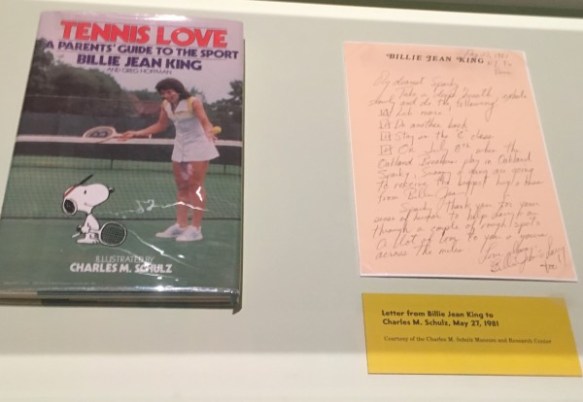
I devoured the strips as a very young reader; I am not a particular fan of the various TV movies. But I had not appreciated how politically attuned they were. The story of Franklin’s introduction has been well coveredspeculating that there is a deliberate lesbian subtext. Billie-Jean King was not only a fan but a friend.

Some of the accompanying contemporary art in London is striking; in particular, Mel Brimfield’s “Mel Brimfield Is Nuts” repays close examination (click to embiggen):

Coming back to the strips as an adult, some of them have eerie resonances:

And some remain eternally relevant.

In summary, I found the London exhibition very thought-provoking, while the Santa Rosa museum is just plain fun.

Posted in Uncategorised

My tweets

Posted in Uncategorised

All The King’s Men: 1949 film and novel by Robert Penn Warren

All the King’s Men won the Oscar for Best Motion Picture of 1949, and Broderick Crawford and Mercedes McCambridge won Best Actor and Best Supporting Actress. The other nominated films were Battleground, The Heiress, A Letter to Three Wives and Twelve O’Clock High, none of which I have heard of.

On the two IMDB systems, it ranks 8th and 20th for the year. The Third Man, Kind Hearts and Coronets, White Heat, On The Town, and She Wore a Yellow Ribbon are all ranked ahead of it on both lists (none of them was nominated for Best Motion Picture; this was a year when Academy voters were notably out of sync with the judgement of history). I have actually seen The Third Man and Kind Hearts and CoronetsThe Third Man is one of my favourite films, but it did not get a single Oscar nomination in any category. I don’t think I have seen any other film from that year.

All The King’s Men is the story of Willie Stark, who progresses from county treasurer, to unsuccessful candidate for governor, to populist revolutionary governor, to assassination victim. It’s pretty obviously modelled on the career of Huey Long, who was governor of Louisiana from 1928 to 1932, and maintained political control of the state from the U.S. Senate from 1932 until his assassination in 1935, as he was preparing a presidential campaign. Stark, like Long, runs for governor and loses before winning on the second attempt, and is shot dead by the relative of a judge who was a political enemy, the assassin in turn being gunned down by his victim’s bodyguard(s).

Not to beat about the bush, I did not much care for All The King’s Men, and this won’t be one of my longer reviews. Perhaps it was a mistake to watch it on the Eurostar home after a long and tiring day in London; it’s mercifully short, less than two hours, but seemed a real drag at times. I went through three phases as I watched it.

At first I was seriously shocked at the whitewashing of the setting – it is clearly understood to be a portrayal of Huey Long’s Louisiana, which at the time had the second or third highest proportion of African-American inhabitants of any state of the Union (Mississippi has the most; Georgia has now slipped behind Louisiana to third but was in second place at the start fo the period when the film is set.) The book on which the film is based refers to African-Americans throughout (though the writer does not use that terminology), including three times in its very first paragraph, and includes a long chapter meditating on slavery and the Civil War. Yet literally everyone in the film is white, apart from one waiter on a train, whose face is not even seen clearly.

I know that I go on about this issue a lot, but this really is pretty egregious. The book, with plot firmly rooted in the race politics of the Deep South, was a best-seller, and most American cinema-goers of 1949 would have read it or at least been aware of it; the film has totally erased an entire ethnic group, a third of the population. There’s a word for that. It’s utterly shocking. (And it’s now seven years since we had an Oscar-winning film with a speaking part for a black actor.)

I got over this dissonance to a certain extent and began to actually rather like the film’s theme. There are not a lot of movies out there about the political process, and as far as I know this is the only Oscar winner which features elections quite so centrally. It’s my home territory, as it were, and I liked the mapping of Willie Stark’s political career, from county treasurer, to unsuccessful candidate for governor, to populist revolutionary governor, to assassination victim. His rapid adoption of populism as a political tool has obvious resonances today.

Having said that, I was not as impressed as the Oscar voters were with Broderick Crawford’s performance in the lead role. At the beginning of the film it’s fairly clear what’s going on: this is a chap from a not especially privileged background trying to make good as a public servant and a lawyer. But I didn’t feel that Crawford really got to grips with Stark’s transition into becoming a monster; as this reviewer comments, he’s rather a one-note actor. In general, as the film went on I felt increasingly that we were going through the motions to put the best episodes from the book on screen, and I lost the sense of connection between different parts of the narrative.

I felt that my disconnection was shared by the cast to an extent. There is a rumour that the director let the actors read the script just once and then took it away from them, forcing them to improvise while shooting. If so, I am not sure that this was a successful tactic; there are a lot of scenes that just feel under-rehearsed, with the actors’ arms hanging by their sides, which is never a good sign.

I did like Mercedes McCambridge’s Oscar-winning performance as election worker Sadie Burke, and John Ireland as the narrator and central character Jack Burden, both of them with a crush on Stark (which is understandable at the beginning of the film but less so as it goes on).

It should also be said that the actual photography is gorgeous, and while you can never quite believe that southern California is the Deep South, you can be persuaded that it is a distinct territory with its own characteristics, politics and landscape.

But basically this one didn’t work for me. The best film I’ve seen from 1949 remains The Third Man, and the best film I’ve seen about political campaigning remains Primary Colors.

I’m ranking All The King’s Men pretty low down my list, behind Mutiny on the Bounty but ahead of Broadway Melody. Most people who have seen it seem to have liked it more then me. You can get it here if you like.

Next up is All About Eve, which I know nothing about. I’ll also have a look at Destination Moon, which won a Retro Hugo for the relevant year.

As has become my habit, after watching the film, I read the novel on which it was based, published two years earlier and winner of the Pulitzer Prize. This is the second paragraph of the third chapter.

That was the way it had always been—when I had come home from school, when I had come back from camps, when I had come back from college, when I had come back from jobs—and that was the way it was that late rainy afternoon, on the borderline between winter and spring, back in 1933, when I came back home again, after not coming home for a long time. It had been six or eight months since my last visit. That time we had had a row about my working for Governor Stark. We always sooner or later got into a row about something, and in the two and a half years that I had been working for Willie it usually in the end came round to Willie. And if his name wasn’t mentioned, he stood there like a shadow behind us. Not that it mattered much what we rowed about. There was a shadow taller and darker than the shadow of Willie standing behind us. But I always came back, and I had come back this time. I would find myself drawn back. It was that way, and, as always, it seemed to be a fresh start, a wiping out of all the things which I knew could not be wiped out.

It’s a really good novel, and like Cimarron and Gentleman’s Agreement the screen rather failed to do it justice – in fact somewhat more so than in the other two cases. The narrator, Jack Burden, has a convincing Hemingwayish voice, and takes us through the career of Willie Stark from his beginning to his bloody end, explaining his motivations and actions partly in his own voice and partly through Burden’s fascinated gaze, and ends with a decent final chapter which wraps up all the plot threads left hanging by the central character’s death. The interlocking relationships of Stark’s political and sexual affairs make a lot more sense on the page than on the screen, especially as regards the personal links between Burden, the narrator, and Stark’s entourage and enemies. The descriptions of landscape and people are detailed and compelling. As mentioned above, there is an entire chapter on slavery and the Civil War, giving historical context to the dismal poltical environment in which Stark flourishes. The novel is still pretty white, but unlike the film there are actually black characters who actually say the occasional sentence. I must also admit that the women characters, though very well drawn, are not given a lot of agency, if anything a bit less than in the film.

I had not previously heard of Robert Penn Warren, America’s first Poet Laureate and the only writer to have won Pulitzers for both prose fiction and poetry, but I will keep an eye out for his other work. You can get this book here.

1920s: Wings (1927-28) | The Broadway Melody (1928-29)
1930s: All Quiet on the Western Front (1929-30) | Cimarron (1930-31) | Grand Hotel (1931-32) | Cavalcade (1932-33) | It Happened One Night (1934) | Mutiny on the Bounty (1935, and books) | The Great Ziegfeld (1936) | The Life of Emile Zola (1937) | You Can’t Take It with You (1938) | Gone with the Wind (1939, and book)
1940s: Rebecca (1940) | How Green Was My Valley (1941) | Mrs. Miniver (1942) | Casablanca (1943) | Going My Way (1944) | The Lost Weekend (1945) | The Best Years of Our Lives (1946) | Gentleman’s Agreement (1947) | Hamlet (1948) | All the King’s Men (1949)
1950s: All About Eve (1950) | An American in Paris (1951) | The Greatest Show on Earth (1952) | From Here to Eternity (1953) | On The Waterfront (1954, and book) | Marty (1955) | Around the World in Eighty Days (1956) | The Bridge on the River Kwai (1957) | Gigi (1958) | Ben-Hur (1959)
1960s: The Apartment (1960) | West Side Story (1961) | Lawrence of Arabia (1962) | Tom Jones (1963) | My Fair Lady (1964) | The Sound of Music (1965) | A Man for All Seasons (1966) | In the Heat of the Night (1967) | Oliver! (1968) | Midnight Cowboy (1969)
1970s: Patton (1970) | The French Connection (1971) | The Godfather (1972) | The Sting (1973) | The Godfather, Part II (1974) | One Flew Over the Cuckoo’s Nest (1975) | Rocky (1976) | Annie Hall (1977) | The Deer Hunter (1978) | Kramer vs. Kramer (1979)
1980s: Ordinary People (1980) | Chariots of Fire (1981) | Gandhi (1982) | Terms of Endearment (1983) | Amadeus (1984) | Out of Africa (1985) | Platoon (1986) | The Last Emperor (1987) | Rain Man (1988) | Driving Miss Daisy (1989)
1990s: Dances With Wolves (1990) | The Silence of the Lambs (1991) | Unforgiven (1992) | Schindler’s List (1993) | Forrest Gump (1994) | Braveheart (1995) | The English Patient (1996) | Titanic (1997) | Shakespeare in Love (1998) | American Beauty (1999)
21st century: Gladiator (2000) | A Beautiful Mind (2001) | Chicago (2002) | The Lord of the Rings: The Return of the King (2003) | Million Dollar Baby (2004, and book) | Crash (2005) | The Departed (2006) | No Country for Old Men (2007) | Slumdog Millionaire (2008)

November books

Non-fiction: 1 (YTD 46)
52 Ways of Looking at a Poem, by Ruth Padel
0099429152.01._SX175_SY250_SCLZZZZZZZ_[1].jpg

Fiction (non-sf): 6 (YTD 32)
Baptism in Blood, by Jane Haddam
Burr, by Gore Vidal
The Stone Book Quartet, by Alan Garner
The Prisoner and The Fugitive, by Marcel Proust
And the Mountains Echoed, by Khaled Hosseini
All The King’s Men, by Robert Penn Warren
bd5176da8518e53597833505451437641506f41[1].jpg 92319db45ca6ff6593435746241437641506f41[1].jpg 9f14f1a793fdfcb593268675677437641506f41[1].jpg

Theatre: 1 (YTD 4)
Hamlet, by William Shakespeare
0521094747.01._SX175_SY250_SCLZZZZZZZ_[1].jpg

sf (non-Who): 2 (YTD 105)
Hybrid, by Shaun Hutson
Hardwired, by Walter Jon Williams
0316860751.01._SX175_SY250_SCLZZZZZZZ_[1].jpg B005O5VR3U.01._SX175_SY250_SCLZZZZZZZ_[1].jpg

Doctor Who, etc: 1 (YTD 32)
Doctor Who: Twelve Angels Weeping: Twelve Stories of the Villains from Doctor Who, by Dave Rudden
B07FF3SJ5R.01._SX175_SY250_SCLZZZZZZZ_[1].jpg

Comics: 1 (YTD 25)
Brüsel, by Benoît Peeters and François Schuiten

~5,100 pages (YTD ~67,400)
2/12 (YTD 98/248) by non-male writers (Padel, Haddam)
1/12 (YTD 25/248) by PoC (Hosseini)
2/12 (YTD 22/248) reread (Hamlet, The Prisoner and The Fugitive)

Reading now
The Amazing Adventures of Kavalier and Clay, by Michael Chabon
Outside In: 160 New Perspectives on 160 Classic Doctor Who Stories by 160 Writers, ed. Robert Smith?
Fools, by Pat Cadigan

Coming soon (perhaps):
Delta of Venus, by Anaïs Nin
The Name of This Book Is Secret, by Pseudonymous Bosch
Perilous Dreams, by Andre Norton
A Cold Day in Hell, by Alan Grant
The Year's Best Science Fiction & Fantasy, 2010 Edition, ed. Rich Horton
Factfulness, by Hans Rosling
Heartspell, by Blaine Anderson
Bitter Angels, by C.L. Anderson
A Little Life, by Hanya Yanyagihara
The Paying Guests, by Sarah Waters
Fanny Hill, by John Cleland
“The Queen of Air and Darkness”, by Poul Anderson
Stepping Stones: Interviews with Seamus Heaney, by Dennis O’Driscoll
Grimm Tales: For Young and Old, by Philip Pullman
Nebula Awards Showcase 2011, ed. Kevin J. Anderson
Lambik, by Marc Legendre
Candide, by Voltaire
Feersum Endjinn, by Iain M. Banks
Secret Histories, ed. Mark Clapham

Posted in Uncategorised

And the Mountains Echoed, by Khaled Hosseini

Second paragraph of third chapter:

“I’m sorry,” Masooma whispers.

I wasn’t totally convinced by the two previous novels I’ve read by Hosseini, but I really enjoyed this one: a narrative from multiple points of view, following the lives of three Afghan siblings from 1952 to 2010, from childhood to old age, across continents and cultures. The youngest brother stays in Afghanistan; the middle sister is adopted by a Franco-Afghan poet and grows up and lives her life in Paris; and the story ends with the oldest in California, which by odd coincidence is where I was travelling to when I finished the book today. I found the shift of narrative between viewpoint characters very effective, and I was able to put my cynicism aside to be moved by the last chapter. Recommended. You can get it here.

This was my top unread book by a non-white author, my top unread non-genre fiction book and my top book acquired this year. Next on those lists respectively are A Little Life, by Hanya Yanyagihara, Delta of Venus by Anaïs Nin and The Paying Guests by Sarah Waters.

Posted in Uncategorised

My tweets

Posted in Uncategorised

My tweets

Posted in Uncategorised

Brüsel, by Benoît Peeters and François Schuiten

Second frame of third chapter:

Second frame with words from third chapter:


Constant Abeels: "Christ, what's all this mess?"

There is actually a comics shop in downtown Brussels named after this volume, and I had assumed for some reason that it was originally in Dutch and a standalone tale. In fact it was originally in French (but I read the Dutch translation) and it's the fifth (at least; counts vary) in a series of works with the overall title Les Cités obscures, which sort-of translates to "The Obscure Cities", set in a succession of parallel conurbations which are closely related to those on our own world. There's no doubt whatsoever as to which city Brüsel refers to, particularly since my edition is prefaced with an angry and well-illustrated essay about how urban development has destroyed communities and heritage in the real Brussels. This frame is a particularly chilling reinterpretation of the Palais de Justice (uncompleted here; apparently the original plan was to put a pyramid rather than a dome on top):

It's a book of polemic rather than plot. Our hero, Constant Abeels, is a florist who has switched from real flowers to plastic ones. He gets drawn into the steampunkish world of the urban developers of Brüsel, led by the sinister Mr De Vrouw (whose name means Mr Woman); at the same time he is subjected to medical treatment for a condition similar to but not entirely like tuberculosis; and keeps encountering the enigmatic Tina Tonero, whose clothes have a tendency to fall off at strategic moments.

I found this sufficiently intriguing that I will try and find the rest of the series, starting from the beginning, in the original French. I would recommend getting this in French too, here.

My only other unread non-English comic (at present) is Lambik, by Charel Cambré and Marc Legendre.

Posted in Uncategorised

My tweets

Posted in Uncategorised

Monday reading

Current
And the Mountains Echoed, by Khaled Hosseini
The Amazing Adventures of Kavalier and Clay, by Michael Chabon
Outside In: 160 New Perspectives on 160 Classic Doctor Who Stories by 160 Writers, ed. Robert Smith?
All The King’s Men, by Robert Penn Warren

Last books finished
Burr, by Gore Vidal
The Stone Book Quartet, by Alan Garner
The Prisoner and The Fugitive, by Marcel Proust
Brüsel, by Benoît Peeters and François Schuiten

Next books
Fools, by Pat Cadigan
Delta of Venus, by Anaïs Nin
The Name of This Book Is Secret, by Pseudonymous Bosch

Posted in Uncategorised

My tweets

Posted in Uncategorised