The Merchant and the Alchemist’s Gate, by Ted Chiang, and The Yiddish Policemen’s Union, by Michael Chabon

These both won the Hugo and Nebula Awards for work of 2007, awarded in 2008.

The second paragraph of the third section of The Merchant and the Alchemist’s Gate is:

He was wandering by the Zuweyla Gate, where the sword dancers and snake charmers perform, when an astrologer called to him. “Young man! Do you wish to know the future?”

Back in 2008, I ranked it second on my ballot, behind The Cambist and Lord Iron, by Daniel Abraham, and wrote:

A lovely lovely story of time travel at the time of the Abbasid Caliphate, working up all those human themes of loss and love in a richly imagined fantastic environment that Chiang has done so well before. I expect this will win.

I still think that it is really good, and it has certainly proved to have staying power. It’s a story of time travel paradoxes, predestination and acceptance. I love Borges’ short story “The Other”, in which the writer meets his younger self and finds that they do not understand each other. Chiang riffs on this theme as well, with the extra twist that the older self comes to collude in his younger self’s destiny. I also give it good marks for the subtly different portrayals of Baghdad and Cairo, respectful rather than Orientalist (at least that was my take).

The Merchant and the Alchemist’s Gate was the only work on both the Hugo and Nebula ballots for Best Novelette that year. The other Hugo finalists were “The Cambist and Lord Iron: A Fairy Tale of Economics”, by Daniel Abraham; “Dark Integers”, by Greg Egan; “Finisterra”, by David Moles and “Glory”, by Greg Egan. The other Nebula finalists were “Child, Maiden, Mother, Crone”, by Terry Bramlett; “The Children’s Crusade”, by Robin Wayne Bailey; “The Evolution of Trickster Stories Among the Dogs Of North Park After the Change”, by Kij Johnson; “The Fiddler of Bayou Teche”, by Delia Sherman; “Pol Pot’s Beautiful Daughter (Fantasy)”, by Geoff Ryman; and “Safeguard”, by Nancy Kress.

The second paragraph of the third chapter of The Yiddish Policemen’s Union starts as follows (explicit surgical details redacted):

Instead, he lights a papiros. After a decade of abstinence, Landsman took up smoking again not quite three years ago. His then-wife was pregnant at the time. It was a much-discussed and in some quarters a long-desired pregnancy—her first but not a planned one. As with many pregnancies that are discussed too long there was a history of ambivalence in the prospective father. At seventeen weeks and a day—the day Landsman bought his first package of Broadways in ten years-they got a bad result. Some but not all of the cells that made up the fetus, code-named Django, had an extra chromosome on the twentieth pair. A mosaicism, it was called. It might cause grave abnormalities. It might have no effect at all. In the available literature, a faithful person could find encouragement, and a faithless one ample reason to despond. Landsman’s view of things-ambivalent, despondent, and with no faith in anything prevailed… Three months later, Landsman and his cigarettes moved out of the house on Tshernovits Island that he and Bina had shared for nearly all the fifteen years of their marriage. It was not that he couldn’t live with the guilt. He just couldn’t live with it and Bina, too.

I ranked it third on my ballot that year, writing:

 The setting is an alternate present where a large chunk of Alaska was colonised by Jewish refugees after the Second World War, and the Israelis lost in 1948 – there are other differences too, but those are the major ones. Now, sixty years on from those events, the Alaskan territory is within weeks of reverting to US control and its inhabitants face displacement again.

Chabon’s viewpoint character is a memorably seedy and depressed detective, trying to solve a murder which appears to be linked to chess and a Messianic Jewish sect, and at the same time dealing with his own professional and family dilemmas. The tenuous society of Sitka is well depicted at all its levels. In places it’s terrifically sad. I was a bit dubious about the portrayal of conspiratorial politics at the highest political level, but perhaps that was part of the point.

However, it’s not going at the top of my Hugo list; I don’t think it is sfnal enough. Apart from the ahistorical setting, there is no sfnal content (well, a couple of miracles are hinted at, but I’m not sure that counts). The genre of this novel is detective, not sf; the setting is not much more counterfactual than Agatha Christie’s country houses, or Lindsey Davis’ richly imagined and researched Rome, or Ellis Peters’ medieval Shrewsbury (which also gets the very occasional miracle, but that doesn’t make it fantasy).

Don’t get me wrong: I liked the book enormously. The setting seemed to me a very thought-provoking response to the history of Jews, in America in particular, since 1940, far better than the other attempts I’ve read recently. I’ll probably end up ranking it ahead of the other two nominees which I haven’t yet read and of which I don’t have huge expectations. But, while in a lot of ways it may be the best novel of the three I’ve read so far, it lacks the sensawunda that I got in spades from both Halting State and Brasyl, so loses my vote on that account.

Coming back to it seventeen years later, I was not sure that I liked it as much. It’s difficult to believe the political set-up; where are the people who would have been lobbying in Washington to allow Sitka to remain Jewish? Is political extremism really monopolised by religious extremists? There is an intersection, sure, but it’s rarely the perfect overlay depicted here. There’s a bit of an assumption that the experience of urban American Jews applies to Jews everywhere, and I don’t see that that really tracks. And I must also say that I found it rather a long book. Anyway, you can get The Yiddish Policemen’s Union here.

Again, this was the only book on both the Hugo and Nebula ballots for Best Novel. The other Hugo finalists were Brasyl, by Ian McDonald; Halting State, by Charles Stross; The Last Colony, by John Scalzi; and Rollback, by Robert J. Sawyer. The other Nebula finalists were The Accidental Time Machine, by Joe Haldeman; The New Moon’s Arms, by Nalo Hopkinson; Odyssey, by Jack McDevitt; and Ragamuffin, by Tobias S. Buckell, none of which I have read.

In the Best Novella categories, three stories were nominated for both Hugo and Nebula: the Nebula-winning “The Fountain of Age”, by Nancy Kress; “Memorare”, by Gene Wolfe; and “Stars Seen Through Stone”, by Lucius Shepard. The other two Hugo finalists were “Recovering Apollo 8”, by Kristine Kathryn Rusch, which I voted for, and “All Seated on the Ground”, a particularly silly story by Connie Willis, which won. The other Nebula finalists were “Awakening”, by Judith Berman; “The Helper and His Hero”, by Matt Hughes; and “Kiosk”, by Bruce Sterling.

There was no overlap in the Short Story categories. The Hugo finalists were “Tideline”, by Elizabeth Bear, which won, and also got my own vote; “Distant Replay”, by Mike Resnick; “Last Contact”, by Stephen Baxter; “A Small Room in Koboldtown”, by Michael Swanwick; and “Who’s Afraid of Wolf 359?”, by Ken MacLeod. The Nebula finalists were “Always”, by Karen Joy Fowler, which won; “Captive Girl”, by Jennifer Pelland; “Pride”, by Mary Turzillo; “The Story of Love”, by Vera Nazarian; “Titanium Mike Saves the Day”, by David D. Levine; and “Unique Chicken Goes In Reverse”, by Andy Duncan.

The Hugo for Best Dramatic Presentation Long Form went to Stardust, and for Short Form to Blink. The Nebula for Best Script went to Pan’s Labyrinth.

Next in this sequence is The Windup Girl, by Paolo Bacigalupi.

The Last Unicorn, and Two Hearts, by Peter S. Beagle

“Two Hearts” was next in my list of joint Hugo and Nebula winning fiction, having taken the Hugo for Best Novelette in 2006 and the Nebula in the same category in 2007 (though that was the Nebula for 2006). Before reading it, I thought, well, I had not actually read Peter S. Beagle’s The Last Unicorn before, so maybe I should read it first and see what I thought?

The second paragraph of the third chapter of The Last Unicorn is:

The unicorn was gray and still. “There is magic on me,” she said. “Why did you not tell me?”

Reader, I hated it. I found it the worst kind of sentimental glurge. The dissonance of calling the wizard Schmendrick is one more false step on top of the teeth-grinding saccharinity of the rest of the story. I lasted not much more than fifty pages. I’m sorry, I know it’s a much-loved classic, and perhaps I am a bitter ageing man, but I could not take it.

“Two Hearts” does not have internal sections, so here is the third paragraph.

But it didn’t ever eat children, not until this year.

When the awards were first being voted on in 2006, I put “Two Hearts” at the top of my Hugo ballot.

Back in 1968, Beagle published his classic fantasy novel, The Last Unicorn. I have never read it, nor have I seen the film made some time back (apparently very successful, though Beagle did not profit much from it) and so I expected this follow-up novella (written almost four decades later!) to leave me pretty cold. In fact, it had entirely the opposite effect: I was totally captured by the lyrical and moving story of a king’s last quest, told through the eyes of a young girl, in a fantasy world where Bad Things Happen but you can hope for Good to have a partial victory at the end. Perhaps I am just getting sentimental in my old age, but I loved it.

Again, I must be getting bitter as I get older, because I really didn’t like it this time. Perhaps my teeth were still on edge from reading The Last Unicorn.

You can get The Last Unicorn here, and you can get “Two Hearts” in a sequel collection here.

Next up in this sequence is “The Merchant and the Alchemist’s Gate” by Ted Chiang, which I hope has aged better.

“The Faery Handbag”, by Kelly Link

Third paragraph (it has no sections):

One time we were looking through kid’s t-shirts and we found a Muppets t-shirt that had belonged to Natalie in third grade. We knew it belonged to her, because it still had her name inside, where her mother had written it in permanent marker, when Natalie went to summer camp. Jake bought it back for her, because he was the only one who had money that weekend. He was the only one who had a job.

This was the subject of the very last of my first set of reviews of joint winners of the Hugos and Nebulas in the written fiction categories, published in January 2008 before I completely ran out of steam for that project. I wrote then:

I didn’t vote for it. Indeed, I put it last of the five nominees in the novelette category for the Hugos, where I had a vote as a Worldcon member; not because I didn’t like it, but because I liked the other stories on the ballot even more. The result was the closest of the four fiction categories, and voters found it difficult to choose for the lower places – second place decided by a single vote, joint win for third place. I don’t begrudge the result; all five nominees were very good, and I see that by the time the Nebulas came around I had changed my views and put it top (though three of the other four stories of course were different). Well, what was it Emerson said about consistency?

In fairness to myself, I think it’s a story that grows on you. On first reading I found it very entertaining but didn’t think it was especially deep; part of my increase in affection for it came about as a result of reading the whole Magic for Beginners collection of Kelly Link’s stories and developing a taste for her particular style of magical realism, urban fantasy, underlaid with darker tones. ‘The Faery Handbag’ is a story told by Genevieve, a young woman living near Boston whose grandmother came with her handbag from far-off Baldeziwurlekistan; the handbag may or may not contain a fierce canine guardian, Grandmother Zofia’s home village, Genevieve’s grandfather Rustam and her boyfriend Jake. But Genevieve has lost the handbag (this is not a spoiler as she tells us so on the second page). And that’s about it.

Part of my initial under-appreciation of the story may be my own background, as a native of Northern Ireland who has worked on the various different countries of Eastern Europe for the last eleven years. Perhaps from an American perspective, Baldeziwurlekistan is an amusing mix of those funny European countries over there, combining Celtic, Germanic, Slavic and classical elements in its mythology. For me, the lack of precision in the geography of Baldeziwurlekistan was a problem; I need to know where things are on the map, and Link’s story is about taking them off the map. I also found myself a bit frustrated by the narrator’s ambiguity about her own reliability, though other reviewers felt this was part of the story’s charm.

Having said that, I agree with everyone who loves Link’s descriptive writing here, from the account of looking through second-hand clothes in the first paragraph to the poignancy of Zofia’s death at the end; and the way we learn about the narrator’s frame of mind from the way she describes the events around her is tremendously subtle and effective. Indeed, as Abigail Nussbaum points out, it’s a bit more approachable than some of Link’s other stories, which may (again) be part of the reason I didn’t quite take to it immediately. But I’ve found it rather a difficult story to grasp sufficiently to write about, which is part of the reason this series of reviews has been on hiatus for seventeen months.

(And of course I never returned to that sequence, instead rebooting the joint Hugo and Nebula winners in chronological order starting in 2017.)

Rereading the story now, I found that it has grown on me again – in particular I loved the resonance between grandmother Zofia and grandfather Rustam, and present-day Genevieve and boyfriend Jake. And perhaps I have got more used to American humour in the last two decades, but I found the story funnier than my recollection. Definitely worth revisiting. “The Faery Handbag” is available on Link’s website for free.

“The Faery Handbag” won the Hugo for Best Novelette in Glasgow in 2005, the first ceremony that I attended. Best Novel went to Jonathan Strange & Mr Norrell, by Susanna Clarke; Best Novella to “The Concrete Jungle”, by Charles Stross; and Best Short Story to “Travels with My Cats”, by Mike Resnick.

These were the days of the crazy Nebula nominations system, so it won the 2005 Nebula for Best Novelette in 2006 (for a 2004 publication). Best Novel went to Camouflage, by Joe Haldeman; Best Novella to “Magic for Beginners”, also by Kelly Link; and Best Short Story to “I Live With You”, by Carol Emshwiller (who turned 85 the month before the ceremony).

Of the other Best Novelette finalists, “The People of Sand and Slag” by Paolo Bacigalupi was on the ballot with “The Faery Handbag” both times, and “The Voluntary State” by Christopher Rowe was on the same Hugo ballot and the previous year’s Nebula ballot.

Next in this sequence: “Two Hearts”, by Peter S. Beagle.

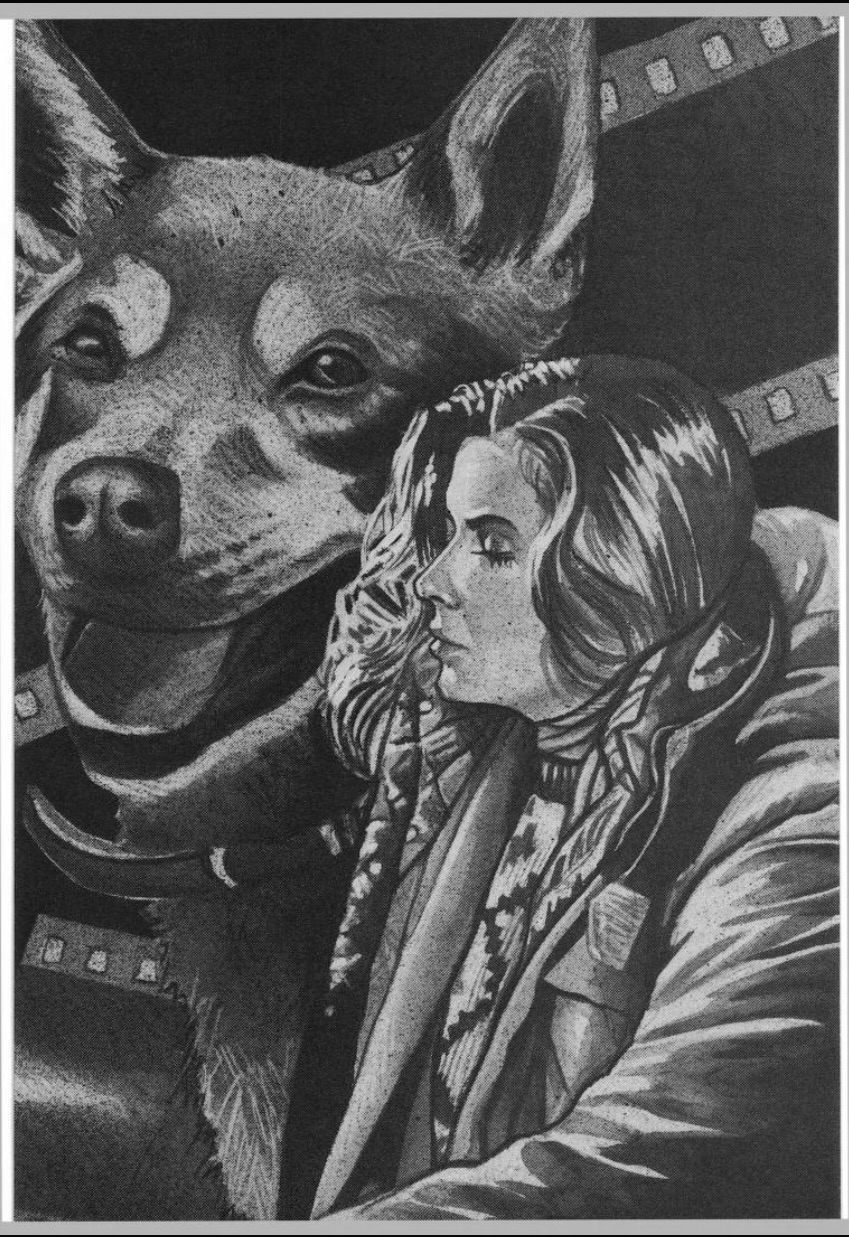
I don’t know where this illustration comes from, but it’s cute.

“Hell is the Absence of God”, by Ted Chiang

“Hell is the Absence of God” won both the 2002 Hugo and the 2002 Nebula for Best Novelette.

Second paragraph of third section:

What people assumed about Neil had in fact happened to Janice. When Janice’s mother was eight months pregnant with her, she lost control of the car she was driving and collided with a telephone pole during a sudden hailstorm, fists of ice dropping out of a clear blue sky and littering the road like a spill of giant ball bearings. She was sitting in her car, shaken but unhurt, when she saw a knot of silver flames—later identified as the angel Bardiel—float across the sky. The sight petrified her, but not so much that she didn’t notice the peculiar settling sensation in her womb. A subsequent ultrasound revealed that the unborn Janice Reilly no longer had legs; flipperlike feet grew directly from her hip sockets.

Back in 2006, I wrote of this story:

“Hell Is the Absence of God” is a story set in a world very like ours, but where there is no doubt about whether angels, Heaven and Hell are all real. This does raise an interesting question as to whether it can be counted as fantasy or science fiction; Chiang himself is clear that he sees the work as fantasy, but as Jeremy Smith and Niall Harrison [dead link] have argued, apart from the supernatural premise, the world he has created is a pretty mechanistic one, with angels behaving like natural forces (what an earlier age termed “acts of God”); there is no means of mediating with them. (There is, however, a possibility of interaction directly with God, which must surely undermine the classification of the story as science fiction rather than fantasy.)

But the story is not about God or angels. It is about what it is like to be human in this world, and in particular on the nature of devotion and religion when faith is no longer an issue. Only those who love God can go to Heaven; Hell, however, is not a place of torment, but simply somewhere “not physically worse than the mortal plane”, occasionally visible below our own world, characterised by (as we are told in the story’s title) the absence of God.

This is not a story about Christianity, not even about evangelical Christianity, though a lot of people have made that mistake (including me when I first read it, and the writer of the blurb for one of the collections it has been published in). Explicitly, Christ is not mentioned anywhere in the text. Implicitly, faith as such has been taken out of the equation by the empirical and undeniable proofs of God’s existence. There are no unbelievers in Chiang’s world. There are, however, people who are not religious. 

Some readers didn’t get this crucial point, including John C. Wright on the Amazon site, who calls it “trite antichristian propaganda” and William December Starr on usenet [dead link], who described is as “just yet another “God’s a jerk” story, big deal”. (Elf Sternberg has repeatedly praised it for much the same reasons, suggesting that Chiang is telling exactly the same story here as C.S. Lewis in The Great Divorce, but from a different perspective.) I find it rather interesting that those readers who react to the story as thin anti-Christian propaganda tend to also describe themselves as non-believers. I haven’t yet found a Christian writer who had the same reaction, though it will be interesting to see what Mirtika Schulz’s group  [dead link] makes of it when they get there. (Kathy Wang  [dead link] actually thought it a pro-Christian, proselytising story at first, though realised her mistake on further reading.) My suspicion is that for most believers, and for some non-believers (and perhaps for anyone who is interested in exploring the spectrum of opinion between Richard Dawkins and Billy Graham, rather than pledging their allegiance to one side or the other), Chiang’s thought-experiment is in fact an interesting one. 

It is made more interesting by the style of narrative – tight third-person, but with no direct speech at all. It gives the story some of the qualities of a documentary: it is as if the camera focusses on each person individually, and then moves on. There are three main characters: Neil Fisk, introduced in the first sentence, whose wife is killed by an angelic visitation and whose quest to become devoted to God in order to join her in heaven is the core of the plot; Janice Reilly, disabled and then cured, whose career as a motivational speaker is bound up with Neil’s quest; and Ethan Mead, whose quest for meaning in the world is perhaps meant to be closest to the experience of the reader. Through the characters, Chiang also explores grief  [dead link] and disability  [dead link], both of which are of course key elements in the eternal question of why a loving God allows bad things to happen in the world. Again, Chiang is not trying to answer this question himself, but he is exploring how people do answer it, in a world where “God doesn’t exist” is not an option. He is also by his own account, if to a very small extent, exploring the role of God.

Chiang has in fact written up the roots of this story, in an afterword in his Stories of Your Life and Others collection. He mentions briefly Gregory Widen’s film, The Prophecy, and the work of modern mystic Annie Dillard, but then goes on to devote two paragraphs (out of four in the short piece) to the Book of Job.

For me, one of the unsatisfying things about the Book of Job is that, in the end, God rewards Job. Leave aside the question of whether new children can compensate for the loss of his original ones. Why does God restore Job’s fortunes at all? Why the happy ending? One of the basic message of the book is that virtue isn’t always rewarded; bad things happen to good people. Job ultimately accepts this, demonstrating virtue, and is subsequently rewarded. Doesn’t this undercut the message?

It seems to me that the Book of Job lacks the courage of its convictions. If the author were really committed to the idea that virtue isn’t always rewarded, shouldn’t the book have ended with Job still bereft of everything?

The Book of Job is one of the most interesting and puzzling parts of the Bible (and, according to one reference work I consulted, the one book whose text is most corrupt). Job, an upright and honest man, is inflicted with tremendous suffering by Satan as part of a wager with God (Satan betting that suffering will make Job turn against God). Much poetry ensues, Job’s friends attempting to persuade him that his suffering is just punishment for something, Job himself asserts his own righteousness, and then God Himself appears in a whirlwind; Job is overwhelmed by the divine presence, and the book ends as Chiang describes it.

Apologists for the Book of Job can of course mutter that the original text may well have concluded without this disappointing and inconsistent happy ending. The prose narrative of verses 7-17 of the last chapter has the feel of being by a different hand to most of the rest of the book (perhaps the two introductory chapters are from the same source or a similar one). But Chiang is right. The text we have is the one we have, not what one might wish it to be, and the ending is inconsistent. His choice of ending for his story – where Neil Fisk is, as we would see it, unfairly damned by God, is a direct response to the climax of the Biblical story, where Job is, as Chiang sees it, unfairly saved. 

In a different year, one could imagine that the Hugo and/or Nebula might have gone either to a traditional hard sf story like Allen Steele’s tale of the one man who wakes up on a starship where everyone else is asleep in cold storage, or to Charles Stross’ vibrant vision of the the founder of a post-Singularity, post-human dynasty. I think it would have had a good chance of winning anyway – I tipped it for the Hugo myself, and scoffed at those who felt it was unworthy of the Nebula. But (I owe this point to Glenn Gillette [dead link]) in the months after September 2001, Chiang’s tale of humans trying to come to terms with tragedy and disaster happened to hit the Zeitgeist in a way that (I hope) he never anticipated, and this must have made a difference with the voters of both SFWA and Worldcon.

Nineteen years on, I agree with myself and I don’t have much to add. I think the story remains a really good thought experiment, emotionally charged yet sparsely written, with perhaps some understated rage at an irrationally cruel world and its creator.

One point I should have made is that the angels, who are impersonal forces of disruption and often destruction, are given names by the human onlookers to their passage, even though there is no hint that they actually have any personalities or intelligence, exactly as we give names to hurricanes. It raises the question, to what extent do we really know anything, let alone control it, by giving it a name?

I have it in the collection Stories of your Life and Others, which you can get here (also for sale under the variant title Arrival). Back in the days of FictionWise, you could get it separately, but that’s long gone now.

Other novelettes on final ballot for both Hugo and Nebula: “The Days Between”, by Allen Steele and “Lobsters”, by Charles Stross.

Other novelettes on final ballot for Hugo: “Undone”, by James Patrick Kelly and “The Return of Spring”, by Shane Tourtellotte.

Other novelettes on final ballot for Nebula: “The Pagodas of Ciboure”, by M. Shayne Bell; “The Ferryman’s Wife”, by Richard Bowes; and “Madonna of the Maquiladora”, by Gregory Frost.

Other winners of 2002 Hugos: American Gods, by Neil Gaiman (best novel); “Fast Times at Fairmont High”, by Vernor Vinge (best novella); “The Dog Said Bow-Wow” by Michael Swanwick (best short story); The Lord of the Rings: The Fellowship of the Ring (dramatic presentation).

Other winners of 2002 Nebulas: American Gods, by Neil Gaiman (best novel); “Bronte’s Egg”, by Richard Chwedyk (best novella); “Creature”, by Carol Emshwiller (best short story); The Lord of the Rings: The Fellowship of the Ring (dramatic presentation).

Normally I’m reviewing joint Hugo and Nebula winners from the same year together, but I don’t feel like revisiting American Gods right now. For the same reason, I’m going to skip Coraline, which won both the 2003 Hugo and the 2003 Nebula for Best Novella, and will go on to Paladin of Souls, by Lois McMaster Bujold, for my next write-up in this sequence.

The Ultimate Earth, by Jack Williamson

Second paragraph of third section:

“Sandor’s Tycho Memorial!” Pepe jogged my ribs. “There’s the old monument at the American capital! I know it from Dian’s videos.”

This won the the 2001 Best Novelette Award in both the Hugos and the Nebulas, the author having been born in 1908, making him certainly the oldest person to win either award in, I suspect, any category (Retro Hugos aside). These were the only final ballot places for fiction that Williamson ever got in his long career (his autobiography won a Hugo for Best Nonfiction Book sixteen years earlier, in 1985).

I wrote at the time of the Hugo final ballot that although I preferred Ted Chiang’s “Seventy-Two Letters” and Greg Egan’s “Oracle”:

None of the others were real turkeys though. “The Ultimate Earth” didn’t have a very satisfactory ending but that seems to be standard for stories about nanotechnology.

“The Ultimate Earth” came eighth in the Locus poll, which normally hews closer to the Hugo and Nebula rankings, and only fourth in Analog‘s own readers poll of novellas of 2000. (The Locus poll was won by “Radiant Green Star” by Lucius Shepard, and the Analog poll by “A Roll of the Dice”, by Catherine Asaro, both of which were also Hugo and Nebula finalists.) Ted Chiang’s “Seventy-Two Letters” surely has shown more staying power; likewise Greg Egan’s “Oracle”.

Looking back now, it’s clear that the Hugo and Nebula voters of the day were honoring Williamson’s career rather than the qualities of this particular story, which is rather old-fashioned despite the use of nanotechnology.

After disaster strikes Earth, a group of clone children who have been raised on the Moon steal a spaceship to go back to the home planet. They find it is not what they expected (this is where the nanobots come in) and head off into the stars. Not very new ideas, and not really done in a new way. But you can get it here.

The Hugo for Best Novel went to Harry Potter and the Goblet of Fire; the Nebula to Catherine Asaro’s The Quantum Rose, neither of which are brilliant choices. There is better luck in some other categories – Dave Langford’s “Different Kinds of Darkness” is a jewel of a short story Hugo winner, and Crouching Tiger, Hidden Dragon won both Hugo and Nebula

Next in this series of joint Hugo/Nebula winners will be “Hell Is the Absence of God” by Ted Chiang. After that, I will skip American Gods and Coraline and go straight on to Paladin of Souls, by Lois McMaster Bujold.

Forever Peace, by Joe Haldeman

Second paragraph of third section:

(Fewer than a dozen nuclear weapons, small ones, had been used in twelve years of war. A large one had destroyed Atlanta, and although the Ngumi denied responsibility, the Alliance responded by giving twenty-four hours notice, and then leveling Mandellaville and Sao Paulo. Ngumi contended that the Alliance had cynically sacrificed one nonstrategic city so it could have an excuse to destroy two important ones. Julian suspected they might be right.)

Next in my sequence of joint Hugo and Nebula winners. When I first read it in 2002, I wrote:

Julian Class and his lover Amelia Harding are physicists at a Texas university in 2049. Julian is also a part-time conscripted soldier, fighting ten days a month in the Central American front of a war between the developed world and the developing world, but doing his fighting by remote control as the brains of a military robot. He and his platoon are linked by a neurological modification known as “jacking” which enables them to share each others’ sensations, experiences and memories. He is also the part-time narrator of the book, which drops into third person now and then, giving the impression that his memories have been assembled by a later editor to make a coherent whole. Haldeman used a slightly similar presentation in his earlier The Long Habit of Living and I first came across this technique used to devastating effect in the books based on the TV series Yes, Minister! and Yes, Prime Minister! In this case, of course, it helps the author get around the problem of a first-person narrator who has suicidal impulses; by dropping into the third person now and again we readers are kept guessing as to whether or not the narrator makes it to the end of the book (cf. Podkayne of MarsFlowers for Algernon.)

When Haldeman writes in the foreword to Forever Peace that it examines some of the problems of his earlier novel, The Forever War, “from an aspect that didn’t exist twenty years ago”, one of the problems in question must surely be the evolution of humanity towards the day “when violence towards another human being must become as abhorrent as eating another’s flesh”, to use the words of Martin Luther King quoted in the first pages of the book. The aspect that (I guess) didn’t exist in 1974 is the concept of nanotechnology and by extension the whole set of ideas about the human/computer interface associated with the cyberpunk movement, which came to the fore in sf only in the 1990s. It transpires that those who have been “jacked” with other people for more than two weeks become “humanised”, incapable of deadly violence against other human beings. Julian and Amelia (who for various reasons are both excluded from being affected in this way themselves) decide that this is a Good Thing and conspire with their friends to get the entire command structure of the US military modified in this way.

There is a second conspiracy, one which they are working against. It turns out that the vastly ambitious particle physics experiment Amelia has been working on has the potential to end the universe (or at least the solar system) by replicating the conditions of the Big Bang. A millennialist conspiracy within the higher reaches of the US government decides that the end of the world would be a Good Thing and resolves to thwart Amelia’s efforts to prevent the experiment from being carried out. Various agents are sent to stop them, including a memorably sexy female assassin. But the good guys triumph just in time. Some find the idea of such conspiracies at high level in the US government unconvincing. Well, first of all, it’s a novel, and novels contain things which are not true but make a good story. Secondly, I’ve been sufficiently involved in shedding light on various Balkan conspiracies involving the highest levels of government that little can surprise me any more.

The future war in Central America is between a developed world fighting largely by remote control, and an indigenous population absorbing most of the casualties; from the 1997 perspective, this must have seemed a reasonable extrapolation from the 1990-91 Gulf War, and indeed Kosovo in 1999 and Afghanistan in 2001 were largely fought on that basis. Haldeman even has a massive, one-off attack on a major American city, though it’s nuking Atlanta rather than jumbo jets in New York. The descriptions of the conflict are graphic, on a par with Lucius Shepard’s Life In Wartime, and the narrative is particularly gripping as the assassin closes in on our heroes towards the end. As a novel, it works. The portrayal of Julian’s suicidal impulses and emotional confusion is convincing, and we the readers can see what is really going on for Amelia through his perceptions. The fact that neither main characters is able to share in the jacked consciousness of the newly enhanced humanity is rather poignant. The final couple of pages, describing the victory of the good guys, are perhaps a little too rapid, and when we first encounter those who have already been “humanised” in their North Dakota hideout, I found the scene rather reminiscent of the decaying scientists in the 1983 Doctor Who story Mawdryn Undead, which slightly spoiled it for me. But in general, I felt the tone was more mature and the ending more plausible, if the style a little less raw, than Haldeman’s earlier Hugo and Nebula winner, The Forever War.

One of the least successful aspects of Haldeman’s earlier book is its portrayal of a pacifist end-state for the human race. The Big Idea of Forever Peace is that this pacifist end-state can be achieved by technological intervention; through the sharing of our common humanity via “jacking”. Now, the idea that the Next Big Step in human evolution will involve a fundamental shift in consciousness is quite an old one, with honorable antecedents in Olaf Stapledon and George Bernard Shaw up to Arthur C Clarke’s Childhood’s End and Greg Bear’s Blood Music. The angle is still an unusual one. I was reminded a bit of Frank Herbert’s minor novel, The Santaroga Barrier, where the hero begins by rejecting the prospect of a new form of human consciousness but end up eagerly participating. Forever Peace‘s biggest flaw, as a novel examining issues of humanity and morality, is that it lacks an examination of the ethics of forcing major (and risky) brain surgery on people to bestow on them the benefits of the evolutionary leap forward.

Coming back to it twenty-two years later, I feel that it has not aged especially well. The waging of war remotely, and the attached civilian horrors, perhaps resonate with today’s atrocities in Ukraine and Gaza, though of course these are being largely waged by drone and missile, with deployment of human troops a smaller part of the story than was the case fifty years ago (though still very important). We can see now that Haldeman’s anthropomorphic soldier robots are militarily unnecessary.

And who would have thought that rather than conspiracy theorists in government needing to hide their activities from the authorities, they would actually be getting cabinet-level appointments from the incoming president of the United States?

And the woman assassin at the end is just a little bit too homicidally competent to be true.

Anyway, you can get it here. Next up is “The Ultimate Earth”, by Jack Williamson.

Usually in these entries I go through the other Hugo and Nebula contenders for that year, but this was in the odd period when the Nebulas seemed to part company with quality control. I wrote at the time (though I think my views have shifted a bit over the last two decades):

Since the Nebulas changed their eligibility criteria to allow novels to be considered two years running, the number of works winning both Hugo and Nebula has decreased quite dramatically. Between 1966 and 1996, 15 novels and 34 shorter works pulled off the double, ie on average more than one each year, in each case winning Hugo and Nebula for different years but awarded in the same year. Since 1996, one novel (Forever Peace) and one shorter work (Jack Williamson’s “The Ultimate Earth”) have managed to win both awards, in both cases for the same year but awarded in different years. [We now know that in fact “The Ultimate Earth” kicked off a new sequence of joint wins, but that wasn’t knowable in December 2002 when I wrote this.]

It seems quite clear that, for whatever reason, the profiles of the sf likely to win each award has diverged. My own experience is that the Nebula Award final ballot is not very useful for me in identifying novels that I would like to read, and two of the three awards for Best Novel made since Forever Peace are, in my humble opinion, completely incomprehensible.* The Hugo shortlist, on the other hand, always includes several books that I already own and I usually enjoy tracking down and reading the others; and while I may disagree with three of the four Hugos for Best Novel awarded since Forever Peace I can at least understand what the voters saw in them.** Perhaps there are SF readers out there for whom the Nebulas in recent years make sense, but I have not heard from any of them.

* For the record: I consider The Parable of the Talents, by Octavia Butler, to be a comprehensible and worthy winner of the Nebula Award for 2000, though had I been voting I would probably have gone for George R.R. Martin’s A Clash of Kings or Ken MacLeod’s The Cassini Division. I cannot say the same for Greg Bear’s Darwin’s Radio, which beat both A Civil Campaign by Lois McMaster Bujold and Midnight Robber by Nalo Hopkinson for the 2001 award. And while the 2002 shortlist is generally uninspiring, with the singular exception of George R.R. Martin’s superb A Storm of Swords, I simply cannot comprehend the award going to Catherine Asaro’s The Quantum Rose, with its awful stereotyped romantic lead characters and contrived attempts to link the plot to quantum mechanics.

** The Hugo Award I agree with was the 1999 one to To Say Nothing Of the Dog, by Connie Willis. For 2000 I’d have picked A Civil Campaign or Neal Stephenson’s Cryptonomicon over A Deepness in the Sky, for 2001 Ken MacLeod’s The Sky Road or George R.R. Martin’s A Storm of Swords rather than Harry Potter and the Goblet of Fire, and for 2002 Bujold’s Curse of Chalion rather than Gaiman’s American Gods, but I’ll admit that it’s a close call in all three cases and I certainly respect the judgement of those who voted the other way.

There were no novels on both the relevant Hugo and Nebula final ballots other than Forever Peace; it beat the following year’s Hugo winner, To Say Nothing of the Dog, for the Nebula. That year’s Best Dramatic Presentation Hugo winner was Contact; there was no SFWA equivalent.

“Seven Views of Olduvai Gorge”, by Mike Resnick; “The Martian Child”, by David Gerrold

These two stories both won the Hugo and the Nebula in their respective categories in 1996 for work published in 1994. They are very different works, one trying to put a new gloss on an old theme and the other barely sfnal.

The second paragraph of the third section of “Seven Views of Olduvai Gorge” is:

But the more he concentrated on those memories, the more vague and imprecise they became, and he knew they must have occurred a very long time ago. Sometimes he tried to remember the name of his tribe, but it was lost in the mists of time, as were the names of his parents and siblings.

This is an old-fashioned tale about the decline of humanity, as detected by alien anthropologists investigating a depopulated Earth; the narrator is able to sense the story of the owner of an artefact through its aura (or whatever). It turns out that the humans are not so extinct after all. Seven short stories add up to a grim big picture. I found it a somewhat moralising tale, with an original concept reaching a rather obvious conclusion. The best of the internal stories is the middle one, about a safari in the year 2103, which is also the only one explicitly about white folks from outside swooping in to look at Africa; better when you write what you know. People loved this at the time, but I feel it slightly muffs the landing, though not as badly as Resnick’s later humorous squibs.

“Forgiveness Day”, by Ursula K. Le Guin, was also on both Hugo and Nebula ballots for Best Novella.

Cover by George Barr for the 1994 chapbook

The second paragraph of the third section of “The Martian Child” is:

I was in Arizona, at a party at Jeff Duntemann’s sprawling house. Jeff is a two-time Hugo nominee who gave up science fiction to write books about computer programming. Apparently, it was far more profitable than science fiction; now he was publishing his own magazine, PC-Techniques. I write a regular column for the magazine, an off-the-wall mix of code and mutated zen. It was the standing joke that my contribution to the magazine was the “Martian perspective.”

This on the other hand is a story I love, even though it may not even be sfnal depending on how you read it. The author, who is not named but clearly shares many characteristics with David Gerrold, adopts a boy who has certain behavioural quirks, one of which is that he believes that he is a Martian and may have a limited ability to grant wishes. Any of us who have experienced or closely observed parenthood will sympathise with the experience of having a tiny and new personality developing right in front of you. Any child that you raise includes bits of you, but also has characteristics that seem to come from somewhere else entirely. From Mars? Why not?

Cover from Gerrold’s website, no artist given.

I was fortunate to meet with David Gerrold at SMOFCon in Santa Rosa, California, in December 2018, and we discussed this story among other topics. Here we are at the Charles M. Schulz Museum. I admit that I was a little starstruck.

“The Singular Habits of Wasps”, by Geoffrey A. Landis. and “The Matter of Seggri”, by Ursula K. Le Guin, were also on both Best Novelette ballots.

That year the Hugo for Best Novel went to Mirror Dance, by Lois McMaster Bujold, and the Nebula to Moving Mars, by Greg Gear; the Hugo for Best Short Story went to “None So Blind”, by Joe Haldeman, and the Nebula to “A Defense of the Social Contracts”, by Martha Soukup.

This marks the start of a rather odd period when there was very little crossover between the Hugos and Nebulas. Normally there are a couple of joint winners every year, but between 1995 and 2001 there was only one, Forever Peace by Joe Haldeman, which will be the next in this series.

Meanwhile my own copy of both stories is in the Nebula Awards 30 anthology, which you can get here.

Nebula final ballot: Goodreads / LibraryThing stats

Quick post after running three of the Nebula final ballot categories through Goodreads and Librarything.

Best NovelGoodreadsLibraryThing
Titleratersratingownersrating
Witch King, Martha Wells 146513.728883.78
Translation State, Ann Leckie 83604.134444.20
The Terraformers, Annalee Newitz 46643.393893.43
The Water Outlaws, S.L. Huang18273.841983.91
The Saint of Bright Doors, Vajra Chandrasekera13463.721603.48
Shigidi and the Brass Head of Obalufon, Wole Talabi4543.74663.56
Oddly enough the only one of these that I have read so far is the last, which is also up for the BSFA.

Best NovellaGoodreadsLibraryThing
Titleratersratingownersrating
Thornhedge, T. Kingfisher200784.055434.14
Untethered Sky, Fonda Lee73103.902423.95
The Mimicking of Known Successes, Malka Older48333.662793.84
The Crane Husband, Kelly Barnhill 57923.892234.08
Mammoths at the Gates, Nghi Vo 37044.271484.36
Linghun, Ai Jiang 13014.04494.40
The only one of these I own is the last, which I picked up at the Lovecraft bookshop in Providence.
Andre Norton Nebula Award for Middle Grade and Young Adult FictionGoodreadsLibraryThing
Titleratersratingownersrating
To Shape a Dragon’s Breath, Moniquill Blackgoose 48664.192514.15
Liberty’s Daughter, Naomi Kritzer 1984.12414.11
The Ghost Job, Greg Van Eekhout 573.8484.00
The Inn at the Amethyst Lantern, J. Dianne Dotson174.591
I’m a bit baffled by this – usually if a book scores low on Librarything users, I begin to suspect that the author may not exist, but in fact I had a very pleasant meal with J. Dianne Dotson in Los Angeles last month, so am well aware that she is perfectly real! Her Goodreads fans are enthusiastic.

Babel, or the Necessity of Violence, by R.F. Kuang

Second paragraph of third chapter:

`Because the journey happens in stages,’ Professor Lovell explained when Robin gave up. ‘Horses don’t want to run all the way from London to Oxford, and usually neither do we. But I detest travellers’ inns, so we’re doing the single-day run; it’s about ten hours with no stops, so use that toilet before we go.’

This won the Locus and Nebula Awards for Best Novel last year, but infamously not the Hugo. It’s an alternative history story where Britannia rules the waves (and much of the land) through the magical use of linguistics and etymology, which has been developed in depth at an institute known as Babel in Oxford University. Our protagonist, Robin Swift, adopted from the streets of Canton (now Guangzhou) by the unpleasant Professor Lovell, is educated to become one of the instruments of British domination, alongside three close friends, a chap from India and two young women from England and Haiti.

After lengthy academic reflections on the nature of language, illuminated by footnotes (not endnotes, thank heavens, and mostly brief and succinct), it becomes apparent to Robin that violent resistance against the British Empire is the only available course of action. (This isn’t really a spoiler as it’s pretty clearly signalled in the novel’s subtitle.) His group of friends fractures and there is a grand tragic apocalyptic climax.

A couple of friends of mine told me (separately) that they really didn’t like the book. They found it too info-dumpy and thought the magical parts were ripped off from Jonathan Strange & Mr Norrell. I respectfully disagree. I’ve been fascinated by linguistics since before I was a teenager, and loved the info-dump bits. I’m a Cambridge graduate, so I really don’t mind Oxford being represented as the centre of all that is evil in the world. I found the dynamics between the protagonist, his friends and the rest of society fully convincing. And the idea that words carry power goes a lot further back than Susanna Clarke; only a month ago I was in Prague, where the legend of the Golem lurks around many of the corners. I really enjoyed it, and you can get it here.

Although there are several strong women characters, including two of the protagonist’s three close friends, I had to hunt a bit for a Bechdel pass because the story is largely told from Robin’s point of view. But I found one at least, in Chapter Six, where Letty (Robin’s fellow student from England) tries to discuss the situation of women at Babel with Professor Craft, and Professor Craft tries to deflect her.

As luck would have it, I finished reading Babel on the morning of 20 January, the day that the Chengdu Worldcon Hugo nominations statistics were released and it became clear that it had been disqualified in the Best Novel category. Despite my previous and subsequent involvement with Hugo Award administration, I have no more information than is in the public domain about why this happened. I think it’s a shame. Babel is selling very well in China (translated by Chen Yang). I would have voted for it if it had been on the Hugo ballot, and I suspect that I am not alone.

This was my top unread book by a writer of colour, my top unread book by a woman, and my top unread sf book. Next on all three piles is Parable of the Sower, by Octavia E. Butler.

“Georgia on my Mind”, by Charles Sheffield

Second paragraph of third section:

It didn’t work out that way. For one thing, I overslept and felt terrible when I got up. I had forgotten what a long, sleepless journey can do to your system. For the past five years I had done less and less traveling, and I was getting soft. For another thing, the rain had changed to sleet during the night and was driving down in freezing gusts. The wind was blowing briskly from the east, in off the sea. Bill and I sat at the battered wooden table in the farm kitchen, while Mrs. Trevelyan pushed bacon, eggs, homemade sausage, bread and hot sweet tea into me until I showed signs of life. She was a spry, red-cheeked lady in her middle sixties, and if she was surprised that Bill had finally brought someone else with him to explore Little House, she hid it well.

When I was doing my first run through stories that won both the Hugo and Nebula in 2004, I wrote:

Back in the summer of 1991 I was finishing up my M Phil in Cambridge, and dropped in one day on my supervisor, who at the time was the curator of the history of science museum. He welcomed me into his office, shuffled through some papers with strange cylindrical diagrams on them, and flourished them at me: “These,” he said, “are Charles Babbage’s original blueprints for the Difference Engine.” He had a tendency to do that. I remember one seminar on Newton where he brought in an authentic 17th-century widget, “just like Newton would have had”, and showed the original owner’s notes of how it had been used, almost casually indicating at the end that the original owner in this case had in fact been Isaac Newton. We would occasionally see the current Lucasian Professor, a post previously held by Babbage and Newton, trundling through the cobbled streets in his battery-driven wheelchair.

Babbage was all the rage in those days, it being the bicentenary of his birth, and with no less than three sf novels published the previous year in which Babbage’s difference engine was actually built (Michael Flynn’s In the Country of the Blind, S.M. Stirling’s The Stone Dogs, and William Gibson & Bruce Sterling’s The Difference Engine), and thus the computer was brought into being a century and a half before Bill Gates. Apart from those three novels and Sheffield’s novelette, which is dated as having been finished on December 31, 1991, there aren’t many stories with that theme, though steampunk as a genre keeps on going. In all three of those novels, the difference engine is at least partly responsible for revolutionising society.

Sheffield, however, takes it in a different direction: what if it were simply built in 1850 as a project of an eccentric couple in the farther flung reaches of the British Empire, and then forgotten? His unnamed narrator and his old New Zealander friend Bill Rigley team up to find out the truth behind the manuscripts located on a farm at the back end of nowhere. In fact, the largest surviving fragment of Babbage’s analytical engine was indeed discovered, along with various papers now in the Wanganui Museum, on a farm in New Zealand in the late 1970s by Garry Tee, to whom “Georgia On My Mind” is dedicated and who “is no more Bill Rigley than I [Charles Sheffield] am the narrator of this story.” However, in our timeline the Babbage material reached New Zealand via Australia in the hands of Babbage’s son and grandson when they emigrated, rather than being constructed from scratch.

Tee made his real-life discovery about the time that Charles Sheffield’s first wife died, in 1977, and the narrator of “Georgia on My Mind” has had a similar recent loss. The theme of nostalgia and loss runs strongly and powerfully through the story, permeating the excitement of the two friends as they look through the papers of Luke and Louisa Derwent from over a century before. Anyone who has ever been bereaved will sympathise with the narrator’s sharp intake of breath as a picture of Louisa reminds him of his dead wife. The setting of New Zealand is also richly portrayed, in the days before Peter Jackson made it as iconic as it now has become. And so we are not really prepared for what happens next.

It seems that the Derwents – a married couple, exiled from England because they were also, scandalously, half-brother and half-sister – had made contact with aliens – or at least intelligent non-humans – on Macquarie Island. One last letter written in 1855 reveals that Luke and the dying Louisa set off to the permanent base of the “heteromorphs”; there is just about enough information in the manuscripts to enable the identification of the site of that permanent base as being South Georgia, in the Atlantic Ocean. (The story’s title has nothing to do with the U.S. state of Georgia, let alone the former Soviet Republic of the same name, where I will be this time next week as I write these words.)

And so, just as the Derwents’ story finishes with preparation for a long and dangerous journey, “Georgia On My Mind” ends with our narrator and Bill Rigley preparing to follow the Derwents to South Georgia. But they will not be alone; word has leaked out, and a host of people from MIT, Livermore and the hard science fiction community are rumoured to also be converging on the island. For some readers, this somewhat recursive twist at the end spoils the story. Not for me. I read it as a tribute, 14 years on, to the support Sheffield drew from his professional and literary colleagues at the time of his bereavement, and a good end to a story whose plot was never intended to be fully resolved.

I should say that Garry Tee of the University of Auckland, on whom the character of Bill Rigley is based, found this review soon after I had posted it in 2004 and we maintained a friendly correspondence until he retired in 2018. If he is still around, he will turn 92 next month, so I do not feel offended that I have not heard from him in a while.

Edited to add, June 2024: Nigel Rowe emailed me to say that in fact Gary Tee died on 18 February 2024, only a few days after I had published this blog post. He was 91. There are two lovely obituaries here and here. Thank you, Gary, for your friendly correspondence with a random chap on the other side of the world.

Coming back to it two decades later, I still loved this story for bringing me back to my history of science days, the most intellectually interesting work I have ever done in my life. I wondered also if E.J. Swift was slightly inspired by it for The Coral Bones. And I think we can all do with a hidden history occasionally.

Bechdel fail, I’m afraid; the two women characters are Mrs Trevelyan and Louisa Derwent, who live more than a century apart.

The story has not been reprinted in English since 1998, in The New Hugo Winners, Volume IV where I first encountered it. You can also get it in:

“Georgia on my Mind” won the Hugo and Nebula Awards for Best Novelette presented in 1994 for work published in 1993. “The Franchise” by John Kessel was also on both final ballots. The Nebula ballot also included two other Hugo winners due to varying year / word count qualifications.

The other Hugos in the written categories went to Green Mars by Kim Stanley Robinson (Novel), “Down in the Bottomlands” by Harry Turtledove (Novella) and “Death on the Nile” by Connie Willis (Short Story). The Best Dramatic Presentation Hugo went to Jurassic Park. The other Nebula winners were Red Mars by Kim Stanley Robinson (Novel), “The Night We Buried Road Dog” by Jack Cady (Novella) and “Graves” by Joe Haldeman (Short Story).

Next up in this sequence: “Seven Views of Olduvai Gorge” by Mike Resnick.

“Even the Queen” and Doomsday Book, by Connie Willis

Next in my sequence of joint Hugo and Nebula winners, this short story and novel by the same writer both won both awards made in 1993 for work in 1992, so the 1993 Hugo but 1992 Nebula in each case. I wrote them both up twenty years ago (Doomsday Book and Even the Queen), and was generally positive about both.

The second paragraph of the third section of “Even the Queen’ is:

‘What?’

For the first time in this sequence of posts, I have revised my views sharply downwards. I actually considered skipping my usual post of my previous opinion and just writing afresh. But I think I ought to be honestly in dialogue with my former self. So here goes. In 2002, I wrote the following (dead links trimmed):

As has not been unknown on other occasions, the voters got it right. “Even the Queen” is a real jewel of a story, combining humour with a glimpse of a future made possible by an advance in technology. In this case, the outrageous technological advance is that menstruation has become an optional extra. The narrator is a woman judge; her mother a doctor; and her mother-in-law a very senior international diplomat. The father of the narrator’s two daughters is not mentioned, and nor is the father of her granddaughter. The only man in the story is the narrator’s clerk. The general sense is that in this very-near-future world, women are free both to pursue careers and to raise children.

And yet this is no feminist utopia. Indeed, the butt of much of the humour is feminism, or rather its loopier extremes:

In the first fine flush of freedom after the Liberation, I had entertained hopes that it would change everything – that it would somehow do away with inequality and matriarchal dominance and those humorless women determined to eliminate the word “manhole” and third-person singular pronouns from the language.

Of course it didn’t. Men still make more money, “herstory” is still a blight on the semantic landscape, and my mother can still say, “Oh, Traci!” in a tone that reduces me to pre-adolescence.

The main joke of the story is that the “Cyclists” of the future – inspired by “a mix of pre-Liberation radical feminism and the environmental primitivism of the eighties” – reject the technological advance offered by the abolition of periods, in the name of “freedom from artificiality, freedom from body-controlling drugs and hormones, freedom from the male patriarchy that attempts to impose them on us” (basically much the same rhetoric used in our world by the more evangelical advocates of natural childbirth). Perdita, the narrator’s younger daughter, is thinking of joining the Cyclists; the narrator herself uncomfortably defends her decision in the name of Personal Sovereignty, “the inherent right of citizens in a free society to make complete jackasses of themselves”.

This should make the alert reader realise that actually the abolition of menstruation is not the only advance that society has made. There are repeated references to the entranchment of the principle of “Personal Sovereignty” and to the “days of dark oppression” which came before. It sounds as if the “Liberation” may have included a libertarian component at least as important as the biological advance at the heart of the story. [Here I think I completely missed the point.]

(Inspired by a post to humanities.philosophy.objectivism, I tried to find political science or literary roots for the phrases “Personal Sovereignty” and “days of dark oppression”. For “Personal Sovereignty” I drew a total blank; though some commentators invoke the concept in discussions of Rousseau, Locke, Hobbes, etc, the original writers themselves don’t appear to have used the phrase, though it does crop up fairly consistently in recent libertarian discourse. Wordsworth, writing romantically of the French revolution in his “Descriptive Sketches“, and Wilde, writing ninety years later in similar vein of the Risorgimento in “Ravenna“, both use the phrase “dark oppression” to describe what had gone before, and it also appears in one of the more lurid passages of Shelley’s “The Revolt of Islam“, but I am inclined to feel this is coincidence and that I have been Taking It Too Seriously.)

The alert reader will also realise that while the joke of the story is on the Cyclists, the humour of the story depends on the family interactions between the four generations – the narrator, her mother, her mother-in-law, her elder daughter and her granddaughter – who gather at a restaurant in an attempt to brow-beat the recalcitrant Perdita. Anyone who has – or fears they have – relatives like that will appreciate the way Willis characterises them. The story ends with two minor surprises, that the narrator’s clerk gets off with her elder daughter, and her younger daughter gives up being a Cyclist when she discovers that menstruation hurts. [Here I mistook a silly narrative trick for genius.]

Not everyone sees the point of “Even the Queen”. They are supported in their error [sic] by Willis’ own tongue-in-cheek comment that “I was just a tad vexed at radical feminists who were always after me to write a story about women’s issues. So I did.” I know there are many people out there who simply don’t get or don’t like the story; for me personally, considering all six short stories to have won both Hugo and Nebula, it’s a close run between “Even the Queen” and Simak’s Grotto of the Dancing Deer as to which is my favourite (the others being Ellison’s “‘Repent, Harlequin!’ Said the Ticktockman” and “Jeffty is Five”, Bisson’s Bears Discover Fire and Bear’s “Tangents”). [There have been several better ones since.]

Right. Re-reading the story twenty years later and twenty years older, it is a mean-spirited skit on feminism. In the world of the story, the abolition of menstruation has immediately resulted in the emancipation of women everywhere (except that “men still make more money”). Considering how embedded the patriarchy is in real life, this is a deeply dishonest and disempowering message. Considering also how technology does or doesn’t spread between and across cultures, it’s a thought experiment that assumes that everyone is a white American, or behaves like them. (The jokes about peace processes and conflict resolution are in particularly poor taste.)

There could be a great story to be written about how improvements in women’s healthcare could be rolled out globally, yet fought by conservative politicians at home and abroad; except that it’s actually happening in real life, in Texas and Alabama, never mind other cultures; it is journalism rather than sf. The story misses the point of what is really going on so badly that it’s offensive. If I had had my eyes open in 2002, I could have seen it even then. I’m dropping it to the bottom of my list of Hugo and Nebula winners in this category, along with “‘Repent, Harlequin!’ Said the Ticktockman”.

Other short stories on both final ballots that year: “The Arbitrary Placement of Walls”, by Martha Soukup, and “The Mountain to Mohammed”, by Nancy Kress. Also on the Hugo ballot: “The Lotus and the Spear”, by Mike Resnick, and “The Winterberry”, by Nicholas A. DiChario. Also on the Nebula ballot: “Lennon Spex”, by Paul Di Filippo; “Life Regarded as a Jigsaw Puzzle of Highly Lustrous Cats”, by Michael Bishop; “Vinland the Dream”, by Kim Stanley Robinson.

The Hugo for Best Novelette went to “The Nutcracker Coup”, by Janet Kagan, and the Nebula in that category to “Danny Goes to Mars”, by Pamela Sargent. The Hugo for Best Novella went to “Barnacle Bill the Spacer”, by Lucius Shepard, and the Nebula to City of Truth, by James Morrow.

Doomsday Book, by Connie Willis, won both Hugo and Nebula for Best Novel. The second paragraph of the third chapter is:

Dr. Ahrens had come in first, and then Mr. Dunworthy, and both times Kivrin had been convinced they were there to tell her she wasn’t going after all. Dr. Ahrens had nearly cancelled the drop in hospital, when Kivrin’s antiviral inoculation had swelled up into a giant red welt on the underside of her arm. “You’re not going anywhere until the swelling goes down,” Dr. Ahrens had said, and refused to discharge her from hospital. Kivrin’s arm still itched, but she wasn’t about to tell Dr. Ahrens that because she might tell Mr. Dunworthy, who had been acting horrified ever since he found out she was going.

Back in 2001, I wrote:

Doomsday Book is a story of time travel, in the same series as “Fire Watch” which also won both awards and To Say Nothing of the Dog which won the Hugo. Reading it soon after The Dispossessed, I was struck by a couple of (presumably unintentional) similarities: the narrative structure, of alternating chapters set at different time periods; the fact that in both novels a key plot element is the petty squabbling among academics researching the nature of Time. However Kivrin, who is sent from a near-future Oxford to the fourteenth century as a university project despite the warnings of Dunworthy, the story’s other main character, is not a revolutionary like Shevek, but a historian, doing research on what the fourteenth century was actually like.

Thomas M. Disch, in his incisive but sympathetic survey The Dreams Our Stuff is Made Of: How Science Fiction Conquered the World, comments on the propensity of sf writers to try their hand at historical novels, and vice versa. “The reason for the crossover phenomenon lies in the similarity of the task: to create a densely imagined world, with social protocols and physical environments radically unfamiliar to most readers. That skill, learned in one genre, can be readily transferred to the other.” And if there’s one point where Doomsday Book is outstanding, it’s the portrayal of the fourteenth century as an alien environment – smells, bells, and a chill December wind – and the shock and dislocation experienced by the historian who travels there. (Of course her shock and dislocation are enhanced by illness.)

On the other hand, some readers complain that the future Oxford of Doomsday Book is quite improbable. It does indeed feel more like a future projection of the pre-Thatcher Oxbridge whose remnants were still just visible in my time at Clare College in the late 1980s, dominated by a hierarchical male establishment, obsessed with petty rivalries to the extent of overriding sensible safety precautions in order to prove a point, with no telephones anywhere when you really need them. (I once read the biography of an early 20th century Cambridge physiologist who carried out weird blood transfusion and oxygen deprivation experiments on himself and his students, and as a result died of a heart attack one day trying to catch a bus on Silver Street Bridge. I hate to think of what happened to his students.)

Of course any sensible forecast of what Oxford will look like in the middle of this century, with or without the Pandemic, must look very different from the Oxford of Doomsday Book (apart that is from the irritations of dealing with American tourists). There will be more women in senior positions; safety regulations will be stringently applied, and senior academics will be as much subject to them as anyone; time machines, when available, will be on a university-wide basis rather than attached to the individual colleges; and everyone, and I mean everyone, will have a mobile phone. [Two lost reviews] remark that bells ring out a message of redemption in both time periods of the novel, but the real future Oxford will resound to a medley of electronic trills in the quads.

But guess what? It doesn’t matter. The Oxford of Doomsday Book is no more an attempt at predicting the future than Terry Pratchett’s Discworld is an attempt to consider the implications of life on a flat planet. [A lost review] picks it up as a point of contrast with the medieval period; the 21st century can fight disease with technology, but the 14th has to find the spiritual resources to accept its own limitations. Anne points out that there is a strong sense of the spiritual in both parts of the story: religious services are prominent events, and both Kivrin and Dunworthy are confused with divine beings at different stages. Willis uses the two settings of the book as a stage for a wrenching story of love, death and loss, with a hint of redemption at the end.

The key relationships are quasi-parental – [A lost review] notes the way Kivrin takes on parental responsibilities for the children of the household where she ends up, and in the future, Dunworthy’s lover, Mary Ahrens, is caring for her great-nephew Colin, who by the end of the book has himself become attached to Dunworthy as a surrogate son. The parental relationship between Dunworthy and Kivrin, of course, is at the heart of it. These contrast with more destructive relationships: the undergraduate William Gaddson and his mother, in 21st century Oxford; Lady Imeyne and her son’s household in the medieval period. And there is illicit love: Lady Eliwys and her steward; William Gaddson and his many girlfriends; and Dunworthy and Mary Ahrens, this last so understated that one could be forgiven for missing it. As [a lost review] points out, where Albert Camus used a sparse narrative technique to emphasise existential distance, Willis is capable of using the same technique to develop our empathy with the characters (even more true of Le Guin in The Dispossessed).

A couple of technical points on time travel enable the plot: in Willis’ universe, the space-time continuum itself has a built-in inertia that prevents the occurrence of paradoxes. This is much more important in the later To Say Nothing of the Dog, but it’s an imaginative leap by the author which means that many of sf’s hoary clichés of time travel can be sidestepped. At the same time, the extra precise measurements necessary to ensure the time traveller’s safe return are fundamental to the plot. It hangs together a lot more convincingly than, say, Doctor Who. [Fight! Fight! between my 2001 self and my 2023 self.]

Two things have happened since 2001 which have caused me to revise my opinion of Doomsday Book downwards – though not as sharply downwards as with “Even the Queen”.

The first is that Willis’ awful Blackout / All Clear two-part novel won the Hugo and Nebula eighteen years after Doomsday Book, and I realised that her poor research and clichéd portrayal of Oxford academia can’t be excused with ignorance, but is part of the goal of her writing, reconstructing a romantic nostalgic vision of England as seen by dewy eyed Americans. The second is that we have now actually lived through a global pandemic, and Willis’s portrayal of what it might look like is so far out of whack that it hurts.

Two essays written by Gillian Polack and Lydia Laurenson in June 2020, as we began to get to grips with the pandemic, are more sympathetic than me. Even so, Gillian Polack spots the trick Willis is pulling on the reader:

Willis presents an emotional relationship with the past, and convinces readers that this emotional relationship is a true depiction of history. That’s very clever writing and very powerful.

(But not actually true to history.) Laurenson looks more at the religious aspects of the book, and I’m glad that it resonated with her. Both pieces are still worth reading, three years on, for perhaps a more balanced view than mine.

Anyway. Next up in this sequence is “Georgia on my Mind”, by Charles Sheffield.

“Beggars in Spain”, by Nancy Kress

The second paragraph of the third section of “Beggars in Spain” is:

She had studied the theory of cold fusion at school, and her global studies teacher had traced the changes in the world resulting from Yagai’s patented, low-cost applications of what had, until him, been unworkable theory: the rising prosperity of the Third World; the death throes of the old communistic systems; the decline of the oil states; the renewed economic power of the United States. Her study group had written a news script, filmed with the school’s professional-quality equipment, about how a 1985 American family lived with expensive energy costs and a belief in tax-supported help, while a 2019 family lived with cheap energy and a belief in the contract as the basis of civilization. Parts of her own research puzzled Leisha.

Back when I was first attempting to work through the joint winners of the Hugo and Nebula Awards, more than twenty years ago, I had the silly idea of doing them in alphabetical order by title, which meant that this was the second I got to after “Bears Discover Fire” (at that point, American Gods, Among Others, Ancillary Justice and All Systems Red all lay in the future). In 2001 I wrote the following (links have been updated):

I think this was the first work by Kress that I ever read, just around the time that my own daughter was born in 1997. The story begins with the planned conception of a genetically modified child, Leisha Camden, and her “normal” twin sister, Alice, and follows them until their early twenties, so as a new father myself I was gripped from the start. All parents know that their child is the most marvellous creature in the world, of course, and part of the monstrosity of Roger Camden is that he barely acknowledges the existence of the ordinary Alice and concentrates his affection on the augmented Leisha. The dysfunctional family of Camden, his wife who gradually disintegrates, the geneticist who Camden subsequently marries, and the girls themselves, is all too credible and painfully (if sparsely) portrayed; likewise Leisha’s discovery of a new community with the other children born with the same modification that she has. However it is not the main point of the story.

Leisha has been genetically modified so that she does not need to sleep. Along with this most obvious change come other benefits: the Sleepless (for she is among the first of many such children) are more intelligent, more capable, and more content than the Sleepers (as we normal humans become known). As the Sleepless progress to maturity they have to deal with the prejudices that many display against them. The story of prejudice against children who are not just different but who are feared to be superior is an old SF trope, going back at least to 1911 and J.D. Beresford’s The Hampdenshire Wonder. Kress’ triumph here is that she displays a certain compassion for both the ordinary humans who are terrified by the emergence of the Sleepless, and indeed for the isolationists among the Sleepless who want to build a new society for themselves, leaving cut off the rest of humanity. Howwever we are in no doubt that her sympathies lie with those including Leisha Camden who want to maintain a single human society including both Sleepers and Sleepless.

Dealing with prejudice is a hall-mark of Kress’ best work; it is the main theme of her Nebula-winning “Out of All Them Bright Stars” and prominent also in her other Nebula-winning novella, “The Flowers of Aulit Prison”. Her understanding is that many, perhaps even most, will be prejudiced against those who seem insufficiently “human”, but those of us who do not feel that way must stand up and be counted against such bigotry, even if it seems that the odds are stacked against us. It’s a powerful and profound argument. But that too is not the main point of this particular story.

The main theme of the story concerns the responsibilities of those who have favourable positions in society towards those who are less fortunate. The intellectual underpinning of the argument here is a fictional philosopher/scientist called Kenzo Yagai, who has not only invented cheap energy but propounds a moral code based on these principles: “That spiritual dignity comes from supporting one’s life through one’s own efforts, and from trading the results of those efforts in mutual cooperation throughout the society. That the symbol of this is the contract. And that we need each other for the fullest, most beneficial trade.” In a crucial passage where Leisha debates this issue with Tony, an embittered fellow Sleepless, later martyred, he introduces the metaphor of the story’s title:

“What if you walk down a street in Spain and a hundred beggars each want a dollar and you say no and they have nothing to trade you but they’re so rotten with anger about what you have that they knock you down and grab it and then beat you out of sheer envy and despair?”
Leisha didn’t answer.
“Are you going to say that’s not a human scenario, Leisha? That it never happens?”
“It happens,” Leisha said evenly. “But not all that often.”
“Bullshit. Read more history. Read more newspapers. But the point is: what do you owe the beggars then? What does a good Yagaiist who believes in mutually beneficial contracts do with people who have nothing to trade and can only take?”
“You’re not–“
What, Leisha? In the most objective terms you can manage, what do we owe the grasping and nonproductive needy?”
“What I said originally. Kindness. Compassion.”
“Even if they don’t trade it back? Why?”
“Because…” She stopped.
“Why? Why do law-abiding and productive human beings owe anything to those who neither produce very much nor abide by just laws? What philosophical or economic or spiritual justification is there for owing them anything? Be as honest as I know you are.”
Leisha put her head between her knees. The question gaped beneath her, but she didn’t try to evade it. “I don’t know. I just know we do.”

Kress’ source for Yagaiism is quite explicitly the philosophy of Ayn Rand, as expressed in her 1957 novel Atlas Shrugged (famously mocked as Telemachus Sneezed by Robert Shea and Robert Anton Wilson in the Illuminatus! trilogy). In one interview, Kress says of Rand: “although there’s something very appealing about her emphasis on individual responsibility, that you should not evade reality, you should not evade responsibility, you should not assume that it’s up to the next person to provide you with your life, with what it is that you need, whether that’s emotional, or physical… [it] lacks all compassion, and even more fundamental, it lacks recognition of the fact that we are a social species and that our society does not exist of a group of people only striving for their own ends, which is what she shows, but groups of people co-operating for mutual ends, and this means that you don’t always get what you want and your work does not always benefit you directly.”

She goes on to draw another contrast in the other direction, between the society she depicts in her own fiction and the society of Anarres in Ursula Le Guin’s The Dispossessed, but I guess this must have more relevance to the expanded, novel version of Beggars in Spain which I have not read. There is an interesting discussion of both Rand and Kress on the everything2.com discussion site. [And it’s still there, almost a quarter of a century later!] The central message of “Beggars in Spain” is that our humanity as individuals is bound up in our obligations to the rest of humanity, and if we forget that, we become less human.

It would be easy to write a didactic and boring story about how we all ought to be nice to each other, even including the two subsidiary themes identified above. “Beggars in Spain” is not that story. We have vivid characterisations of Leisha and her sister Alice, their stepmother the geneticist, and several of the other Sleepless (perhaps the father is a little too monstrous here). Also Kress has a very strong sense of place, with the Camdens’ mansion by Lake Michigan, Leisha’s student environment in Harvard, and the middle America through which she and Alice eventually flee having rescued a Sleepless child from abuse, all depicted convincingly. And there are a couple of beautiful vignettes; a scene where Leisha confronts a pregnant Alice, slightly (deliberately?) reminiscent of the end of Lolita; an earlier scene where the Sleepless kids try a drug that will make them sleep for the first time, with their sense of anticipation – and then disappointment when they all wake up hung over – wickedly portrayed. This story is strongly recommended.

I stand by pretty much all of that from 22 years ago. Two new points jumped out at me. First, the Sleepless kids’ communication, presented as a deeply clever and privileged way of staying in touch across computer networks, is basically a WhatsApp group or a private Telegram channel; the fact that everyone would have access to that sort of networked communication in the future was unthinkable in 2001.

Second, the scene with Alice barefoot and pregnant in the kitchen in the Appalachians resonates backward with Lolita, but also forward with Barbara Kingsolver’s Demon Copperhead (review coming soon). Having said that, I do wonder how the daughter of a Chicago millionaire managed to get into a (not very) romantic relationship with an older man from the sticks?

Anyway, I’m glad to say that it has retained its power, a classic case of sf being not just “What if…?” but “My God! What if…?” You can get it here as a standalone novella.

That year Barrayar by Lois McMaster Bujold won the Hugo for Best Novel, and Stations of the Tide by Michael Swanwick won the Nebula. For Novelette, the Hugo went to “Gold” by Isaac Asimov, who had just died, and the Nebula to “Guide Dog” by Mike Conner; and for Short Story, the Hugo went to “A Walk in the Sun” by Geoffrey Landis, and the Nebula to “Ma Qui” by Alan Brennert. I remember reading the two shorter Hugo winners but not the Nebula winners. The Hugo for Best Dramatic Presentation and the Ray Bradbury Award both went to Terminator 2: Judgement Day.

Next up in this sequence is a Connie Willis double: the short story “Even the Queen” and the novel Doomsday Book.

“Bears Discover Fire”, by Terry Bisson; “The Hemingway Hoax”, by Joe Haldeman

Next in my sequence of joint winners of the Hugo and Nebula Awards, these two shorter pieces were published in 1990 and awarded in 1991. They also mark the beginning and end of my previous project of writing up the joint winners of both awards; back in the early 2000s, I decided to go through them in alphabetical order of title, and although since then American Gods, Among Others, Ancillary Justice and All Systems Red have picked up both awards, back in 2001 that was not yet the case and “Bears Discover Fire” was the first in line. And when I ran out of steam with that project a few years later, I had started but nowhere near finished a write-up of “The Hemingway Hoax”.

The second paragraph of the third section of “Bears Discover Fire” is:

The school bus let Wallace Jr. off at my house on Wednesday, the day they left. The boy doesn’t have to pack much of a bag when he stays with me. He has his own room here. As the eldest of our family, I hung onto the old home place near Smiths Grove. It’s getting run down, but Wallace Jr. and I don’t mind. He has his own room in Bowling Green, too, but since Wallace and Elizabeth move to a different house every year (part of the Plan), he keeps his .22 and his comics, the stuff that’s important to a boy his age, in his room here at the home place. It’s the room his dad and I used to share.

First time around, I was not super enthusiastic about the story, but I was enthusiastic enough about the project to give it a long write-up:

“Bears Discover Fire” is described by John Clute in The Encyclopedia of Science Fiction as a story that “elegizes the land, the loss of the dream of America; it is also very funny”. I appreciated the story but didn’t see the joke at all. Obviously others enjoyed it more: apart from the Hugo and Nebula, “Bears Discover Fire” won four other awards and was nominated for another two, probably a record. (Having said that, the competition from other short stories in 1990-91 was not very strong. [I don’t think that was really fair of me.])

Terry Bisson writes very American science fiction, rooted in a strong sense of place (Owensboro, Kentucky) and time (the present day, or something very like it); his best-known books include Talking Man and Fire on the Mountain, set in an alternate history where the US Civil War had a quite different course. His website gives a good feel for the man. I really dislike his story “macs”, even though I completely agree with the political point of the story. Perhaps a non-American inevitably has difficulty in accessing Bisson’s work. I notice that I am not alone here [dead link to Asimov’s readers forum]. It took me a couple of rereadings of “Bears Discover Fire” to realise that the “torches” held by the bears at the end of the first section were not battery operated, and this despite the whacking great clue in the story’s title.

Bisson has described “Bears Discover Fire” as being about exactly what the title says. This is not true. The narrator, his brother and his nephew suffer a flat tyre one night; their flashlight goes out, and the narrator changes the tyre in “a flood of dim orange flickery light… coming from two bears at the edge of the woods, holding torches.” It seems that the bears have given up hibernating and are instead settling in the wooded medians (what I would call the central reservations) of the interstate highways, surviving on a newly evolved fruit called a “newberry”. The narrator’s elderly mother disappears from her nursing home, and he and his nephew find her sitting around a fire with a silent group of bears. They fall asleep together, and wake in the morning to find that the bears have gone and she has died in the night.

The most sensitive element (in what is anyway quite a sensitive story) is the portrayal of the narrator’s relationships with his mother and his nephew. The nephew, Wallace Jr, is “old enough to want to help and not old enough (yet) to think he knows it all. If I’d married and had kids, he’s the kind I’d have wanted.” Wallace Jr stands up for his uncle against his father; his uncle responds by correcting his grammar, not wanting him to end up talking like “what Mother used to call ‘a helock from the gorges of the mountains.'” It’s beautifully portrayed. The mother, on the other hand, is long prepared for her own death, and the narrator is gradually coming to terms with it. Bisson (introducing the story in Nebula Awards 26) comments that the story was his own way of coming to grips with the deaths of his mother and a favourite uncle.

The tone is elegiac throughout. The narrator’s brother chides him for wasting time on fixing old tyres rather than using the new radials. The brother himself is introduced to us as a preacher, but it turns out he makes two-thirds of his living in real estate. The bears seem to be gaining something that we humans have lost, the art of enjoying company by a warm fire in the woods perhaps. “It looked like only a few of the bears knew how to use fire, and were carrying the others along. But isn’t that how it is with everything?” The scientists who try to explain the bears’ new behaviour are at a total loss; it’s a phenomenon which is only really understood by the narrator’s mother. “It would be rude to whisper around these creatures that don’t possess the power of speech, she let me know without speaking.”

The bears are individuals: “Though they were gathered together, their spirits still seemed solitary, as if each bear was sitting alone in front of its own fire.” That “gathered together” is very Biblical, particularly reminiscent of Matthew 18:20, “For where two or three are gathered together in my name, there am I in the midst of them.” Even the narrator is astonished to find the new natural paradise that is in the median, “all tangled with brush and vines under the maples, oaks and sycamores. Even though we were only a hundred yards from the house, I had never been there, and neither had anyone else that I knew of. It was like a created country.” The bears are truly in Eden.

Meanwhile the average human is just insensitive. The nursing home tell the narrator that he will have to keep paying for his mother’s care for another two days even though she has disappeared. The state troopers who arrive in the morning after the bears have gone “scattered the bears’ fire ashes and flung their firewood away into the bushes. It seemed a petty thing to do.” Hunters in Virginia (not Kentucky, I notice!) complain that the bears have burnt down their house. The narrator clearly feels that if the bears did it, they had a right to do so: “The state hunting commissioner came on and said the possession of a hunting license didn’t prohibit (enjoin, I think, was the word he used) the hunted from striking back… I’m not a hunter myself.”

John Kessel notes [dead link] in particular an exchange between the narrator and his nephew where the nephew wants to shoot one of the bears (for me, the horror I feel at the idea of a twelve-year-old running around with a rifle illustrates yet another cultural difference with America). “I explained why that would be wrong. ‘Besides,’ I said, “a .22 wouldn’t do much more to a bear than make it mad.'” New paragraph. “‘Besides,’ I added, “it’s illegal to hunt in the medians.'” Kessel says that “This combination of the legal, the practical and the moral sums up something about the voice of Terry Bisson.” I think Kessel has it right, but in the wrong order: it’s significant that the moral reasoning, God’s law, is mentioned first; then the practical, Nature’s law; and the legal issues, Man’s law, are an afterthought.

John Kessel [kindly] sent me an email in response to this paragraph: “I think you have it exactly right, and I was trying to say exactly that – that for Bisson, the issues are moral, practical and legal, in descending order of importance. This reflects a rather Emersonian and typically American faith in the idea of a “natural” virtue that only coincidentally has any connection with the law, and is often in opposition to law.”

One of the roles of speculative fiction is to make us look again at our world and re-evaluate what we are doing to it. “Bears Discover Fire” has been described by Robert Sawyer and Bob Sabella [dead link] as a “tall-tale”. I think it’s actually a fable, in the Aesopian sense of a moral story featuring animals which behave as humans. But whereas we were meant to look at Aesop’s animals and laugh at their failings while realising that we share them, Bisson’s bears are in fact on a spiritual plane which may or may not be higher than ours, but is certainly better.

Michael Swanwick has [also kindly] sent an reaction by email: “I was dumbfounded that you couldn’t see the humor in ‘Bears Discover Fire,’ particularly since the opening is structured as a shaggy-dog joke. Every time I reread it, that last line, ‘”Looks like bears have discovered fire,” he said,’ makes me laugh out loud. And those triads of explanations the narrator offers, always ending with the anteclimactic: ‘Besides, it’s illegal to hunt in the medians.’ Or: ‘Also, old people tend to exaggerate.’ (You were spot-on about the hierachy of values, incidentally; one of the things I love about this story is how many virtues Bisson layered atop each other.) I think it’s a profoundly funny story, one whose humor lies in its wisdom and vice versa.

“Oh, and did you notice that the last line of the story is implicitly the last statement of one of his triads with the prior two omitted? Terry’s a sly guy.”

I must say that on rereading it more than twenty years later, I still don’t see it as very funny. I guess that this is an American thing.

You can get the story in the collection of the same name here.

“Bears Discover Fire” was the only story to be on both Hugo and Nebula ballots in the Short Story category that year. The other Hugo finalists were “Cibola”, by Connie Willis; “Godspeed”, by Charles Sheffield; “The Utility Man”, by Robert Reed; and “VRM-547”, W. R. Thompson. I don’t think I have read any of these – “Cibola” has not been republished in any of the Connie Willis collections. W[illiam] R[och] Thompson was born in 1955 and has published precisely one story since 1996.

The other Nebula finalists were “Before I Wake”, by Kim Stanley Robinson; “Lieserl”, by Karen Joy Fowler; “Love and Sex Among the Invertebrates”, by Pat Murphy; “The Power and the Passion”, by Pat Cadigan; and “Story Child”, by Kristine Kathryn Rusch. I think I have read “Lieserl”; I note that four of the five losing stories were by women.

There was more overlap in the Best Novelette category that year. The Hugo was won by “The Manamouki”, by Mike Resnick, and the Nebula by “Tower of Babylon”, by Ted Chiang. Both were on both shortlists, as were “Over the Long Haul”, by Martha Soukup, and “The Coon Rolled Down and Ruptured His Larinks, A Squeezed Novel by Mr. Skunk”, by Dafydd ab Hugh.

The Hugo and Nebula for Best Novella were jointly won by “The Hemingway Hoax”, by Joe Haldeman. The second paragraph of the third chapter is:

John left the place soon, walking slowly through the afternoon heat. He was glad he hadn’t brought the bicycle; it was pleasant to walk in the shade of the big aromatic trees, a slight breeze on his face from the Gulf side.

As mentioned above, I hit a permanent block when trying to write about this story fifteen years ago, which I think was much more because of family and work circumstances at the time than due to any difficulty with the story itself. It’s complex, but not overly so; an English literature professor and Vietnam veteran, in a marriage that is less happy than he realises, gets inveigled by his wife and a conman into forging the papers lost by Ernest Hemingway’s first wife, Hadley, on a train leaving Paris in 1922. (The Hemingways were members of the same library as my grandmother.) This scheme attracts the attention of time-travelling entities, one of whome keeps reappearing in the form of Hemingway, for whom it is crucially important that Hemingway’s early writing history remains unchanged and unchallenged, because of his importance to the development of civilisation. Sex, violence and time paradoxes ensue, as the Hemingway entity kills the protagonist only to find him resurrected in a slightly different universe. I enjoyed it without being entirely clear what had happened at the end.

The one element that really has dated is the notion of Hemingway’s exceptionalism.

“the accelerating revival of interest in Hemingway from the seventies through the nineties is vitally important. In the Soviet Union as well as the United States. For some reason, I can feel your pastiche interfering with it.”

When I first read The Hemingway Hoax I had not read any of Hemingway’s books; in the interim, I have in fact read several, and I’ll agree that they are great literature, but really not as earth-shattering as all that. I think we’re meant to take seriously the notion that Hemingway’s writing is central to the present and future of Western civilisation; and I can’t.

On the plus side, the story is clearly also Haldeman working out his own feelings about Vietnam and literature, and both of those are deep wells to draw from. The women characters (wife and lover) wobble on the edge of stereotype but don’t quite fall over. I felt that while it has dated, it’s still very good. You can get a standalone version, slightly expanded from the original publication, here.

Two other novellas were on both Hugo and Nebula ballots that year; “Bones”, by Pat Murphy, and “Fool to Believe”, by Pat Cadigan. The others on the Hugo ballot were Bully!, by Mike Resnick, and A Short, Sharp Shock, by Kim Stanley Robinson; and the others on the Nebula ballot were “Mr. Boy”, by James Patrick Kelly, and “Weatherman”, by Lois McMaster Bujold, which is the only one of these that I am sure I have read (see next para).

The only novel on both Hugo and Nebula final ballots was The Fall of Hyperion, by Dan Simmons, which I liked when I first read it but didn’t like so much on rereading, though it won the BSFA Award. The Hugo for Best Novel was won by Bujold’s The Vor Game, which incorporates “Weatherman”, and the Nebula by Le Guin’s Tehanu.

The Hugo for Best Dramatic Presentation went to Edward Scissorhands.

Next in this sequence is “Beggars in Spain”, by Nancy Kress.

“The Mountains of Mourning” by Lois McMaster Bujold

Second paragraph of third section:

The interior of the pavilion was shady and cool after the glare outside. It was furnished with comfortable old chairs and tables, one of which bore the remains of a noble breakfast—Miles mentally marked two lonely-looking oil cakes on a crumb-scattered tray as his own. Miles’s mother, lingering over her cup, smiled across the table at him.

Next in my sequence of joint Hugo and Nebula winners, this is an old favourite of mine. If you don’t know Bujold’s Vorkosigan saga, I urge you to give it a try. Most of the stories are about Miles, a nobleman from a conservative planetary empire which is only just re-engaging with the rest of the galaxy and with modernisation, who suffers from restricted growth and brittle bones in a society where disability is abhorred.

In “The Mountains of Mourning”, one of the earlier stories in the sequence, Miles investigates and judges a case of infanticide in the impoverished back-country of his ancestral fiefdom. It’s about change to an ancient way of living, and poisonous family dynamics, and about disability in society. Every character is credibly, in some cases agonisingly, drawn. I think I first read it when I was getting to grips with my own family’s situation, and it has a special place in my heart for that reason. I think also it would be a very good place to start your journey into the Vorkosigan saga. You can get it here and here as a standalone, and here as part of a larger collection.

I’d also note that apart from the “truth drug” which Miles and his henchmen use to discover the identity of the murderer, the story could be perfectly well set in other times and places, with no sfnal elements at all.

It is interesting that the cover by Alan Gutierrez for the original publication in the May 1989 Analog, and for the later Arc Manor publication (artist not known to me), both concentrate on Miles as the focal point; whereas Ron Miller’s cover for Bujold’s own version concentrates on the empty cradle.

Also on both Hugo and Nebula ballots for Best Novella were “Tiny Tango”, by Judith Moffett, and “A Touch of Lavender”, by Megan Lindholm. The other Hugo finalists were The Father of Stones, by Lucius Shepard, and “Time-Out”, by Connie Willis. The other Nebula finalists were A Dozen Tough Jobs, by Howard Waldrop; “Great Work of Time”, by John Crowley; and “Marîd Changes His Mind”, by George Alec Effinger. I can’t recall having read any of them.

The Hugo for Best Novel that year went to Hyperion, by Dan Simmons, and the Nebula to The Healer’s War, by Elizabeth Ann Scarborough. The Hugo for Best Novelette went to “Enter a Soldier. Later: Enter Another”, by Robert Silverberg, and the Nebula to “At the Rialto”, by Connie Willis. The Hugo for Best Short Story went to “Boobs”, by the late Suzy McKee Charnas, and the Nebula to “Ripples in the Dirac Sea”, by Geoffrey A. Landis. And the Hugo for Best Dramatic Presentation went to Indiana Jones and the Last Crusade.

The following year there were two joint winners of both Hugo and Nebula, “Bears Discover Fire” by Terry Bisson and “The Hemingway Hoax” by Joe Haldeman, so I’ll get to them next.

“Schrödinger’s Kitten”, by George Alec Effinger; “The Last of the Winnebagos”, by Connie Willis; and the art by Charles Pfahl and Laura Lakey illustrating both stories

Content warning: brief mention of sexual assault

These two stories both won the Hugo and Nebula Awards presented in 1989 for work published in 1988. For completeness, the Hugo for Best Novel went to Cyteen by C.J. Cherryh, and the Nebula to Falling Free by Lois McMaster Bujold; the Hugo for Best Short Story went to “Kirinyaga” by Mike Resnick and the Nebula to “Bible Stories for Adults, No. 17: The Deluge” by James Morrow; and the Hugo for Best Dramatic Presentation to Who Framed Roger Rabbit?

The second paragraph of the third section of “Schrödinger’s Kitten”, which won both Best Novelette awards, is:

Leaning against a grimy wall, Jehan heard the chanted cries of the muezzins, but she paid them no mind. She stared at the dead body at her feet, the body of a boy a few years older than she, someone she had seen about the Budayeen but whom she did not know by name. She still held the bloody knife that had killed him.

Before I get into the story, I’m going to talk about the art that illustrated it. The opening page has this gorgeous painting of a woman wearing a flowing red dress, seen from above, credited to Charles Pfahl.

I have checked with Pfahl’s widow, his third wife Sharon van Ivan, and she informs me that this is “Patterns I”, part of a set of three paintings for which his second wife Charlotte Pfahl (nee Charlotte Weltys) was the model. Here is “Patterns II”, from a 2017 auction card:

In the third painting, “Spectrum”, shown in Joe Singer’s 1977 book, Charles Pfahl: Artist at Work, the model is definitely Charlotte again, wearing what appears to be the same dress but this time back to front – note the very high neckline, and the two blue buttons which are visible on her back in the first picture.The setting is their apartment on 45th Street in New York.

Sharon van Ivan informs me that all three paintings would have been done between 1973 and 1975, long before Omni published one of them in 1988. Charles died in 2013, aged 67; Sharon maintains his legacy website, and Charlotte is still practicing law.

The story was accompanied also by two unrelated humorous cartoons, neither of which is really very funny.

Anyway. “Schrödinger’s Kitten” is about a young Arab woman, Jehan Fatima Ashûfi, living in the 1930s, who is conscious of numerous diverging realities a la Everett’s “many worlds” hypothesis. Maybe she is raped by a neighbour and disowned by her family; maybe she kills her future rapist and is sentenced to death; maybe she is rescued from the scaffold by a passing German physicist, becomes a lab assistant to Heisenberg and Schrödinger and single-handedly stops the Nazis developing nuclear weapons.

The story’s heart is in the right place – woman of colour defeats fascism! – but I don’t think it really works for today. The Arab world is depicted as barbarous and uncivilised, compared to the sophisticated German scientists; but which of them was planning to exterminate their Jews at the time? Indeed, which country makes a rape victim who killed her attacker pay his family $150,000 in compensation? Much less important, Jehan prevents the Nazi bomb by sending boring scientific papers to the political leadership to make them lose interest; if only life was that easy! The layering of narratives is intricately done, I’ll give it that.

The whole original printing of the story in Omni has been scanned and uploaded here, but I also have it in Donald A. Wollheim Presents the 1989 Annual World’s Best SF, which you can get here.

Also on both ballots were “Do Ya, Do Ya, Wanna Dance?” by Howard Waldrop, “Ginny Sweethips’ Flying Circus” by Neal Barrett, Jr, and “Peaches for Mad Molly” by Steven Gould. The fifth Hugo finalist was “The Function of Dream Sleep” by Harlan Ellison; the other three Nebula finalists were “The Hob” by Judith Moffett, “Unfinished Portrait of the King of Pain by Van Gogh” by Ian McDonald and the Hugo Short Story winner “Kirinyaga” by Mike Resnick, which is the only one I can remember having read.

The second paragraph of the third section of “The Last of the Winnebagos”, which won both Best Novella awards, is:

Toward the end, it wouldn’t even let my grandmother near it, but she refused to have it put to sleep and was unfailingly kind to it, even though I never saw any indication that the dog felt anything but unrelieved spite toward her. If the newparvo hadn’t come along, it probably would still have been around making her life miserable.

The art is of cute women, one old and one young, and cute dogs, by Laura Lakey, who is best known for her collaborations with her husband John Lakey illustrating role-playing-games, especially D&D.

Unlike the illustrations in Omni, it’s clear that these were commissioned by Asimov’s for the story. I wondered if Laura Lakey herself was the model for the younger woman; according to her website, she and her husband “often used themselves as characters in stories they illustrated”. But I checked with her and she says it is someone else, and also incidentally she still has the original art in case anyone is interested in buying it.

There’s also a wee rocket, uncredited, at the end of the story.

I am sorry that I am posting whiny reviews today of two stories that many other people love. But “The Last of the Winnebagos” sucks. The single biggest negative is that the protagonist is still mourning the death, years ago, of his dog, whose name was Aberfan.

Aberfan.

What possessed Connie Willis to use this name? And what possessed Gardner Dozois to let her? Would anyone find it acceptable to call a pet, even a fictional one, “Sandy Hook“? Or “Chernobyl“? Or do dead Welsh children just not count? Actually, maybe don’t answer that last question.

This is a consistent problem with Willis’ writing (see also: “Fire Watch“, Blackout here and here, All Clear). She is so relentless about maintaining a single emotional tone of loss and mourning that she does not care enough about the significance or accuracy of the details. Seemingly, neither did Hugo or Nebula voters in those years.

Having been thrown out of the narrative, I began to question other parts of it. The unseen villain of the story is a sinister quasi-government force called the Humane Society, which has massive powers of intervention to protect animals, in the aftermath of a plague that killed all dogs. There are very valid questions to be asked about the use of coercive force by the American state, but this premise a) trivialises that issue and b) panders to lazy libertarianism. If only the problem were simply that the state was protecting animals, rather than the entrenched power structures of capitalism and patriarchy.

The core emotional dynamic of the story is that the elderly couple who are driving the eponymous vehicle, the last of the Winnebagos, are concerned that they may lose the right to drive it because they have accidentally killed a wild animal. We are also told that they are in their late eighties. Sorry, people in their late eighties should not be driving, full stop.

The protagonist’s own deep regret is that he has no photographs of his dog, Aberfan. A professional photographer, who never took a single photograph of his best friend? I mean, I remember that in the Before Times, when we did not have cameras on our cellphones (indeed, we did not have cellphones), we didn’t habitually take quite as many photos of friends and family and household as we do now. But none at all?

I was uneasy about a couple of other aspects as well – the protagonist’s unrealistic relationship with his (woman) boss, his nonchalant ease of access to other people’s private data – but never mind. The characterisation and descriptions are fine, but once you have been thrown out of the narrative by the above rather major reservations, the tragic tone of the story starts to seem manipulative rather than convincing.

You can read the whole of that issue of Asimov’s here, but I also have the story in the collection Impossible Things which you can get here.

All four of the other Hugo finalists in this category were also on the Nebula ballot, an unusual degree of overlap. They were “The Calvin Coolidge Home for Dead Comedians” by Bradley Denton; “Journals of the Plague Years” by Norman Spinrad; The Scalehunter’s Beautiful Daughter by Lucius Shepard; and “Surfacing” by Walter Jon Williams. The Nebula ballot also included The Devil’s Arithmetic by Jane Yolen. I think I’d have voted for Lucius Shepard myself, though I say that because it’s the only other one I remember having read.

Next up in this sequence is a real favourite of mine, “The Mountains of Mourning” by Lois McMaster Bujold; I hope that it will turn out to have stood the test of time a bit better than these two.

“Tangents”, by Greg Bear and Speaker for the Dead, by Orson Scott Card

So, on to the joint winners of the Hugo and Nebula Awards presented in 1987 for works of 1986. This time there are two, a short story and a novel.

“Tangents” by Greg Bear, the short story in question, was originally published in Omni. I found scans of the original publication and thought I should share these two cartoons that were originally published alongside it. Unfortunately I can’t read the credits on the scan of page 12 which would have identified the artist, nor can I identify the signature on the first (the second is unsigned).

A conference hall full of people, with a sign reading "National Holography Association"; a man discovers that one of the audience is really a hologram.
Three men looking at two blackboards. Two of them are standing in front of a blackboard with a very complex equation written on it. One of them is sayiong to the other, "Cotsworth here claims to have found a simpler version." He pointing to the third man, who is looking at another blackboard which has the simple inscription "1 + 1 = 2".

This piece by Michel Henricot which illustrated the story itself.

A metallic, mouthless male figure from the chest up.

Second paragraph of third section of “Tangents”:

“None of my muscles move that way,” Lauren said. “You’re sure you can’t make him … happy, stop all this trouble?”

When I first read it in 2000, I briefly commented:

A story of the fourth (and higher) dimensions which is good fun but didn’t quite work for me.

I stand by that judgement twenty years on. The story is about the Platonic friendship between an adult gay man and a young boy, and about how we in three-dimensional space might perceive four-dimensional beings, and there is music in there as well, but it just doesn’t hang together for me. You can get it in the collection of stories by Bear with the same name.

Three other stories were on both the Hugo and Nebula final ballots for Best Short Story: “The Boy Who Plaited Manes”, by Nancy Springer; “Rat”, by James Patrick Kelly; and “Robot Dreams”, by Isaac Asimov. The Hugo ballot also included “Still Life”, by David S. Garnett, and the Nebula ballot also included “The Lions Are Asleep This Night”, by Howard Waldrop, and “Pretty Boy Crossover”, by Pat Cadigan. I’m sure I’ve read the Asimov but can’t remember which one it is, and I don’t think I have read the others.

Speaker for the Dead by Orson Scott Card won both the Hugo and Nebula Awards for Best Novel, the sequel to Ender’s Game which had won both awards the previous year. A few weeks ago in the middle of the night I came across a fanzine article from 1987 drawing attention to Card’s own role in the Nebula process, but I failed to note it down and now can’t find it again. The second paragraph of the third chapter is:

We’ve never seen them eat anything else. Novinha analyzed all three foods – macios, capim blades, and merclona leaves – and the results were surprising. Either the peclueninos don’t need many different proteins, or they’re hungry all the time. Their diet is seriously lacking in many trace elements. And calcium intake is so low, we wonder whether their bones use calcium the same way ours do.

Again, I first read it in 2000 and noted then,

Speaker for the Dead is a better book than Ender’s Game; a grown-up Ender, many centuries on thanks to time dilation, comes to solve the problems of the interaction between humans and the alien Piggies on the latter’s home world, and incidentally resolve several issues of the human society there as well. Tackles family life for adults as the previous book tackled children.

As with Ender’s Game, this time around the things that annoyed me about the book annoyed me more. There are two central tragedies in the narrative: Ender’s own hidden past as a perpetrator of genocide, and the unintentional homicide of the indigenous aliens, and also the well-intentioned destruction inflicted by the aliens on their human friends. But the real story here is about colonialism and colonisation, and there’s not much interrogation of that at all; and the fact that the aliens are given an insulting nickname throughout is frankly disgusting. But you can get it here.

There was one other novel on both Hugo and Nebula ballots, Count Zero by William Gibson, which like every other Gibson novel I have read I cannot remember anything about. The Hugo ballot also included The Ragged Astronauts, by Bob Shaw, which won the BSFA Award that year, and Black Genesis by L. Ron Hubbard and Marooned in Realtime by Vernor Vinge neither of which I have read.

The Nebula ballot also included The Handmaid’s Tale by Margaret Atwood, winner of the Clarke Award and a retrospective Tiptree Award and surely the most important sf novel of the year in retrospect, and Free Live Free by Gene Wolfe, The Journal of Nicholas the American by Leigh Kennedy and This Is the Way the World Ends by James Morrow, none of which I have read. The Handmaid’s Tale is a far better book than Speaker for the Dead, and it’s not to the credit of Hugo or Nebula voters that they chose the latter.

In the other categories, the Hugo for Best Novelette went to “Permafrost” by Roger Zelazny, one of the many by him that I rather like, and the Nebula to “The Girl Who Fell into the Sky”, by Kate Wilhelm. “Permafrost” was on both ballots, as were “Hatrack River” by Orson Scott Card and “The Winter Market” by William Gibson.

The Hugo for Best Novella went to “Gilgamesh in the Outback” by Robert Silverberg, and the Nebula to “R&R” by Lucius Shepard. Both were on both ballots, as was “Escape from Kathmandu” by Kim Stanley Robinson.

That was also the year that the Hugo for Best Dramatic Presentation went to Aliens, which is better than anything else I have mentioned in this post, apart from The Handmaid’s Tale.

The following year, unusually, there were no joint winners. The Hugo written categories were won by The Uplift War by David Brin, “Eye for Eye” by Orson Scott Card, “Buffalo Gals, Won’t You Come Out Tonight” by Ursula K. Le Guin and “Why I Left Harry’s All-Night Hamburgers” by Lawrence Watt-Evans; and the Nebulas were won by The Falling Woman by Pat Murphy, “The Blind Geometer” by Kim Stanley Robinson, “Rachel in Love” again by Pat Murphy and “Forever Yours, Anna” by Kate Wilhelm.

So the next post in this sequence will cover two shorter pieces from 1988 that won in 1989: “Schrödinger’s Kitten” by George Alec Effinger and “The Last of the Winnebagos” by Connie Willis.

Ender’s Game, by Orson Scott Card

Second paragraph of third chapter:

‘I know. She can undo it all, from the start. He won’t want to leave her.’

When I first read this in December 2001, I wrote:

Ender’s Game is a vivid and disturbing book. The most vivid part is its portrayal of the casual violence of childhood and the isolation of the gifted child. Much great sf literature appeals to readers who themselves were (or indeed are) gifted children, whose experience of childhood friendship was limited and whose attempts to strike out physically were often unsuccessful and almost always duly punished. (Card himself, in a lengthy introduction to the second, 1991 edition of the novel, spends more time on this topic than on any other.) The twist in Ender’s story is, first, that when he attacks other children physically, he is more or less rewarded rather than punished by the military elite who control his life; but second, it really doesn’t make him feel any better. Most child-genius-turned superhero stories at least let their hero feel good about what they have done at some point; Ender is denied even that luxury.

The most disturbing part is the military’s manipulation of Ender. On one level, given the universal perception that humanity is under threat of utter destruction, the use of Ender’s genius for winning battles, for, er, winning battles would have been portrayed as right and necessary by a lesser author. However, it becomes apparent that the manipulation of Ender began before his birth, and continues right up to the last chapter of the book. He has been genetically engineered to hold a middle point between the violence and manipulation of his brother and the empathy and compassion of his loving sister. (A weak area of the book is the rather extreme characterisation of the siblings, combined with the fact that their parents appear to be rather dull and yet produced not one but three genius offspring.) As a six-year-old Ender is taken to an asteroid along with other precocious children, in order to be taught how to fight and kill. In a series of war-games (described in somewhat excessive detail) of ever-increasing sophistication, where the odds have been stacked ever more against him, he finally passes what he thinks is the final exam – only to discover that (as the astute reader will have already suspected) in fact the last few battles have not been simulations, and he has utterly destroyed the alien threat.

Ender’s response to this revelation lifts the book beyond a well-told war story (à la Starship Troopers or The Forever War) and into a novel of redemption. He repents his genocide of an entire alien species, brought about essentially by a mistake in communications, and, in a hastily told last chapter which actually covers years of narrative time, resolves to atone for his crime on behalf of all humanity by telling the story of the aliens. Michael R. Collings has reflected on the parallels between Ender and Jesus Christ, and while he is wrong on some of the details he is clearly right on the big picture. (Unlike, I would add, the reviewer who became obsessed with the parallels between Ender Wiggin and Adolf Hitler – shades of Dave Barry’s suggestion that Moby Dick actually represents the Republic of Ireland – all the more so since I actually once read a Lit Crit paper attempting to prove the latter.)

One has to suspend one’s disbelief slightly to believe that not only Ender but his entire crew of prepubescent commanders are sophisticated enough to win a war. I don’t know what the statistics are correlating the brilliance of military commanders with their age, but I would be surprised if there is any real reason to think that children could be super-competent in this field. Similarly, the ease with which Peter and Valentine, Ender’s siblings, capture the political high ground through their skillful debating techniques, is simply not credible even within the parameters of the book. I look back on stuff I wrote when I am half my present age – I am now 34 – and cringe with embarrassment. (One such item, about Turkish opening strategy in the game of Diplomacy, is much more widespread than it deserves to be on the Web.) The gift of political argument matures slowly. My other big problem with the book is the portentous, mythic tone of the narrative, but there’s not much Card can do about that; it’s his natural voice, I think, and suits books like the Alvin Maker series perfectly, but sometimes irritated me here.

There are some great bits in Ender’s Game: the “fantasy game” which turns out to be a link with the alien minds, the difficulty of fighting in free fall, the character of Mazer Rackham, the delicate political situation of Earth, the way in which Peter and Valentine rapidly become experts simply through writing about stuff on bulletin boards under pseudonyms. The best single moment for me is when Ender is set up with his team of squadron leaders in the penultimate chapter, and discovers that they are all his friends from the earlier chapters of the book. There is a sense that all the collective suffering was worth something. I can understand why Card returned to that setting for the most recent of the sequels.

I still agree with most of that, but this time around, the things I didn’t like about the book annoyed me much more. Watching adults fighting desperately in Ukraine, as we have ben since February, it seems really tasteless to suggest that children might somehow do the job better. At the same time, watching how online political discussion has worked out in practice, the notion that people with good ideas and deep philosophical insights might consequently emerge as powerful political figures seems hilariously naïve. It’s also notable that almost all (though not quite all) of Ender’s classmates are white boys – this for a force that is supposed to represent the whole of humanity. It’s a quick read at least. You can get it here.

Ender’s Game won both the Hugo and Nebula for Best Novel presented in 1986 for works of 1985. The novel version of Blood Music, by Greg Bear, and The Postman, by David Brin, were on both ballots. Also on the Hugo ballot were Cuckoo’s Egg, by C. J. Cherryh and Footfall, by Larry Niven & Jerry Pournelle; I have read the latter but would not vote for it. Also on the Nebula ballot were Dinner at Deviant’s Palace, by Tim Powers, and Helliconia Winter, by Brian Aldiss, both of which I have read; and The Remaking of Sigmund Freud, by Barry N. Malzberg, and Schismatrix, by Bruce Sterling, which I haven’t. I think I’d have voted for Blood Music.

The other three fiction awards were split. The Hugo for Best Novella went to “24 Views of Mt. Fuji, by Hokusai”, by Roger Zelazny, and the Nebula to “Sailing to Byzantium”, by Robert Silverberg. Each was on both ballots, as were “Green Mars”, by Kim Stanley Robinson, and “The Only Neat Thing to Do”, by James Tiptree, Jr.

The Hugo for Best Novelette went to “Paladin of the Lost Hour”, by Harlan Ellison, and the Nebula to “Portraits of His Children”, by George R. R. Martin. Again, both were on both ballots, as were “Dogfight”, by Michael Swanwick & William Gibson; “The Fringe”, by Orson Scott Card; and “A Gift from the GrayLanders”, by Michael Bishop.

The Hugo for Best Short Story went to “Fermi and Frost”, by Frederik Pohl, and the Nebula to “Out of All Them Bright Stars”, by Nancy Kress. This time neither story was on the other ballot, but three stories were on both: “Flying Saucer Rock & Roll”, by Howard Waldrop, “Hong’s Bluff”, by William F. Wu, and “Snow”, by John Crowley.

There was no dramatic Nebula that year, but the Hugo went to Back to the Future.

Onwards to the following year’s joint winners, Greg Bear’s “Tangents” and Speaker for the Dead, the sequel to Ender’s Game.

Nebula ballot, Goodreads / LibraryThing stats

The Nebula Awards final ballot is out, so here are the ratings of the nominated books on Goodreads and LibraryThing. The top number in each column is in bold.

Best Novel

GoodreadsLibraryThing
reviewersav ratingownersav rating
A Desolation Called Peace, Arkady Martine128214.384894.18
A Master of Djinn, P. Djèlí Clark89994.154473.96
The Unbroken, C.L. Clark40333.882083.64
Machinehood, S.B. Divya14473.691113.83
Plague Birds, Jason Sanford803.8144.38

One of these is not like the others.

Best Novella

GoodreadsLibraryThing
reviewersav ratingownersav rating
A Psalm for the Wild-Built, Becky Chambers203474.295404.25
Fireheart Tiger, Aliette de Bodard31353.511783.84
Flowers for the Sea, Zin E. Rocklyn7043.57473.79
Sun-Daughters, Sea-Daughters, Aimee Ogden3913.47343.85
And What Can We Offer You Tonight, Premee Mohamed1243.93144.17
The Necessity of Stars, E. Catherine Tobler793.91123.83
“The Giants of the Violet Sea”, Eugenia Triantafyllou

The last of these was not published as a standalone and so is not comparable. (Martha Wells declined nomination for Fugitive Telemetry.)

Andre Norton Award for Middle Grade and Young Adult Fiction

GoodreadsLibraryThing
reviewersav ratingownersav rating
Iron Widow, Xiran Jay Zhao238914.264134.23
Redemptor, Jordan Ifueko49824.321163.95
Victories Greater Than Death, Charlie Jane Anders19213.552013.63
Root Magic, Eden Royce16714.24764.38
A Snake Falls to Earth, Darcie Little Badger12144.14863.42
Thornwood, Leah Cypess2103.82212.5

Again, a bit of variation here.