Behind Frenemy Lines, by Zen Cho

Second paragraph of third chapter:

I could hot desk in the open plan area, as Arthur had suggested, but then I wouldn’t have such luxuries as shelves for my client files, or a permanent noticeboard, or a drawer to keep spare pens and Post-it notes in. Even sharing with Kawan Baik was better than that.

Another contemporary romance (following on from The Friend Zone Experiment), this has two young British Asian lawyers in London gradually figuring out their destiny, while also navigating the perils of white patriarchy in their profession and the ethics of dodgy political assignments. There are some glorious moments, including a particularly gruesome wedding chapter. The ending surprised me; I didn’t expect the characters to go (literally) there. Again, you know where the story is likely to end up emotionally from roughly page 3, but the journey is gripping and very entertaining. You can get Behind Frenemy Lines here.

Doctor Who: Lux, by James Goss

Second paragraph of third chapter:

Belinda stepped outside the time machine, feeling her pumps scrape against a pavement that her feet did not belong on.

The episode that this novelisation is based on was broadcast on Easter Sunday this year, and I wrote:

Lux was the episode shown at Easter and I watched it with other fans in Belfast. The basic concept of yet another ancient deity emerging – which turns out to be rather easily defeated – didn’t appeal to me, and the acknowledgement of segregation felt a bit by-the-numbers, but I loved the episode’s fanservice, reminiscent of The Girl Who Loved Doctor Who. Everyone’s favourite episode is Blink, right?

James Goss has picked this up and run with it, and turned in another cracking novelisation (following City of Death, The Pirate Planet and The Giggle). It’s a story with several epic shifts of scale – the small-minded tableau of a Florida town, the big imaginative expanse of the fans’ cramped living room, and the superhuman struggle between the Doctor and a rogue god. The fourth-wall-breaking scenes of the Doctor and Belinda with the fans, Hasan, Robyn and Lizzie, are really excellent, and I found I had something in my eye at the end. As usual with this writer, recommended. You can get Doctor Who: Lux here.

J.R.R. Tolkien and Dorothy L. Sayers

Bumping this up from a social media post I made a couple of weeks ago: I came across a fascinating article, “Tolkien, Sayers, Sex and Gender”, by David Doughan, which looks at the possible reasons why Tolkien disliked the work of Dorothy L. Sayers. He says in a letter of 31 May 1944 to his son Christopher:

I could not stand Gaudy Night. I followed P. Wimsey from his attractive beginnings so far, by which time I conceived a loathing for him (and his creatrix) not surpassed by any other character in literature known to me, unless by his Harriet. The honeymoon one (Busman’s H.?) was worse. I was sick . . .

Doughan says, in the abstract of his paper:

Tolkien’s expressed “loathing” for Dorothy Sayers and her novels Gaudy Night and Busman’s Honeymoon is remarkable considering that Sayers is generally considered to belong to the same milieu as the Inklings. Possible reasons for this are the contrast between the orthodox Catholic Tolkien’s view of male sexuality as inherently sinful, requiring “great mortification”, and Sayers’s frankly hedonistic approach. Another reason may be Sayers’s depiction of an independent Oxford women’s college getting by successfully without men, and her representation of marriage as a source of intellectual frustration for creative women.

Indeed, Sayers was very friendly with Tolkien’s friends C.S. Lewis and Charles Williams, and is sometimes seen as an honorary member of the Inklings. But there is no evidence that she and Tolkien ever met, even though they graduated from Oxford in the same year (1915) and were both first published in the same volume of Oxford Poetry (also 1915).

In fairness to Tolkien, he doesn’t say that he hates all of the Lord Peter Wimsey books; he says that he particularly hated Gaudy Night and Busman’s Honeymoon, the last two books of the thirteen, but that the series had “attractive beginnings”. People who are bigger Wimsey fans than me tell me that they also hate Busman’s Honeymoon, so it’s a point of view which reasonable people can take. (For a counter perspective, Busman’s Honeymoon has the highest reader approval rating of any of the individual Wimsey novels on Goodreads, with Gaudy Night second.)

Doughan speculates that Tolkien’s dislike of Gaudy Night is because it showed a successful Oxford college run by women, and that Tolkien felt uncomfortable about such a scenario. Personally, without having gone into the details, I think this argument fails on two grounds. I have not read Gaudy Night myself, but again people who are bigger Wimsey fans than me tell me that it’s very much about internal rivalries and poisonous academic politics, rather than portraying the women’s college as a feminist utopia. I think it’s more likely that Sayers’ satire of the collegiate snakepit hit too close to home for Tolkien, and made him uncomfortable.

A very stupid person told me on social media (in a comment now deleted) that Tolkien simply hated and feared women. This is just rubbish. On women’s education, Tolkien’s record is actually rather good. A few years back, I came across this fascinating snippet in John D. Rateliffe’s essay, “The Missing Women: J. R. R. Tolkien’s Lifelong Support for Women’s Higher Education”:

A vivid glimpse into Tolkien as a teacher of women can be found in the biography of Mary Challans, better known by her pen name, Mary Renault. Renault’s biographer notes that Tolkien had tutored women from St. Hugh’s while working at the OED and describes the impact of Tolkien’s return from Leeds on Renault and her fellow students at St. Hugh’s in these terms:

the women at St. Hugh’s […] had every reason to be grateful for his return. He was a conscientious lecturer, offering al-most double the statutory hours in order to ensure that his students, female as well as male, covered the entire subject. Indeed, he was unusual in being notably sympathetic to women undergraduates.

We don’t have any contemporary references by Challans to Tolkien during her undergraduate days (1925–28), although we know she was obsessed with all things medieval at the time and that long afterward her letters exchanged with her old college roommate, Kasia Abbott, make “frequent references to their old teacher Tolkien”. And that, when asked about him more than sixty years later, Kasia described him to Renault’s biographer as “darling Tolkien”. We don’t have any correspondence between Tolkien and Renault, unfortunately, but we know that Tolkien and Renault admired each other’s fiction; he singles out The King Must Die and The Bull from the Sea for special praise and mentions receiving “a card of appreciation” from Renault, describing it as the piece of fan mail that had pleased him the most.

Considering just how much reader correspondence Tolkien received, to single out the postcard from Mary Renault / Challans as “perhaps the piece of ‘Fan-mail’ that gives me most pleasure” is a very strong statement indeed.

A couple of people suggested to me that perhaps Tolkien and Sayers had had an unsuccessful romantic encounter as students at Oxford, which then poisoned his perception of her forever. I think this is unlikely for several reasons. First of all, Tolkien actually says that he liked the earlier Wimsey books, and that his aversion to both books and writer developed later, possibly even as late as Gaudy Night; so he was not carrying an old grudge over three decades. Second, it’s totally plausible that Tolkien and Sayers, at different colleges and studying different subjects, would simply never have had occasion to meet as undergraduates.

Third, Tolkien was (as far as we know) obsessed with Edith Bratt throughout his Oxford years, and Dorothy L. Sayers’ not entirely successful love life as an undergraduate is also well chronicled in her own records. Of course, that doesn’t exclude some unrecorded disastrous attempted flirtation – or even a non-romantic yet enduringly bitter exchange of very different intellectual and/or political views – but Sayers in particular was pretty open about her past life, and doesn’t ever seem to have mentioned Tolkien in correspondence, even when he became famous (which was long after she did).

Sometimes people just don’t get on with each other, even if they have friends and interests in common, and sometimes later analysts can learn from the interaction, and sometimes there is not much there there; and I tend to feel this is one of the latter cases.

Final Cut, by Charles Burns

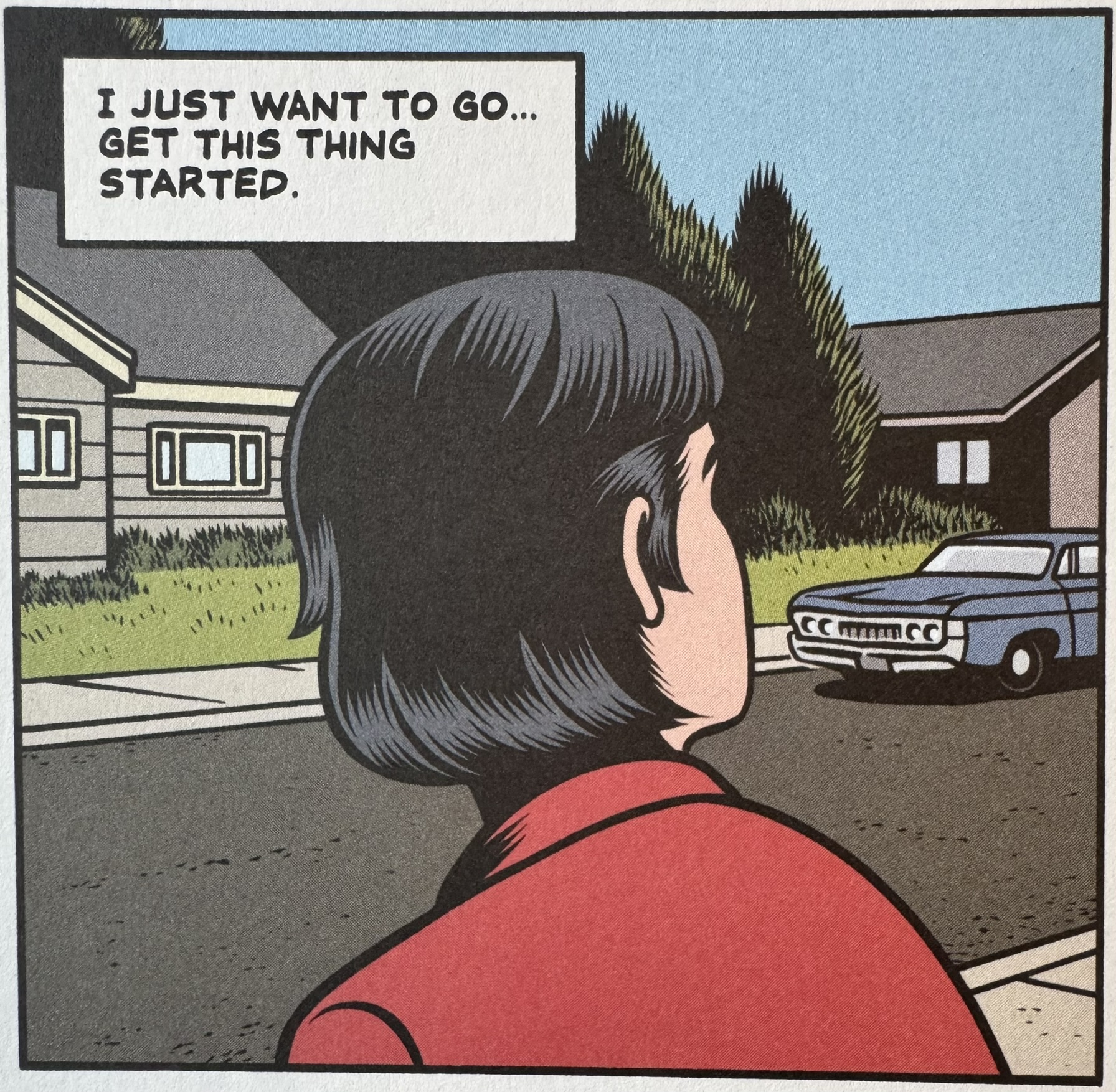
Second frame of third section:

Brian (narrating): I just want to go… get this thing started.

I’ve really enjoyed Burns’ weird stories in the past, and I’m sorry to say that I didn’t find this one as much to my taste, perhaps because it is not as weird. Brian, the protagonist, is a teenager who is obsessed with classic films such as Invasion of the Body Snatchers and The Last Picture Show, and also with his friend Laurie. He stumbles around rocky outcrops, both physical and emotional, and doesn’t quite manage to get where he needs to go. It’s OK as a coming of age story, but I wanted a bit more. You can get Final Cut here.

Next on my pile of unread comics in English is Ness: A Story from the Ulster Cycle, by Patrick Brown.

Omega, by Mark Griffiths and John Ridgway

Second frame of part three:

“And my cells won’t renew in space. What would be the point? I’d only suffocate all over again.”

Another in Cutaway Comics’ explorations of unseen parts of Doctor Who history, this goes behind the backdrop of both The Three Doctors and more importantly Underworld. It is about the difficulties of the Minyan princess Malika, who tries to prevent Omega from destroying the planet Minyos and then leads a further attack on him from the planet Draktria in the fourth of four parts. I found it a rather right-wing narrative; Malika and her family have been elevated against the common people of Minyos by superior technology supplied by the Time Lords, and the rebellion of the Minyans against their oppressive rulers is stoked by Omega and an evil populist politician. The Draktria chapter is straight from the playbook of great powers recruiting loyal but doomed native troops from the colonies. The writer does not seem conscious of the tropes that he has put into the story… The art is generally good but Ridgway doesn’t always get his characters’ faces consistent.

You can get Omega here, along with a DVD and an audio version starring Brian Blessed; unfortunately I don’t have those as I bought it from the Cutaway stall at Gallifrey One.

Wednesday reading

Current
The Letters of J. R. R. Tolkien: Revised and Expanded Edition
The Partition: Ireland Divided, 1885-1925, by Charles Townshend

Last books finished 
Jerusalem, Part 1, by Selma Lagerlöf
Silence: A Christian History, by Diarmaid MacCulloch (did not finish)
The Casuarina Tree, by W. Somerset Maugham
The Irish Assassins: Conspiracy, Revenge and the Murders that Stunned an Empire, by Julie Kavanagh
The House of Doors, by Tan Twan Eng 
The New Machiavelli, by Jonathan Powell

Next books
The Twist, by George Mann et al
Burning Brightly: 50 Years of Novacon, by Ian Whates
East of Eden, by John Steinbeck

Science(ish): The Peculiar Science Behind the Movies, by Rick Edwards & Dr Michael Brooks

Second paragraph of third chapter:

[Rick Edwards:] No it doesn’t. In 1979, French astrophysicist Jean-Pierre Luminet used a punch-card computer to work out what one [a blackhole] would look like. He didn’t have a printer, so he drew the result of his computations by hand – and it looks quite like Interstellar‘s black hole, Gargantua.

This is a popular science book, aimed perhaps at the older end of the teenage market. It takes ten well-known films – The Martian, Jurassic Park, Interstellar, Planet of the Apes, Back to the Future, 28 Days Later, The Matrix, Gattaca, Ex Machina and Alien – and hangs a series of short reflections off them about the state of play in real science of the concepts developed in each film. It is breezily presented as a dialogue between the two podcast hosts. I found the sidebar sections a little annoying, and would have preferred them to be integrated into the main text, but otherwise it is harmless enough. Of the films I have not seen, Gattaca sounds the most interesting. You can get Science(ish) here.

This was my top unread book acquired in 2021. Next on that pile is The Irish Assassins: Conspiracy, Revenge and the Murders that Stunned an Empire, by Julie Kavanagh.

’Salem’s Lot, by Stephen King

Second paragraph of third chapter (a long ‘un):

4:00 AM
The Griffen boys – Hal, eighteen, and Jack, fourteen – and the two hired hands had begun the milking. The barn was a marvel of cleanliness, whitewashed and gleaming. Down the center, between the spotless runways which fronted the stalls on both sides, a cement drinking trough ran. Hal turned on the water at the far end by flicking a switch and opening a valve. The electric pump that pulled water up from one of the two artesian wells that served the place hummed into smooth operation. He was a sullen boy, not bright, and especially irked on this day. He and his father had had it out the night before. Hal wanted to quit school. He hated school. He hated its boredom, its insistence that you sit still for great fifty-minute chunks of time, and he hated all his subjects with the exceptions of Woodshop and Graphic Arts. English was maddening, history was stupid, business math was incomprehensible. And none of it mattered, that was the hell of it. Cows didn’t care if you said ain’t or mixed your tenses, they didn’t care who was the Commander in Chief of the goddamn Army of the Potomac during the goddamn Civil War, and as for math, his own for chrissakes father couldn’t add two-fifths and one half if it meant the firing squad. That’s why he had an accountant. And look at that guy! College-educated and still working for a dummy like his old man. His father had told him many times that book learning wasn’t the secret of running a successful business (and dairy farming was a business like any other); knowing people was the secret of that. His father was a great one to sling all that bullshit about the wonders of education, him and his sixth-grade education. He never read anything but Reader’s Digest and the farm was making $16,000 a year. Know people. Be able to shake their hands and ask after their wives by name. Well, Hal knew people. There were two kinds: those you could push around and those you couldn’t. The former outnumbered the latter ten to one.

This is the top book published in 1975 as rated by Goodreads users and owned by LibraryThing users – the second place goes to Tuck Everlasting, by Natalie Babbitt, of which I confess I know nothing.

This was King’s second book, after Carrie, and like Carrie it is tremendous. It leans on Bram Stoker’s Dracula, not so heavily as to be ripping it off, but enough that you can see the footprints. It also lays the ground for many future vampire stories, and in particular it sets up a lot of the lore for Buffy, which can only be a good thing.

Of course, what makes it a great novel is the combination of 1) the detailed mapping of the people of a small Maine town, with the arrivals of the struggling writer who is the main viewpoint character and of the sinister strangers who, spoiler, turn out to be vampires, and; and 2) the delicious ramping up of tension and then release, as we know that something horrible is going to happen and then it does. At the other end of New England, H.P. Lovecraft at his best was a master of this sort of thing, and King clearly drank from the same wells.

It has its problems; there is only one significant female character, and I didn’t like the way her storyline ended; and the means and motivation of the vampires are not quite as internally consistent as I would have liked. But I really enjoyed the book as a whole, and sometimes I had to just pause for a moment and admire the writing.

The telephone wires make an odd humming on clear, cool days, almost as if vibrating with the gossip that is transmitted through them, and it is a sound like no other – the lonely sound of voices flying over space. The telephone poles are gray and splintery, and the freezes and thaws of winter have heaved them into leaning postures that are casual. They are not businesslike and military, like phone poles anchored in concrete. Their bases are black with tar if they are beside paved roads, and floured with dust if beside the back roads. Old weathered cleat marks show on their surfaces where linemen have climbed to fix something in 1946 or 1952 or 1969. Birds – crows, sparrows, robins, starlings – roost on the humming wires and sit in hunched silence, and perhaps they hear the foreign human sounds through their taloned feet. If so, their beady eyes give no sign. The town has a sense, not of history, but of time, and the telephone poles seem to know this. If you lay your hand against one, you can feel the vibration from the wires deep in the wood, as if souls had been imprisoned in there and were struggling to get out.

My Kindle copy came with an Afterword written twenty-five years later, in 1999, and also with two short stories, “One for the Road” which is a post-epilogue postscript for the novel, and King’s early story “Jerusalem’s Lot”, which is set in the 1850s and about witchcraft rather than vampires (and leans a bit more heavily on Lovecraft). It also includes a number of deleted or edited scenes from the book, most of which I found rather good, though I agree with King and his editors that the final text of the book was better without them. So that’s a nice bit of extra value.

You can get ’Salem’s Lot here.

This was the top unread sf book on my shelves, and the top book I acquired this year. Having recently inherited some of my father’s library, the next two on those piles respectively are East of Eden, by John Steinbeck, and If on a Winter’s Night a Traveller, by Italo Calvino.

September 2025 books

Non-fiction 7 (YTD 60)
Science(ish): The Peculiar Science Behind the Movies, by Rick Edwards & Dr Michael Brooks
Het Zoet Water door de eeuwen heen, by Jean Binon and Paul Coeckelbergh
American Prometheus: the Triumph and Tragedy of J. Robert Oppenheimer, by Kai Bird and Martin J. Sherwin
The Years, by Annie Ernaux 
Chernobyl: History of a Tragedy, by Serhii Plokhy
Silence: A Christian History, by Diarmaid MacCulloch (did not finish)
The Irish Assassins: Conspiracy, Revenge and the Murders that Stunned an Empire, by Julie Kavanagh

Non-genre 7 (YTD 32)
Behind Frenemy Lines, by Zen Cho
Mother Ross: An Irish Amazon, by G.R. Lloyd 
Glorious Exploits, by Ferdia Lennon (did not finish)
The Emperor of Portugallia, by Selma Lagerlöf
Jerusalem, Part 1, by Selma Lagerlöf
The Casuarina Tree, by W. Somerset Maugham
The House of Doors, by Tan Twan Eng 

Poetry 1 (YTD 3)
Musings on Mothering, ed. Teika Bellamy

SF 6 (YTD 98)
Prophet Song, by Paul Lynch 
Annie Bot, by Sierra Greer
’Salem’s Lot, by Stephen King 
The Last Unicorn, by Peter S. Beagle (did not finish)
“Two Hearts” by Peter S Beagle
Howul: A Life’s Journey, by David Shannon

Doctor Who 2 (YTD 23)
Ghost Devices, by Simon Bucher-Jones
Doctor Who: Lux, by James Goss

Comics 4 (YTD 27)
The School of Death, by Robbie Morrison et al
Omega, by Mark Griffiths and John Ridgway
Final Cut, by Charles Burns 
Histoire de Jérusalem, by Vincent Lemire and Christophe Gaultier

6,600 pages (YTD 62,000)
7/27 (YTD 99/246) by non-male writers (Ernaux, Kavanagh, Cho, Lagerlöf x2, Bellamy, “Greer”) 
2/27 (YTD 29/246) by a non-white writer (Cho, Eng) 

2/27 reread (“Two Hearts”, Ghost Devices

204 books currently tagged unread, down 5 from last month, down 78 from September 2024.

Reading now
The Letters of J. R. R. Tolkien: Revised and Expanded Edition
The New Machiavelli, by Jonathan Powell
The Partition: Ireland Divided, 1885-1925, by Charles Townshend

Coming soon (perhaps)
The Twist, by George Mann et al 
Mean Streets, by Terrance Dicks 
Paradise Towers, by Sean Mason and Silvano Beltramo 
Doctor Who: The Well, by Gareth F. Powell
Doctor Who: The Mysterious Planet, by Terrance Dicks
The Mysterious Planet, by Jez Strickley
Burning Brightly, ed. Ian Whates
Het lijkt Washington wel: Hoe lobbyisten Brussel in hun greep hebben, by Peter Teffer
Wag the Dog, by Andreas Heinemann-Grüder
An Island Called Moreau, by Brian Aldiss
Dragon’s Teeth, by Ian Bancroft
The Enchantments of Flesh and Spirit, by Storm Constantine
Madame Prosecutor, by Carla del Ponte
The Good Wife of Bath, by Karen Brooks
East of Eden, by John Steinbeck 
“The Merchant and the Alchemist’s Gate”, by Ted Chiang
Thief of Time, by Terry Pratchett 
The Enigma Score, by Sheri S. Tepper
Gitanjali, by Rabindranath Tagore
Amongst Our Weapons, by Ben Aaronovitch 
An Experiment with Time, by J. W Dunne 
Camp Damascus, by Chuck Tingle
If On A Winter’s Night A Traveller, by Italo Calvino
Ness: A Story from the Ulster Cycle, by Patrick Brown
Spa 1906, by Drac
Say Nothing, by Patrick Radden Keefe

Ghost Devices, by Simon Bucher-Jones

Second paragraph of third chapter:

Deftly, Mr Misnomer stitched the transparent thread through the innards of the computer. His long surgeon‘s fingers spliced the nanoscopic connections with practised ease. Fizzing and spluttering, the autopilot of the crashed skimmer sprang to life.

Another book that I really didn’t get on with. The plot ostensibly is about Bernice Summerfield investigating a mysterious artefact, the Spire, which is almost three hundred miles high (or almost 482.803 kilometers high, as Philip Jose Farmer would have said). I found the writing very confusing, with too many characters whose means and motivation were not clear to me, and a choppy narrative abruptly switching between points of view. I understood what happened at the end, but not so much of the beginning or middle. You can get Ghost Devices here.

This is the second last of the Bernice Summerfield novels that I read in 2014-15 and did not get around to writing up at the time. The last is Mean Streets, by Terrance Dicks, which promises to be a little different.

Annie Bot, by Sierra Greer

Second paragraph of third chapter:

Annie is suspended in an agony of knowing Doug is displeased. She can focus on nothing else. It eats her memory, corrosive and hot. She can still hear his voice: No, it’s a fucking party. She has identified his words as sarcasm, his tone as scathing.

This is the last in a series of posts that I began in 2012, when I determined to read all of the winners of the BSFA Award for Best Novel, the Arthur C. Clarke Award, and the James Tiptree Jr. Award, now the Otherwise Award (and currently on hiatus). It’s been an interesting process; the awards have occasionally overlapped – Air by Geoff Ryman won all three – but more often they have charted somewhat different courses through the genre. It’s a sufficiently complex subject to deserve its own post.

Meantime since I started this series I found myself physically counting the votes for the BSFA Awards several times just before the pandemic, and served on the Arthur C. Clarke Award jury twice, in 2015 and 2023. (I have had no engagement with the administration of the Tiptree / Otherwise Award.)

As a result of my previous Clarke service I was invited to the presentation of this year’s award in June in London, despite at that point having read only one of the six shortlisted novels (The Ministry of Time, by Kaliane Bradley), and was therefore not very surprised when the award went to one of the five books I had not read, Annie Bot by ‘Sierra Greer’ (Caragh M. O’Brien). Here she is accepting the award.

So, I finally got around to reading the book. And I’m afraid it is not for me. I hate cute anthropomorphic robots; the protagonist is a sexbot, which is the extreme case of cute anthropomorphic robot. She is in an abusive relationship with Doug, and is in fact obsessed with him by design. Navigating this set-up to a satisfactory conclusion is a difficult task, and I did not feel that it was accomplished here. The Clarke judges are entitled to make their choice on the basis of their own feelings and reactions, and it’s good when they pick a book that has been overlooked by the other awards; but I think that if I had been on the jury this year, this book would probably not even have been shortlisted.

You can get Annie Bot here.

As I said, that concludes my read-through of all of the Clarke, BSFA and Tiptree/Otherwise winners. So I’m starting a new project, reading a new book (or two) by every winner of the Nobel Prize for Literature who was not a white man – that’s 29 of the 121. The first will be Selma Lagerlöf, the tenth winner, and I’ll be reading both her early Jerusalem and her later The Emperor of Portugallia.

Arthur C. Clarke Award winners:
The Handmaid’s Tale | The Sea and Summer | Unquenchable Fire | The Child Garden | Take Back Plenty | Synners | Body of Glass | Vurt | Fools | Fairyland | The Calcutta Chromosome | The Sparrow | Dreaming in Smoke | Distraction | Perdido Street Station | Bold as Love | The Separation | Quicksilver | Iron Council | Air | Nova Swing | Black Man | Song of Time | The City & the City | Zoo City | The Testament of Jessie Lamb | Dark Eden | Ancillary Justice | Station Eleven | Children of Time | The Underground Railroad | Dreams Before the Start of Time | Rosewater | The Old Drift | The Animals in that Country | Deep Wheel Orcadia | Venomous Lumpsucker | In Ascension | Annie Bot

The best known books set in each country: the Netherlands

See here for methodology. Books are disqualified if less than 50% of them is set in the Netherlands. 

These numbers are crunched by hand, not by AI.

TitleAuthorGoodreads
raters
LibraryThing
owners
The Diary of a Young GirlAnne Frank4,099,13240,263
Girl with a Pearl EarringTracy Chevalier771,65517,980
The Hiding Place: The Triumphant True Story of Corrie Ten BoomCorrie ten Boom350,19911,617
The DinnerHerman Koch173,3065,406
The MiniaturistJessie Burton151,0624,466
Confessions of an Ugly StepsisterGregory Maguire62,0239,067
Girl in Hyacinth BlueSusan Vreeland40,8493,270
Anne Frank Remembered: The Story of the Woman Who Helped to Hide the Frank FamilyMiep Gies66,4231,600

The winner here is not at all surprising, and in fact we’ve only had two countries where the winner had a higher ranking on both Goodreads and LibraryThing – the USA and the UK; and only another three where the winner had a higher ranking on LibraryThing but not Goodreads – Russia, Kazakhstan and Afghanistan. This week’s winner also won when I did this exercise in 2015.

In the improbable case that you don’t know, The Diary of a Young Girl is the journal of a Jewish teenager hiding from the Nazis in Amsterdam during the Second World War, with her own family, another family and a random dentist taking refuge in an hidden annex to her father’s office. The diary ends abruptly, because they were all arrested in August 1944 and deported to a series of concentration camps, where all of them except Anne Frank’s father died. I’m personally fascinated by the story, and have written about the translation and about Anne’s writing here and here, and also about the dentist who she shared her room with.

Goodreads combines the numbers for all three editions of The Diary of a Young Girl currently on the market, while LibraryThing separates them out (and I have combined them above), but it would have been the winner anyway. Also worth noting perhaps that the eighth book is also about Anne Frank.

I disqualified six books this time. Less than half of The Fault in Our Stars by John Green is set in the Netherlands (though I believe that it too has a lot of Anne Frank in it). The Goldfinch by Donna Tartt is set in New York. Amsterdam by Ian McEwan, despite the title, is mainly set in London. Infidel by Ayaan Hirsi Ali is set in many countries, though she does end up in the Netherlands. The Thousand Autumns of Jacob de Zoet by David Mitchell is actually set in Japan. And Humankind: A Hopeful History by Rutger Bregman is global in scope.

That’s it from Europe for a while; next are Ecuador, Cambodia, Zimbabwe and Guinea-Conakry.

Asia: India | China | Indonesia | Pakistan | Bangladesh (revised) | Russia | Japan | Philippines (revised) | Vietnam | Iran | Türkiye | Thailand | Myanmar | South Korea | Iraq | Afghanistan | Yemen | Uzbekistan | Malaysia | Saudi Arabia | Nepal | North Korea | Syria | Sri Lanka | Taiwan | Kazakhstan | Cambodia | Jordan | UAE | Tajikistan | Israel
Americas: USA | Brazil (revised) | Mexico | Colombia | Argentina | Canada | Peru | Venezuela | Chile | Guatemala | Ecuador | Bolivia | Haiti | Dominican Republic | Honduras | Cuba
Africa: Nigeria | Ethiopia (revised) | Egypt | DR Congo | Tanzania | South Africa | Kenya | Sudan | Uganda | Algeria | Morocco | Angola | Mozambique | Ghana | Madagascar | Côte d’Ivoire | Cameroon | Niger | Mali | Burkina Faso | Malawi | Zambia | Chad | Somalia | Senegal | Zimbabwe | Guinea | Benin | Rwanda | Burundi | Tunisia | South Sudan | Togo | Sierra Leone
Europe: Russia | Türkiye | Germany | France | UK | Italy | Spain | Poland | Ukraine | Romania | Netherlands | Belgium | Sweden | Czechia | Azerbaijan | Portugal | Greece | Hungary | Austria | Switzerland | Belarus
Oceania: Australia | Papua New Guinea

Prophet Song, by Paul Lynch

The second section of the third chapter of Prophet Song is long, what with the lack of paragraphing. I count 872 words.

She is distracted at work, pacing within, seeing before her some shadowed obstacle and seeking a path around it, saying to herself over and over, they will not take my son. There are rumours in the company of a blood-letting, of a phased wind-down, none of it can be true. They are called into the meeting room where it is announced the managing director Stephen Stoker has been stood down, he did not come into work this morning, they are told that Paul Felsner will replace him. He comes before them pulling on the tips of his fingers with a small hand and cannot hide his delight. She watches about the room as he speaks selecting for his supporters by the clapping hands and smiles, seeing the wild animal among them, seeing how it has done away with concealment and pretence, how it prowls now in the open as Paul Felsner raises his hand in hieratic gestures speaking not the company speak but the cant of the party, about an age of change and reformation, an evolution of the national spirit, of dominion leading into expansion, a woman walks across the room and opens a window. Eilish finds herself stepping out of the lift onto the ground floor. She crosses the street and goes into the newsagent’s, points to a pack of cigarettes. It has been a long time, she thinks, standing alone outside the office building, sliding a cigarette from the box, fondling the paper skin, running its odour under her nose. The cottony taste of cellulose acetate as she lights and pulls the hot smoke into her mouth, recalling the day she last quit, this feeling of some younger self, perhaps Larry was with her, she doesn’t know. Memory lies, it plays its own games, layers one image upon another that might be true or not true, over time the layers dissolve and become like smoke, watching the smoke that blows out her mouth vanish into the day. Watching the street as though it belongs to some other city, thinking how it is so that life seems to exist outside events, life passing by without need of witness, the congested traffic fuming in the dismal air, the people passing by harried and preoccupied, imprisoned within the delusion of the individual, this wish now she has to escape, watching until she is brought clean outside herself, the light altering tone by tone until it becomes a lucent sheen on the street, the gulls nipping at food in a gutter are dark underwing as they whip up out of the path of a lorry. Well now. Colm Perry is standing beside her tapping a cigarette on its box. I didn’t know you smoked, Eilish. She is squeezing her eyes as if to see an answer to a question she has not been asked and then she shakes her head. I can’t say that I do. Colm Perry lights a cigarette and exhales slowly. Neither do I. She pulls the dark burn inside her and wants the burn some more, studying Colm Perry’s wrinkled shirt, knowing the cerise face of a drinker, the look that rests sly in the eye of a man well in on the joke though he is laughing at them from the outside. He glances behind towards the automatic door. The gall of that man, he says, there will be a purge soon enough, they like their own kind so keep your head down, that’s all I have to say. He looks again over his shoulder and pulls out his phone. Have you seen the latest? What she sees on the phone are images of graffiti on windows and walls denouncing the gardai, the security forces and the state, triumphant scrawls in sprayed red paint. The writing looks like blood, the building looks like a school. St Joseph’s in Fairview, he says, they are saying the principal called in the GNSB who came and arrested four boys, they haven’t yet been released, it’s gone on a few days but the story’s only online now, there are parents and students gathering outside Store Street Garda Station waiting for the boys to be freed. My son has been called up for national service, she says, he is to hand himself over the week he turns seventeen, he is still just a kid in school, and this after they take his father. Colm Perry looks at her and then he shakes his head. Bastards, he says. He cups his hand to his mouth and thinks long upon a drag then extinguishes the cigarette on the smokers’ box. You’re going to have to get him out, he says. Get him out where? She watches him shrug and open his hands and then he puts them in the pockets of his jeans. He is looking across the street to a newsagent’s. Right now, he says, I’d love an ice cream, an old-fashioned cone with a 99, I’d like to be on a beach freezing my butt off, I’d like for my parents to be still alive, look, Eilish, I don’t know, England, Canada, the USA, it’s only a sug-gestion, but you’re going to have to get him out, look, I must go back inside.

I picked this off the shelf in a California bookshop on the margins of last year’s Gallifrey One, knowing that it had won the Booker Prize but incorrectly under the impression that it was a gritty realist slice-of-Dublin-life story. I was of course wrong about this. It’s set very firmly in middle-class Dublin, but in the very near future where an extremist party wins an election and creates a police state, in turn sparking armed resistance, civil war and the collapse of society; it’s told through the viewpoint of a mother of four whose trade unionist husband disappears early in the book and who witnesses her family disintegrating.

Lynch is very clear in interviews that his intention was to bring the horrors of the Syrian conflict home to a local audience, and I think he very much succeeds. The litany of familiar Dublin place names converted into locations of violent convulsion is tremendously effective. The conversion of standard Irish official banter into the language of oppression is chilling. The worst of the violence happens off screen, but its aftermath is vividly realised. And of course it’s not just Syria; I remember Bosnia when I lived there nearly thirty years ago, which had undergone a similar implosion, and today we can look at Palestine, not only Gaza but also the West Bank, for societies being destroyed by violence.

If I had been writing a book like this, I would have also gone into the grand politics of the disaster, looking at bad and evil leadership decisions, and ineffectual international interventions which could have been done better. But Paul Lynch is not into finger-pointing; it’s simply the human experience of state violence followed by violent state collapse, and I find it all the more effective as a result. The non-paragraphed style brings an immediacy to the prose, while of course also being a salute to Joyce’s retelling of everyday Dublin life from a previous century. I am not sure if I could say I actually liked the book, but I do recommend it. You can get Prophet Song here.

I haven’t read any of the other books on the Booker Prize longlist or shortlist for 2023, but I will get to Tan Twan Eng’s The House of Doors very soon. Oddly enough, Prophet Song is set in the city where one of my parents was born, and The House of Doors in the city where the other was born.

This was the top unread book that I had acquired last year, and also I had thought that it was the top unread non-genre book on my shelf, but I think it is pretty clearly in the dystopian sub-genre of sf. Next on the former pile is Camp Damascus, by Chuck Tingle; next on the latter pile, after acquiring some of my father’s books last month, is East of Eden, by John Steinbeck.

Musings on Mothering, ed. Teika Bellamy

Second piece of third section:

I am all

I am food
I am drink
I am comfort
I am security I am warmth
I am love
I am your mother

NIK HARRIS

This is a collection of art, poetry and short prose pieces on motherhood, that I picked up for free at Novacon in 2021. It was sponsored by the British branch of La Leche League,so there’s a not very subtle emphasis on breastfeeding, but in general it’s a nice assembly of pieces of varying quality, speaking to the experience of maternity, which is designed to be an appropriate gift to a new mother. One aspect that is left out is the experience of parents of children with special needs. It is basically out of print, but you can probably get Musings on Mothering here.

Because I picked it up at a science fiction convention, I initially classified it as the sf book that had lingered longest unread on my shelves, but now that I have actually read it, I realise that there is no sfnal content, and I will count it as poetry, which takes up about three quarters of the book.

The next long-unread sf book on my shelf is another that I picked up at that Novacon, Howul: A Life’s Journey, by David Shannon, who is married to Bernardine Evaristo.

The School of Death, by Robbie Morrison et al

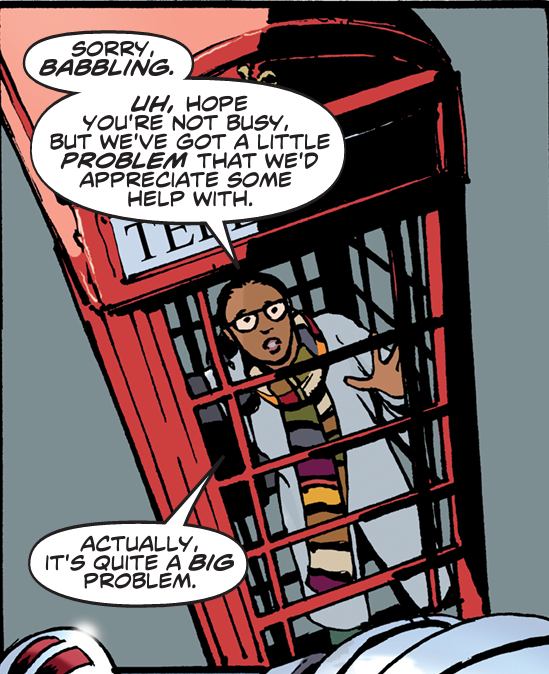
Second frame of third story (“Robo Rampage”):

Osgood: Sorry, babbling. / Uh, hope you’re not too busy, but we’ve got a little problem that we’d appreciate some help with… / Actually, it’s quite a big problem.

Starting Year Two of Titan’s Twelfth Doctor sequence, this is a compilation of three separately published stories. The title story starts with a character called Christel Dean, who is clearly an incarnation of well-known Doctor Who fan and writer Christel Dee, teaching at a remote Scottish boarding school with added Sea Devils. Oh, and the Doctor has a new companion, a stuffed swordfish called Sonny. The second story, “The Fourth Wall”, gets properly recursive with characters being absorbed into (and occasionally escaping from) comics, thanks to alien meddling. And the third story, “Robo Rampage”, is a sequel to the Fourth Doctor story Robot, featuring the twenty-first century UNIT. All three of these are above average; I particularly liked the art of Rachael Stott in the first two. You can get The School of Death here.

Next in this list is The Twist, by George Mann et al.

Wednesday reading

Current
The Irish Assassins: Conspiracy, Revenge and the Murders that Stunned an Empire, by Julie Kavanagh
The House of Doors, by Tan Twan Eng 
Jerusalem, by Selma Lagerlöf

Last books finished 
“Two Hearts” by Peter S Beagle
Het Zoet Water door de eeuwen heen, by Jean Binon and Paul Coeckelbergh
Glorious Exploits, by Ferdia Lennon (did not finish)
American Prometheus: the Triumph and Tragedy of J. Robert Oppenheimer, by Kai Bird and Martin J. Sherwin
Histoire de Jérusalem, by Vincent Lemire and Christophe Gaultier
The Years, by Annie Ernaux 
Howul: A Life’s Journey, by David Shannon
The Emperor of Portugallia, by Selma Lagerlöf
Chernobyl: History of a Tragedy, by Serhii Plokhy

(the amazing effect of an intercontinental plane flight with not much sleep)

Next books
The Twist, by George Mann et al
The Partition: Ireland Divided, 1885-1925, by Charles Townshend
Silence: A Christian History, by Diarmaid MacCulloch 

Thirst, by Amelie Nothomb

Second paragraph of third chapter:

Une seule fois, je me suis mal servi de ce pouvoir de l’écorce. J’avais faim, les fruits du figuier n’étaient pas mûrs. Moi qui avais tellement le désir de mordre dans une figue chaude de soleil, juteuse et sucrée, j’ai maudit l’arbre, je l’ai condamné à ne jamais porter de fruits. J’ai prétexté une parabole, pas la plus convaincante.Just once, I misused the power of the husk. I was hungry, and the fruit on the fig tree was not ripe. My desire to bite into a fig—warm with sunshine, juicy and sweet—was so great that I cursed the tree, and condemned it to never again bear fruit. I said it was for a parable, not the most convincing.
translated by Alison Anderson

I confess that I picked this up and read it quickly at the end of August so that I would have a nice round number of books for the month (32). I was not at all impressed with Nothomb’s The Book of Proper Names when I read it in 2007, but I feel vaguely obliged to engage with one of Belgium’s best-known writers, and pulled this off the shelf in a bookshop to have another go.

Well, it’s not what I expected; it’s an account of the crucifixion and resurrection of Jesus Christ, from his point of view, anticipating and then experiencing his painful death and then attempting to express the experience of return to the flesh. I have to say that I was not grabbed by it. You can find plenty of more interesting Bible fanfic on AO3. There is a hint that Jesus’ relationship with Mary Magdalen (here, “Madeleine”) was physically intimate; but it’s a work of fiction so who really cares?

I fear that Nothomb is on her second strike for me. I’m not sure if there will be a third.

You can get Thirst here.

@Wouters Wondere Wereld, by Guy Gilias

Third artwork described:

De jaarlijkse ‘Week van het Bos’ was voor Ad weer de uitgelezen gelegenheid om aan een oude lindeboom een nieuw leven te schenken. Hij zou de stam versnijden tot de beeltenis van de verzorgers van het bos, de zeer gewaardeerde bosarbeider. Een uitverkoren boomstronk aan het Zoet Water in Oud-Heverlee kreeg de typische boswachtershoed aangemeten, terwijl de lange regenjas elegant gesneden werd uit de mooie schors van de lindeboom. De figuur kreeg een gelaat en werd Wannes genoemd.
Intussen heeft de natuur haar werk gedaan en is de sculptuur spijtig genoeg vergaan.
The annual “Forest Week” was once again the perfect opportunity for Ad to give new life to an old linden tree. He would carve the trunk into an image of the forest’s caretakers, the highly esteemed forestry workera. A selected tree stump at Zoet Water in Oud-Heverlee was fitted with the typical forester’s hat, while the long raincoat was elegantly carved from the beautiful bark of the linden tree. The figure was given a face and named Wannes.
Nature has since taken its course, and sadly the sculpture has decayed.

I bought this just as the pandemic was starting to lift, and the local history society held a carefully socially distanced launch of a couple of its books, including this one. It is a compilation of the public art of our local sculptor, Ad Wouters, whose monogrammed AW you can see on the hat of the Wannes sculpture above. Ad is actually Dutch originally, but has lived in these parts for decades and his work decorates the forest and some of the streets. This book takes us through it all, with more than half of the pages devoted to the woodwork that he specialises in, and the rest describing his work in other media: ceramic, polyester and recycled materials. In each case the reason for the artwork is described and its history and current location, and sometimes also with a poetic reflection from local poet Wim Van den Abeele. It’s a nice production. You can get @Wouters’ Wondere Wereld via the local history society here.

I have previously posted elsewhere about Ad Wouters’ work. Here is a video I shot during lockdown with six of the closest sculptures to our house:

And here’s an Instagram post of two of the wooden sculptures at De Torenvalk park, a bit further away:

I see however that I have missed a lot of his sculptures in the city cemetery in Leuven, and in the Botanic Garden there. Also a lot of the art is just outside his own home, on the terrain that he has christened “Het Land van Bompa”, “Grandad’s Land”. More exploring to do!

The Principle of Moments, by Esmie Jikiemi-Pearson

Second paragraph of third chapter:

The boy with grey eyes. A planet, viewed from space, imploding. A gaunt woman wrapping her arms around Asha’s middle and whispering sister.

Big chunky queer time-travel Regency romance crossover space opera; what’s not to love? I confess that I got this purely because I enjoyed the author’s novelisation of The Church on Ruby Road, and basically this has everything you would expect, dynastic manoeuvrings and far future warfare. I get a lot of books like this, and often I don’t last past the first fifty pages, but I kept going with this one to the end and it was satisfying. You can get The Principle of Moments here.

This was my top unread book by a writer of colour. Next on that pile is The House of Doors by Tan Twan Eng.

Irish Conflict in Comics: Rebellion, Nazi Spies and the Troubles, by James Bacon

Second paragraph of third chapter, with illustration:

The Congregation of Christian Brothers, who published Éire – Sean is Nua [Ireland – Old and New], were a Catholic celibate community who founded several Catholic education schools and who, with this publication, portrayed themselves as supporters of Irish Republicanism. Our Boys, another Christian Brothers publication, was a reaction to The Boy’s Own Paper and other British boys’ papers, viewed as imperialist propaganda. Our Boys was first published in 1914 and sought to present a Catholic and nationalist alternative to Irish children.

This is a totally comprehensive listing of how Ireland is portrayed in comics. The start of the story is actually told in a very intertesting appendix, looking at revolutionary era cartoonists – Grace Gifford, Ernest Kavanagh, Joe Stanley (Padraig Pearse’s press office during the Easter Rising, who published Ireland’s first comic, Greann, in 1934) and Constance de Markievicz.

Most of the book looks at the mainstream comics industry as it has developed since 1940, usually featuring American writers trying to get to grips with local complexity. There are some cringeworthy moments, for instance the heroic Gay Ghost who comes from the castle of Connaught in County Ulster. There are a number of stories featuring Nazi meddling in Ireland, usually with the involvement of the IRA, though the latter are not consistently portrayed as being on either side.

In the post-war decades, Irish creators start to get in on the act, with the Christian Brothers publishing Eire – Sean is Nua [Ireland – Old and New]; and there’s also a flattering biography of Eamon de Valera from the early 1970s, at a time before the events of his life after 1921 were taught in school history classes.

The Troubles offered plenty of narrative opportunities for long-running comics series to visit Ireland’s shores, some of them more effectively than others. Sometimes the comics publishers found that they had bitten off more than they could chew; a 1986 story with Spiderman visiting Northern Ireland was aborted by Marvel after the publishers received a bomb threat. Was it credible? I guess it doesn’t matter.

The main narrative (before the appendix) look particularly at the work of Garth Ennis and Malachy Coney, mainstream comics writers who are from Northern Ireland. Ennis doesn’t always do it for me, but I remember his early Troubled Souls and Coney’s Holy Cross stories with great affection.

Those of you who know the author will not surprised to learn that it reads like he speaks; this isn’t polished academic writing, it’s a rush of enthusiastic information, crammed onto the 259 A4 pages with wafer-thin headers and footers. But the information is cool, and important. I’ll try and get hold of the French-language comics mentioned (including Partitions irlandaises) and will report back. Meanwhile you can get Irish Conflict in Comics here.

Winning online Diplomacy as France, against six AIs

I know, I know, reading about other people’s diplomacy games is about as interesting as listening to other people’s dreams. But after many brief unsuccessful attempts to defeat the AIs on WebDiplomacy.net, and two successes, one as Turkey and one as Italy, I finally scored another victory, this time as France, and I feel like recording it here.

Spring 1901

I started with a simple strategy: smash England and then smash Germany. (This is not what actually happened.) I took the risk of leaving Burgundy open and moved my northern army to Picardy, tried for the English Channel (bouncing for the first but not the last time) and sent my southern army to Spain, so that I would get at least one build. I was lucky with Burgundy, and though Italy could have tried a stab with the army in Venice, the Austria situation was of course a higher priority there.

Continue reading

Black Mountain and other stories, by Gerry Adams

Second paragraph of third story (“Bluebells”):

She unpacked her clothes, but was drawn back to the wall-paper. She looked closely at it, ran her hand over the circular bouquets of bluebells on the pale-pink background. It was like seeing a face in a crowd she couldn’t quite place. But then it came to her. The street in West Belfast from her childhood. The room she shared with her little sister, Sarah. Not much money in the house. Bare wooden floorboards before that became fashionable. No oilcloth or carpet in their room, but that same lovely pink wallpaper covered with bluebells just beside their bed.

Gerry Adams will need no introduction to anyone familiar with Irish politics; as well as his public career, he has published a number of books, and my brother got me this short story collection as a joke, a few years back.

It’s not very good. Adams’ command of language in his public speeches has always been somewhat clunky, and that’s true here as well. Abrupt shifts of tone and setting make it difficult to focus on whatever it is each story is about. I read the first four and put it in the charity pile. The author is retired now, but was wise to stick to his day job. You can get Black Mountain here.

This was the non-genre fiction book that had lingered longest unread on my shelves. Next on that pile is The Good Wife of Bath, by Karen Brooks.

Old Babes in the Wood, by Margaret Atwood

Second paragraph of third story (“Morte de Smudgie”):

When Nell and Tig’s cat Smudgie died, Nell dealt with her disproportionate sense of loss by rewriting Tennyson’s “Morte d’Arthur,” with Smudgie in the leading role, supported by a full cast of noble cats in medieval robes and chain mail. This was a deeply frivolous thing for her to do, and the results were not felicitous:

A paw,
Clothed in white sarmite, mystic, wonderful…

After some thought, I classified this collection of short stories as non-genre rather than sf in my roundup from last month; several of the stories are quite explicitly sf, and a couple more verge on fantasy, but the majority are sent in our world, and seven of the fifteen deal with Nell and her husband Tig, firmly rooted in today’s Canada.

I thought these were all excellent, with particular shout-outs to “The Dead Interview”, in which Atwood imagines herself having a conversation with George Orwell through a medium, “Metempsychosis” in which a snail becomes human, “Death By Clamshell” in which Hypatia of Alexandria tells the story of her own murder, and “A Dusty Lunch” in which Nell finds out about Tig’s father’s war record. But each of them is very much worth reading.

You can get Old Babes in the Wood here.

This was my top unread book by a woman. Next on that pile is The Years, by Annie Ernaux.

A Tall Man In A Low Land: Some Time Among the Belgians, by Harry Pearson

Second paragraph of third chapter:

At lunchtime we found a fantastic restaurant. From the outside it looked ordinary, a little run-down even, but once you went through the door you were in another world. There was Duke Ellington playing on the tape deck, and a smell of rich sauces reducing and cognac and cigars. A group of businessmen were sitting having dessert. Their puddings looked like they had been fashioned by Faberge.

Pearson is apparently a well-known UK sports journalist; he wrote this book about exploring Belgium with his girlfriend and their baby daughter in 1997 and 1998 (so the baby must now be almost 30). It’s a slightly frustrating book. There are some memorable turns of phrase and neat anecdotes such as this, from the museum in Tournai:

There was one eye-catching canvas, a massive Victorian oil painting called The Plague of Tournai in 1090 by someone named Galliat. The scene depicted was one of gruesome devastation, with people weeping and wailing and mad dogs tearing at the flesh of unburied bodies. I couldn’t help noticing in the centre of it all that several young women had reacted to the crisis by tearing open their bodices and baring their perfectly formed breasts. At first I thought this was simply gratuitous. Later, though, I wondered if Monsieur Galliat hadn’t based his work on historical records. After all, people did all sorts of weird stuff to prevent the plague – wore masks, burned incense; Arnold of the Abbey of Oudenburg near Bruges even insisted his parishioners drank beer instead of water, and became patron-saint of Belgian brewers as a result – perhaps this was just another of them.
I imagined a meeting of Tournai Town Council.
‘What will we do about this dreadful plague?’ the mayor asks.
‘Why don’t we get all the nubile women of the city to expose their bosoms?’ cries a councillor.
‘And will that stop the plague?’ asks the mayor.
‘Who cares!’ replies the councillor.

Alas, this is a little too good to be true. Close inspection of the actual painting reveals only one or two boobs, so it’s not exactly a major theme of the art.

Internally the book is very disorganised, jumping around in space and time somewhat jerkily within chapters. There’s a bit of “aren’t foreigners funny”, but there’s also a fair bit of defensiveness towards Belgium.

Maurice Maeterlinck, for example, is routinely described in English-language surveys of European writers as a ‘Belgian-born French dramatist’, despite the fact that he didn’t actually move to France until he was thirty-six. Nor was it such a surprise to hear the actor Gene Wilder telling Sue Lawley of his love of all things French on Desert Island Discs and then going on to pick a record by Jacques Brel to remind him of Paris.

In summary, I was a bit disappointed. The book has its moments, but needed to have them better connected to each other. You can get A Tall Man in a Low Land here. I see that Pearson has more recently written a book about Flemish bike racing, with the intriguing title The Beast, the Emperor and the Milkman.

This was both my top unread book acquired in 2021, and the non-fiction book which had lingered longest on my shelves. The next books on those piles respectively are Science(ish): The Peculiar Science Behind the Movies, by Rick Edwards, and Mother Ross: An Irish Amazon, by G.R. Lloyd.

The Five Red Herrings, by Dorothy L. Sayers

Second paragraph of third chapter, with the list that it introduces:

At the end of the meal, the list stood as follows:
Living in Kirkcudbright:

  1. Michael Waters – 28 – 5 foot 10 inches – unmarried – living in lodgings with private latch-key – landscape painter – boasts of being able to counterfeit Campbell’s style – quarrelled with Campbell previous night and threatened to break his neck.
  2. Hugh Farren – 35 – 5 foot 9 inches – figure and landscape painter – particularly broad in the shoulder – married – known to be jealous of Campbell – lives alone with a wife who is apparently much attached to him.
  3. Matthew Gowan – 46 – 6 foot 1 inch – figure and landscape painter, also etcher – unmarried – house with servants – wealthy – known to have been publicly insulted by Campbell – refuses to speak to him.
    Living in Gatehouse-of-Fleet:
  4. Jock Graham – 36 – 5 foot 11 inches – unmarried – staying at Anwoth Hotel – portrait painter – keen fisherman – reckless – known to be carrying on a feud with Campbell and to have ducked him in the Fleet after being assaulted by him.
  5. Henry Strachan – 38 – 6 foot 2 inches – married – one child, one servant – portrait painter and illustrator – secretary of golf-club – known to have quarrelled with Campbell and turned him off the golf-course.

I remember the TV version of this story broadcast in 1975 when I was eight, starring Ian Carmichael as Lord Peter Wimsey and scripted by Antony Steven, infamous in Doctor Who lore as the writer of The Twin Dilemma. It was enjoyable but rather above my head, so I got the original novel out of the library soon after, at a point when I was really way too young to understand why Mrs Smith-Lemesurier wanted to be coy about her night-time visitors, and then read it again when I was about thirteen and more into the mystery genre.

So I have a sneaking nostalgic affection for this book. I first read it at about the same time as I first read The Lord of the Rings, and the attractive point that jumped out at me then was the map of Galloway inside the front cover, not so very different from Tolkien’s maps of Middle-Earth. Ever since, Galloway has had slight resonances of JRRT for me. Family holidays did sometimes take us that way driving south to London from Stranraer, but we would tend to zoom quickly through Newton Stewart, Castle Douglas and Dumfries before hitting the M6 at Carlisle, without time to explore excitingly-named places like Kirkcudbright or Gatehouse of Fleet, where much of The Five Red Herrings is set. I don’t think I have been to or through Galloway in the last thirty years.

Incidentally, although Tolkien and Sayers were almost the same age (he was born in 1892, she in 1893) and graduated from Oxford in the same year (1915) there is no evidence that they ever met, though both were very friendly with C.S. Lewis and Charles Williams. Tolkien hated her Wimsey novels Gaudy Night and Busman’s Honeymoon.

The story starts off very promisingly, with some lyrical description:

The artistic centre of Galloway is Kirkcudbright, where the painters form a scattered constellation, whose nucleus is in the High Street, and whose outer stars twinkle in remote hillside cottages, radiating brightness as far as Gatehouse-of-Fleet. There are large and stately studios, panelled and high, in strong stone houses filled with gleaming brass and polished oak. There are workaday studios – summer perching-places rather than settled homes – where a good north light and a litter of brushes and canvas form the whole of the artistic stock-in-trade. There are little homely studios, gay with blue and red and yellow curtains and odd scraps of pottery, tucked away down narrow closes and adorned with gardens, where old-fashioned flowers riot in the rich and friendly soil. There are studios that are simply and solely barns, made beautiful by ample proportions and high-pitched rafters, and habitable by the addition of a tortoise stove and a gas-ring. There are artists who have large families and keep domestics in cap and apron; artists who engage rooms, and are taken care of by landladies; artists who live in couples or alone, with a woman who comes in to clean; artists who live hermit-like and do their own charing. There are painters in oils, painters in water-colours, painters in pastel, etchers and illustrators, workers in metal; artists of every variety, having this one thing in common – that they take their work seriously and have no time for amateurs.

[…]

After a brief delay, bumping over the new-laid granite, he pushed on again, but instead of following the main road, turned off just before he reached the bridge into a third-class road running parallel to the main road through Minnigaff, and following the left bank of the Cree. It ran through a wood, and past the Cruives of Cree, through Longbaes and Borgan, and emerged into the lonely hill-country, swelling with green mound after green mound, round as the hill of the King of Elfland; then a sharp right-turn and he saw his goal before him – the bridge, the rusty iron gate and the steep granite wall that overhung the Minnoch.

At the same time, there is a perhaps unhealthy obsession with railway timetables as part of the solution to the murder:

The Sergeant replied, with a certain grim satisfaction, that the 9.51 only ran on Saturdays and the 9.56 only on Wednesdays, and that, this being a Thursday, they would have to meet him at 8.55 at Ayr.

[…]

He had not gone on to Glasgow by the 1.54, because it was certain that the bicycle could not have been re-labelled before the train left. There remained the 1.56 to Muirkirk, the 2.12 and the 2.23 to Glasgow, the 2.30 to Dalmellington, the 2.35 to Kilmarnock and the 2.45 to Stranraer, besides, of course, the 2.25 itself.

There is free but not frequent use of the n-word, and a really offensively stereotyped Jewish minor character. Some readers complain that the Scottish accents of all the local characters, including most of the police, go too far, but I did not find it distracting myself. And the mystery is fair enough, though I think it’s a bit mean of Sayers to keep the one crucial detail about the murder scene from the reader; I remembered that moment in the TV serial, where it is revealed quite fairly to the audience, and of course it gives necessary context to the vital clue when we get to it on page 173.

I got hold of this after reading Sir John Magill’s Last Journey, because my memory was that The Five Red Herrings is the better book. I still think that it is better, though not by quite as much as I remembered. Sayers does description of countryside and of people much more memorably than Crofts, and she also has visible women characters. Both books depend a bit too much on railway timetables, The Five Red Herrings slightly more so if anything. Amusingly, Sayers references Crofts’ book, which was published a year earlier.

I had a book – a very nice book, all about a murder committed in this part of the country. Sir John Magill’s Last Journey, by one Mr. Crofts. You should read it. The police in that book called in Scotland Yard to solve their problems for them.

The Five Red Herrings is a long way down most Sayers fans’ lists, but I still retain my eight-year-old affection for it. Here’s a lovely piece making the same point by A.J. Hall, aka Susan Hall, aka the late great @legionseagle. And I am pondering reviving my Sayers reading as a mini-project; there’s really quite a lot in this one, even with its drawbacks. You can get The Five Red Herrings here.

(Incidentally, I had always thought that the title was Five Red Herrings, without the definite article. That was certainly the name of the TV adaptation, but the original book is clearly articled.)

(Incidentally again, Lord Peter Wimsey was born in 1890, so would be 40 or 41 in the year that the book is set; Ian Carmichael was 55 in 1975.)

Wednesday reading

Current
Het Zoet Water door de eeuwen heen, by Jean Binon and Paul Coeckelbergh
Histoire de Jérusalem, by Vincent Lemire and Christophe Gaultier
American Prometheus: the Triumph and Tragedy of J. Robert Oppenheimer, by Kai Bird and Martin J. Sherwin

Last books finished 
Science(ish): The Peculiar Science Behind the Movies, by Rick Edwards & Dr Michael Brooks
Omega, by Mark Griffiths and John Ridgway
Final Cut, by Charles Burns 
Doctor Who: Lux, by James Goss
The Last Unicorn, by Peter S. Beagle (did not finish)
Behind Frenemy Lines, by Zen Cho
Mother Ross: An Irish Amazon, by G.R. Lloyd 
“Two Hearts”, by Peter S. Beagle

Next books
Howul: A Life’s Journey, by David Shannon
The Years, by Annie Ernaux 
The House of Doors, by Tan Twan Eng 

Somna: a bedtime story, by Becky Cloonan and Tula Lotay

Second frame of third chapter:

I really love Tula Lotay’s lush drawing style, here illustrating a tale of witchcraft in medieval England, where all the women and almost all the men are youthful and sexy, and occasionally take their clothes off. I think any actual medieval specialist would get a bit annoyed by the depiction of medieval life, but the point here is to have fun and revel in the sensuous story. You can get Somna here.

London Centric: Tales of Future London, ed. Ian Whates

Second paragraph of third story (“Infinite Tea in the Demara Café”, Ida Keogh):

He had found himself at his usual corner table in the Demara Café, affording him a full view of both the establishment and the street outside where the morning traffic was making haphazard progress towards central London. Or rather, at first glance it looked like his usual table. But it didn’t feel like it. Without thinking, he straightened the cutlery. It felt too light.

A 2020 collection of thirteen stories from NewCon Press, concentrating on London as a setting, which I had bought originally because one of them was on the BSFA shortlist the following year. The list of authors is pretty stellar and the quality of the writing what you would expect. The two stories that particularly jumped out at me were “Fog and Pearls at the King’s Cross Junction”, by Aliya Whiteley, and “Nightingale Floors”, by Dave Hutchinson, the latter possibly in the same continuity as his Europe books. You can get London Centric here.

This was the sf book that had lingered longest unread on my shelves. Next on that pile is Musings on Mothering, ed. Teika Bellamy.

The Women Could Fly, by Megan Giddings

Second paragraph of third chapter:

“Are you okay?”

One of the books from the Clarke submissions pile that I put aside because it clearly wasn’t science fiction but looked like it might be worth reading anyway. A future world where women are likely to be witches, and are kept under strict social control by being compelled to marry; our protagonist’s mother vanished years ago, and the quest to find her, and what happens next, is part of the story. It’s a rather healthy contrast to Fritz Leiber’s awful Conjure Wife, which takes the same premise in a different direction. The concept is not so dissimilar to The Handmaid’s Tale, but I think it is sufficiently different to be interesting, and the society depicted is sufficiently close to our own to be scary. You can get The Women Could Fly here.

This was my top unread books acquired in 2023. Next on that pile is An Experiment with Time, by J. W Dunne.