12) Variable Star, by Robert A Heinlein and Spider Robinson (.co.uk, .com)
Read for review elsewhere.

Happy birthday to Tom Baker, who turns 74 today!
Coincidentally, my listening on the train yesterday was the abridged audiobook version (.co.uk, .com) of his 1997 autobiography, Who on Earth is Tom Baker? (.co.uk, .com) which I remember frenziedly skimming shortly after it was published on one of my rare visits to England (I was living in Bosnia at the time). I remember the book being rather depressing, as he put his melancholic side very much on display. The audio abridgement has, I think, got a decent balance between humour and morbidity, to the point that I was laughing out loud, to the dismay of fellow passengers.
There’s not a lot here about Baker’s time playing Doctor Who. There is a huge amount about his childhood and early life, hilarious and moving: the Liverpool Catholic education, the years in a monastery, the unwise early marriage, nursing his awful father-in-law through a final illness, the efforts to find work in London; also teenage masturbation, and a failed erotic scene in his first film appearance (playing the husband of the Wife of Bath). And towards the end, reflections on age, celebrity, and the confusions that sometimes arise therefrom: I’ve snipped one such anecdote here.
Anyway, definitely worth picking up if you can find it.
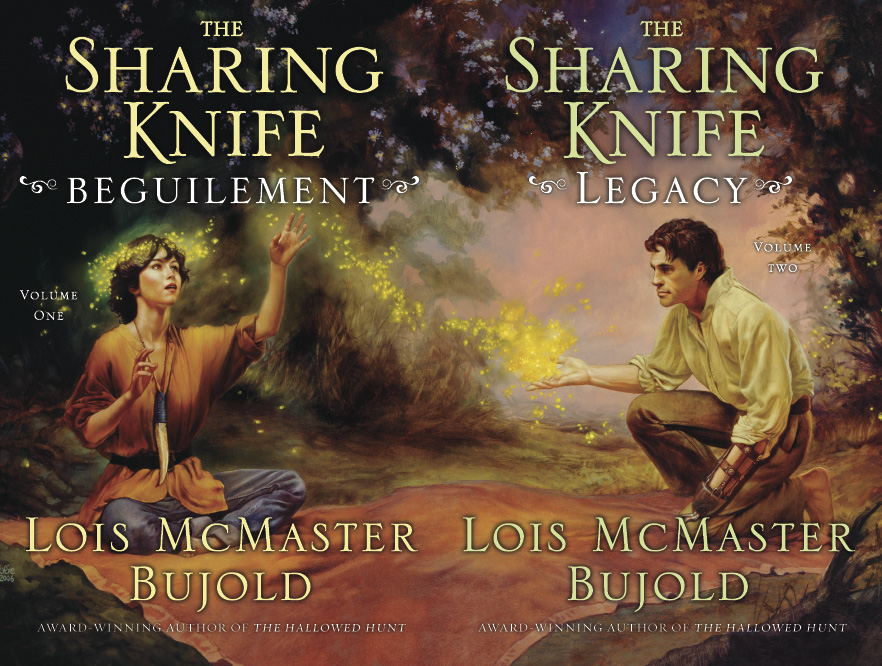
Julie Bell is a great artist. But Dag is too young, and Fawn not young enough.
To watch later: here.
It seems that, as predicted back in August here, and despite the protestations of Sean Ó Neáchtain here, there have been difficulties in implementing the decision to make Irish an official EU language. In fact, I hear from a friend who works in the European Commission (and is a fluent Irish speaker) that the EU has failed to recruit anything like the number of sufficiently qualified Irish-language interpreters it needs. Not to worry though, they have identified some candidates who can be trained up to do the job and are at this very moment doing an EU-funded course in simultaneous Irish-language translation. In what part of Ireland, you may ask, is this very useful course taught? Why, it is taught here. Don’t laugh too loud.
Of course, this bears out my observation that the Irish language, in the last 150 years at least, has not done badly under British rule: Conradh na Gaeilge’s hey-day was over long before independence, apart from the revival of recent decades in Belfast. The language’s worst enemies have been Irish nationalists, such as those who ousted Douglas Hyde from the organisation he had founded. Daniel O’Connell, a native speaker himself, said rather shockingly that “the superior utility of the English tongue, as the medium of all modern communication, is so great that I can witness without a sigh the gradual disuse of Irish.” Not, of course, that he was ever in a position to implement any policies about it.
The real killer blow was dealt by the Rev Timothy Corcoran, the leading educational theorist in the early years of the Irish Free State, whose absurd ideas about enforced rote-learning and countering the fiendish modern notions of Montessori, when implemented on a state-wide level, turned the Irish language into an object of terror and incomprehension for generations of schoolchildren. (I went through Corcoran’s archives in UCD for my doctoral research – fascinating stuff, particularly his unsuccessful attempt to destroy the Royal Irish Academy.)
Well, come the end of the year I shall see if I can get a friendly MEP to ask a parliamentary question about just how often Irish translation services have been required since it became an official language on 1 January.
The new job is going fine. Setting up a new office is hassle; planning a foreign trip for next week is hassle. But in a good way.
On Tuesday, it was a straight-forward writing assignment: one hour to write half a page on this, a page on that, and half a page in French on the other. It also gave me a chance to look at the other candidates since we were all put in a single examination room in the organisation's headquarters. Mostly, I thought, rather dry military types.
On Wednesday, I was supposed to turn up at 7.45 am for the second leg. But we had a lousy night with U on Tuesday night (like many autistic children, she does not really believe in regular sleeping patterns), and at about 4 am I struggled downstairs to the computer to send them an email saying that due to a domestic crisis involving my children's health I would not be able to attend. That, I thought, was that – but when I eventually surfaced a few hours later there was an email waiting for me inviting me to come at the much more civilised hour of 1545 anyway.
So I did, and sat a pretty simple computer-moderated French test – 80 multiple choice questions on grammar (which of these sentences is grammatically correct, which is the right answer to this question, etc) and then 60 on comprehension, where they played a sentence or a dialogue at you through headphones and you had to choose the answer which best summarised what you had just hear. I was gratified that I found the comprehension bit a lot easier – I don't think of myself as using French very much, and the last time I had a work conversation in it was with a Balkan foreign minister last March.
The last leg of the interview was yesterday morning. It looked fairly straightforward in the information I'd been sent – 45 minutes to prepare a 15-minute briefing on the subject provided, and present it to your interview panel who will be pretending to be members of the Dutch parliament. I was looking forward to boiling down complex sets of information about some topic and making it digestible. Then I turned over the paper and found that the assignment consisted of the one line, "Describe what [potential employer] is doing in [Blefuscu]".
I don't know very much about [Blefuscu], apart from what I picked up from former colleagues (my last employers did quite a lot of work there) and what I have read in the news. I certainly didn't feel I knew enough to spoof my way through a grilling by politicians, or even people pretending to be politicians. I told the personnel people that I just couldn't do it, and would have to leave.
They persuaded me to stay at least for the 45 minutes preparation time, and see how I felt at the point that the interview was due to start; "See how well you can wing it," I thinnk were the exact words used. So I sat and thought about the history of [Blefuscu], its importance to the rest of the world, thought of an anecdote I could tell about each of the neighbouring countries, and by the time I'd done that I had two pages of material.
So I did the briefing, in broad-brush political terms with no pernickety details; and I suspect this may actually have been what they wanted, not a regurgitation of the key numbers of people deployed in [Blefuscu] but someone who is able to take a lead in a more general political debate. (I also, of course, included a few words of Dutch in my introductory remarks; as I suspected, none of the interview panel were in fact themselves Dutch.)
Well, we'll see. I hadn't seriously prepared for the interview process, because I'm pretty content in the new job I have just started. But I'm very encouraged that it seemed to have gone pretty well all the same, despite my actually missing one part of it and nearly walking out of another. And if they do make me an offer, it will confirm to me that I was right in my assessment of the other candidates…
10) Machiavelli in Brussels: The Art of Lobbying the EU, by Rinus van Schendelen (.co.uk, .com)
This is a pretty comprehensive description of how policies are made and legislation passed in the European Union, and of how an organised group of people can best hope to influence the process. I found particularly fascinating the description of the various semi-official or non-official bodies that are involved with the policy process in most areas where the EU has power; as a foreign policy person myself, a lot of these simply aren’t relevant to me, but it does explain what an awful lot of the people I see wandering past my office or at the next table in the restaurant are doing. I also very much liked his characterisation of the different national styles of operating – the French tendency to concentrate on getting their people rather than their policies in place, the British tendency to be the bad boys in negotiation, the Germans’ difficulty with coordination between different levels of their own government, the Italians’ combination of charm with ineffectiveness, etc. How close this is to reality is of course for the reader to judge.
Van Schendelen’s two main conclusions are, first, that the key to being effective in the EU is to know what you are doing and to do it well – sound advice in any setting, but he explores how you can find out what you should be doing, and how you can do it better, in considerable detail – and second, that EU lobbying is an essential part of European democracy. I think he claims too much on the second point. I certainly agree with his description of the Brussels policy process as being surprisingly open and transparent, provided that you know where to look and who to talk to. But that is quite a far cry from the accountability to the wider public which is surely key to an active democracy.
Unfortunately, the book is written in appalling English. I do not say this lightly. It’s not just the recurrent management-speak of jargon phrases which are used frequently but never explained – “feedforward”, “window-in and window-out”, and most bafflingly “U-turn” apparently used to mean some sort of deceptive practice. It’s not just the irritating habit of italicising one or two words, apparently chosen at random, in the first sentence of every paragraph (curiously reminiscent of that spoof travel guide to the fictional country of Molvania published a couple of years ago). It’s the fact that the sentences are tortuously and often ungrammatically constructed, with frequent irritating use of the word “hardly”, where “amper” would be appropriate in Dutch, but a completely different construction is needed in English. It is a shame that the academic publishers responsible for this volume did not take the trouble to have it edited by a competent native English speaker.
9) The Sharing Knife: Beguilement, by Lois McMaster Bujold (.co.uk, .com)
Like my wife, I am a complete and total Bujold fan. So a new Bujold novel is a Good Thing whether it be great or merely enjoyable. The Sharing Knife: Beguilement heads towards the “great” end of the spectrum, with a nice clash of cultures between settled “farmers”, who are reminiscent of the frontier spirit of early nineteenth-century America, and the “Lakewalkers” who keep them safe from supernatural nasties, who combine aspects of native Americans – but on the same side as the farmers – and Tolkien’s Rangers. Indeed I thought the geographical references were made pretty strong when we were told of the seven lakes of olden days which merged to form the huge Dead Lake of the story’s setting (OK, so in our world there are only five), and the drowned city of Ogachi, five miles across (shift that last syllable to the front of the word, and add an extra consonant).
So, it’s a compelling fantasy environment, there’s a cross-cultural romance, there’s a mystical Thing which has to be sorted out in the second volume (of, we are told, two). There’s also pregnancy and miscarriage, which I don’t often recall in sf or fantasy novels (the rather mystical interpretation in A Game of Thrones aside). I did like it, though the come-down from supernatural nasties of the early chapters to the bathos of aggrieved potential in-laws at the end was a little odd. Still, I have the sequel on pre-order from Amazon.
This is prompted by someone on my friends list who was mourning the demise of the Slovenian tolar.
Count all the euro (and related) coins in your pocket – not by how much they are worth, but by which country they come from. (The full list of coins showing which ones come from which country can be found in many places, including http://www.euro.gov.uk/eurocoins.asp )
Belgium: 15
Germany: 4
Netherlands: 4
Spain: 3
France: 3
Italy: 2
Luxembourg: 1
Now, which country do you live in?
Belgium
Obviously it helps to do this meme if you live in Austria, Belgium, Finland, France, Germany, Greece, Ireland, Italy, Luxembourg, Netherlands, Portugal, Slovenia, Spain, Monaco, San Marino, the Vatican, Andorra, Montenegro or Kosovo, but people outside those enchanted places can play too. Not quite half of mine are from the country I live in. And I haven’t been to Spain in over a decade. Unlike the money in my pocket.
I’ve been getting two somewhat different types of comment spam over the last few weeks, and wonder if any of the rest of you have been getting the same.
Version 2 is a bit weirder; a series of sock-puppet lj accounts who post what appear to be interesting and interactive comments, but then you follow the link back to their journal and it has just one or two entries, full of somewhat unsolicited and very hyperlinked sex advice. I tend to delete the comments, mark them as spam, ban the commenter, and not follow any of the links; but I am wondering if this is related to the first set of harassing comments, or if it is different? Again, I would be interested to know if any of the rest of you have been experiencing this (the harassing accounts include
Two audios and a DVD edited release this time, none of them therefore available as they were when first broadcast (in 1965, 1966 and 1983 respectively).

I liked the creative reinterpretation of the characters from the Greek legend. Priam takes a shine to Vicki, renames her Cressida and won’t hear a word against her. Both Paris and Menelaus are incompetent, the former a coward and the latter drunk, making one wonder what Helen ever saw in either of them. (Menelaus: “I was heartily glad to see the back of her!” Paris: “I think this whole business has been carried just a little bit too far. I mean, that Helen thing was just a misunderstanding.”) Helen herself never appears in person, the BBC beauty budget presumably not reaching that far. The interpretation of the story that will always remain with me, I think, is Roger Lancelyn Green’s The Luck of Troy, but this will do as an sfnal version.
As with all the “lost” stories, one never knows what one missed, though I can make a couple of guesses – Frances White (Julia in I CLAVDIVS) as Cassandra, or Vicki in her dress. But Peter Purves’ narration is, as ever, great, even though of the three regular characters his has the least to do. We end with a real acceleration of pace towards the next story; Vicki and the Doctor say their goodbyes off-screen, while Cassandra’s handmaiden Katarina accompanies a wounded Steven aboard the Tardis as a new (but very short-lived) companion.
It helps, of course, that Steven rather than the Doctor is the central character here, so Purves is telling his own character’s story. Freshly arrived in Paris from the end of the Daleks’ Master Plan, having lost three fellow companions in the recent past (Vicki through romance, Katarina and Sara Kingdom through horrible death), the Doctor now abandons Steven who has to make his way through a hostile and confusing environment. No wonder he walks out at the end, giving the First Doctor, alone at last, a great soliloquy.
As a future Englishman, Steven is C of E without ever having really thought about it, but now finds himself in a setting where “Catholic” and “Protestant” are terms which can cost you your life – a cognitive dissonance I’ve seen often enough, and I suppose experienced myself in reverse. While the program tends to side with the Protestants, who after all were the massacrees rather than the massacrers in this case, they are very definitely not completely innocent in their suffering.
The story is very neatly structured, with each of the first three episodes lasting from dawn to dusk. Tat Wood and Laurence Miles have some intriguing speculation as to what was happening after dusk, but you should buy their book to find out more. Unlike me, they can’t forgive the end for the way in which new companion Dodo is introduced; I think Steven is a bit out of character (despite this being otherwise his best story) but I can roll with it.

The plotting is peculiar, because it wasn’t clear until quite late on which Doctors and former companions would be available (though of course it was obvious that Hartnell’s part would have to be taken by a stand-in as he had been dead for several years). The pairing of Tegan plus One doesn’t really work in terms of character dynamics, Turlough plus Susan even less; whereas the Brigadier/Two and Sarah Jane Smith/Three scenes are noticeably better. Indeed Troughton is just great, and it’s not surprising that they asked him back once more a few years later (thought it is surprising that on that occasion it was such a bad story).
Of course you get sucked into it, and I started to play the continuity games. While Susan recognises Gallifrey (as ought to be expected) how come she recognises Cybermen, but not the Master (and nor does One)? Then again, in The Tenth Planet, One already knew about Mondas and the Cybermen, so perhaps he took the time to tell Susan about them at some (much) earlier point. And perhaps the Master and the Doctor didn’t know each other all that well at the Academy. The moment of both Tegan and Sarah Jane recognising the Brigadier is pure squee. Presumably Sarah Jane’s memories were wiped by the Time Lords after she went home, to judge by her reaction on meeting Ten in School reunion (and his statement then that he’s regenerated “half a dozen times since we last met”).
So yeah, villainous Time Lords, one useless Dalek, a solitary Yeti, lots of Cybermen, a Killing Plot Device Robot, but generally pretty good fun and far better than The Three Doctors. I was particularly amused by one detail that had completely escaped me in 1983: the spot in Cambridge where Four and Romana are swept into the time eddy is precisely under Clare Bridge, which was to be a major geographical feature of my life from 1986 to 1991.
The editor of The Wellsian posts a query in response to an old book review of mine. Anyone interested in following this up? (Thinking of
and
in particular, but others may be intrigued too.)
And on a completely different topic, Helm’s Deep as you’ve never seen it before. (Hat-tip
.)
has read Bujold’s The Sharing Knife.
really likes The Brigadier. And Bret Vyon.
Robert Anton Wilson died.
8) About Time: The Unauthorised Guide to Doctor Who, 1963-1966, by Tat Wood and Lawrence Miles (.co.uk, .com)
This series of books about Doctor Who had previously been recommended to me by
Compared with the last two books I read about Doctor Who, I felt this volume was much less superficial than Kim Newman’s, and made fewer grandiose promises but delivered on more of them than John Chapman’s. My one regret is that, following leads from Newman and Chapman, I bought both the DVD of The Web Planet and the CD of The Celestial Toymaker while in London, only to discover that Wood and Miles have a very low opinion of both stories.Grr, when I think what else I could have got… I am about half a dozen stories behind in my Doctor Who reviews anyway, so it will be a little while before I publish my own views here.
BTW, my new userpic, for Doctor Who books, was drawn for me yesterday as a "welcome home" present by young F, aged seven and a half. I may not wander to quite such exotic places as the Doctor, but I do travel quite a bit.
7) Preacher [#3]: Proud Americans, by Garth Ennis and Steve Dillon (.co.uk, .com)
I find myself strangely compelled to buy and read more volumes in this series, even if I didn’t much enjoy the graphic violence of the first two. Volume 3 is a game of two halves, with the first part seeing our heroes bust their Irish vampire friend out of captivity in southern France, overcoming adversaries who, if this weren’t a graphic novel, you would happily describe as “comic-book villains”. But the second part of the book was much more interesting for me; a presentation of the Easter Rising as witnessed by Cassidy, followed by a melancholy meditation on immortality and watching his friends grow old and die around him. I winced a wee bit at the historical inaccuracies in the Irish bit, yet it is a decent effort to portray the story to an audience who would have been mostly utterly unfamiliar with it.
Top UnSuggestions for this book are a diverse lot:
I wondered to myself, does this happen in other jurisdictions too? And it does:
Trevor Sargent TD: We have a choice. Do we use money to go down that dangerous and expensive road or do we spend it more cost effectively on insulation? I am proud to say that my area’s local authority has been leading the national debate on energy insulation and has doubled the number of new energy efficient houses in its development plan. It has passed the point that Sustainable Energy Ireland believed we could reach. I am beginning to sound like the introduction to a “Star Trek” film.
(From Hansard, 25 October 2005)
Eric Pickles MP: The discussion about whether we should use national insurance numbers was utterly pointless. Sure, we could use some other method—iris recognition, DNA, blood sample, or a person’s ability to recite the “Star Trek” cast list.
Eleanor Laing MP: No.
Eric Pickles MP: I am sure that my hon. Friend would qualify in that respect.
Later that same day:
Colin Challen MP: …five times more research money is spent on looking for the holy grail of nuclear fusion than is spent on renewables, even though we know that renewables can deliver in our lifetime, not in a time frame that “Star Trek” fans would be more familiar with.
(From Hansard, 11 June 2002)
Paul Flynn MP: In “Star Trek”, which is one of my favourite television programmes, the Ferengi are a dire warning of what the future is likely to be. They are based on a nightmare view of Thatcherism. My right hon. Friend the Member for Hartlepool (Mr. Mandelson) should be shown tapes of the programme so he knows what he is really suggesting. The Ferengi are the likely result if the daughters of financial advisers marry the sons of bankers and breed a generation instilled in their philosophy. They have 250 laws of acquisition, including never cheat a man who is wearing a better suit than you are; treat people in your debt like family; and employees are the rungs on the ladder of success, so step on them. Those laws would not be out of place in the boardrooms of many insurance and banking companies. Two precepts of acquisition—rules 239 and 59—strike a chord. They are: never be afraid to mislabel a product, and free advice is never cheap. The word “integrity” does not occur in the Ferengi language.
Paul Boateng MP: We should remember that there are people in the financial services industry who possess integrity and who are concerned about the welfare of those to whom they sell products. We need to achieve a balance in the debate, because we want to ensure a successful industry. I hope that no one will take that as a sign that I have gone over to the Ferengi. I rather lost interest in “Star Trek” when Lieutenant Uhuru was subject to a compulsory redundancy: when she went, so did I. I have no doubt that lessons can be learned from the Ferengi—and my hon. Friend shared them with us.
(From Dail debates, 17 April 2002)
Alan Shatter TD: At the conference of the Association of Garda Sergeants and Inspectors just a few days ago, the general secretary was anxious to say in his speech that he was concerned that Operation Encounter was simply a short-term public relations exercise. That is exactly what it is. The name has more to do with the “Star Trek” television programme than with any coherent, comprehensive policy to tackle the problems of street violence.
(From Hansard, 1 January 2002)
Michael Weir MP: We have heard much in the debate about e-business and the threat from text messages and e-commerce, but although we can order goods over the internet and even pay for them electronically, until we get our hands on Star Trek’s transporters, someone physically has to move goods from one place to another.
(From Dail debates, 25 November 1999)
Dan Neville TD: To the man on the street, a person with Asperger’s syndrome may just appear to be odd, eccentric or irritating. Their most notable characteristics are the absence of friends and their tendency to have obsessional interests, be it astronomy, cars or Star Trek.
(From Hansard, 23 November 1999)
Lord Fraser of Carmyllie: …for the first time in history, into the mouth of the Sovereign was put a split infinitive. Knowing the effort that goes into the preparation of the Queen’s Speech, I do not believe that this was a flaw on the part of the Civil Service and it must have been intended by Ministers. I suppose that in a modernised Britain, what is good enough for “Star Trek” is good enough for the Sovereign.
Lord McIntosh of Haringey: My Lords, what is good enough for Sir Ernest Gowers is good enough for the Sovereign.
Lord Fraser of Carmyllie: My Lords, the noble Lord may say that, but it is the first time that a split infinitive has appeared and I am happy, if nothing else, to record that change in our modernised Britain.
(From Dail debates, 29 June 1999)
Alan Dukes TD: It is a measure of how desperate the problem is, and how desperate the Government is, that it must resort to clapping itself on the back because the rate of increase in house prices appears marginally to have slowed down or, to borrow a phrase from “Star Trek”, reduced from warp speed to the merely supersonic.
(From Dail debates, 15 April 1997)
Seamus Brennan TD (attacking Alan Dukes, as it happens): Does the Minister not agree that this is a general election trick which he has dressed up in “Star Trek” language when he refers to “spectrums”, etc?
(From Dail debates, 27 February 1997)
Brendan Kenneally TD: Genetic science is at the point where susceptibility to common causes of death such as heart disease and cancer can now be assessed. As tests become more sophisticated the risks of dying young or needing expensive medical treatment will be increasingly quantifiable. It is expected that within a decade full scale genetic tests will be able to predict a threefold difference in mortality between people with good and bad genes. Far from being a Star Trek issue, genetic rating is now a reality.
(From Dail debates, 19 February 1997)
James McDaid TD, on the same issue: This area is not covered in the Minister’s Bill. Some people might regard it as a “Star Trek” type of issue. However, with genetic engineering making headway as it is — and a [351] recent BBC programme pointed this out — it will be statistically possible to earmark people who will have specific conditions in years to come, and insurance companies, for example, might demand to use genetic profiling in the future. Could legislation be introduced to prohibit insurance companies using genetic profiling to load people who may have specific conditions i.e. diabetes, blood pressure and so on?
(Dail debates, 7 November 1995)
Pat Rabbitte TD: I do not accept that it is impossible to turn a scientific article into a piece of popular journalism. I do not believe that we have to write every science article as if it were the most grave and serious matter of earth-shattering importance. It permeates every facet of our daily lives, for example: the application of microwave technology is a fairly recent development; now you can buy a microwave cooker for less than £100; microprocessors, often thought of as the preserve of high tech computer and communication companies, run our domestic washing machines; and laser beams used to be “STAR TREK” material; now they tell us our weekly supermarket bill.
(Dail debates, 26 October 1995)
Pat Gallagher TD: Nonetheless, the overall manner in which the Department of Justice deals with migrants, other than refugees, is in need of overhaul. Any Member who has had dealings with that Department, for example, through the Aliens Office on behalf of people endeavouring to gain entry to this State to study or work, or even those endeavouring to take out Irish citizenship will know its antiquated, convoluted and secretive system for dealing with such applications; even the term “aliens” is offensive, sounding like something from the movie “ET” or “Star Trek”.
(Dail debates, 3 October 1995)
Alan Shatter TD (again): In his foreword to a new book “The Physics of Star Trek” by the American astronomer, Lawrence Krauss, Professor Stephen Hawking acknowledges that time travel is possible.
(Dail debates, 8 February 1995)
Charlies McCreevy TD: When Deputy Quinn talked about the 2010 strategy, one of the backbenchers on this side of the House referred to a space odyssey. I would describe this budget as being rather like the “Star Trek” TV programme, which has the great line: “Beam me up, Scotty”. This budget is more like “Beam us up, Ruairí” into a world of fantasy where no one will pay bills either now or in the future.
But we should not be restricted to Star Trek:
Peter Luff MP: Did the Paymaster General by any chance watch “Doctor Who” on Saturday? If she did, she might understand why her statement today reminds me of a cyberman coming, appropriately, through a portal from a parallel universe and insisting that its purpose was to upgrade humanity to achieve perfection. I freely acknowledge that the tax credit system has done much good, but in the universe in which I live, I hear of another case of despair and misery caused by the malfunctions in the system virtually every day. Unlike the heartless cybermen in “Doctor Who”, will the right hon. Lady at least acknowledge that harm has been done and apologise to the families who have suffered so much?
Dawn Primarolo MP: Perhaps the hon. Gentleman would like to travel back in the Tardis and experience the despair and destitution that existed when his party was in government and child poverty doubled. That was a disgrace, and it is about time that he joined the real world and supported the Government’s objective to eradicate child poverty, and of reaching our first target of halving it as soon as we can.
(From Hansard, 10 July 2006)
Denis MacShane MP: I am unsure whether my right hon. Friend the Secretary of State was able to watch the last episode of “Doctor Who” on Saturday night. I say—with the affection that she knows that I have for her—that she could be very well-placed to audition for the role of the next Rose, to replace Billie Piper, because that young lady is an expert in the concept of the parallel universe, which, having watched “Doctor Who”, I am beginning to understand. I have to say to my right hon. Friend, with affection and respect, that I am not sure that my Rotherham constituents are prepared to be quite as enthusiastic about the BBC as she is… I am just not convinced, however, by the arguments, which seem—if I may finish on a “Doctor Who” analogy—to come from a parallel universe not inhabited by my constituents.
(From Hansard, 6 June 2002)
Viscount Astor: My Lords, does the Minister agree that the noble Lord, Lord Tanlaw, has done this House a service by bringing this issue to your Lordships’ attention? The Minister explained that there are normally six pips to enable us to recognise the hour. Does he realise that once a year there are seven pips, usually on New Year’s Eve, because the Earth’s rotation is slowing down and a seventh pip is required, no doubt due to the Government’s economic policy in that area? Does the Minister agree that we will forgive the BBC for being a couple of pips late if it returns the weather forecast to its original state on the television?
Lord Davies of Oldham: My Lords, I should confess that I am not a time lord and more of a Doctor Who—perhaps I should say “Lord Who”. The answer to the noble Viscount’s question is straightforward. Of course he is right. That adjustment has to be made because the Earth’s travel around the Sun is not precise and we are not able to measure it with the precision that is indicated. We have, of course, got atomic clocks to which people can refer. The Great Clock of Westminster—sometimes referred to as Big Ben—is governed by that. Railway digital clocks are governed by a signal sent out from the National Physical Laboratory. So we maintain accurate time in this country, but there is a problem with regard to the broadcast. I am sorry if on this occasion I am obliged to give the noble Viscount the pip.
(From Hansard, 23 May 2005)
Stephen McCabe MP: It is pure fantasy for a party that gained fewer seats than Michael Foot did in Labour’s disastrous 1983 election to claim a partial victory. It is a figment of the Leader of the Opposition’s imagination. The scriptwriters for “Doctor Who” could not come up with a better storyline; it is complete and utter nonsense.
Unfortunately the Oireachtas debates search engine won’t let me fine-tune searches which include the word “who”, so this is all just Westminster.
Good to see lots of you last night, for much conversation about the new Apple iPhone, Doctor Who, perfect electoral systems and whether or not I actually look like my user pics!
Just to record who was actually there and sitting where (once the main course, and the stragglers, had arrived):
Look forward to next time!
There were a substantial cohort of political activists in Northern Ireland whose initial burst of public activity coincided with the peace process in the mid-1990s. I was one of the least prominent (and least successful) among them; David Ervine was one of the most prominent. He is, I think, the first of that cohort to have died.
I have to get up early tomorrow morning to get the train to London, and he deserves a longer tribute than this. But I’ll just record for now that I always found him congenial, sincere, and straightforward in our relatively few mutual dealings. I think the last time we met was in a TV studio before the 2003 elections, where I correctly assured him that his own Assembly seat was reasonably safe but his colleague in North Belfast might have a more difficult task.
His time, to be honest, had passed. He was unable to really engage the UVF in the decommissioning process; he was unable to keep the Loyalist electorate engaged in his political project. I had already predicted on my website that he was likely to lose his East Belfast assembly seat to the DUP in the event of elections this year, and I think that that DUP gain must now be a near-certainty.
But I would have liked to see him sit around the TV studios for the next twenty years in graceful (or graceless) retirement as a pundit, puffing on his pipe and continuing to expound mercilessly on the topic of why those who voted for the other Unionist parties were voting against their own self-interest. We won’t see that now.
OK, as discussed the best time for dinner at Maroush on Vere St appears to be 7 pm. I shall accordingly make a reservation for 12 people (including those who did not express a time preference). I look forward very much to seeing
,
,
,
,
,
,
,
,
,
,
,
, and whoever else shows up. If anyone else is planning on showing please text me on +32 485 555 944 – I am not sure if I’ll be on-line between now and then.
Unsuitable Christmas gifts: The children’s railway FROM HELL (hat-tip
the Engrish is fun enough (“Run quickly when on the iong bridge with loosing planks!”), but surely cultural differences cannot explain why a toddlers’ play railway needs a logo with dripping blood. To say nothing of the demon in the corner.
A reflective commentary from James Graham on the trouble with Torchwood (hat-tip
One suggestion just made to me is to make Lembit Opik a consultant for the show, given that he is an authority on Wales, intergalactic phenomena and sex with odd-looking aliens.
A brilliant piece of forensic investigating from those people at snopes.com:
Claim: While interviewing the mother of a large number of children for the show You Bet Your Life, Groucho Marx made a risqué remark about his cigar.
Status: False.
This last from the
So the brother-in-law turned up this evening with an old map:
…and wondered if I could date it for him.
After much googling I discovered this map:
…which is dated to 1746, a little older than my b-i-l thought it was. He was delighted to hear that it was drawn over a quarter of a millennium ago.
But I was not completely satisfied with that date, and eventually tracked down the real original; the date was not 1746 but
I am kicking myself for making such a horrendous mistake; wrong by several decades.
I occasionally have trouble with mouth ulcers, as chronicled here in the past. I think I now have the silver bullet:
Otherwise they break out in full, and it’s back to the usual analgesic methods and being unable to talk properly for a week and a half.
6) Actors of the Century: a Play-Lover’s Gleanings From Theatrical Annals, by Frederic Whyte (.co.uk, .com)
Published in 1898, this was my distant relative’s first book (and he didn’t write another until 1925). It’s very difficult to write about performances that happened long ago, by actors who are long dead, and yet make it interesting. I think Whyte does it as well as is possible. It’s a chatty account of great actors of the nineteenth century, illustrated with lots and lots of photographs (or engravings, for the older subjects) some of which are really striking – Edmund Kean, for instance, looks extraordinary. My copy of the book has a dozen or so extra contemporary loose-leaf photographs of contemporary actors tucked inside it as an unexpected bonus. I’ve scanned and uploaded the one of Lily Langtry, nowadays better remembered as the lover of the future King Edward VII, partly because I really can’t work out what is going on with her costume.
Whyte runs through several generations of great British actors, but also extends his view to the United States, writing for example of how Junius Brutus Booth emigrated from London to a career of success in which he was followed by his son Edwin; and also of how the play Our American Cousin had provided a ready-made role for the best American actors to perform in Europe. The off-stage part played by Junius Booth’s younger son at a Washington DC performance of Our American Cousin on 14 April 1865 is not mentioned. I discovered while checking this on WikiPedia that Junius Booth’s younger brother Algernon, who stayed in England, apparently was the great-great-great-grandfather of Cherie Booth, who is married to Tony Blair.
Whyte is also very keen to emphasise the Irish links of all the key theatrical figures he possibly can (in the year this book was published, he was heckled while giving a public lecture on “Irish Actors and Dramatists” by both George Bernard Shaw and Bram Stoker, who were in the audience). I was surprised that I knew one he missed – William Betty, who (as reported here and elsewhere) took the London stage by storm aged 13 in 1804, was brought up in Dromore, Co Down.
I was especially struck by Whyte’s exhortation to the reader, after quoting extensively from someone else’s glowing review of Mrs Patrick Campbell’s 1895 performance as Juliet, as follows:
The theatrical dilettante of a hundred years hence, who may turn over these pages at the British Museum, will accept this passage, I imagine, as we accepted those in which [Charles] Lamb and [his colleagues] sang the praises of the players of their time.
Do so, Casual Reader of 1998! Do so, without hesitation!
It is startling to be addressed so directly from the past, by a writer who was born precisely a hundred years before me. OK, it’s eight years later than he was aiming for, but it’s a good shot none the less.
5) The Secret Visitors, by James White (.co.uk, .com)
This was James White’s first novel, published in 1961, and like many of his others the central character is a human doctor confronted with peculiar health problems, a precursor to his best-known works, the Sector General galactic hospital series. However, it’s definitely a novel of its time; the galactic federation is interested in Earth, apparently, because our planet is unique in having a) an axial tilt and b) decent scenery. Added to this, our Earthmen heroes discover that the ultra-civilised galactics have lost all knowledge of a) surgery and b) battle tactics, and are able to help them out of a tricky spot or two. But it’s fun; and it’s particularly fun for me because of the use of Northern Ireland (in particular Portballintrae) as a setting for much of the first half of the book – this being a reason for me to read it, as it’s part of my list.
As suggested by
4) Sourcery, by Terry Pratchett (.co.uk, .com)
I have to say that this is not one of pterry’s greatest hits. Rincewind is really a one-joke character, and the proof of Pratchett’s genuis is that he stretched the joke out over two excellent books, The Colour of Magic and The Light Fantastic. The wizardly bits of Sourcery are done better in the earlier books, and the exotic foreign parts are better done in later books; the humour hits unrelentingly on the single note of bathos, with very little wit to enliven it. Though I did like this exchange, about why the magic carpet goes up when you tell it to go down, and vice versa:
“How did you get the carpet to fly? Does it really do the opposite of what you command?”
“No. I just paid attention to certain fundamental details of laminar and spatial arrangements.”
“You’ve lost me there,” she admitted.
“You want it in non-wizard talk?”
“Yes.”
“You put it on the floor upside down,” said Rincewind.
Anyway, I shall look out for Wintersmith when in London next week.
Top UnSuggestions for this book: seven evangelical Christian books, and then Runaway, a short story collection by Alice Munro.
The Colour of Magic | The Light Fantastic | Equal Rites | Mort | Sourcery | Wyrd Sisters | Pyramids | Guards! Guards! | Eric | Moving Pictures | Reaper Man | Witches Abroad | Small Gods | Lords and Ladies | Men at Arms | Soul Music | Interesting Times | Maskerade | Feet of Clay | Hogfather | Jingo | The Last Continent | Carpe Jugulum | The Fifth Elephant | The Truth | Thief of Time | The Last Hero | The Amazing Maurice and His Educated Rodents | Night Watch | The Wee Free Men | Monstrous Regiment | A Hat Full of Sky | Going Postal | Thud! | Wintersmith | Making Money | Unseen Academicals | I Shall Wear Midnight | Snuff | Raising Steam | The Shepherd’s Crown
Lots of people are doing this over on the
3) A Clash of Kings, by George R.R. Martin (.co.uk, .com)
Having reread and enjoyed A Game of Thrones last year, and in hope that my rereading the books will telepathically spur
on to finishing the next one, I went back to the second in the series and reread it over the last week. Martin, having killed off one of his viewpoint characters in the first volume, now introduces two more to add to the mix; one of these is the piratical princeling Theon Greyjoy (thanks to
for correction), whose hubris and fall is the clearest trajectory of any character in the book. As ever, the writing is engaging and exciting; the horrid death of one of the claimants to the kingdom half way through is a memorable moment, and the fact that you never know who is going to be alive at the end keeps you on your toes – I think no less than four of the viewpoint characters seem to be killed off at one point or another, though it turns out not to be true in every case.
Oddly enough, the one point where I felt the writing faltered because of Martin’s choice of multiple narratives was in the description of the climactic naval battle outside the walls of the capital city, told from three different perspectives, none of them, of course, having a full picture of what is going on, but failing to really add up to a coherent picture.
In rereading this time, I was careful to pay more attention to the characters’ dreams and visions, since it’s fairly clear that they are signals to the plot to come – in particular, Daenerys has a vision of a young king with a wolf’s head, surrounded by corpses, which of course we find out all about at the end of the following volume. Knowing what is to come for the odious Queen Cersei, it was interesting to see how Martin is already foreshadowing her troubles here.
Anyway, a jolly good re-read, and still very strongly recommended.
Top five UnSuggestions for this book: