Doctor Who novels, as recommended on LibraryThing and Goodreads, part 2

See previous post covering the Sarah Jane books, also Class, the three Companions novels, Missing Adventures, Past Doctor Adventures, and the Sixth, Thirteenth, Fifth, Eighth and Twelfth Doctor books.

Seventh Doctor novelisations and New Adventures

The top Seventh Doctor book on Goodreads is the second in the series of 74 New Adventures published by Virgin during the Wilderness Years, starting with Seven and Ace and expanding to include other companions, notably Bernice Summerfield. Timewyrm: Exodus shows veteran Terrance Dicks on especially good form, taking the Doctor and Ace to a Hitler Won timeline in the early 1950s. You can get it here.

The top New Adventure on Goodreads is Paul Cornell’s Human Nature, still the only novel on which a TV adventure for a later Doctor was based. You can get it here.

My own favourite of the New Adventures is the Sherlock Holmes / Cthulhu mashup All-Consuming Fire by Andy Lane. You can get it here.

The top Seventh Doctor novelisation on both LibraryThing and Goodreads is Ben Aaronovitch’s adaptation of his TV story Remembrance of the Daleks. You can get it here. My own favourite is Doctor Who: Dragonfire, by Ian Briggs, which you can get here.

Third Doctor

The top Third Doctor book on LibraryThing is Terrance Dicks’ novelisation of Day of the Daleks, definitely one of his better books, in which freedom fighters from the future attempt to infiltrate the present day to cause a strategic assassination. The book was one that I pored over as a kid, and inevitably when I watched the original TV story I was disappointed. You can get it here.

My favourite Third Doctor novelisation is Malcolm Hulke’s treatment of his own script for Jo Grant’s last story, The Green Death, which you can get here.

The top Third Doctor novel on Goodreads is from the BBC’s Past Doctor Adventures, Last of the Gadarene by Mark Gatiss (one of the few people who has both appeared in the show and written for it). It’s a story set in the UNIT era with aliens infiltrating a village fete. You can get it here.

Second Doctor

The top Second Doctor novel on Goodreads is a 2012 book by renowned hard sf author Stephen Baxter, probably the most prominent writer to top any of these individual categories for sole authorship of a novel (but see below for short fiction and joint authorship). The Wheel of Ice takes the Doctor, Jamie and Zoe to a human colony in the outer solar system, a classic Troughton-era base under siege, with added marital discord and stroppy teenagers. There are ancient, weird aliens, and a mystery stretching across millions of years, which entirely convince the reader that this is a Stephen Baxter novel. There are also various pleasing references both to Who continuity and to Baxter’s other work, none of them crucial to enjoying the book, which is also probably my favourite Second Doctor book. You can get it here.

(Though I must point out that “The Wearing of the Green” is not a Jacobite tune. Wrong island, and more than half a century out.)

The top Second Doctor book on LibraryThing is the first Troughton-era novelisation published, Doctor Who and the Cybermen, adapting the TV story The Moonbase. I don’t rate it as highly as The Wheel of Ice, but you can get it here.

50th anniversary e-shorts

I have been tweaking these individual categories for each Doctor to look at novels only, because in most cases the numbers are hugely distorted by the short stories published individually and electronically by Puffin in 2013 for the 50th anniversary, many of which are more popular than any of the novels featuring those Doctors. At the top of that list, on both Goodreads and LibraryThing, is the one that came out the week of the anniversary itself, ten years ago this month – Nothing O’Clock by Neil Gaiman, which takes the Eleventh Doctor and Amy to a creepy house with shades of Coraline and Sandman. I like it a lot too, and you can get it here.

The other one I particularly liked in this sequence was Michael Scott’s Second Doctor story The Nameless City, which nicely salutes the Cthulhu mythos. You can get it here, and you can get a collection of all of the stories (now increased to 13) here.

War Doctor

There is one novel featuring the War Doctor, as played by John Hurt; it is Engines of War by George Mann. I didn’t find it much to my own taste, but you can get it here. The Big Finish War Doctor series is much better.

First Doctor

The first and (IMHO) the best of all the old Target novelisations is also top of both the LibraryThing and Goodreads charts: originally published in 1964 as Doctor Who in an Exciting Adventure with the Daleks, now generally just known as Doctor Who and the Daleks, the novelisation of the second broadcast Doctor Who TV story, and the one which made the show such a success; later also made into a cinema film starring Peter Cushing.

David Whitaker, who adapted the book from Terry Nation’s script, rewrote it as if it was the very first of the Doctor’s adventures, told entirely from the point of view of Ian Chesterton, a teacher who becomes the Doctor’s companion along with granddaughter Susan and her tutor Barbara. There’s lots of lovely extra detail given to the story of the Daleks and Thals on Skaro, and the Daleks themselves are more interesting than they have often been since. It’s a firm favourite of mine, and you can get it here.

Torchwood

There are 19 original Torchwood novels, and most of them are pretty good. Top of the charts for both LibraryThing and Goodreads is the first in the sequence, Another Life by Peter Anghelides. There is lots of good Torchwood stuff, a body-hopping alien, a spaceship which endangers Cardiff, a former lover of one of the team (Owen in this case), all against a gloomy backdrop of awful weather littered with variously dead bodies. I like it too and you can get it here.

Having said that, my personal favourite of the Torchwood books is the much later First Born by James Goss, who I find one of the best Whoniverse writers currently working. It’s a kind of prequel to Miracle Day, with Gwen and Rhys in hiding, and weird children being weird. You can get it here.

Eleventh Doctor

The top Eleventh Doctor novel on Goodreads is Touched by an Angel, by Jonathan Morris. It is a story of car crashes and mixed-up timelines with the addition of the Weeping Angels, who both create the possibility of temporal paradox and hope to feed off it. Morris does a beautiful job of conveying the history of the relationship between the car crash victim and her husband which is central to the narrative, and the Angels also come across superbly. It also has the Doctor, Rory and Amy. You can get it here.

The top Eleventh Doctor book on LibraryThing is The Silent Stars Go By, by Dan Abnett, which is also my favourite of the original novels, a Christmassy story of a generations-long terraforming plan. You can get it here. But I like Steven Moffat’s novelisation of the 50th anniversary special, The Day of the Doctor, even more; you can get it here.

Ninth Doctor

The third highest rated Doctor Who book on LibraryThing, and fourth highest on Goodreads, and top Ninth Doctor book on both systems, is Gareth Roberts’ Only Human, which I think benefited from being one of three released in September 2005, when people were starting to get thirsty for new Who material.

It is largely set in Bromley, where the Doctor and Rose get involved with Neanderthals, local homo sapiens, and humans who have travelled there from the far future, all under threat from ambitious monsters and monstrous ambition. Meanwhile, in the early 21st century, Jack Harkness is helping a displaced Neanderthal settle into contemporary Bromley. There is a certain amount of playing the situation for laughs, but also a bit of exploration of what it is that makes us human. You can get it here.

It’s my own favourite Ninth Doctor novel too, and it’s a shame that the author himself has turned out to be an intolerant bigot.

Fourth Doctor

The top Fourth Doctor book by ownership, and second highest of all Doctor Who books, on both Goodreads and LibraryThing, is another by Gareth Roberts, his 2012 novelisation of the unshown Fourth Doctor TV story Shada from Douglas’ Adams script featuroing the Doctor, Romana, K9 and Cambridge and an ancient Time Lord secret.

I enjoyed it; I wrote at the time that Roberts had teased out threads of narrative left him by Adams, thickened them up and knitted them into a warm colourful and much longer scarf of story. The means and motivation of Skagra and Salyavin are fully explained. In addition, we have the extra romantic depth we had always hoped must be there between Clare and Chris, nicely contrasted with the relationship between the Doctor and Romana. You can get it here.

I must add that I enjoyed even more the novelisation of another Douglas Adams script, The Pirate Planet, this time by James Goss (who is one of my favourite Who writers anyway) which you can get here; and I retain affection for Terrance Dicks’ original novelisation of Genesis of the Daleks, which you can get here, and which is the top traditional novelisation on Goodreads; and his Doctor Who and the Loch Ness Monster, the top traditional novelisation on LibraryThing, which you can get here.

Tenth Doctor: The Winner

The top Doctor Who book by ownership, on both Goodreads and LibraryThing, is Jacqueline Rayner’s The Stone Rose. It was the very first Tenth Doctor novel to be published, in April 2006 just before the start of Series 2, and was then republished in 2015 which will have given it an extra boost.

It features the Tenth Doctor and Rose with Micky and Jackie, sorting out the mystery of a statue of Rose dating from Roman times in the British Museum. Solving the mystery takes a certain amount of timewarping, mostly during the reign of Hadrian, and dealing with an advanced technology indistinguishable from magic. You can get it here.

My own favourite Tenth Doctor novel is Beautiful Chaos, by Gary Russell, with the Doctor, Donna, Wilf and an old enemy in contemporary London. You can get it here.

Conclusion

I hope that this has been interesting, and will encourage you to look out for more Doctor Who books by more writers. The late great Terrance Dicks has the most books by far on my lists, but I’ll always look out for more by James Goss, Steve Cole, Paul Cornell, Justin Richards and Jacqueline Rayner; and indeed most of the others. The core of Doctor Who will always be TV dramas, but books, audios, games and especially comics (not mentioned here) have a venerable history with the franchise as well. Go, and enjoy them.

Doctor Who novels, as recommended on LibraryThing and Goodreads, part 1

It may not have escaped your notice that the sixtieth anniversary of Doctor Who is in a few days. This blog is primarily a book blog, so I’ve done a bit of analysis of which Doctor Who books are particularly well known on the two main online book catalogue sites – LibraryThing and Goodreads. Personally I remain a LibraryThing loyalist, but I have to recognise the reality that Goodreads’ user base is at least an order of magnitude higher. I’ve looked at the statistics of the various series of Doctor Who books on LibraryThing and Goodreads, splitting differences by multiplying together the number of owners of the book registered on LibraryThing, and the number of Goodreads users who have rated it (Goodreads also allows you to see the number of users who say they own the book, but it’s trickier to get to). In a fair number of cases, the same book comes out on top, but there are differences as well, and in every category I’m also giving my own personal favourite, which is usually different again.

A lot of western Whovians are unaware of the full variety of the runs of novels and other written fiction related to the show, but I was struck by how much the New Who books matter to the Chinese fans who I met in Chengdu. Here I’m listing the most obscure categories first, and the most widely owned and rated book of all Doctor Who literature (which is the same on both systems) at the end. What book is that? You’ll have to wait until tomorrow to see, because this post got too long for one day…

The Sarah Jane Adventures

The much-missed Elisabeth Sladen starred in three and a half series of the spinoff Sarah Jane Adventures before her untimely death in 2012. The BBC took an interesting approach to linked publications: some of the SJA episodes, especially from the early seasons, were novelised from the scripts; but there were also a number of stories released only as audiobooks, and it is the second one of these, The Glittering Storm by Stephen Cole, that has the top rating on Goodreads and on the two systems combined.

Like most of the Sarah Jane Adventures, it’s about alien intrusions into our world, this time featuring respectable ladies engaging in burglary. It was the second of the audios to come out and must have benefited from marketing to the Goodreads audience demographic. You can get it here, but it’s not my favourite among the audios (which are generally one of the better is least well-known series of Who publications); I recommend The Thirteenth Stone, by Justin Richards, and Deadly Download, by Jason Arnopp.

The most popular of the novelisations on LibraryThing, and on the two systems combined, is the very first, Invasion of the Bane, written by veteran Who writer Terrance Dicks, who was the script editor for the show during the Pertwee years in the early 1970s. It’s a straightforward screen-to-page exercise, with the character who was axed after the pilot episode somewhat underplayed in the book. You can get it here. Often the first in a sequence of books bubbles to the top of reader ratings.

The top novelisation on Goodreads is the last of them, Death of the Doctor, by Gary Russell, which features a guest appearance from Matt Smith’s character and also from Katy Manning’s Jo Grant/Jo Jones. Again, multi-Doctor stories, which this almost is, tend to do well, as we shall see. You can get it here.

My own favourite is the late great Rupert Laight’s novelisation of the first regular episode, Revenge of the Slitheen. You can get it here.

Class

The 2016 spinoff Class, set in Coal Hill school where the show started in 1963 (and where the Twelfth Doctor later worked as a janitor) ran for only eight episodes, but had three spinoff novels as well, and a fair number of Big Finish audios reuniting some or all of the TV cast. Of the three novels, the top-ranked on both Goodreads and LibraryThing is The Stone House, by A.K. Benedict, a fairly straightforward haunted-house story that I think has a slightly better cover than the other two and maybe enjoyed greater sales. You can get it here.

My own favourite of the three was the first, a social media tale called What She Does Next Will Astound You, by James Goss, who is one of my favourite Who writers, always delivering really good quality stories, but has never written for TV. You can get it here. (The third book is Joyride, by Guy Adams. Complete the set if you like.)

The Companions of Doctor Who

Another long-forgotten set of three spinoff books still has more traction than either the Sarah Jane stories or the Class novelisations: they were published in 1986 and 1987, and feature recently departed companions from the TV show without the Doctor. The top novel of the three on LibraryThing, in second place on Goodreads by a hair, is Harry Sullivan’s War by Ian Marter, who as an actor had actually played Harry Sullivan in the first Tom Baker season and wrote a number of novelisations for Doctor Who and other franchises. I wasn’t wowed, but you can get it here.

Turlough and the Earthlink Dilemma, by Tony Attwood, is a shade ahead of the other two on LibraryThing, probably because it was the first published. Turlough ends up at the centre of a galactic conspiracy where the villain’s name is Rehctaht, which tells you all you need to know. You can get it here.

Surprisingly the novelisation of an actual TV story, K9 and Company by Terence Dudley, fails to score top place on either system; I think it’s much the best of the three, and you can get it here.

Sixth Doctor

The top Sixth Doctor novel on both Goodreads and LibraryThing is one of the BBC-published Past Doctor Adventures from 1999, reissued with a new cover in 2013: Players by the veteran Terrance Dicks. He has the Sixth Doctor and Peri encountering Winston Churchill at various points in his career, with a look-in from the Second Doctor and Jamie. It’s the first of three books by Dicks featuring the Players, the other two being Endgame (Eighth Doctor) and World Game (Second Doctor). You can get it here.

The top Sixth Doctor novelisation on both LibraryThing and Goodreads is also my own favourite Sixth Doctor book, the novelisation of The Two Doctors, by Robert Holmes. You can get it here. If I am not allowed a multi-Doctor story, I’ll take the Telos novella Shell Shock by Simon A. Forward, which you can get here.

Thirteenth Doctor

One of my personal frustrations with the Chibnall era is that little attention was paid to spinoff material beyond the TV programme itself. The last few Doctor Who annuals are by far the least impressive in sixty years. There are a grand total of ten books featuring the Thirteenth Doctor; there are thirty-two featuring the Sixth. She has been the least well served of any of the Doctor’s incarnations.

LibraryThing users, Goodreads users and I myself all agree that the top of the ten is Juno Dawson’s The Good Doctor, in which the Doctor and friends return to a world centuries after their adventure there, to discover that their first visit has become the founding myth of the dominant oppressive religious cult, with Graham remembered as the Doctor, the Doctor herself largely forgotten, and their own past used to justify slavery. It is very well done and packs a lot of action and thought into 227 pages. You can get it here.

Missing Adventures

Virgin published 34 Missing Adventures of Doctor Who between 1994 and 199. These were the first original novels featuring a Doctor other than the current incarnation (at the time Sylverster McCoy’s Seven), during the period when Virgin also had the New Adventures franchise (which we’ll get to in due course). The first published of these is also top by a decent margin on both Goodreads and LibraryThing; Goth Opera by Paul Cornell (who we’ll meet again), a sort of sequel to the Fourth Doctor TV story State of Decay involving the Fifth Doctor, Tegan Nyssa, Romana, vampires and cricket in Australia. You can get it here.

As is often the case, I differ from the conventional wisdom, and my own favourite of the Missing Adventures is Evolution by John Peel, a glorious Victorian romp featuring the young Arthur Conan Doyle and an even younger Rudyard Kipling, combined with affectionate references to Horror of Fang Rock and The Talons of Weng-Chiang. You can get it here.

Fifth Doctor

The top novel on both Goodreads and LibraryThing set during the Fifth Doctor era is one of a number of multi-Doctor stories that will be on this list, Doctor Who: The Five Doctors, Terrance Dicks’ novelisation of the 20th anniversary TV show in 1983 (which he also wrote). In case you have forgotten, the Fifth, Second, Third and an ersatz First Doctor join forces to defeat various baddies on Gallifrey. It was all pulled together rapidly, and if memory serves correctly was actually published before the TV episode was broadcast. You can get it here, and rather cheaper here as part of the new Terrance Dicks collection.

Purists may grumble that they want to know which novel featuring only the Fifth Doctor is top. On Goodreads, it’s the novelisation of his first story, Doctor Who: Castrovalva, by the TV story’s writer Christopher H. Bidmead, which you can get here; on LibraryThing, it’s Goth Opera, already described.

Personally my favourite Fifth Doctor novel is The Sands of Time by Justin Richards, a sequel to Pyramids of Mars with a nod also to Black Orchid. You can get it here.

Eighth Doctor Adventures

The BBC published no less than 73 Eighth Doctor novels between 1996 and 2005, and on Goodreads the most-rated of them is the very first, The Eight Doctors, once again by Terrance Dicks, which sets up the character and new companion Sam for many future adventures. You can get it here. If again you complain that you’re not counting multi-Doctor stories, the next on Gooreads is the second Eighth Doctor novel, Vampire Science by Jonathan Blum and Kate Orman, which again brings back the vampires to contemporary San Francisco. You can get it here.

The top Eighth Doctor Adventure on LibraryThing is EarthWorld by Jacqueline Rayner, which features a murderous amusement park, lots of mad alien stuff and entertaining misinterpretations of Earth history. I enjoyed it and you can get it here.

None of the Eighth Doctor novels is a standout favourite for me as with some of the other categories, but I want to call your attention to Escape Velocity by Colin Brake, set largely in Brussels and featuring the Atomium on the front cover; at one point the Doctor and friends run past the building where I worked between 2008 and 2014. You can get it here.

Past Doctor Adventures

At the same time as the BBC were publishing the Eighth Doctor Adventures, they brought out an even longer series of novels featuring the first seven Doctors. Top of these on Goodreads is Ten Little Aliens by Stephen Cole, taking the First Doctor, Ben and Polly to an asteroid where there is also a sequence of mysterious murders taking place. Cards on the table: I personally didn’t much like this one, but you can get it here.

I liked much more the top novel of this sequence with LibraryThing readers, Festival of Death by Jonathan Morris, which successfully channels the glory days of the Tom Baker / Lalla Ward relationship. You can get it here.

Again, I don’t have a standout favourite from this run, but I’d call your attention to another First Doctor novel and another Fourth Doctor novel. Salvation by Steve Lyons brings the Doctor, Steven and Dodo to New York where they encounter angels and Dodo’s accent gets changed. You can get it here. Eye of Heaven by Jim Mortimore brings the Doctor and Leela to Rapa Nui / Easter Island and asks some interesting questions about colonialism. You can get it here.

Twelfth Doctor

Goodreads and LibraryThing users concur in that the most popular Twelfth Doctor book on both systems is Silhouette, by Justin Richards. His name has already been mentioned, but I want to emphasise that he has written more Doctor Who books than anyone except the late Terrance Dicks, and I think may well overhaul him if given a chance by the BBC. This particular novel is a fun reunion of the Doctor and Clara with the Paternoster Gang (Madam Vastra, Jenny and Strax) investigating a peculiar series of murders. (I’m noticing that this is a trope that pops up more than once in popular Who novels; and indeed TV stories.) You can get it here.

I too enjoyed it, but I’m also going to call your attention to Doctor Who: The Eaters of Light, Rona Munro’s novelisation of her own TV story, which gives the characters and setting (Roman era Scotland, menaced by a transdimensional alien) a lot more detail. You can get it here.

Tomorrow we’ll cover the Seventh, Second, First, Eleventh, Ninth, Fourth and Tenth Doctors, with a side order of Torchwood, the War Doctor and the 50th Anniversary short stories.

The Battle of Ranskoor av Kolos, by James F. McGrath

This was the closing story of Jodie Whittaker’s first season as the Doctor. On first watching, I’m afraid that I was unforgiving.

The Battle of Ranskoor Av Kolos: (See also Matt Hills at DWRMatthew Kilburn at STT)
It’s not unusual for Doctor Who to muff the final story of the year, both in Old Who (The Time Monster in 1972, The Armageddon Factor in 1979) and New Who (Last of the Time Lords in 2007, Dark Water/Death in Heaven in 2014; not to mention End of Days, the appalling last episode of the first season of Torchwood, also in 2007). It’s still disappointing when it happens, though, and I felt that the final episode had a particularly complex setup (the Ux requiring considerable suspension of disbelief) which then failed to pay off emotionally or even dramatically – it seemed rather bathetic to lock the villain in a box from which the next space tourist will surely release him. Bradley Walsh’s Graham did get a bit of closure, but at the end of it all I didn’t really feel I understood the point of the whole journey. Maybe things will become clearer on New Year’s Day.

I rewatched it again for this post, and felt even less engaged, taking it on its own rather than as the last in a sequence of ten episodes. I could not really get into the plot; and to take a small but important point, the lighting of the whole story was dim and dull, as if we weren’t really expected to pay much attention.

When Twitter user @Heraldofcreatio ran a poll to rank all 296 Doctor Who episodes to that date, The Battle of Ranskoor av Kolos ranked dead last, behind even The Twin Dilemma. I think that is a little unfair – there are several stories that I like less from both Old and New Who. But I rank it pretty low.

James F. McGrath is a theologian, and has chosen to take this Black archive as an opportunity to grind some personal axes against the yielding structure of a not very good Doctor Who episode. The result, as sometimes (but rarely) happens, is a book constructed to defend a not terribly good story by linking it to the writer’s personal interests. McGrath argues that The Battle of Ranskoor av Kolos is making some terribly important theological points; I would feel more kindly towards the book if he admitted that it does not make them terribly well. (You’ll have deduced that this is not my favourite Black Archive.)

A longer than usual introduction places The Battle of Ranskoor av Kolos as the final story in the Thirteenth Doctor’s first season.

The first substantial chapter, “What’s in a Name?”, asks whether it’s “the planet Ranskoor av Kolos” or “the planet of Ranskoor av Kolos”, and wonders how the Ux actually relate to it.

The second chapter, “The Ux’s (Misplaced) Faith”, tries to disentangle what the Ux understand by a Creator and how that relates to Tzim-Sha.

The third chapter, “Tzim-Sha’s (Delusions of) Godhood”, looks at whether or not Tzim-Sha is a god. Its second paragraph is:

By the time Tzim-Sha and the Doctor meet again after a period of thousands of years, Tzim-Sha has had ample opportunity to develop a plan for revenge and to become powerful. He tells the Doctor, ‘You have made me a god’, in a manner that may be intended to taunt, but also seems to reflect a genuine belief. Previously, we considered the basis for the Doctor’s insistence that Tzim-Sha is a false god. Here we can approach the matter from the other side and explore what framework would allow a particular being to think of themself, and be thought of by others, as a ‘god’. The category of ‘god’ has traditionally encompassed entities that are similar to what Doctor Who depicts as powerful alien entities. It is a lack of familiarity with humanity’s many polytheistic traditions that probably accounts for the facile dismissal of the notion that ‘god’ could be an accurate label for such entities. Divinity has historically been defined in terms of power in many cultures, and that attribute is to the fore here2, as evinced in Tzim-Sha’s words:

‘It has taken thousands of years. Every fragment of scientific understanding the Stenza ever possessed, allied to the impossible power of the Ux. You will see, Doctor. I must be a god. I have the powers of one… This shrine is the weapon. The Ux worked so hard to keep me alive. And they’re right to worship me. I am unstoppable…’

2 On power and divinity see Smuts, Aaron, ‘The Little People’; Litwa, M David, Iesus Deus, pp58, 80.

The fourth chapter, “The Doctor’s (Flexible) Creeds”, looks at the Doctor’s own ethical framework when challenged by a Creator figure.

The fifth chapter, “Graham’s Devotion (to Grace)”, looks further at the Doctor’s ethical framework for dealing out judgement (to Tzim-Sha, the Daleks, the Family of Blood, etc).

The brief conclusion, “Travel Hopefully”, is succinct enough and true enough to the rest of the book to be worth quoting in full:

The Battle of Ranskoor Av Kolos provides wonderful food for thought. The Doctor’s experience as a student and as an educator has sometimes briefly come to the fore in the plot of previous episodes. Here, however, we actually see the Doctor’s core convictions and pedagogical strategies articulated, exposed, and tested in a far more explicit and sustained manner than is typical. The episode thus provides a wonderful starting point either for wrestling with contemporary issues in the real world using Doctor Who as a base, or for exploring faith and morals in this fictional universe, which may or may not be in some sense ‘divine’ in the perception of at least some of those who inhabit it. To end with some sort of definitive summary or answer would be at odds with the ending of the episode. Indeed, it would clash with it in an extremely jarring manner. This study of major themes in the episode – such as faith, godhood, family, ethics, and power – does not grasp everything the episode has to offer for careful viewers. It points to important questions and invites you on a journey.

Keep looking. Travel hopefully. Doctor Who will surprise you… constantly.

Completists will want this, and perhaps those who want to find links between Doctor Who and theology as well, but I felt that it stretched its analysis rather further than the material warranted.

The Black Archives
1st Doctor: The Edge of Destruction (67) | Marco Polo (18) | The Aztecs (71) | The Dalek Invasion of Earth (30) | The Romans (32) | The Myth Makers (65) | The Massacre (2) | The Ark (81)
2nd Doctor: The Underwater Menace (40) | The Evil of the Daleks (11) | The Mind Robber (7)
3rd Doctor: Doctor Who and the Silurians (39) | The Ambassadors of Death (3) | The Dæmons (26) | Carnival of Monsters (16) | The Time Warrior (24) | Invasion of the Dinosaurs (55)
4th Doctor: Pyramids of Mars (12) | The Hand of Fear (53) | The Deadly Assassin (45) | The Face of Evil (27) | The Robots of Death (43) | Talons of Weng-Chiang (58) | Horror of Fang Rock (33) | Image of the Fendahl (5) | The Sun Makers (60) | The Stones of Blood (47) | Full Circle (15) | Warriors’ Gate (31) | Logopolis (76)
5th Doctor: Castrovalva (77) | Kinda (62) | Black Orchid (8) | Earthshock (51) | Mawdryn Undead (80) | The Awakening (46)
6th Doctor: Vengeance on Varos (41) | Timelash (35) | The Mysterious Planet (79) | The Ultimate Foe (14)
7th Doctor: Paradise Towers (61) | The Happiness Patrol (68) | Silver Nemesis (75) | The Greatest Show in the Galaxy (66) | Battlefield (34) | The Curse of Fenric (23) | Ghost Light (6)
8th Doctor: The Movie (25) | The Night of the Doctor (49)
Other Doctor: Scream of the Shalka (10)
9th Doctor: Rose (1) | Dalek (54)
10th Doctor: The Impossible Planet / The Satan Pit (17) | Love & Monsters (28) | Human Nature / The Family of Blood (13) | The Sound of Drums / Last of the Time Lords (38) | Silence in the Library / The Forest of the Dead (72) | Midnight (69)
11th Doctor: The Eleventh Hour (19) | Vincent and the Doctor (57) | The Pandorica Opens / The Big Bang (44) | A Christmas Carol (74) | The Impossible Astronaut / Day of the Moon (29) | The God Complex (9) | The Rings of Akhaten (42) | Day of the Doctor (50)
12th Doctor: Listen (36) | Kill the Moon (59) | Under the Lake / Before the Flood (73) | The Girl Who Died (64) | Dark Water / Death in Heaven (4) | Face the Raven (20) | Heaven Sent (21) | Hell Bent (22)
13th Doctor: Arachnids in the UK (48) | Kerblam! (37) | The Battle of Ranskoor av Kolos (52) | The Haunting of Villa Diodati (56) | Ascension of the Cybermen / The Timeless Children (70) | Flux (63)
15th Doctor: The Devil’s Chord (78)

Earthshock, by Eric Saward, Ian Marter and Brian J. Robb

I vividly remember watching Earthshock on first broadcast in 1982, at the age of fourteen, and, like many viewers, being pleasantly thrilled by the appearance of the Cybermen in the first episode, and then traumatised by the demise of Adric in the last. This was only a few months after Blake’s 7 ended with the entire team being mown down by the bad guys. BBC science fiction was getting brutal. (It always had been, but it was possible to pretend otherwise.)

When I rewatched it for the first time in 25 years in 2007, I wrote:

As it happens I’ve just been reading Tat Wood and Lawrence Miles on the first two Cyberman stories, The Tenth Planet and The Moonbase, and it’s interesting that Cyberman stories seem particularly lacking on plot plausibility or scientific credibility (particularly as the scientific credentials of their co-creator Kit Pedler were widely touted by the BBC). I think the Cybermen are particularly naff here (but I haven’t seen Silver Nemesis, so there may be worse in store for me). Their plan makes no sense at all, they are less strong than their android slaves, and their failure to shoot all their enemies when they have the chance is totally illogical. In addition the Cyber-controller comes very close to displaying emotions (“Excellent!”).

Another annoying thing about the story is the way in which the troopers and scientists all merrily crowd into the TARDIS, which has normally been the private space of the Doctor and companions (indeed, we see Adric’s own teenage private space in the first episode – he likes decorating it a lot more than Susan did). Once Cybermen start wandering all round the TARDIS shooting people (like the unfortunate Professor Kyle, played by Clare Clifford who was later to try and seduce Anna/Daniela Nardini in This Life – and wouldn’t you?) it almost feels like just deserts for being over-hospitable to armed earthlings. Earlier Doctors would never have allowed it. (When Salamander violates TARDIS sanctity in The Enemy of the World, he gets sucked into the vortex.)

One good thing about the story, and a striking contrast with The Tenth Planet and The Moonbase, is the number of women in leadership roles – Professor Kyle, Beryl Reid as starship captain, plus numerous others. And unlike some commentators I thought both Janet Fielding and Sarah Sutton turned in good performances in their roles.

I remember at the time, when the first episode was broadcast, being slightly startled by Adric suddenly developing a personality after a year and a half of appearing without one. Of course this was build-up to him being killed off in the last episode, and that sequence, the credits being rolled in silence over a picture of his gold star for mathematical excellence, is still effective now; shame they didn’t spend more time on building up the character over the previous months.

When I came back to it in 2011 for my Great Rewatch, I wrote:

Earthshock is a different matter [to Black Orchid]. It has brilliant bits and terrible bits. The bits I don’t like: the adolescent spat between Adric and the Doctor, a bolted on bit of inconsistent characterisation to make us feel more interested in Adric before he dies; the androids, which make no sense; the Cybermen’s plan, which makes no sense at all (though that at least is traditional for Cyber-stories); the Cyber-Controller’s emotional glee; the Tardis becoming not only a taxi but a battleground, which runs against all the history of pre-JNT Who. (I’m glad that New Who has kept it as a place of refuge on the whole.)

But there are a couple of brilliant bits as well. The Cybermen’s watching of clips from The Tenth PlanetThe Wheel in Space and Revenge of the Cybermen is actually rather reassuring that this is still Doctor Who, despite the full turnover of cast in the last year or so and the new style of the JNT era, and equally reassuring that these Cybermen (despite the personal peculiarities of the Cyber-Controller) are the same as the ones we saw before – this is the first returning villain who actually looks the same as last time they appeared since Destiny of the Daleks two years ago (the Master doesn’t count). It may be a new-look show but it is still our show.

The other brilliant bit is the killing off of Adric. Purely in dramatic and strategic terms, it’s a masterstroke; this may still be our show, but we shouldn’t think it is safe any more. One of the weaknesses of the end of the first (but not the second or third) series of Torchwood was that we rather felt that the regular characters who were killed would probably come back, and to be honest I feel that way a bit about the current Who season; but from this day on one could never feel that about Old Who. Yes, of course we’d been there before in The Daleks’ Master Plan; but one can’t really call Sara Kingdom or Katarina (and I’d argue for Bret Vyon to be in the same category) long-established characters, and anyway that story had been broadcast before many first-time watchers of Earthshock (myself included) were even born. One can forgive Earthshock a lot for its dramatic success of killing Adric.

Poor old Adric, anyway. At the time I didn’t deeply dislike him, but there was certainly a feeling that the Tardis was too full – I had never seen the older stories with more than two companions, and the dynamics were unfamiliar to me, and frankly not all that well worked out. It got a bit tedious that in a majority of his stories, Adric appears to defect to the bad guys, particularly since Waterhouse’s acting abilities really weren’t up to it, but with three companions there’s not a lot else for them to do. He does have one or two good moments – his awe of Tom Baker in Logopolis (definitely not reciprocated) and his final words (which only on this time of watching did I realise referred to his inability to return home). But he will be well down most people’s list of memorable companions, apart from the manner of his passing. (I do recommend the Big Finish audio, The Boy That Time Forgot,  where Andrew Sachs plays an older insane Adric who is taking over the Earth with mutant scorpions. Peter Davsion comments, “So imagine my surprise when I saw that they had brought Adric back, only this time he is being played by … an actor!”)

Rewatching it this time, I did feel a real thrill when the archive footage of previous Doctors was shown, and the ending retains its tension even if you know what is going to happen. But I was even more annoyed than on three previous viewings by the Tardis’s role as killing ground, and by the narrative disconnection; what the heck are the Cybermen doing in the space freighter in the first place? Still, the two high points do outweigh the negatives. Just.

(See also one of the funnier posts in the very funny Wife in Space series.)

The second paragraph of the third chapter of the novelisation, by Ian “Harry Sullivan” Marter, is:

The Doctor stopped in the entrance. ‘Wait. I have a feeling we shouldn’t go any further,’ he warned them.

I did a long piece on Ian Marter’s novelisations for Strange Horizons long ago, and said this about Doctor Who – Earthshock:

The 1982 Fifth Doctor story Earthshock famously, shockingly, killed off the Doctor’s companion Adric in battle with the Cybermen. While the descriptions in early chapters of people being melted into puddles of liquid by androids seem like yet another gruesome addition of detail by Marter, in fact for once his novelization, published in 1983, stuck pretty closely to the original broadcast version—indeed more so than for any of his other novelizations. Unfortunately this does also emphasise the numerous flaws in the plot—not, of course, Marter’s fault but among many crimes which must be laid at the door of the television script’s author, Eric Saward. Why are the Cybermen hiding on the spaceship? Why aren’t their weapons as good as their androids’? How did they get the bomb onto Earth in the first place? Faced with this material, Marter did a barely adequate job of the novelization.

Rereading it, I found no reason to vary my opinion. Marter did a couple of very good novelisations, but this was not one of them. The cover is a photo still of the Doctor about to shoot something, which grates for several reasons. You can get it here.

The other important and relevant source that I have read since 2011 is Matthew Waterhouse’s autobiography, Blue Box Boy, where he is frank about the reasons he was written out.

The Black Archive on Earthshock, by Brian J. Robb, has only three chapters, but they are long and it is one of the longer books in the sequence.

The first chapter, “Everyone Loves Adric”, looks at how the character evolved, rose and fell, with brief reflection on other teen genius characters (eg Wesley Crusher), and plenty of detail on the strategic choices made by the production team and the reasons for them, starting from Tom Baker’s last season.

The second chapter, “The Saward Imperative”, looks at the specific roles of writer Eric Saward and director Peter Grimwade in writing the story, and considers Saward’s attempt to be true to previous Cyberman stories and Grimwade’s directing technique (good with lighting, less good with actors). The Christopher Priest affair is touched on, but I have heard all about that from a more reliable source. (This is the chapter that deals most with the actual topic of the book.)

The third and longest chapter, “Nostalgia and Cynicism”, looks at the success of Earthshock at the time, but also at how the wrong lessons were learned from it, empowering Nathan-Turner and Award to delve back into the show’s history as it went forward, which in the end killed a lot of the potential creativity. Its second full paragraph is:

There can be little argument that whatever other failings John Nathan-Turner may have had, he was a showman who understood publicity and the various ways to bring much-needed attention to an almost 20-year-old programme. His instinct for ‘gimmicks’, whether in casting (Beryl Reid) or the individual elements (Cybermen) that could make up a Doctor Who story, was unsurpassed. He was willing to take a chance on talent and to develop the skills of actors, writers, and script editors, although perhaps not always successfully. In Saward, Nathan-Turner found the creative talent that would define much of his period in the job and reshape the programme – for good and bad – for the 1980s.

This is not just a book about Earthshock, but a guide to the trajectory of the whole Nathan-Turner / Saward era, and it works very well. You can get it here.

The Black Archives
1st Doctor: The Edge of Destruction (67) | Marco Polo (18) | The Aztecs (71) | The Dalek Invasion of Earth (30) | The Romans (32) | The Myth Makers (65) | The Massacre (2) | The Ark (81)
2nd Doctor: The Underwater Menace (40) | The Evil of the Daleks (11) | The Mind Robber (7)
3rd Doctor: Doctor Who and the Silurians (39) | The Ambassadors of Death (3) | The Dæmons (26) | Carnival of Monsters (16) | The Time Warrior (24) | Invasion of the Dinosaurs (55)
4th Doctor: Pyramids of Mars (12) | The Hand of Fear (53) | The Deadly Assassin (45) | The Face of Evil (27) | The Robots of Death (43) | Talons of Weng-Chiang (58) | Horror of Fang Rock (33) | Image of the Fendahl (5) | The Sun Makers (60) | The Stones of Blood (47) | Full Circle (15) | Warriors’ Gate (31) | Logopolis (76)
5th Doctor: Castrovalva (77) | Kinda (62) | Black Orchid (8) | Earthshock (51) | Mawdryn Undead (80) | The Awakening (46)
6th Doctor: Vengeance on Varos (41) | Timelash (35) | The Mysterious Planet (79) | The Ultimate Foe (14)
7th Doctor: Paradise Towers (61) | The Happiness Patrol (68) | Silver Nemesis (75) | The Greatest Show in the Galaxy (66) | Battlefield (34) | The Curse of Fenric (23) | Ghost Light (6)
8th Doctor: The Movie (25) | The Night of the Doctor (49)
Other Doctor: Scream of the Shalka (10)
9th Doctor: Rose (1) | Dalek (54)
10th Doctor: The Impossible Planet / The Satan Pit (17) | Love & Monsters (28) | Human Nature / The Family of Blood (13) | The Sound of Drums / Last of the Time Lords (38) | Silence in the Library / The Forest of the Dead (72) | Midnight (69)
11th Doctor: The Eleventh Hour (19) | Vincent and the Doctor (57) | The Pandorica Opens / The Big Bang (44) | A Christmas Carol (74) | The Impossible Astronaut / Day of the Moon (29) | The God Complex (9) | The Rings of Akhaten (42) | Day of the Doctor (50)
12th Doctor: Listen (36) | Kill the Moon (59) | Under the Lake / Before the Flood (73) | The Girl Who Died (64) | Dark Water / Death in Heaven (4) | Face the Raven (20) | Heaven Sent (21) | Hell Bent (22)
13th Doctor: Arachnids in the UK (48) | Kerblam! (37) | The Battle of Ranskoor av Kolos (52) | The Haunting of Villa Diodati (56) | Ascension of the Cybermen / The Timeless Children (70) | Flux (63)
15th Doctor: The Devil’s Chord (78)

About Time 9, by Tat Wood and Dorothy Ail

Second paragraph of third chapter:

Firsts and Lasts It’s the end of a trilogy of stories set in the same time-period (as per X3.3, “Gridlock” last year), with the forty-second story getting another visit after X2.8, “The Impossible Planet”, and X3.7, “42”. The ood aren’t afflicted by any ultimate-source-of-all-evil this time, so we have our first recurring friendly aliens since the show’s return.

Second paragraph of sidebar essay to third chapter:

For those of us raised on 1970s Doctor Who, where the conditions of a world fed into the story-telling right from the start, obvious mismatches such as this can be distracting. Take a relatively simple tale such as “The Mutants” (9.4) or “The Caves of Androzani” (21.6), where the basic knowledge every child had picked up from the Moon landings or news items about pollution was deployed in a conceptually exciting and intriguing way (regardless of the execution), then compare it to The Mill’s persistent inability to get phases of the Moon right, and you’ll see why experienced viewers get a little peeved.

Latest in the magisterial set of books about Doctor Who (I have previously read volumes 1, 2, 3, 3 (revised), 4, 5, 6, 7 and 8), this covers Series 4 of New Who, the season with the Tenth Doctor and Donna, and also the 2009 special, with a side order of the Proms concert Music of the Spheres, The Wedding of Sarah Jane Smith and the animated Dreamland story. This actually came out in 2019, but I only got it in August, and with David Tennant and Donna Noble about to return to our screens, it’s a timely read.

As usual, there is lovely detailed analysis of each story, including all the sections familiar from past volumes plus a new one, “English Lessons”, explaining cultural allusions which may not be as clear to the non-UKanian reader. None of these stories has yet been covered by the Black Archives, so you can’t really compare and contrast, but I feel comfortable that the two series are doing different things and both doing them well. In particular, the chapters on Silence in the Library / Forest of the Dead, Midnight and The End of Time were very good.

I’m sorry to say that I did not feel the same way about the sidebar essays accompanying the analysis of each story. There are two standout pieces in the middle of the book, one on the history of the online spinoffs of the show, and one asking “Why Can’t Anyone Just Die?” in the Moffat version of the show, a valid question answered in forensic detail. But in general the companion essays seemed to me a notch or two below the very high standards set in previous volumes, most of them dedicated to exploring obscure rabbit-holes of continuity which I find it difficult to care about.

However, it’s comprehensive on the actual episodes, and the Black Archives you would get for the same price would cover a fraction of the material. So I would still recommend it to the analytical fan, just not as highly as some of the earlier volumes. You can get it here.

Facing Fate: Breakfast at Tyranny’s, by Nick Abadzis et al

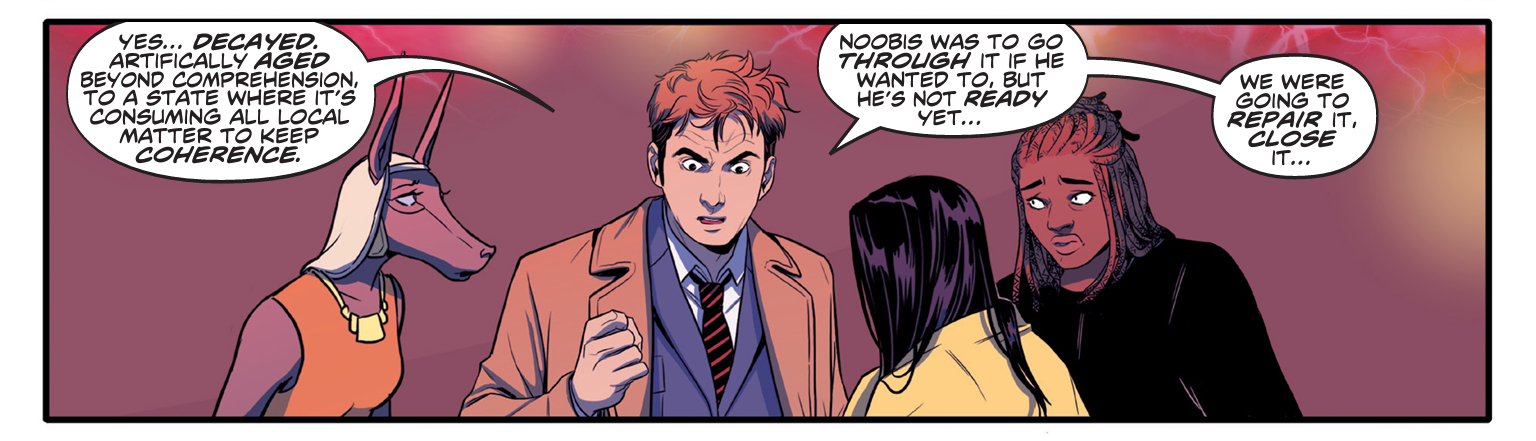
Second frame of the third of the four issues collected here:

Two two-part stories here, the first being the titular “Breakfast at Tyranny’s”, where the Doctor with companions Gabby, Cindy and the deity Anubis are held captive with their memories being harvested; and a more exciting second half, “Sharper Than a Serpent’s Tooth”, set in ancient China with Nestenes. The art here is not always up the usual standards, I’m sorry to say. You can get it here.

Chengdu Worldcon 1: Doctor Who in China

Before I start: Hooray! New Doctor Who episodes on 25 November, 2 December and 9 December!!!!!

I’ve been pondering how best to write up my experiences at Chengdu WorldCon last week. In summary, it was an amazing experience; tremendous hospitality from our Chinese hosts, a chance to engage with an ancient culture, and I saw the pandas.

Most convention reports just go chronologically through the two, or three, or four, or five days of the convention. I’ve decided to take a more thematic approach, looking at some of the things I really liked in a bit more detail.

Many aspects of Chengdu Worldcon were great fun. I will write about the things I especially enjoyed: the pandas, the set-piece events, and the friends I made along the way. (I enjoyed the WSFS Business Meeting even less than usual, so I won’t write about that.)

The thing that gave me the most unexpected joy was the love for Doctor Who shown by the Chinese fans. I have to give huge credit here to Yan Ru, 晏如, an English Chinese teacher from Wuhan, who may well be the leading Doctor Who fan in China. We had made contact before the convention, and had a lot of conversations about our shared passion.

Yan Ru invited me to participate in the Chengdu Worldcon panel on “Doctor Who in China” (in Chinese « 神秘博士 » 在中国 ) along with English fan Joseph B, and three other Chinese speakers. Joseph and I were I think the only non-Chinese participants in the room, which was packed.

The panel started with a joyous chant of the Doctor Who theme tune – all Doctor Who panels should start like that! – and a translator whispered to Joseph and me in English, as the other panelists and the audience engaged in intense discussions in Chinese. We spoke in English, and most people seemed to understand perfectly well (and those who didn’t were tolerant). I should add that a lot of the Chengdu Worldcon panels had simultaneous translation, but in this case, probably because Joseph and I were last-minute additions, that didn’t happen. There are some brilliant photos here from #154 to #322 – I especially like that they concentrate on my upper body rather than my tummy – here are two good ones.

With six of us on the panel, and only an hour, we only answered three questions. Not very surprisingly, the first two were 1) Who is your favourite Doctor? (a lot of love for Christopher Ecclestone in China) and 2) What does Doctor Who mean to you?; but slightly more surprisingly the last question was 3) what is your favourite Doctor Who book?

The Doctor Who books appear to be relatively bigger on the inside in China than in Europe or the USA. Yan Ru was running a Doctor Who stall (along with everything else) and sold out of the books on the second last day of the convention. I should say also that the main shopping area of the convention was graced by a large TARDIS, beside a screen showing the current Doctor Who trailer on continuous loop. It too sold out by the last day.

I had been assigned a young volunteer to keep me straight in the unfamiliar world of the convention, a young local student of English and French, who made sure that I went to all of the places I was supposed to go to on time, and also sorted out my phone issues and located my lost laundry.

As a parting present, I got her a signed copy of Yan Ru’s translation of Jac Rayner’s Ninth Doctor Novel Winner Takes All (and a cuddly panda). She seemed very pleased.

I’m glad to say that Yan Ru got home to Wuhan and discovered that she had been promoted at work, in recognition of her translating Who-ology and Winner Takes All into Chinese. She also received the prize for the best Chengdu Worldcon fan party for the Doctor Who party on the Friday night (which I missed for reasons which will be explained). More power to her.

I normally set my blog posts to go live after my working hours, but for this and the other Chengdu reports I’m setting then for lunchtime in Brussels, so that my Chinese friends can read them in the early evening.

The Night of the Doctor and The Day of the Doctor, by James Cooray Smith, Alasdair Stuart and Steven Moffat

So, back in November 2013, I was having a dull Thursday afternoon in the office when my social media started pinging with news of a new short Doctor Who story on Youtube. I fired up the link and watched it; and watched it again. I don’t think that you can ever recreate the impact of Paul McGann, 18 seconds in, saying “I’m a Doctor – but probably not the one you were expecting.”

The continuity issues raised by precisely which companions were mentioned led me into completely inaccurate speculation about the plot of The Day of the Doctor.

That evening, still excited, I was reading through Big Finish’s online magazine and unthinkingly tweeted the final paragraph of their interview with Tom Baker, which turned into my most retweeted tweet ever (to the point that Buzzfeed ranked it ninth in their list of 16 pictures we can probably stop tweeting in 2014).

https://twitter.com/nwbrux/status/401103755825147905

Nine days later, we drove to Germany for the showing of The Day of the Doctor in a cinema near Cologne. I wrote:

The cinema is part of the massive Hürth Park shopping complex, and we found food without difficulty at their in-house restaurant. They were showing [TheDay of the Doctor in three different screens, and ours, which was the emptiest when I booked it, was full on the night, so I guess that all three sold out. Sitting beside me were three young women speaking Russian to each other, who gasped with appropriate appreciation in all the right fannish places(such as “Bad Wolf” and “I don’t want to go”). I wondered how far they had come to watch it. Probably not as far as us on the night, anyway.

We cinemagoers also got a lecture from Dan Starkey as Strax about cinema etiquette, showing unfortunates who had been arrested by the Sontarans for using their mobile phones or for trying to record the event, but also rejoicing in the eating of popcorn; followed by Matt Smith and David Tennant demonstrating the 3D while bantering with each other. (It’s perhaps a little regrettable that the 3D glasses were not returnable, at least not where we are; I can’t imagine that we’ll ever use them again.)

And then on with the main feature. Well, I liked it a lot. As everyone has been saying, John Hurt slipped into the part of the missing incarnation utterly smoothly, and in just the right way, portraying a veteran in his own incarnation aware that there would be others to come, and mocking the future Doctors very effectively. I was also relieved that Tennant dialled it down a bit; I felt he sometimes pushed too far in his own stories. And Smith seemed totally energised by the experience, though he must have already decided to go when it was being made.

I was actually glad that Billie Piper didn’t play Rose again (and delighted with the way the script covered that); she actually does well when she gets decent material to work with. Jenna Coleman is a delight. I liked the UNIT subplot (Yay, Jemma Redgrave and Ingrid Oliver!) more than the Elizabethan subplot, but enjoyed both (Joanna Page excellent, if improbable, and softening one of the stupider lines from The End of Time). I remembered the Zygons fondly, and indeed rewatched Terror of the Zygons last weekend to refresh myself; the negotiating the deal moment was perhaps a bit contrived in plot terms, but theoretically sound from the diplomatic perspective. And the shedding of the Time War baggage, both in terms of plot and in terms of liberating the Doctor from what we now know was more than just survivor’s guilt, and possible reintroduction of the Time Lords and Gallifrey is excellent for the future of the show’s storylines.

Not to mention the fan service:


A terrific way of including the former Doctors
(who did Harnell’s voice, by the way?)


Just one look from his eyes, but
already we know it will be different.


I was spoilered for this, which is probably
just as well as I don’t think I could
have remained dignified otherwise.

In the global scheme of things, this was one of Moffat’s better Event episodes and probably the best anniversary special. (I know that Moffat has declared that there is only one previous anniversary special, The Five Doctors; he is entitled to his opinion, but I definitely count The Three DoctorsSilver NemesisDimensions in Time and Zagreus, plus perhaps one or two others.) He has always been good at witty banter, and at identity confusion; he hasn’t always been as good at fitting these things to the frame of a wider show, but he did it this time, and I’m a happy fan.

I rewatched both Night and Day of the Doctor in preparation for writing this post, and they both held up really well. The Night of the Doctor packs so much into six and a half minutes. The plot threads of The Day of the Doctor just about tie up properly (this is one of Moffat’s skills). It’s all great fun and rekindled my enthusiasm.

It’s a little sad that there isn’t quite the atmosphere around the 60th anniversary as there was for the 50th, but it’s understandable why; in 2013 we had the first significant milepost since the 2005 reboot, and the show was on a high; but the Chibnall years did not reach the same level of public interest. It should also be said that I’ve heard from sources involved with the production that some at the BBC felt that 2013 went too far, with An Adventure in Space and Time, The Five-ish Doctors Rebooted, and the awful After-party alongside the actual specials. I’m sure that there will be extras around the anniversary this year, but not as many as ten years ago. (Dismayed by the rumours that the next episode will be shown on 11 November, as I will be out of town that day.)

Stephen Moffat’s novelisation, Doctor Who: The Day of the Doctor, actually covers both Night and Day. The second paragraph of the third chapter (numbered Chapter 1) is:

‘He’s here,’ I said, keeping tight rein on the panic levels in my voice. ‘I can hear him, moving about. He’s in Time Vault Zero. The Doctor is in Time Vault Zero.’

The second paragraph of the seventh chapter (numbered Chapter 3) is:

I am writing this account so that perhaps, finally, I can leave it behind.

When it came out in 2018, simultaneously with three other New Who novelisations, I wrote:

Steven Moffat is, oddly enough, the one writer of the four new novelisations who had not previously written a Doctor Who novel. Yep, his previous written Who prose, despite his being the show-runner for the whole of the Eleventh and Twelfth Doctor eras, and having generated screenplay for more Doctors than any other writer (even if you don’t count the extra five in The Curse of Fatal Death), amounts to only a few short stories, starting with “Continuity Errors” in the 1996 collection Decalog 3: Consequences, and going on to “What I Did In My Christmas Holidays – By Sally Sparrow“, the short story from the 2006 Annual that became the TV episode Blink.

Of course, I really enjoyed the 2013 50th anniversary special, which in retrospect we now see as a last salute to the Tennant era from almost the end of the Smith era. And I am glad to report that this is by far the best of the four new Doctor Who novels published last month. Moffat has veered further from the script than any of the other writers; the chapters are told by alternating narrators, in non-sequential numbers, interspersed with reports from other characters (Chapter Nine, significantly, is missing); the basics of the storyline (starting with the Eighth Doctor’s regeneration, and ending with the Curator) remain the same, but the transmission to the printed page has been done in a very different way. And there are some lovely shout-outs to odd bits of continuity – Peter Cushing’s Doctor is canonicalised; there is a desperate attempt to explain the black and white era. In general, it’s just good fun, and it feels like the process of writing the book was much more enjoyable for the author than was notoriously the case with the original script. If you are a Who fan, you should get it here.

I stand by that. Several more novelisations down the line, Doctor Who: The Day of the Doctor remains the best of them – so far.

The 49th and 50th Black Archive monographs on Doctor Who are on The Night of the Doctor, which is James Cooray Smith’s fourth in the series, and Day of the Doctor, by the appropriately named Alasdair Stuart, who I also know as a Hugo finalist and commentator on sf and fandom. To jump to the end, they are both very good and enhanced my appreciation still further for two stories that I already liked a lot.

James Cooray Smith’s monograph on Night is only 73 pages long, but that’s roughly 11 pages per minute of script; compare the volumes on the seven-part stories that are barely a page per minute! There’s a lot to say about these short few scenes, of course, and Smith says most of it.

The first chapter, ‘I’m a Doctor, but probably not the one you were expecting’, reminds us (as if we needed to be reminded) of the excitement around the 50th anniversary and the surprise launch of the mini-episode; and looks at the returns of past Doctors (which turns out to be an even more timely topic in 2023).

The second and longest chapter, ‘What if I get bored? I need a television’, debates whether or not Night counts as TV Doctor Who, looking at other edge cases, of which there are a lot more than you might have thought.

The third chapter, ‘The universe stands on the brink’, looks briefly at the origins of the War Doctor. Its second paragraph is

This assumption, however, fits rather less well with other aspects of ‘The Night of the Doctor’, and the possible discontinuities that result are worth consideration for what they imply about the story and its relationship with The Day of the Doctor, particularly with regards to how much time passes between them. In ‘The Night of the Doctor’, Ohila describes the perilous situation in which the universe finds itself at this point in the Last Great Time War in very stark terms, saying that ‘The war between the Daleks and the Time Lords threatens all reality. You are the only hope left,’ and later insisting that, ‘The universe stands on the brink. Will you let it fall?’

The fourth chapter, ‘What do you need now?’, looks further at the concept of the War Doctor.

The fifth chapter, ‘I don’t suppose there’s any need for a Doctor any more’, looks at the Time War and the character of Cass.

The sixth chapter, ‘Physician, heal thyself’, looks at the last words of various Doctors and at the Doctor as Jesus.

The seventh chapter, ‘Doctor no more’, looks at how the episode fits into the wider Steven Moffat’s wider concept of who and what the Doctor is.

It’s a little cheeky of the publishers to offer this slim volume at the same price as others in the series which are almost three times as long, but the completist will want it, need it and enjoy it anyway. You can get it here.

Alasdair Stuart’s The Day of the Doctor is twice as long. It starts with an introduction, setting out the author’s stall: this is a story involving metafiction and death, and combining Old and New Who. Usually I write my own chapter summaries, but in this case the author has done it for me so I will lazily cut and paste, inserting the chapter titles:

The first chapter [“The Doctor Can See You Now”] looks in more detail at the concept of postmodernism and Who’s own unique flavour of it. Fans of a certain stripe will probably be thinking the word ‘discontinuity’ and they are not wrong.

The second chapter [“The Barn at the End and the Barn at the Start”] talks about the barn, what it represents to the show and also, crucially, the fictional spaces it allows the show to step into. It’s also going to look at the concept of postmodern and metafiction and what that, and 1970s BBC Shakespeare adaptations, have to do with Doctor Who.

The third chapter [“A Man Goes to War”] looks at the War Doctor. He’s arguably the most important incarnation of the Doctor and also one of the least well known. Here we’re also going to explore the idea that each one of these incarnations represents an era of the character.

Just interrupting to say that the second paragraph of the third chapter is:

But before all that, we need to talk about Christopher Eccleston.

Going back to the chapter summaries:

The fourth chapter [“The Man Who Regrets”] turns the attention to the 10th Doctor. Poster boy for the series’ triumphant return! Big-haired righter of wrongs! Lonely god and occasional near mass murderer. He’s also the representation of the show’s past, which is an odd, interesting thing for him to be.

The fifth chapter [“The Man Who Forgets”] focuses on the 11th Doctor and how this is a story which is a prelude to his final bow in The Time of the Doctor (2013) and how it sets up the future of the show. A future which is far more introspective, for both Doctor and Daleks, than it first seems.

The sixth chapter [“Impossibilities, Moments, Revolutionaries and Evolutions”] examines Clara, the Moment, Kate Stewart and Osgood and why the future of the show is carefully, subtly encoded into those four women.

Finally, [in te seventh chapter, “Midlife Crisis of the Daleks”] we take a look at the Daleks and how The Day of the Doctor is a fictional structure through which the past, present and future of both the Doctor and his nemeses are examined and defined.

There’s also an appendix looking at how the 2020 story The Timeless Children affects our understanding of Day of the Doctor now, including also the “Morbius Doctors”.

This is all good, meaty stuff, well worth adding to the thinking fan’s shelves, and you can get it here.

The Black Archives
1st Doctor: The Edge of Destruction (67) | Marco Polo (18) | The Aztecs (71) | The Dalek Invasion of Earth (30) | The Romans (32) | The Myth Makers (65) | The Massacre (2) | The Ark (81)
2nd Doctor: The Underwater Menace (40) | The Evil of the Daleks (11) | The Mind Robber (7)
3rd Doctor: Doctor Who and the Silurians (39) | The Ambassadors of Death (3) | The Dæmons (26) | Carnival of Monsters (16) | The Time Warrior (24) | Invasion of the Dinosaurs (55)
4th Doctor: Pyramids of Mars (12) | The Hand of Fear (53) | The Deadly Assassin (45) | The Face of Evil (27) | The Robots of Death (43) | Talons of Weng-Chiang (58) | Horror of Fang Rock (33) | Image of the Fendahl (5) | The Sun Makers (60) | The Stones of Blood (47) | Full Circle (15) | Warriors’ Gate (31) | Logopolis (76)
5th Doctor: Castrovalva (77) | Kinda (62) | Black Orchid (8) | Earthshock (51) | Mawdryn Undead (80) | The Awakening (46)
6th Doctor: Vengeance on Varos (41) | Timelash (35) | The Mysterious Planet (79) | The Ultimate Foe (14)
7th Doctor: Paradise Towers (61) | The Happiness Patrol (68) | Silver Nemesis (75) | The Greatest Show in the Galaxy (66) | Battlefield (34) | The Curse of Fenric (23) | Ghost Light (6)
8th Doctor: The Movie (25) | The Night of the Doctor (49)
Other Doctor: Scream of the Shalka (10)
9th Doctor: Rose (1) | Dalek (54)
10th Doctor: The Impossible Planet / The Satan Pit (17) | Love & Monsters (28) | Human Nature / The Family of Blood (13) | The Sound of Drums / Last of the Time Lords (38) | Silence in the Library / The Forest of the Dead (72) | Midnight (69)
11th Doctor: The Eleventh Hour (19) | Vincent and the Doctor (57) | The Pandorica Opens / The Big Bang (44) | A Christmas Carol (74) | The Impossible Astronaut / Day of the Moon (29) | The God Complex (9) | The Rings of Akhaten (42) | Day of the Doctor (50)
12th Doctor: Listen (36) | Kill the Moon (59) | Under the Lake / Before the Flood (73) | The Girl Who Died (64) | Dark Water / Death in Heaven (4) | Face the Raven (20) | Heaven Sent (21) | Hell Bent (22)
13th Doctor: Arachnids in the UK (48) | Kerblam! (37) | The Battle of Ranskoor av Kolos (52) | The Haunting of Villa Diodati (56) | Ascension of the Cybermen / The Timeless Children (70) | Flux (63)
15th Doctor: The Devil’s Chord (78)

War of Gods, by Nick Abadzis et al

Second frame from third part:

Really good climax to a multi-volume Tenth Doctor story, involving the Osirans and all the recurring characters from the previous installments of this sequence. Also includes a less impressive story bringing the Tenth Doctor to London to meet his previous companions (or are they). You can get it here.

The Daleks, ed. Marcus Hearn

Second frame of third story:

This is a collection of the Dalek comic strips from the magazine TV Century 21, published between 1965 and 1967, a page a week about everyone’s favourite evil metallic pepperpots and the obstacles that get thrown up in their plans to dominate the universe. I found it an unexpected pleasure. There are about a dozen storylines across the run, each reasonably self-contained in the structure of needing each page to have a beginning, middle and end. There are not a lot of women – a slave princess in an early story, a little girl who gets into trouble in a later one – but there aren’t in fact a lot of humans, as the main dynamic in the stories is between the Daleks themselves.

There’s also a dozen pages of introduction setting the scene for the series and printing a 1986 interview with one of the main artists. The only two women mentioned are both fictional – Lady Penelope from Thunderbirds and Maria from Metropolis, but no doubt this reflects the reality.

I must say that this greatly exceeded my expectations, and it seems a lot more mature than the contemporary First and Second Doctor strips that I have seen. Hugely recommended. Sadly it’s out of print, but I’d keep an eye out for it if I were you.

This was my top unread English-language comic. Next on that pile is Land of the Blind, by Scott Gray et al.

Arachnids in the UK, by Sam Maleski

A Black Archive on the recently concluded 13th Doctor era, like Kerblam! looking at one of the more unsatisfactory Chibnall/Whittaker stories. After it was first broadcast, I wrote:

A very obvious riff on The Green Death, my favourite Third Doctor story, which also had some great return-to-Sheffield characterisation moments, and really impressive special effects, but completely muffed the ending. (What happens to the bad guy? Is it really more compassionate to lock the spiders up until they die?)

Rewatching it this time, all the same points occurred to me; the other thing is that the production was very obviously saving money by not having many extras – I mean, what American billionaire would go anywhere without at least half a dozen aides?

Some Black Archive books on similarly problematic stories try gamely to make us see the best in them. Sam Maleski here is frank about Arachnids‘ shortcomings as well as its thematic beats, and doesn’t go on too long about either, turning in a decent analysis of an inferior script.

The first (and longest) chapter, “Doctor Who and the Spiders from Sheffield”, starts by admitting that the story begins and ends on very different notes, but then goes into an in-depth analysis of giant spiders (and other creepy-crawlies) in science fiction film and in Doctor Who in particular. He omits Adrian Tchaikovsky, but he’s not really looking at print.

The second chapter (almost as long), “Yorkshire Gothis”, looks at the ways in which the story is Gothic – a theme in several of the Black Archives I have read recently – and at the importance fo the setting in Yorkshire, and of the shadow of Donald Trump.

The second paragraph of the third chapter, “Doctor Who in an Exciting Adventure with Muddled Politics”, is:

But while the aesthetics of the episode are deeply and incandescently political, it seems rather unclear as to what course the characters, and by extension the viewers, should pursue as a response. It’s an episode marred by contradictions: these sometimes enrich its text, and other times simply prove frustrating. In order to demonstrate this, this chapter focuses on three focal points that the episode uses to signal its political nature: science, minority identities and the influence of political music.

It looks at how the story opens up, and then basically squanders, engagement with the politics of science, race and gender, and music. These points are particularly well made.

The fourth and final chapter, “Absence, or Clearing the Cobwebs”, argues that even though the story fails to answer a lot of the interesting questions it raises (including also what “family” means, for the Doctor and for us), that should not stop us from thinking further about them.

Sam Maleski took on a tricky assignment here, and I think did a good job as far as that can be done. You can get it here.

The Black Archives
1st Doctor: The Edge of Destruction (67) | Marco Polo (18) | The Aztecs (71) | The Dalek Invasion of Earth (30) | The Romans (32) | The Myth Makers (65) | The Massacre (2) | The Ark (81)
2nd Doctor: The Underwater Menace (40) | The Evil of the Daleks (11) | The Mind Robber (7)
3rd Doctor: Doctor Who and the Silurians (39) | The Ambassadors of Death (3) | The Dæmons (26) | Carnival of Monsters (16) | The Time Warrior (24) | Invasion of the Dinosaurs (55)
4th Doctor: Pyramids of Mars (12) | The Hand of Fear (53) | The Deadly Assassin (45) | The Face of Evil (27) | The Robots of Death (43) | Talons of Weng-Chiang (58) | Horror of Fang Rock (33) | Image of the Fendahl (5) | The Sun Makers (60) | The Stones of Blood (47) | Full Circle (15) | Warriors’ Gate (31) | Logopolis (76)
5th Doctor: Castrovalva (77) | Kinda (62) | Black Orchid (8) | Earthshock (51) | Mawdryn Undead (80) | The Awakening (46)
6th Doctor: Vengeance on Varos (41) | Timelash (35) | The Mysterious Planet (79) | The Ultimate Foe (14)
7th Doctor: Paradise Towers (61) | The Happiness Patrol (68) | Silver Nemesis (75) | The Greatest Show in the Galaxy (66) | Battlefield (34) | The Curse of Fenric (23) | Ghost Light (6)
8th Doctor: The Movie (25) | The Night of the Doctor (49)
Other Doctor: Scream of the Shalka (10)
9th Doctor: Rose (1) | Dalek (54)
10th Doctor: The Impossible Planet / The Satan Pit (17) | Love & Monsters (28) | Human Nature / The Family of Blood (13) | The Sound of Drums / Last of the Time Lords (38) | Silence in the Library / The Forest of the Dead (72) | Midnight (69)
11th Doctor: The Eleventh Hour (19) | Vincent and the Doctor (57) | The Pandorica Opens / The Big Bang (44) | A Christmas Carol (74) | The Impossible Astronaut / Day of the Moon (29) | The God Complex (9) | The Rings of Akhaten (42) | Day of the Doctor (50)
12th Doctor: Listen (36) | Kill the Moon (59) | Under the Lake / Before the Flood (73) | The Girl Who Died (64) | Dark Water / Death in Heaven (4) | Face the Raven (20) | Heaven Sent (21) | Hell Bent (22)
13th Doctor: Arachnids in the UK (48) | Kerblam! (37) | The Battle of Ranskoor av Kolos (52) | The Haunting of Villa Diodati (56) | Ascension of the Cybermen / The Timeless Children (70) | Flux (63)
15th Doctor: The Devil’s Chord (78)

The Stones of Blood, by Katrin Thier (and David Fisher, and Terrance Dicks)

I remember watching and hugely enjoying The Stones of Blood when it was first broadcast in 1978. I’ve come back to it several times and it retains its charm. When I came back to it in 2008, I wrote:

The Stones of Blood was one that I remembered fondly from first time round, and I liked it again on re-watching three decades later. Perhaps, now that puberty is behind me rather than yet to come, I appreciate Mary Tamm’s costumes as Romana all the more. But of course I also have a fascination with megaliths, and this is the only broadcast story that really uses them (though see also the SJA story The Thirteenth Stone). And of the three stories featuring an ancient cult in England within a few years of 1980, this is the only one that really pulls it off well (the other two being Image of the Fendahl and K9 and Company).

When I came back a couple of years later for my Great Rewatch, I wrote:

We are back on firmer ground [after The Pirate Planet] with The Stones of Blood. This just shows the difference that a decent plot (as opposed to a decent script, which Adams was capable of doing) and good casting and direction can make, though unfortunately we are now slipping into Romana as screamy girl rather than smart aleck, which is a shame, especially as the story has two excellent female leads in Beatrix Lehmann and Susan Engel. (I must also add that the viewing experience on DVD is greatly enhanced by the extras, which include a documentary with Mary Tamm exploring the Rollright Stones where it was filmed.) 

It’s a story of two halves, Satanic cults (as previously seen in Image of the Fendahl and The Masque of Mandragora) and then the abandoned prison spaceship with the ruthlessly homicidal justice machines. The story wobbles a bit at times – Beatrix Lehmann, who died a few months after filming, is notably shaky on some of her lines – but stays just the right side of the quality divide. The location filming around the stones is particularly memorable, (including particularly K9 on one of his few field outings) and well blended in with the studio scenes. I am really looking forward to the new novelisation by David Fisher, the author of the original script; the original Terrance Dicks novelisation is workmanlike but not terribly memorable, but Fisher’s two previous novelisations of his own stories – The Creature from the Pit and The Leisure Hive – are particularly good, among the best Fourth Doctor books and certainly better than the TV originals.

Rewatching it again, I liked it a bit more if anything; it clearly too Beatrix Lehmann a couple of scenes to get comfortable with the situation but once she gets in the swing, she is great. And the monstrous Ogri are depicted as pretty horrifying even though we see very little of what they actually do to people (apart from the unfortunate lady camper). I also liked the clues that the segment is around somewhere nearby, which I picked up on more than on previous watches.

Unusually, though not uniquely, there are two different Target novelisations of the story, the first being a rather workmanlike effort by Terrance Dicks. The second paragraph of its third chapter is:

Romana straightened up, releasing her end of the tape. A sudden loud cawing sound made her jump. A big black bird was perched on the stone above her head. Romana jumped back. ‘What’s that?’

A longer novelisation by the story’s original author, David Fisher, was released on audio a few years back and is now available in book form. The second paragraph of its third chapter is:

The figures pushed back their hoods, revealing themselves to be Mr de Vries, a plump man sporting a wisp of a beard on his chin, and Martha Vickers, a middle-aged lady with the face of a discontented bulldog. She was a resident of the nearby village of Bodcombe Parva, and a member of the local Women’s Institute. Her fellow members would have been astonished to see her there, because she was known to be non-religious and only sang ‘Jerusalem’ under protest. In fact, ever since meeting Mr de Vries a couple of years ago, she had been a pillar of his Druid circle, gradually initiated into the inner mysteries of the BIDS. She used to hunt in her younger days, and unlike some of the other group members was not disturbed by the sight of blood. Hence her presence at all the sacrifices.

I wrote up both novelisations when the audio of Fisher’s version came out in 2011:

Earlier this year the BBC released a new novelisation of an Old Who story – David Fisher, who wrote the original TV story The Stones of Blood, has now converted it not to a print novel but to audiobook format, read with great gusto by Susan Engel (who played the villain of the piece on screen) with John Leeson doing K9’s lines. I had been looking forward to this with hopeful enthusiasm, as Fisher’s novelisations of his other two stories are among the best of the Target range.

I am very glad to say that I was not disappointed. The audio is about twice as long as the original series (four hour-long CDs), and Fisher has bulked out the material with lots more character background and atmosphere than was possible on screen – the full story of the campers gruesomely slain by the Ogri, for example, and various brazen but humorous infodumps. There are lots of decent sound effects as well. Very highly recommended.

I also went back and reread Terrance Dicks’ original novelisation of the story for comparison. It must be a lot shorter than Fisher’s new text. I noted of it three years ago that it is “a standard Dicks write-what’s-on-the-screen treatment, somewhat flattening a rather good story” and I found no reason to change my views. I did think Dicks handled the climax of the story with some finesse, but the rest it pretty thin.

The print version is topped and tailed by some lovely personal reminiscences about Fisher by his son Nick Fisher and by the BBC Audio commissioning editor Michael Stevens. It remains a good read.

As my regular reader knows, I myself am pretty interested in megalithic sites and in their mythology. Katrin Thier, the author of this monograph, apparently shares my interest and has given us a good chunky read with no less than seven chapters, not counting introduction and afterword. There’s plenty to say about this story and where it fits in British popular culture.

An introduction sets out Thier’s stall, reviewing the previous careers of writer, director and guest cast and describing the ‘folk horror’ and Gothic modes, and making a link to Irish independence,

Chapter 1, “The Stones”, starts with the bold proposition that “the main guest stars in The Stones of Blood are the King’s Men at Little Rollright in Oxfordshire, playing the Nine Travellers.” Thier reviews the cult of medievalism, especially around the Rollright Stones themselves, and looks at the origin of the Ogri.

Chapter 2, “The Druids”, reviews what is really known about the Druids and the Gorsedds.

Chapter 3, “Megalithic Afterlives”, looks at the scientific investigation of megalithic monuments and how it has been reflected in popular culture (including The Goodies episode “Wacky Wales”, which features Jon Pertwee as a homicidal cultist). Its second paragraph is:

When the Doctor explains to Romana that the circle is a ‘megalithic temple-cum-observatory’, he expresses an interpretation widespread in the 1970s, suggesting that the prehistoric builders of these monuments were not simple undeveloped countryfolk, but were in fact highly sophisticated, maintaining a class of scientists to rival those of the ancient Egypt, Greece and Rome. The evidence for this was seen in the way many of these monuments seemed to be laid out to allow astronomical calculations. The study of this idea now called archaeo-astronomy (although ‘astro-archaeology’ is also sometimes found, reflecting the different emphasis assumed by different scholars). The idea arose partly out of the well-established observations that some of the major monuments interact with points on the sun’s annual circuit, especially the solstices, and a simple explanation for this is that the monument points to the event it is used to celebrate.

Chapter 4, “The Women”, explores the fact that the two main guest stars are women and that Romana rather than the Doctor carries a lot of the plot. This ties into Graves and Mallory, of course. A nice note – although on screen, Beatrix Lehmann is older than Susan Engel who in turn is older than Mary Tamm, Professor Rumford is the youngest of the three characters, a mere 70ish, whereas Romana is in the first half of her second century and Cessair of Diplos is thousands of years old. (Cessair is a genuine if obscure Celtic figure, but should of course be pronounced with a hard ‘c’.)

Chapter 5, “‘To Wit, a Celtic Goddess'”, looks more deeply at the goddesses – the Morrigan, Nemetona, the Cailleach, Ceridwen and the origin of the Great Seal.

Chapter 6, “Mere Mortals”, looks at the origins of Vivien Fay / Cessair’s other identities. I love this coincidence: the site of the Nine Travellers was supposedly owned at one time by the Little Sisters of St Gudula. St Gudula of course is the patron saint of Brussels, but is also the name of a key character in Victor Hugo’s Notre Dame de Paris, who in the BBC’s 1966 TV adaptation was played by… Beatrix Lehmann!

Chapter 7, “Leaving Earth”, looks at hyperspace, slightly jarring with the themes of the previous six chapters (as indeed the hyperspace parts of the story jar with the rest).

An afterword, “Reithian Gothic?”, points out that the story is really quite informative about megalithic sites and lore, and would have sent the curious viewer off to find out more. It certainly fed my own interest, both on first watching at eleven and since.

This is a good analysis of a good story, even if it’s light on the production details which I usually enjoy hearing about. You can get it here.

The Black Archives
1st Doctor: The Edge of Destruction (67) | Marco Polo (18) | The Aztecs (71) | The Dalek Invasion of Earth (30) | The Romans (32) | The Myth Makers (65) | The Massacre (2) | The Ark (81)
2nd Doctor: The Underwater Menace (40) | The Evil of the Daleks (11) | The Mind Robber (7)
3rd Doctor: Doctor Who and the Silurians (39) | The Ambassadors of Death (3) | The Dæmons (26) | Carnival of Monsters (16) | The Time Warrior (24) | Invasion of the Dinosaurs (55)
4th Doctor: Pyramids of Mars (12) | The Hand of Fear (53) | The Deadly Assassin (45) | The Face of Evil (27) | The Robots of Death (43) | Talons of Weng-Chiang (58) | Horror of Fang Rock (33) | Image of the Fendahl (5) | The Sun Makers (60) | The Stones of Blood (47) | Full Circle (15) | Warriors’ Gate (31) | Logopolis (76)
5th Doctor: Castrovalva (77) | Kinda (62) | Black Orchid (8) | Earthshock (51) | Mawdryn Undead (80) | The Awakening (46)
6th Doctor: Vengeance on Varos (41) | Timelash (35) | The Mysterious Planet (79) | The Ultimate Foe (14)
7th Doctor: Paradise Towers (61) | The Happiness Patrol (68) | Silver Nemesis (75) | The Greatest Show in the Galaxy (66) | Battlefield (34) | The Curse of Fenric (23) | Ghost Light (6)
8th Doctor: The Movie (25) | The Night of the Doctor (49)
Other Doctor: Scream of the Shalka (10)
9th Doctor: Rose (1) | Dalek (54)
10th Doctor: The Impossible Planet / The Satan Pit (17) | Love & Monsters (28) | Human Nature / The Family of Blood (13) | The Sound of Drums / Last of the Time Lords (38) | Silence in the Library / The Forest of the Dead (72) | Midnight (69)
11th Doctor: The Eleventh Hour (19) | Vincent and the Doctor (57) | The Pandorica Opens / The Big Bang (44) | A Christmas Carol (74) | The Impossible Astronaut / Day of the Moon (29) | The God Complex (9) | The Rings of Akhaten (42) | Day of the Doctor (50)
12th Doctor: Listen (36) | Kill the Moon (59) | Under the Lake / Before the Flood (73) | The Girl Who Died (64) | Dark Water / Death in Heaven (4) | Face the Raven (20) | Heaven Sent (21) | Hell Bent (22)
13th Doctor: Arachnids in the UK (48) | Kerblam! (37) | The Battle of Ranskoor av Kolos (52) | The Haunting of Villa Diodati (56) | Ascension of the Cybermen / The Timeless Children (70) | Flux (63)
15th Doctor: The Devil’s Chord (78)

Doctor Who: The Zygon Invasion, by Peter Harness

Second paragraph of third chapter:

Clara was twenty-eight years old and, for the past few years, she’d been mixed up with a suspicious gentleman in a blue box who hopped periodically into her life and caused varying degrees of chaos.

I did not write up the two-part story The Zygon Invasion / The Zygon Inversion at the time of broadcast, though I did note that it was my favourite two-part story of Series 9 (though my favourite Capaldi story remains Heaven Sent, also from Series 9). I enjoyed it – there’s some necessary preachiness about the Other, and immigration and terrorism, some very good skullduggery by villains who can look just like you, and some excellent horror in everyday life. The scene of the plane being brought down by a hand-held missile is a bit too close to the bone for me; several friends of friends died when the Russians destroyed MH-17 in a similar way.

The novelisation is a good competent screen-to-page job, adding a bit more background about the Zygon Bonnie (who used to have a boyfriend called Clyde, who looked like Danny Pink). There are a couple of footnotes citing other DW novelisations, including one quoting a books called The Clones of Dr. Funkenstein, for which you will search bookshops in vain. At my reading pace it’s quicker to read the novelisation than rewatch the story, and it’s well enough done. You can get it here.

The Shadow Man, by Sharon Bidwell

Second paragraph of third chapter:

Surprise stopped Anne midway across the living room. Granted the room wasn’t huge, but a pair of two-seater sofas, separate miss-matched chairs, a coffee table, sideboard and bookcase, left plenty of room to walk between the furniture. A sense of Madeleine’s apology extending far beyond the limits of her home unsettled Anne, though she struggled to understand why. Before she could enquire, Madeleine pushed them into a whirlwind tour, cutting their greeting short.

Second in the Bloodlines sub-series of Lethbridge-Stewart books, in which Anne Travers and her husband Bill visit France to investigate sinister gangs-on and body-horror in a laboratory. The story is decently enough told, but the connection with Doctor Who so weak that I think I may clear this sequence from my reading list in future. You can get it here.

Sins of the Father, by Nick Abadzis, Giorgia Sposito, Eleonora Carlini and Arianna Florean

Second frame of third story (“The Long Con”):

More adventures of the Tenth Doctor with comics-only companions Gabby Gonzalez and Cindy Wu. The first of the three stories here features another sound monster taking advantage of the Jazz era in New Orleans; the second is the opening part of the conclusive adventure in this sequence of comics, bringing back the Osirans and Sutekh; and the third is a neat little multi-Doctor adventure with Ten, Eleven and Twelve. I am consistently impressed by the quality of this series, though it has now reached the stage where you’d need to have been reading it from the beginning. You can get this volume here.

The Awakening, by David Evans-Powell (and Eric Pringle)

I am not sure if I caught The Awakening on first broadcast – I think I did see the second episode but not the first. When I came to it in 2008, I wrote:

Fandom seems to be generally fond of The Awakening; it didn’t really grab me. Tegan’s relatives have worse luck with alien invaders than those of any other companion pre-Rose. I found the Malus utterly unconvincing, and as so often its means and motivation made little sense. I did like Polly James as Jane though.

When I came back to it three years later, for my Great Rewatch, I wrote:

Hey, it’s another two-part story with roots in a past period of English history! For the second time in four stories, and the third in three seasons. For once, the fundamentals are fairly sound, but the execution a bit haphazard – most notably, the Malus itself rather fails to be scary despite smoke machines and dramatic music, there is an awful lot of infodumping for little emotional payoff, and we have yet another Tardis invasion of both bystanders and the Malus somehow penetrating it. Polly James does her best but it’s not really convincing. 

Tegan’s grandfather is about the same age as her late aunt, but I suppose that’s not out of the question.

Nice for the team to get a break and relax after it’s all over. NB that The Awakening is the first story since Black Orchid, almost two seasons before, not to feature a returning villain or companion.

I particularly endorse the first paragraph here. The means and motivation of the baddies are (as so often) not well explained.

As mentioned, Frederick Hall, who played Tegan’s grandfather, was only five years older then Delore Whiteman, who had played her aunt three years before; and he was only thirty years older than Janet Fielding, his on-screen granddaughter. One can think of plenty of ways to resolve this, of course.

I also reread the novelisation by Eric Pringle, who wrote the TV story. The second paragraph of the third chapter is:

She dived around the comer of a barn, and stopped. she was gasping for breath and leaned against the barn wall for support, beside its open doorway. The bricks, warmed by the sun, burned against her back.

In 2008, I wrote:

Often the novelisations of two-part stories bring new material and imagination to the narrative, and I thought at first that this was going to be one of those, with good introductory description (especially of Jane Hampden, one of the great companions who never was). However, the pace isn’t really sustained, and the plot sinks under its own flaws; notably, Pringle misses the opportunity to make something more of the Malus’s physical appearance on the page, and the whole thing ends up essentially as a cut-down version of The Dæmons.

One extra point is that Jane Hampden, played by Polly James who turned 43 in the year of broadcast, is described as “young” in the book. Pringle was six years older than her; it’s a matter of perspective, I suppose. You can get the book here.

David Evans-Powell has done his best here to find depth in what is honestly not a spectacularly good story. The introduction to his Black Archive monograph sets out his stall: that The Awakening is a mediation between 1970s folk horror, and 1980s heritage drama.

The first chapter, ‘Unexpected Aura for a Quiet English Village’, briefly looks at villages in literature and culture as outposts of traditional values under threat from modernity.

The second chapter, ‘There Will Be No Visitors to the Village”, looks at Little Hodcombe as an uncanny landscape, ending up inevitably with the Wicker Man.

The third and longest chapter, ‘We’re in the Wrong Century!’, looks at The Awakening as a ghost story and a time slip drama, ending up with Sapphire and Steel and Quatermass and the Pit. The second paragraph is:

One of the working titles associated with the serial was ‘Poltergeist’1, and this alleged form of haunting is witnessed by the characters alongside more traditional ghostly manifestations. German for ‘noisy spirit’, poltergeists are a particular form of ghostly phenomena in which objects appear to move, appear and disappear without human intervention and where unexplained sensations (such as sudden cold or heat, smells, sounds and noises, and gusts of wind) are experienced. These phenomena have been attributed to psychic abilities, usually telekinesis (the power to move objects with the mind), manifested by those going through emotional or physiological change, such as during puberty2. This association between apparently ghostly activity and psychic ability is a critical aspect of the serial.
1 Doctor Who: The Complete History #38, p63.
2  Dagnall, Neil, and Ken Drinkwater, ‘Eight Things You Need to Know about poltergeists”

The fourth chapter, ‘But That’s a Representation of the Devil!’, looks at the Malus’s roots in the Green Man and M.R. James, and the ancient Greek Gorgons.

The fifth chapter, ‘Think of it as the Resurrection of an Old Tradition’, comes back to the question of folk horror vs heritage drama, and comes down on the heritage side.

The sixth and final chapter, ‘You Must Join in Our Games’, looks at re-enactment in general and at how it is portrayed here in particular.

A coda, ’20th-century Men Playing a Particularly Nasty Game’, looks briefly at how civil wars are remembered, mentioning Northern Ireland and briefly looking at Spain.

I generally prefer the Black Archives where the production itself is described; those that concentrate on trying to find the meaning behind the story sometimes run adrift because there is not much there there, and I’m afraid this is one of them. A good effort, but I was not wholly convinced. You can get it here.

The Black Archives
1st Doctor: The Edge of Destruction (67) | Marco Polo (18) | The Aztecs (71) | The Dalek Invasion of Earth (30) | The Romans (32) | The Myth Makers (65) | The Massacre (2) | The Ark (81)
2nd Doctor: The Underwater Menace (40) | The Evil of the Daleks (11) | The Mind Robber (7)
3rd Doctor: Doctor Who and the Silurians (39) | The Ambassadors of Death (3) | The Dæmons (26) | Carnival of Monsters (16) | The Time Warrior (24) | Invasion of the Dinosaurs (55)
4th Doctor: Pyramids of Mars (12) | The Hand of Fear (53) | The Deadly Assassin (45) | The Face of Evil (27) | The Robots of Death (43) | Talons of Weng-Chiang (58) | Horror of Fang Rock (33) | Image of the Fendahl (5) | The Sun Makers (60) | The Stones of Blood (47) | Full Circle (15) | Warriors’ Gate (31) | Logopolis (76)
5th Doctor: Castrovalva (77) | Kinda (62) | Black Orchid (8) | Earthshock (51) | Mawdryn Undead (80) | The Awakening (46)
6th Doctor: Vengeance on Varos (41) | Timelash (35) | The Mysterious Planet (79) | The Ultimate Foe (14)
7th Doctor: Paradise Towers (61) | The Happiness Patrol (68) | Silver Nemesis (75) | The Greatest Show in the Galaxy (66) | Battlefield (34) | The Curse of Fenric (23) | Ghost Light (6)
8th Doctor: The Movie (25) | The Night of the Doctor (49)
Other Doctor: Scream of the Shalka (10)
9th Doctor: Rose (1) | Dalek (54)
10th Doctor: The Impossible Planet / The Satan Pit (17) | Love & Monsters (28) | Human Nature / The Family of Blood (13) | The Sound of Drums / Last of the Time Lords (38) | Silence in the Library / The Forest of the Dead (72) | Midnight (69)
11th Doctor: The Eleventh Hour (19) | Vincent and the Doctor (57) | The Pandorica Opens / The Big Bang (44) | A Christmas Carol (74) | The Impossible Astronaut / Day of the Moon (29) | The God Complex (9) | The Rings of Akhaten (42) | Day of the Doctor (50)
12th Doctor: Listen (36) | Kill the Moon (59) | Under the Lake / Before the Flood (73) | The Girl Who Died (64) | Dark Water / Death in Heaven (4) | Face the Raven (20) | Heaven Sent (21) | Hell Bent (22)
13th Doctor: Arachnids in the UK (48) | Kerblam! (37) | The Battle of Ranskoor av Kolos (52) | The Haunting of Villa Diodati (56) | Ascension of the Cybermen / The Timeless Children (70) | Flux (63)
15th Doctor: The Devil’s Chord (78)

The Deadly Assassin, by Andrew Orton (and Terrance Dicks, and Robert Holmes)

I loved The Deadly Assassin when it was first broadcast in 1977, and I love it still. When I rewatched it in 2007, immediately after my first watch of The Mind Robber, I wrote:

As for The Deadly Assassin: I was really a bit worried about watching it this time round; could it possibly be as good as I remembered it being from when I was nine years old, over thirty years ago? But yes, yes it is. Tom Baker is at the top of his form, combining humour, moral outrage, and determination to do the right thing by his home planet and people, even if they seem at times equally determined to do the wrong thing by him. And Robert Holmes’ superb script has so many memorable moments – here’s an early one, spoken by the exasperated official trying to pin the Doctor down who comes closest to filling the companion role. There’s a great Doctor/Tardis love moment as well.

Yet there are a couple of oddities. One, which is nothing to do with the series as originally presented, is that it has been preserved only as a 90-minute movie, which is rather annoying for those of us purists who like the old cliffhangers. [No longer the case, thank heavens.] Another, which is very bizarre indeed, is that there are no women visible anywhere in the Gallifrey of The Deadly Assassin. (Helen Blatch plays the disembodied voice of the Time Lords’ computer system.) This is of course the only story featuring the Doctor with no companion (unless one counts The Runaway Bride), but it really does seem peculiar. One could probably do a short list of stories featuring only male guest stars (?The Moonbase?) but I think this must be the only one with no women on the screen at all.

The interesting linkage with The Mind Robber is that for much of the story the Doctor enters a constructed, invented world, in which he has to battle an artifical reality and try and impose his own will on it. There is an interesting compare-and-contrast between the Second Doctor urging Jamie and Zoe to deny the existence of the unicorn charging at them, and the Fourth Doctor denying the fact that he has been wounded in the leg – same theme but pointing to the very different ways the series as a whole was going in 1968 and 1976. Like the Land of Fiction, the world inside the Matrix of the Time Lords turns out to be under the control of a cosmic villain called the Master – and this time it is that Master, reappearing for the first time since 1973, but horribly altered; with an audacious plan to seize control of the universe by tapping the very power of the Time Lords themselves. (The reality-altering theme is nicely echoed in the final episode by Cardinal Borusa’s attempt to impose his own version of historical reality on recent events.)

As I hinted at above, The Deadly Assassin has Bernard Horsfall returning – this time not as Gulliver (left), but as Chancellor Goth of the Time Lords (right). (I believe he is a Thal officer in Planet of the Daleks too, but haven’t seen that yet.) Horsfall also appeared in the last episode of The War Games in 1969 (middle), pronouncing sentence of exile and regeneration on the Doctor. If we are meant to read the two characters as the same person – though they have very different haircuts – then The Deadly Assassin represents the Fourth Doctor not only overcoming the Third Doctor’s unfinished business with his arch-enemy, but also reversing the Second Doctor’s defeat by the Time Lords in general (and by this one in particular).

Rewatching it in 2010, I wrote:

I always loved The [companionless] Deadly Assassin, and rewatching it made me realise once again how brilliant it is. It is as if Sarah Jane Smith’s departure liberated Robert Holmes from the constraints of the show’s previous history, to go back to the Doctor’s own origins and rewrite them completely. We’ve been gradually moving towards Gallifrey as not so much a place of magical, ineffable power, as we saw in The War Games, but as the fading bureaucracy glimpsed in Colony in Space and The Three Doctors, subject to the political corruption that could give rise to a Morbius. Now it all comes together. I suspect that my own professional fascination with politics may be partly rooted in watching this at the age of nine; the reality that the most powerful people are none the less fallible individuals, operating to their own private agendas as much as to public perceptions, is well portrayed here.

There are so many delights in this: the nightmarish world of the Matrix, the Engin/Spandrell [Pravda/Chitty] double act, Runcible the Fatuous, the final battle amidst crumbling architecture (so dismally copied by the TV Movie). It seems almost churlish to mention two flaws. First off, the re-introduction of the Master worked much better for me at the age of nine, when I barely remembered his existence in the Pertwee era, than it does in sequence – apart from anything else the Time Lords have forgotten him now, having specifically warned the Doctor about him in Terror of the Autons; and of course nobody, not even Peter Pratt who was a great performer, can match Roger Delgado as the arch-enemy. [Since 2010 we’ve seen strong competition from Michelle Gomez and Sacha Dhawan.] Secondly, as my mother remarked when I was nine, there appear to be no Time Ladies among the Time Lords. Now, there are other Who stories without woman among the guest cast – Warriors’ GateThe Power of KrollThe Pyramids of MarsPlanet of EvilRevenge of the CybermenThe MutantsThe Abominable SnowmenThe MoonbaseThe Smugglers and The Rescue – but this is the only one with no visible speaking female character at all (the voice of the Matrix is played by Helen Blatch. It’s a sad lacuna in what is otherwise one of the greatest stories.

When the whole thing was streamed on Twitch in January 2019, I happened to be stuck at a loose end in London and watched it again, live-tweeting as it rolled.

https://twitter.com/nwbrux/status/1085625887578640384

Needless to say I watched it again for this post, and needless to say I enjoyed it again. You can get it here. Nothing much to add to what I have already extensively written. But I was intrigued to learn that the following slide was dropped from the end titles:

We thank the High Court of Time Lords and the Keeper of the Records, Gallifrey, for their help and co-operation.

Who are “we”?

Diverting to another book entirely, I am intrigued by Richard Molesworth’s suggestion, in his biography of Robert Holmes, that the writer at this point was getting irritated with Doctor Who, and that the tall blond Chancellor Goth stalking the hero through the swamp in hope of wiping him out could be seen as wish fulfillment by the author, who was also tall and blond, and had fought in the swamps of Burma / Myanmar during the second world war.

The second paragraph of the third chapter of Terrance Dicks’ novelisation is:

Three figures appeared out of the gathering darkness. Castellan Spandrell and Chancellor Goth walked side by side, Hildred following respectfully behind them.

When I reread it in 2007, I noted very briefly that it’s an average Terrance Dicks treatment of one of Robert Holmes’ best scripts, and there’s nothing much to add to that now. NB that “Hildred” in the book is “Hilred” on screen. You can get it here.

Andrew Orton’s Black Archive on the story is very meaty, with seven chapters and three appendices. Up front: I liked it a lot for shedding new light on a story I already love.

“Chapter 1: The Gothic Assassin” is the longest of the chapters, setting out Orton’s agenda. It leads with a consideration of the Gothic in Doctor Who of the Hinchcliffe/Holmes period in general, and of course in The Deadly Assassin in particular. There’s a whacking great indicator in the name of the main Time Lord villain. Even the opening rollover caption echoes the faux manuscript theme in Gothic literature.

“Chaper 2: The Noir Assassin” looks not only at the visible noir influence in the story but also as American and British political scandals: Watergate, Jeremy Thorpe, Harold Wilson’s resignation honours (announced the day the first episode was shown).

“Chapter 3: The Wartime Assassin” looks at the influence of the Second World War and the Cold War on British TV of the era in general, and on Doctor Who and this story in particular. Orton makes the point that the first twenty years of Doctor Who were dominated by the memory of conflict, Holmes in particular with his Burmese experience (it has been previously noted that he has a fondness for swamp planets with bubbling explosive gas). The second paragraph is:

The Second World War cast a massive pall over the first 20 years of Doctor Who, as it did over most of British culture. The Leisure Hive (1980) and Terminus (1983) were the series’ final real dalliances with War imagery, through their use of background radiation as a threat. Up until this point, the War permeated the series. Almost all of Doctor Who’s writers had lived through it (Douglas Adams was the first writer who hadn’t lived through at least a part of the War, although Chris Boucher was only born in 1943 and Graham Williams was born after VE Day but before VJ Day), and its influence informed and is present throughout the series’ first couple of decades. This tended to be shown in two strands: that of the totalitarian regime against which a resistance is formed, and that of the atomic bomb and the dangers of nuclear fallout.

“Chapter 4: The Symbolic Assassin” looks at the way in which the Time Lords mirror British society, especially parliament, and at the symbolism of the Matrix.

“Chapter 5: The Observant Assassin” reflects on the significance of the Panopticon and the Eye of Harmony; what are the Time Lords actually observing?

“Chapter 6: The Linguistic Assassin” looks at Robert Holmes’ inventive use of language throughout his Doctor Who career.

“Chapter 7: The Dangerous Assassin” points out that the story comes more or less at the half-way point of Old Who, and reflects that Holmes’ attempt to myth-bust the Time Lords resulted in yet more mythology.

“Appendix 1: Engines” reports briefly on the whereabouts of the four railway engines seen in Episode 3, all of which are still intact.

“Appendix 2: How Might the Eye of Harmony Actually Work?” unsuccessfully attempts to bring scientific rigour to a technobabble plot twist.

“Appendix 3: Observer Theory” looks at why it is that the Doctor (generally) has his adventures in order. Of course, we know the real reason, but it’s fun to try and put it in fictionally coherent terms.

In summary, Robert Holmes is the greatest Old Who writer, The Deadly Assassin is his greatest story, and this book is a great book because it provides further evidence for those uncontroversial opinions. You may be able to get it here.

Next, The Awakening.

The Black Archives
1st Doctor: The Edge of Destruction (67) | Marco Polo (18) | The Aztecs (71) | The Dalek Invasion of Earth (30) | The Romans (32) | The Myth Makers (65) | The Massacre (2) | The Ark (81)
2nd Doctor: The Underwater Menace (40) | The Evil of the Daleks (11) | The Mind Robber (7)
3rd Doctor: Doctor Who and the Silurians (39) | The Ambassadors of Death (3) | The Dæmons (26) | Carnival of Monsters (16) | The Time Warrior (24) | Invasion of the Dinosaurs (55)
4th Doctor: Pyramids of Mars (12) | The Hand of Fear (53) | The Deadly Assassin (45) | The Face of Evil (27) | The Robots of Death (43) | Talons of Weng-Chiang (58) | Horror of Fang Rock (33) | Image of the Fendahl (5) | The Sun Makers (60) | The Stones of Blood (47) | Full Circle (15) | Warriors’ Gate (31) | Logopolis (76)
5th Doctor: Castrovalva (77) | Kinda (62) | Black Orchid (8) | Earthshock (51) | Mawdryn Undead (80) | The Awakening (46)
6th Doctor: Vengeance on Varos (41) | Timelash (35) | The Mysterious Planet (79) | The Ultimate Foe (14)
7th Doctor: Paradise Towers (61) | The Happiness Patrol (68) | Silver Nemesis (75) | The Greatest Show in the Galaxy (66) | Battlefield (34) | The Curse of Fenric (23) | Ghost Light (6)
8th Doctor: The Movie (25) | The Night of the Doctor (49)
Other Doctor: Scream of the Shalka (10)
9th Doctor: Rose (1) | Dalek (54)
10th Doctor: The Impossible Planet / The Satan Pit (17) | Love & Monsters (28) | Human Nature / The Family of Blood (13) | The Sound of Drums / Last of the Time Lords (38) | Silence in the Library / The Forest of the Dead (72) | Midnight (69)
11th Doctor: The Eleventh Hour (19) | Vincent and the Doctor (57) | The Pandorica Opens / The Big Bang (44) | A Christmas Carol (74) | The Impossible Astronaut / Day of the Moon (29) | The God Complex (9) | The Rings of Akhaten (42) | Day of the Doctor (50)
12th Doctor: Listen (36) | Kill the Moon (59) | Under the Lake / Before the Flood (73) | The Girl Who Died (64) | Dark Water / Death in Heaven (4) | Face the Raven (20) | Heaven Sent (21) | Hell Bent (22)
13th Doctor: Arachnids in the UK (48) | Kerblam! (37) | The Battle of Ranskoor av Kolos (52) | The Haunting of Villa Diodati (56) | Ascension of the Cybermen / The Timeless Children (70) | Flux (63)
15th Doctor: The Devil’s Chord (78)

Blackpool Remembered, ed. John Collier

Second paragraph of third chapter:

“I became fascinated with the Daleks at an early age. I remember in the early 1980s, being quite disturbed by children’s television programmes such as Jigsaw and Chockablock — things that were supposed to be fun, completely freaked me out, while things that were designed to be terrifying — like the Daleks — enthralled me.[“]

I remember going to the Doctor Who exhibition in Blackpool in 1977, when I would have been ten; it was a subterranean chamber full of Doctor Who monsters, and I bought the new novelisation of The Dalek Invasion of Earth, the very first Doctor Who book that I bought for myself. My memories of exactly what was on display are dim.

Not so for the contributors to Blackpool Remembered, a lovely full-colour commemoration of the exhibition which ran from 1974 to 1984. There’s a loving recreation of the exhibition space, which was updated each year to bring in more recent monsters – and these were genuine BBC props, with only a couple of Daleks specially made for Blackpool. There are extensive memories by fans who kept more careful notes and photographs than I did, including a couple who have gone on to become bigger names in the Whoniverse, such as Steve Cole and Matt Fitton. It’s a great example of how to reconstruct a purely physical and temporary display space after almost four decades.

There is a great interview with Julie Jones, the Doctor Who production office staffer who masterminded the whole thing; but disappointingly, we don’t get much from the female fan perspective. Lots of mums and sisters and a few girlfriends appear in the photographs; I don’t think we hear directly from any of them. I guess that reflects the resources available to the editor, but it’s an unfortunate gap. (Also everyone seems to be white.)

Still, it’s a lovely production which you can download for free from here.

Doctor Who rated on the Internet Movie Database, part 2: best-rated episodes

As with yesterday’s post, I’m trying to derive some meaning from the Internet Movie Database’s user ratings of Doctor Who episodes. Here, for your edification and delight, are the top-rated episodes from each of the incarnations of the show. (Based on these statistics.)

The twentieth episode of the Australian K9 spinoff series, 2010’s Taphony and the Time Loop, has a better rating, at 5.7, than any of the other twenty-five K9 episodes, but that is still lower than any episodes of the Third, Fourth, Fifth, Eighth, Ninth, Tenth, Eleventh, and Twelfth Doctors, or of any of the other spinoffs. I agree that it’s probably the best of the undistinguished run of the Aussie show, with an escaped Time Being in the shape of a cute girl (Taphony, played by Maia Mitchell) draining the essence of the regular cute girl character (Jorjie, played by Philippa Coulthard) and K-9 sorting it all out. It’s still not particularly good, though; I rewatched it last week for this post and I think it deserves a little better than 5.7. Maybe 5.8.

The metal mutt takes both of the bottom places in this list, in fact, with A Girl’s Best Friend, the only episode ever made of the unsuccessful 1981 spinoff K-9 and Company, scoring a lowly 6.1 with IMDB users. This brought back both Lis Sladen as Sarah Jane Smith and John Leeson as the voice of K9, but had a very silly plot involving pagan cultists in the English countryside – not natural Who territory, and a story that has been told much better before and since by others. Sarah Jane, of course, also went on to have her own much more successful spinoff.

The second and final episode of 1985’s Revelation of the Daleks is the top-rated Sixth Doctor story at 7.7 (and the first episode of the story is in second place at 7.6). I agree that this is the one story where the Six/Peri pairing comes together, partly because they’re not actually in the story all that much. If you can overlook the huge plot flaw of Davros feeding the entire galaxy with the corpses of a few rich people, it’s very well done, with various different factions of characters motivated for different reasons.

Village of the Angels, the fourth of the six-part Flux storyline, is the top-rated Thirteenth Doctor episode. I am among the many who found this series difficult to follow, but this was a good instalment, with many murky and dramatic goings-on in the Village, culminating with the Doctor herself being transformed into a Weeping Angel. IMDB users rate it at 7.8, which again seems a bit mean.

The top-rated episode of short-lived 2016 spinoff Class is its finale, The Lost, ranked at 8.1 and ending with a massive battle between the Coal Hill Academy kids who have been charged with the defence of Planet Earth and the alien Shadowkin. Alliances and friendships are forged and broken and several significant characters are (apparently) killed off. We are left with a massive cliff-hanger regarding the new nature of regular girl April, which presumably would have been resolved had the BBC commissioned a second series. It’s a shame that they didn’t. I couldn’t recommend watching this on its own, but there are only eight episodes altogether, so you might as well watch them all. I was myself rather disappointed by this episode; my own favourite of the eight is the third, Night Visiting.

The top-rated surviving First Doctor episode, broadcast the day after Christmas Day in 1964, saw the first ever departure of one of the regular characters in Flashpoint, rated 8.3 by IMDB users, the last of the six-part story that we now call The Dalek Invasion of Earth. Susan, the Doctor’s granddaughter, falls in love with a Scottish resistance fighter against the Daleks who bears an uncanny resemblance to David Tennant (six years before David Tennant was born), and is left behind on Earth to build a new life, Hartnell delivering one of his great set-piece speeches in farewell. Actually my own favourite episode of this story is the third, Day of Reckoning, which features a desperate scramble across a deserted London. But I won’t fight (much) with those who prefer this one.

The top-rated Seventh Doctor episode is the second of the opener to his second season, Remembrance of the Daleks, at 8.5. It took me a while to warm to this story, but I have come around to its good points. I still prefer the middle two stories from the final season of Old Who, Ghost Light and The Curse of Fenric, but there are a couple of great set-pieces in this episode, with the Doctor retrieving the Hand of Omega from a London gravesite in 1963, and Ace menaced by Daleks.

The top-rated Third Doctor episode, also at 8.5, is the second last of his 1970 debut season, the sixth of the seven parts of Inferno. The story concerns a dangerous experiment to drill into the Earth’s crust; for several of the episodes, the Doctor is transported to a parallel Earth where his friends are all fascists and the experiment is further advanced. In the sixth episode, despite the Doctor’s efforts, the parallel Earth begins to disintegrate and he escapes back to our timeline. It’s dramatic doomed stuff, and I think I’m with the IMDB voters here.

I’m surprised to see a lost episode outpolling all of the surviving First Doctor episodes, but it’s a good one. My favourite Hartnell story is the thirteen-part epic that we now (mostly) call The Daleks’ Master Plan. Only three episodes survive, and they do not include the finale, Destruction of Time, in which the Doctor activates the Time Destructor in order to defeat the Daleks by aging them into oblivion, but loses his own companion Sarah Kingdom in the process. IMDB voters rank it at 8.5, which I think I can agree with. You’ll appreciate it more after experiencing the previous twelve parts of the story.

I think that the best single story of the Sarah Jane Adventures is Whatever Happened to Sarah Jane Smith? from the 2007 first series, in which she is replaced in her life history by the ambiguous Andrea, played by Jane Asher. IMDB users rate its two episodes third and fourth at 8.6, but rank two other episodes with visiting guest stars from the parent show just a bit higher at 8.7: in second place, the second part of 2010’s Death of the Doctor, with Matt Smith (and Katy Manning), and at the top, the second part of The Wedding of Sarah Jane Smith, for which David Tennant did his last filming in his first run as the show’s regular star in 2009. Sarah has been yanked into a prison dimension through a fake wedding with a rotter played by Nigel Havers and the Doctor turns up to save her with her friends. Great stuff.

There’s a fairly strong fan consensus that the Fifth Doctor’s final story, The Caves of Androzani, is also his best, and IMDB voters also subscribe to that view; its four episodes hold four of the top five Fifth Doctor spots in the system (the other going to the last episode of Earthshock). And the best of the four, according to IMDB where it is rated 8.8, and also frankly in my own opinion, is the last, where desperate people fight over dwindling resources and lives are brutally and dramatically ended, including the Doctor’s own. Poor Peri doesn’t get much to say except at the end, but it’s her second appearance in this list.

While I’m not surprised that the Eighth Doctor’s unexpected 2013 return in Night of the Doctor rates higher then The Movie, I am surprised that it rates as high as 9.0 on IMDB. It’s less than seven minutes long, and I feel that fannish enthusiasm at the time of the fiftieth anniversary has not yet been tempered by sober reflection.

In general I’ve been concentrating on the top-rated single episodes for each case, but for the Ninth Doctor’s 2005 series, the top two episodes, rated 9.0, are a two-part story, The Empty Child / The Doctor Dances, which also incidentally won the Hugo Award that year. This is the one introducing Captain Jack Harkness, set in WW2 London, famously featuring the gasmask zombie child asking “Are you my mummy?” My own favourite Ninth Doctor story is Dalek, but I’m clearly not with the majority. The second part, The Doctor Dances, is a hair above the first part on IMDB.

My own favourite Second Doctor episode is the completely bonkers opening to The Mind Robber, but IMDB voters disagree. Their top-ranked episode of the black-and-white era is also the very last: the tenth episode of epic 1969 story The War Games, rated 9.1. Having invoked his own people, the Time Lords, to defeat an alien mastermind’s evil plans, the Doctor himself is put on trial for interference in cosmic affairs, and sentenced to exile on Earth, his companions sent home with their memories wiped. The final shots, as he howls in protest at the Time Lords changing his face, are among the bleakest of the whole of Doctor Who (cf above mentions of The Daleks’ Master Plan and Earthshock).

My favourite story of Old Who is the Fourth Doctor’s The Deadly Assassin, from 1976. But I find it difficult to argue with the verdict of IMDB users that the best single episode of Old Who, rated 9.1, is the sixth and final part of 1975’s Genesis of the Daleks, in which their crazed creator Davros loses control of the malevolent pepperpots. (It’s their fifth appearance on this list.) There are many beautiful moments here, including Davros’s large button marked “TOTAL DESTRUCT” which lurks like Chekhov’s gun.

The spinoff shows have had a mixed success rate here, but Children of Earth, the third series of Torchwood (co-starring Peter Capaldi as a harassed senior British government official), is in a league of its own, its five episodes ranked between 8.7 and 9.2, all of them higher than any First, Third, Sixth, Seventh or Thirteenth Doctor stories. The top-ranked episode is the fourth, which features the growing evidence of Jack’s involvement with the alien threat to the world’s children, and famously ends with the demise of the much-loved Ianto, and I think I’d support that choice, though maybe not put it as high as 9.2.

We’re getting near the end here. I totally agree with the final three verdicts by IMDB voters. Their top-ranked Eleventh Doctor story, at 9.3, is Vincent and the Doctor, with its intense portrayal of artistic genius and mental illness, leavened by an alien incursion. I was surprised that the 2010 season closer, The Pandorica Opens / The Big Bang, won the Hugo that year; the verdict of history, I think, is with Vincent.

The top-rated Thirteenth Doctor episode, 2015’s Heaven Sent at 9.6, is again my favourite from the era, with the Doctor, newly bereaved of Clara, trapped in a mysterious castle where he must recapitulate a cycle of death and renewal, over and over. I think it’s tremendous, though very different from the norm.

And finally, my favourite Doctor Who episode of all time, and also well clear at the top of IMDB’s rankings, is the Hugo-winning 2007 Tenth Doctor story Blink, which introduced the Weeping Angels and communicated much of its plot through DVD Easter eggs. I loved it on first broadcast and I still love it now. IMDB voters give it a massive 9.8 out of 10. It also won the Hugo Award. Although it barely has the Doctor and Martha in it, I think you could safely show it to someone who had never seen Doctor Who before, and who wondered if they would like the show; it would be a valid litmus test.

Steven Moffat wrote four of the above (Night of the Doctor, The Empty Child / The Doctor Dances, Heaven Sent and Blink) and Terry Nation is credited with two (Genesis of the Daleks and Flashpoint, though there are varying reports of the real extent of his input). Graeme Harper, David Moloney and Douglas Camfield are each credited with directing two of them (Harper: Revelation of the Daleks and The Caves of Androzani; Moloney: The War Games and Genesis of the Daleks; Camfield: Destruction of Time and Inferno, though in fact he was too ill to direct episode 6 of the latter).

I am a little surprised that the greatest Old Who writer Robert Holmes appears in both the “best” and “worst” lists, for The Caves of Androzani and The Space Pirates respectively. As previously noted, I think The Space Pirates is underrated. Director Andrew Morgan did only two Doctor Who stories, but one of them is on each list, Remembrance of the Daleks here and Time and the Rani yesterday.

To round off the post, the average ratings for each Doctor and spinoff show:

10th Doctor: 8.04 (highest 9.8, lowest 5.9)
9th Doctor 7.93 (highest 9.0, lowest 6.9)
11th Doctor: 7.81 (highest 9.3, lowest 6.7)
12th Doctor: 7.80 (highest 9.6, lowest 5.8)
Torchwood 7.72 (highest 9.2, lowest 6.2)
8th Doctor 7.65 (higher 9.0, lower 6.3)
Sarah Jane Adventures 7.56 (highest 8.7, lowest 6.7)
4th Doctor 7.55 (highest 9.1, lowest 5.8)
3rd Doctor 7.47 (highest 8.5, lowest 6.4)
Class 7.46 (highest 8.1, lowest 6.9)
2nd Doctor 7.36 (highest 9.1, lowest 4.9)
5th Doctor 7.12 (highest 8.8, lowest 5.9)
1st Doctor 7.05 (highest 8.5, lowest 5.6)
7th Doctor 6.94 (highest 8.5, lowest 5.3)
6th Doctor 6.72 (highest 7.7, lowest 5.3)
13th Doctor 6.25 (highest 7.8, lowest 4.2)
K9 and Company 6.1
[Australian] K9 4.87 (highest 5.7, lowest 4.1)

If you have been, thank you for reading this.

Doctor Who rated on the Internet Movie Database, part 1: worst-rated episodes

I’m perhaps a little more obsessed than I should be with extracting meaning from the Internet Movie Database. Thinking about the question of what to show (and what not to show) a friend who doesn’t know much about Doctor Who, I wondered if the user rankings for individual episodes might shed any light? Well, maybe they do and maybe they don’t.

This is in no way meant to be competition for the ruthless ongoing vote run by @Heraldofcreatio on Twitter, in which The People vote on paired Doctor Who stories to decide which is better and which worse. But I encourage those of you on Twitter to participate.

So, which are the worst-rated episodes for each Doctor and Whoniverse spinoff series, as voted by IMDB users? I have compiled the numbers.

The Doctor with the highest rated worst episode, if you see what I mean, is Christopher Eccleston’s Ninth Doctor, who graced our screens in 2005. Aliens of London, the one with the spaceship crashing into Big Ben and farting monsters, scores 6.9 from IMDB users. It actually includes the first scene ever filmed for New Who, where Eccleston’s Doctor, and Naoko Mori as Dr Sato (later to return in Torchwood), inspect the alien pig.

You may have missed Class, the 2016 spinoff about some kids at Coal Hill School who are charged by the Doctor with defending the Earth. (One of the kids is in fact an alien prince, and one of the teachers is his secret and reluctant bodyguard.) The worst-ranked episode, Brave-ish Heart, also at 6.9, is the second of a two-part story which sees two of the kids sucked into another dimension while the others fight off an invasion of carnivorous petals and an alien who has taken over the school’s board of governors. There’s nothing terribly wrong with it, but the unearthly dimension is a bit naff.

The worst-ranked episode of the Sarah Jane Adventures, at 6.7, is the second of the sadly truncated 2011 final season, the closing half of a two-parter named Sky, after the new regular character who it introduces. Sinead Michael, playing the new girl, was only twelve years old when the episode was filmed, making her the youngest actor ever to play a regular character in the Whoniverse. The story sees her transformed from a living planet-busting bomb to a human girl, and Sarah adopts her at the end. Again, nothing terribly wrong with it, but a slightly awkward introduction of a new character. (I should note also that I’m not counting the 2009 Comic Relief Special with Ronnie Corbett and more fart jokes, which scores only 6.1.)

I remember watching the worst-rated Eleventh Doctor story, The Curse of the Black Spot, after a full day at the BBC studios in Belfast where I had been covering the 2011 Northern Ireland Assembly election. IMDB users give it a rating of 6.7, but I rather enjoyed it, a tale of swashbuckling nonsense aboard a pirate ship that isn’t what it seems. I may have been tired and my critical faculties dulled. But I think there were a couple of worse Eleventh Doctor episodes. (IMDB also rates a factual minisode about the making of a different Eleventh Doctor story a hair below The Curse of the Black Spot, but I’m not including it here.)

On the other hand, I think that IMDB voters have it about right in their disdain for the third episode of the 1972 Third Doctor story, The Time Monster, rated at an average of 6.4. The story in general is a pretty silly tale of the Master attempting to Conquer The World by linking up with the mystic powers of ancient Atlantis, and this is the silliest episode of the six, culminating in Pertwee’s Doctor constructing an anti-timewarping device from a corkscrew, while he and the rest of the cast struggle to keep their faces straight.

There are only two televised Eighth Doctor stories, made 17 years apart, and they are very different kettles of fish. The lower-rated of the two, at 6.3, is The (1996) Movie, which saw Sylvester McCoy regenerate into Paul McGann and get involved with a plot to thwart another attempt by the Master to Conquer The World and incidentally steal the Doctor’s remaining lives and the TARDIS. I think it is enjoying a bit of a renaissance among fannish opinion at the moment, but its overall rating remains perhaps unfairly low.

The worst-rated episode of Torchwood is Cyberwoman, from the 2006 first series, at 6.2, in which it turns out that Torchwood crew member Ianto has been keeping his semi-cyberised girlfriend in the cellar without anyone noticing. She wakes up and goes on the rampage, and comes to a nasty end, clearing the way for Ianto’s subsequent romance with Jack. The episode is mainly memorable for Caroline Chikezie’s costume as the Cyberwoman. I must say that I personally enjoyed it, but many others didn’t.

(K-9 and Company: A Girl’s Best Friend, fits here at 6.1, but I’ll cover it tomorrow.)

The Tenth Doctor may be the favourite of the masses, but that doesn’t go for all of his stories. Fear Her is set around the opening of the 2012 Olympics, six years in the future when the story was shown in 2006, and rates 5.9 on IMDB; it features the Doctor being transformed into a child’s squiggly drawing, and just generally looks a bit low budget. However I feel it’s underrated here, and Nina Sosanya is especially good as the kid’s mother.

However, the worst-rated Fifth Doctor episode is one that I remember watching with crashing disappointment when it was first broadcast in 1982. Season 19 of Old Who, Peter Davison’s first, ended with a story called Time-Flight in which the Doctor’s old adversary, the Master, attempts to entrap him with a time-travelling Concorde aircraft. The plot made little sense and the director made little effort. At the end of the story, loyal and long-suffering companion Tegan is casually left behind (though retrieved in the first story of the next season). The fourth and final episode is rated 5.9.

For my money the worst Twelfth Doctor story is the ridiculous Kill the Moon in which it turns out that the large ball of rock orbiting the Earth is actually an alien dragon’s egg. IMDB users disagree. The worst rated Twelfth Doctor episode, at 5.8, is the 2015 story Sleep No More, which I couldn’t remember much about and rewatched for this post. The Doctor and Clara get involved with investigating the apparently abandoned Le Verrier space station; the story is told in documentary form, narrated by the guy who set the station up. It’s a different format but I found it effective enough, not especially memorable but not awful either.

The worst-rated Fourth Doctor episode is another that I watched on first broadcast with feelings of disappointment and almost of betrayal. After the glory years of Robert Holmes as script editor, the arrival of his successor coincided with a funding crunch, and the 1978 story Underworld, though ambitiously riffing off both Greek mythology and Time Lord lore, ends up being remarkable for its cheap-looking special effects, and I agree with IMDB voters that the third episode, also rated 5.8, is probably the least impressive of an unimpressive quartet.

The worst rated surviving episode from the Second Doctor era, at 5.7, is rated ahead of several lost episodes from the black and white era, but I am listing it anyway. It’s from 1969, the second episode of The Space Pirates, an ambitious attempt at space opera written by Robert Holmes, the greatest of Old Who script writers. I tend to think that this (and the whole story) would be in better regard if more of it had survived, though I’ll admit that it probably didn’t quite hit the mark even in 1969. Again there’s a notable female costume, this time Lisa Daniely’s hairdo as mining magnate Madeleine.

The lowest-rated surviving episode of the black-and-white era is from 1964, when individual stories did not have specific names, but each episode had its own individual title; it’s The Centre, the sixth and final part of the First Doctor story that we now call The Web Planet. As with The Space Pirates, it’s an ambitious story which doesn’t quite meet the mark of today’s production values, this time with insectoid alien races and a disembodied intelligence duelling for control of the planet Vortis. I don’t think it is so very terrible myself, and would give it more than 5.6.

The lowest-rated Sixth Doctor episode will come as little surprise. Colin Baker’s 1984 debut story, The Twin Dilemma, features bizarre characterisation for the show’s central character, very poor acting from a couple of the guest performers, and unambitious (to put it politely) direction. A friend of mine who lives in Spain told me that her new English neighbour proudly informed her that his dad had written the worst Doctor Who story ever; it was this one. Fans can debate which of the four episodes is worst; myself I’d have said the first, but IMDB users say the last, with a rating of 5.3.

To my surprise, that’s not the lowest-rated surviving episode of Old Who; it is pipped by another closing episode from a debuting Doctor’s first story, the fourth episode of Time and the Rani starting Sylvester McCoy in 1987. This story was adapted by authors Pip and Jane Baker from a Choose Your Own Adventure book, and involves a crazy conspiracy by rebel Time Lord the Rani to harvest the brains of geniuses from Earth’s history. After some initial confusion the actor and Ace defeat her and herd the curiously docile geniuses into the TARDIS to go home.

The lowest-rated episode of Old Who is a lost episode, the sixth and final instalment of 1969’s The Space Pirates, as referred to above. I think this must reflect general lack of knowledge of the story more than anything. There is quite a good reconstruction available on Dailymotion, and it seems to me that The Dominators, from earlier in that season, is a far weaker story in every regard. (And The Twin Dilemma is weaker still.)

The worst-rated episode of Doctor Who proper is the 2020 Thirteenth Doctor story Orphan 55, at a dismal 4.2. I confess that as with Sleep No More, although I watched it on first broadcast, I had completely forgotten what it was about and rewatched it for this post. The Doctor and fam end up at a resort which turns out to be constructed on the ruins of Earth and also under alien attack. There are a couple of doomed romances and lots of bangs. Whitaker, as always, does her best to inject energy into it; the Doctor preaches a sermon about climate change at the end. It does a lot of the things that other episodes do, but doesn’t do them any better than any of the others. I agree that it’s not all that good, but myself I’d still rank it above The Twin Dilemma, and indeed Kill the Moon.

The worst rated episode from the televised Whoniverse is one you have probably forgotten even if you ever saw it. Mind Snap, the twenty-second episode of the twenty-six in the Australian spinoff series about the Doctor’s robot dog, K9, is a cheap and lazy filler 2010 episode in which K9 loses his memory and needs to be reminded of his true self by re-experiencing clips from the previous twenty-one episodes. The IMDB rating of 4.1 is harsh, but I agree with the voters’ verdict in giving this one the wooden spoon. Bob Baker, who co-authored both this and Underworld, is the only writer with two different stories on this list. (Robert Holmes has two episodes from the same story, so it doesn’t really count.)

More cheerfully, I’ll be celebrating the best-rated episodes of each Doctor and spinoff show tomorrow. (Including K9 and Company, in case you were wondering.)

Arena of Fear, by Nick Abadzis, Eleonora Carlini, Elena Casagrande, Iolanda Zanfardino, Arianna Florean, Rodrigo Fernandes and Hi-Fi

Second frame of third story (“The Infinite Corridor”):

Continuing the adventures of the Tenth Doctor and New Yorker Gabby Gonzalez. The first of these, the title story, has a rather cliched arena situation crossed with a much better than usual take on the characters losing and recovering their memories. Gabby’s friend Cindy joins the TARDIS at the end of the story, though to be honest I have difficulty distinguishing between their characters. The second story, “The Wishing Well Witch”, is a pleasing little vignette set in an English village that is not quite Stockbridge. The third story sets us up for the next volume with the Osirians returning to the fore. You can get it here.

Next in this sequence: Sins of the Father, by a similar team.

The Pandorica Opens / The Big Bang, by Philip Bates

As is often the case with more recent New Who, I don’t seem to have written up the closing episodes of Series 5 previously. In case you have forgotten, it is the climax to the first set of stories featuring Matt Smith as the Doctor, Karen Gillan as Amy and Arthur Darville as Rory, first shown in 2010. (And Alex Kingston also turns up as River Song.) It’s a story that merrily zips back and forth from Roman times to the present day, with loads of Doctor Who monsters and also Stonehenge. The universe gets destroyed and then put back together again, and the Doctor and the TARDIS are almost eliminated from it but summoned back by Amy at her wedding to Rory. It’s a lot of fun.

Doctor Who is meant to be entertaining, and I’m with the majority who find that this time it worked – The Pandorica Opens had the highest audience ratings so far of any Series 5 episode, beaten the following week by The Big Bang. It was the fifth of six Doctor Who stories to win the Hugo for Best Dramatic Presentation (Short Form), remarkably rising from second last place in both nominations and first preferences to win the award on transfers. It’s the first of the Hugo winners to be covered by the Black Archive series (and at time of writing, the only one).

I noted briefly before that it “manages to avoid pulling its punches”; I think I’d go further, and say that it’s the best of all of the Moffat era season endings (cf Dark Water / Death in Heaven, and Heaven Sent / Hell Bent).The plot doesn’t honestly make a lot of sense, but this is covered with spectacle, action, wit and knowing references to things that had happened earlier in the season so that you are made to feel that it all hangs together, more perhaps than it really does. Amy’s line “something borrowed, something blue”, tying ancient and incomprehensible wedding traditions to the TARDIS is simply beautiful.

Philip Bates has written a fair bit of commentary, but this appears to be his first book. A short prologue states his case that the story succeeds because it is “an intimate tale on epic proportions”. The rest of the book provides supporting arguments.

The first chapter, “Balancing the Epic and the Intimate”, looks at how Moffat pulls off the feat of intricately linking the story with the preceding episodes of the season, and indeed how they are linked to the rest of Doctor Who.

The second chapter, “Myths and Fairytales”, interrogates the concept of fairytales, stopping off briefly at Pandora’s Box, and the way in which fairytale lore informs both the story in question and the character of the Doctor.

The third chapter’s title is “Anomalies”. Its brief second paragraph is:

And so, we’re teased with timely anomalies that hint at what we’ve lost and what could return.

Here Bates looks at the concept of anomalies and how they contribute to the plot of the episode, going (perhaps a little more than necessary) into the scientific concepts underpinning the term.

The fourth chapter, “When Time Travel Wouldn’t Help”, looks at the “rules” of time travel and how Moffat uses them to support the plot – referring back also to his first Doctor Who work, the short story “Continuity Errors“.

The fifth chapter, “The Trouble with Time”, which is the longest in the book, looks at the arrow of time, time loops, and (again) the current scientific understanding behind them, and the way in which they are used in the story.

The sixth chapter, “Endings and Beginnings”, is mostly about scientific understandings of the end (and beginning ) of the universe.

A brief conclusion meditates on the concept of “favourite stories”.

An appendix, “Good Question for Another Day”, attempts to unpack the question of why the TARDIS explodes and who, if anyone, is responsible.

This book lacks a lot of the things I usually like about the Black Archives – analysis of the development of the script or of details of the production -and includes a fair bit of science, which is not what I get the Black Archives for. But I can forgive a lot of it for Bates’ infectious enthusiasm for a story that I already liked a lot. You can get it here.

The Black Archives
1st Doctor: The Edge of Destruction (67) | Marco Polo (18) | The Aztecs (71) | The Dalek Invasion of Earth (30) | The Romans (32) | The Myth Makers (65) | The Massacre (2) | The Ark (81)
2nd Doctor: The Underwater Menace (40) | The Evil of the Daleks (11) | The Mind Robber (7)
3rd Doctor: Doctor Who and the Silurians (39) | The Ambassadors of Death (3) | The Dæmons (26) | Carnival of Monsters (16) | The Time Warrior (24) | Invasion of the Dinosaurs (55)
4th Doctor: Pyramids of Mars (12) | The Hand of Fear (53) | The Deadly Assassin (45) | The Face of Evil (27) | The Robots of Death (43) | Talons of Weng-Chiang (58) | Horror of Fang Rock (33) | Image of the Fendahl (5) | The Sun Makers (60) | The Stones of Blood (47) | Full Circle (15) | Warriors’ Gate (31) | Logopolis (76)
5th Doctor: Castrovalva (77) | Kinda (62) | Black Orchid (8) | Earthshock (51) | Mawdryn Undead (80) | The Awakening (46)
6th Doctor: Vengeance on Varos (41) | Timelash (35) | The Mysterious Planet (79) | The Ultimate Foe (14)
7th Doctor: Paradise Towers (61) | The Happiness Patrol (68) | Silver Nemesis (75) | The Greatest Show in the Galaxy (66) | Battlefield (34) | The Curse of Fenric (23) | Ghost Light (6)
8th Doctor: The Movie (25) | The Night of the Doctor (49)
Other Doctor: Scream of the Shalka (10)
9th Doctor: Rose (1) | Dalek (54)
10th Doctor: The Impossible Planet / The Satan Pit (17) | Love & Monsters (28) | Human Nature / The Family of Blood (13) | The Sound of Drums / Last of the Time Lords (38) | Silence in the Library / The Forest of the Dead (72) | Midnight (69)
11th Doctor: The Eleventh Hour (19) | Vincent and the Doctor (57) | The Pandorica Opens / The Big Bang (44) | A Christmas Carol (74) | The Impossible Astronaut / Day of the Moon (29) | The God Complex (9) | The Rings of Akhaten (42) | Day of the Doctor (50)
12th Doctor: Listen (36) | Kill the Moon (59) | Under the Lake / Before the Flood (73) | The Girl Who Died (64) | Dark Water / Death in Heaven (4) | Face the Raven (20) | Heaven Sent (21) | Hell Bent (22)
13th Doctor: Arachnids in the UK (48) | Kerblam! (37) | The Battle of Ranskoor av Kolos (52) | The Haunting of Villa Diodati (56) | Ascension of the Cybermen / The Timeless Children (70) | Flux (63)
15th Doctor: The Devil’s Chord (78)

Doctor Who: The Ninth Doctor Adventures: Into the Stars

trailer:

I am hugely enjoying the Big Finish audios starring Christopher Eccleston. This is already the fifth three-play collection, released last summer, and it includes one really standout story which I must admit I listened to three times: Salvation Nine by Timothy X Atack.

Salvation Nine is about an abandoned tribe of crashed space travellers who have developed their own culture, and moved far away from their origins to the point of oblivion; they live a happy life but their singing is absolutely terrible. They are Sontarans, and the rest of the galaxy wants to destroy them. It’s really well done by everyone – Dan Starkey in particular, demonstrating that he’s so much more than just a funny voice, and Eccleston switching register from tragic to comic effortlessly. I listen to a lot of Big Finish audios (I have been very slack about recording them here), but this was one of the freshest takes on a well-established feature of the Whoniverse that I can remember for a while. Atack also wrote the earlier Ninth Doctor audio Planet of the End, which I also enjoyed.

The middle story, Last of the Zetacene by James Kettle, was less to my taste and has the same theme of unpleasant people engaged in hunting as his previous Ninth Doctor audio, Hunting Season. But there is a superb bit of stunt casting with Maureen O’Brien, who turns 80 next week, as one of the nastier characters.

The third story, Break the Ice by Tim Foley, is back up to Big Finish’s usual standards with a story of elemental peril from a deity of frost. Again, it’s closely linked to the writer’s previous Ninth Doctor story, Auld Lang Syne, but has some good twists and good performances from the two lead guest stars, Thalissa Teixeira and Amy Manson.

But anyway, the first story almost justifies the three on its own. You can get them here.

The Robots of Death, by Fiona Moore, and Chris Boucher, and Terrance Dicks; and Corpse Marker, by Chris Boucher

I watched The Robots of Death when it was first shown in 1977, and hugely enjoyed it as a nine-year-old. I have rewatched it several times since and still feel the same way. When I first blogged about it in 2006, I wrote:

The Robots of Death has worn pretty well. I had seen it twice before – the original showing in 1977 when I was 9, and I think again some evening about ten years ago watching someone’s video when there may have been booze and conversation as distractions. The robots themselves look superb – swisstone has commented on the origins of the design. I had not previously picked up the very interesting tension between Uvanov, the captain of the trawler, and the First Families representatives Zilda and Cass – it is an interesting inversion of racial politics, since Zilda and Cass are clearly of non-European origin, unlike the rest of the crew, but are also deferred to socially.

I had forgotten how good Louise Jameson is as Leela. She doesn’t steal the show – as always, that is centred on Tom Baker’s Doctor – but it’s a very interesting performance, I guess the only seriously physically assertive female companion bar perhaps Ace. My sister-in-law giggled manically at the line, “You talk like a Tesh!” for a reason that is only comprehensible if you know who my in-laws are. Which is why I think we’ll watch The Face of Evil next. (After catching up with Sunday’s Torchwood and re-watching yesterday’s Doctor Who.)

It’s also unusual to see a Doctor Who story which is quite so obvious in its homage to classic sf. As long-time readers of this blog well know, I hate cute anthropomorphic robots. But the Robots of Death, despite being designed to Asimovian specifications (at least as far as the First Law is concerned), are not cute at all, even if they are anthropomorphic. The one person who does think they are cute turns out to be the psychopathic murderer. There’s a moral there; are you listening, Mike Resnick? Also the mining machine on the surface of a desert planet is very reminiscent of Dune (though no sandworms here as far as we know).

The plot, of course, doesn’t stand up to a lot of scrutiny – as ever, the Doctor happens to arrive just at the moment of crisis, and the powers-that-be accept his credentials as a benevolent actor pretty swiftly (though it must be admitted not as swiftly as in some stories); and we find out who the villain of the piece is long before the characters do (though the Doctor seems to have worked it out). But it’s all done with great conviction, and the whole thing just looks fantastic.

When I came back to it for my Great Rewatch in 2010, I was still convinced, though more briefly:

The Robots of Death is another jewel of a story – Baker and Jameson on top form, a stellar guest cast, a claustrophobic and believable scenario, understated but convincing special effects. Gregory de Polnay’s heroic D84 stands out as a particularly great character – “Please do not throw hands at me!” – but everyone is good; Davids Baillie and Collings as baddie Dask and good guy Poul, and Russell Hunter as the besieged commander Uvanov, Pamela Salem as loosely-dressed Toos. And Louise Jameson, now playing Leela in a high-tech envornment, is just fantastic. I really found it something of a struggle to keep to my one-episode-a-day discipline while watching this.

It’s also interesting that The Robots of Death has a substantial aftertrail. Chris Boucher’s novel Corpse Marker takes up the story of the Doctor and Leela returning to Kaldor City to see what happened to the Sandminer crew, and there are then a series of excellent audios set in Kaldor City by Alan Stevens, Jim Smith, Fiona Moore, Daniel O’Mahony and Chris Boucher, including not only Uvanov but also Paul Darrow playing a sinister character who is obviously Avon under a pseudonym (Boucher was of course script editor for Blake’s 7). Strongly recommended.

Rewatching it again, I still think it is great. Why can’t Doctor Who, or indeed life, be that good all the time? You can get the DVD here.

The second paragraph of the third chapter of Terrance Dicks’ novelisation is:

‘This time,’ muttered Zilda.

When I reread it in 2008, I wrote (briefly):

Doctor Who and the Robots of Death loses in the transition to the written page; the TV version just looks so memorable, and I think hints better at the background setting of Kaldor City.

Again I have little to add; where Dicks sometimes enriched the narrative for the printed page, here he simply transposed from the TV script. Not one of his more memorable efforts, but you can get it here.

On the other hand, I went back to Chris Boucher’s sequel novel Corpse Marker, and found it an excellent expansion of the Robots of Death continuity. The second paragraph of the third chapter is:

Watching them, the Doctor had begun to think that what one member of any particular group of six learned, the others in that group would also know. How the information was communicated within the group he was not yet sure and he could not tell whether there was the same communication between the different groups. Were they factory-produced clones? He wondered. Was each group of six effectively a multiple of one single individual? And was that the root of their mysterious powers of communication?

When I previously read it in 2008, I enjoyed it:

Corpse Marker takes us to Kaldor City and the three surviving crew members from The Robots of Death, several years on, in a complex web of political intrigue and threat. Once again Leela gets some good bits, and for once Boucher’s world-building is on form: Kaldor City feels pretty real, and there are a number of very visual moments. One of the characters actually has escaped from Blake’s Seven, but I think I missed that particular episode. My caveats about Boucher’s portrayal of the Doctor still apply, though.

Again, I don’t have much to add: perhaps one point is that we don’t often get to revisit a society after the Doctor has intervened and see what effect he has had. You can get Corpse Marker here.

Unusually for a Black Archive author, Fiona Moore has already contributed fictionally to the Robots of Death universe via the Kaldor City audios, which you can get here. So it’s not very surprising that she comes to the story with an even more positive approach than me, wanting to explain why it works so well, without explaining it away. She succeeds in this.

The first chapter, ‘The Robots of Death in Context’, starts with the big picture of 1970s arty TV, then zooms in on the Hinchcliffe era of Doctor Who and then briefly examines some of the aspects of the story that make it work.

The second chapter, ‘Script to Screen’, delightfully finds that some of the best bits were added at the last moment, by the actors including Tom Baker.

The third chapter, ‘The Machine Man’, looks at the very direct impact of Expressionism on the design of the story, specifically through the classic film Metropolis. The second paragraph is:

There are three reasons why the design of The Robots of Death is effective. Firstly, it is of a high aesthetic standard; much of it could work out of context, simply as art. Secondly, it makes use of the common technique of using past design rather than ‘futuristic’ designs, which can wind up dating a story. However, above all of this, the past society being referenced was one whose interests and concerns harmonised with the themes of the story itself.

The fourth chapter, ‘Artificial Intelligence and Artificial Stupidity’, points out that contra some descriptions, the robots themselves don’t actually rebel; and finds roots for the story’s take on AI in the back-story of Dune.

The fifth chapter, ‘Class and Power in the Works of Chris Boucher’, looks at how these themes played out in The Robots of Death and in his other TV work, the series Blake’s 7, Gangsters and Star Cops and the two other Doctor Who stories (both of which have been Black Archived), The Face of Evil and Image of the Fendahl.

The sixth chapter, ‘Cast All Ethnicities’, makes the point that the story is ahead of its time in assembling a multi-ethnic cast and treating them equally, though the character of Leela is a little problematic.

The seventh chapter, ‘The Legacy of The Robots of Death’, lists at the various Kaldor-set sequels in print and audio (though curiously does not mention Moore’s own authorship explicitly, except in a footnote), and then also looks at the treatment of similar themes in the Ood stories of New Who, and Voyage of the Damned, Oxygen and Kerblam!.

All in all this is a good roundup of why the story is a good one, and it also spurred me to reread Corpse Marker. You can get it here.

The Black Archives
1st Doctor: The Edge of Destruction (67) | Marco Polo (18) | The Aztecs (71) | The Dalek Invasion of Earth (30) | The Romans (32) | The Myth Makers (65) | The Massacre (2) | The Ark (81)
2nd Doctor: The Underwater Menace (40) | The Evil of the Daleks (11) | The Mind Robber (7)
3rd Doctor: Doctor Who and the Silurians (39) | The Ambassadors of Death (3) | The Dæmons (26) | Carnival of Monsters (16) | The Time Warrior (24) | Invasion of the Dinosaurs (55)
4th Doctor: Pyramids of Mars (12) | The Hand of Fear (53) | The Deadly Assassin (45) | The Face of Evil (27) | The Robots of Death (43) | Talons of Weng-Chiang (58) | Horror of Fang Rock (33) | Image of the Fendahl (5) | The Sun Makers (60) | The Stones of Blood (47) | Full Circle (15) | Warriors’ Gate (31) | Logopolis (76)
5th Doctor: Castrovalva (77) | Kinda (62) | Black Orchid (8) | Earthshock (51) | Mawdryn Undead (80) | The Awakening (46)
6th Doctor: Vengeance on Varos (41) | Timelash (35) | The Mysterious Planet (79) | The Ultimate Foe (14)
7th Doctor: Paradise Towers (61) | The Happiness Patrol (68) | Silver Nemesis (75) | The Greatest Show in the Galaxy (66) | Battlefield (34) | The Curse of Fenric (23) | Ghost Light (6)
8th Doctor: The Movie (25) | The Night of the Doctor (49)
Other Doctor: Scream of the Shalka (10)
9th Doctor: Rose (1) | Dalek (54)
10th Doctor: The Impossible Planet / The Satan Pit (17) | Love & Monsters (28) | Human Nature / The Family of Blood (13) | The Sound of Drums / Last of the Time Lords (38) | Silence in the Library / The Forest of the Dead (72) | Midnight (69)
11th Doctor: The Eleventh Hour (19) | Vincent and the Doctor (57) | The Pandorica Opens / The Big Bang (44) | A Christmas Carol (74) | The Impossible Astronaut / Day of the Moon (29) | The God Complex (9) | The Rings of Akhaten (42) | Day of the Doctor (50)
12th Doctor: Listen (36) | Kill the Moon (59) | Under the Lake / Before the Flood (73) | The Girl Who Died (64) | Dark Water / Death in Heaven (4) | Face the Raven (20) | Heaven Sent (21) | Hell Bent (22)
13th Doctor: Arachnids in the UK (48) | Kerblam! (37) | The Battle of Ranskoor av Kolos (52) | The Haunting of Villa Diodati (56) | Ascension of the Cybermen / The Timeless Children (70) | Flux (63)
15th Doctor: The Devil’s Chord (78)

K9 Megabytes, by Bob Baker

Second paragraph of third story (“The Time Thief”):

The secret of this huge ornate building was a NuSev technical innovation, known as a holo cloak. The entire exterior of the museum, was, in fact, a massive 3D virtual reality illusion, projected across the building by tiny holo emitters, dotted around the building’s base, ensuring that it looked like a solid bygone age structure when seen from afar. The truth of the building was only revealed when visitors entered it, disrupting the light emitters. Walking in, visitors found themselves in a massive hall made of marble and artificial sandstone. Upon entry, visitors were required to wear holo glasses so exhibits could be viewed clearly, even though in reality they were all held in high security light box cages.

A modest volume of four short stories featuring K9 Mark 1, subsequent to his Australian adventures. For two of the stories Baker revives other Whoniverse creations, namely Axos and Drax, and the Axos story in particular is an interesting revisiting of the concept. Bt in the end there’s not so much to see here; K9 can never progress much as a character, so it’s really adventure-of-the-week stuff. Out of print, I’m afraid.

The Endless Song, by Nick Abadzis et al

Second frame of third story (actually a full page):

Next in my sequence of Tenth Doctor graphic novels, this pulls together three very different stories, of which the first story is the best: the Doctor and comics-only companion Gabby end up on a world where some of th inhabitants are intelligent forms of music, a concept that is difficult to portray in any medium, but done very well here. There’s also a New York vignette with Jack Harkness, and an interesting aliens-at-the-dawn-of-time story which has a pretty overt anti-colonialist theme. You can get it here.

The Rings of Akhaten, by William Shaw

I don’t seem to have written anything about The Rings of Akhaten when it was first broadcast in 2013, nor did I pick is as one of my essential Twelfth Doctor watches in my 2017 guide to New Who. Both on first watching and on rewatching ten years later, I enjoyed it without especially loving it. It’s Clara’s first proper adventure as a companion, after several previous appearances, and I like the variety of alien races and the back-story for Clara, while regretting that more wasn’t made of either of these in the continuity. Emilia Jones rather glows as the main guest actor, in a story filmed when she was ten years old. She went on to star in an Oscar-winning film (CODA). I am less wild about planet-sized (let alone star-sized) evil aliens. Like I said, I enjoyed it without especially loving it.

It has not been adapted for print, and no subsequent adventure in TV or other media has returned to Akhaten. Several of the alien species have been seen again, notably as exhibits in Nightmare in Silver, and the story itself is moored into the wider continuity by the Doctor’s remark that he had previously visited Akhaten with his granddaughter. (And one of the alien races is a Hooloovoo, encountered differently in The Hitch-hiker’s Guide to the Galaxy.)

William Shaw’s Black Archive monograph has really opened my eyes to what was actually going on in the story. and succeeded in making me feel that I need to give it another go to catch what I missed first time round. (Though I don’t think of myself as a careless watcher, so perhaps I should not take all the blame for my having missed some of these points.)

A brief introduction defends Shaw’s choice of The Rings of Akhaten to analyse, and introduces the themes of the book.

The first and longest chapter, “The Doctor as New Atheist”, jumps right in by looking at the impact of Richard Dawkins and other New Atheists on Doctor Who in the Russell T. Davies years (Dawkins himself actually appears on the show, of course) and examines how the Moffatt years saw a shift to a more measured engagement with gender, race, colonialism and indeed religion. The Rings of Akhaten is in fact a story about a religious ceremony, and the Doctor, coming in with a dismissive attitude to religion, is proved wrong several times. That’s a lot more interesting than I had realised.

The second chapter, “Clara, Merry, and the Most Important Leaf in Human History”, looks at the centrality of Clara and her relationship with Merry in the story, taking some time also for consideration of Murray Gold’s music and Orientalism by Edward Said. Again, I realised that there was more going on than I had noticed, especialiy if you consider the story’s place in Clara’s narrative arc.

The second paragraph of the third chapter, “Marks out of Akhaten” is:

This chapter therefore focuses on The Rings of Akhaten’s flaws, in terms of both its storytelling and its wider political context. In particular, it examines the episode’s relationship to some key concepts in postcolonial and feminist theory, and the ways in which it both exceeds, and ways in which it both exceeds, and tragically fulfils, the expectations of these schools of thought. None of this is to denigrate the episode. It is simply to argue that, while The Rings of Akhaten represents a positive step forward for Doctor Who, there are several ways in which it could have gone further.

I like very much that Shaw concedes that the story has flaws; some other Black Archive writers feel the need for total defence of their chosen story even when it’s a much worse story than The Rings of Akhaten. He mentions that its narrative beats are a bit uneven, which I agree with, and that there are not enough non-white actors, which I also agree with. He also looks at the disappointment felt by fans of writer Neil Cross’s previous career who may have expected something closer to the “gritty cop drama” Luther for which he is best known. I was not familiar with any of Cross’s non-Who work so that point passed me by.

The fourth chapter, “Anniversary Anxiety”, looks in a little more detail at the wider arc of story-telling in Moffat-era Who (though that phrase is not used), and how the story is one of the building bricks of the Clara narrative, interrogating and subverting what the show is actually about (ie the nature of the Doctor himself).

A brief conclusion explains Shaw’s own journey from sceptic to fan, having not enjoyed The Rings of Akhaten on first broadcast to realising its deeper significance.

An appendix asks whether Akhaten is a planet or a sun.

A second appendix has a decently long interview with the director, Farren Blackburn, explaining some of the artistic choices made during production.

A third appendix reproduces Blackburn’s “Director’s Statement”, his vision for the episode.

This is one of the longer Black Archives, but it really opened my mind to some of the aspects of the story that I wished I had caught for myself on watching. The last in this series that really excited me in the same way was Alyssa Franke’s monograph on Hell Bent. You may be able to get The Rings of Akhaten here. (Or here.)

The Black Archives
1st Doctor: The Edge of Destruction (67) | Marco Polo (18) | The Aztecs (71) | The Dalek Invasion of Earth (30) | The Romans (32) | The Myth Makers (65) | The Massacre (2) | The Ark (81)
2nd Doctor: The Underwater Menace (40) | The Evil of the Daleks (11) | The Mind Robber (7)
3rd Doctor: Doctor Who and the Silurians (39) | The Ambassadors of Death (3) | The Dæmons (26) | Carnival of Monsters (16) | The Time Warrior (24) | Invasion of the Dinosaurs (55)
4th Doctor: Pyramids of Mars (12) | The Hand of Fear (53) | The Deadly Assassin (45) | The Face of Evil (27) | The Robots of Death (43) | Talons of Weng-Chiang (58) | Horror of Fang Rock (33) | Image of the Fendahl (5) | The Sun Makers (60) | The Stones of Blood (47) | Full Circle (15) | Warriors’ Gate (31) | Logopolis (76)
5th Doctor: Castrovalva (77) | Kinda (62) | Black Orchid (8) | Earthshock (51) | Mawdryn Undead (80) | The Awakening (46)
6th Doctor: Vengeance on Varos (41) | Timelash (35) | The Mysterious Planet (79) | The Ultimate Foe (14)
7th Doctor: Paradise Towers (61) | The Happiness Patrol (68) | Silver Nemesis (75) | The Greatest Show in the Galaxy (66) | Battlefield (34) | The Curse of Fenric (23) | Ghost Light (6)
8th Doctor: The Movie (25) | The Night of the Doctor (49)
Other Doctor: Scream of the Shalka (10)
9th Doctor: Rose (1) | Dalek (54)
10th Doctor: The Impossible Planet / The Satan Pit (17) | Love & Monsters (28) | Human Nature / The Family of Blood (13) | The Sound of Drums / Last of the Time Lords (38) | Silence in the Library / The Forest of the Dead (72) | Midnight (69)
11th Doctor: The Eleventh Hour (19) | Vincent and the Doctor (57) | The Pandorica Opens / The Big Bang (44) | A Christmas Carol (74) | The Impossible Astronaut / Day of the Moon (29) | The God Complex (9) | The Rings of Akhaten (42) | Day of the Doctor (50)
12th Doctor: Listen (36) | Kill the Moon (59) | Under the Lake / Before the Flood (73) | The Girl Who Died (64) | Dark Water / Death in Heaven (4) | Face the Raven (20) | Heaven Sent (21) | Hell Bent (22)
13th Doctor: Arachnids in the UK (48) | Kerblam! (37) | The Battle of Ranskoor av Kolos (52) | The Haunting of Villa Diodati (56) | Ascension of the Cybermen / The Timeless Children (70) | Flux (63)
15th Doctor: The Devil’s Chord (78)

Vengeance on Varos, by Jonathan Dennis (and Philip Martin); also, Sil and the Devil Seeds of Arodor

I watched Vengeance on Varos on first broadcast in 1985, and was frankly bored and appalled by it. (Actually I have only a clear memory of the first episode; I may have missed the second.) The start, with a prisoner being tortured and the Doctor / Peri relationship in a deep trough, was not promising.

When I rewatched it in 2008, my views had not changed much.

I remember catching the first scenes of Vengeance on Varos first time round, where Jason Connery’s Jondar is unpleasantly tortured as an audience looks on, and then the Tardis breaks down and the Doctor decides it can’t be fixed. At that point I gave up and went away to do something else. Well, I misjudged it slightly. The torture scenes are unnecessarily unpleasant, and Colin Baker’s portrayal as annoying as before, but the rest of the story is not bad, Martin Jarvis and Nabil Shaban being especially good. Having said which, the scene with Peri turning into a bird is a bit crap.

Coming back to it in 2011, I was a bit more forgiving:

There’s a decent story in Vengeance on Varos, and particularly some good guest performances by Martin Jarvis, Nabil Shaban, and Sheila Read who plays Etta, and decent special effects at a period when these were sometimes a bit embarrassing. But it is rather spoiled for me by the violence, which I am now realising is a consistent problem with this season; by the silly subplot of Peri being turned into a bird and then magically cured in about five seconds; and by a number of under-rehearsed scenes where actors stand around with their hands limply at their sides, always a bit of a red flag for me.

Rewatching this time, my eye was particularly caught by Stephen Yardley, who is also the mutant Sevrin in Genesis of the Daleks, appears in the last series of Blake’s 7 in the Tanith Lee episode Sand, and is also a regular in the second series of Secret Army.

However, it’s still a rather stupid story. To add to my complaints above, it’s weird and a bit dehumanising that The Governor and The Chief Officer don’t have names. More trivially, when the Doctor is supposedly dead to all appearances during the cliff-hanger at the end of the first episode and the start of the second, Colin Baker is visibly still breathing.

The novelisation is also by Philip Martin, and the second paragraph of its third chapter is:

‘Next time he will die,’ he said soothingly.

When I read the novelisation in 2008, I mocked a malapropism:

“I just won’t look!” Peri said, clenching her eyes shut but feeling the stiff vulpine feathers that had now emerged almost fully all over her arms.

(Philip Martin, Doctor Who – Vengeance on Varos)

Vulpine feathers, eh?

With extra irony, the chief villain is given to malapropisms due to a faulty translation unit. The omniscient narrator has no such excuse!

I was interested to note that the cliff-hanger comes relatively early in the book, a good ten pages before the half-way point. Otherwise the book is a safe transformation from screen to print. You can get it here.

Before I get into Jonathan Dennis’s Black Archive, I just want to look at the later career of Sil. I’m actually rather a fan of Mindwarp, the second part of Trial of a Time Lord, with its shock ending for poor Peri (foolishly revoked six episodes later). Mission to Magnus, the unbroadcast story from the cancelled 1986 season, failed to impress me either in print or on audio. I was much more impressed by an original Big Finish audio by Martin, Antidote to Oblivion.

And for this post, I sought out and read Martin’s novel Sil and the Devil Seeds of Arodor, based on a direct-to-video film which I have not seen (though apparently Jeremy Corbyn got a copy from Nabil Shaban). The second paragraph of the third chapter is:

The profit chamber on Thoros Beta monitored the progress of its multiple investments throughout the universe. Thoros Betans were hunched over display panels giving the latest profit and loss values, and muttered voices echoed in the corridors as fortunes were made . . . and sometimes lost.

It’s not very good. Sil and Lord Kiv get caught up in a plot to sell dangerously addictive drugs to the people of earth (specifically the “Eurozone”, whose boundaries are not defined). Lots of characterful screeching, but as so often, the plot is just nasty for the sake of being nasty. You can get it here.

Jonathan Dennis, who previously wrote the Black Archive on Ghost Light (incidentally, the first Black Archive that I didn’t really care for), has mounted a detailed but ultimately unconvincing defence of Vengeance on Varos.

The first chapter, “Introduction – In Poor taste”, defends the aesthetic and tonal changes made to Doctor Who for the 1985 season, and asserts that they work. I think a more nuanced view is possible.

The second chapter, “Winston Smith Takes it on the Jaw”, looks at dystopias, especially 1984, and at the uncharacteristic (for Doctor Who) pessimism of the story.

The third chapter, “Capital (It Fails Us Now)”, looks at the critique of capitalism and to a lesser extent colonialism in the story, and in other Who stories (including Kerblam!). The second paragraph is:

Keeping this history in mind, it stands out when looking into the production of Vengeance on Varos that ‘producer John Nathan-Turner was wary, fearing that Philip Martin might inject political comment into the storyline.’4 Martin said, ‘He suspected I had some sort of political aim in mind, and so he insisted I prove myself first by doing a scene breakdown.’5
4 Pixley, ‘The DWM Archive: Vengeance on Varos’, p17.
5 Bentham, Jeremy, ‘Keep Watching!’ In-Vision #80 p4.

The fourth chapter, “‘They Also Affect Dogs’ – Sadism and Video Nasties”, looks at the moral panic around video nasties in the mid-80s, in the context of the horror genre in general and Videodrome in particular. Dennis finds a smidgeon of regret that the music cue in the acid bath scene is handled badly, and that Peri is exploited worse than usual here.

The fifth and final chapter, “Who Speaks for the Audience? – Conclusion” makes the fairly obvious point that Arak and Etta to some extent stand for us the audience.

An appendix, “6 Times 2 Equals 12”, makes some very interesting paralells between the Sixth and Twelfth Doctors:

The obvious similarity is in the Doctor’s character arc. Both eras feature a gruff, arrogant Doctor who gradually smooths out and becomes more (conventionally) likeable. In the sixth Doctor’s case that arc is unfortunately truncated due to real-world circumstances outside the narrative. It was a good concept in the Colin Baker era and Moffatt is able to bring it to its proper conclusion with Peter Capaldi.

Aside from this general similarity of the character arc, many of the details are echoed as well. Baker and Capaldi both appeared on the show prior to being cast as the Doctor…

The Doctor and Clara bicker. It doesn’t come off quite as harshly as comparable scenes between the sixth Doctor and Peri, but that’s down to the dialogue being funnier…

The first full years of both Baker and Capaldi’s tenure end with stories heavy on body horror, set in funeral homes where the Doctor’s old enemies are recreated with human corpses as the raw material. There’s even similar imagery, of the glass Dalek and the transparent Cybermen in tanks. They both have companions who die – Capaldi gets two – and all those companions get those deaths negated in some way…

Capaldi gets the all-black outfit that Colin Baker wanted, and it does serve as a visual reminder of the severity of the character. However, Moffatt starts progressing the character arc immediately.

Dennis is ready to admit that this was much more successful in the 2010s than in the 1980s. He seems curiously shy of drawing the obvious conclusion that it’s simply that Steven Moffatt (plus team) is a much better show-runner than John Nathan-Turner (plus Eric Saward). His argument is that the decision to darken the Sixth Doctor era in terms of aesthetics and tone was not a bad decision, just inadequately executed. I’m sorry, but that makes it a bad decision as far as I am concerned.

You can get this Black Archive here.

The Black Archives
1st Doctor: The Edge of Destruction (67) | Marco Polo (18) | The Aztecs (71) | The Dalek Invasion of Earth (30) | The Romans (32) | The Myth Makers (65) | The Massacre (2) | The Ark (81)
2nd Doctor: The Underwater Menace (40) | The Evil of the Daleks (11) | The Mind Robber (7)
3rd Doctor: Doctor Who and the Silurians (39) | The Ambassadors of Death (3) | The Dæmons (26) | Carnival of Monsters (16) | The Time Warrior (24) | Invasion of the Dinosaurs (55)
4th Doctor: Pyramids of Mars (12) | The Hand of Fear (53) | The Deadly Assassin (45) | The Face of Evil (27) | The Robots of Death (43) | Talons of Weng-Chiang (58) | Horror of Fang Rock (33) | Image of the Fendahl (5) | The Sun Makers (60) | The Stones of Blood (47) | Full Circle (15) | Warriors’ Gate (31) | Logopolis (76)
5th Doctor: Castrovalva (77) | Kinda (62) | Black Orchid (8) | Earthshock (51) | Mawdryn Undead (80) | The Awakening (46)
6th Doctor: Vengeance on Varos (41) | Timelash (35) | The Mysterious Planet (79) | The Ultimate Foe (14)
7th Doctor: Paradise Towers (61) | The Happiness Patrol (68) | Silver Nemesis (75) | The Greatest Show in the Galaxy (66) | Battlefield (34) | The Curse of Fenric (23) | Ghost Light (6)
8th Doctor: The Movie (25) | The Night of the Doctor (49)
Other Doctor: Scream of the Shalka (10)
9th Doctor: Rose (1) | Dalek (54)
10th Doctor: The Impossible Planet / The Satan Pit (17) | Love & Monsters (28) | Human Nature / The Family of Blood (13) | The Sound of Drums / Last of the Time Lords (38) | Silence in the Library / The Forest of the Dead (72) | Midnight (69)
11th Doctor: The Eleventh Hour (19) | Vincent and the Doctor (57) | The Pandorica Opens / The Big Bang (44) | A Christmas Carol (74) | The Impossible Astronaut / Day of the Moon (29) | The God Complex (9) | The Rings of Akhaten (42) | Day of the Doctor (50)
12th Doctor: Listen (36) | Kill the Moon (59) | Under the Lake / Before the Flood (73) | The Girl Who Died (64) | Dark Water / Death in Heaven (4) | Face the Raven (20) | Heaven Sent (21) | Hell Bent (22)
13th Doctor: Arachnids in the UK (48) | Kerblam! (37) | The Battle of Ranskoor av Kolos (52) | The Haunting of Villa Diodati (56) | Ascension of the Cybermen / The Timeless Children (70) | Flux (63)
15th Doctor: The Devil’s Chord (78)

Home Fires Burn, by Gareth Madgwick

Second paragraph of third chapter:

She had never been given orders to socialise by a superior before. But then, she’d never before been given many of the orders she now got in the Fourth. Mrs Roberts had taken the telegram to Hilda from Eileen. In it, Eileen had played the pure innocent. Two long separated friends meeting in the middle of a war, and then she would try and find where the missing Ministry money and resources were going. Because it certainly wasn’t leaving the factory as steel parts for Avro Lancaster and Spitfire crankshafts.

First of another sub-series of the Lethbridge-Stewart books, set during the second world war in Derbyshire, and centring on Edward Travers and Eileen Le Croissette (who was actually a real person). The other Doctor Who reference is that the invading robots are the Quarks. It’s decent enough but not really breaking new ground, and I’m wondering how long I will stick with this series. You can get it here.

The John Nathan-Turner Doctor Who Production Diary, 1979-90, by Richard Molesworth

Second paragraph from third year (1981):

John had also overseen a complete change of regular cast, and once ‘Logopolis’ was completed in the early weeks of January 1981, he would be in charge of a show that he had totally cast himself. The unveiling of Peter Davison as the fifth Doctor had afforded a welcome shot of publicity, and the show now needed to capitalise on this.

The one Who book that I picked up at Gallifrey One this year, this is the archive of papers retrieved from John Nathan-Turner’s estate after his death, briefly running through most of the days of each of the years in which he was in charge of the show. The bones of the story have been told elsewhere, notably by Nathan-Turmer himself and by Richard Marson, so this is just extra supporting documentary evidence.

I did find a couple of points of interest, all the same. I hadn’t appreciated that JNT and Peter Davison were already friends from All Creatures Great and Small, which both had worked on. It’s clear that the 1986 cancellation crisis was caused in part by JNT taking his eye off the ball and doing too many pantomimes and US conventions. And I don’t think I had absorbed that the eventual cancellation in 1989 came about almost accidentally after a co-funding opportunity for the show fell through.

It’s also interesting to see the scripts that never were. A few of these have since been completed and recorded by Big Finish, most notably “Song of the Space Whale” by Pat Mills. I wonder what happened to American writer Lesley Elizabeth Thomas, who submitted a four-part story which never got to screen? There’s not much else about her online; I bet she is mainly known under a different name.

Anyway, this really is for the completist only, but the completist will enjoy it. You can get it here.