These two stories both won the Hugo and the Nebula in their respective categories in 1996 for work published in 1994. They are very different works, one trying to put a new gloss on an old theme and the other barely sfnal.
The second paragraph of the third section of “Seven Views of Olduvai Gorge” is:
But the more he concentrated on those memories, the more vague and imprecise they became, and he knew they must have occurred a very long time ago. Sometimes he tried to remember the name of his tribe, but it was lost in the mists of time, as were the names of his parents and siblings.
This is an old-fashioned tale about the decline of humanity, as detected by alien anthropologists investigating a depopulated Earth; the narrator is able to sense the story of the owner of an artefact through its aura (or whatever). It turns out that the humans are not so extinct after all. Seven short stories add up to a grim big picture. I found it a somewhat moralising tale, with an original concept reaching a rather obvious conclusion. The best of the internal stories is the middle one, about a safari in the year 2103, which is also the only one explicitly about white folks from outside swooping in to look at Africa; better when you write what you know. People loved this at the time, but I feel it slightly muffs the landing, though not as badly as Resnick’s later humorous squibs.
“Forgiveness Day”, by Ursula K. Le Guin, was also on both Hugo and Nebula ballots for Best Novella.
Cover by George Barr for the 1994 chapbook
The second paragraph of the third section of “The Martian Child” is:
I was in Arizona, at a party at Jeff Duntemann’s sprawling house. Jeff is a two-time Hugo nominee who gave up science fiction to write books about computer programming. Apparently, it was far more profitable than science fiction; now he was publishing his own magazine, PC-Techniques. I write a regular column for the magazine, an off-the-wall mix of code and mutated zen. It was the standing joke that my contribution to the magazine was the “Martian perspective.”
This on the other hand is a story I love, even though it may not even be sfnal depending on how you read it. The author, who is not named but clearly shares many characteristics with David Gerrold, adopts a boy who has certain behavioural quirks, one of which is that he believes that he is a Martian and may have a limited ability to grant wishes. Any of us who have experienced or closely observed parenthood will sympathise with the experience of having a tiny and new personality developing right in front of you. Any child that you raise includes bits of you, but also has characteristics that seem to come from somewhere else entirely. From Mars? Why not?
Cover from Gerrold’s website, no artist given.
I was fortunate to meet with David Gerrold at SMOFCon in Santa Rosa, California, in December 2018, and we discussed this story among other topics. Here we are at the Charles M. Schulz Museum. I admit that I was a little starstruck.
“The Singular Habits of Wasps”, by Geoffrey A. Landis. and “The Matter of Seggri”, by Ursula K. Le Guin, were also on both Best Novelette ballots.
That year the Hugo for Best Novel went to Mirror Dance, by Lois McMaster Bujold, and the Nebula to Moving Mars, by Greg Gear; the Hugo for Best Short Story went to “None So Blind”, by Joe Haldeman, and the Nebula to “A Defense of the Social Contracts”, by Martha Soukup.
This marks the start of a rather odd period when there was very little crossover between the Hugos and Nebulas. Normally there are a couple of joint winners every year, but between 1995 and 2001 there was only one, Forever Peace by Joe Haldeman, which will be the next in this series.
Meanwhile my own copy of both stories is in the Nebula Awards 30 anthology, which you can get here.
She’d been trekking for days across the grassy plains that lay beyond the valley and the river and the settlements, but at last the ground was beginning to climb. She was sure she would find answers here.
A rather lovely Fifteenth Doctor novel, with two different sets of cute aliens in potential conflict with each other, and the Doctor and Ruby sorting out the conflict. You won’t get the same level of characterisation here as in Ruby Red, but it’s a good sfnal concept, executed in a very Whovian way. You can get it here.
See here for methodology, though now I am restricting the table to books actually set in the Vietnam.
Title
Author
Goodreads raters
LibraryThing owners
The Things They Carried
Tim O’Brien
319,911
14,549
On Earth We’re Briefly Gorgeous
Ocean Vuong
316,900
3,996
The Quiet American
Graham Greene
64,499
8,127
The Lover
Marguerite Duras
58,999
5,234
Matterhorn
Karl Marlantes
44,343
2,823
We Were Soldiers Once… and Young
Harold G. Moore
31,305
2,550
Dispatches
Michael Herr
20,166
3,242
The Best We Could Do
Thi Bui
36,511
1,231
I excluded the following because less than half of the book (as far as I can tell) is set in Vietnam: A Prayer for Owen Meany, by John Irving; The Women, by Kristin Hannah; The Sympathizer, by Viet Thanh Nguyen; Inside Out & Back Again, by Thanhhà Lại; and In the Lake of the Woods, by Tim O’Brien.
That still leaves a better list than I had expected. I feared that it would be dominated by American experiences of the war, and indeed four of the top eight books are in that category. But two of them are actually about the West’s encounter with Vietnam before the war with the USA (and it’s interesting to see Graham Greene make my list for the second week running).
I’m not 100% confident that On Earth We’re Briefly Gorgeous passes my 50% test, but The Best We Could Do certainly does, and it’s also the first graphic novel to feature here.
However, the US perspective remains dominant, even if not quite as dominant as I had feared, and the top book for Vietnam is Tim O’Brien’s The Things they Carried – not the first short story collection to feature in these posts, but the first to win.
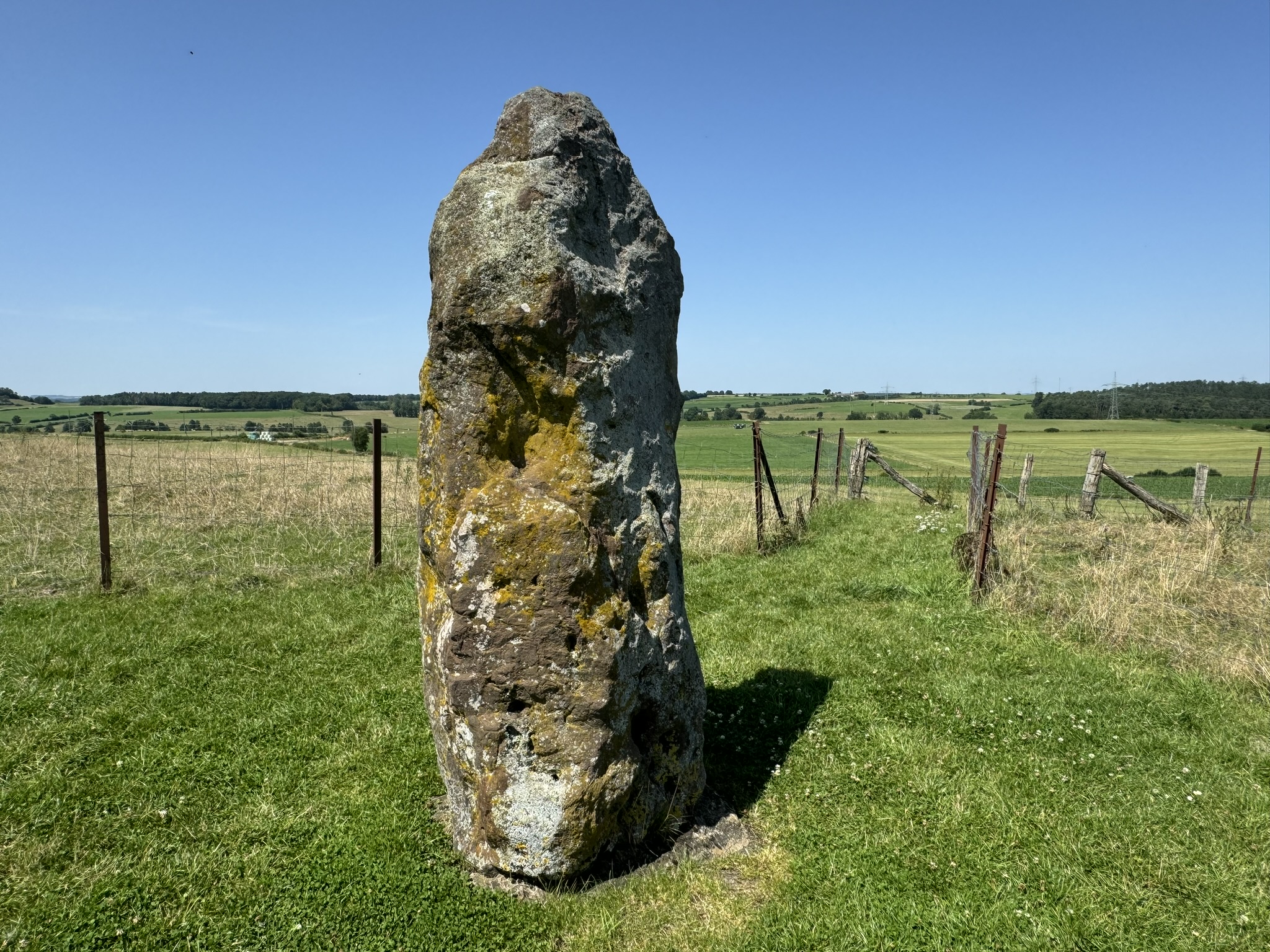
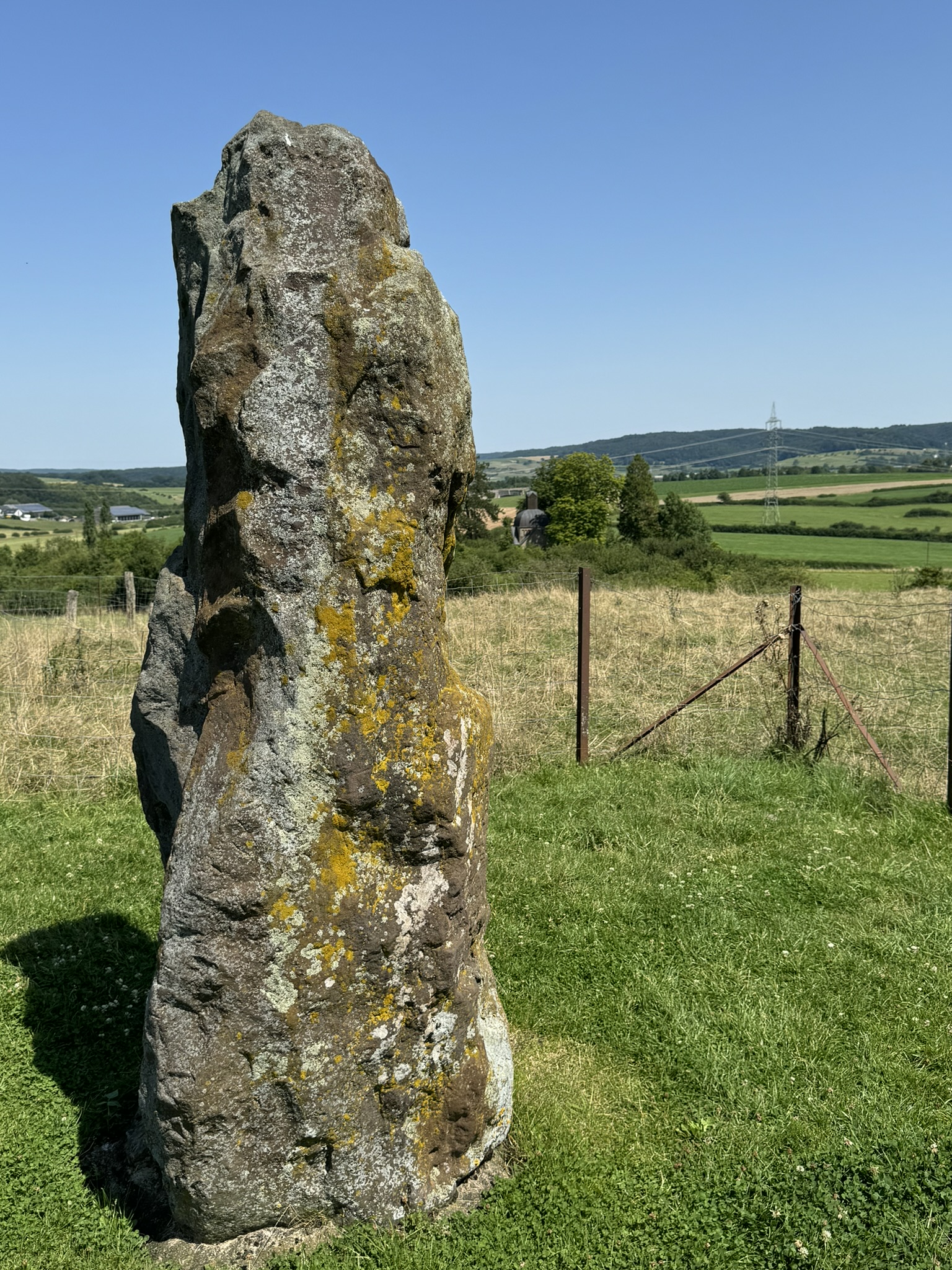
As my regular reader knows, I have done a few road trips over the last few years to visit all the surviving menhirs of Belgium. (I grew up calling them “standing stones”, which is the usual UK / Ireland terminology, but local practice is to use the French term “menhir” which originates from the Breton for “long stone”, though apparently in modern Breton the completely different word “peulvan” is used.)
I’ve exhausted Belgian resources in this regard – the excellent Megalithic Portal lists several that I have not visited, but expresses serious doubt about whether any of them are real megaliths. But there is still plenty to look at in the neighbourhood. I had been tipped off by Herman Clerinx’s Roman book to the joys of Luxembourg, and a bit of research indicated that there was enough there to tick many of my antiquarian boxes.
So on Tuesday, the hottest day of the year so far, I set off down south for a long afternoon.
Diekirch: the necropolis and the museum
My first stop was the northern Luxembourgish town of Diekirch. It has a local beer, an obsession with donkeys, a museum of military history, a museum of historic motor vehicles, and a museum of the history of brewing. But I was not there for any of those. In the 1960s, excavations under the Church of St Lawrence revealed that it had been built on top of a Gallo-Roman necropolis, an indoor cemetery; and a block away a nearly intact large Roman mosaic was found in 1950.
The necropolis, with one of the deceased residentsThe mosaic
The church is free, but to access the necropolis and mosaic you have to pay a very modest entrance fee to the Diekirch History Museum, which I warmly recommend. The museum is very accessible and friendly. Unfortunately all the displays are in German; there are leaflets available in other languages but they really don’t cover much of the content.
Deiwelselter
On a rock outcrop overlooking the town of Diekirch is the site of what used to be a megalithic dolmen, the Devil’s Altar or Deiwelselter in Luxembourgish. From the number of stones, it must have been about half the size of the big Wéris dolmens, far bigger than the Irish ones that I grew up with. Unfortunately, in 1892 the city fathers of Diekirch decided to rearrange the stones into a large arch shape, completely destroying the existing structure. God save us from the arrogance of the nineteenth-century antiquarian.
It’s quite a hike to get to as well. I am afraid that I ignored the ‘No Entry’ sign at the bottom of the lane, and parked at the edge of a field. Today’s city fathers of Diekirch could profitably think about improving access.
Beisenerbierg
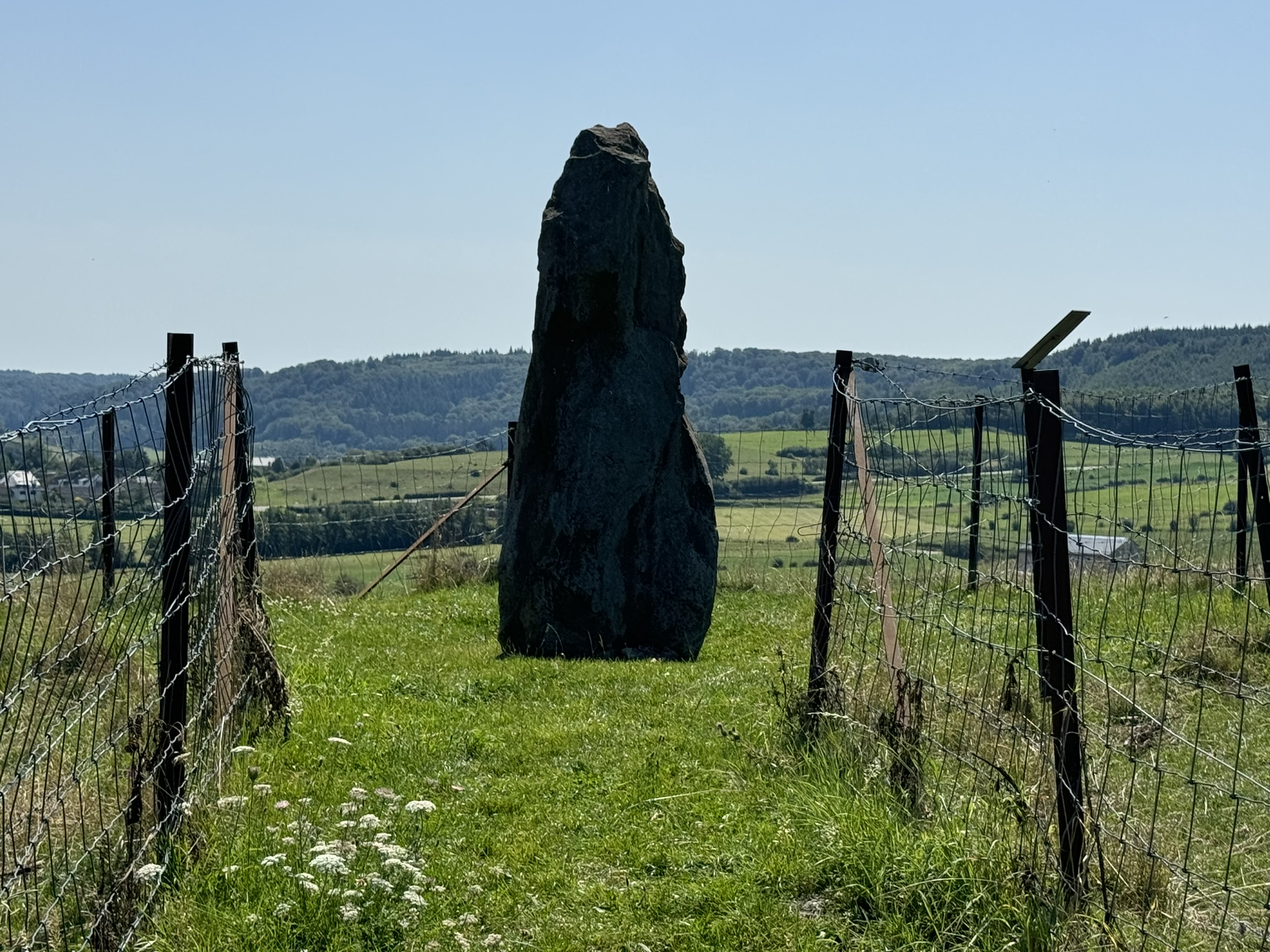
The only genuine menhir surviving in the whole Grand Duchy of Luxembourg is near the town of Mersch. It was buried until 1978 and then erected on its present location, 30 metres from where it was found. It’s unusual among menhirs in that it’s on top of a hill – usually they are on the flank of a slope. Some commentators claim to see an anthropomorphic shaping of its profile; I am not convinced myself, but see what you think.
Of the four monuments I tracked down in the field, this was by far the easiest to find – you park in a layby by a 17th century chapel, and then the path from the chapel is pretty obvious. (And it’s interesting that although the stone itself was buried for centuries, Christianity built a shrine nearby.)
Häerdcheslee/ La Roche des Payens
I have never seen anything quite like this before.
Here are two figures carved into a sandstone boulder on a hillside. In the rock above them is a rectangular pit (which I am not athletic enough to access). Are they gods? A funeral memorial? Who knows? Nearby rock show signs of stone-age grooves, but the Häerdcheslee figures are dated firmly to the first century AD (…ish).
In his novel L’homme qui rit, Victor Hugo makes a passing reference to:
…la clairière dite la Mauvaise Femme, près Diekirch, où il y a deux bas-reliefs énigmatiques représentant une femme qui a une tête et un homme qui n’en a pas…
…the clearing called “The Wicked Woman” near Diekirch, where there are two mysterious sculpted figures representing a woman with a head and a man without one…
It’s not all that close to Diekirch, and I think I’d say the headless figure is more likely to be female, but he’s clearly talking about the same place.
It’s not well signposted at all, but as long as you have the coordinates you will find it.
Raschpëtzer Qanat
The Raschpëtzer Qanat is a 600 metre long tunnel, built around 130 AD, which brought water from a spring on one side of the Petschend hill to a large Roman villa in the Alzette valley on the other side. It is an extraordinary feat of engineering. At least eighteen shafts were dug from the hillside down to the channel below. The mysterious pits on the hill were known about for centuries, but the water channel was only rediscovered in 1986.
One of them has been lit so that you can see all the way down to the water flowing at the bottom.
My cousin J lives in Luxembourg, close to the Qanat, and joined me for the trip. “I’ve lived in this country for ten years, we are less than ten minutes’ drive away, and I’d never been here before!”
There is a visitors’ gallery to the tunnels which is supposedly open only on Sunday afternoons; but we were lucky and found it open on a Tuesday.
From the top of the hill there is a lovely view of the towns of Heisdorf and Steinsel.
This is impressive engineering, and the best example of this sort of water management system north of the Alps, but in fact the emperor Claudius (remember him?) had set up a similar and much bigger structure to drain the waters of Lake Fucino in Italy about 80 years earlier (including what was the longest tunnel in the world, until 1871), and it is on record that this was repaired at almost exactly the same time that the Raschpëtzer Qanat was built, so the technology was available within the Roman Empire.
The Raschpëtzer Qanat is not very well signposted (a familiar refrain) from the car park, but if you use online resources you can find your way fairly quickly. A fellow rambler told us that there used to be more and better signs, so perhaps by the time you get there the situation will have improved again. And on such a warm day it was nice to spend so much time in the woods with their natural air conditioning.
Food and language
Always worth noting where I ate – you may want to follow suit. In Diekirch I had lunch at Niklos Eck, an unpretentious Luxembourgish eatery at 3 rue Nicolas Wathelet – actually on the square around the corner from St Laurence’s Church and the museum. The lentil and sausage salad was yummy and kept me going all afternoon. It doesn’t have a website, you’ll just have to show up and hope for the best.
For dinner, J. took me to Um Eck in Hostert, which apparently has upgraded significantly in the most recent period and did a rather good seafood platter – the calamari were a bit chewy but that’s tricky to get right for the first customers of the evening, and the rest was very yummy.
Everyone speaks French and German in Luxembourg, and most people speak English; and if your German is good enough you can catch most of what is written or spoken in Luxembourgish as well. It’s one of those situations where making all the languages official and legal has taken the sting out of the cultural issue.
So, I don’t think I need to go back to Luxembourg for the sake of the antiquities, but I am glad I went. (And it’s always nice to spend time with J.)
Second paragraph of third chapter (“Party Systems and Structures of Competition”, by Peter Mair):
The most conventional and frequently adopted criterion for classifying party systems is also the most simple: the number of parties in competition. Moreover, the conventional distinction involved here has also proved appealingly straightforward: that between a two-party system, on the one hand, and a multiparty (i.e., more than two) system, on the other (see Duverger 1954). Nor was this just a casual categorization; on the contrary, it was believed to tap into a more fundamental distinction between more or less stable and consensual democracies, which were those normally associated with the two-party type, as opposed to more or less unstable and conflictual democracies, which were those associated with the multiparty type. Thus, two-party systems, which were typically characteristic of the United Kingdom and the United States and invariably involved single-party government, were assumed to enhance accountability, alternation in government, and moderate, center-seeking competition. Multiparty systems, on the other hand, which usually required coalition administrations and were typically characteristic of countries such as France or Italy, prevented voters from gaining a direct voice in the formation of governments, did not necessarily facilitate alternation in government, and sometimes favored extremist, ideological confrontations between narrowly based political parties. And although this simple association of party system types and political stability and efficacy was later challenged by research into the experiences of some of the smaller European democracies, which boasted both a multiplicity of parties and a strong commitment to consensual government (e.g., Daalder 1983) and thus led some early observers to attempt to elaborate a distinction between “working” multiparty systems (e.g., the Netherlands or Sweden) and “nonworking” or “immobilist” multiparty systems (e.g., Italy), the core categorization of two-party versus multiparty has nevertheless continued to command a great deal of support within the literature on comparative politics.2 2 See, for example, Almond, Powell, and Mundt (1993, 117-20), where this traditional distinction is recast as one of “majoritarian” versus multiparty systems; see also the influential study by Lijphart (1984) where one of the key distinctions between majoritarian and consensus democracies is defined as that between a two-party system and a multiparty system.
This was another of the books that I got at the end of 2016, lost and then found again, to prepare a talk that I gave in Belfast that December. It was published in 1996, but it seems a bit dated even for 28 years ago; most of Eastern Europe was already two cycles into the new democratic system by then, and more could have been made of the test bed for democracy. In addition, there’s almost nothing about the actual subject of my talk, which was electoral boundaries. Still, I only paid £3.88 for it, so I can’t really complain.
What it does have is quite a wide range of essays picking out different aspects of the democratic process – not just the legal framework of the vote and the political party system, but also the roles of what we would now call civil society, opinion polls, media, the economy, and the impact of leadership, recruitment of candidates, and campaigning – the chapter on actual campaigning by David Farrell is probably the best in the book.
A useful snapshot of where research stood in the mid-1990s, but with massive gaps even then in the Global South. I hope that there is a more up to date volume out there. Meantime, you can get it here.
My usual system of quoting the second paragraph of the third section is always challenged by theatre scripts, and in this case there are no sections to the play at all, though there is a point where an optional interval is indicated. So I’ll just quote the most famous lines.
History says, Don’t hope On this side of the grave. But then, once in a lifetime The longed-for tidal wave Of justice can rise up, And hope and history rhyme.
So hope for a great sea-change On the far side of revenge. Believe that further shore Is reachable from here. Believe in miracle And cures and healing wells.
Call miracle self-healing: The utter, self-revealing Double-take of feeling. If there’s fire on the mountain Or lightning and storm And a god speaks from the sky
That means someone is hearing The outcry and the birth-cry Of new life at its term.
These lines come at the conclusion of a grim story: the young Neoptolemus is sent by Odysseus to retrieve the bow of Philoctetes, who has been abandoned by the Greeks on the island of Lemnos. Philoctetes’ bow shoots invincible arrows, and the Greeks know that they cannot conquer Troy without it. But the only way to get it from Philoctetes is for Neoptolemus to pretend that he too has fallen out with the Greeks. Eventually a divine intervention helps to resolve the plot into a more cheerful place than seemed likely for most of the duration. (This is not a spoiler; the chorus tells us that it’s going to happen in the first speech of the play.)
It’s often difficult to appreciate a play from the script (well, difficult for me at least), but I really enjoyed this, in particular Heaney’s use of Ulster turns of phrase to give a clear voice to the characters. It’s a psychological story which can be told with minimal scenery. I’d certainly pay to see it.
Paulius has draped a robe over Kenna’s shoulders as he leads Kenna across the orchard, headed for a small frosted-glass door set into a polished aluminum wall. Kenna clutches at the white linen lapels, reveling in the feeling of clean cloth; he’s worn his filthy Inevitable Robe for so long he can no longer distinguish between the stained cloth and his squalid skin.
I used to occasionally dip into Ferrett Steinmetz’s livejournal back in the day – I remember a particularly vivid account he wrote about of having sex during a showing of the Rocky Horror Picture Show. This was one of the books in the 2020 Hugo packet which I have only just now got around to. It is a space opera with a somewhat wacky setting. It didn’t really grab me and I gave up after a hundred pages. But you can get it here.
This was my top unread book acquired in 2020. Next on that pile is Desdemona and the Deep, by C.S.E. Cooney.