The Sontarans

I like Simon Guerrier; up to now I have generally liked his writing; I love Peter Purves both as Stephen and playing the Doctor; in the week when we got the sad news of Jean Marsh’s death, it was lovely to hear her resuming the role of Sara Kingdom; and the story of the Doctor’s first encounter with Sontarans – proper bloodthirsty Lynx and Styre type Sontarans – is well structured and well told.

But I am afraid I don’t like torture scenes, and although of course it’s perfectly consistent with Styre in The Sontaran Experiment, I didn’t like that much either. So it’s a rare thumbs down for me for this particular combination of creators.

You can get it here.

The Ravelli Conspiracy, by Robert Khan and Tom Salinsky

Next in the sequence of First Doctor audios, this gives Peter Purves licence to do his famous and excellent William Hartnell impression, along with Maureen O’Brien as Vicki, in a pure historical story which takes place in Florence in 1514. Main characters are Giuliano de’ Medici, ruler of Florence; his brother Pope Leo X; and Niccolo Macchiavelli. There’s also a comic guard and a token Renaissance woman. It’s actually great fun, and my only complaint is that they all pronounce ‘Giuliano’ with a hard ‘g’ – it’s Julie-anno, folks, not Gully-anno. You can get it here.

A Christmas Carol, by Jaime Beckwith and Leslie Grace McMurtry (and Steven Moffat); and Charles Dickens

A Christmas Carol was the first Doctor Who Christmas special produced and written by Steven Moffat and starring Matt Smith. It has Amy and Rory trapped on a doomed spaceship, which for handwavium reasons only the Scrooge-like Kazan Sardick (Michael Gambon) can save. The Doctor goes into Sardick’s past to make him into a nicer person through the love of the beautiful Abigail (Katherine Jenkins). Unfortunately for more handwavium reasons this means that Sardick no longer has the power to save the doomed spaceship, but luckily Abigail’s voice resonates at just the right frequency, so she saves the day (it is implied that she then dies of some fatal but not very debilitating illness). The music is good.

I ranked it fourth out of five votes in that year’s Hugo Awards, noting:

Don’t get me wrong – this was a lovely episode of Doctor Who and just right for Christmas evening. But as a work of SF, I think the other nominees are better.

Rewatching it, I felt the same; it’s a remake of Dickens in Doctor Who terms with light comedic relief from Rory and Amy, the story line is a little too clever and also a little too simple (often the case with Steven Moffat), and it’s perfect fare for a day when you’re not expecting anything too demanding on the brain cells. It did inspire one of the more remarkable cosplays that I saw at Gallifrey One in 2013:

Jaime Beckwith and Leslie Grace McMurtry have taken the interesting tack of looking at the TV episode in the context of Charles Dickens, asserting firmly that it “remains the only explicit adaptation of another text in the Doctor Who back catalogue.” I disagree with that – I think that The Androids of Tara is even more closely aligned with The Prisoner of Zenda – but I can see their point.

A short introduction looks at Christmas specials in Davies and Moffat era Doctor Who.

The first chapter, “A Traditional English Christmas With Sharks”, considers the history of Christmas in Britain, the previous adaptations of Charles Dickens’ A Christmas Carol, and its importance in British popular culture.

The second chapter, “A Blot of Mustard, a Crumb of Cheese”, looks at Steven Moffat’s gift for transforming apparently normal situations into fairy tales.

The third chapter, “Time and Relative Child-centrism”, looks at children as focal narrative figures in Moffat’s Doctor Who. Its second paragraph is:

Had it always been thus? Could British audiences expect throughout the 20th and 21st centuries to encounter Dickens (and ACC [A Christmas Carol]) in late December? Certainly, on British television December was seen as a good time to air adaptations of Dickens’ works. On the BBC, adaptations of ACC aired on Christmas Day 1950, Christmas Eve 1977 and a few days before Christmas in 2019. The 1999 TV series of David Copperfield debuted on Christmas Day, and the 1976 episode of A Ghost Story for Christmas was an adaptation of the short story ‘The Signalman’ (1866). The Pickwick Papers (1952), David Copperfield (1974) and Great Expectations (2011) all first aired in December. In 2007, Dickens was central to the battle for the Christmas season ratings, with the BBC broadcasting a five-part adaptation of Oliver Twist in the week leading up to Christmas, and ITV airing a feature-length adaptation of The Old Curiosity Shop on Boxing Day (with production design by Michael Pickwoad, of whom more in Chapter 4).

The fourth and longest chapter, “The Pickwoad Papers”, looks in great and pleasing detail at the superb design of the story.

The fifth chapter, “What Right Have You To Be Merry?”, looks at the Doctor’s habit of interference in human timelines.

A brief conclusion, “Everything’s Got To End Some Time”, summarises the above.

I still feel that the actual story is not particularly memorable, but Beckwith and McMurtry gave me some pause for thought about where it came from. You can get their Black Archive here.

I only recently watched The Muppet Christmas Carol for the first time, which sticks surprisingly closely to the original text, but as a result of that experience combined with reading the Black Archive monograph, I was inspired to go back and read Dickens once again, probably for the first time since I was a child. The second paragraph of the third ‘Stave’ of the short book is:

Gentlemen of the free-and-easy sort, who plume themselves on being acquainted with a move or two, and being usually equal to the time of day, express the wide range of their capacity for adventure by observing that they are good for anything from pitch-and-toss to manslaughter; between which opposite extremes, no doubt, there lies a tolerably wide and comprehensive range of subjects. Without venturing for Scrooge quite as hardily as this, I don’t mind calling on you to believe that he was ready for a good broad field of strange appearances, and that nothing between a baby and a rhinoceros would have astonished him very much.

It’s tremendous, even when you know what is going to happen; Dickens sometimes succumbed to mawkish sentimentality, but here he largely keeps himself restrained and lets the story tell itself. I found I had something in my eye as I got to the end, and you will too. God bless Us, Every One!

You can get it here.

The Child of Time, by Jonathan Morris et al

Second frame of third story (“The Golden Ones”):

Man on left: “No thank you Mr Kin. / Who’s the little girl? Your granddaughter?”
Man behind desk: “Chiyoko. And no, my wife and I were never blessed with children. / Chiyoko acts as my … marketing consultant on the Goruda project.”

This is a compilation of comic strip stories from Doctor Who Magazine during the Eleventh Doctor era, all by Jonathan Morris; I had not appreciated it at the time, but they actually have a cleverly worked out arc (about, er, the Child of Time) which culminates at the end, shortly after we meet the killer Brontë sisters.

Charlotte: “Doctor, how delightful to finally make your acquaintance!”
Emily: “If I may introduce myself – I am Emily, these are my sisters Charlotte and Anne.”
Anne: “Together, we are the Brontës!”

Having been working through the IDW Doctor Who comics dating to the same era, it’s interesting to feel a very different dynamic to the DWM strips, which have much shorter episodes and also had to respond to the TV show in real time – there are some very informative endnotes from Morris and the artists about the creative process.

Also I particularly like the story with C.S. Lewis and J.R.R. Tolkien.

C.S. Lewis: “‘…And that was the very end of the adventure of the bookshop.’ / So, what does everyone think?”
J.R.R. Tolkien: “Well, I thought it was a bit juvenile… a jumble of unrelated mythologies… all rather derivative, I’m afraid… / And I wasn’t convinced by the allegorical element at all!”

Rather a jewel. You can get it here.

The Fifth Traveller, by Philip Lawrence

I slightly regretted my decision to get into the Big Finish First Doctor stories when the last one I tried turned out to be rather a dud. But this is much better, a story of the Doctor, Ian, Barbara, Vicki and Jospa landing on a very alien planet with vividly realised aliens, and also the question of just how many people are in the Tardis crew. It’s a concept that was also visited in the Buffy episode Superstar and the Torchwood episode Adam (and the Torchwood novel Border Princes), but I think we have a new twist here – rather than having a strange new character intruding on our heroes’ regular setup, we have both a strange new character and a strange new world, and this being a Big Finish audio which was released more than fifty years after the TV stories with which it is in continuity sequence, we listeners don’t quite know what to make of it at first. On top of that, as I said, the aliens are very alien and well depicted; and it’s William Russell’s second last audio performance, as both Ian and the Doctor, recorded shortly before his 90th birthday. James Joyce (no relation) is suitably suave as the extra companion Jospa, and Kate Byers as the lead alien. You can get it here.

Oh No It Isn’t!, by Paul Cornell (and Jacqueline Rayner)

Second paragraph of third chapter:

Professor Bernice Surprise Summerfield woke up, stretched, and sang a single pure note. The stretch had brought on the singing. It was all because of the look of the day. Sunlight was dap­pling through leaves above her. Birds were cheeping. The air smelt of a summer morning.

The first of the Bernice Summerfield spinoff novels, adapted to become the first Big Finish audio. Bernice, settling into her new job as a professor of archæology, finds herself sucked into a world where she and her colleagues are transformed into pantomime characters, and facing down the alien Grel. (Facts! Good facts!) It’s actually rather well done – the concept risks being either too twee or too clever for its own good, but Paul Cornell bends the rules of narrative here just enough to get away with it. You can get it here.

The audio adaptation – from 27 years ago, good heavens! – is particularly memorable for Nicholas Courtney’s performance as Wolsey, Bernice’s cat, though everyone is good including Alastair Lock as the Grel. I listened to it just after re-reading the book, so can’t really tell how well it stands on its own. You can still get it here.

On my first encounter with the Grel of the Whoniverse (which was actually in the Sixth Doctor audio The Doomwood Conspiracy), I confusedly assumed that they were the same as the Grell, a D&D creature that I remember from White Dwarf #27 back in 1981 (actually invented by Ian Livingstone in WD #12, two years earlier). But the D&D Grell, with two ‘l’s, are disembodied hovering brains with a beak and barbed tentacles, while the DW Grel, with one ‘l’, are humanoids with squid-like faces. You’re welcome.

Sky Jacks!, by Andy Diggle, Eddie Robson and Andy Kuhn

Second frame of third part:

Clara (in her first appearance in comics) falls through what appears to be a black hole, into a pocket universe where there are lots of stranded airmen and the like, and eventually the Doctor as well. The big reveal of What Is Really Going On is well done. The art seemed to me not to capture the Doctor and Clara terribly well, but is fine on the big sweeeps of scenery.

There’s also a short story about alien mind control through getting everyone on earth to wear an electronic fez, but they are rescued by Eleven, Amy and Rory, which is dire as you would expect.

You can get it here.

The Age of Endurance, by Nick Wallace

A two-hour Big Finish audio from 2013, featuring William Russell as Ian (and also playing the Doctor) and Carole Ann Ford as Susan, set during the original first season of Who. Also brings in Jemma Powell as Barbara, but doesn’t give her much to do. Unfortunately it’s not all that good; a helping-the-rebellion plot which is spread too thin, no particularly memorable lines or unusual soundscapes. Big Finish usually much better than this, alas. You can get it here.

What’s on the TARDIS bookshelves?

Back in September 2015, I was lucky enough to get a look at the Doctor Who set in Cardiff, including the TARDIS. This was just after filming had been completed on The Husbands of River Song. I took loads of photos, but the studio lights were off so it was all a bit dark and the pictures are out of focus. However, looking at them the other day, I realised that there is enough detail to make out the titles of most of the books on the TARDIS bookshelves. Lesson learned – if I ever have another chance, I’ll make sure to get better and more complete shots.

I took photos of two sets of bookshelves, and the books on this one are much less easy to distinguish than the other. On the top shelf, beside the wooden horse, are two volumes of a History of England, Vol II to the left of Vol I, and three volumes of what looks like the collected works of some author (or possibly “Philosophical Works“), Vol VIII, Vol X and Vol VII.

On the middle shelf, I can’t make out the book on the left; the next two appear to be The Holy Bible, Vol I and Vol II; another two that I can’t make out, and then The Holy Bible Vol IV followed by Vol III. The two paperbacks to the left of the skull are Term of Trial, by James Barlow, and a combined Penguin edition of D.H. Lawrence’s short novels St Mawr and The Virgin and the Gipsy. I can’t make out anything of the next two titles, to the right of the skull, but on the spine of the last fully visible book, the middle word is Plays.

On the bottom shelf, the light is too bad to see any titles clearly.

The other bookshelf that I photographed is much clearer, thanks to all of the books being paperbacks and most of them being Penguins. I can identify all 35 books on the top shelf, and 25 of the 30 on the bottom shelf with reasonable guesses at two of the other five.

On the top shelf we have:

  • Pride and Prejudice, by Jane Austen
  • Hard Times, by Charles Dickens
  • Selected Short Stories, by Guy de Maupassant
  • The Mayor of Casterbridge, by Thomas Hardy
  • King Solomon’s Mines, by H. Rider Haggard
  • Man and the Vertebrates: 1, by A.S. Romer
  • The Political Economy of Growth, by Paul A. Baran
  • New Horizons in Psychiatry, by Peter Hays
  • Roman Britain (Political History of England 1), by I.A. Richmond
  • The Simplicity of Science, by Stanley D. Beck
  • Language in the Modern World, by Simeon Potter
  • Family Policy, by Margaret Wynn
  • Mister Johnson, by Joyce Cary
  • The Secret Agent, by Joseph Conrad
  • Elizabeth and Essex, by Lytton Strachey
  • Gormenghast, by Mervyn Peake
  • The White Monkey, by John Galsworthy
  • Heart of Darkness, by Joseph Conrad
  • Bliss and Other Stories, by Katherine Mansfield
  • The Loved One, by Evelyn Waugh
  • Introduction to Sociology: A Humanistic Perspective, by Peter L. Berger
  • Birth Control in the Modern World, by Elizabeth Draper
  • Modern Science and the Nature of Life, by William S. Beck
  • The True Wilderness, by H.A. Williams
  • The Reader’s Guide, edited by Sir William Emrys Williams
  • Organic Chemistry Today, by F.W. Gibbs
  • Maid in Waiting, by John Galsworthy
  • To Let, by John Galsworthy
  • Left Luggage, by C. Northcote Parkinson
  • In Chancery, by John Galsworthy
  • A Little of What You Fancy, by H.E. Bates
  • a second copy of In Chancery, by John Galsworthy
  • A Breath of French Air, by H.E. Bates
  • When the Green Woods Laugh, by H.E. Bates
  • Blood Rights, by Mike Phillips

The lower shelf is more out of focus, but I’m pretty sure that we see:

  • Shardik, by Richard Adams
  • Debbie Go Home, by Alan Paton
  • a second copy of Shardik, by Richard Adams
  • two copies of The Wild Cherry Tree, by H.E. Bates
  • Birds of America, by Mary McCarthy
  • The Group, by Mary McCarthy
  • one that I have difficulty reading but it might be The Innovators by Michael Shanks
  • The Chemistry of Life, by Steven Rose
  • Voters, Parties and Leaders, by Jean Blondel
  • one that I cannot read
  • A High Wind in Jamaica, by Richard Hughes
  • Anna of the Five Towns, by Arnold Bennett
  • Britain on Borrowed Time, by Glyn Jones and Michael Barnes
  • The Jungle, by Upton Sinclair
  • Goodbye to All That, by Robert Graves
  • another that I cannot read, though the author’s first name looks like “Henry” or possibly “Hilary”
  • North and South, by Elizabeth Gaskell
  • a book by H.E. Bates whose title is unreadable, but it seems very odd that the Doctor would not have a copy of The Darling Buds of May despite having all four of its sequels, so that’s probably it
  • The Portrait of a Lady, by Henry James (upside down)
  • two copies of The Cold Moons, by Aeron Clement (the title of the second book is unreadable, but Aeron Clement’s name is clear, and he only wrote one book, so it’s got to be a duplicate)
  • a second copy of The Mayor of Casterbridge, by Thomas Hardy
  • Three Plays by John Webster (The White Devil, The Duchess of Malfi, and The Devil’s Law-Case)
  • Little Dorrit, by Charles Dickens
  • Owls and Satyrs, by David Pryce-Jones
  • a third copy of Shardik, by Richard Adams
  • a second copy of A Little of What You Fancy, by H.E. Bates
  • The N****r of the Narcissus, Typhoon and Other Stories, by Joseph Conrad
  • finally, one more that I cannot read, though the author’s first name looks like “Henry”.

So: there’s a fair number of classics; a lot of middle-brow twentieth century literature (H.E. Bates, John Galsworthy); very little science fiction or fantasy (apart from Shardik, of which the Doctor has no less than three copies, and two copies of The Cold Moons, a Watership Down-style novel about badgers [edited to add: Rich Horton points out that Gormenghast surely counts too]); lots of well-meaning Penguin 1960s and 1970s sociology; some rather odd popular science books; only two history books (Roman Britain and Elizabeth and Essex); and precisely one book about religion (The True Wilderness, by H.A. Williams), though of course there’s a multi-volume Bible on the other shelf.

Unfortunately I think the Glyn Jones who co-wrote Britain on Borrowed Time is not the same person who wrote The Space Museum. That would have been nicely recursive.

There were more books in the TARDIS than this, as you can see from this screenshot from The Husbands of River Song, but I’m happy to have salvaged some information from my own archives.

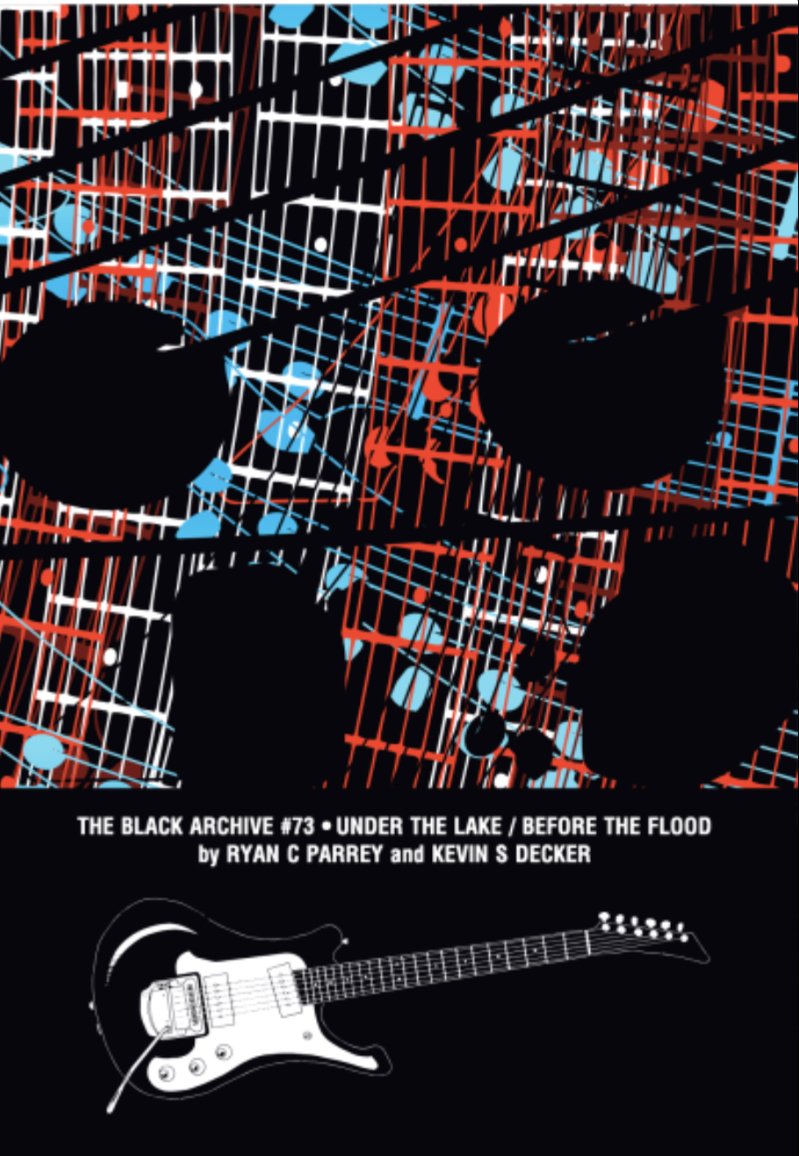
Under the Lake / Before the Flood, by Ryan C. Parrey and Kevin S. Decker (and Toby Whitehouse)

This was a two-part Twelfth Doctor story from Series 9 in 2015, set in the early 22nd century in a base under a Scottish reservoir, and also in 1980, in the abandoned village that was there before the reservoir was built. I don’t appear to have written it up at the time – I was a bit sparing when the last name on the screen was my first cousin, which may have been too cautious of me.

The TARDIS, with the Twelfth Doctor and Clara on board, arrives in the year 2119, in an underwater base under siege from ghosts, which appear linked with a mysterious alien vessel at the bottom of the lake. The crew of the base start getting picked off one by one. The Doctor goes back to 1980 to try and sort things out, but apparently returns as a ghost. The trouble is being caused by a semi-dead alien called the Fisher King, but I confess I did not really follow that part. Eventually all is resolved with the use of time paradoxes – the Doctor has a breaking-the-fourth-wall conversation with the viewer about who really wrote Beethoven’s music. There are some very good shots of Capaldi in particular.

Notably, Cass, the woman who takes command of the crew for most of the story (after the original commander is an early victim) is deaf, played by deaf actor Sophie Leigh Stone, and communicates with everyone else by signing through an interpreter.

I also noted with interest that two characters played by actors of Asian heritage, Zarqa Ismail and Arsher Ali, are given the thoroughly Anglo names Tim Lunn and Mason Bennett. (I don’t think we ever find out Cass’s first name.)

The writer was Toby Whitehouse, who also wrote School Reunion, one of my favorite New Who episodes; Greeks Bearing Gifts, one of my favourite Torchwood episodes; the series Being Human; and the New Who episode The God Complex, which I didn’t rate as highly and have written up here along with its Black Archive.

Rewatching Under the Lake / Before the Flood, I would rank it as average or slightly below. Over on X/Twitter, it did better, at 120th of 309 Who stories in @heraldofcreatio’s poll. Anne could not remember having seen it first time round. I find the plot decently sfnal and the base well realised, but the energy somehow not quite there, and the means and motivation of the alien menace obscure. Full marks of course for the portrayal of Cass’s disability, which we’ll get back to.

Ryan C. Parrey and Kevin S. Decker have done a solid though relatively short Black Archive on the story. The first chapter is an introduction which briefly touches on bases under siege, evil capitalism, and the reversed sequence of the narrative.

The second and longest chapter, “The Bootstrap Paradox”, goes in detail into the exploration of time paradoxes in this story and in other Doctor Who stories, and the extent to which they also carry the freight of moral dilemmas.

The third chapter, “‘Only Room for One Me’”, looks at Clara’s arc overall in the wider Doctor Who narrative. Its second paragraph is:

“This two-part story contributes important elements to Clara’s arc during her time with the 12th Doctor, an arc that begins before Danny’s death and that sees Clara act on her fascination with the Doctor’s power and responsibility. Making a conscious decision to leave certain inhibitions behind after Danny dies, she experiments here and elsewhere in series nine with, in effect, becoming the Doctor.

Incidentally I am writing this at Gallifrey One, where Jenna Coleman as usual is charming the participants.

The very brief fourth chapter, “Ghosts in the Machine”, looks at the ghosts in the story as compared to other Who stories, and unpacks how they are not really ghosts.

The fifth chapter, “New Waste Lands”, which is also short, looks at the alien Fisher King and successfully explained to me what is actually going on in the story, better than the script did.

The sixth and best chapter, “The Case of Cass”, looks at the varying ways that disabled people are portrayed in the media, especially in Doctor Who, coming to the conclusion that Cass is uniquely well depicted in this story. Hard to disagree with that, and it’s well argued.

The seventh and concluding chapter takes us back to ethics and invokes Jean-Paul Sartre.

I rate this about average of the Black Archives, but with significant bonus points for the discussion of disability. You can get it here.

The Black Archives
1st Doctor: The Edge of Destruction (67) | Marco Polo (18) | The Aztecs (71) | The Dalek Invasion of Earth (30) | The Romans (32) | The Myth Makers (65) | The Massacre (2) | The Ark (81)
2nd Doctor: The Underwater Menace (40) | The Evil of the Daleks (11) | The Mind Robber (7)
3rd Doctor: Doctor Who and the Silurians (39) | The Ambassadors of Death (3) | The Dæmons (26) | Carnival of Monsters (16) | The Time Warrior (24) | Invasion of the Dinosaurs (55)
4th Doctor: Pyramids of Mars (12) | The Hand of Fear (53) | The Deadly Assassin (45) | The Face of Evil (27) | The Robots of Death (43) | Talons of Weng-Chiang (58) | Horror of Fang Rock (33) | Image of the Fendahl (5) | The Sun Makers (60) | The Stones of Blood (47) | Full Circle (15) | Warriors’ Gate (31) | Logopolis (76)
5th Doctor: Castrovalva (77) | Kinda (62) | Black Orchid (8) | Earthshock (51) | Mawdryn Undead (80) | The Awakening (46)
6th Doctor: Vengeance on Varos (41) | Timelash (35) | The Mysterious Planet (79) | The Ultimate Foe (14)
7th Doctor: Paradise Towers (61) | The Happiness Patrol (68) | Silver Nemesis (75) | The Greatest Show in the Galaxy (66) | Battlefield (34) | The Curse of Fenric (23) | Ghost Light (6)
8th Doctor: The Movie (25) | The Night of the Doctor (49)
Other Doctor: Scream of the Shalka (10)
9th Doctor: Rose (1) | Dalek (54)
10th Doctor: The Impossible Planet / The Satan Pit (17) | Love & Monsters (28) | Human Nature / The Family of Blood (13) | The Sound of Drums / Last of the Time Lords (38) | Silence in the Library / The Forest of the Dead (72) | Midnight (69)
11th Doctor: The Eleventh Hour (19) | Vincent and the Doctor (57) | The Pandorica Opens / The Big Bang (44) | A Christmas Carol (74) | The Impossible Astronaut / Day of the Moon (29) | The God Complex (9) | The Rings of Akhaten (42) | Day of the Doctor (50)
12th Doctor: Listen (36) | Kill the Moon (59) | Under the Lake / Before the Flood (73) | The Girl Who Died (64) | Dark Water / Death in Heaven (4) | Face the Raven (20) | Heaven Sent (21) | Hell Bent (22)
13th Doctor: Arachnids in the UK (48) | Kerblam! (37) | The Battle of Ranskoor av Kolos (52) | The Haunting of Villa Diodati (56) | Ascension of the Cybermen / The Timeless Children (70) | Flux (63)
15th Doctor: The Devil’s Chord (78)

TARDIS Type 40 Instruction Manual, by Richard Atkinson and Mike Tucker

Second paragraph of third chapter:

The key maintains a direct link with the TARDIS at all times. Even if the TARDIS is isolated by a temporal disturbance the key should be able to summon it back (see Case Study, page 32). Conversely, the TARDIS can be concealed, a second out of sync with your current time zone, using the key as an anchor.

This is one of those really lovely BBC spinoff books, looking in detail at the TARDIS, presented as an operator’s manual and pulling together all the TARDIS lore from the first 55 years of Doctor Who (it features Jodie Whittaker but not any of her stories). None of this is new, but it’s put together very imaginatively and entertainingly. I had forgotten that many of the early stories include a TARDIS malfunction of some kind, and the authors heroically retcon everything together, even the Eye of Harmony from the TV movie. A lovely effort. You can get it here.

Mission: Impractical, by David A. McIntee

Second paragraph of third chapter:

Most people called it the Jewelled City, because they had no imagination of their own and just picked up on what some down-market visnews journalist correctly thought would make a catchy slogan. The planet had originally been colonised as a source of jethryk, but the mining boom had long since died out, and it reverted to being just another human world. Nowadays there were no more jewels around than there were in any other colonial capital.

I never had the pleasure of meeting David McIntee, but we were Facebook friends for years, and like many others I was shocked and saddened when he died last December, two weeks before his 56th birthday. He wrote twelve Doctor Who novels between 1993 and 2004, one of which (Autumn Mist) is among the very few Doctor Who stories set in Belgium. My favourite is The Face of the Enemy, set while the Doctor and Jo Grant are off in Peladon, so that UNIT has to bring in the Master and some bloke called Chesterton and his wife to help out.

Mission: Impractical is the last of the Sixth Doctor novels that I read a decade ago, failed to write up at the time and have now reread again. It’s a comedy heist story, not usually one of my favourite sub-genres, but done very well here. The cast of characters includes Sabalon Glitz and his sidekick Dibber, who appeared in a couple of TV stories, and Frobisher, originally a DWM comic strip companion, who is a shape shifting alien Whifferdill and prefers to take the shape of a penguin. There are also Ogrons and an ancient artifact which is the McGuffin. McIntee had a good ear for dialogue and robustly characterizes both the continuity characters and the bad guys who turn up in this story, and the settings are vivid. So I am ending this mini-project on a high note.

The purchase link says it’s out of print and that Amazon doesn’t know of any second-hand copies. But who knows, you may be lucky?

I find that I also never wrote up some of the early Bernice Summerfield books, so I will do them next, possibly alongside the early Big Finish audio adaptations.

The Eye of Ashaya, by Andy Diggle, Joshua Hale Fialkov, Richard Dinnick et al

Second frame of third section:

Three stories here. The title story by Andy Diggle and Craig Hamilton brings Lady Christina de Souza back for a space heist with the Doctor, Amy and Rory, and raised a smile or two. The second, “Space Oddity” by Joshua Hale Fialkov and Horacio Domingues, is an excellent tale of the Vashta Nerada and an early undocumented Soviet space mission. The third, “Time Fraud” by Richard Dinnick and Josh Adams, has bird-like aliens and fake Time Lords. You can get it here.

Next in this series is Sky Jacks!, by Andy Diggle, Eddie Robson and Andy Kuhn

The Companion Chronicles: The First Doctor Vol 1: The Sleeping Blood by Martin Day, The Unwinding World by Ian Potter, The Founding Fathers by Simon Guerrier, The Locked Room by Simon Guerrier

Big Finish had a First Doctor sale last month, and I took advantage of it to get hold of some of the audios I would have liked to have caught at the time. This is the first of three quartets of First Doctor Companion Chronicles, each featuring an original series actor and a guest performer, in this case released in October 2015 (so I am some way behind).

The Sleeping Blood, by Martin Day, has Carole Ann Ford as Susan travelling with her grandfather before they arrive on Earth, and looking for medical treatment when the Doctor is struck down by a mysterious infection. She ends up at a medical facility where the local security team are fighting off a mysterious terrorist (both the terrorist and the head of security are played by Darren Strange). It’s a smart Doctor-lite script, exploring truth and trust and the use of violence, and giving Ford a bit more space to perform than she really got on screen.

The Unwinding World, by Ian Potter, has Vicki telling the story of how she, together with the Doctor, Ian and Barbara, are stuck doing grunt work on a boring but repressive planet. This is framed as a conversation between Maureen O’Sullivan and Alix Dunmore, who plays the all-powerful computer and a couple of other female parts. I started off wondering exactly what was going on, but then realised that a nicely constructed plot – expressed basically as a dialogue – was coming to a clever and satisfactory conclusion.

The Founding Fathers is one of two stories in this set by Simon Guerrier, sequels to The War to End All Wars, with a framing narrative where Steven Taylor, having retired as king of the planet of the Elders/Savages, is engaged in long conversations with the copy of the Doctor’s brain made by Jano long ago. The main plot element is a flashback to a Doctor-and-Steven trip to Paris in 1762, where they encounter Benjamin Franklin and give him pointers on the future governance of the American colonies and also electricity. But there’s a subsidiary plot set on Steven’s planet, where his granddaughter Sida (played by Alice Haig, now Alice Tate, who does all the female characters) is listening and learning.

Finally, in Simon Guerrier’s The Locked Room, we get not only the First Doctor returning in the flesh, but also the Vardans, of all monsters, to trouble Steven and Sida on their home world, which is of course itself in the middle of a huge political crisis involving them both in different ways. The soundscape of all of these is vey good, but I felt this was particularly impressive, where two actors in adjacent sound booths summon up an entire planet under threat. Peter Purves’ version of Hartnell is uncanny as ever.

So, basically my mini-project of catching up with Big Finish’s First Doctor stories is off to a good start. You can get this set here.

Silence in the Library / The Forest of the Dead, by Dale Smith

The 2009 Hugos were the only year of the seven from 2006 to 2012 where a Doctor Who episode failed to win, comprehensively thrashed by Dr Horrible’s Sing-Along Blog, though with Turn Left coming third. (Sorry that the final ballot stats on the right are cramped, but you can click to embiggen.)

When I first write about this TV story in 2009, I said:

Unlike a lot of people I wasn’t overwhelmed by Silence in the Library / Forest of the Dead. On re-watching, I enjoyed it more, but still feel it is weaker than Moffat’s previous New Who stories. Perhaps I am being unfair, and I guess that expecting another Blink is not reasonable. I must admit that as sf, its concept works very well – the intersecting levels of reality, the time-traveller who meets a lover from his own future; and as drama it is pretty effective, with Alex Kingston and Catherine Tate particularly strong, and the utterly horrible creepiness of the ghosting data chips (“Who turned out the lights?”, etc).

My two problems with it are both to do with River Song’s story. To get the easier one out of the way, her ending is not a particularly happy one; she is still dead, and gets to spend an ersatz afterlife in the computer’s memory with her crew rather than with the man she loves. (If you work or have ever worked in a team with other people, just consider for a moment whether you would prefer to spend eternity with them or with your lover.) The script didn’t quite do justice to the tragedy of River’s story for me.

My other problem is that while the story works as sf and (apart from the above niggle) as drama I’m not so sure it works as Doctor Who. Back in 2006 I enjoyed The Girl in the Fireplace, but rated it below School Reunion, because one of my sources of enjoyment in Who is its dealing with its own mythology, and another is the relationship that we as viewers build up with the regular characters, and TGitF did not deliver much on the second and nothing on the first of these. Now, where at least TGitF had a decent start and closure to the Doctor’s love story, with Renette’s death ending their relationship, SitL/FotD cheats us because we are asked to care very deeply about the Doctor/River dynamic, without getting the payoff of it becoming a regular plot theme. (No televised return to explore River’s past relationship with the Doctor seems likely now, and anyway it would hardly get satisfactory treatment in the time we have left.) So while this episode may well get strong support from Hugo voters who are not regular Who watchers, I was and am surprised by the favour it has found among fans.

It’s rare that I come back to a review and admit that I was completely wrong, but as it turned out, I was completely wrong. River Song went on to be a fixture of the Eleventh Doctor’s era, her origins were a major plot line for Series 6, and she has made the occasional appearance since then (plus a well-received set of Big Finish spinoff audio plays). Looked at now, the story is a clever pitch-rolling for the future arc of the show. An important data point is that it was written precisely at the moment that Stephen Moffat was deciding whether or not to be the new show-runner.

And I mentioned it in my first paragraph, but did not give enough credit to the story’s success as drama. The ghosting data chips are truly horrible and awful and compelling, and Donna’s alternative history rather moving (capped with Lee’s inability to get her attention at the last moment). Midnight is still my favourite episode of a good season, but Silence in the Library / The Forest of the Dead succeeds better than I allowed at the time.

Dale Smith’s Black Archive on the story ranges far and wide across Stephen Moffat’s œuvre, not only in Doctor Who but in Press Gang, Coupling, etc, to explore where the themes of the story come from. The first chapter, “An Irrational Fear of the Dark”, considers Moffat’s vision for Doctor Who as fairy tale, not at all in a negative way.

The second chapter, “Please Tell Me You Know Who I Am”, looks at the origin and subsequent life of River Song, and at Moffat’s attitude to time-travel and continuity.

The third chapter, “Nothing More Than Virtual Reality”, looks at the philosophical and biological basis of identity, and death. Its second paragraph is:

The idea that real life is a simulation is one with a long history, from 1 Corinthians 13:123, via Descartes’ evil demon4, to the more SF idea of the brain in a vat, fed false images of the world it is living in5, like Morbius if Solon had been of a more philosophical bent. It’s an extension of any number of conspiracy theories that provide comfort by putting somebody secretly in charge of the apparently arbitrary randomness and cruelty of real life, only better because it is unprovable: whoever runs the simulation has complete control over our ability to perceive that we are simulations, and so anything that might seem to disprove the idea can simply be re-assimilated as proof of the opposite. It is the perfect teapot in space6, an idea maintained by faith alone and with so little impact on day-to-day life as to be completely useless. But in Silence / Forest, it is uncomplicatedly positive: a chance to cheat death and live for as long as there is a Lux family willing to ensure the real-world hardware doesn’t go down.
3  ‘For now we see through a glass, darkly’, The Bible, King James translation.
4  Descartes, René, ‘Meditations on First Philosophy’.
5  Putnam, Hilary, ‘Reason, Truth and History’.
6  Russell, Bertrand, ‘Is There a God? [1952]’, In Slater, John G. (ed.), The Collected Papers of Bertrand Russell, Vol. 11, pp 542-548.

The fourth chapter, “It Can’t Be the Books, Can It?” looks at books and archives, with a diversion into classification systems, and the power of the written word.

The fifth, final, and longest chapter, “Brilliant and Unloved”, looks at how Stephen Moffat writes women, how he writes men’s relationships with women, and how this all adds up to the writing of River Song.

This is an unusual Black Archive in that it ranges far beyond the story in question to look at the work of the story’s writer. But Stephen Moffat is one of the two most significant writers of New Who (I’ll not choose here between him and RTD as to who is #1 and who is #2), and so it’s definitely worth the excursion into the bigger picture. It does mean that the book isn’t as much about the actual story in question as most of the Black Archives are, but there is no harm in variety. You can get it here.

The Black Archives
1st Doctor: The Edge of Destruction (67) | Marco Polo (18) | The Aztecs (71) | The Dalek Invasion of Earth (30) | The Romans (32) | The Myth Makers (65) | The Massacre (2) | The Ark (81)
2nd Doctor: The Underwater Menace (40) | The Evil of the Daleks (11) | The Mind Robber (7)
3rd Doctor: Doctor Who and the Silurians (39) | The Ambassadors of Death (3) | The Dæmons (26) | Carnival of Monsters (16) | The Time Warrior (24) | Invasion of the Dinosaurs (55)
4th Doctor: Pyramids of Mars (12) | The Hand of Fear (53) | The Deadly Assassin (45) | The Face of Evil (27) | The Robots of Death (43) | Talons of Weng-Chiang (58) | Horror of Fang Rock (33) | Image of the Fendahl (5) | The Sun Makers (60) | The Stones of Blood (47) | Full Circle (15) | Warriors’ Gate (31) | Logopolis (76)
5th Doctor: Castrovalva (77) | Kinda (62) | Black Orchid (8) | Earthshock (51) | Mawdryn Undead (80) | The Awakening (46)
6th Doctor: Vengeance on Varos (41) | Timelash (35) | The Mysterious Planet (79) | The Ultimate Foe (14)
7th Doctor: Paradise Towers (61) | The Happiness Patrol (68) | Silver Nemesis (75) | The Greatest Show in the Galaxy (66) | Battlefield (34) | The Curse of Fenric (23) | Ghost Light (6)
8th Doctor: The Movie (25) | The Night of the Doctor (49)
Other Doctor: Scream of the Shalka (10)
9th Doctor: Rose (1) | Dalek (54)
10th Doctor: The Impossible Planet / The Satan Pit (17) | Love & Monsters (28) | Human Nature / The Family of Blood (13) | The Sound of Drums / Last of the Time Lords (38) | Silence in the Library / The Forest of the Dead (72) | Midnight (69)
11th Doctor: The Eleventh Hour (19) | Vincent and the Doctor (57) | The Pandorica Opens / The Big Bang (44) | A Christmas Carol (74) | The Impossible Astronaut / Day of the Moon (29) | The God Complex (9) | The Rings of Akhaten (42) | Day of the Doctor (50)
12th Doctor: Listen (36) | Kill the Moon (59) | Under the Lake / Before the Flood (73) | The Girl Who Died (64) | Dark Water / Death in Heaven (4) | Face the Raven (20) | Heaven Sent (21) | Hell Bent (22)
13th Doctor: Arachnids in the UK (48) | Kerblam! (37) | The Battle of Ranskoor av Kolos (52) | The Haunting of Villa Diodati (56) | Ascension of the Cybermen / The Timeless Children (70) | Flux (63)
15th Doctor: The Devil’s Chord (78)

Two Fifteenth Doctor audiobooks – On Ghost Beach, by Neil Bushnell, and Sting of the Sasquatch, by Darren Jones

There’s a whole run of original Doctor Who audiobooks which I have only recently discovered. (List on Tardis.wikia, as there doesn’t seem to be an official listing page.) I had listened to several of them without realising it, but now that I have a full list I can go through them systematically.

I am starting, of course, at the end, with two recently produced stories of the Fifteenth Doctor and Ruby. On Ghost Beach, by Neil Bushnell and read by Susan Twist, takes the two of them to the County Durham coastline in 1958 where they get tangled up with a ghost story and deal with intruders from another dimension. It’s nicely done, though Susan Twist makes the Doctor more Scottish than Ncuti Gatwa actually sounds. You can get it here.

Sting of the Sasquatch, by Darren Jones, read by Genesis Lynea, did not satisfy me as much. The TARDIS lands in contemporary Washington State, where we encounter a park ranger and Bigfoot hunter. Inevitably the Sasquatch turn out to be aliens on their own mission, dealing with rather yukky parasitic telepathic worms. I think the story is basically fine, but Genesis Lynea (who played Sutekh’s Harbinger in The Legend of Ruby Sunday) took some time to get into her stride in the reading, starting off rather flat and oddly paced; it’s quite a different skill from stage acting. So it’s less warmly recommended, I’m afraid. You can get it here.

Killing Ground, by Steve Lyons

Second paragraph of third chapter:

The worry and the lack of sleep were making him nauseous. Madrox didn‘t help. He had summoned Taggart to a cell and made him witness to a brutal interrogation. The victim was the man in whose care the shattered rebel leader had been placed a decade and a half ago, to live out his days as an example to dissidents. Madrox had bullied him, bribed him and punched him, but his opponent had kept an obstinate silence. When finally he removed his blaster from its holster, Taggart felt like attacking him, disarming him, killing him. But he didn‘t.

Second last in my run of re-reading Sixth Doctor novels which I failed to blog in 2015. It features Grant Markham, a books-only companion, who the Doctor takes back to his home planet which is under attack from horrible metal creatures. It is a gritty tale of Cybermen; people who want to be like Cybermen; and people trying to fight Cybermen by becoming worse than Cybermen. Some chilling moments, and thought-provoking considerations of what it is that the Cybermen actually want and mean. You can get it here.

Next up: Mission: Impractical, by the much-missed David A. McIntee.

Ninth Doctor Adventures: Shades of Fear

More Ninth Doctor audio plays from Big Finish, this time a trilogy with a very good beginning and end and a weaker middle. Here is a promotional video, not so much a trailer as a teaser with Frank Skinner doing a voiceover.

The Colour of Terror by Lizzie Hopley

This has the Ninth Doctor meeting Frank Skinner and Susan Penhaligon in a charity shop somewhere in England, where the colour red is taking on sinister and awful characteristics. It’s very well done, with a top guest cast, including also Laura Rollins and Dinita Gohil as a couple who get caught up in the situation. Coming back to Frank Skinner though – he’s obviously loving every minute of it, and it’s a joy to hear.

The Blooming Menace, by James Kettle, is the one that doesn’t quite hit the mark; it’s set around a young fogeys’ club out of P.G. Wodehouse, with carnivorous plants. The star guest here for me was Milanka Brooks, playing a chap who isn’t actually a chap.

But we’re back on track again with the finale, Red Darkness by Roy Gill. To get to the best bit first: it brings back the Vashta Nerada from Silence in the Library / Forest of the Dead. You might have thought that such a visual monster might not work well on audio, but with good scripting and acting it is a real hit. The Doctor comes to the rescue of a doomed colony with the help of partially sighted Callen (played by Adam Martyn) and his talking dog (played by Karki Bhambra).

The strengths of the first and third of these more than make up for the weakness in the middle, and I recommend the set. You can get it here.

The Hypothetical Gentleman, by Andy Diggle, Mark Buckingham, Brandon Seifert and Philip Bond

Second frame of third original issue:

Two completely different stories in a single album here, both featuring the Eleventh Doctor with Amy and Rory, both pretty firmly tied into the sequence of events in the TV series.

(And by the way, congratulations to Karen Gillan on the recent birth of her daughter Clementine!)

“The Hypothetical Gentleman”, by Andy Diggle with excellent art by Mark Buckingham, starts with a somewhat disconnected section fighting Nazis in London in 1936, and then takes the team to 1851 and a time-stealing monster. I found the pacing of squeezing two stories into the space for one a bit odd, but the 1851 bit of the story worked perfectly well as Doctor Who.

The second half, “The Doctor and the Nurse”, is written by Brandon Seifert with art by Philip Bond. I didn’t warm to Bond’s art which seemed to me cartoonish and not really looking like the characters. The story is a comedy about the Doctor and Rory having some guy time together, while Amy finds herself dealing solo with the Silents infiltrating the TARDIS. Comedy Who can go horribly wrong, but this one sticks the landing.

You can get it here.

Next in this sequence: The Eye of Ashaya, by Andy Diggle et al.

Christmas Who: The War Games in colour, Joy to the World and the Christmas Prom

It took me a couple of weeks to acquire the newly colorised version of The War Games, the longest surviving Old Who series and the last of the black and white era, which was released just before Christmas by the BBC. I am of course a purist who believes that you should, if you can, watch the four hours of the original story. But in these busy times, who has four hours to sit down to a show made in 1969? So I guess I welcome the fact that it has been made accessible to viewers with less time and patience. Here’s a trailer.

It’s very pleasing, I must admit. I certainly had a jolt of excitement when I saw the first real splashes of colour on screen. There’s no denying that the human eye is naturally attracted to chromatic variation; it represents immense effort by the colourists, and it has paid off.

I’m a little more hesitant about the editing. Sure, cutting four hours down to 90 minutes is going to be a challenge, even if there are several extraneous escape-and-recapture sequences which were ripe for trimming. There is a little jerkiness in continuity as a result, which could perhaps have been smoothed over with a caption or a voiceover – thinking particularly of Vilar who comes out of nowhere.

But the ending is where the editors have added rather than taken away. We get nods to New Who at a crucial moment in the trial scene, and the two extra minutes inserted between the last seconds of the last black-and-white Doctor Who episode, and the first canonical appearance of the Third Doctor, are a delight – originally developed by a fan on YouTube, who the BBC then brought into the project. Beautifully done.

(Also the line “Too fat!” has been removed, but that’s a good thing.)

I’m not going to do an overall analysis of Joy to the World, but here were some things that struck me.

  • I can’t recall watching anything on screen or stage that addressed the pandemic so directly. It’s not just the explicit “those awful people and their wine fridges, and their dancing, and their parties” line; the Doctor’s isolation for a year in the hotel, sitting chastely distanced from Anita, is a very obvious callback to 2020. In-universe of course, the Doctor could perfectly well have gone to visit with Ruby, or UNIT, or his other self and Donna’s family, since he knows he has a year but doesn’t have to be on the spot. But that’s not the story that Stephen Moffat chose to tell.
    (I’ve read a couple of pandemic-referencing novels – Ali Smith in particular.)
  • Speaking of Anita, although Nicola Coughlan was the top billed guest star as Joy, it was Steph de Whalley who nailed it as the lonely hotel receptionist. She is 37 and has not previously had a major role in her career. Hopefully that will change now.
  • Speaking of other members of the cast, I had seen Joel Fry, who played Trev, on stage as Jodie Whittaker’s secret husband in The Duchess last year.
  • Nicola Coughlan is the first Northern Irish actor to get top billing in a Doctor Who episode. (Edited to add: she is from Galway.) (Edited again: Er, after Dervla Kirwan.)
  • I winced a bit at the Bethlehem scene at the end. But does this mean that the whole New Testament is now an annex of the Whoniverse? Or just the gospels of Matthew and Luke?
  • Annexing another continuity, in case you didn’t know, Silvia Trench (the wopman on the Orient Express) is also James Bond’s London girlfriend in the first two films, Dr. No and From Russia with Love.
  • The usual Moffat problem: nobody ever stays dead.

But in general, I enjoyed it – the good bits definitely outweighing the misfires.

And of course the first Doctor Who content to drop over the Christmas break was the Christmas Prom, introduced by Catherine Tate. Lots of joyous energy in the hall and among the performers; audience clearly appreciating the scary monsters walking among them. The whole thing is online here:

Doctor Who annual 2025, by Paul Lang

Second paragraph of third section:

One of my big complaints about the Chibnall era was that the Doctor Who Annuals were very thin indeed, with only weakly regurgitated plot summaries of recent episode and a few rather pathetic puzzles. This must have been set from the top, because although the credited author of the 2025 Annual, Paul Lang, is the same as for the last few, there seems to be a new energy to this side of things.

Yes, we have each episode retold briefly in hard copy; but it’s more of a sideways look, with the story told from a different angle than on TV, and the Fourteenth Doctor stories are interspersed among the first few Fifteenth Doctor stories. We also have a print adaptation (by veteran Steve Cole) of the Comic Relief skit with Davros. And even the puzzles seem to have a new level of sophistication.

I don’t seem to have read the 2023 or 2024 Annuals; I had better put that right.

Meanwhile you can get the 2025 Annual here. I think it’s excellent value for money (£10 or so).

Ninth Doctor Adventures: Hidden Depths

I’ve been really bad at tracking my Big Finish listening here, and one of my minor New Year’s resolutions is to do that a bit better. I actually listened to this trilogy mainly while doing Christmas shopping, and perhaps I was in a good mood, but I notice that I liked it more than a few of the other reviews I have glanced at. They all feature Christopher Eccleston as the Ninth Doctor, with no common companion across the three plays (though two Eighth Doctor companions pop up in the third). Here’s a trailer:

The first of these The Seas of Titan by Liz Myles, is a Sea Devils story with a difference in that it’s set on Titan, not Earth. It hits much the same beats as most other Silurian / Sea Devils stories, with the wrinkle that both humans and Sea Devils have been abandoned by the rest of their race who have moved on (or stayeed put). I really liked the change of setting and the consequent difference of pace.

BF tend to include a historical story in every trilogy, and this time it’s Lay Down Your Arms, by Lisa McMullin, set in a late Habsburg spa resort where aliens are infiltrating the convalescents. Some of the virtual architecture was a bit unbelievable (“bonkers”, as another reviewer put it), but Kate Sissons as Betha Kinzky, the companion of the hour, is tremendous with Eccleston, and there is a great sting in the tail as we discover what she did with the rest of her life. (I at least had heard of her, under her married name.)

But my breath was taken away by Flatpack, by John Dorney, the third of the trilogy. The Doctor arrives in a mysterious self-assembly furniture superstore, and encounters Liv Chenka (Nicola Walker) and Tania Bell (Rebecca Root), who featured as companions of the Eighth Doctor in the extensive (perhaps overextended) saga Stranded which I listened to last year (and never got around to writing up). It becomes clear, as the entertaining script develops, that the secret controllers of the furniture store are up to no good – but I totally missed the clues as to who they actually turn out to be, a tremendous plot twist which I don’t think I’ve seen before in any Doctor Who story.

The first Big Finish stories with the Ninth Doctor were a little uneasy, as if the star and the production team were still sizing each other up. But now they seem to have properly got into their stride, and I highly recommend getting this here.

The Aztecs, by Doris V. Sutherland (and John Lucarotti)

When I first watched this 1964 story in 2006, I wrote:

This was the last of the First Doctor stories that I felt I must Get Hold Of. I think you have to allow for the fact that it is mid-1960s drama to take into account the rather slow pacing. I liked it all the same; a real attempt to get into the spirit of the historical period, with some difficult dilemmas for the time-travellers – Barbara determined to abolish human sacrifice, but ultimately fails; and the Doctor has someone fall in love with him for the first time (but not, of course the last) in his on-screen adventures. Cameca’s helping them to escape in the end, even though she knows she will never see them again, was as touching as Barbara’s acceptance of her inability to change history. A minor gem, I would say.

When I came back to it for my Great Rewatch in 2009, I wrote:

The Aztecs is very good, but doesn’t quite rise to greatness. There are some great bits – Barbara struggling with the consequences of her divinity, the Doctor’s romance with Cameca, the Doctor and Barbara arguing about changing history. (It should be added that Lucarotti did some good female characters – Barbara is at her best here, and don’t forget Cameca, Ping-Cho and Anne Chaplet.) But I find Tlotoxl a little too pantomimey as a villain, and Ian just biffs Aztecs about, and gets condemned to death again, while Carole Ann Ford is on holiday. Everyone does it with great conviction, and you barely notice that it’s all done in a hot studio with a painted backdrop. And we end with another cliff-hanger into the next story, though our heroes have had enough time to change clothes.

This time around, a little wiser to the constraints of 1960s television, I am amazed at how well the director and cast managed to convey a grand sweeping city and civilization in four cramped studio sets. Also Margot van der Burgh is very impressive as Cameca, a mostly quiet but crucial role. You can get it here.

The second paragraph of the third chapter of the novelisation is:

The Aztecs they passed on the way to the barracks bowed respectfully to Tlotoxl, but Ian sensed they were afraid of the High Priest.

When I first read it in 2007, I wrote:

I was disappointed by Lucarotti’s novelisation of The Massacre, which stuck much more closely to his original script than the show as broadcast. Here again he has added bits and pieces which presumably were in his original concept, and I was again disappointed, but for a different reason: the narration is strangely flat, and you really miss the performances of the actors breathing life into Lucarotti’s lines back in 1964. One cannot help but feel that the production team on the whole did Lucarotti a favour by editing his material. Also he has a really annoying habit of mixing indirect speech with direct speech, which reads like a desperate attempt to make a novel out of a TV script.

Reading the book again very soon after rewatching the story, there are a few important differences included to smoothe out the plot; but I stand by my complaint about the jerky switches from indirect to direct speech. You can get it here.

Doris V. Sutherland’s Black Archive on the story has four chapters, a substantial conclusion and an interesting appendix. The first chapter, ‘Building the Pyramid’, looks at The Aztecs in the context of the 1960s historical stories of Doctor Who, as a showcase for Jacqueline Hill as Barbara, and as a reflection on the effects of time travel, pointing out how new all of this was for Doctor Who at the time.

The second chapter, ‘Not One Line? The Historical Accuracy of The Aztecs’ goes in detail, perhaps a bit too much detail, on whether or not the story is a good description of the real Aztec culture. Though there are a couple of good observations, eg “it is hard to miss the awkward results of the script’s reluctance to mention the Aztec deities by name. It appears that such monikers as Quetzalcoatl and Huitzilopochtli were deemed insufficiently pronounceable for a production in which retakes were to be avoided for budget reasons.”

The third and longest chapter, ‘Narratives of Conquest’, looks at where the ideas for the story really came from. Its second paragraph is:

The Doctor Who Discontinuity Guide by Paul Cornell, Martin Day and Keith Topping lists, as an influence on the serial, The Royal Hunt of the Sun², a play by Peter Shaffer that depicted Francisco Pizarro’s conquest of the Incas and was performed in the same year as The Aztecs³. However, the dates here do not quite match up: as Lawrence Miles and Tat Wood point out, the play was originally performed in mid-February, while Lucarotti has stated that he first discussed the possibility of an Aztec-themed story during the filming of Marco Polo, which wrapped up on 17 February⁴. [Comment: actually that looks to me like a very good match-up of the dates!]
² Cornell, Day and Topping, Discontinuity Guide, loc 370.
³ And was adapted into a movie in 1969, starring Robert Shaw and Christopher Plummer.
⁴ Miles, Lawrence and Tat Wood, About Time: The Unauthorized Guide to Doctor Who, 1963-1966, Seasons 1 to 3, p70.

Sutherland considers the 1947 film Captain from Castile and G.A. Henty before swinging again into the question of historical detail, examining very closely the extent of human sacrifice among the Aztecs and, crucially, whether or not it made much difference to the brutality of the Spanish conquest, concluding that it didn’t. I somewhat parted company with the writer here; I think that it doesn’t matter all that much that the story is not based on perfect historical knowledge.

The fourth chapter, ‘What Does The Aztecs Have to Say?’, starts by recounting critical opinion of the story but then swings back into the question of colonialism, pointing out that the barbarism of Spanish colonialism, as perceived in English culture, is a really crucial element of understanding what was going on. How very different, perhaps we are meant to think, to enlightened British colonialism! I think there is actually a bit more that could have been looked at here, in terms of 1960s British perceptions of the Franco regime. Her ultimate judgement is that the message of The Aztecs on colonialism is confused, rather than definitively pro or anti.

I have to take issue with the final section of Chapter 4, which states that “Only with the first Chibnall / Whittaker season, which aired in 2018, did the series hire its first non-white writers.” Glen McCoy, who wrote the 1985 story Timelash, is Anglo-Indian – I have checked this with him personally.

The conclusion makes the point that The Aztecs is quite different from most Doctor Who stories, while still being similar enough to be recognisable and sound enough to remain watchable decades later.

An appendix looks at the differences in the novelisation, flagging up in particular a more overtly Christian agenda, and then briefly looks at Child of the Sun God, an episode of the Andersons’ Joe 90 also written by Lucarotti with striking similarities (a lost Amazonian tribe is striking down world statesmen; Joe 90 must infiltrate them, pass himself off as a white god and save the day), but which is much less memorable.

I confess to not being completely satisfied with this particular Black Archive. Researching the factual basis of a particular story takes us quickly to the point where the commentator can show off the superiority of their knowledge to the original writer. I preferred the discussions of ideology and of Lucarotti’s use of his sources, whatever they were. But you can get it here.

The Black Archives
1st Doctor: The Edge of Destruction (67) | Marco Polo (18) | The Aztecs (71) | The Dalek Invasion of Earth (30) | The Romans (32) | The Myth Makers (65) | The Massacre (2) | The Ark (81)
2nd Doctor: The Underwater Menace (40) | The Evil of the Daleks (11) | The Mind Robber (7)
3rd Doctor: Doctor Who and the Silurians (39) | The Ambassadors of Death (3) | The Dæmons (26) | Carnival of Monsters (16) | The Time Warrior (24) | Invasion of the Dinosaurs (55)
4th Doctor: Pyramids of Mars (12) | The Hand of Fear (53) | The Deadly Assassin (45) | The Face of Evil (27) | The Robots of Death (43) | Talons of Weng-Chiang (58) | Horror of Fang Rock (33) | Image of the Fendahl (5) | The Sun Makers (60) | The Stones of Blood (47) | Full Circle (15) | Warriors’ Gate (31) | Logopolis (76)
5th Doctor: Castrovalva (77) | Kinda (62) | Black Orchid (8) | Earthshock (51) | Mawdryn Undead (80) | The Awakening (46)
6th Doctor: Vengeance on Varos (41) | Timelash (35) | The Mysterious Planet (79) | The Ultimate Foe (14)
7th Doctor: Paradise Towers (61) | The Happiness Patrol (68) | Silver Nemesis (75) | The Greatest Show in the Galaxy (66) | Battlefield (34) | The Curse of Fenric (23) | Ghost Light (6)
8th Doctor: The Movie (25) | The Night of the Doctor (49)
Other Doctor: Scream of the Shalka (10)
9th Doctor: Rose (1) | Dalek (54)
10th Doctor: The Impossible Planet / The Satan Pit (17) | Love & Monsters (28) | Human Nature / The Family of Blood (13) | The Sound of Drums / Last of the Time Lords (38) | Silence in the Library / The Forest of the Dead (72) | Midnight (69)
11th Doctor: The Eleventh Hour (19) | Vincent and the Doctor (57) | The Pandorica Opens / The Big Bang (44) | A Christmas Carol (74) | The Impossible Astronaut / Day of the Moon (29) | The God Complex (9) | The Rings of Akhaten (42) | Day of the Doctor (50)
12th Doctor: Listen (36) | Kill the Moon (59) | Under the Lake / Before the Flood (73) | The Girl Who Died (64) | Dark Water / Death in Heaven (4) | Face the Raven (20) | Heaven Sent (21) | Hell Bent (22)
13th Doctor: Arachnids in the UK (48) | Kerblam! (37) | The Battle of Ranskoor av Kolos (52) | The Haunting of Villa Diodati (56) | Ascension of the Cybermen / The Timeless Children (70) | Flux (63)
15th Doctor: The Devil’s Chord (78)

Eden Rebellion, by Abi Falaise

Second paragraph of third chapter:

‘Hmm …’ the Doctor mused as his eyes passed over the houses surrounding him. ‘Why have a plant pot without any plants?’

A Fifteenth Doctor book which is yet another story of rebels against the system, with world-building so complex that I am afraid I got lost in it, and loads of characters who barely have time to establish themselves before the book ends (or they get killed). Yes, it’s an important anti-colonial narrative; yes, there are a lot of Doctor Who stories that have this theme; but most of them are better executed. Heart in the right place, perhaps needed twice as much space (or substantial editing). You can get it here.

Palace of the Red Sun, by Christopher Bulis

Second paragraph of third chapter:

Judd sat behind an imposing antique desk of heavy wood. It helped conceal the fact, not obvious when he was wearing battle armour, that although he had a fine physique, he was slightly under average height. He was wearing a formal suit loosened a little at the collar. On the desk before him several neat stacks of reports were arranged about a multi-function keypad. To one side was a monitor screen, angled so that Dynes’ cameras would get an oblique view of moving columns of text and changing images, without revealing any detail. On the bulkhead behind Judd lighting panels glowed brightly while the rest of the office was rather dimly lit. Even though there was no natural day or night onboard a spacecraft, it implied that the hour was late.

This is the last in my run of Sixth Doctor re-reads, and I guess typical rather than brilliant. The Doctor and Peri land on a garden planet where not all is as it seems; most of the apparent humans are holograms, an interplanetary dictator is on his way to take over, the robots are revolting, there’s a comedy journalist recording everything and a hidden princess. Entertaining enough, but not at the top of my list. You can get it here.

When Worlds Collide, by Tony Lee et al

Second frame of third part:

Doctor: I really won’t agree with you! Too stringy! And I’ll keep repeating! Come on, come on! Why did I let Amy keep the sonic screwdriver –

Again, this unites a one-shot story with a three-parter, both by Tony Lee. We start with the Tardis going astray on its way to the 1966 World Cup final (though I think that Amy, being Scottish, might have had mixed feelings about that), and getting mixed up with a conflict between Anglo-Saxons and Vikings on the future site of Wembley stadium, which maybe fails to interrogate the full historical detail, especially as regards gender; Matt Smith of course in real life was captain of the youth team of Leicester City, before a back injury ended his football career and forced him into acting. The art is by the always reliable Mark Buckingham.

The rest of the book takes the Tardis crew to a world where they encounter various parallel versions of themselves, a trope that always appeals to me, and it turns out to be all part of a Truman Show-like entertainment; and there are Nazi Sontarans tied up with it all. Enjoyable writing and art by Matthew Dow Smith (as opposed to any other person with a similar name involved with Doctor Who). You can get it here.

The Force of Death, by Andrew Lane

I have only just become aware of the Doctor Who Audiobook Originals range from the BBC, which looks very promising – I had listened previously to the First World War trilogy released in 2018 but hadn’t realised that they were part of an ongoing series, which I’ll have to work into my schedule somehow. This one caught my interest because it is set in Ireland – specifically in Galway in the 1890s. I winced at a couple of errors – Dún Laoghaire was Kingstown until 1920, and there is no County Connemara – but it’s a well enough done alien zombie menace story, apparently the fourth to feature the Eighth Doctor and companion James MacFarlane. And Dan Starkey, who is really tremendously versatile as an actor, does a great job of reading the text and bringing the characters to life. You can get it here.

Ascension of the Cybermen & The Timeless Children, by Ryan Bradley

When I first watched the two-part ending of the second Jodie Whittaker season, I wrote:

I was tremendously excited by one aspect of the first episode – no single minute of TV Doctor Who had ever previously been set in Ireland, as I have previously written. Of course, with the revelation of the second part, it turns out that there is still no moment of Doctor Who set in the “real” Ireland, is the one that exists in the same universe as the Doctor and the Tardis rather than just being in the Doctor’s imagination. Again, as someone who saw The Brain of Morbius first time round, I’m not unhappy with the disruption of what a lot of people thought was established continuity. 

Rewatching it, I felt that there was a bit too much telling and not enough action. If the real point of the story is the true nature of the Doctor, why are we worrying about the Cybermen? (Except that they are obviously a Bad Thing.) But again, I enjoyed the Irish sections in the first episode, and the revelation of the Doctor’s origins in the second.

Ryan Bradley’s Black Archive on the story is longer than usual, but has only three chapters, plus an introduction and conclusion, so that’s a bit of a variation on the usual format. In the introduction, ‘Everything You Know is About to Change’, he sets out his stall: he believes that Chibnall’s agenda as show-runner always was to have the Doctor experience the ‘ego-death’ of psychedelia, and that the story considered here draws heavily on the story of the (real-life) CIA’sa MK-Ultra brianwashing project. These are strong claims.

But in the first chapter, ‘The Harp That Once’, he diverts from those issues to one that is very close to my own heart: the question of how Doctor Who treats Ireland, and especially how Ireland is treated in this episode. I have written myself (at length here in 2018, abbreviated and updated here in 2019 a few months before Ascension of the Cybermen was broadcast) about Ireland in the show. Before getting into Bradley’s analysis, I’ll recapitulate my own: I believe that TV Who doesn’t go to Ireland for much the same reason as it doesn’t go to the Holocaust, or to other historical atrocities: these are topics too controversial for a family show.

Chibnall did nibble at the edges here, with Rosa and Demons of the Punjab, but I would argue that these are different cases – Rosa Parks’ heroism is not remotely controversial these days, and the worst aspects of the 1947 Partition are somewhat sanitised by telling it as the story of one rural family, rather than the urban massacres. It’s also worth noting that Chibnall never returned to that semi-historical format after his first season: The Haunting of Villa Diodati is not presented as historical fact, let alone Nikola Tesla’s Night of Terror or War of the Sontarans.

There are more, but still not many, references to Ireland in spinoff novels and comics, and they are generally unsatisfactory – note especially the First Doctor era villain Questor.

Audio is a different matter. There are no less than six Big Finish plays and a BBC Audio Original which are entirely set in Ireland. These go to places where I don’t think TV Who could go – Cromwell’s atrocities; the Famine. Of course, for audio it’s very easy to portray an Irish setting by simply hiring actors with the right accent; TV has to try much harder with the locations (and even here, the relevant bits of Ascension of the Cybermen are filmed in Wales, but indicated as Ireland by diddly-dee music).

Ryan Bradley, like me, is from Northern Ireland, and in this first chapter he explores the conception of Ireland in British culture and in Doctor Who. He points out that Ashad the semi-Cyberman is actually played by a Northern Irish actor, Patrick O’Kane, and draws a parallel between Ashad’s half-transformed nature and Ulster Unionism, or indeed Northern Ireland itself, constructed political concepts which have outlived their original purpose. Ko Sharmus in this story is also played by an Ulsterman, Ian McElhinney.

He goes on to look at some of the previous mentions of Ireland in Old Who, including the Gallifrey joke, and makes the point (which I had missed) that in Terrance Dicks’ novelisation of Terror of the Autons, Harry Towb’s Northern Irish character McDermott is transformed into a ‘stocky Northcountryman’. He misses a few other examples: Casey in Talons of Weng-Chiang, the less obvious case of Clark in The Sea Devils, and the fairly major characters of McGillop in Day of the Doctor, Morgan Blue in Into the Dalek and Angstrom in The Ghost Monument. (I’ll forgive him Bel in Flux, as it post-dates 2020.)

He looks at the linkage between Frankenstein and Ireland, including Tenniel’s 1882 cartoon depicting Parnell as Frankenstein and the Fenians as the monster. Here he misses an important point – Chapter 21 of Mary Shelley’s novel (plus the end of Chapter 20 and the start of Chapter 22) are actually set in Ireland, as Frankenstein gets shipwrecked on the west coast and imprisoned by the local authorities.

He then looks at law enforcement, especially the dubious aspects of the history of the Garda Síochána in Ireland (more briefly also the RUC), and at Chibnall’s previous depictions of (British) law enforcement in Broadchurch and Born and Bred. To my surprise my great-great-uncle is mentioned – not one of my Irish family connections (and my great-great-grandfather James Stewart actually was an Irish policeman), but the former US Attorney-General, George W. Wickersham, who chaired the National Commission on Law Observance and Enforcement in 1929-31. His report is mainly remembered as giving the Hoover administration a ladder to climb down from Prohibition, but it made many interesting findings on police brutality and corruption as well.

But, perhaps because of his concentration on the Gardaí (and to a much lesser extent the RUC), Bradley misses what is surely the most spectacular portrayal of Irish law enforcement in science fiction and fantasy: Flann O’Brien’s The Third Policeman, which also features human beings turning into machines. (Well, bicycles anyway.) The Third Policeman himself is clearly in the old RIC rather than a Garda, and the novel is set firmly in the Irish Midlands rather than on the coast, but I’d have thought it worth a mention.

[Edited to add: The author himself got in touch to tell me that references to Frankenstein and The Third Policeman were cut from his draft for reasons of space.]

Having said all that, the chapter is very rich in detail and references, and while there are some things that I would have liked to see included, there are others that were new to me, and I found it all very thought-provoking. I don’t think I have ever before written 800 words on a single chapter of a Black Archive (or indeed of any other book).

The second chapter, ‘Any Idiot Can Make Themselves Into a Robot’, starts by looking at Ashad in the context of Bradley’s overall themes of loss of self and hybridization, and briefly notes poor old Lisa in the Torchwood episode Cyberwoman, before moving on to absorption of personalities in Chibnall’s other work, with reference also to Robert Graves and to the First Doctor story The Savages.

The third chapter, ‘Half Sick of Shadows’, looks at what we learn here about the Doctor. Its second paragraph is:

The story has been critiqued for being a ‘scroll through a newly updated Wikipedia page’, but it essentially creates new sections on that page with entirely blank or fragmented entries under them³. Paradoxically, we know more and, perhaps more significantly, less about the Doctor than we previously knew. Their home planet, their species, the number and order of their lives, are all unknown now. Whether audiences should know more or less about the Doctor’s apparent home and past has long been a subject of spirited debate⁴. In one of the most quietly important moments in Ascension of the Cybermen, the Doctor tells Ravio, ‘Don’t need your life story’. While this appears as an oddly self-aware jab at the ill-served side characters of both this story and the Chibnall era as a whole, it anticipates the central issue that the Doctor wrestles with before deciding – both here and at the end of Flux – that she doesn’t need to know everything about her own life story either.
³  Moreland, Alex, ‘Doctor Who Review: The Timeless Children’.
⁴  See Howe, David J, and Stephen James Walker, Doctor Who: The Television Companion, pp313-14.

I’ll be honest, this one lost me a bit in discussion of the Buddhist concept of anattā, Timothy Leary, Aldous Huxley, Chibnall’s previous work (again) and She-Ra, among others, but it succeeded in convincing me that the story as a whole is semiotically much thicker than perhaps I first appreciated. (Which maybe makes up for it not being better television.)

A brief conclusion argues that the story is “worth ruminating on”, and I think the book as a whole makes that argument well, though I also think Bradley goes on about the CIA’s MK-Ultra programme at unnecessary length. You can get it here.

Next up: The Aztecs, by Doris V Sutherland.

The Black Archives
1st Doctor: The Edge of Destruction (67) | Marco Polo (18) | The Aztecs (71) | The Dalek Invasion of Earth (30) | The Romans (32) | The Myth Makers (65) | The Massacre (2) | The Ark (81)
2nd Doctor: The Underwater Menace (40) | The Evil of the Daleks (11) | The Mind Robber (7)
3rd Doctor: Doctor Who and the Silurians (39) | The Ambassadors of Death (3) | The Dæmons (26) | Carnival of Monsters (16) | The Time Warrior (24) | Invasion of the Dinosaurs (55)
4th Doctor: Pyramids of Mars (12) | The Hand of Fear (53) | The Deadly Assassin (45) | The Face of Evil (27) | The Robots of Death (43) | Talons of Weng-Chiang (58) | Horror of Fang Rock (33) | Image of the Fendahl (5) | The Sun Makers (60) | The Stones of Blood (47) | Full Circle (15) | Warriors’ Gate (31) | Logopolis (76)
5th Doctor: Castrovalva (77) | Kinda (62) | Black Orchid (8) | Earthshock (51) | Mawdryn Undead (80) | The Awakening (46)
6th Doctor: Vengeance on Varos (41) | Timelash (35) | The Mysterious Planet (79) | The Ultimate Foe (14)
7th Doctor: Paradise Towers (61) | The Happiness Patrol (68) | Silver Nemesis (75) | The Greatest Show in the Galaxy (66) | Battlefield (34) | The Curse of Fenric (23) | Ghost Light (6)
8th Doctor: The Movie (25) | The Night of the Doctor (49)
Other Doctor: Scream of the Shalka (10)
9th Doctor: Rose (1) | Dalek (54)
10th Doctor: The Impossible Planet / The Satan Pit (17) | Love & Monsters (28) | Human Nature / The Family of Blood (13) | The Sound of Drums / Last of the Time Lords (38) | Silence in the Library / The Forest of the Dead (72) | Midnight (69)
11th Doctor: The Eleventh Hour (19) | Vincent and the Doctor (57) | The Pandorica Opens / The Big Bang (44) | A Christmas Carol (74) | The Impossible Astronaut / Day of the Moon (29) | The God Complex (9) | The Rings of Akhaten (42) | Day of the Doctor (50)
12th Doctor: Listen (36) | Kill the Moon (59) | Under the Lake / Before the Flood (73) | The Girl Who Died (64) | Dark Water / Death in Heaven (4) | Face the Raven (20) | Heaven Sent (21) | Hell Bent (22)
13th Doctor: Arachnids in the UK (48) | Kerblam! (37) | The Battle of Ranskoor av Kolos (52) | The Haunting of Villa Diodati (56) | Ascension of the Cybermen / The Timeless Children (70) | Flux (63)
15th Doctor: The Devil’s Chord (78)

Doctor Who: Rogue, by Kate Herron and Briony Redman

When I first wrote up this year’s Doctor Who episodes, I wrote:

And the fourth in a good run of four episodes was Rogue, in which it turns out that aliens in the Doctor Who universe are also fans of Bridgerton. This had particularly good emoting from Ncuti Gatwa, suddenly taken by feelings for Jonathan Groff’s Rogue, but also had Millie Gibson playing Ruby pretending to be an alien pretending to be Ruby, and getting away with it. The contrast between spaceship and 1813 was well done.

Jonathan Groff of course was the very first King George in Hamilton, and so his voice was the first heard by the audience. I felt that (unlike Jinkx Monsoon) he avoided chewing the scenery here. And I also cheered for Indira Varma, the Duchess here, but previously seen by me in Game of Thrones and the first season of Torchwood.

Re-watching before reading the novelisation, I felt again that as an episode it hangs together very well, even if the imminent peril seems to slightly come out of nowhere (which, let’s face it, is hardly unusual in Doctor Who). Millie Gibson is really spectacularly good. There is, however, one costume that doesn’t really do it for me.

The novelisation is by the writers of the TV episode, Kate Herron and Briony Redman. The second paragraph of the third chapter is:

It had been a good night, all in all, but none of it could have prepared Ruby Sunday for a party like this. This was the kind of party she’d dreamed of.

As well as the efficient and effective transfer of script to page, we get lots more back story about Rogue himself and the lover who he lost on a previous mission, and a little more on the Chuldur. Rogue’s ship is named as the Yossarian, perhaps as a nod to Catch-22, though I note also that there is a London band with that name. The book has a lot of humorous flashes as well, reminiscent of Douglas Adams but not trying too hard to be him. This is the best Fifteenth Doctor book so far. You can get it here.

Synthespians™, by Craig Hinton

Second paragraph of third chapter:

‘I couldn’t possibly,’ said Peri politely. ‘I’m still full after our lunch.’

Second last of the Sixth Doctor books that I read in 2015 and failed to blog at the time. To be honest, I didn’t get much out of this; the Doctor and Peri land on a planet where Autons are re-enacting the dramas of 1980s soaps, a cultural phenomenon that I’m not especially invested in. It turns out that the Nestene Consciousness is the offspring of Shub-Niggurath from the Lovecraft mythos. There are some fun nods to other parts of the Doctor Who canon. One for completists. You can get it here (at a price).

Next up: Palace of the Red Sun, by Christopher Bulis.