This is pretty good fun. The Angels of the Heavenly Host come up against the Weeping Angels; the Judoon and Margaret Slitheen get involved; some nice character moments for the Doctor and Missy, and to a lesser extent Bill and Nardole. Does what it needs to do. You can get A Confusion of Angels here.
I arrived just in time to attend a royal wedding. My royal wedding, I was betrothed to the Great A.l. Generator, a giant machine that wanted to unite queen and machine to rule over everyone and stop the war. It had a copy of my certificate, which it called the Binding Contract of the Star, and it ordered the robots to come and get me ‘so metal and skin may weld within Miss Belinda Chandra’,
The Doctor Who annuals of the Chibnall/Whitaker years were notably thin. This is a bit thicker, if not quite at the glory days of the 1960s and 1970s. There’s a lot of recapitulation of the 2025 episodes, including a couple of extracts in photonovel format which I think is a first. There’s a small amount of reflection on previous Doctor Who lore, and a foreword from Varada Sethu. The most original material is a short story by Pete McTighe, “Night of the Shreek”, a prequel to Lucky Day, which is very nice. I’d say it’s worth the cover price. You can get the 2026 Doctor Who Annual here.
‘These trees don’t look all that healthy’, she observed.
A Ninth Doctor and Rose story which exports the Frankenstein narrative to 1880s Wales, throwing in some Unquiet Dead-style aliens as well. I thought it was very confidently written, and in particular captured the Series One Rose very well, with in general a good sense of the human landscape – with exceptions; Heath, an Australian with a solid writing record of his own, doesn’t seem to realise that Wales doesn’t have lochs.
This was the sixth of the eight Puffin Doctor Who Classic Crossover novels, of which I had already read the first two (both by Jac Rayner). I’ll keep an eye out for the other five, four of which are by Paul Magrs.
Anji shuddered. Whatever those buildings had once been, they were now unrecognisable, hulking ghosts being teased apart by ivy It was amazing how quiet everything was. No traffic, no birdsong, none of the hurly-burly of the city as it should be. Only the sound of their own footsteps and conversation, and the wind sighing through the trees.
Next in the sequence of Eighth Doctor novels that I read but did not review a decade ago, this has the Doctor, Fitz and Anji arriving in a parallel universe – Bristol, to be specific – where a chronological disaster has wiped out most animals and devastated humanity. There is some good action between the macro plot of trying to fix things and the micro plot of the local politics of the (doomed) inhabitants of the parallel timestream. Despite the fact that this Bristol is depopulated and desolate, there is a real sense of place and space in this book and good characterisation of the main characters, including more than one parallel version of Isambard Kingdom Brunel. I liked it more than some in this sequence. You can get Reckless Engineering here.
The physicians thought it was unlikely she would live much longer.
I’m not wild in general about the sequence of Eighth Doctor books that I am currently reading, but this one hit the spot for me. The Doctor, Fitz and Anji land in Edinburgh in 2003, but in a timeline where computers were never invented and Britain is ruled by a fascist, racist regime. Inevitably they are accused of terrorism, fall in with the real terrorists, and then end up in the Tower of London trying to unravel the sleeve of history without setting off a domino effect of time destruction. There’s some graphic violence, and some very twisty plot twists at the end (and inevitably Sabbath turns up, does nothing very much and then leaves again), but I liked it more than some of these. You can get The Domino Effect here.
Next in this sequence: Reckless Engineering, by Nick Walters.
A First Doctor audio original story, read by Maureen O’Brien and featuring Steven Taylor and Vicki as companions, with Nick Briggs making a couple of interjections as the voice of the Daleks. The TARDIS team land on an isolated space station facing attack from the Daleks, and Steven is arrested as a spy, collaborator and agent. The truth is rather more complex, and involves some of the Dalek technology seen in The Chase, and the sorts of time paradox that New Who has also played with – so it’s a bit deeper than it might first appear to be. Good stuff. You can get Agent of the Daleks here.
Another of the BBC Original audio Doctor Who stories which I have been getting into, one that I particularly selected because I like Una McCormack, both as a person and as a writer, and Clare Corbett has delivered some of the best audio readings that I have heard.
I wasn’t disappointed. This is set in the middle of the recent Fifteen / Belinda series, with the two landing on a planet where two robot bases appear to be at war with each other; meanwhile the bases’ distant human commanders try to work out what is going on before it is two late. At heart it’s a classic story of computers-don’t-argue, but the Doctor and Belinda are captured very nicely by both author and reader, and it’s good to have a bit more time with this sadly short-lived pairing. You can get Counterstrike here.
This is one of the BBC’s original audio Doctor Who stories, which I only recently discovered and am gradually working through. In this one, released last year, the Seventh Doctor and Ace investigate the mysterious appearance of a plastic processing centre which turns out to be a front for the next Auton invasion. The story is very nicely set up with the viewpoint character a retiree from the local senior citizens’ home, and the concept that the Autons would want to take advantage of the microplastics is a neat update of Auton lore. Terry Molloy is a good reader, with the rather grievous exception that his Scottish accent for the Seventh Doctor is poor. Nothing extraordinary, but solid. You can get House of Plastic here.
[I] found that now I had seen so many more Brigadier stories, and indeed listened to numerous audios featuring him, I enjoyed his resurrection in Mawdryn Undead much more than first time round when he was a vague childhood memory and a figure from the Target books. There are essentially two plots here, the Mawdryn plot which is good sf stuff, teleports, spaceships, time shifts and all, and the Turlough/Black Guardian stuff which seems to me as superfluous as Turlough himself. Really, if the Black Guardian wanted to kill the Doctor off, there might be better ways to do it than hiring an unreliable alien posing as a schoolboy! Nyssa and Tegan are good here though, and I really loved the Brigadier flashback which actually incorporates a clip of Hartnell as well as the other three.
In fact, before we go any further, let’s just revisit that superb flashback, and re-experience how it made us feel moored in 19 years of tradition.
I got back to this story in my Great Rewatch in 2011, shortly after the death of Nicholas Courtney, and wrote:
Watching Mawdryn Undead is a slightly wistful experience so soon after the loss of Nicholas Courtney; but it is a real delight to see him back again, playing two slightly different Brigadiers, and again we have the flashbacks which always gratify the heart of us old school fans. The other returning character is the Black Guardian, who for some reason is unable to manifest physically, even to equip his chosen agent with anything other than a prop crystal, but again it is nice to feel a re-connection with the Tom Baker era.
I was a little startled on rewatching it to realise that the plot only starts towards the end of the second episode, but until then we have had quite a lot of decent groundwork, and the actual explanation for what is going on is one of the better sfnal ideas in the whole of Who. Presumably the Doctor is exaggerating when he says that a millisecond either way would have been critical. And perhaps he has some comprehensible but private reason, never explained, for inviting Turlough along as a companion rather than just behaving like an idiot who opens the Tardis up to all comers. (I know that there are fanfic writers who have an answer to that.) Apart from that, it’s another reasonably satisfying tale.
Watching it again now, I appreciated slightly more the performance of David Collings, unrecognisable as Mawdryn, after his previous appearances as the anguished Poul and the treacherous Vorus. He also pops up in the final episode of Blake’s Seven as Blake’s new collaborator on Gauda Prime. On the other hand, the Black Guardian’s constraints feel even more handwavium than on my previous three watches. And speaking of hands, there are a couple too many scenes where the actors’ arms hang limply by their sides, showing a lack of rehearsal or direction or both.
The second paragraph of the third chapter of Peter Grimwade’s novelisation of his own story is:
Tegan didn’t trust Turlough an inch. As if anyone from Earth would just walk into a transmat capsule! Though Nyssa was quick to point out that that was exactly what she had done when she walked into the Doctor’s police box on the Barnet By-pass.
I was bracing myself for another terrible book after the awfulness of Doctor Who – Time Flight. But in fact I was pleasantly surprised; I think it is a better story in the first place, but Grimwade is able to bring in a bit more characterisation to new companion Turlough and the Brigadier, and a bit more background to the public school. Not bad at all.
Nothing much to add to that, on re-reading; it does take me back to the days when the novelisation was the only way you could reliably expect to re-experience the story. I would also say that the cover is probably the least imaginative cover of any Doctor Who book of any era, simply a photograph of the Fifth Doctor in the TARDIS. You can get it here.
Kara Dennison’s monograph on Mawdryn Undead is quite a short Black Archive, at only 93 pages, but it’s good and meaty.
It starts with a personal introduction by Dennison, reflecting on becoming a editor of the series as well as a contributor.
I hope this Archive, like the ones before and the ones to come, helps you find new ways to love this show we all adore.
The first chapter, “The Turlough Dilemma”, looks at the problematic concept of Turlough as a companion, from beginning to end, which certanily tickedsome of my oxes about the story.
The second chapter, “‘Some Shocking Experience'”, looks at the Brigadier’s experience of PTSD, referencing also the 1980-81 BBC series To Serve Them All My Days and the Twelfth Doctor story In The Forest of the Night.
The third chapter, “Regeneration Crisis”, looks at the difficulties that regeneration brings for the faithful viewer. Its second paragraph is:
In an interaction that quickly went viral, Capaldi met with the young fan (who was wearing a Dalek costume at the time) to reassure her that, while his Doctor would be different, things would be all right. ‘[Matt Smith and Jenna Coleman] say it’s okay for me to be the Doctor. I hope you think it would be okay for me to be the Doctor, too.’2 2 McCarthy, Tyler, ‘Peter Capaldi Comforts Young Doctor Who Fan With Autism’.
The fourth chapter, “‘Our Endless Voyage'”, compares the travels of Mawdryn with The Flying Dutchman (which Grimwade himself cites as inspiration, quoting it at the start of the novelisation), and also the Marie Celeste and Prometheus.
The fifth chapter, “‘Life Without End or Form'”, looks at immortality in Doctor Who, Swift, Tolkien and manga.
The sixth chapter, “‘Very Much in the Present'”, looks at time paradoxes in Doctor Who with a reflection also on Robert A. Heinlein.
The brief conclusion, “The First Question”, asks “why does this serial feel so much more ‘modern’ than others of its time?” and gives a few answers arising from the topics of the previous chapters.
As I said, it’s a short Black Archive but it’s full of quality thought-provoking analysis. You can get it here.
Second paragraph of third story (“Demons in Levenshulme”, by Paul Magrs):
Yaz was used to this kind of sudden call-to-arms while with her time-travelling friend. ‘What is it?’
An anthology of sequels to broadcast Doctor Who stories. Some real jewels here, including the first one, “The Verge of Death”, a sequel to The Edge of Destruction credited to Carole Ann Ford, Rob Craine, and Beth Axford; “Demons in Levenshulme”, by Paul Magrs, which is a Thirteenth Doctor sequel to The Dæmons; “Take Our Breath Away”, credited to Katy Manning, a breathless what-happened-to-Jo-Grant story; “Harry Sullivan and the Chalice of Vengeance”, by Mark Griffiths, which is a Fourth Doctor sequel (sorta) to The Christmas Invasion; and “Afterlife”, by Alfie Shaw, expanding on the moving webcast P.S. by Chris Chibnall, about Rory’s father and son awkwardly bonding after the events of The Angels Take Manhattan. The fact that I’ve mentioned more than half of the eight stories as particularly good speaks for itself. You can get The Adventures After here.
I normally like to credit the editors of anthologies, but no editing credit is given here. BBC, please do let your talented editors emerge blinking into the light!
The Doctor made a few half-hearted attempts to outmanoeuvre the complex restructuring the saboteur had made to the control units but he knew it would be to no avail. He shone the torch over the sealed magnetic systems box welded to the engine relays. The noise in here was incredible; the power stacks were primed well over maximum. Heat stole the oxygen from the depths of the ship.
Next in the sequence of Eighth Doctor books which I read years ago and failed to write up at the time. The Doctor, Fitz and Anji have slipped into a parallel universe where they encounter the mysterious Sabbath, once again, and get involved with a race that is more than it seems. I’m not a fan of the Sabbath arc, and the racing story has been done better elseWho; also Messingham uses first-person narration from both Fitz and Anji, and doesn’t really get convincing voices for either. Not very memorable, for me anyway. You can get The Infinity Race here (at a price).
Second frame of third issue of first story (“Beneath the Waves”):
Compilation of two Titan Twelfth Doctor stories, a four-parter and a one-shot. “Beneath the Waves” by George Mann was an unexpected hit for me, in that I normally bounce off Mann’s writing, but this is a competently done tale of creepy alien seaweed monsters in an English town, with Hattie the future rock star pulled back into the Doctor’s adventures from the previous volume. “The Boy With The Displaced Smile”, by James Peaty, has an alien incursion into a Western American town, another standard enough story, competently done.
Second frame of third issue of “Terror of the Cabinet Noir”:
The Doctor: Woo-hoo-ha-ha-ha! / “We are the Darkness! You would do well to fear us!” / Well, sorry to burst that delusional bubble, but we don’t. Julie: We don’t?
Two rather well developed Twelfth Doctor stories here. The first, “Terror of the Cabinet Noir”, is a nicely set up adventure mainly in an alternative history 17th century France, with the historical opera singer and adventuress Julie d’Aubigny as a one-off companion. It’s true to the spirit of The Girl in the Fireplace, though obviously with different characters and a completely different alien threat. An affirming read.
The other story, “Invasion of the Mindmorphs”, has the Doctor going to confront the creators of a comic strip called Time Surgeon with an eerie resemblance to his own adventures. A bit more could have been done with this concept, but it’s a funny enough idea and executed very much as a Capaldi era story.
I first watched The Mysterious Planet in 2007. I wrote then:
The Mysterious Planet was Robert Holmes’ swan-song, from 1986. He wrote some of the best stories of the original Doctor Who run; this is not one of them. It’s the first segment of the infamous Trial of a Time Lord season, with the action of the main narrative (the Doctor and Peri land on a mysterious planet and must prevent the local bad guys from taking over the universe; also confusingly it may or may not be a far future Earth) frequently interrupted by flashforwards to a courtroom where the Doctor is on trial, the main story being presented as evidence for the prosecution.
The trial sub-plot simply does not work. There appears to be no due procedure that makes any sense; the evidence presented by the Valeyard (at least as far as this story goes) doesn’t do much to prove the case (as even the Inquisitor admits). If you simply tune out these deeply embarrassing bits, you are left with a fairly standard story: a couple of decent performances from guest actors, and a couple of very cardboard-looking robots.
When I came back to it in 2011, for my Great Rewatch, I wrote:
I started watching the Trial of a Time Lord season in a rather foul mood. But in fact, rather to my surprise, I found myself warming to The Mysterious Planet – in relative terms, of course; it’s definitely in the lower third of Robert Holmes’ stories, and has a number of plot elements recycled from his previous scripts when he did them better. But there is a sense that the show might be finding its feet again: back to the 25-minute format, and also embedding the season in a narrative arc (which was successful last time it was tried) in which the Time Lords are up to no good; the basics are actually there, and I think it is the production values that let it down as much as anything. (Though I should admit that the plot is also a bit confusing and over-filled.) The Mysterious Planet is a little dull but it’s not actively bad, unlike most of the previous season.
Rewatching it again, I remain more negative than positive, though I liked some of the Holmesian characterisation. The ridiculous trial set-up remains very poor.
Holmes’ life ended sadly early. He died aged only 60 in 1986, half-way through writing the final story of that year’s Doctor Who season. This was the much contested Trial of a Time Lord arc, for which Holmes had contributed the first four episodes and was due to write the final two (but died before starting the last one). A higher-up at the BBC had sent round a brutal deconstruction of the flaws of the first four episodes (generally now referred to as The Mysterious Planet), which clearly deeply wounded Holmes and possibly even contributed to his illness and death. In a career of a quarter of a century, nobody before had been quite so brutal about his writing. It’s painful reading, and the one positive thing I will say is that the account here raises Eric Saward’s reputation in my view, as he attempted (but failed) to shield Holmes and also keep the show on the road. But between the lines it’s clear that Holmes no longer had what he had once had had. Between 1982 and his death in 1986, literally the only non-Who scripts he sold were three episodes of Bergerac and five for a short-lived drama series set in a Citizens Advice Bureau. Brutal though it is, the BBC higher-up’s criticism of The Mysterious Planet is mostly pretty well-founded.
Molesworth is defensive of The Mysterious Planet‘s virtues, but I’m afraid I am with the BBC hierarchy; it’s a turkey.
The second paragraph of the third chapter of Terrance Dicks’ novelisation is:
This is, however, not one of Dicks’ greatest efforts. I’ve noted before how the Dicks/Holmes combination is only rarely successful on the printed page, and this, the last of the sequence, is fairly typical, a faithful recounting of what the viewer sees on the screen without much added. There are some mystifying slips, Peri’s full name being given as “Perpegillian”, for instance. It also fails (as did the original TV version) to establish the Time Lord trial setting convincingly (let alone fit it into continuity).
Nothing to add to that, on re-reading.
So I turned with interest to the latest Black Archive, released last month, by Jez Strickley. Sometimes the Black Archives about Doctor Who stories I did not like much achieve a bit of redemption for me by calling attention to aspects that I had not considered before, and sometimes they at least woo me with the author’s enthusiasm. Which would it be?
I’m sorry to say that of the 79 Black Archives that I have read so far, this was the least penetrable. Strickley has written it as an exploration of his pet concepts, topophilia and topophobia, through the lens of the story, but using many other sources as well. I found it dense and uninteresting, and I gave up after the first chapter. The second paragraph of the third chapter will give you some idea, though I did not get that far.
The life of daleswoman Hannah Hauxwell may be a rare example of Heidegger’s concept of dwelling in practice. Born in 1926, Hauxwell lived most of her life at Low Birk Hatt, a farm in Baldersdale in the North Pennines. In the early 1970s, her life became the subject of a television documentary. Until then, and for a time thereafter, Hauxwell lived frugally on the produce of her farming, managing without electricity and running water. Yet, despite these privations, her love of her home and the nearby Hunder Beck, whose ‘waters sing a song to me’, was unwavering. Reflecting on her life in that remote and, in winter at least, unforgiving setting, she once observed that ‘I know this place will always be loyal to me […] It’s mine […] and always will be […] even when I’m no longer here.’⁴ Hauxwell’s turn of phrase, described by one critic as ‘Wordsworthian’, acknowledges a conception of place which goes beyond the purely material and approaches a bond that may be Heideggerian in nature⁵. ⁴ Hauxwell, Hannah, and Cockcroft, Barry, Seasons of My Life: The Story of a Solitary Daleswoman, p10. ⁵ Hauxwell and Cockcroft, Seasons of My Life, p186.
You see what I mean? Heideggerian, eh?
An unprecedented miss for me in this generally hugely enjoyable series. I believe that the next will be on The Enemy of the World, by Robert Fairclough, who has previously written about The Prisoner; I have higher expectations.
Even while screaming, part of the Doctor’s mind analysed the problem. They were falling towards something, which most likely meant they were dropping towards a planetary surface. Based on the rate of their descent, he made a guess at the strength of the planet’s mavity. Then he ran that information through a complicated calculation involving the number of seconds they had been in freefall and came up with an estimate that they had so far fallen 30,000 feet.
The Well was my favourite of this year’s Doctor Who stories. I wrote of it:
Midnight is (still) my favourite Russell T. Davis episode, and I must admit I was delighted when The Well turned out to be a sequel, with a real base-under-siege plot and a really scary monster. We had more mind-blowing stuff to come this season, but this was the scariest episode by far.
I was a bit surprised by the news that Gareth Powell had been assigned the job of writing the novelisation – I don’t think he has published any other tie-in literature, instead developing his own complex universes. But it makes perfect sense – Powell’s writing is definitely on the more advanced side of military SF, and The Well is the most military Doctor Who story for years; the Doctor and Belinda even change into military uniform, before the horror part of the story gets going.
And of course it’s a good piece of work. A lot of the appeal of the episode was visual, which can be difficult to translate onto the printed page, but Powell actually uses this for freedom to explore the rather small world of the Well and its visitors a bit more. The story is broken up by brief bios of the military characters, fleshing them out a bit more than we got on screen. The tension of the plot is effectively maintained. I felt pretty satisfied. You can get Doctor Who: The Well here.
General Favalan: Viv-2 is infected by that most deadly disease… curiosity. She wrongly believes there is more than Paradise Towers has to offer. / But there is nothing that Paradise does not provide.
Another of Cutaway Comics’ Doctor Who-related slipstream graphic stories, these four issues (which I bought as a collection) include, first, a full four part story, “Paradise Found” set a few years after the events of the Seventh Doctor TV series Paradise Towers, but also an eight page prequel, “Paradise Before” explaining (a little) how Paradise Towers ended up that way, and yet more: a spinoff from The Happiness Patrol, “Terra Alpha Blues”. It comes with several DVDs, combining extra stories and commentary both on the comics and about the original series, and I felt it brilliantly captured the spirit of the original story, which I always liked more than was fashionable anyway. You can get Paradise Found here.
The city, and indeed the planet, have a strange history and an oddly mixed economy.
A very solid and enjoyable Bernice Summerfield novel by Terrance Dicks, bringing her and Chris Cwej to a large city called, er, Megacity, where a huge corporate crime scheme called The Project is bubbling under the surface, and parts of the story are told in the first person by an intellectually enhanced Ogron who is a private eye. It’s not trying to be deep, it’s just trying to be fun, and it succeeds. You can get Mean Streets here (at a price).
That takes me to the end of the Bernice Summerfield novels that I read ten years ago and failed to blog at the time. I’ll jump now to the unblogged Eighth Doctor novels, starting with Time Zero by Justin Richards.
Jakob: You make it sound as though they’re being kind! I mean, what sort of choice is that – a life in prison or a quick, painless death?
Two more Twelfth Doctor comics, both by George Mann, featuring one-off (well, twice-off) companion Hattie, who is recruited during the first story and then gets to do the second story before going home in time for the next band rehearsal.
George Mann is not my favourite writer, and I found the title story here typically under par – an interesting concept, of a society based on a huge twisted metal structure in space, but let down by an implausibly hidden secret at the heart of it, and also a sudden yet inevitable betrayal at the end. Of course it’s nice to see the Capaldi Doctor doing music, but that was the best thing about it.
The second story, “Playing House”, was a bit better – the Doctor and Hattie encounter a family who are unwittingly storing a disintegrating TARDIS which is dangerously warping their reality. There were still some bits that didn’t really add up, but it hangs together as well as most Who.
The art by Mariano Laclaustra and Rachael Stott is very good.
Belinda stepped outside the time machine, feeling her pumps scrape against a pavement that her feet did not belong on.
The episode that this novelisation is based on was broadcast on Easter Sunday this year, and I wrote:
Lux was the episode shown at Easter and I watched it with other fans in Belfast. The basic concept of yet another ancient deity emerging – which turns out to be rather easily defeated – didn’t appeal to me, and the acknowledgement of segregation felt a bit by-the-numbers, but I loved the episode’s fanservice, reminiscent of The Girl Who Loved Doctor Who. Everyone’s favourite episode is Blink, right?
James Goss has picked this up and run with it, and turned in another cracking novelisation (following City of Death, The Pirate Planet and The Giggle). It’s a story with several epic shifts of scale – the small-minded tableau of a Florida town, the big imaginative expanse of the fans’ cramped living room, and the superhuman struggle between the Doctor and a rogue god. The fourth-wall-breaking scenes of the Doctor and Belinda with the fans, Hasan, Robyn and Lizzie, are really excellent, and I found I had something in my eye at the end. As usual with this writer, recommended. You can get Doctor Who: Lux here.
Deftly, Mr Misnomer stitched the transparent thread through the innards of the computer. His long surgeon‘s fingers spliced the nanoscopic connections with practised ease. Fizzing and spluttering, the autopilot of the crashed skimmer sprang to life.
Another book that I really didn’t get on with. The plot ostensibly is about Bernice Summerfield investigating a mysterious artefact, the Spire, which is almost three hundred miles high (or almost 482.803 kilometers high, as Philip Jose Farmer would have said). I found the writing very confusing, with too many characters whose means and motivation were not clear to me, and a choppy narrative abruptly switching between points of view. I understood what happened at the end, but not so much of the beginning or middle. You can get Ghost Devices here.
This is the second last of the Bernice Summerfield novels that I read in 2014-15 and did not get around to writing up at the time. The last is Mean Streets, by Terrance Dicks, which promises to be a little different.
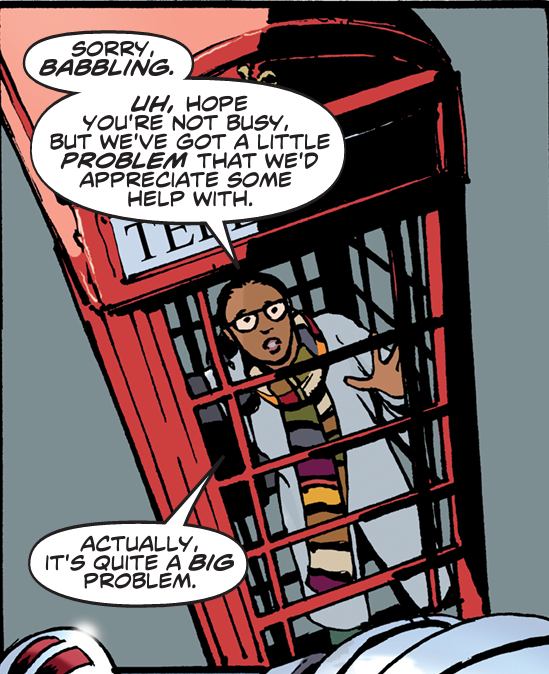
Osgood: Sorry, babbling. / Uh, hope you’re not too busy, but we’ve got a little problem that we’d appreciate some help with… / Actually, it’s quite a big problem.
Starting Year Two of Titan’s Twelfth Doctor sequence, this is a compilation of three separately published stories. The title story starts with a character called Christel Dean, who is clearly an incarnation of well-known Doctor Who fan and writer Christel Dee, teaching at a remote Scottish boarding school with added Sea Devils. Oh, and the Doctor has a new companion, a stuffed swordfish called Sonny. The second story, “The Fourth Wall”, gets properly recursive with characters being absorbed into (and occasionally escaping from) comics, thanks to alien meddling. And the third story, “Robo Rampage”, is a sequel to the Fourth Doctor story Robot, featuring the twenty-first century UNIT. All three of these are above average; I particularly liked the art of Rachael Stott in the first two. You can get The School of Death here.
Next in this list is The Twist, by George Mann et al.
This is a nice idea from Cutaway Comics: what happened in the parallel universe of Inferno? How did Britain get to a state where it was ruled as a military regime by a dictator who looks just like the founder of the BBC’s Visual Effects Department?
This short comic, which I picked up at Gallifrey One earlier this year, has the answers. It’s a somewhat complex plot – Churchill allies with Oswald Mosley, who betrays and assassinates him, and then rules first in alliance with Germany and then against, before being in turn betrayed by the new leader. Meanwhile over in China, a Professor Keller is doing something odd with a mind-bending machine… It’s a well put together romp, though in our timeline Oswald Mosley would have been addressed as “Sir Oswald”, not “Baronet” (obviously a point of divergence there). But a resource-hungry country needs the potential power unleashed by Professor Stalmann…
Good stuff and you can get Inferno here (along with a DVD of extras which I didn’t get at Gallifrey).
I rankedThe Devil’s Chord fifth out of the eight stories from last year’s Doctor Who series, writing about it:
The Devil’s Chord has a really sinister plot, with music being removed from the world; Big Finish has sometimes dared to play with the soundscape of the fictional universe, but this is the first time that the TV show has really gone there. This time it was the execution that was a bit silly, with Jinkx Monsoon really chewing the scenery as the Maestro.
The returning figure from the show’s history that really took me by (pleasant) surprise was June Hudson, in her first appearance on screen at the age of ninety-something; she did all the costume design for late 1970s and early 1980s Who, and also for Blake’s 7. She is the only character actually killed in the 1963 part of the episode.
In his typically readable and enjoyable new Black Archive, out this month, Dale Smith goes behind the spectacle which was my abiding impression of the episode and looks at its commentary on pop culture, especially on the Beatles – indeed, the book is almost as much about the Beatles as about Doctor Who, not that this is a bad thing necessarily.
The first chapter, “The Beatles and the 60s”, looks at the social and political context of post-war change, and in particular how this produced the Beatles, James Bond and Doctor Who. He looks at the extent to which different eras of Who lean towards the Beatles or Bond.
The second chapter, “‘You Can’t Use a Single Note'”, looks in detail at the surprisingly interesting question of when and how the music of the real Beatles has been and can be used in Doctor Who, both in broadcast of new stories and in the re-issuing of old ones.
The third chapter, “The Day the Music Died”, starts by examining the extent to which the episode belongs to the character of Maestro, and then takes a deep dive into music as a cultural phenomenon and the ethical questions of creativity. Its second paragraph is:
Whilst we’ve seen that pop music was a part of Doctor Who almost from the very start, it was predominantly used as diegetic background music. That began to change in the dying days of 20th-century Doctor Who, with Delta and the Bannermen (1987) bolstering its 1950s credentials by including ‘live’ cover versions of a number of period hits, rerecorded by Keff McCulloch, his wife, her sister and a number of other singers put together just for this occasion, or Silver Nemesis (1988) featuring a ‘live’ performance from the actual Courtney Pine². But it was Davies who introduced the modern TV trope of large sections of silent action played to loud, emotive non-diegetic music to Doctor Who, perhaps most notably with the Master unleashing the Toclafane to the sounds of ‘Voodoo Child’ (2005) by Rogue Traders³. But still he held back from sending the TARDIS into one of the few genres it has never visited: the full-blown musical. Rumours abounded that The Devil’s Chord would be Doctor Who’s version of the musical episode, something which had become a staple of genre TV since Buffy the Vampire Slayer (1997-2003) gave us Once More with Feeling (2001). ² Cooray Smith, James, ‘Delta and the Bannerman’. ³ Donnelly, KJ, ‘Tracking British Television: Pop Music as Stock Soundtrack to the Small Screen’, Popular Music vol 21 no 3, Music and Television, October 2002, pp 331-43.
The fourth chapter, “‘I Thought That Was Non-Diegetic'”, looks briefly at the circumstances of the episode’s production, and then at the breaking of the fourth wall in Doctor Who and elsewhere as an element of postmodernism.
The fifth chapter, “Beatles vs Stones”, looks at Russell T. Davies’ intentions for his second go at running the show: change, to adapt to the demands of today’s audience, while also appreciating its ‘cultural heft’. He posts out that while you can have an argument about whether the Beatles or The Rolling Stones were the better band, there is no argument about which was more culturally important. He mounts a strong defense of Davies’ approach to New Who, even in the current uncertainty about the way forward. In a sense, this is the Black Archive we need to read in the current time of confusion.
Once upon a time a long way from Croydon, a child was born, the fifty-fifth child to be born that year in the North Zone in BC-ville. The Nativity Robots decanted her from the amniotic chambers and, with huge smiles upon their chests, duly proclaimed her Sasha 55.
When I watched the TV episode earlier this year, I wrote:
Something didn’t quite gel for me with the first episode, The Robot Revolution. Partly that the plotline wasn’t all that original, but somehow it felt like actors on a set in a way that even early 60s Who didn’t. I was watching it on a cramped screen in a B&B with ants in the floorcracks, so it may not have been the best circumstances, but it really felt like spectacle was being prioritised, and it was one of the weirder introductions for a new companion even by New Who standards.
I am glad to report that I liked Una McCormack’s novelization much more than the TV story; we get a lot more of Belinda’s background and a lot more of poor Sasha 55, and a very good sense of the world of Missbelindachandra as a more-or-less functioning society. It really rounds off the corners of what felt like a slightly hasty TV production. Well worth adding to the shelves. You can get Doctor Who: The Robot Revolution here.
The robarman, Charlie X, at the Witch and Whirlwind was keeping them nicely supplied with drink, so who could complain? And – she smiled at this – she had neatly convinced Professor Shingbourne that none of them needed to be in class until one thirty tomorrow afternoon. As her class automatically followed his, she could have a lie in until about three.
A curious Bernice Summerfield novel in that she’s not in it much; the real protagonist is her ex-husband Jason Kane, who gets mixed up in an archaeological dig gone wrong and also discovers the amnesiac Chris Cwej, a companion from the Seventh Doctor New Adventures novels. There’s also a planet which has got out of place, and Benny trying to work out what is happening at long distance (as are we all). Solid stuff; I see some rave reviews and some very negative, but I was simply satisfied. You can get Deadfall here.
A tale of two parts, a one-shot by George Mann with a twist punchline that you can see coming from a mile off (apology for spoilers, but you probably weren’t going to read it anyway):
And a much better four-parter by Robbie Morrison, picking up the story of the sun-like Hyperion creatures from Fractures, featuring also a heroic fireman and a very venal (“I for one welcome…” politician. I felt that the art sometimes din’t quite get the Doctor and Clara, but otherwise quite enjoyed it.
Michael [Troughton], however, was to see very little of his father as he grew up. While he was still a baby, Patrick set up a second home in south London, near Kew, with his girlfriend Ethel ‘Bunny’ Nuens. Patrick and Bunny would go on to have three children together, but Patrick and his wife Margaret never announced a separation. The couple kept up the pretence that they still had a normal marriage. Patrick’s long absences from the family home were explained away as his having to work away from home, due to the nature of the acting profession. When Patrick’s mother died twenty-four years later, in 1979, she was still unaware of the separation. Patrick and his original family had kept up the façade by visiting her every Christmas Day and pretending that nothing had happened. She never knew she had three more grandchildren.
This is a nice chunky book about the history of Doctor Who, from 1963 to 2024, by the author of the book about Watling Street which I enjoyed a few years ago. It takes an interesting approach: a chapter per Doctor (two for the First and Fourth Doctors), looking very much at the story behind the scenes, why particular decisions were made, why particular people were hired and fired, and treating the sixty years of the show as a whole, single phenomenon to be explained as a whole.
A lot of the material was familiar (indeed the Second Doctor chapter seemed very familiar to me, though others seemed more original). I wished also that a bit more space had been given to the spinoff series (sadly neither The Curse of Fatal Death nor The Scream of the Shalka is mentioned), and to the comics, books and audios (and indeed games); although the TV series is by definition the core, there’s a lot more Whoniverse out there.
(Also, it is not entirely Higgs’ fault, but I cannot completely forgive him for inspiring me to seek out Jon Pertwee’s two scenes in the 1977 sex comedy Adventures of a Private Eye. I urge you not to look for them. Some things are better left in well-deserved obscurity.)
However, Higgs brings a lot of good stuff here. His analysis of how the show got created in the first place in 1962-63 is one of the best of the many that I have read, bringing in some new facts and circumstantial material. I think he is also right to split the First and Fourth Doctor eras; the case for treating Four/Hinchcliffe distinctly from Four/Williams+JNT is fairy obvious, but I have long felt that there’s a similar case for One/Lambert and One/Wiles+Lloyd, and Higgs just does it effortlessly.
It also feels to me like it’s fairly rare to take the holistic approach and treat Old Who just the same as New Who (and the Movie). Even within Old Who, we tend to treat the so-called black-and-white era separately from the color era. But in principle, there’s no reason not to apply the same analytical approach to all of it, and Higgs demonstrates that such an approach can be successful.
A particular sub theme that I will have to think about is Higgs’ insistence that some key stories should be seen as direct reflections of what was happening in the production history of the show at the time. So, the two trials of the Doctor in The War Games and in Season 23 reflect the pressures of potential cancellation of the entire show (as does The Greatest Show in the Galaxy). This only gets you so far, but it does get you a certain distance.
In the end, Higgs is entitled to write the book he wanted to write, which is not completely the book I wanted to read, but is certainly close enough to it to make this very worthwhile. It’s only just out, folks, so you may not have seen much hype around it – well worth getting, and I will nominate it for the BSFA Non-Fiction award next year. You can get Exterminate/Regenerate here.
And it just … kept … going. A howl of deep, horrible agony, a soul-shredding pain.
A Fifteenth Doctor novel set during his travels with Belinda, probably between Lux and The Interstellar Song Contest, with the Doctor and Belinda exploring a world where a dying sentient spaceship’s screams are disrupting the mental state of everyone withing range, most notably the descendants of the original crew who live in Sevateem-like conditions. It’s a fairly standard plot, but what I like is that we get a lot more characterisation of Belinda than we did onscreen; one of the things I didn’t like about the most recent season was that we didn’t really get to know her, and Fergesen has done well by her in this story. Not a book for non-Whovians, but a pleasing extra for fans, especially younger fans. You can get Spectral Scream here.
Short, sweet story read by Carole Ann Ford, with the First Doctor working through his relationship with Barbara. Phipps says it is set at the very end of The Edge of Destruction. I groaned a little at the punchline which I found a bit corny, but otherwise it is nicely done. You can get A Small Semblance of Home here.
Second frame of third story (“The Body Electric”):
Two hours earlier… Clara: When you mumbled something about where we were going, Doctor, I thought you were taking me for dessert. Doctor: No time for consonant-based puns, Clara. Doctor: These are the quartz wastes of Asmoray.
Another collection of three Titan Comics stories featuring the Twelfth Doctor and Clara. The first is about a bereaved family trying to reunite across timelines but finding that nasty timey-wimey creatures want to get involved. The second has Sammy Davis Junior, Dean Martin and friends thwarting alien invasion in 1960s Las Vegas. The third has Clara reflecting on her own role as she helps ward off another alien threat to an exploitative human colony, and perhaps goes in the wrong direction. All decent enough. You can get Fractures here.
Next in this sequence: Hyperion, by Robbie Morrison et al.