Man on left: “No thank you Mr Kin. / Who’s the little girl? Your granddaughter?” Man behind desk: “Chiyoko. And no, my wife and I were never blessed with children. / Chiyoko acts as my … marketing consultant on the Goruda project.”
This is a compilation of comic strip stories from Doctor Who Magazine during the Eleventh Doctor era, all by Jonathan Morris; I had not appreciated it at the time, but they actually have a cleverly worked out arc (about, er, the Child of Time) which culminates at the end, shortly after we meet the killer Brontë sisters.
Charlotte: “Doctor, how delightful to finally make your acquaintance!” Emily: “If I may introduce myself – I am Emily, these are my sisters Charlotte and Anne.” Anne: “Together, we are the Brontës!”
Having been working through the IDW Doctor Who comics dating to the same era, it’s interesting to feel a very different dynamic to the DWM strips, which have much shorter episodes and also had to respond to the TV show in real time – there are some very informative endnotes from Morris and the artists about the creative process.
Also I particularly like the story with C.S. Lewis and J.R.R. Tolkien.
C.S. Lewis: “‘…And that was the very end of the adventure of the bookshop.’ / So, what does everyone think?” J.R.R. Tolkien: “Well, I thought it was a bit juvenile… a jumble of unrelated mythologies… all rather derivative, I’m afraid… / And I wasn’t convinced by the allegorical element at all!”
Meanwhile, advancing internal decay, as well as external pressure, had severely weakened the Porte. Capitalising on this weakness, the Serbian and Montenegrin principalities took advantage of the Russo-Ottoman war of 1877-8 to invade Kosovo, thus bringing the Serbs and Montenegrins into their first serious conflict with Albanians. Thousands of Kosovo Serbs crossed over into Serbian territory to enlist in the Serbian army; those Serbs and Montenegrins who remained in Kosovo largely managed to avoid conscription into the Ottoman army by bribing military officials. Facing little opposition, the Serbian army advanced steadily, occupying the towns of Nis, Lescovac, Vranje and Prokuplje, before entering Kosovo. During this period thousands of Albanians were forcibly expelled from the region of Toplice in the Sandjak of Nis, and many of the region’s mosques were destroyed, while as many Serbs fled southern Kosovo ahead of unleashed bashibazouks, who began to take vengeance upon the remaining Serbian inhabitants. The operations of the Serbian army in Kosovo provoked a wave of refugees in the opposite direction as an estimated 30,000 Albanians deserted those parts of the region which the Serbian army occupied. Alongside the retreating Ottoman troops were thousands of displaced Albanians who arrived in Kosovo as refugees. Unaware that Russia and the Porte had agreed to a truce, the voluntary Serb regiment of Major Radomir Putnik took Gnjilane, while the advance guard of the Serbian army reached the Gracanica monastery near Pristina towards the end of January 1878. There a solemn liturgy was performed to honour the victory of the Serbian army and Prince Milan, and a commemoration was held for the heroes of 1389. However, the concluded truce was inclusive of the Serbian army whose units were thus compelled to withdraw from Kosovo.² ² Batakovic, The Kosovo Chronicles, p. 108.
I had read this ages ago, soon after it came out in 1998, and like any book about Kosova published before 1999 (well, 2008), it misses the climax of the story through no fault of the author’s. It’s also somewhat in the shadow of Noel Malcolm’s better known Kosovo: A Short History. But it complements Malcolm in concentrating on the twentieth century and the internal dynamics of Kosova’s emerging autonomy and confidence within pre-1988 Yugoslavia, followed by the collapse of communications between the majority population and the structures of the state.
It’s actually rather difficult to see what other paths were possible from the main actors at the end of this period, given the personalities and starting points; Milošević’s destruction of the Yugoslav state was rooted in his destruction of Kosova’s autonomy, while on the other hand Kosovar militants were not in a position to resort to military pressure earlier than they actually did, never mind the fact that the Americans had told them not to.
I had forgotten, if I ever knew, that the political violence spilled from Kosova as far as Brussels. Vickers recounts that in 1981, a Yugoslav diplomat was killed and another injured in a shooting near the Bourse, in what was then the White Horse pub and is now a hotel / shisha bar called La Pièce. The gunman himself was found shot dead in 2004 in the Loi underground car park, quite close to my office. There were other Brussels incidents too, but those were the most notable. (And of course there were plenty of incidents in other parts of Western Europe.)
This was my top unread book about Kosova. Next on that pile is British Generals in Blair’s Wars, edited by Jonathan Bailey, Richard Iron, and Hew Strachan (where I suspect the Kosova content may not be huge).
Next in my sequence of educating myself about the work of winners of the Nobel Prize for Literature who were not white men. Gabriela Mistral (real name Lucila Godoy Alcayaga, 1889-1957) was awarded the Nobel Prize in 1945, the first Latin American writer to get the award. Originally trained as a teacher, she had become famous as a writer with her second volume of poetry, Desolación, published in 1922, and had also pursued an international career in education which transitions to being a full-time diplomat from 1932 onwards.
Her Nobel speech is short and modest, and the presentation speech from the Swedish Academy is also short but makes interesting parallels with the career of Selma Lagerlöf, also a schoolteacher who hit the big time with her writing.
It’s actually quite difficult to get hold of Mistral’s writing in English, and I had to be satisfied with a 2002 collection of prose and prose-poems edited and translated by Stephen Tapscott. The second paragraph of the third piece, “The Golden Pheasant”, is:
Gracias al blanco y al negro no hace arder el arrayán sobre el que se coloca.
Thanks to the white part and the dark part, it doesn’t scorch the myrtle tree where it perches.
I found the pieces in general lyrical, but also sad; a lot of them are religious, rooted in the Catholic tradition which looked eternal in the early twentieth century but is now crumbling away; the emotional energy is rich and intense. None of the passages particularly jumped out at me, but I could see that the whole is at least as great as the sum of tis parts. The observations at the end about writing and politics are also interesting, as she tried to carry the perspectives of Chile to the rest of the world and vice versa. You can get it here. I wish I had been able to find a translation of Desolación though, or of Ursula Le Guin’s tranlation of some of her poems.
The circumstances of [David] Hunter Blair’s conversion were spectacular. During the winter term of 1875 he obtained leave to study music in Leipzig and from Leipzig proceeded to Rome in time to attend the ceremony at which [Henry] Manning was created a cardinal, on 15 March 1875. Manning was a special hero because of his stern espousal of the doctrine of papal infallibility, which he had recently defended against Gladstone’s charge that it ‘equally repudiated modern thought and ancient history’. Swept away by enthusiasm, Hunter Blair, ten days after the Manning ceremony, was himself received into the Church. He was a notable convert: Archbishop (later Cardinal) [Edward] Howard confirmed him, Pius IX himself blessed him and conferred on him the honorary post of papal chamberlain.
When I was nine years old, the final edition of Burke’s genealogies of noted Irish families was published. The Whytes qualified for entry not for being famous, as we weren’t (apart from one or two notable ancestors in the 16th and 17th centuries) but because we happen to have a genealogy that goes back to the twelfth century, though I suspect that the earliest parts are fake. I noted with very slight interest that the family listed immediately after us in Burke’s had changed their name at some point, and vaguely wondered why. Eventually I found out.
(And, good heavens, they published people’s private addresses back in those days! Merlin Holland, Oscar Wilde’s only grandchild, is still alive aged 80, but has lived in France for many years now.)
Richard Ellmann’s Pulitzer-winning biography of Wilde is pretty comprehensive. It starts with his parents, noted surgeon Sir William Wilde and the revolutionary poet and writer born Jane Elgee but known as Speranza. (Oscar was born at 1 Merrion Square.) 550 heavily footnoted pages take us through the 46 years of Oscar’s life, though it’s clear that there is a lot more to say about him (and some of it has been said).
It’s a story that combines many elements. While still a student at Oxford, Wilde rapidly became famous for being famous, to the point that D’Oyly Carte sent him on a (very enjoyable) lecture tour of America before launching their opera about him, Patience. But he was a genuinely good writer as well; Ellmann goes into some of his work, but I think more could also be said about the extent to which it echoed his life.
Wilde was a posh boy who made a career out of being a posh boy, but intellectually he was genuinely a supporter of socialism, Irish nationalism and revolution. This is what gives the drawing-room comedies their vicious edge; he is echoing back to his English hosts what he actually heard them saying behind the polite niceties.
He very courageously chose martyrdom because of his sexuality. He could have escaped to France, Italy and/or the USA and avoided prosecution. But he chose to stay and face his fate in the courts, though he knew it would probably kill him.
Nancy Mitford (born four years after he died) has a telling observation on his legacy in The Pursuit of Love, in an exchange that would have fitted well into one of Wilde’s own plays:
Linda and I were very much preoccupied with sin, and our great hero was Oscar Wilde.
‘But what did he do?’
‘I asked Fa once and he roared at me – goodness, it was terrifying. He said: “If you mention that sewer’s name again in this house I’ll thrash you, do you hear, damn you?” So I asked Sadie and she looked awfully vague and said: “Oh, duck, I never really quite knew, but whatever it was was worse than murder, fearfully bad. And, darling, don’t talk about him at meals, will you?”’
‘We must find out.’
‘Bob says he will, when he goes to Eton.’
Wilde was witty but not wise; he spent his way through both money and relationships extravagantly. Even the grand love affair with Bosie Douglas, which brought him down, seems to have brought him as much pain as pleasure. He genuinely loved Constance and his sons, but accepted that the consequences of his own choices had parted him from them.
It’s a really interesting book and I recommend it, though I know that scholarship in the last four decades may have advanced our knowledge of Wilde a bit further. You can get it here.
This was my top unread non-fiction book. Next on that pile is H is for Hawk, by Helen Macdonald.
We watched the National Theatre production of The Importance of Being Earnest, starring Ncuti Gatwa as Algernon, a few weeks back. I didn’t feel that the stage production transferred to the screen all that well – obviously in live theatre, a lot of the experience is bound up in the audience dynamic with the actors. But Ncuti Gatwa is, as ever, completely magnetic, and Sharon Clarke (who was Grace O’Brien, Graham’s wife / Ryan’s grandmother, in Doctor Who) steals the scene as a very West Indian Lady Bracknell.
Note also Richard Cant, Brian Cant’s son, as Canon Chasuble. The staging more than hints at intense relations between Algernon/Jack on the one hand and Gwendolen/Cecily on the other, and livens it up with music long postdating the original 1895 production. I think the only production of the play that I had seen before was a 1988 BBC version with Joan Plowright and Paul McGann. (But can that be right? I feel it was a bit earlier.)
Anyway, the play itself is very entertaining if just a bit implausible, and although the good lines are front-loaded in the first half, the whole thing is fun.
In anticipation of the 25th anniversary of my bookblogging, which will come in late 2028, I’m reposting my monthly summaries since November 2003 when I started. (I already did this in 2019-2023, but this gives me a chance to consolidate all the posts and links to this WordPress site rather than my old Livejournal.) Everything will be linked under the bookblog nostalgia tag.
The big work news of February 2004 was the tragic death in a plane crash of Boris Trajkovski, the genial President of Macedonia who was very friendly with me and many others. This was the day after we published a report on pan-Albanianism (concluding that there was not much there there). I also went to London to shadow my boss at a Chatham House meeting where the other speaker was the late great Albert Rohan.
4,400 pages (YTD 8,300) 3/21 by women (YTD 6/21) none by PoC
The best of these was probably The Cambridge Companion to Science Fiction, which won the Hugo the following year; you can get it here. Molvania has some good lines; you can get it here. The one to skip: The Meeting of the Waters.
Apologies for length, but this is an important monograph about an important Doctor Who story.
I first watched the original version of The Daleks back in 2007, from the DVD set of the first three Who stories. I wrote then:
Great fun. I had of course read David Whitaker’s novelisation, roughtly 25 years ago. A few things that sprang to mind:
1) the settings were very convincing – the Dalek city (OK, we know with the eye of hindsight that it was a model shot), the sense that this was a big landscape with forest, swamp and caves.
2) Barbara’s romance with Ganatus – there is surely some fanfic dealing with that somewhere?
3) The devious Doctor, sabotaging the TARDIS deliberately to get a chance to explore the city.
4) The time travellers, despite Barbara’s relations with Ganatus, are all set to just bugger off and leave the Thals to their doom at the end of episode 4.
5) The end of episode 6 is indeed a literal cliff-hanger – with a brutal resolution
6) Terry Nation’s attack on pacifism. A lot more ideological than I remembered from the book.
7) The Daleks at the end talking about the total extermination of the Thals practically raise their plungers in Nazi salutes – sounds silly when I describe it but actually very effective.
8) the one bit that really didn’t work – the fight at the end; the time-travellers and Thals win too easily.
Anyhow, well worth it. I watched with the closed caption commentary, which to be honest was more annoying than helpful on the whole. Though it was interesting that the very day of the filming of the Doctor’s first encounter with the Daleks was 22 November 1963, the day before the first Doctor Who (recorded over a month before) was to be broadcast, and also the day of John F Kennedy’s assassination. (And of the deaths of C.S. Lewis and Aldous Huxley; but who remembers that?)
When I came back to it in 2009 early in my Great Rewatch, I wrote:
The Daleks really is where Doctor Who gets going. There is a case to be made that the pepperpots never get so interesting again. Certainly they are incomprehensible, blankly hostile, psychopathically destructive, and strangely watchable. The conversion of the Thals from pacifists to fighters has some moral ambiguity – the Tardis crew are motivated by their own need to get away, and there is a certain air of tragedy even in the final victory. (Shame that the actual final fight scene is a bit crap.) And Barbara gets the first Who romance with Ganatus (comprehensively rewritten to Barbara/Ian by David Whitaker for the book).
Coming back to it again, I felt that it holds up really well, especially if you are sensitive to the cramped sets and other constraints of the production. The four main cast are very good, clearly getting into their stride. And I should have previously mentioned the superb incidental music of Tristram Cary. You can get it in this box set.
The colorised and abbreviated version of the story released a few years back (you can get it here) foolishly dumps Cary’s music, misses some of the plot and loses out a bit on pacing, but ends with this lovely montage of the rest of the Hartnell era.
I know the novelisation well, and re-read it for this post. The second paragraph of its third chapter is:
I ran towards the sound, the branches of trees cracking and powdering in clouds around me as I forced my way through. I found Barbara with her back pressed up against a tree, the knuckles of one hand pushed hard against her teeth. She was staring away from me into some bushes. I caught the glint of the eyes of some animal or other and stopped dead still.
There was a time when this was literally the only Doctor Who book in existence (under its excellent original 1964 title of Doctor Who in an Exciting Adventure with the Daleks); indeed it was the only commercially available representation of any Doctor Who story, in those days long before video-recorders (let alone DVDs). So we have Whitaker taking much greater liberty with Terry Nation’s TV script than almost any other novelisation (John Lucarotti’s treatment of The Massacre differs even more from the story as broadcast, but he was reverting back to his own original script).
And the result is quite possibly the best of the novelisations, judged as a novel. The opening of the story is comprehensively rewritten, Ian being an unemployed research scientist who accidentally encounters Barbara, who has been tutoring the mysterious Susan, and gets involved with the Doctor and his Tardis. So much time is invested – wisely – in setting the scene that we are a third of the way through the book before we reach the equivalent point to the end of the TV story’s first episode (out of seven).
The biggest novelty, for those of us who have read almost any of the subsequent hundreds of Who books, is that the whole story is told in the first person, from Ian’s point of view. (It’s not unknown in later Who literature, but it is very unusual.) This does require a certain amount of narrative juggling, but Whitaker gets away with it better than I remembered from when I first read this, three decades ago.
Today’s generation of fans will squee at the pronounced sexual tension in the Ian/Barbara relationship here – the TV story has Barbara close to flirting with Ganatus, one of the Thals, but he barely gets to look at her on the printed page. Poor Susan rather fades into the background as well after she has done her mercy run to the forest. The characterisation of the Doctor is much more harsh and edgy than Hartnell’s depiction; since Whitaker was the story editor, perhaps this was what he had originally in mind? (A possibility supported by the surviving first cut of the first ever episode.)
And the Daleks themselves are pretty memorable here, though Whitaker seems a bit confused about their size – three feet high at one point, four foot six at another, though the illustrations are of our “normal” sized pepperpots. However, this confusion is compensated for by the glorious description of the mutants within the metal casings, and their glass-enclosed leader. The TV show has never managed such memorable presentations of the creatures inside, though it has occasionally tried. (The versions encountered by the Ninth Doctor come closest.)
Anyway, this is an excellent read, well worth hunting down.
In for a penny, in for a pound, I thought, so I went and also rewatched the Peter Cushing film Dr Who and the Daleks. Last time I saw it, in 2010, I wrote:
As a Doctor Who fan, it is impossible not to judge this film in comparison with the original seven-part Dalek story, so I won’t really try. The positives: it is in colour, which is a huge difference. It looks better (except, oddly enough, the interior of Dr. Who’s Tardis, which just looks like a film set with some machines dotted around it). The plot is tighter – it’s difficult (with one exception, which I’ll get to) to remember what has been cut from the original story to produce a film half its length, and some of the best bits are still there. The music is decent – not as unearthly as in the TV version, but not offensive either.
The huge difference, however, is in the performances and portrayals. Peter Cushing plays elderly slightly comical scientist Dr. Who, who keeps a time machine called ‘Tardis’ in his back garden, shaped like a police box for some reason. He doesn’t have the grumpy gravitas of William Hartnell, but I detect some homage to his portrayal in the approach taken by Sylvester McCoy. Roberta Tovey as his nine-year-old granddaughter Susie is actually rather good, and recasts Carole Anne Ford with perhaps a bit more grit.
When I first saw this on a Saturday morning repeat aged about 11, the surprise was that Ian is played by Roy Castle, who of course I knew as the presenter of the BBC children’s programme Record Breakers. This was actually his second film role – he had also appeared with Peter Cushing in another Max Subotsky film with a doctor in the title (Dr. Terror’s House of Horrors) earlier in 1965. Castle’s Ian starts as a clown but more or less settles into the heroic sidekick to Cushing’s Who by the end, probably the closest of the four main characters to the TV version (though William Russell’s Ian is much brainier).
The most serious cut in the film as compared to the TV original is Barbara, Dr. Who’s other grand-daughter, played by Jennie Linden. She gets almost nothing to do, except that her over-vigorous embrace of Ian sets Tardis going in the first place. (And even that is portrayed as Ian’s clumsiness.) She is practically background scenery, especially when compared to Jacqueline Hill’s history teacher.
Rewatching it in close proximity to the original TV story brought home to me how much better the latter is. Just compare the almost wordless acting of Hartnell and Russell here:
versus Cushing, Castle and Tovey playing the same scene for weak laughs here:
Obverse Books have published a novelisation of the film, ostensibly by “Alan Smithee” but I believe actually by Iain McLaughlin. The second paragraph of its third chapter is:
Ian considered himself to be fit and healthy. He had been drilled into good shape during his National Service and he was still active now, playing football twice a week and turning out for the local cricket side during the summer. He also went dancing – hopefully from now on with Barbara – every weekend, but even he was feeling the effects of the journey. He was out of breath and perspiring heavily. His shirt was soaked with sweat and his muscles ached.
It made me realise that the visual comedy of the film is one of its key elements, very difficult to transfer to the printed page! Anyway, you can get it here.
So, on to the latest of the Black Archives, Oliver Wake’s monograph on The Daleks, concentrating on the original TV series but also referring to the Whitaker novelisation and the Cushing film, and to later Dalek and Terry Nation stories. There is a real break of format with previous Black Archives, with no less than eighteen short chapters each addressing a different aspect of the story, and building the overall case (which is surely unassailable anyway) that The Daleks can be seen as the crucial founding text of the show as a whole. A short introduction explains the book’s agenda:
I aim, firstly, to explore the influences and inspirations Nation called upon in devising the story; secondly, to analyse the story’s mixed authorship and the ways in which varied contributors gave it meaning; and thirdly, to examine The Daleks’ world-building as a piece of televisual fantasy fiction.
The first chapter, “Commissioning The Daleks”, recapitulates what we know about how the story came into being – it was written very quickly, which meant that it was ready for production when an early gap needed to be filled.
The second chapter, “The Bomb”, looks at how the story portrays radiation sickness and the neutron bomb.
The third chapter, “A Climate of Fear”, looks at other portrayals of the aftermath of nuclear war in fiction up to the mid-1960s. Its second paragraph is:
Stories of nuclear weapons had been science fiction and consequently were hidden away in niche publications. After the Second World War they began to emerge into the mainstream, in Britain at least; in the more conservative USA they tended to remain hived off in the sci-fi niche¹. Every conceivable scenario of nuclear devastation was played out in literature, much of it ill-informed and scientifically illiterate. ¹ Brians, Paul, Nuclear Holocausts: Atomic War in Fiction, unpaginated online edition, Chapter 1.
The fourth chapter, “The Survivors”, queries the extent to which the story is meant to show the future of Planet Earth humanity.
The fifth chapter, “The Dead Planet”, looks at the Petrified Jungle and also in some detail at the Magnadon (the dead metallic lizard).
The sixth chapter, “Alien Sound”, looks at the brilliant soundscape of the story created by Tristram Cary’s music and Brian Hodgson’s effects. As I noted earlier, this is one point where the Cushing film is seriously deficient.
The seventh chapter, “The Time Machine”, looks at the influence of Wells’ novel and George Pal’s film adaptation on The Daleks.
The eighth chapter, “The Mutants”, looks at what we are told about both Thals and Daleks as mutations, and points out the inconsistencies. (I must say I prefer this approach to desperately trying to retcon everything.)
The ninth chapter, “The Aryan Thals”, points out the problematic of the perfect Thal race being tall and blond, leaning again on The Time Machine.
The tenth chapter, “Pacifism, the Thals and Terry Nation”, goes into Nation’s well-documented political views, which he expressed as pacifist and sometimes socialist. (So Gareth Roberts is completely wrong on this, not surprisingly.) Ian’s argument with the Thals is Nation’s argument with himself.
The eleventh chapter, “Gender and Authority”, looks at the story’s problematic treatment of gender roles among the Thals and the character of Dyoni, and queries how both Thal and Dalek societies are actually governed.
The twelfth chapter, “Martians and Ants”, looks at the influence of The War of the Worlds (both the Wells novel and the 1953 film) and the early John Wyndham story “Wanderers of Time” on The Daleks.
The thirteenth chapter, “The Power (and Irradiation) of the Daleks”, looks at the Daleks’ dependence on static electricity, their life support systems, and their vulnerability to radiation, and then asks, what do they eat?
The fourteenth chapter, “Outer Space Robot People”, makes some interesting points about who the Daleks are shown to be, as opposed to later portrayals.
In their first appearance, the Daleks are scared isolationists. They are survivalists trapped in their fallout shelter, unable to go outside but possessive of the world beyond their city. This jealousy manifests as paranoia and xenophobia when the Doctor’s party and then the Thals come calling.
The sixteenth chapter, “The Direction of the Daleks”, calls attention to the work of Christopher Barry and Richard Martin in bringing the story (and the Daleks) alive.
The seventeenth chapter, “Extermination, Then?” looks at how the Daleks’ catchphrase slipped subtly into the script.
The eighteenth chapter, “Dal to Lek”, looks at the sources for the name Dalek. These include Wyndham’s “Wanderers of Time” and Nation’s general fondness for cycling through similar names. Wake considers and discounts the relevance of the fact that “dalek”/“daleko” means “far away” in the languages once known collectively as Serbo-Croat.
If I may divert for a moment, I am not quite so sure. My relationship with Balkan nationalisms is ambivalent, but there is a haunting Serbian First World War song, “Tamo daleko”, about the exiled remnants of the Serbian army sheltering on Corfu. (As a Serbian military friend once said to me, it’s not so much like Dire Straits’ “So Far Away From Me”, which would be a literal translation of the title, as “It’s a Long Way to Tipperary”, only less jolly.) I do not know if Nation was ever exposed to, say, a Serbian restaurant playing live or recorded folk music, or some other aspect of Serbian culture, but I can imagine him hearing this song somewhere, somehow, and “daleko” sticking in his subconscious memory. It is the heavily emphasised second word of each of the first three verses; even if you don’t speak any Serbian, it is difficult to miss.
A brief conclusion pulls all this together and looks at questions of authorship.
An even briefer note looks at one of the story’s many variant titles, “Beyond the Sun”, and how this might have come to be.
I was a bit worried at first that I wasn’t going to like this Black Archive; Wake’s style starts out a little jerky. But he settles down fairly quickly and delivers a must-read analysis of one of the most important Doctor Who stories. You can get it here.
Well, Switzerland marks the 100th country in the world by population (of 234 on the Worldometer list), so i thought it would be a good moment to look back over the last two years of posting about the best known book in each country.
First of all, of course my methodology is a white, Western measure of the extent to which particular authors and works are recognised in the mainly Anglophone world of LibraryThing, Goodreads and StoryGraph. This doesn’t make my analysis valueless, but it does mean that each of my posts should be regarded as a jumping-off point rather than a definitive answer to the question, “What should I read about this country?”
(I was very amused when a work colleague, planning to go on holiday to Tunisia, told me that he had asked an AI agent what books to read about the country and it recommended my Tunisia page and therefore Flaubert’s Salammbô – I hope that the fictional account of Carthage in the third century BC was useful.)
Second, for developing economies there is therefore a bias towards Western writers who have gone in as white saviours – literally in a couple of cases where there is a strong Christian element to the story. For each country I have therefore tried to also note the top-ranked local authors, and in cases where the list is rather male, the top-rated women authors.
Third, I’m genuinely finding this project fun, especially as we get to countries that I know less and less about – though even in the more familiar European territory, I’m finding new work published since I did a similar analysis for European countries only in 2015.
Of the hundred books so far, there are fifty known to be by men, forty-nine known to be by women, and the Epic of Gilgamesh whose author is unknown.
54 are by authors who (in my judgement) are not from the country that they have written about in this case, but 46 are by local writers.
I count one play (Italy); two graphic novels (Iran and Côte d’Ivoire); 19 science fiction or fantasy; 22 non-fiction; and 56 fiction other than plays, graphic novels, or sff.
See here for methodology, though NB that I’m now also using numbers from Storygraph. Books are disqualified if less than 50% of them is set in Switzerland.
Title
Author
GR raters
LT owners
SG reviewers
Heidi
Johanna Spyri
212,815
14,145
16,290
The Sanatorium
Sarah Pearse
205,740
2,418
29,120
The Magic Mountain
Thomas Mann
63,457
11,051
4,251
The Other Einstein
Marie Benedict
88,207
1,757
7,882
The Physicists
Friedrich Dürrenmatt
44,556
2,126
5,881
The Enigma of Room 622
Joël Dicker
76,499
1,019
5,884
The Visit
Friedrich Dürrenmatt
39,324
2,078
5,166
The English Assassin
Daniel Silva
45,379
2,413
2,200
When I did this survey less systematically back in 2015, I awarded the prize to Frankenstein; but I have checked, and in fact considerably less than half of the book is set in Switzerland. So I have had to disqualify it here.
I declared Heidi the runner up in 2015, and I declare her the winner this time. In case you don’t know, it’s a wholesome tale of an orphan girl, brought up by her grumpy grandfather, bringing hope and healing. Johanna Spyri, the author, lived in Switzerland all her life. (Incidentally the bridge over the Rhine near Maienfeld, the town where most of Heidi is set, is called the Tardis Bridge. Yes, really.)
The Sanatorium was only published in 2020, so would not have been on my 2015 list, but it has clearly done very well, rivaling Heidi on Goodreads and actually beating her on StoryGraph. It’s a murder mystery set in, er, a sanatorium. The Magic Mountain a classic novel which came third in my 2015 survey, comes third again; it too is set in a sanatorium.
The Other Einstein is about Albert’s first wife, Mileva, and her unhappy life with him in Zürich. She was an ethnic Serb from what was then the Austro-Hungarian Empire and is now Vojvodina, and was also a talented scientist to the point that she may deserve credit for some of the work published under Albert’s name.
I am not completely sure about The Physicists, a play about three physicists in, yes, a sanatorium. But it was originally written in German, and the name of the sanatorium, Les Cerisiers, is French, and Dürrenmatt is in general a very Swiss writer, so I think it counts.
The Enigma of Room 622 is a mystery novel by French-speaking Swiss writer Joël Dicker. All his previous books were set in America, but this one is in a somewhat fictionalized Geneva.
The Visit, like The Physicists, is a play by Dürrenmatt which is not explicitly set in Switzerland, but the protagonist’s real name turns out to be Kläri, which is very Swiss.
Again I wasn’t completely sure about The English Assassin, a baroque tale of wartime looting of Jewish property coming home to roost decades later, but I think enough of it happens in and around Zürich to count for my purposes.
Thanks to StoryGraph we gained The Enigma of Room 622, which scored relatively poorly on the less Francophone LibraryThing, and lost Memories, Dreams, Reflections by Carl Jung. Hotel du Lac, by Anita Brookner, was in a very close ninth place both with and without StoryGraph numbers.
I disqualified a lot of other books without needing to think too hard. Only one apart from Frankenstein caused me any head-scratching – Daisy Miller by Henry James. However the action switches to Italy from Switzerland just before the half-way point in the book.
The next four countries are very different from each other – Sierra Leone, followed by Belarus, then Laos and then Turkmenistan.
In case you hadn’t noticed, this year’s Hugo Voter Packet is out, with tremendous efficiency; I had however already located a lot of the finalists online, and wrote up this listing of the stories in advance.
1) My top vote goes to “In My Country”, by Thomas Ha. I thought this was a tremendously creepy depiction of a totalitarian society where thought control and euphemism are heavy and omnipresent. Also on the Nebula ballot.
You didn’t know these things about him when he first moved to your city. You’d talked yourself out of the associate’s degree before high school graduation, pragmatism trumping college dreams, and taken an apprenticeship as an electrician with a program specializing in bot tech. You were progressing well, nearing the end of your training. You liked unravelling tricky problems the best, diagnosing a malfunctioning bot like a doctor might a patient.
We adopt a pair of cats. We name them Shaun and Liz.
4) “Wire Mother” by Isabel J. Kim. What do you do if you are a teenager whose mother has been replaced by an AI? Second paragraph of third section:
Rina’s in her late twenties. Before there was Rina, there was Wren, and before Wren, there was Agatha, all of whom were pretty, strawberry-blonde women who Cassie’s father had dismissed before they turned thirty. On the screens, Cassie’s mom is forever twenty-five. Some digital people age in simulacrum. Others stay the same as when they were created, and AMY was made the moment that Cassie’s father had the funds to make himself a wife
5) “Laser Eyes Ain’t Everything” by Effie Seiberg, about a superhero who is also a wheelchair user. I appreciate the message but I found the prose a bit clunky. Second paragraph of thirdsection:
The union leader, a woman named “Big Dig” with hands like gopher claws, went through the agenda. Most of it was assigning press stuff. But eventually we got to the one real thing on the agenda—the union wanted to defeat Doctor Croc, a green scaly menace who’d been razing buildings, most recently a conference center.
6) “Six People to Revise You” by J.R. Dawson. I didn’t really understand this one, and to the extent that I did, I wasn’t sure if it was sf. Second paragraph of third section:
In anticipation of the 25th anniversary of my bookblogging, which will come in late 2028, I’m reposting my monthly summaries since November 2003 when I started. (I already did this in 2019-2023, but this gives me a chance to consolidate all the posts and links to this WordPress site rather than my old Livejournal.) Everything will be linked under the bookblog nostalgia tag.
The most crucial event of January 2004 was that little U took her first steps, at 13 months.
My first work outing of the year was to the Liberals’ New Year reception in Brussels, after which I note that I had an awful lot of whisky with MEP Graham Watson. I was on a panel with the Bosnian and Croatian foreign ministers as well. (Fraser Cameron sitting between them.) This was shortly after returning from a conference on Moldova in Munich.
We also did a report for the new Independent Monitoring Commission in Northern Ireland, comparing its mission with Balkan equivalents. This was also the month that I started to seriously strategise about getting a job with the new European Commission due to take office at the end of the year. (Spoiler: I didn’t get a job there in the end.)
The Lord of the Rings is of course one of my favourite books ever, but that was a re-read (you can get it here if you still need to). My best new book this month was Claire Tomalin’s Samuel Pepys, which is superb and made me a real Pepys fanboy (and also a bit of a Claire Tomalin fan). You can get it here.
Second paragraph of third story (“The Case of the Discontented Soldier”):
The major took a deep breath and abruptly plunged through the swing door leading to the outer office. A plain young woman looked up from her typewriter and glanced at him inquiringly.
A dozen Agatha Christie stories featuring London – though the main settings of individual stories can wander far beyond the suburbs and into the Home Counties. Includes some of her crazy wannabe political thriller work, notably “The Kidnapped Prime Minster”, and some particularly contrived romances, such as “The Case of the Discontented Soldier” and “The Listerdale Mystery”. But there’s some good classic mystery stuff here too, notably “Witness for the Prosecution”, and “The Case of the Caretaker”. Thanks to whoever at HerperCollins had the idea of finding and assembling all of these. You can get Capital Christie here.
Current Annette Vallon: A Novel of the French Revolution, by James Tipton Sometime Never…, by Justin Richards Inventing the Renaissance, by Ada Palmer The Damnable Question, by George Dangerfield
Last books finished The Lost Dimension Book 1, by Cavan Scott et mult al Crooked House, by Agatha Christie Equinox, by David Towsey The Raven Scholar, by Antonia Hodgson The Lost Dimension Book 2, by Gordon Rennie et mult al Kosovo: The Path to Contested Statehood in the Balkans, by James Ker-Lindsay Coffeeshop in an Alternate Universe, by C.B. Lee
Next books Jubilee, by Robert Shearman British Generals in Blair’s Wars, by Jonathan Bailey Slow Horses, by Mick Herron
I am enjoying working my way through the BBC Doctor Who audiobooks starting from a decade ago. This is a series of four loosely linked stories, two by one of my favourite Who writers (James Goss) and two by one of my least favourite (George Mann). The linking theme is a family called Winter who possess a card that summons the Doctor and the TARDIS, and is passed through the centuries. I may have missed something, but I didn’t think that the overarching theme was actually resolved, which subtracts from the narrative oomph. Also unfortunately the sequence is not related to Goss’ excellent Eleventh Doctor novel The Dead of Winter.
The Gods of Winter by James Goss, read by Claire Higgins (Ohila of Karn), starts with a little girl who has lost her cat and summons the Doctor to find it. We then gradually discover that there is more going on in the human space colony in conflict with the mysterious Golhearn. I don’t think it is a big spoiler to say that the second half of the story takes us several decades forward to a moment when the little girl is now one of her community’s leaders, in dire straits, and the Doctor exerts diplomatic skills to sort it all out. You can get The Gods of Winter here.
The House of Winter, by George Mann, read by David Schofield (Odin) surprised me in that I actually enjoyed it. Th premise is that the Doctor and Clara are stuck in a house with its creepy owner and two creepy servants, and a bunch of vampire moths. There is one classically awful Mann-ish bit of description: “His expression was serene, save for his eyes which were open and staring, peering up at her as if pleading for help” – so, not actually very serene at all. But apart from that it hung together very well. You can get The House of Winter here.
The Sins of Winter, by James Goss, read by Robin Soans (Luvic in The Keeper of Traken and the Chronolock guy in Face the Raven), is the best of these (and the fact that the linking between the four is weak means that you can get this without having to worry about the other three). Shadrak Winter, the High Cardinal of the Cult of the Prime Self, summons the TARDIS to his space cathedral which is infested by the sluglike Sinful, who love feasting on people’s past sins. The Doctor has plenty of these to go on, leaving Clara to save the day. It’s a theme that has been used before and since i Doctor Who, but executed very well here. I see that fan opinion is divided on this one, but I’m on the positive side. You can get The Sins of Winter here.
The Memory of Winter, by George Mann, read by Jemma Redgrave (who is the best reader of all of these) takes the Doctor and Clara to fifteenth-century France for an adventure with Joan of Arc. There is Time Lord knowledge turning up in the wrong place and giving poor Joan the impression of hearing voices. I thought the story was well enough done, but it doesn’t really tie into the historical events around Joan at all and doesn’t resolve the linking mystery of the series. You can get The Memory of Winter here.
In the previous two chapters, we have examined the culprits co-responsible for the strange death of what we used to call the liberal international order.² We have analysed the resentments, aspirations and chicanery of both the Central European populists and Vladimir Putin. But they plainly did not act alone. Indeed, no Poirot-style sleuthing is required to discover that the current President of the United States has been their willing accomplice.³ His motives for turning his back on America’s allies, disavowing multilateral treaties, and trying to wreck the international institutions created by the US after the Second World War are a matter of controversy. But whatever his motives, he has been an eminent confederate in the gang-slaying of the ‘liberal hegemony’ that characterized international politics for three decades after 1989. ² Graham Allison, “The Myth of the Liberal Order, Foreign Affairs (July/August 2018) ³ David Leonhardt, “Trump Tries to Destroy the West”, The New York Times (Io June 2018); Robert Kagan, “Trump Marks the End of America as World’s “Indispensable Nation”, Financial Times (19 November 2016).
I am conscious that my last couple of books reviews here have been less than positive, so I’m very glad to turn that around and give a glowing recommendation to this short explanation of how western liberal democracy got into its current mess. There are three chapters, one on Viktor Orbán and the other Eastern European populists, one on Vladimir Putin and Russia, and one on Donald Trump, with an afterword on China.
The key argument is that “the future was better yesterday”; western liberals failed to grasp the nature of the task of building and preserving democracy and decent societies in the former Socialist world, and indeed at home in the USA, and that populist politicians, by operating smartly within and outside the new rules, were able to capture the imagination of their own publics and gain and consolidate power. Even now that Orbán and PiS are out, and Trump appears to be struggling, the arguments remain valid.
Indeed, I am sure that the authors would agree that the missing part of the book in retrospect is Western Europe, where we actually have a populist (though relatively well behaved) government in Italy, Nigel Farage seems very likely to win the next British election, the Rassemblement National is not quite as close but close enough to worry about in France, and the AfD is on the rise in Germany.
Their conclusion is that in the end, populism does not present long term stable solutions in the way that liberal democracy does; but that liberals remained complacent for too long, and did not pay attention to the internal threats to the democratic system. They speculate – hope, perhaps – that the rise of China, a a more durable alternative system but one which is not very interested in exporting its societal model, may prove a stimulus to liberals to become more creative.
Nine years on, a lot of this remains just as valid, with the second Trump term proving worse than the first. We have a long way to go.
This bubbled to the top of three of my lists simultaneously- the top unread book acquired in 2022, the non-fiction book that had lingered longest unread on my shelves, and the shortest book acquired in 2022 on the unread shelf. Next on the first two of those piles is The Damnable Question, by George Dangerfield; next on the third is Kosovo: The Path To Contested Statehood in the Balkans, by James Ker-Lindsay.
In anticipation of the 25th anniversary of my bookblogging, which will come in late 2028, I’m reposting my monthly summaries since November 2003 when I started. (I already did this in 2019-2023, but this gives me a chance to consolidate all the posts and links to this WordPress site rather than my old Livejournal.) Everything will be linked under the bookblog nostalgia tag.
In December 2003 we celebrated little U’s first birthday, and at work I was dealing with the fallout from the previous month’s events, rushing out a report on Georgia on the first of the month (actually most of it had been writen before the revolution on 25 November, but obviously needed updating) followed by one on the Preševo Valley in Southern Serbia. At the end of the month Serbia had an election.
Yugoslavia’s air defenses were dominated by surface-to-air missile (SAM) batteries equipped with thousands of Soviet-made SAMs, including three SA-2 battalions; 16 SA-3 battalions, each with numerous launchers directed by LOW BLOW fire-control radars; and five SA-6 regiments fielding five batteries each, for a total of 25 SA-6 batteries directed by STRAIGHT FLUSH radars. These radar-guided SAMs were supplemented by around 100 vehicle-mounted SA-9 and several SA-13 infrared SAMs, along with a profusion of man-portable infrared SAMs, some 1,850 antiaircraft artillery (AAA) pieces, and numerous stockpiled reserve weapons and buried communications lines. Backing up these defenses, the Yugoslav air force consisted of 238 combat aircraft, including 15 MiG-29 and 64 MiG-21 fighterinterceptors.¹ Although the Yugoslav IADS employed equipment and technologies that dated as far back as the 1960s, albeit presumably with selected upgrades, its operators knew U.S. tactics well and had practiced air defense drills and honed their operational techniques for more than four decades. They also had the benefit of more equipment and better training than did the Bosnian Serbs in 1995. Finally, they enjoyed the advantage of being protected both by mountainous terrain and by the cover of inclement weather when the air war began.
¹ “AWOS [Air War Over Serbia] Fact Sheet,” Hq USAFE/SA, December 17, 1999. See also The Military Balance, 1998/99, London, International Institute for Strategic Studies, 1998, p. 100.
A RAND study of the Kosova war from the point of view of the air force. Reading the introduction, I rather got the impression that this was a supposedly independent report, funded by the USAF and coincidentally promoting the idea that it would have been so much better to just let the USAF get on with dropping bombs, without any political interference. The background historical analysis chapter was full of flaws as well. When we got onto the weapons porn (“16 SA-3 battalions, each with numerous launchers directed by LOW BLOW fire-control radars; and five SA-6 regiments fielding five batteries each, for a total of 25 SA-6 batteries directed by STRAIGHT FLUSH radars”) I decided I had had enough. You can download it here.
This was my top unread book about Kosova. Next on that pile is Between Serb and Albanian, by Miranda Vickers.
See here for methodology, though NB that I am now also using numbers from StoryGraph. Books are disqualified if less than 50% of them is set in the current boundaries of Austria.
When I did this exercise in 2015, I declared the winner to be Persepolis 2: The Story of a Return, by Marjane Satrapi. But closer examination reveals that it (just) fails my criteria; the protagonist spends only the first 91 pages of a 187-page book in Vienna. Otherwise it would have been far ahead of the field.
The three sites have again served up three different winners. I had not previously heard of Marlen Haushofer, or her dystopian novel The Wall, in which the protagonist finds herself and her Alpine cabin sealed off from the outside world by an invisible barrier. I see that there was a film in 2012. It is way ahead on StoryGraph, second on Goodreads and not so very far behind on LibraryThing.
Letter from an Unknown Woman is a 68-page novella which wins on Goodreads, is in second place on StoryGraph, but lags on LibraryThing. It is about a years-later tragic resolution of an upstairs-downstairs love affair. For some reason Goodreads logs it under the Turkish translation, Bilinmeyen Bir Kadının Mektubu, which makes me suspect that it is a popular text for students learning German.
Zweig’s autobiography, The World of Yesterday, is ahead on LibraryThing but only fourth on Goodreads and further behind on StoryGraph. It is the only one of these that I have read, and I enjoyed it a lot.
Love Virtually, originally Gut Gegen Nordwind, is an email romance story. As far as I can tell, the setting is not specified, but everyone assumes that the protagonists live in Vienna.
I thought long and hard about Zweig’s Beware of Pity, as mentioned last week. The setting is described as “eine kleine Garnison an der ungarischen Grenze”, a garrison on the Hungarian border, on the main train line from Vienna to Budapest and closer to Vienna. Although the protagonist’s love interest is the daughter of the local Hungarian aristocrat, it is clear that everyone is speaking German (he comments on her Hungarian accent). I reckon that this would be one of the towns that was historically in Hungary and then briefly in the Banate of Leitha before being incorporated into today’s Austrian state of Burgenland.
Dream Story and The Piano Teacher are both explicitly set in Vienna, and A Whole Life is set in the Austrian Alps.
Bringing in the StoryGraph numbers again helped the gender balance; we lost The Third Man, by Graham Greene, and The Radetzky March, by Joseph Roth and gained The Piano Teacher and A Whole Life. I am not sure if The Radetzky March would have qualified geographically anyway.
I disqualified a number of books which had been tagged “austria” on LibraryThing and Goodreads. I already awarded Kafka’s The Metamorphosis and The Trial to the Czech Republic. Man’s Search for Meaning, by Viktor E. Frankl is mainly set in German concentration camps, some of which are now in Poland. Carmilla, by J. Sheridan Le Fanu, is set in what is now Slovenia. The Only Woman in the Room, by “Marie Benedict” (Heather Terrell) is about Hedy Lamarr, who was born in Vienna but spent most of her life elsewhere. I already mentioned Persepolis 2. The Hare with the Amber Eyes jumps around too. There were many others.
Next up will be Switzerland; then a jump south to Sierra Leone; then back to Europe, for the last time in a while, for Belarus; then way off east for Laos.
Back in 2019-23, I revisited each of the months that I’ve been bookblogging since November 2003, in anticipation of the twentieth anniversary of my bookblogging. I’m going to do the same now for the tweenty-fifth anniversary in November 2028, this time spacing the monthly updates at three or four day intervals. Also since my first go started on Livejournal and moved to WordPress only in March 2022 when I abandoned LJ, it means I can tidy up the internal links and have the definitive versions all in one place.
November 2003 was politically momentous – there were elections in Northern Ireland and Croatia, a major political crisis in Moldova, and an election followed by a revolution in Georgia, all of which affected my work, though we were able to publish a report on Mostar. I also attended a conference in Vienna with my American intern B, who now works in IT in Arizona. He left halfway through the month and was replaced by a Croatian journalist, S, who I last heard of back in Zagreb working as a press officer for an international organisation.
At home, we took the kids to a snoezelruimte, which the older two both enjoyed. (B was six and F was four.)
For me (aged 36) and U (eleven months) it was a bit overwhelming.
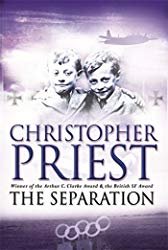
The one I wrote least about at the time, but that on reflection I think is definitely the best of them, is The Separation, Christopher Priest’s story of dual identites, overlapping histories and alternate timelines for the second world war. I’ll return to it in due course, as it won both the Clarke and BSFA Awards. You can get it here. (I always felt that American Gods was interesting but flawed; you can get it here.)
The book I would not recommend is Ersatz Nation, a poorly written and jumbled narrative.
I’m still not totally sure about the Best Poem category, but I’m going to kick off my Hugo reviewing for this year by revealing my own votes, as follows.
Mission Control, you told me not to be shocked. I’m just an envoy among these meetings. A pleasure just to be invited and all that. And you told me not to sell myself short, I know I am neither peerless nor no less a peer as the others here, but you don’t get it. I… get emotional. When we gather here, we consensus the stars. We draft the laws that carve diamonds fine, we dictate the portent paths, we school and are thus schooled; in a ten-minute parley between panels we broker treaties that move stories through the digit-lines; in a brief passing twixt moving platforms two colleagues will draft new craft guidances for new worlds; in a barcon brokerage tomorrow night two lords will strike delicate business firm; all weekend we will declare truces— sparing doubt without relying on fear, holding sorrow without swelling to hopelessness, saving our blades for the armies of capital growth and the rattle of the badly impersonating clanker swarms and oh God the fascists why are there still fascists but that’s why we have these meetings in the first place. I would risk a rank or more if I could fellowship here forever. Because are we ever still together if we can’t break bread or ice or our own bad habits of not being personable? Aren’t I allowed to dream of more realms being let into our commonwealth?
A witty depiction of a space explorer visiting a Worldcon.
Bitch got stuff done. Lightning hits a bit different now. Still pounds against the clouds, of course. Still kills when it lands too close. But doesn’t pierce the way it once did, or leave half-orphans in its wake. And those temples. You’ve seen them, right — still gleaming over broken fields. And her hands, a sudden gentle touch, slicing through the sharpest pains.
You can spend your days sitting on the rocks, stirring the tidal pools as though they were cauldrons, causing shipwrecks if you want to, granting wishes, stealing the voices of mermaids and seabirds to make yours especially shrill, screeching like a gull, or sonorous, like buoy bells ringing far from shore. You can gather and store the treasures of the waves—bits of glass worn smooth, coral and pearls, gold vessels from Phoenician ships. How rich you will be! And how deeply you will dream, sea witch— as deeply as the dark hidden depths of the sea.
Way back in 2007, I was just getting into the Big Finish audios, and it did not take long until I reached the 29th of their monthly releases, The Chimes of Midnight, starring Paul McGann as the Eighth Doctor and India Fisher as his audio-only companion, Charlotte “Charley” Pollard. I wrote it up as follows:
The Chimes of Midnight is just creepy: the Doctor and Charley trapped in a house where the servants keep on dying horribly – and even more mysteriously coming to life. Clearly some Big Revelation about Charley’s nature is being planned.
With the new novelisation just published, I listened to it again and it deserves its place of one of the consistently top-rated Big Finish audios. The soundscape successfully invokes the cramped servants’ quarters of an Edwardian mansion, with the guest stars utterly convincing in their denial of reality, especially as they start getting bumped off one by one. There is an Irish character, the butler, Shaughnessy, played by Lennox Greaves (who in real life is a Yorkshireman). I ended the story not quite sure what had happened, but certain that I had been entertained.
This story was recorded in January 2001 but released only in February 2002. You can get it here.
It used to be that one could handily check facts about Big Finish audios on Wikipedia, but I was dismayed to discover that Wikipedia has deleted all of its pages covering individual Big Finish plays. I guess that they were judged not to be of general interest in the way that, say, Andorra’s 2007 Eurovision Song Contest entry obviously is. A shame.
Rob Shearman has novelised his two best known Big Finish audios, this and Jubilee, so needless to say I have got hold of them both. The second paragraph of the third chapter of The Chimes of Midnight is:
‘And is this exactly the same as your house back home as well?’ asked the Doctor.
This is a very lucid retelling of the story, offering a lot more depth to some of the characters – particularly Charlotte herself, but also Shaughnessy the bultler – and giving a slightly better idea of what the story is actually about. It’s twenty-five years since Shearman first wrote this, and his style has become comfortable and fluid. The house as portrayed on the page is recognisably the same as in the original play.
I think that readers who aren’t already into the Big Finish Eighth Doctor continuity might be sufficiently intrigued by this to try the other plays in the sequence, though they should be warned that this is something of an outlier. However there is plenty to discover about the Eight / Charley relationship.