“Jarvis, give me some music,” I growl. The gym is far too quiet at four in the morning. Unnervingly so. And my nerves have already had their fill of nerves today.
YA, fast paced, apparently doomed protagonist overthrowing the unnatural order of things, doesn’t quite deliver on the premise. You can get it here.
`I don’t understand why you have brought me here,’ says the individual. ‘Why not simply kill me, on Earth? Bringing me all the way here, transporting eighty kilos of carbon and water all this way — it is a waste of effort.’
I sometimes feel that Roberts is keener to show us how clever he is than to write a decent story, and this was yet another example. The chapter with a parallel narrative track running in a footnote killed my enthusiasm, and it’s pretty early in the book. But you can get it here.
‘The pictures are very pretty, doctor. I’ve never seen a book so nice.’
Very nicely done and interesting linkage of the protagonist in several similar but different timelines – the Arctic in the nineteenth century, the Antarctic in the twentieth, and outer space in the near future. I tend to think of Reynolds as a hard sf writer, but this goes in some unexpected directions. You can get it here.
Chad was standing on an unbroken spur of the former sea road, staring out at the remains of the town’s old seaside pier when he felt the phone vibrating in his pocket. The rusty upright piles of the pier managed to hold on somehow, still visible and prodding up at low tide, although low tide had itself become something of a rarity. The sunshine on the white foam of the breakers was dazzling. Greg’s name was on his screen. He turned his back on the sea.
An intricate story, involving (as usual from Priest) twins and (unusually for him) climate change, with three timelines (late 19th century, early 20th, mid-21st) whose interlinkages gradually come into view, meshing to form a complete story. Not my all-time favourite book by this writer but I still liked it a lot. You can get it here.
The problem this time is that his phone has died, so he can’t use it to navigate, and he has no cash, having given it to a man whose wife was dying and needed medical care. (A man who, in retrospect, might not have been telling the truth.)
Hugely enjoyed this near-future tale where memory editing has become an established practice, and the drawbacks are now becoming clear, especially when people start trying to get their deleted memories back and buried secrets re-emerge. Well told with lots of different viewpoint characters. Recommended. You can get it here.
‘But I’ve been offered a place at Sussex University,’ said Cara. She wore a white loopback cotton sweater and pre-distressed, wide-cut jeans with no socks. For two years her OCEAN Personality Test Score had been 40 89 15 60 90, within a tolerance of 0.4%.
Marginalised non-humans trying to integrate into our society. Two and a half narrative strands that did not really add up. Omnipresent narrator has weird obsession with precise measurements, including of characters’ personalities. I didn’t like it all that much, but you can get it here.
Standing in her kitchen with a glass of water in hand, which means he went through her cupboard to find it. His big hand out-stretched to touch the thyme growing behind the sink, in the patch of light that comes in from the emergency stairwell. He’s wearing a chain around his neck. At the end of it, a ring with a purple stone that she recognizes as his mother’s.
Young woman who is the tool of a dystopian surveillance state conspires to overthrow it. Has been done better elsewhere. You can get it here.
Now that the Clarke shortlist is out, I’m posting my brief notes on those books which were not shortlisted and which I do not intend to reread. In many cases it’s because I didn’t think the book was all that good, though often enough (including today) it was a decent enough book which just didn’t end up in the top six, or clearly not sf or not a novel and therefore not eligible. There are about a dozen that I do intend to get back to in due course, so I won’t be publishing my original notes about them here.And we’re starting with Braking Day, by Adam Oyebanji.
Second paragraph of third chapter:
The pattern began to disappear. Slowly at first, then ever faster under tendrils of green mold that spread across the surface until all that was left of the plate beneath was its shape. And soon, not even that. The mold kept growing. Thicker and higher, and thicker and higher, until it was reaching his face and forcing his mouth apart and putting roots down in his throat.
The first of the 98 books submitted for the Arthur C. Clarke Award which I read. A good example of the generation starship tale, which held together very well though there were a couple of twists that didn’t quite work for me. Debut novel, so will look forward to more from this writer. You can get it here.
I’ll do these Mondays to Fridays until I run out. That will take several months.
Chisom’s mother agreed. ‘Yes, indeed. If only we had stayed in touch.’
A 2009 novel set in Belgium, about four women who have been trafficked from Nigeria for sex work in Antwerp (on Zwartzusterstraat, though in the novel the street name gets an extra ‘e’). Their back stories in Nigeria (and in one case Southern Sudan, as it then was) are well depicted, but the Antwerp sections are inconsistent, sometimes tightly described, but particularly towards the denouement at the end (which is signalled from the beginning) rather under-written in places. It’s important to give the victims of human trafficking their voices, and the novel asks and answers important questions, but I was a bit frustrated by the inconsistencies of structure and style. You can get it here.
This is the last blog post about a book that I finished in 2022, other than the Clarke nominees. (The last book I finished in December was Matt Ruff’s Sewer, Gas & Electric, but I have already written it up.)
Second paragraph of the answer to the question in the third chapter, which is “What if I took a swim in a typical spent nuclear fuel pool? Would I need to dive to actually experience a fatal amount of radiation? How long could I stay safely at the surface?”
Spent fuel from nuclear reactors is highly radioactive. Water is good for both radiation shielding and cooling, so fuel is stored at the bottom of pools for a couple decades until it’s inert enough to be moved into dry casks. We haven’t really agreed on where to put those dry casks yet. One of these days we should probably figure that out.
This is a collection of short pieces originally published on the XKCD website, scientific answers to peculiar questions. They all seem to be well thought out, with plenty of detail, and it’s also very very funny in places.
They say lightning never strikes in the same place twice. “They” are wrong. From an evolutionary perspective, it’s a little surprising that this saying has survived; you’d think that people who believed it would have been gradually filtered out of the living population.
Had she not been swinging hard under full helm − had she, instead, taken the initial impact of the blow full on her reinforced stem − then she would have crumpled, flooded her forepeak tank, breached the collision bulkhead, even breached her forward hold space . . . yet Lycomedes might still have survived.
I had read this when I was 19 and living in Germany, and was moved to search it out again a few years ago – but then did not get around to reading it; it was the non-genre fiction book that had lingered longest unread on my shelves. It’s a vivid and succinct account of the sinking of a cargo ship in a storm on the North Sea, as the result of a collision with an uncrewed barge. The writer takes us inside the heads of many of the crew as catastrophe hits them hard and swiftly. I remembered several of the most striking images very clearly from thirty-five years ago. No women, of course, and a rather dodgy portrayal of the one Chinese crewman (though that is somewhat subverted at the end). But the big picture is very memorably done. You can get it here.
Next in the stack of long-unread non-genre fiction is Observe the Sons of Ulster Marching Towards the Somme, by Frank McGuinness.
Second paragraph of third chapter (“The Right to be Buried”, by Helena Ranta):
When we boarded the plane again, there were only four Finns left. The plane flew low and the devastation of the war could be seen clearly as we approached Sarajevo Airport.
This is a lovely collection of eleven short papers by Finns involved with peace-making in the Balkans, pulled together to commemorate the award of the Nobel Peace Prize to former Finnish president Martti Ahtisaari in 2008. I myself worked with Ahtisaari quite a lot in the 2002-2008 period, and the collection was given to me by co-editor Nina Suomalainen. He is ill now, but I am sure that he appreciated this collection at the time.
These are all very good papers. Contributors include Ahtisaari himself, three others who I know personally (Olli Rehn, Alpo Rusi and Kai Sauer), and also Elisabeth Rehn – who was defeated by Ahtisaari in the 1994 presidential election – and the late Harri Holkeri, who I knew by sight from both the Northern Ireland peace talks, where he was one of George Mitchell’s co-chairs, and his stint as head of the UN in Kosovo.
The Finns have a reputation for being somewhat silent (the joke is that you can tell an extrovert Finn, because they look at your shoes), but these are all eloquent accounts of personal experience in a region where the Finns felt needed and useful. Most of the details are about Kosovo at its different stages, with both Ahtisaari and Sauer giving their accounts of the diplomatic process that led to independence, and Holkeri trying to give his own side of the story to explain his disastrous tenure. (Ahtisaari pushed for his appointment, which was surely a mistake.)
But I learned most from two people I had not heard of; Arto Räty gives an account of what it is like to be a peacekeeper in a NATO mission at a time when Finland’s relationship with NATO was less comfortable than it is now, and Terhi Nieminen-Mäkynen tells us about being the unelected, UN-appointed mayor of the southern Kosovo town of Prizren.
The other thing I learned – though of course the authors are a self-selected and not necessarily representative sample – is that Finns feel quite strongly about the Balkans. Their own nation emerged from conflict and spent most of the twentieth century uneasily balance between two blocs; older Finns can recall when they and Tito’s Yugoslavia were the lynchpins of the Non-Aligned Movement, and Helsinki hosted the signing of the Final Act which laid the groundwork for the peaceful ending of the Cold War fifteen years later.
I should note that Finns feel equally strongly, if not more so, about Ukraine, having themselves emerged from a century of Russian dominance. The current war has pushed them directly to join NATO. It did not always look inevitable. I remember a lunch in Kyiv in 2005 where I was sitting between Martti Ahtisaari and Thorvald Stoltenberg, the former Norwegian foreign minister. Stoltenberg leaned across me to say, “Martti! Congratulations! I hear that you have tripled the support for NATO membership in Finland!” Ahtisaari replied, “Yes! From 5% to 15%!” That was then, this is now, and Stoltenberg’s son is now the NATO Secretary-General.
Unfortunately this book is out of print and there seem to be no second-hand copies available, so I can’t supply my usual “get it here” link, and I am all the more grateful to Nina for giving it to me in 2016. I’m ashamed to say however that this was the non-fiction book which had lingered longest unread on my shelves. Next on that pile is Diary of a Witchcraft Shop 2 by Trevor Jones and Liz Williams.
Two hundred yards away, I paused and looked over my shoulder. At that moment, branches and tree trunks burst outward into splinters. Something large and black and nearly shapeless moved half behind the cover of the forest, half in the open. Rounded black limbs reached a hundred feet into the sky. More limbs stretched from the forest at ground level, toward me. At their touch, bushes and trees lost their leaves, turned gray, and collapsed in puffs of dust. Grass withered and died. The stream froze. Even as far away as I now stood, I felt a sharp coldness radiating from its darkly massive body.
Fourth and, praise be to God, final of the prequels to Roger Zelazny’s classic Amber series. It’s noticeably shorter than the other three, as if the writer had simply given up. Understandable if so. I read it several days before writing this and can’t now remember anything about it. You can get it here.
This was the SF book that had lingered longest unread on my shelves. Next on that pile is Death Draws Five, edited by George R.R. Martin.
These two stories both won the Hugo and Nebula Awards presented in 1989 for work published in 1988. For completeness, the Hugo for Best Novel went to Cyteen by C.J. Cherryh, and the Nebula to Falling Free by Lois McMaster Bujold; the Hugo for Best Short Story went to “Kirinyaga” by Mike Resnick and the Nebula to “Bible Stories for Adults, No. 17: The Deluge” by James Morrow; and the Hugo for Best Dramatic Presentation to Who Framed Roger Rabbit?
The second paragraph of the third section of “Schrödinger’s Kitten”, which won both Best Novelette awards, is:
Leaning against a grimy wall, Jehan heard the chanted cries of the muezzins, but she paid them no mind. She stared at the dead body at her feet, the body of a boy a few years older than she, someone she had seen about the Budayeen but whom she did not know by name. She still held the bloody knife that had killed him.
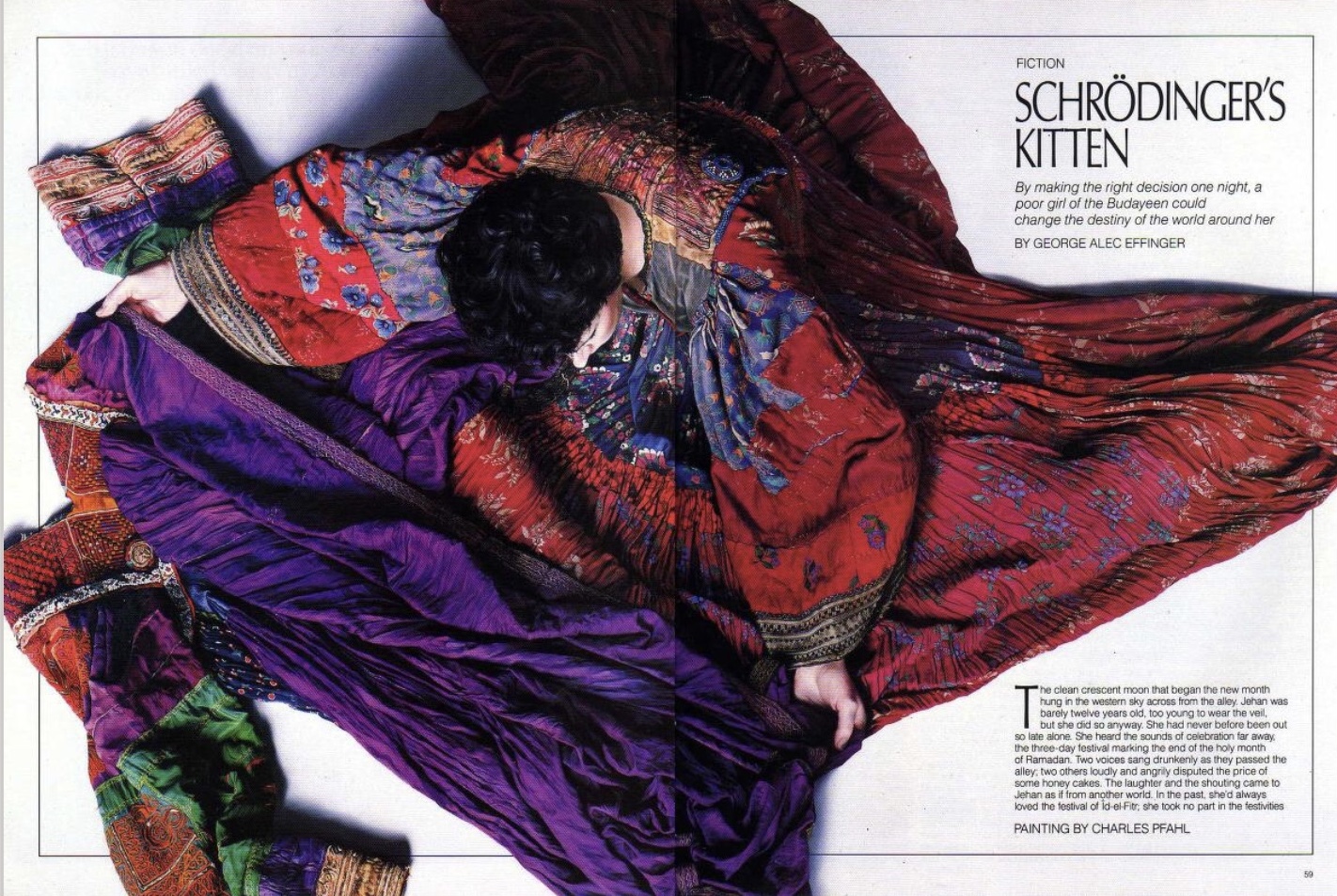
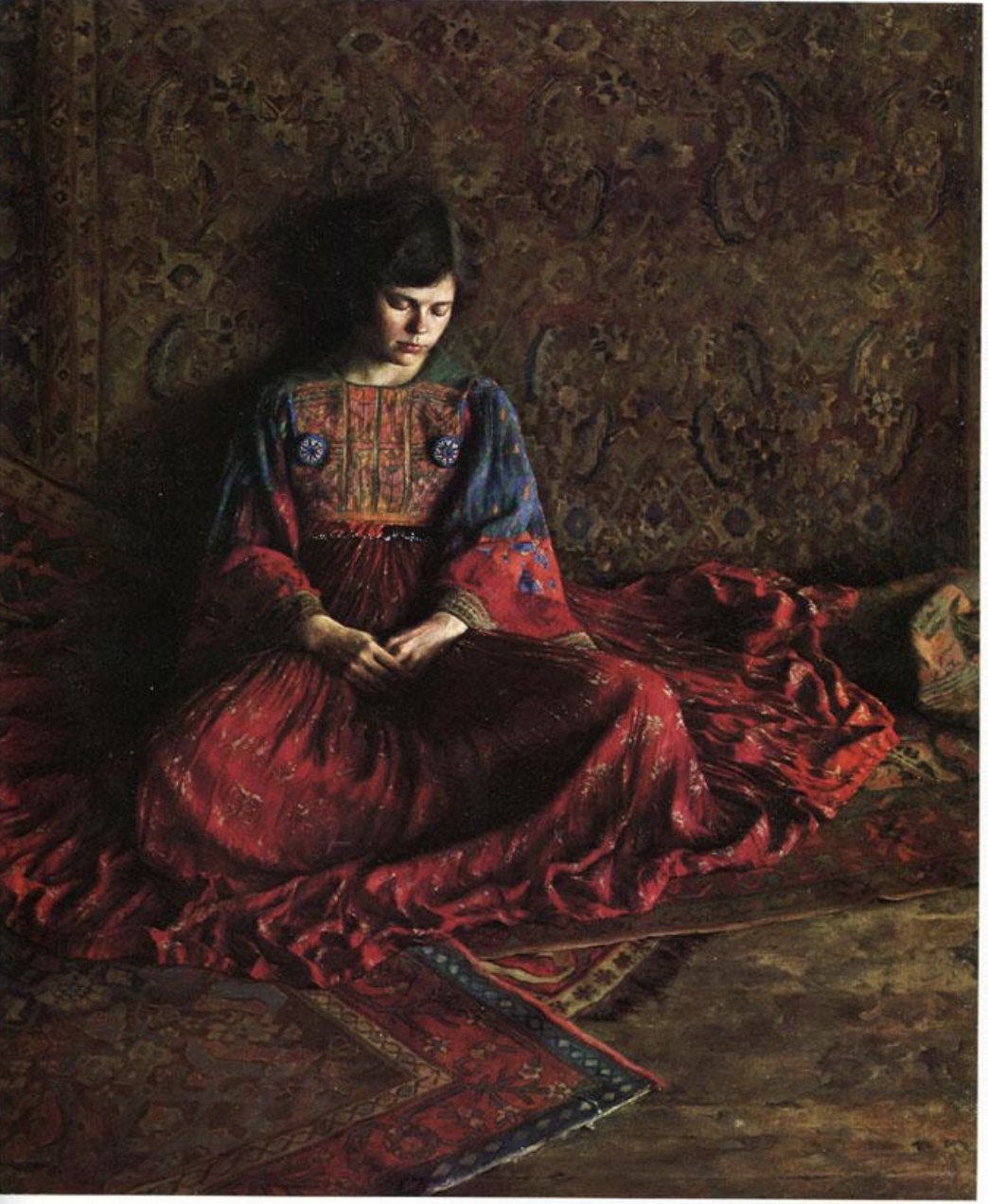
Before I get into the story, I’m going to talk about the art that illustrated it. The opening page has this gorgeous painting of a woman wearing a flowing red dress, seen from above, credited to Charles Pfahl.
I have checked with Pfahl’s widow, his third wife Sharon van Ivan, and she informs me that this is “Patterns I”, part of a set of three paintings for which his second wife Charlotte Pfahl (nee Charlotte Weltys) was the model. Here is “Patterns II”, from a 2017 auction card:
In the third painting, “Spectrum”, shown in Joe Singer’s 1977 book, Charles Pfahl: Artist at Work, the model is definitely Charlotte again, wearing what appears to be the same dress but this time back to front – note the very high neckline, and the two blue buttons which are visible on her back in the first picture.The setting is their apartment on 45th Street in New York.
Sharon van Ivan informs me that all three paintings would have been done between 1973 and 1975, long before Omni published one of them in 1988. Charles died in 2013, aged 67; Sharon maintains his legacy website, and Charlotte is still practicing law.
The story was accompanied also by two unrelated humorous cartoons, neither of which is really very funny.
Anyway. “Schrödinger’s Kitten” is about a young Arab woman, Jehan Fatima Ashûfi, living in the 1930s, who is conscious of numerous diverging realities a la Everett’s “many worlds” hypothesis. Maybe she is raped by a neighbour and disowned by her family; maybe she kills her future rapist and is sentenced to death; maybe she is rescued from the scaffold by a passing German physicist, becomes a lab assistant to Heisenberg and Schrödinger and single-handedly stops the Nazis developing nuclear weapons.
The story’s heart is in the right place – woman of colour defeats fascism! – but I don’t think it really works for today. The Arab world is depicted as barbarous and uncivilised, compared to the sophisticated German scientists; but which of them was planning to exterminate their Jews at the time? Indeed, which country makes a rape victim who killed her attacker pay his family $150,000 in compensation? Much less important, Jehan prevents the Nazi bomb by sending boring scientific papers to the political leadership to make them lose interest; if only life was that easy! The layering of narratives is intricately done, I’ll give it that.
The whole original printing of the story in Omni has been scanned and uploaded here, but I also have it in Donald A. Wollheim Presents the 1989 Annual World’s Best SF, which you can get here.
Also on both ballots were “Do Ya, Do Ya, Wanna Dance?” by Howard Waldrop, “Ginny Sweethips’ Flying Circus” by Neal Barrett, Jr, and “Peaches for Mad Molly” by Steven Gould. The fifth Hugo finalist was “The Function of Dream Sleep” by Harlan Ellison; the other three Nebula finalists were “The Hob” by Judith Moffett, “Unfinished Portrait of the King of Pain by Van Gogh” by Ian McDonald and the Hugo Short Story winner “Kirinyaga” by Mike Resnick, which is the only one I can remember having read.
The second paragraph of the third section of “The Last of the Winnebagos”, which won both Best Novella awards, is:
Toward the end, it wouldn’t even let my grandmother near it, but she refused to have it put to sleep and was unfailingly kind to it, even though I never saw any indication that the dog felt anything but unrelieved spite toward her. If the newparvo hadn’t come along, it probably would still have been around making her life miserable.
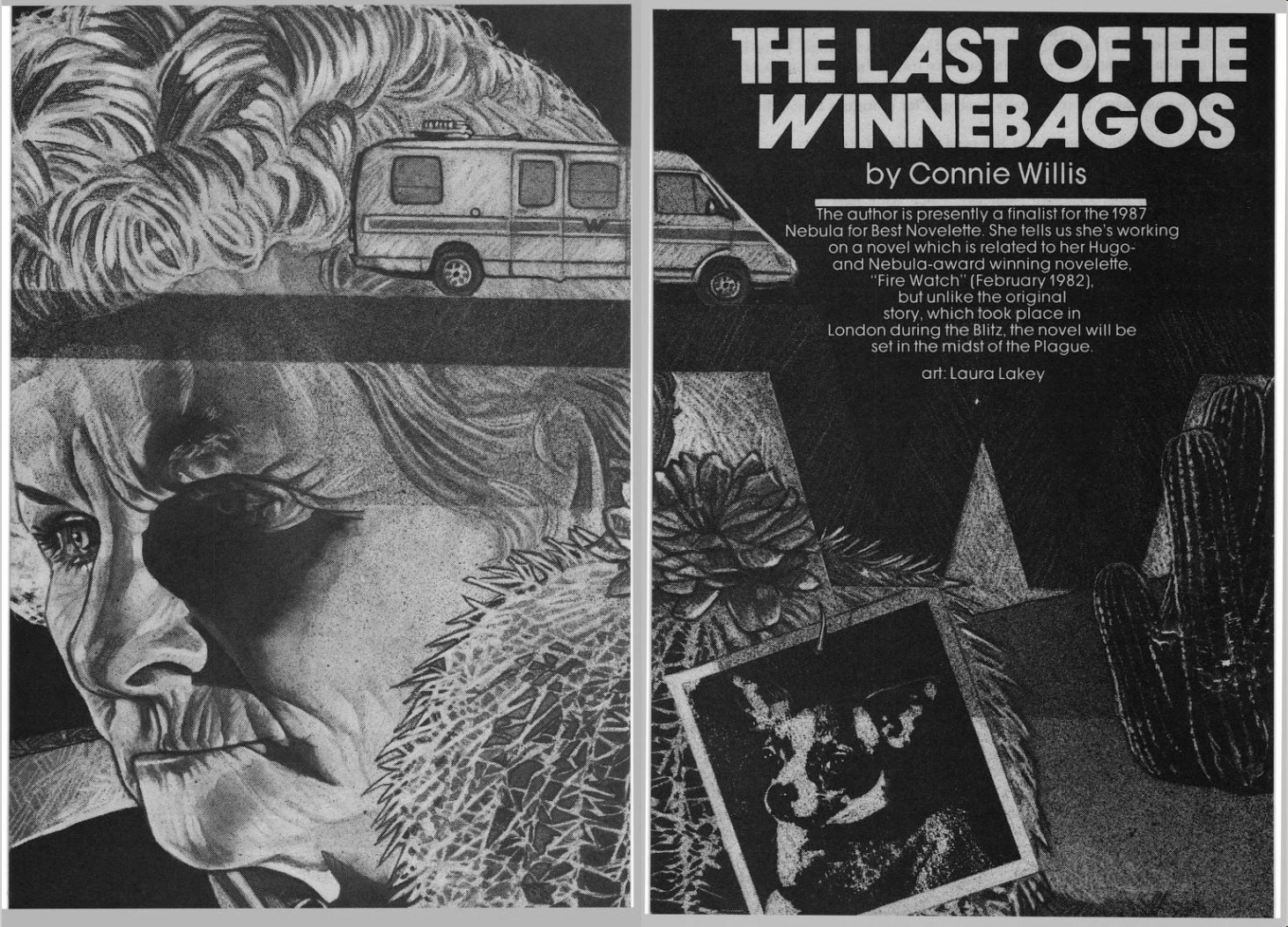
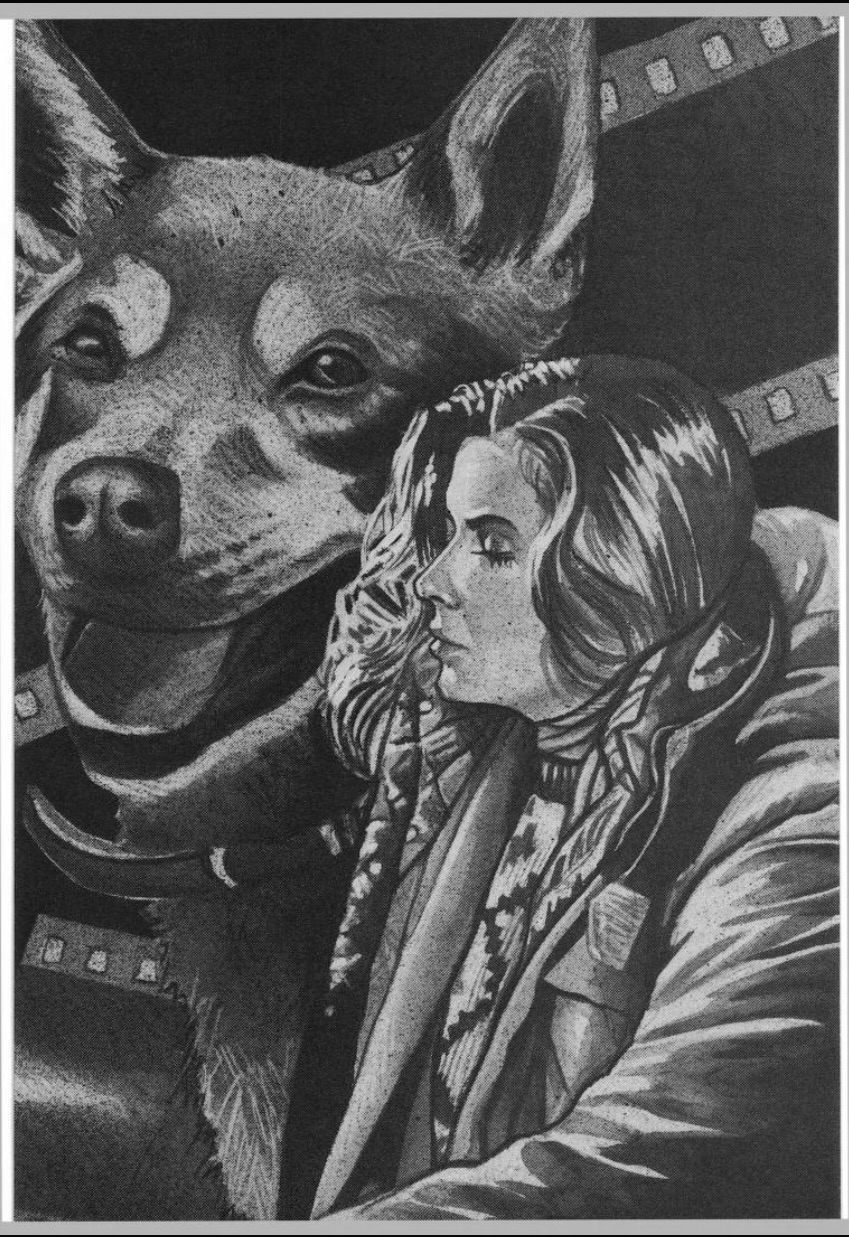
The art is of cute women, one old and one young, and cute dogs, by Laura Lakey, who is best known for her collaborations with her husband John Lakey illustrating role-playing-games, especially D&D.
Unlike the illustrations in Omni, it’s clear that these were commissioned by Asimov’s for the story. I wondered if Laura Lakey herself was the model for the younger woman; according to her website, she and her husband “often used themselves as characters in stories they illustrated”. But I checked with her and she says it is someone else, and also incidentally she still has the original art in case anyone is interested in buying it.
There’s also a wee rocket, uncredited, at the end of the story.
I am sorry that I am posting whiny reviews today of two stories that many other people love. But “The Last of the Winnebagos” sucks. The single biggest negative is that the protagonist is still mourning the death, years ago, of his dog, whose name was Aberfan.
What possessed Connie Willis to use this name? And what possessed Gardner Dozois to let her? Would anyone find it acceptable to call a pet, even a fictional one, “Sandy Hook“? Or “Chernobyl“? Or do dead Welsh children just not count? Actually, maybe don’t answer that last question.
This is a consistent problem with Willis’ writing (see also: “Fire Watch“, Blackouthere and here, All Clear). She is so relentless about maintaining a single emotional tone of loss and mourning that she does not care enough about the significance or accuracy of the details. Seemingly, neither did Hugo or Nebula voters in those years.
Having been thrown out of the narrative, I began to question other parts of it. The unseen villain of the story is a sinister quasi-government force called the Humane Society, which has massive powers of intervention to protect animals, in the aftermath of a plague that killed all dogs. There are very valid questions to be asked about the use of coercive force by the American state, but this premise a) trivialises that issue and b) panders to lazy libertarianism. If only the problem were simply that the state was protecting animals, rather than the entrenched power structures of capitalism and patriarchy.
The core emotional dynamic of the story is that the elderly couple who are driving the eponymous vehicle, the last of the Winnebagos, are concerned that they may lose the right to drive it because they have accidentally killed a wild animal. We are also told that they are in their late eighties. Sorry, people in their late eighties should not be driving, full stop.
The protagonist’s own deep regret is that he has no photographs of his dog, Aberfan. A professional photographer, who never took a single photograph of his best friend? I mean, I remember that in the Before Times, when we did not have cameras on our cellphones (indeed, we did not have cellphones), we didn’t habitually take quite as many photos of friends and family and household as we do now. But none at all?
I was uneasy about a couple of other aspects as well – the protagonist’s unrealistic relationship with his (woman) boss, his nonchalant ease of access to other people’s private data – but never mind. The characterisation and descriptions are fine, but once you have been thrown out of the narrative by the above rather major reservations, the tragic tone of the story starts to seem manipulative rather than convincing.
All four of the other Hugo finalists in this category were also on the Nebula ballot, an unusual degree of overlap. They were “The Calvin Coolidge Home for Dead Comedians” by Bradley Denton; “Journals of the Plague Years” by Norman Spinrad; The Scalehunter’s Beautiful Daughter by Lucius Shepard; and “Surfacing” by Walter Jon Williams. The Nebula ballot also included The Devil’s Arithmetic by Jane Yolen. I think I’d have voted for Lucius Shepard myself, though I say that because it’s the only other one I remember having read.
Next up in this sequence is a real favourite of mine, “The Mountains of Mourning” by Lois McMaster Bujold; I hope that it will turn out to have stood the test of time a bit better than these two.
Voor Marie Rixen, het dienstmeisje in Düsseldorf, is alles pas begonnen met die fijne, zwarte knoopjes, of beter: is alles misgelopen bij die knoopjes, onherroepelijk misgelopen. Na enkele maanden zegt ze het hem, prevelend, ze liggen naast elkaar. Ineens is het gedaan met zijn lieve handen op haar huid, met zijn volle vochtige lippen in haar hals. Zijn mond is zijn mond niet meer, maar een zwarte vlek die brult als een van zijn staalovens. Uit zijn ogen. Uit zijn huis. Dat ze maar had moeten oppassen. Dat het een schande is. Is ze niet beschaamd? In zijn eigen huis? Hij als familieman! Trouwens, is het wel van hem? Hoe durft ze dat te beweren? Hij kent haar soort volk! En nog huilen ook?
For Marie Rixen, the maid in Düsseldorf, everything just started with those fine, black buttons, or rather: everything went wrong with those buttons, went irrevocably wrong. After a few months she tells him, muttering, they are lying next to each other. Suddenly there’s an end to his sweet hands on her skin, his full moist lips on her neck. His mouth is no longer his mouth, but a black smudge roaring flame like one of his steel furnaces. Out of his sight. Out of his house. She should have been careful. It’s a scandal. Isn’t she ashamed? In his own house? He, a family man! By the way, is it his? How dare she say that? He knows her kind of people! And now the waterworks?
David Van Reybrouck is one of Belgium’s best known public intellectuals, and this was his essay commissioned for the annual Dutch language Book Week Essay in 2016. It’s the story of the peculiar enclave of Neutral Moresnet, a small territory run jointly by Prussia and the Netherlands, later Belgium and Germany, from 1815 until the first world war, noted for its zinc mine, casino, gin distilleries and freedom from neighbouring jurisdictions. It was annexed by Germany in the first world war, and by Belgium afterwards, and survives only in its boundary markers today.
Van Reybrouck tells the story of one of its inhabitants, born Joseph Rixen in 1903 but brought up as Emil Pauly, and explains the shifting concept of Neutral Moresnet’s identity through his story. There are also diversions to Esperanto, which claimed Moresnet as its world capital at one point, and to the last living person who was born there, Catharina Meessen. Overall it’s a fascinating glimpse at a forgotten corner of Western European history. You can get it here in Dutch and here in German (no English translation as far as I know).
This was the shortest unread book that I had acquired in 2016. Next on that pile, if I can find it, is God is No Thing: Coherent Christianity, by Rupert Shortt.
In a future galaxy where humans are practically extinct, society continues through various races of uplifted animals, of whom the elephants – Fants for short – are exiled on their own planet, Barsk, and are both reviled by and essential to the other races. There’s some fairly obvious analogies to contemporary human societies, which at least are not signalled too virtuously, and a couple of good twists at the end. I got it because I know the author – to whom I wish swift and full recovery from recent illness – and it was nominated for the Nebula. You can get it here.
This was the top book on my unread shelf acquired in 2016. Next on that pile is Fugue for a Darkening Island, by Christopher Priest, which I have in fact previously read, but many years ago.
When I first watched the story we now call The Romans in 2006, I wrote:
The Romans has a considerable, and surprisingly effective, comedy element, carried almost entirely by Hartnell’s Doctor. On a whim, he decides to leave their holiday villa and go to Rome (taking Vicki with him) pretending to be a murdered musician, and succeeds in fending off Nero’s jealous attempots to have him killed. There is a much less funny sub-plot involving Ian and Barbara, kidnapped by slavers, who also end up in Rome – Ian as a gladiator, Barbara as palace slave, pursued by the lustful Emperor – before making their escape. (Somewhere there must be a definitive list of the characters who have lusted after Barbara: Ganatus in a very gentlemanly way in The Daleks, the much nastier Vasor in The Keys of Marinus, the equally nasty El Akir in The Crusade, and now Nero.) The Ian/Barbara chemistry is very sweet – they have a nice joke between them about looking in the fridge. The script rather neatly resists bringing the travellers together, so that neither the Doctor and Vicki nor Ian and Barbara ever discovers what the other pair of characters is up to in Rome. Hartnell is simply superb, utterly watchable, imperious, funny, devious. It’s a shame that Maureen O’Brien can’t quite rise to the challenge of being his straight man, but this was only her second story, so I suppose one must make allowances.
When I came back to it three years later for my Great Rewatch, I wrote:
I’ve watched The Romans a couple of times, which may be once or twice too many. There are a lot of good things about it – the costumes, sets and background sound are totally convincing; the Ian/Barbara relationship is at its sweetest and snuggliest; Maureen O’Brien is carving out a quite different Vicki persona to Carole Ann Ford’s Susan, less frightened and more curious. The plot of course takes in all the cliches – lecherous emperor, slavers, the threat of the arena, and even culminating in the Great Fire. The two interlocking plot strands are deftly contrived. The problem is, unusually, with Hartnell himself who is way over the top, smirking, chortling and giggling manically; it matches quite well with Derek Francis’ portrayal of Nero but is otherwise a bit much.
I gave it another go two years later, and wrote:
Last time I watched The Romans, just over two years ago, it left me rather cold. On F’s suggestion we watched the first two episodes last night and the other two this evening, and I found I loved it (and so did he). Last time round I was watching while waking up early and jetlagged on a particularly arduous field trip; shows how the mood you are in can make a difference to your appreciation of, well, anything.
Watching it again, this time with the DVD info text, I enjoyed it again. Hartnell is still a wee bit over the top, and the plot doesn’t really hold together once you start poking at it, but I particularly appreciated Jacqueline Hill keeping in character.
The second paragraph of the third section of the novelisation is:
I hope you are as well as habitual, and as it leaves me also, I am pleased to say.
When I first read it in 2008, I wrote:
I had been looking forward to this one, famed as one of the best Doctor Who novelisations, and I was not disappointed. Cotton has recast the narrative of Dennis Spooner’s TV script into epistolary/diary form: letters from Ian Chesterton to his headmaster, the Doctor’s own diary, letters from Ascalis the assassin and Locusta the poisoner, and contributions also from Barbara, the Emperor Nero, and Nero’s wife Poppæa (but not Vicki); the whole thing framed in a covering note by Tacitus (obviously written several decades later). Eye of Heaven, the best of the spinoff novels featuring Leela, also featured multiple first-person viewpoints, and I’ve read first-person narratives in other First Doctor stories, but this is the only case of the whole thing being ostensibly done from written records (the Doctor having compiled everything and then left it behind in the villa for the archivists to discover).
Admittedly, as an actual story it’s no great shakes, and purists will be disappointed that we lose a lot of the funny lines from the TV version and one of its major comic elements (the two pairs of time travellers not actually meeting each other in their wanderings). But the whole thing is done for language and laughs; it’s meant to be fun, and it is fun, and that’s all you can really ask.
Now that I’ve read almost all of the Doctor Who novelisations (apart from the very latest ones), I appreciate even more the imaginative flexibility that Cotton was allowed to bring to the story. But it’s interesting that the Ian Chesterton of the novel is clearly a teacher at a minor public school, rather than the secondary modern or comprehensive Coal Hill that we see on screen. It’s also regrettable that the women characters don’t get as much bandwidth on the page as they did on screen. Anyway, you can get it here.
Jacob Edwards has written a substantial monograph on The Romans, not quite as long as Frank Collins on Warriors’ Gate but still, I think, one of the longer Black Archives. It’s good chunky stuff, which I think would be useful for anyone interested in mid-sixties UK television in general as well as us Whovians.
A short introduction points out that at time of broadcast, nobody ever expected to see The Romans again; yet we are still analysing it almost six decades later.
The first chapter, “Why Comedy?”, looks at Dennis Spooner’s conscious decision to make Doctor Who funnier than Sydney Newman had imagined it, and points out that The Romans was the first story which was intended to be humorous.
The second chapter, “Humour in The Romans – Is It Funny?” looks at the roots of the humour in the TV story, admits that audience feedback for the fourth episode was negative but challenges the (mostly long-dead) viewers on their reactions; and then looks at the novelisation (“mostly the same type of funny”) and the reception of the later releases of the TV story, the DVD coming out at roughly the same time as the Tenth Doctor’s The Fires of Pompeii.
The third chapter’s title is “Comedy After The Romans“. The second paragraph (with equally long footnote) is:
After The Romans, season 2 continued with three very serious stories – The Web Planet; then The Crusade and The Space Museum (both 1965) – before lightening up with The Chase (1965), a six-part Terry Nation runaround intended to make the Daleks more fun. The humour here is rather patchy, and none-too-subtle, the nadir coming atop the Empire State Building with Peter Purves’ prolonged and cringeworthy appearance as sent-up hillbilly Morton Dill¹. Purves later proved himself a fine actor, returning in ‘The Planet of Decision’ (episode 6) as new companion Steven Taylor. As Dill, however, he was terribly ill-used. ¹ ‘Flight Through Eternity’ (The Chase episode 3). Dennis Spooner by this time was script-editing Doctor Who, and must bear some responsibility. In the audio commentary to ‘Flight Through Eternity’, director Richard Martin says of Dill’s incredulous, irreverent inspection of a Dalek: ‘That’s a Dennis Spoonerism. Dennis invented this. It wasn’t at all a Terry Nation thing.’ But here we see a key difference between The Romans and The Chase. Spooner may have dictated a more comedic approach, and in the former case, with Christopher Barry’s direction, was able to carry it through successfully; yet, humour was a tricky business, and the ham-fistedness with which Morton Dill was written (and directed; Martin heaps praise upon the performance) in large part bears the hallmarks of Terry Nation.
The chapter looks at the humour of later Who stories, pointing out that while the show became funnier in the rest of the black and white era, neither Letts / Dicks nor Hinchcliffe / Holmes wanted there to be many laughs and it was only for the couple of years of Douglas Adams’ influence that comedy re-emerged – to retreat again under John Nathan Turner, with occasional sorties of varying success.
The fourth chapter, “What Else was New in The Romans?” argues that it was the first real four-part story, earlier four-parters having ended up at that length by accident rather than by design; that Derek Francis was the first big name guest star; and that it marked the end of any pretensions to historicity from the historical stories, with the Doctor actually causing history rather than refusing to intervene. On that last point, I note that two of the three previous Hartnell-era Black Archives also deal with historical stories, and contra Edwards, Dene October argues that the earlier Marco Polo lacks historical detail and James Cooray Smith argues that The Massacre, made after The Romans, has much more historical accuracy than may at first be apparent.
The fifth chapter, “What is History?” attempts to untangle the concept of time in the Whoniverse, but does not get very far.
The sixth chapter, “Where Did The Romans Come From?”, briefly looks at the debt the story owes to Carry On Cleo and more particularly A Funny Thing Happened On The Way To The Forum.
The seventh chapter, “How Historically Accurate Is The Romans?”, details a number of inaccuracies before concluding (correctly, in my view) that it doesn’t matter very much.
The eighth chapter, “The Romans and Counterculture – Rewriting the Margins”, briefly unpacks the approach of the story to class, race, sexuality, gender, religion and disability, in the context of wider societal trends and later Doctor Who.
The ninth and final chapter, “A Viewer’s Response to The Romans”, goes through the story episode by episode, and practically scene by scene, listing the successes of the format (and one or two lapses). It’s difficult not to be charmed by Edwards’ enthusiasm here.
As I said earlier, this is a good contribution to the Black Archives series, combining in-depth analysis with enthusiasm, and I recommend it. You can get it here.
It being a new year and time of renewal, I’ve decided that I will (again) change the way I am writing up the previous winners of the Tiptree, Clarke and BSFA Best Novel Awards; if I have already written them up on this blog, I won’t revisit them. I have a couple of other long blog post series of projects that I’d like to think about starting, and a couple that will end naturally this year (Oscars and bookblog nostalgia).
However, I’ll still write up joint winners of the same award together, so for today it’s the winners of the 2009 Tiptree Award (as it was then called). This was the year that Song of Time, by Iain MacLeod, won the Clarke Award and The Night Sessions, by Ken MacLeod, won the BSFA Award for Best Novel. The Tiptree jury made a joint award (which has happened eight times in the last twenty years) to Nisi Shawl’s collection Filter House, and to Patrick Ness’s The Knife of Never Letting Go. The twelve-strong “Honor List” included one novel that I have read and very much enjoyed, Lavinia by Ursula Le Guin, and a set of short novels by a different author of which I have tried one and didn’t like it.
The second paragraph of “The Pragmatical Princess”, the third story in Filter House, is:
Ousmani closed her eyes again. She did not believe in dragons, any more than she believed in the affrits and djinns of her father’s homeland, or the water-demonesses of Mali, where her mother had been born. “It is a horse,” she told herself. “A very large and very ugly horse.” Peering out under her long, dark lashes, she considered the dragon’s glittering snout, its gleaming, golden eyes. Its irises were formed like slits, as were the nostrils inches from her own, from which an occasional wisp of steam escaped.
I think this may be the only collection of stories to have won the Tiptree / Otherwise Award. Perhaps I was just in a tired mood, after an exceptionally busy period at work, but none of these especially grabbed me. I guess the two that lingered most are “The Pragmatical Princess”, whose title character cuts a deal with the monster that was supposed to eat her, and “The Water Museum”, about a society where water is scarce and its guardian is an assassination target. I slightly bounced off Shawl’s Everfair as well, and perhaps this is just one of those authors who is not for me. You can get it here.
The second paragraph of the third chapter of The Knife of Never Letting Go, by Patrick Ness, is:
“I was in the swamp getting apples for Ben,” I say.
I enjoyed this more – a big chunky fantasy about a boy growing up in a village where all the women have died, and where dark secrets lurk in the hearts of the surviving men; he runs away and explores his world, discovering the awful truth. There is a cute dog and a smart girl. Slightly surprised by the ending, which is a cliff-hanger for the next volume. I would not have voted for this myself (of the Tiptree works, my choice would have been Lavinia), but I enjoyed it. You can get it here.
For completeness, I’ll note that from that year’s BSFA shortlist, apart from The Night Sessions, which won, I have read Anathem by Neal Stephenson but not Flood by Stephen Baxter or The Gone-Away World by Nick Harkaway. Of the two I have read, I’d have voted for The Night Sessions.
The City & The City also won the Clarke Award that year, and Yellow Blue Tibia was also on the shortlist, as were Far North by Marcel Theroux, Spirit: The Princess of Bois Dormant by Gwyneth Jones, Galileo’s Dream by Kim Stanley Robinson and Retribution Falls by Chris Wooding. Marcel Theroux was an exact contemporary of mine as an undergraduate at Clare College, Cambridge, though we did not know each other well; China Miéville also went to Clare, but arrived after both Marcel and I had left. I’d have voted for the winner here.
The Tiptree Award was again a tie, between the first two volumes of Ōoku: The Inner Chambers, by Fumi Yoshinaga (volume 1; volume 2) and Cloud and Ashes, by Greer Gilman. I enjoyed the former and bounced off the latter, and haven’t read anything else on the long list.
So next in this sequence of reviews will be the 2011 Tiptoe winner, Baba Yaga Laid an Egg, by Dubravka Ugrešić.
I vividly remember watching Warriors’ Gate when it was first broadcast back in the cold January of 1981. I was thirteen, and knew that this was Tom Baker’s last season; but much of the actual story sailed over my head. My family were not the only fans in Northern Ireland. In Newry, a thirteen-year-old girl missed the last episode:
I slept all day. I missed Dr Who but Romana and K9 left. Daddy watched a stupid Finnish film so we played "offices" in the kitchen.
That evening I too remember watching the “stupid Finnish film”, The Year of the Hare, and unlike NornIronGirl (but like her father) I loved it. (It must have been that evening, because that seems to be the only time it was shown on British TV when I was a teenager.)
I was surprised that I did enjoy Warrior’s Gate. A somewhat surreal plot line, with reflections on colonialism, empire and slavery, and also Romana’s extended farewell to the Tardis (for once, decently signalled in advance, more perhaps than for any companion since Victoria). Even Adric, for once, seemed to fit in reasonably well. Definitely worth watching again.
Coming back to it three years later for my Great Rewatch, I wrote:
Warrior’s Gate is truly weird and wonderful. The slavery of the Tharils is pretty horrifying, but we understand that there’s an element of cosmic karma in that they were once the enslavers (and Rorvik in turn gets his cosmic come-uppance at the end). For a story which is mostly filmed in a blank studio, there is an amazing sense of place about it. I still don’t completely understand the plot but I somehow feel confident that the author did, and wasn’t just making it up as he went along. K9 and Adric get reduced to mere observers here – again, it’s a strong story for Romana, but of course it is her last.
This time around, I came to it having seen the whole of Secret Army and its spinoff Kessler, in which Clifford Rose, who is the chief antagonist Rorvik here, plays the vicious SS officer in charge of Brussels. (Rose died just over a year ago in Denville Hall.) He seemed to me to be turning in a very strong performance: like Kessler, Rorvik is stuck with a mission that many would find ethically unpalatable, in an environment that he doesn’t really understand, and his reaction to new factors tends to be suspicious and violent. But it’s different as well to see him as the head of a team; Kessler tended to have the SS adjutant of the week.
I was also struck by the parallel with the other Doctor Who story mainly filmed in a blank studio, the first episode of The Mind Robber, where the production team successfully made something out of literally nothing. The same trick is pulled off here, with a few more props. You wouldn’t want to do this all the time, but it’s interesting to see it done twice.
Rereading the original novelisation in 2008, I wrote:
This is really good, the best book of this run; Romana II departing in style. Lydecker / Gallagher seems almost to be writing a standard genre sf book that the Doctor, Romana and Adric happen to have wandered into – Romana wanting to wander off on her own, of course. (And K9 gets perhaps his best characterisation in any of the novels, even if he is out of order for much of the story.) Of course, with it being the printed page rather than the screen, the story has to be told in a rather different way; but the author, whatever his name is, really rises to the challenge.
Since then I’ve read Gallagher’s early hit, Valley of Lights, and actually passed him by a couple of times in the corridors at the February 2022 Gallifrey One convention; I wish I had stopped for a chat. The book still holds up, giving a bit more meat to the bones of the show-don’t-tell TV story, especially on the background of the slavers. You can get it here.
But but but… it turns out that in 2019 the BBC released a considerably expanded audiobook of the novelisation, so much altered that it is basically a different book. Read by Jon Culshaw, with John Leeson contributing the voice of K9, it gives us a lot more background and characterisation of the slavers and the Tharils, and mixes up the plot quite substantially. Culshaw is very good at the characterisation of the voices, though I think his Rorvik is actually a bit closer to Kessler than Clifford Rose’s was.
It’s not the only or even the strongest case where the novelisation departs from the TV script, but it’s the most recent, I think, and certainly the one with the biggest broadcast-to-publication gap. It’s well worth getting to shed a new light on the intentions behind the story, and gives new depth to the narrative. You can get it here.
I still don’t completely understand every aspect of the story, but I felt I had a much better grasp of it this time around, especially thanks to the expanded novelisation.
Frank Collins’ monograph on Warriors’ Gate is one of the longer and denser works in the Black Archive series. There are eight chunky chapters, preceded by an introduction that explores the problems of assigning authorship of the story to writer Steve Gallagher, script editor Christopher Bidmead, director Paul Joyce (who becomes a major figure in the narrative) and even John Nathan-Turner and Graeme Harper.
The first chapter, ‘A Medieval Mystery Play’, looks at the appointment of Christopher Bidmead as script editor, touches on the Christopher Priest affair (which I’ve heard from the other side) and then looks at the early career of Steve Gallagher as a radio script writer.
The second chapter, ‘The Dream Time’, looks at the origin and early versions of Gallagher’s scripts, shaped also by the Christopher Priest affair, and its roots in Cocteau’s La Belle et la Bête and the TV mini-series Roots. It also turns out that Gallagher’s original scripts were funnier.
The second paragraph of the third chapter, ‘Aldo and Waldo’, with the quotation that it introduces, is:
Well known for his documentaries on filmmakers, actors and artists made by his company Lucida Productions, Joyce’s wider career spanned theatre, film, television drama, documentary, photography, painting and writing. In 1965, after two terms at The London School of Film Technique, he had used his final grant cheque to fund his first film The Goad, an adaptation of Samuel Beckett’s short mime play Act Without Words II, which he’d seen during an experimental programme of five short plays, Expeditions One, at the Aldwych Theatre in July 1964. He saw the play as a meditation on the relentless rituals of modern life, the empty passage of time ‘from birth to death presented in the simplest of terms. (Two sacks, each containing first, a dozy human, and secondly, a spruce, athletic one, are prodded progressively across the stage by a sharp metal object on wheels, “The Goad”).’2 Perhaps he saw that sense of relentlessness when he encountered the world of Rorvik and his crew in Warriors’ Gate. He also fastened onto one of Beckett’s recurring themes: rubbish. ‘Beckett’s identification of miscellaneous rubbish with the world, minds and bodies of his characters indicates its importance in his writing,’ and itwas a signifier of mortality and the modern world in many of his novels, theatre and radio plays. The tramps in his breakthrough play Waiting for Godot (1953) also inhabit a world of ‘hand-me downs, cast-offs and detritus’ where ritual and habit are bound up with change brought about by uncertainty3. Again, the rundown privateer is a tangible evocation of Beckett. Joyce’s work continued to incorporate elements of the absurd and surreal, a sensibility that he would detect in Gallagher’s scripts for Warriors’ Gate. This could perhaps be traced back to a formative moment in his childhood, when he saw a black-and-white film that was: ‘…a bit like that Laurel and Hardy one where they have difficulty getting a piano up the stairs […] only it was the delivery of a stereo or a radiogram, of enormous proportions, which was taken upstairs and delivered to a bachelor in his apartment. It was what he’d always been wanting, he plugs it in, twiddles around with it, listens to the music. Magnificent. Then he thinks it’s time for a bite and he goes to switch it off. Switches it off and the music continues. Hits the thing. And the fucking thing won’t stop. In the end, he smashes it to a pulp. How about that for a surreal situation? That gave me film and a Beckett kind of situation.’4 2 Joyce, ‘Guinness with Godot’, unpublished essay emailed to author, 20 April 2018. 3 Bates, Julie, Beckett’s Art of Salvage: Writing and Material Imagination, 1932-1987, pp6-9. 4 Joyce, interview with author. Our efforts to identify this film have been unsuccessful.
The third chapter looks at the career of director Paul Joyce, his work with the plays of Tom Stoppard and Samuel Beckett, and his first TV drama, Keep Smiling. It then goes in detail into the changes made by Bidmead and Joyce to Gallagher’s scripts, and explains how we have ended up with two very different novelisations – John Nathan-Turner having forced Gallagher to rewrite the original version (now the audiobook) to be closer to the story as broadcast for publication in 1982.
The fourth chapter, ‘Fade to Grey’, goes into as much detail as is possible given the fading of memories and lack of records about the difficulties faced by Joyce in directing the story. This was his first (and as it turned out only) multi-episode TV assignment (indeed most of his subsequent IMDB credits are documentaries). It’s clear that he was unprepared for the demanding time scales required of Doctor Who story production; it’s less clear to what extent others had to step in to help him out; it’s very clear that John Nathan-Turner never wanted to see him again.
The fifth chapter, ‘Cinematic and Videographic’, looks at the extent to which Joyce brought film productions values to Warriors’ Gate, including the costuming as well as the cinematography, and the extent to which it fitted within the New Romantic Zeitgeist.
The sixth chapter, ‘Going Against the Grain’, looks at the impact of the films Last Year in Marienbad, Dark Star, Orphée and 2001: A Space Odyssey in the cinematography of Warriors’ Gate. An interesting quote from Clifford Rose indicates that he saw Rorvik as much closer to Dad’s Army‘s Captain Mainwaring (Secret Army is not mentioned).
The seventh chapter, ‘The Impeccable Realism of Unreality’, looks more deeply at the two Cocteau films, La Belle et la Bête and Orphée, and at their impact on the plot concepts in Warriors’ Gate. (It is also noted that La Belle et la Bête experienced similar production difficulties in post-war France.)
The eighth chapter, ‘The Individual Confronted by the Desolate Universe’, looks briefly at the design of the story by David H. Smith, especially the eponymous Gate, and what it symbolises and is derived from.
A brief conclusion reflects again on the question of authorship, and applies it to New Who, especially Neil Gaiman’s Nightmare in Silver.
As I said, this is one of the longer, richer books in the Black Archive series, and will certainly help those of us who are still trying to get our heads around Warriors’ gate, forty-two years after it was first broadcast. You can get it here.
I read 298 books in 2022, two more than in 2021, the fourth highest of the nineteen years that I have been keeping track, and the highest since 2011.
Page count for the year: 76,500, ninth highest of the nineteen years I have recorded, almost in the middle; there are some very short books in there.
Books by non-male writers in 2022: 109 (37%), second highest tally and fourth highest percentage of the years I have been counting.
Books by PoC in 2021: 39 (13%), second highest tally and third highest percentage since I started counting.
Most-read author this year: it’s a tie between two previous winners, Terrance Dicks and Kieron Gillen, with five each. The Dicks novelisations were all re-reads.
(previous winners: Neil Gaiman in 2021, Kieron Gillen in 2020, Brian K. Vaughan in 2019, Tove Jansson and Marcel Proust in 2018, Colin Brake and Leo in 2017, Christopher Marlowe in 2016, Justin Richards in 2015 and 2014, Agatha Christie in 2013, Jonathan Gash in 2012, Arthur Conan Doyle in 2011, Ian Rankin in 2010, William Shakespeare in 2009 and 2008, Terrance Dicks in 2007, Ian Marter in 2006, Charles Stross in 2005, Neil Gaiman and Catherine Asaro in 2004).
1) Science Fiction and Fantasy (excluding Doctor Who)
I have to be a little coy here, because there are some very good Clarke nominees coming through the mix that I don’t yet feel free to discuss. Apart from that, I’m going to give a joint award to two books which were in the Hugo packet:
A Psalm for the Wild-Built by Becky Chambers, a novella that totally charmed me despite having a cute robot; you can get it here
95 books (32%) – highest ever number, third highest percentage. I think this has been driven upwards by the excellent Black Archive series of short books about Doctor Who stories, but that’s not the only factor.
Duran Duran: The First Four Years of the Fab Five, by Neil Gaiman, early stuff from a writer who went on to much better things; out of print.
3) Doctor Who
Fiction other than comics: 39 books (13%), 10th highest total (dead in the middle) of the last nineteen years and highest since 2017, 13th highest percentage
Including non-fiction and comics: 72 (24%), 7th highest total and 6th highest percentage, both highest since 2013
Snotgirl Volume 1: Green Hair Don’t Care, by Bryan Lee O’Malley and Lesley Hung, an encouraging start to a new series; get it here
Once and Futurevol 3: The Parliament of Magpies and vol 4: Monarchies in the UK, by Kieron Gillen, Dan Mora and Tamra Bonvillain, continues to delightfully and brutally subvert Arthuriana; get them here and here
18 (6%); second lowest tally and lowest ever percentage of the nineteen years that I have been keeping track. Not quite sure why this is; perhaps as I work through the unread bookshelves more ruthlessly, I am getting through loads of previously unread sf, where I had already got to most of the non-genre fiction I had bought on a whim.
Top non-genre fiction of the year – joint honours to two very different books:
This year’s winner of the Christopher Ewart-Biggs Memorial Prize was, for the first time, a book of poetry, The Sun is Open, by QUB-based writer Gail McConnell. In fact the 119 pages of text are one long poem broken into chunks, playing with text and with font colour, processing the writer’s reaction to going through a box of her father’s things, long after he died in 1984 at 35, shot dead by the IRA while checking under his car for bombs, in front of his wife and his then three-year-old daughter.
Gail McConnell barely remembers her father and has no memory of that awful day, but of course it has affected her whole life, and the poetry captures that disruption and the effect of engaging with her father through a box of personal souvenirs, most notably a diary and a Students Union handbook from his own time at QUB. There is some imaginative playing with structure – quotations from the box are in grey text, documents are quoted in fragments to let us fill in the blanks, at one point the page fills with vertical bars to symbolise the prison where her father worked. It’s provocative and unsettling, and meant to be.
I thought it was incredible and it’s my book of the year for 2022. You can get it here.
Previous Books of the Year:
2003 (2 months): The Separation, by Christopher Priest (review; get it here) 2004: (reread) The Lord of the Rings, by J.R.R. Tolkien (review; get it here) – Best new read: Samuel Pepys: The Unequalled Self, by Claire Tomalin (review; get it here) 2005: The Island at the Centre of the World, by Russell Shorto (review; get it here) 2006: Lost Lives: The stories of the men, women and children who died as a result of the Northern Ireland troubles, by David McKittrick, Seamus Kelters, Brian Feeney, Chris Thornton and David McVea (review; get it here) 2007: Fun Home: A Family Tragicomic, by Alison Bechdel (review; get it here) 2008: (reread) The Diary of a Young Girl: The Definitive Edition, by Anne Frank (review; get it here) – Best new read: Vanity Fair: A Novel without a Hero, by William Makepeace Thackeray (review; get it here) 2009: (had seen it on stage previously) Hamlet, by William Shakespeare (review; get it here) – Best new read: Persepolis 2: the Story of a Return, by Marjane Satrapi (first volume just pipped by Samuel Pepys in 2004) (review; get it here) 2010: The Bloody Sunday Report, by Lord Savile et al. (review of vol I; get it here) 2011: The Decline and Fall of the Roman Empire, by Edward Gibbon (started in 2009!) (review; get it here) 2012: The Tenant of Wildfell Hall, by Anne Brontë (review; get it here) 2013: A Room of One’s Own, by Virginia Woolf (review; get it here) 2014: Homage to Catalonia, by George Orwell (review; get it here) 2015: collectively, the Arthur C. Clarke Award shortlist, in particular the winner, Station Eleven, by Emily St John Mandel (get it here). However I did not actually blog about these, being one of the judges at the time. – Best book I actually blogged about: The Life and Death of Mary Wollstonecraft, by Claire Tomalin (review; get it here) 2016: Alice in Sunderland, by Bryan Talbot (review; get it here) 2017: Common People: The History of an English Family, by Alison Light (review; get it here) 2018: Factfulness, by Hans Rosling (review; get it here) 2019: Girl, Woman, Other, by Bernardine Evaristo (review; get it here) 2020: From A Clear Blue Sky: Surviving the Mountbatten Bomb, by Timothy Knatchbull (review; get it here) 2021: Carrying the Fire, by Michael Collins (review; get it here)
Current Metamorphoses, by Ovid Tales from Ovid, by Ted Hughes γ2 Fugue for a Darkening Island, by Christopher Priest All the Names They Used for God, by Anjali Sachdeva
Last books finished The Free Lunch, by Spider Robinson A Ship is Dying, by Brian Callison What If? by Randall Munroe On Black Sisters’ Street, by Chika Unigwe Sewer, Gas and Electric, by Matt Ruff
December 2022 books
Non-fiction 5 (YTD 97) Warriors’ Gate, by Frank Collins Zink, by David Van Reybrouck The Romans, by Jacob Edwards The Ahtisaari Legacy, ed. Nina Suomalainen and Jyrki Karvinen What If? by Randall Munroe
Non-genre 3 (YTD 18) A Darker Shade, ed. John-Henri Holmberg A Ship is Dying, by Brian Callison On Black Sisters’ Street, by Chika Unigwe
SF 17 (YTD 122) φ1 χ1 (did not finish) Filter House, by Nisi Shawl ψ1 Looking Further Backward, by Arthur Dudley Vinton ω1 Barsk: The Elephant’s Graveyard, by Lawrence M. Schoen α2 “Schrödinger’s Kitten”, by George Alec Effinger The Turing Option, by Harry Harrison with Marvin Minsky The Knife of Never Letting Go, by Patrick Ness “The Last of the Winnebagos”, by Connie Willis Shadows of Amber, by John Betancourt β2 Killing Time, by Caleb Carr The Free Lunch, by Spider Robinson Sewer, Gas and Electric, by Matt Ruff
Doctor Who 3 (YTD 34) Doctor Who: Origin Stories (ed. ?Dave Rudden?) Doctor Who and Warriors’ Gate, by John Lydecker Doctor Who: The Romans, by Donald Cotton
Comics 2 (YTD 20) Official Secrets, by Cavan Scott, Adriana Melo, Cris Bolson and Marco Lesko The Carnival of Immortals, by Enki Bilal
7,100 pages (YTD 66,500) 9/30 (YTD 109/298) by non-male writers (Suomalainen, Unigwe, φ1, Shawl, ψ1, α2, Willis, β2, Melo) 4/30 (YTD 39/298) by a non-white writer (Unigwe, Shawl,ω1, β2)
384 books currently tagged “unread”, 11 less than last month, with more Clarke Award submissions read than received and some work done on the 2016 backlog.
Annual roundup in the next post.
Coming soon (perhaps)
Sin Eaters, by Cavan Scott, Adriana Melo, Cris Bolson and Marco Lesko Rise of the Dominator, by Robert Mammone The Fires of Pompeii, by James Moran Doctor Who and the Horror of Fang Rock. by Terrance Dicks Horror of Fang Rock, by Matthew Guerrieri Doctor Who: Battlefield, by Marc Platt Battlefield, by Philip Purser-Hallard God is No Thing: Coherent Christianity, by Rupert Shortt Diary of a Witchcraft Shop 2, by Trevor Jones and Liz Williams Observe the Sons of Ulster Marching Towards the Somme, by Frank McGuinness At The Edge Of The World, by Lord Dunsany Death Draws Five, by John J. Miller “The Mountains of Mourning” by Lois McMaster Bujold Alternating Current, by Jody Houser et al The Chosen and the Beautiful, by Nghi Vo Neptune – Épisode 1 by Leo Penric’s Progress, by Lois McMaster Bujold Baba Yaga Laid an Egg, by Dubravka Ugrešić Complexity: A Very Short Introduction, by John H. Holland The World Set Free: A Fantasia of the Future, by H.G. Wells Roadside Picnic, by Arkadii and Boris Strugatsky Pale Fire, by Vladimir Nabokov Madam Secretary, by Madeleine Albright Tales from Planet Earth, by Arthur C Clarke Ratlines, by Stuart Neville My Family And Other Animals, by Gerald Durrell Guards! Guards! by Terry Pratchett The Revolution Trade, by Charles Stross The Cider House Rules, by John Irving
New York finally started importing its water, first by aqueduct from Westchester, and later, when the immigrant population explosion had taxed that supply to its limit, from dams in the faraway Catskill Mountains. Publie Works engineers and laborers (many of them only recently arrived from Italy) dug a tunnel from the Catskills to the Hill View Reservoir in Yonkers, then bored south through the bedrock under the Harlem River to bring the water into the city proper. The last segment of the tunnel was blasted open on January 11, 1914, and an incidental consequence of its completion was that it made possible one of the most peculiar marathons in city history: an underground hike of a hundred and twenty miles, from the Catskill Mountains to the Flatbush section of Brooklyn.
Originally published in 1997, this is a satire channeling the sprits of Neal Stephenson’s early work and the Illuminatus! trilogy. It’s set in October and November 2023, focussed on New York. The Empire State Building was destroyed in 2006 when a Boeing 747 accidentally crashed into it, but the Twin Towers are still standing. Donald Trump died in 2013 when the spaceship in which he planned to travel to Mars blew up on the launchpad, but Queen Elizabeth II is still alive and well, and personally directing military strikes against her enemies. There’s a mutant great white shark in the sewers, Ayn Rand resurrected as an AI personality, a 181-year-old civil war veteran, Walt Disney’s chief engineer and a billionaire and his ex-wife at the heart of the story.
So far so good. But there is a massive problem with the set-up: a recent pandemic, which turns out to have been bio-engineered, has killed all the African and African-descended people in the world, leaving the rest of us to get on with it. This fails on biology – it would really be much much easier to design a plague that only kills us genetically homogenous white folks, rather than targetting the super-diverse population of Africa and its diaspora – and on good taste – this is really not a sensitive or sensible way to address the future of racism, especially since African-Americans are then economically replaced by robots called “Electric Negroes”. Ruff has paid his dues to an extent with Lovecraft Country, but I can’t quite believe that this was thought acceptable in 1997.
I greatly enjoyed Ruff’s later Set This House in Order, which I actually rated as my top sf book of 2021, but I only finished this so that I could complete my project of reading books set in 2023. Apart from the racist plague, which is a major negative, there is not enough structure or characterisation and there are too many straw man debates with the reincarnation of Ayn Rand. But you can get it here.
Second, third and fourth paragraphs of third chapter:
And then, even more quickly, he was awake again. Wide awake, instantly aware of who and where he was, motionless in bed, reaching out with all his senses for whatever it was that had wakened him. He couldn’t identify it. But neither could he escape the conviction that something was…well, not wrong exactly, Annie was sleeping soundly beside him, so probably nothing could be seriously wrong. But something was definitely… …different… …happening…
I know that there are a lot of Spider Robinson fans out there, but I’m not hugely convinced on the basis of this, “Stardance” (co-written with his wife) and Variable Star (finishing a discarded Heinlein manuscript). It’s not the worst of the books that I have been reading which are set in 2023, but I’m afraid that is not saying much.
The setting is an American theme park in 2023, where our twelve-year-old protagonist decides to establish himself as a runaway from desperate circumstances. He befriends a woman who has been living undercover in the park since before he was born, and then both need to deal with the ongoing threat posed to them by park security, and also incidentally the time travellers from a doomed future who have started appearing in the park’s midst.
The future technology here is entirely to do with surveillance systems and how to evade them, and the weapons used by the various goons. It’s not very exciting, really, and misses the key point that could have been made about the political dominance of the entertainment induistry. The story offensively romanticises homelessness and disability. Too much of the plot depends on just happening to be in the right place at the right time for it to be believable even on its own terms. It’s difficult also to see who the intended audience are – the protagonist is twelve, as mentioned above, but the violence is pretty squicky for a YA book. But if you want to, you can get it here.
On the screen in front of us was the by then deathly familiar scene of three years earlier: the podium in the hotel ballroom in Chicago; the impressive figure of President Emily Forrester striding up, wiping a few beads of sweat from her forehead and preparing to accept the nomination of her party for a second term; and, in the distance, the face, the assassin’s face that had been enlarged and made familiar to every man, woman, and child in the country since the discovery just a year ago of the private digicam images taken by some still anonymous person in the crowd. It was a face that, after only a two-month search, had been given a name: Tariq Khaldun, minor functionary in the Afghan consulate in Chicago. Justice had been swift: Khaldun, constantly and pathetically shouting his innocence, had been convicted within months and had recently begun serving a life sentence in a maximum-security facility outside Kansas City. As a result, diplomatic relations between the United States and Afghanistan, always fragile, had been strained almost to the breaking point.
Written in 2000, this novel forecasts that the year 2023 will have seen a global financial crisis in 2007, the USA at war with Afghanistan because of a terrorist attack, and the whole world recovering from the effects of a global pandemic. A shadowy group of people are undermining democratic political systems in the West by spreading false information and conspiracy theories on the Internet. Which all sounds pretty impressive in terms of foresight..
Unfortunately it’s just not a very good book. I have not read The Alienist by the same author, but I know it has been widely praised; here, the protagonist, a mild-mannered law professor and behavioral scientist, gets rescued from the Feds by the crew of an invisible airship, led by two siblings, the brother a stereotypical mad-scientist-in-a-wheelchair, the sister becoming our protagonist’s love interest. Infodump follows infodump and our hero eventually evades certain death to wander around central Africa, finishing up in 2024 where in a twist ending it turns out that time travel is possible and history can be altered. From online reviews I can see that most people don’t read that far into it. If you want to try, you can get it here.
Snaresbrook looked relaxed, efficient. Discussing the approaching operation with the anesthesiologist and the nurses, then supervising the careful placement of the projector. “Here is where I am going to work,” she said, tapping the hologram screen. “And this is where you are going to cut.”
Another book set next year, though published in 1992, three decades ago. The first chapter is dated 8 February 2023; the first 18 are set then and later in the year, the next 25 are set in 2024 and the last two in 2026.) I’m going to focus only on the parts set in 2023 here, but I’ll make one general observation: I found the prose to be rather clunky in a number of places, much more so than Harrison at his best, and wondered if Minsky, who was a well known artificial intelligence theoretician rather than a fiction writer, had possibly had more to do with the text than the cover credits suggest.
The narrative thrust of the book is about the development of artificial intelligence in computers, but in fact for most of the first half of it, that theme takes second place to the surgical problems of restoring human brain damage with advanced biological and technological techniques. This is described in immense and frankly excessive detail, though it is interesting that we are now starting to get close to this sort of cybernetic enhancement in real life.
The wounded computer scientist is Irish, which unfortunately allows Harrison to indulge in some stereotyping – Mary Robinson had been elected in 1990 and 1992 saw the X case, so it was clear to anyone who cared to look that the life experience of an Irish person born in 1999 (as his protagonist is) would be pretty different from the de Valera years. And there’s this passage on free movement:
“I have studied the relevant data bases. The European Economic Community forms a customs union. A passport is needed to enter any member country from outside the community. After that there is no need to show it again. However, Switzerland is not a member of this group. I thought that this problem might be postponed until we reached that country’s border.”
I’m cheating a bit because that’s from one of the 2024 chapters. But in fact we’ve had passport-free travel with Switzerland since 2009; and, sadly, we no longer have it with the UK. But this is a book about technological speculation, not future geopolitics. (The word “China” does not appear even once)
I can’t honestly recommend it except as a snapshot of Minsky’s thought at a particular moment, and frankly he said and did more interesting things later in his career. But if you want to, you can get it here.
“After breakfast,” writes Professor West, “Edith informed me that she had put in a requisition for a young man and a young woman from our ward-house, and that she purposed, with their assistance, to devote the first half of the day to putting my study in order. This I took as a notice to absent myself until dinner time; and accordingly having seen that my more important papers were securely locked up, where they could not be disarranged, I wended my way to the college buildings. I found my lecture-room all newly-swept, and smelling somewhat of fresh paint and varnish, so after chatting a little while with such of the other professors as happened to be in the building, I went to the library and spent the rest of the morning there.[“]
I’m going to round out the year with a series of reviews of books set in 2023, though this only barely qualifies: the framing narrative is of a lecture series given in 2023 by Won Lung Li, a Chinese professor of recent history at an American university, but in fact almost all of the story takes place in 2020. Published in 1890, it is a direct riposte to Edward Bellamy’s Looking Backward. Because America (and also incidentally France) have adopted cuddly utopian principles, the Chinese are basically able to walk in and take control with very little resistance. Julian West, the protagonist of Looking Backward, is the only person in America who knows about fighting wars, but he is doomed and his surviving papers supply Won Lung with lecturing material. There are some good bits with West and his family escaping occupied Boston on a railway handcart in the middle of the night, but otherwise it’s not a very good book; the Yellow Peril trope is out in full force, combined with Awful Warnings about the Dangers of Socialism. Mercifully short at least. You can get it here.
Second paragraph of third story (“The Myriapod Mutiny”, by Emma Norry):
When the Great Freeze descended, they buried themselves deeper still and made a pact – to ensure, above all else, their mutual survival. Come what may. Yet neither foresaw the Great Collision which obliterated not only their planet, but their plans for survival too …
An anthology of eleven short stories about Doctor Who characters before their first appearances on TV Doctor Who. No editor’s name is given, but I am assuming it was Dave Rudden because three of the stories are by him (featuring Kate Stewart, Vastra and Jenny, and the Master/Missy); whoever did edit it, it is a shame that they are not given credit.
Two of the other stories are by the actors who actually played the respective companions on screen – Sophie Aldred (Ace) and Katy Manning (Jo Grant), both rather interesting takes on their own characters’ back-stories, Sophie Aldred’s being a good start to the collection as a whole (and available here).
Five of the other six are by women of colour who haven’t previously written for the Whoniverse but have strong writing credentials elsewhere – oh, OK, I’ll name them: Emma Norry (Yaz and Ryan meet the Second Doctor); Temi Oh (Davros); Faridah Àbíké-Íyímídé (Martha Jones meets the Ninth Doctor); Nikita Gill (Amy and Rory as kids); and Jasbinder Bilan (Clara pre-meets the Eleventh Doctor). The other is by Mark Griffiths (Sarah Jane Smith meeting the Fourth Doctor as a schoolgirl). One of them is not very good, but the rest are all excellent, and I can recommend this to anyone with a vague awareness of the series. You can get it here.
Second paragraph of third story (“Never in Real Life” / “Aldrig i verkligheten”, by Åke Edwardson):
Hon läste kartan. Hon var faktiskt bra på det. De kom längre och längre bort från civilisationen men hon missade inte en avtagsväg.
She read the map. She was actually good at it. They drove farther and farther away from civilization, but she never missed a turn.
I got this in advance of Worldcon 75 because John-Henri Holmberg was one of the guests of honour in Helsinki. I know him vaguely because we have ended up on panels together at all three European Worldcons this century, but this was my chance to get into his work. Which I then failed to do in advance of the convention – who knew that running the Hugo Awards takes up quite a lot of one’s spare time???
It’s an anthology of seventeen short stories by Swedish writers, all of them about crime and detection rather than sf or fantasy. Authors include a couple I had heard of, Henning Mankell and Stieg Larsson, and lots more whose names were new to me. Good gender balance. Almost all the stories are set in Sweden, which has been on my mind recently because it is about to assume the EU presidency.
Brief parenthesis: I’ve been to Sweden precisely four times in my life, three of them with my sister. We passed through Stockholm by train in 1990 to and from a visit to Finland, and then I happened to coincide with her when I attended a conference there in April 2006. A year before that, in May 2005, I attended a NATO conference in the skiing resort of Åre, without my sister but with several foreign ministers, and panelled with the stars.
Left to right: James Elles, MEP Kolinda Grabar-Kitarović, foreign minister of Croatia and later President of Croatia Pierre Lellouche, member of the French National Assembly, later trade minister and EU minister Dimitrij Rupel, foreign minister of Slovenia Nicholas Burns, then Under Secretary for Political Affairs in the US State Department, now US ambassador to China Kastriot Islami, foreign minister of Albania me
Going back to the anthology, the weakest story is unfortunately the one by Stieg Larsson, later famous for The Girl with the Dragon Tattoo and itssequels, but he was only 17 when he wrote it (and would probably have blocked its publication if he had still been alive). But the rest are generally good, some very good. At short length you can’t fit in a lot of detection, so more often than not the stories are from the perpetrator’s point of view, but with some interesting twists. The cold revenge of the protagonist of Inger Frimansson’s “In Our Darkened House” will linger with me. A good read. You can get it here.
Next in the sequence of Ninth Doctor graphic novels from Titan Books. There are two stories here; the titular “Official Secrets”, which brings Nine, Rose and Jack into the middle of a UNIT investigation led by a curiously un-aged Harry Sullivan with support from Benton, and the more interesting if less fan-servicey “Slaver’s Song” then brings Team TARDIS, augmented by new UNIT character Tara Mishra, to Brazil in 1682 where there are ancient mermaid-like monsters and hints of Jack’s secret past as a Catholic priest. I especially like artist Adriana Melo’s characterisation of Tara, ad wonder who the model was.