The United Kingdom is also characterised by English domination, insofar as England is by far the most populous of the four nations, accounting for some 55 million of the Kingdom’s 65 million people. As a result, governments tend to be English dominated. This English preponderance contains the seeds of Scottish and Welsh discontents. At the same time, whether those who grow up and live in England choose to self-identify as English or British remains very much a question for the individual. Aside from certain sports, there is scant social necessity for an English person to identify as English rather than British. Though probably most choose to define themselves as English, some identify primarily as British while many others may express different identities in different contexts. There is also ambiguity over whether Englishness constitutes a nationality or an ethnicity, a haziness which impacts on whether non-whites in England favour a British identity over an English one. These sensitivities and nuances may create difficulties within Doctor Who studies, particularly for scholars not imbued with the lived experience of England. For example, in a chapter entitled “Rose is England”, Tanja Nathanael argues that Doctor Who companion Rose Tyler represents England and that indeed “the body of Rose is conflated with England”.3 Yet Nathanael’s account does not explain why Rose represents England rather than Britain and, on occasion, she uses the terms “England” and “Britain” interchangeably. There is, in fact, some evidence that Rose’s narrative aligns her more closely with Britishness than with Englishness.4 3 Tanja Nathanael, “Rose is England”, in Who Travels with the Doctor? eds. Gillian I. Leitch and Sherry Ginn (Jefferson, NC: McFarland, 2016), 79-90. 4 For example, Rose is the only companion to have adventures with the Doctor in England, Scotland and Wales, and she is closely connected to the Union Jack, the flag of the United Kingdom, in “The Empty Child”/”The Doctor Dances” (2005) and “The Idiot’s Lantern” (2006). If she were representing England she would be aligned with England’s own flag, the Saint George’s Cross.
I was alerted to this book by Paul Driscoll’s criticism of it in his Black Archive on The Movie, and then realised that I already had it on the shelves, having acquired it in February but having forgotten to log it in my system. The author is an academic lawyer, and he spends the first three chapters analysing Doctor Who and Britishness, as you would expect from the book’s title; but then he looks at broader questions of law and politics for the remaining four chapters, constituting more than half of the book, so it is slightly mis-sold.
There are interesting thoughts here, but some gaps and slips as well. As Driscoll points out, The Movie, which is remarkable for the extent to which it highlights the Doctor’s Englishness, is barely mentioned (likewise The Dæmons, which we’ve just covered). It’s true that there’s not much to say about either part of Ireland in the show pre-2020, but there is a bit more than Nicol has found. And just a minor point, but it’s not true that everyone except the TARDIS crew has been killed by the end of Warriors of the Deep.
I got the most out of the exploration of wider political ideas in Doctor Who, about the shift from British to international governance (not only UNIT) and the fairly consistent challenging of corporate authority (until 2018’s Kerblam!). ON the other hand, I really didn’t think it was worth spending fifty pages analysing whether or not the Doctor can be considered a war criminal.
So, an interesting enough addition to the shelves, with flaws. You can get it here.
A couple of tweaks here. First I think I have finally cracked the secret of how to include the book covers neatly in each of the thematic sections. Second, I’ve revised the “Coming next” section to include the coming month’s Doctor Who-related reading first, and then the books acquired in 2016, followed by the rest of the Reading Order in sequence. As always, this is for my own records more than anything else.
Non-fiction 7 (YTD 83) Doctor Who: A British Alien?, by Danny Nicol The Bad Christian’s Manifesto, by Dave Tomlinson (did not finish) Twelve Years a Slave, by Solomon Northrup The Face of Evil, by Thomas L Rodebaugh Love and Monsters, by Niki Haringsma Welcome to the Doomsphere: Sad Puppies, Hugos, and Politics, by Matthew M. Foster The Bordley and Belt Families, Based on Letters Written by Family Members, assembled and annotated by Edward Wickersham Hoffman
Plays 1 Juicy and Delicious, by Lucy Alibar
SF 12 (YTD 89) δ1 Empire Of Sand, by Tasha Suri Complete Short Stories: the 1950s, by Brian Aldiss ε1 ζ1 La Femme, ed. Ian Whates η1 Goliath, by Tochi Onyebuchi θ1 ι1 κ1 λ1 (did not finish)
Doctor Who 2 (YTD 28) Lineage, ed. Shaun Russell Doctor Who and the Face of Evil, by Terrance Dicks
Comics 2 (YTD 16) Voorbij de grenzen van de ernst, by Kamagurka Weapons of Past Destruction, by Cavan Scott, Blair Shedd, Rachel Stott and Anand Setyawan
6,500 pages (YTD 62,000) 7/24 (YTD 91/236) by non-male writers (Alibar, Suri, ε1, ι1, κ1, λ1, Stott) 6/24 (YTD 33/236) by a non-white writer (Northrup, Suri, Onyebuchi. κ1, λ1, Setyawan)
381 books currently tagged “unread”, 13 more than last month, with award submissions continuing to come in
Reading now The End of the Day, by Claire North The Harem of Aman Akbar, by Elizabeth Scarborough Rauf Denktaş, a Private Portrait, by Yvonne Cerkez
Coming soon (perhaps) – new format for this list Doctormania, by Cavan Scott et al Moon Boots and Dinner Suits, by Jon Pertwee The Danger Men, by Nick Walter The Impossible Astronaut / Day of the Moon, by John Toon Doctor Who and the Dalek Invasion of Earth, by Terrance Dicks The Dalek Invasion of Earth, by Jonathan Morris Hyperspace Demons, by Jonathan Moeller To Rule in Amber, by John Betancourt Faith in Politics, by John Bruton A Darker Shade, ed. John-Henri Holmberg Barsk: The Elephant’s Graveyard, by Lawrence M. Schoen Null States, by Malka Older Disobedience, by Naomi Alderman Death of a Naturalist, by Seamus Heaney The Clockwise War, by Scott Gray Song of Time, by Ian R. MacLeod The Lost Child of Lychford, by Paul Cornell “Schrödinger’s Kitten”, by George Alec Effinger Metamorphoses, by Ovid What If? by Randall Munroe All the Names They Used for God, by Anjali Sachdeva Pale Fire, by Vladimir Nabokov Guards! Guards! by Terry Pratchett The Revolution Trade, by Charles Stross The World Set Free, by H.G. Wells Neptune – Épisode 1, by Leo Roadside Picnic, by Arkady Strugatsky and Boris Strugatsky Ratlines, by Stuart Neville
Second paragraph of third story (“Breathing Space”):
The younger man lay gasping in the deep dust. Wilms attempted to stand over him and then, too exhausted, sank down beside his late opponent.
One of the books that I got Brian Aldiss to autograph for me.
A collection that does exactly what it says on the tin: this is the sum of the short stories published by Brian Aldiss during the 1950s, his first full decade as a professional writer. I count 65 of them, about half of them republished (or even published) here for the first time. Several of my favourites from other collections are here – “Who Can Replace a Man?”, “Supercity”, the novella “Equator”; some of the new (to me) stories are more experimental than successful, but they are all really interesting illustrations of a talent working out what can be done and which corners of the envelope can be pushed. I don’t think I would recommend it to anyone who is not already interested in Aldiss, but I do think that Aldiss is very interesting! You can get it here.
This was both the sf book that had lingered longest unread on my shelves, and my top unread book acquired in 2015. Next on the former list was La Femme, an anthology edited by Ian Whates, and next on the latter was The Bad Christian’s Manifesto, by Dave Tomlinson. I have read both in the time between finishing the Aldiss collection and publishing this review.
Below her, echoing up from the central courtyard of her home, came the sound of a woman weeping.
I got this because the author and I were both guests of honour at this year’s Eastercon, but did not get around to reading it until now. We’d previously had brief communication when she was a finalist for the first Astounding Award in 2020, though I’m sorry to say that I did not get around to reading the extract from this novel included in that year’s voter packet (there was a global pandemic on, and some things slipped through the cracks).
It’s similar to the standard fantasy romance (arranged marriage which works out, against the odds, with both couples having magical powers), but there are a couple of very interesting twists. The fantasy world is based on Mughal India rather than medieval Europe, and that gives a whole new set of cultural references to play with. There’s court politics among both the empire where the protagonist is from and her husband’s people who are very culturally different. And the settings are vividly realised. Recommended. You can get it here.
This was the top SF novel on my unread pile. Next on that list is Roadside Picnic by the Strugatsky brothers, which I have previously read but a very long time ago.
Continuing to work through my stash of Doctor Who comics, here’s the first of the Titan Ninth Doctor stories, set between The Doctor Dances and Boom Town, featuring the full TARDIS crew of Nine, Rose and Jack in an adventure with Time War technology looted by an alien race. The plot is nicely twisty and the characterisation of the leads (which after all is the main attraction) is bang on. Definitely good fun.
I foolishly got this collection of cartoons for F a couple of Christmases ago thinking that it might appeal to his sense of humour. It didn’t, and it didn’t really appeal to mine either. Most days I feel a close affinity with Belgium, my adopted land, but occasionally I run into bits of culture that I just don’t get. (The last of these was another collection of graphic art, Boerke bijbel.) The reflections on the life of the writer were wry and sharp, but the rest passed me by. You can get it here.
This was my top unread comic in a language other than English. Next up is the first of the new sequence by Leo, Neptune vol. 1.
12 Years a Slave won the Oscar for Best Picture of 2013 and only two others, Best Supporting Actress (Lupita Nyong’o) and Best Adapted Screenplay; Gravity got seven Oscars, the most for that year. There were eight other films in contention for Best Picture: American Hustle, Captain Phillips, Dallas Buyers Club, Gravity, Her, Nebraska, Philomena and The Wolf of Wall Street. I have seen none of them, though Gravity is next on my list as it won both the Hugo and the SFWA Ray Bradbury Awards.
I have seen very few other films from that year. The only one I sat through with my full attention was The Hobbit: The Desolation of Smaug. I have been in the same room as small children watching Frozen. And I got halfway through Saving Mr Banks before something distracted me and I never got around to finishing it. IMDB users rank 12 Years a Slave6th best film of the year on one ranking, but only 30th on the other. The Wolf of Wall Street tops both rankings, and Prisoners and The Man of Steel are both ahead of 12 Years a Slave on both. Of my limited sample of the year, I like 12 Years a Slave best.
Here’s a trailer.
A number of actors who appeared in previous award-winning films, starting with the star himself, Chiwetel Ejiofor, who in Solomon Northrup here and was the Operative in Serenity.
Note: Annoyingly I have lost the images originally compiled for this post.
Not as high up the list, but Sarah Paulson is the gruesome wife of plantation owner Epps here, and was also in Serenity as Dr Caron, who gets gruesomely killed by the Reavers.
Dwight Henry, as Uncle Abram, and Quvenzhané Wallis, as Solomon’s daughter Margaret, return from last year’s Bradbury winner Beasts of the Southern Wild, where they played the key protagonists, father and daughter. Both films of course are mostly set in Louisiana. Unlike last year, they don’t share any scenes together this time.
Going further down the list, Scoot McNairy is Brown, one of Solomon’s captors, here; last year, with less facial hair, he was Joe Stafford, one of the fugitive diplomats in Argo.
And finally Garret Dillahunt, the treacherous Armsby here, was deputy sheriff Wendell in No Country for Old Men, again with much less facial hair but with a similar hat.
Apart from the above, Benedict Cumberbatch, Michael Fassbender and Brad Pitt also play significant roles, Cumberbatch and Fassbender as bad guy slaveholders and Pitt as the good guy who eventually gets Solomon freed. This was also Lupita Nyong’o’s first significant role as Patsy.
After many many entries in which I have castigated Oscar winners for their racism, including as recently as last year’s winner, Argo, this is a film entirely about the African American experience of slavery, which goes a little way towards expiating the Academy’s past faults. Closely based on an autobiographical account, it is the story of a free African-American from New York state who is kidnapped and sold into slavery in 1841, and endures twelve years of horrible treatment on cotton and sugar plantations in Louisiana before finally regaining his freedom by getting a message to friends back north. It is gripping stuff.
As usual, however, I’m going to start with the elements of the film that I did not like as much, before going on to its virtues. The thing I liked least about the film was unfortunately at its very core, and the film could not have been the same without it. The violence is graphic and disturbing. I had to fast-forward through the scene where Solomon is forced to flog Patsey (I had already read the book, so I knew what was coming; it’s 4 minutes and 46 seconds in a single take). It’s not possible to make an honest film about slavery without depicting grim, horrible and repeated violence, but it is not something I enjoy watching. Accounts from the set indicate that the actors were psychologically affected by it too.
My other (much less serious) case of side-eye is the casting of actors playing antebellum Americans. Benedict Cumberbatch is English. Michael Fassbender is Irish. Lupita Nyong’o’s family is from Kenya (the other side of Africa), though she also has Mexican citizenship and was educated in Massachusetts so perhaps it’s a less clear case (she still isn’t Southern, though). The star of the film, Chiwetel Ojiofor, is English and sounds totally London when not acting:
Maybe it’s not such a big deal, but I do think it is unfortunate that none of the lead Southern parts is played by a Southern actor. (And Chiwetel Ojiofor is playing a Northerner.)
Apart from that, the film has a good and important story to tell, and tells it very well. There is no sugar-coating the horrors of slavery, or its shameful endorsement by the forces of the state and the church. (Christianity does not come out well in this film.) There is little Hollywoodisation of the facts – the film has stuck pretty closely to the book it is based on (rare enough), and is probably a better film as a result (even rarer). Although Solomon is freed in the end because he was born a freeman, we are left in no doubt that the continuing enslavement of his fellow workers is an appalling injustice. It skips a little over the formalities of how he was freed, but we know what has happened.
I thought the cinematography and film editing were very good, and look forward to seeing Gravity which won the Oscars in those categories that year. And I don’t usually comment on this, because I am rather fashion-unconscious, but I thought the costuming was superb. I did scratch my head at first at how clean everyone’s clothes generally are, but goin back to the source material, I realised how important cleanliness is to people who have otherwise lost most of their dignity, and indeed how important it was for slave owners to put on a good show.
Unusually, the music is a mixture of diegetic and incidental. Solomon Northrup is a talented violinist, both free and enslaved. One of the most memorable scenes is the singing of the spiritual “Roll, Jordan Roll” by the slaves picking cotton.
The acting is top-notch. I grumbled a bit about the casting of Ojiofor, Nyong’o, Cumberbatch and Fassbender earlier. I have no grumbles about their performances, or about anyone else’s. The slaveholders are flawed human beings rather than caricatures. The slaves are individuals who have been placed in awful circumstances. It is of course a didactic story, but it’s at least as much a story about people.
I would have liked to place this higher in my rankings, but the violence really did squick me, so I’m putting it just over a third of the way down my list, in 26th place, just below Oliver! and above Unforgiven.
Next up in the list of Oscar winners is Birdman, but I’ll watch Gravity and Guardians of the Galaxy first.
I also read the original book on which the film is based, Twelve Years a Slave, by Solomon Northrup but edited by David Wilson. The second paragraph of the third chapter is:
The light admitted through the open door enabled me to observe the room in which I was confined. It was about twelve feet square—the walls of solid masonry. The floor was of heavy plank. There was one small window, crossed with great iron bars, with an outside shutter, securely fastened.
I have previously read a number of slavery narratives – Frederick Douglass, Olaudah Equiano, Harriet Ann Jacobs, the research of Rebecca Hall and the close observations of Fanny Kemble – and they are all interesting in different ways. Douglass and Jacobs were born into slavery, and Equiano born in Africa, so Northrup’s account is unusual in being that of a man born free in the USA but then enslaved. It’s also unusual in the relatively neutral presentation of the means and motivation of the slave owners – these are evil people, sure, but their evil is an inevitable consequence of the system.
I also found it really interesting in the precision of the geography where everything happened – I found myself googling the Williams slave pen in Washington DC, and Bayou Boeuf in Louisiana. Northrup is also very detailed and convincing about the precise techniques of employing slave labour for both cotton and sugar cane farming. And of course he is crystal clear about the brutality of the slavery system.
Not surprisingly, there have been Northrup denialists since 1853, just as there have been Anne Frank denialists since a century later. But the level of verifiable detail about named individuals and places is tremendously convincing. It’s also fairly short, and well-written (as is normal for any mid-nineteenth-century writer). You can get it here.
Richard was furious over the fiasco and denounced his stepfather for leading them into a trap. When Hugh just shrugged it off and blamed his wife, Richard removed his armour, picked up a staff, and made his way through the enemy line as a man of peace. The crusaders he saved in the Holy Land welcomed him with joy and respect and gladly conveyed him to the presence of their king. For Richard it had to be extremely humiliating. The last time he and Louis met, just two years earlier, he had been much feted and honoured. Now he was standing before him, a nervous and sweaty pilgrim humbly begging for a truce.
I was enthusiastically looking forward to this newly published book about Richard of Cornwall after very much enjoying The King of Almayne, by T.W.E. Roche; this is the thirteenth-century English prince, younger son of King John and brother of Henry III, who was elected “King of the Romans” (ie of Germany) and might have become Holy Roman Emperor, a fascinating case of England reaching into the politics of continental Europe with plenty of contemporary resonance.
Baker’s is the first biography of Richard since Roche’s, more than fifty years ago. It follows on from biographies he has previously written about Richard’s brother, Henry III; his brother-in-law, Simon de Montfort; and their wives, Richard’s sister and sister-in-law, both called Eleanor. The preface to the book promises a new portrait of a man driven by ego and greed, and perpetually in the psychological shadow of his brother (who incidentally was not all that bad).
Unfortunately the book itself is not all that good. It is largely a dry recitation of where Richard happened to be travelling to throughout the years of his long life, stifling the more dramatic moments and leavening the dullness of the facts as presented with sweeping and unsupported statements about Richard’s psychological state, failing to really substantiate the points made in the preface.
I also felt that given that this is the author’s fourth book about a member of the dysfunctional ruling family of thirteenth-century England, he assumes that the reader has knowledge of the earlier three, or at least of their subject matter, and important events and background are skipped or over-summarised.
So, on to the joint winners of the Hugo and Nebula Awards presented in 1987 for works of 1986. This time there are two, a short story and a novel.
“Tangents” by Greg Bear, the short story in question, was originally published in Omni. I found scans of the original publication and thought I should share these two cartoons that were originally published alongside it. Unfortunately I can’t read the credits on the scan of page 12 which would have identified the artist, nor can I identify the signature on the first (the second is unsigned).
This piece by Michel Henricot which illustrated the story itself.
Second paragraph of third section of “Tangents”:
“None of my muscles move that way,” Lauren said. “You’re sure you can’t make him … happy, stop all this trouble?”
When I first read it in 2000, I briefly commented:
A story of the fourth (and higher) dimensions which is good fun but didn’t quite work for me.
I stand by that judgement twenty years on. The story is about the Platonic friendship between an adult gay man and a young boy, and about how we in three-dimensional space might perceive four-dimensional beings, and there is music in there as well, but it just doesn’t hang together for me. You can get it in the collection of stories by Bear with the same name.
Three other stories were on both the Hugo and Nebula final ballots for Best Short Story: “The Boy Who Plaited Manes”, by Nancy Springer; “Rat”, by James Patrick Kelly; and “Robot Dreams”, by Isaac Asimov. The Hugo ballot also included “Still Life”, by David S. Garnett, and the Nebula ballot also included “The Lions Are Asleep This Night”, by Howard Waldrop, and “Pretty Boy Crossover”, by Pat Cadigan. I’m sure I’ve read the Asimov but can’t remember which one it is, and I don’t think I have read the others.
Speaker for the Dead by Orson Scott Card won both the Hugo and Nebula Awards for Best Novel, the sequel to Ender’s Game which had won both awards the previous year. A few weeks ago in the middle of the night I came across a fanzine article from 1987 drawing attention to Card’s own role in the Nebula process, but I failed to note it down and now can’t find it again. The second paragraph of the third chapter is:
We’ve never seen them eat anything else. Novinha analyzed all three foods – macios, capim blades, and merclona leaves – and the results were surprising. Either the peclueninos don’t need many different proteins, or they’re hungry all the time. Their diet is seriously lacking in many trace elements. And calcium intake is so low, we wonder whether their bones use calcium the same way ours do.
Again, I first read it in 2000 and noted then,
Speaker for the Dead is a better book than Ender’s Game; a grown-up Ender, many centuries on thanks to time dilation, comes to solve the problems of the interaction between humans and the alien Piggies on the latter’s home world, and incidentally resolve several issues of the human society there as well. Tackles family life for adults as the previous book tackled children.
As with Ender’s Game, this time around the things that annoyed me about the book annoyed me more. There are two central tragedies in the narrative: Ender’s own hidden past as a perpetrator of genocide, and the unintentional homicide of the indigenous aliens, and also the well-intentioned destruction inflicted by the aliens on their human friends. But the real story here is about colonialism and colonisation, and there’s not much interrogation of that at all; and the fact that the aliens are given an insulting nickname throughout is frankly disgusting. But you can get it here.
There was one other novel on both Hugo and Nebula ballots, Count Zero by William Gibson, which like every other Gibson novel I have read I cannot remember anything about. The Hugo ballot also included The Ragged Astronauts, by Bob Shaw, which won the BSFA Award that year, and Black Genesis by L. Ron Hubbard and Marooned in Realtime by Vernor Vinge neither of which I have read.
The Nebula ballot also included The Handmaid’s Tale by Margaret Atwood, winner of the Clarke Award and a retrospective Tiptree Award and surely the most important sf novel of the year in retrospect, and Free Live Free by Gene Wolfe, The Journal of Nicholas the American by Leigh Kennedy and This Is the Way the World Ends by James Morrow, none of which I have read. The Handmaid’s Tale is a far better book than Speaker for the Dead, and it’s not to the credit of Hugo or Nebula voters that they chose the latter.
In the other categories, the Hugo for Best Novelette went to “Permafrost” by Roger Zelazny, one of the many by him that I rather like, and the Nebula to “The Girl Who Fell into the Sky”, by Kate Wilhelm. “Permafrost” was on both ballots, as were “Hatrack River” by Orson Scott Card and “The Winter Market” by William Gibson.
The Hugo for Best Novella went to “Gilgamesh in the Outback” by Robert Silverberg, and the Nebula to “R&R” by Lucius Shepard. Both were on both ballots, as was “Escape from Kathmandu” by Kim Stanley Robinson.
That was also the year that the Hugo for Best Dramatic Presentation went to Aliens, which is better than anything else I have mentioned in this post, apart from The Handmaid’s Tale.
The following year, unusually, there were no joint winners. The Hugo written categories were won by The Uplift War by David Brin, “Eye for Eye” by Orson Scott Card, “Buffalo Gals, Won’t You Come Out Tonight” by Ursula K. Le Guin and “Why I Left Harry’s All-Night Hamburgers” by Lawrence Watt-Evans; and the Nebulas were won by The Falling Woman by Pat Murphy, “The Blind Geometer” by Kim Stanley Robinson, “Rachel in Love” again by Pat Murphy and “Forever Yours, Anna” by Kate Wilhelm.
So the next post in this sequence will cover two shorter pieces from 1988 that won in 1989: “Schrödinger’s Kitten” by George Alec Effinger and “The Last of the Winnebagos” by Connie Willis.
The next in the Black Archive sequence of commentary on Doctor Who is on The Dæmons, which rounded off the eighth season of Old Who in 1971. As usual, I went back and rewatched the original story, and then reread the novelisation, published in 1974, before getting to the Black Archive analysis.
The Dæmons, first shown in 1971, is presumably the only Doctor Who story featuring a character in the title outside the standard 26 letters of the alphabet (plus numbers and punctuation). I’m a bit stunned that it is remembered as the peak of the Pertwee era by some. It’s not very good; it’s not very bad either; perhaps that makes it an archetypal Pertwee story, and so those who like that sort of thing will like this sort of thing. Delgado is good; Benton and Yates are good (and this story has clearly provided much inspiration for slash writers); both the Third Doctor and Jo are bad, as usual; and the monster is just awful, as is the final twist (it is destroyed when Jo offers her life instead of the Doctor’s as such self-sacrifice CANNOT COMPUTE).
JO: Don’t kill the Doctor, he’s fantastic! Kill me instead! AZAL: Good point. I was just realizing how stupid it would be to kill the Doctor. (KILLS JO). DOCTOR: Tut tut. AZAL: I’m the last of my kind, you know. DOCTOR: Really?
The Dæmons is surely the greatest of the UNIT stories, and one of the most English stories of this very English show. Evil morris dancers! A white witch! The Master is your local vicar! The first time I watched this I didn’t like it much, but taken in context, and an episode at a time, I can see why this Barry Letts script is seen as a high point of the Barry Letts years; it is the first time, apart from The War Games, that we have had a season finale as such, pulling all the characters together and ending with the Master’s disgrace and capture.
The Brigadier is off the main field of action for most of the story, which actually gives him a chance to shine on his own rather than be snarled at by Pertwee, and generates a nice the-boss-is-away dynamic among the other UNIT folks, augmented by Delgado on top form and by Damaris Hayman’s wonderfully batty performance as Miss Hawthorne (who we assume had a jolly good fertility dance with Benton throughout the following night). Apart from Richard Franklin, who is clearly the weakest of the regulars, everyone is excellent. (I enjoyed also watching the Return to Devil’s End documentary, bringing Pertwee, Courtney, Franklin and Levene back to the village along with director Christopher Barry.)
I commented back in The Abominable Snowmen that Who has four ways of treating religion: squabbling sectarians, deluded cultists, religious buildings used for nefarious purposes, or true believers. The Dæmons includes both the second and third categories. As far as I remember it is also the first time religion has been portrayed on the show since The Abominable Snowmen, and the only time apart from Steven’s profession of faith (or at least denomination) in The Massacre and the unecclesiastical antics of The Smugglers that we have had anything explicit about the Church of England. More on this in the story after next.
Once again, I liked it a bit more on rewatching. Sometimes one enjoys performances that little bit more because the performers are clearly having a good time, and this is one of those. The spooky line between science and magic is nicely explored as well; we’ll get to that later.
The second paragraph of the third chapter of the novelisation, by Barry Letts, is:
Across the churchyard flitted a shadow a little more dense than the shadows of the gravestones in the moonlight. Seeking the sanctuary of the church wall, it paused momentarily as if to make sure it was unobserved and then vanished through the vestry door.
This was one of those books which, on rereading, very much lived up to my fond childhood memories. It is funny, witty, adds bags of backstory to both minor and major characters (the account of the Doctor and the Master growing up together on Gallifrey ought to be canon for all interested fanfic writers), substitutes far better special effects on the page for the end-of-budget ones we got on-screen, and is generally a good read. My favourite Third Doctor book so far.
Again, I still think this is the best Third Doctor novelisation, with Doctor Who and the Green Death by Malcolm Hulke being its only serious rival; it’s the only classic series novelisation by Barry Letts, the producer throughout the Pertwee years. One aspect that I feel deserves a bit more attention: the dramatic internal illustrations by Alan Willow, this being the first of seven novelisations that he illustrated between 1974 and 1975. (Though his take on Jo isn’t brilliant, and “creature” is misspelt in the second caption – not his fault, I guess.)
Matt Barber’s Black Archive on The Dæmons is of average length for this sequence, but has very long chapters, so this review will probably be unfairly short.
The introduction sets out Barber’s stall: The Dæmons is actually a very atypical and unusual Doctor Who story, “without time travel, with little science fiction and, debatably, an ambiguous approach to the existence of magic; a story in which the TARDIS does not appear and is not even mentioned.” Barber himself has an MA in the History and Literature of Witchcraft, and his PhD focused on the mythologising of American politics in film and television, so he brings an unusual set of analytical filters to the task.
The first chapter, “The Unholy Power of Olive Hawthorne”, looks at witchcraft lore through Margaret Alice Murray, Gerald Gardner, and James Frazer of course, before turning to the role of Miss Hawthorne in the narrative; he makes the interesting point that although she is presented initially as a somewhat batty busybody, in fact she is right about what is really going on and all the men she argues with, including the Doctor, are wrong.
The second chapter, “Satanism, Devilish Pacts and Scientists”, starts with a real-life West Country vicar who was accused of involvement with black magic in 1969; then looks at Faust and the Master (and to an extent the Doctor as well); then at the influence of Aleister Crowley and Dennis Wheatley in general; and finally at the similarities and differences between The Dæmons and The Devil Rides Out.
The third chapter’s title is “A Tour of Devil’s End”. Its second paragraph is:
There is something about the English village that made it an enticing location for particular genres of popular culture in the 1970s. But why should such a parochial and picturesque location become such a standard for horror and dark fantasy? In the previous chapter, I inferred that the writers of Doctor Who were, like fan creators, ‘textual poachers’. In this chapter, I want to press this idea further by looking at how the series adapts the work of genre writers including John Wyndham and Nigel Kneale, MR James and HP Lovecraft to create a new, gestalt narrative. Through this, I want to explore how the English countryside and pastoral mythology has been adopted and reshaped by popular culture before, during and after the production of The Dæmons. In this way I will unpack what the English village brought as a location for this story and others in the 1970s and 1980s, and what Aldbourne in particular contributes to the character and popularity of The Dæmons. This will be a whistle-stop tour through subjects ranging from folk horror and pseudo-archaeology to psychogeography, hauntology and religion.
The opening paragraph of the chapter points out that Aldbourne, the village where The Dæmons was filmed, is very close to Silbury Hill, the ancient artificial mound which was the subject of a televised dig in 1969. (My old friend Jonathan Last has things to say about Silbury Hill.) Barber then looks at the real geography of Aldbourne, the connections between The Dæmons and the Fifth Doctor story The Awakening, the subgenre of Folk Horror, Nigel Kneale’s Quatermass and the Pit, John Wyndham’s The Midwich Cuckoos, the role of the Church (both institution and building), M.R. James, H.P. Lovecraft and the role of the pub.
A brief conclusion reflects on Barber’s personal reaction to visiting Aldbourne over the years, and an appendix gives a plot summary of The Devil Rides Out by Dennis Wheatley, which is clearly a taproot text for this story.
In general I prefer the Black Archive books that reflect a bit more than this does on the production, plot and performances in the stories that they are looking at. But this was a very interesting and well-informed exploration of the cultural roots of The Dæmons. Recommended. You can get it here.
Resuming regular bookblogging, at least until I work through the backlog.
While I am here, I want to respond to a comment from a friend on Facebook who queried my habit of linking to Amazon here for the books that I review. (Unless they are only available elsewhere.) Yes, I know that Amazon has many problems, and I deleted all my reviews from their site back in 2010. But the fact is that every book bought through one of my links gives me a small Amazon credit – not a lot, a pound every couple of months, but it’s the only physical reward I get for writing my blog. I don’t have a lot of other options for ordering English-language books by mail, especially now that Brexit has made it much more difficult to purchase from UK suppliers who haven’t done the EU paperwork. I’m always on the lookout for alternatives, but haven’t yet found any.
Anyway, this was one of the books I got Brian Aldiss to autograph in Forbidden Planet in 2015, a year before he died, published in 2004. It’s a retelling of the Theban Plays, but told largely from the point of view of Jocasta, Oedipus’s wife and mother, as her family and her world disintegrate. It also includes a short story relating the Antigone narrative to political oppression today.
I really enjoyed both parts. The Jocasta story is particularly strong, the title character dealing with supernatural creatures loose in the palace, her aged grandmother communing with the old powers, her teenage children being brats, appearances from Sophocles and other voices from the future, and the claws of destiny slowly closing around her husband. Long long ago I saw Pasolini’s Edipo Re (a very unsuccessful first date), and I’m sure that Aldiss was familiar with it too, as I am sure I detected echoes of it. The Antigone postscript takes a different approach with mixed timelines, but I enjoyed it too. You can get it here. (And here’s a longer review from the Spectator.)
This was the sf book that had lingered longest unread on my shelves. Next on that pile: Aldiss’s Complete Short Stories: The 1950s.
Blogging has been a bit light in the last couple of weeks, due to a combination of two weekends away in a row (normally I write a week or two’s worth of entries at the weekend) and the fact that due to award submissions I can’t actually write about some of the books I have been reading. So I thought I would do a soft relaunch by telling you about how I decide which books to read next.
I have developed a Reading Order to guide me up the slopes of Mount Tsundoku. I have two aims here: first, to get through as many unread books as possible, especially those that have been on my shelves for a while; second, to make sure that in that process I don’t end up spending too much time on books by white men (which are inevitably the majority).
I catalogue all of my books on LibraryThing, a superb resource. At the time of writing I have 8095 books catalogued there, of which 382 are currently tagged as unread. I have classified the unread books into a number of lists, as follows (the original neat alphabetical order has been overtaken by events):
a) unread non-fiction books, in order of entry into my catalogue
c) unread non-fiction books, in descending order of popularity on LibraryThing
d) unread non-sff fiction books, in order of entry into my catalogue
e) unread non-sff fiction books, in descending order of popularity on LibraryThing
f) unread sf books, in order of entry into my catalogue
h) unread sf books, in descending order of popularity on LibraryThing
p) unread comics in languages other than English, in descending order of popularity on LibraryThing
q) unread comics in English, in descending order of popularity on LibraryThing
s) unread books by writers of colour, roughly in order of popularity on LibraryThing
u♀) unread books by writers who are not men
y) unread books acquired in the year I am currently finishing up (2015 at present), in ascending order of page length
b15) unread books acquired in 2015, in descending order of popularity on LibraryThing
b16) unread books acquired in 2016, in descending order of popularity on LibraryThing
b17) unread books acquired in 2017, in descending order of popularity on LibraryThing
b18) unread books acquired in 2018, in descending order of popularity on LibraryThing
b19) unread books acquired in 2019, in descending order of popularity on LibraryThing
b20) unread books acquired in 2020, in descending order of popularity on LibraryThing
b21) unread books acquired in 2021, in descending order of popularity on LibraryThing
b22) unread books acquired in 2022, in descending order of popularity on LibraryThing
hn) joint winners of the Hugo and Nebula Awards, in chronological order
k) winners of the Clarke, BSFA Best Novel and Tiptoe/Otherwise awards, in chronological order
wells) books on my shelves by H.G. Wells that I have not yet written up online, in descending order of popularity on LibraryThing
pterry) books on my shelves by Terry Pratchett that I have not yet written up online, in descending order of popularity on LibraryThing
v) books on my shelves that I have in fact read but have not written up online, and are not by Terry Pratchett, in descending order of popularity on LibraryThing
At the start of the calendar year, I take the top book on each list and arrange them in a Reading Order by length, shortest first. I then bump up any book not by a white man up the Reading Order by six places. (Or to the top of the list if already in the top six.) And that’s my initial Reading Order for the year. Sometimes the same book appears at the top of more than one list, and that’s fine.
As I start each book, I recheck the list it was on to take account of newly acquired books; when I finish each book, the next book on that list goes either to the end of the Reading Order, if by a white man, or seventh from the end, if not by a white man. If the book I have just finished was at the top of more than one list, the next books in each list are arranged by increasing LibraryThing popularity on the Reading Order (so that I get to the more obscure ones first).
I read three books at a time, usually the three which were top of the Reading Order. I make exceptions – if I am already reading two sf books, I may slide down the Reading Order to take the next non-sf book; if I am starting two or three new books at the same time, I’ll start with the shortest of the top two or three on the Reading Order.
I’ve been publishing the current Reading Order in my end-of-month book roundups since January 2010. I have varied the system over the years. Back when Livejournal was a thing and Mount Tsundoku was much lower, I did annual polls to help me decide which books to read the following year. I’m getting through four years’ worth of Tiptree / BSFA / Clarke winners every year, and am now at 2008, so I will finish the k) list in 2026 at that rate. The H.G. Wells and Terry Pratchett lists are new, basically to stop them dominating the b19) and v) lists respectively.
There are special measures for the year that currently has the earliest unread books – at present 2015. I’m about to change the system here. From now on, one of the three regular reading slots will be reserved for the next book on the Reading Order which was acquired in 2015, ie from lists a), d), f), b15) and y). If the top book on lists a), d) or f) was acquired later than 2015, it will be put on hold until I finish the 2015 books. (This is currently the case for lists d) and f), the two fiction categories.) When I do finish the 2015 books I’ll do the same for those acquired in 2016, and so hope to gradually work my way up the Tsundoku slopes.
There are also special measures for Doctor Who books. Each month, the first open slot among my three regular books will be filled by reading the next unread Doctor Who graphic novel from my (large) stash of digital comics, in series canonical order. Then I will read the top unread Doctor Who prose book, whether fiction or non-fiction, from my shelves. Then I will read the next in the Lethbridge-Stewart sequence. Then I will read the next two Black Archive books, and the novelisation of the relevant stories if they exist.
And finally, I also have a “speed read” option where I alternate 50 pages of the three Reading Order books with 50 pages of a book that I want to finish fast. I am currently implementing this for award submissions, but in the first half of the year I tend to use it a lot for Christmas presents, BSFA shortlisted works and Hugo finalists. I also implement it for books that were the basis for Oscar-, Hugo- and Nebula-winning films as I watch them. They tend to be short. (Not always.)
And of course fairly often I just pick up a book off the shelf at random, and read it. Damn the torpedoes!
I missed the broadcast of Doctor Who: The Movie (as we now call it) in 1996, because I was fighting an election campaign at the time. I ought to feel grateful to the 95.9% of voters who supported other candidates in the election and liberated me to follow my subsequent career; but for some reason I hold the 4.1% who did vote for me a little closer to my heart. I did not see it until ten and a half years later, when I wrote:
It really did take me until last night to get around to watching, for the first time, the 1996 Doctor Who TV movie. I think it looks fantastic. The inside of the Tardis, especially, but also the other scenes, hospital, party, city, the policeman riding his motorbike into the Tardis, the lot. The final scenes with the Master, the Doctor and the Eye of Harmony are impossible to look away from. I think it sounds good as well. The arrangement of the theme tune is the only one to take serious liberties with the original and get away with it. (Apart from the original 1963 version, the only good opening music for the TV series is the present one. Though the opening titles for the Tom Baker era are the best of the classic series.)
There is, of course huge violence to continuity which can only really be dealt with by assuming that the post-regeneration Doctor and body-transferring Master were deluded in their statements. There is really no way the Doctor can be half-human. We suspect that Gallifreyans and humans can mate (see Leela’s departure, and the follow-up in Lungbarrow), but the Doctor has made so many remarks over the years about his own separateness and difference from humanity that I must assume he doesn’t mean what his eighth incarnation says. Also the Eye of Harmony was on Gallifrey on the Tardis as far as I remember. (Though Wikipedia has some heroic retconning on this topic.)
But in general I come down in favour. I think McGann, Ashbrook and Roberts are great. I also liked the links to continuity both forward and back – McCoy’s appearance for the first twenty minutes, McGann’s fondling a scarf as he decides what to wear; but also of course (a point that was new to me) the Doctor looking through Grace’s letterbox, a scene repeated by the Ninth Doctor and Rose in the very next episode (nine years later). Sure, the plot was just a bit threadbare, and the revival of the dead companions at the end a bit silly (if repeated for Captain Jack in The Parting of the Ways); and I can see why this did not lead to a revival of the series’ fortunes. But it is far from embarrassing.
When I came to it again at the very end of my 2009-2011 rewatch, I wrote:
And last but not quite least, forward another three years to The TV Movie. It actually has a lot of good points – the repeated motif of eyes, a lot of the business of the Doctor explaining himself to himself as well as to the rest of the world, the comedy moments mixed with SFnal horror. Daphne Ashbrook is channelling all of the female Classic Who companions, with added snogging (and in fairness a much more complicated love life than most companions arrive with); Eric Roberts is I think rather good with the somewhat two-dimensional character he is given, though of course it’s difficult for Old Who fans to accept a Master without either a beard or poached-egg eyes. The script tears big holes in continuity about the Doctor’s genetic heritage and the location of the Eye of Harmony, but I think it does make sense in its own terms (apart from the reset button that allows the dead companions to be resurrected); however, it just doesn’t lead on to great things in the way that An Unearthly Child did thirty-three years before.
Knowing what we do now about Who since 2005, The TV Movie feels like a dead end in continuity, though I was surprised by the number of elements have been first properly seen here and carried through to New Who – including some of the musical themes, which are very close to some of Murray Gold’s work. But of course that is the narrow TV viewer’s perspective; the Eighth Doctor continuity goes on in comics, books and audios, in three separate streams, all rooted in these 85 minutes of movie.
McGann, once he has regained his memory and before he gets tied up, is a rather good Doctor; he combines a wizardly young fogey with a bit of an air of surprise and almost annoyance that the world is not quite as he would wish it to be. He is at his best with Daphne Ashbrook, and fans of McGann’s audio performances will remember that the high points there tend to come with interaction with India Fisher’s Charley Pollard and Sheridan Smith’s Lucie Miller. Whereas the more alien Doctors of Old Who were alien because they were hiding their nature from us, the Eighth Doctor doesn’t even fully know himself. It would have been nice to have had more of him.
Watching it again, it annoyed me a bit more. The pacing is generally off, and it’s difficult to imagine how this could have developed into a successful TV series (as indeed it didn’t). All power to McGann, however, a very nice chap in real life.
The second paragraph of The-Book-Of-The-Movie, by Gary Russell, is:
For Dr Grace Holloway, still dressed in her now crumpled ballgown, it began drearily. She woke up and heaved her face up off her desk and tried to massage some life into her right cheek. It had taken the full weight of her sleeping head all night, and she imagined that someone could jab a needle right through it and she would still not feel a thing.
This was the novel of the TV movie, written by Gary Russell (two of whose other Who novels I have read; I liked one of them). Not really a lot to say about this; he has stuck fairly closely to the script, padding out the introduction a bit more, wisely not expanding on the Doctor’s demi-humanity. I see that I found the visuals and the acting particularly attractive in the broadcast version of the story, and inevitably those get lost in the transfer to the printed page. But it’s basically OK.
Actually I liked it a bit more this time around, perhaps because I re-read it so close to re-watching the original version of the story. A lot of the incidental characters are given significantly more back-story. The Doctor himself comes over as a bit more of an enigma, which was possibly wise. I’ve also read enough Who spinoff fiction now to realise that Russell is among the best of the writers in the stable. You can get it here.
Paul Driscoll’s monograph on The Movie is one of the longest so far in the Black Archive series, featuring an introduction by Matthew Jacobs and a long interview with him as an appendix. Jacobs loves it.
I am compelled and intrigued by patterns Paul can see that were never intended, and delighted by the patterns he has seen that so few people have ever spotted that were absolutely intended. / Intended or not, his observations are always valid and entertaining. This is without doubt the most thorough and complete analysis of the TV movie I have ever read – and there have been quite a few. If I had any idea what I was writing in 1995-6 was going to be analysed this deeply, I might never have started!
The introductory chapter, “Anxious Voices in the Wilderness”, frames the TV movie in the context of the times, not just the hiatus in Doctor Who production but the uncertain international situation.
The second chapter, “He’s Back, But It’s About How”, looks at the extent to which the TV movie does (and doesn’t) rely on Doctor Who continuity,
The third chapter, “Coming to America: Refining the Britishness of Doctor Who”, looks in depth at the extent to which the Doctor’s Britishness, and the show’s British roots, shaped the story. The BBC were much more involved in the scripting process than I had realised. The second paragraph of the third chapter is:
As the most extreme example of the two cultures combining in Doctor Who, The Movie sheds much light on how Britishness is defined and mediated through the programme, as well as the effects of globalisation and Americanisation on the character of the show. Yet despite the movie’s explicit privileging of Britishness, Danny Nicol’s 2018 dissertation on Britishness in Doctor Who as a whole lacks any notable references to the production or story2. One possible explanation for this odd omission is that Nicol excludes from his study any elements of British culture that he considers to be non-political, such as the emotional restraint conveyed by the term ‘stiff British upper lip’3. The Movie prioritises the personal over the social. Structural or societal evils such as repressive governments or greedy multinational corporations, so often the focus of the Doctor’s ire, are entirely absent from the story. However, by Nicol’s own admission, ‘Britishness’ as a term is intrinsically political and the lack of political and social engagement in the script of The Movie is in itself a political act. Besides which, as we shall argue, the Britishness of the Doctor in the movie runs far deeper than his English accent and fondness for tea. 2 Nicol, Danny, Doctor Who: A British Alien? (2018). 3 Nicol, A British Alien, p31.
The fourth chapter, “Who Am I? Reimagining the Doctor for a New Audience” looks at the McGann Doctor’s literary roots in Frankenstein, Christ, superheroes including Batman, the Beast of Beauty and the Beast, Byronic heroes, Wild Bill Hickock and the operas Turandot and Madame Butterfly.
The fifth chapter, “The Doctor’s Nemesis”, looks not only at the Roberts Master but at the character before and since in terms of various villainous literary archetypes.
The sixth chapter, “How Well Do These Shoes Really Fit?”, looks at the continuities and discontinuities between The Movie and both old and new televised Who, starting with a strong comparison of the plot with that of The Deadly Assassin.
An appendix looks at audience reception of the movie as revealed from an online survey, and another appendix, as mentioned previously, interviews the writer Matthew Jacobs.
It’s a book that focuses very much on the script rather than on the production (except where the latter affected the former), but I still enjoyed it a lot. You can get it here.
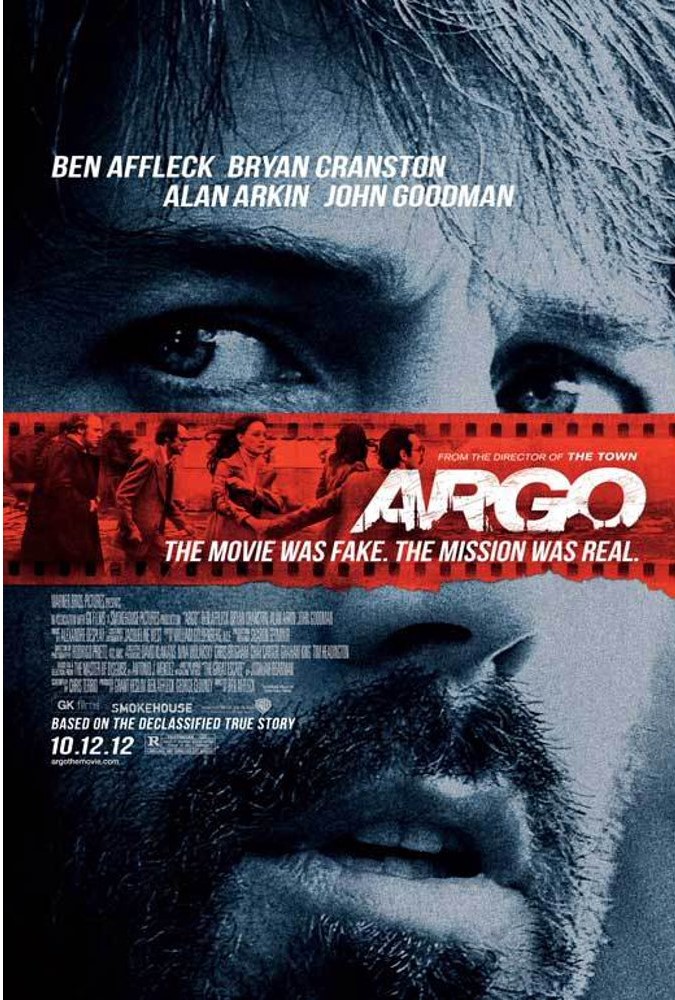
Argo won the Oscar for Best Picture of 2011 and only two others, Best Adapted Screenplay and Best Film editing; Life of Pi got four Oscars, the most for that year. There were eight other films in contention for Best Picture; I have seen Les Miserables, but not Amour, Beasts of the Southern Wild, Django Unchained, Life of Pi, Lincoln, Silver Linings Playbook or Zero Dark Thirty.
The Hugo that year went to The Avengers, and SFWA’s Ray Bradbury Award to Beasts of the Southern Wild. The other films that I have seen from that year are The Hobbit part 1, The Avengers, The Dark Knight Rises, Les Miserables, Brave, Wreck it Ralph and Total Recall. Also, I haven’t yet sat down and watched the whole film, but the Bollywood dance scene set in Dublin from Ek Tha Tiger is a classic.
Sorry about that. I’m just obsessed.
Anyway, back to Argo. IMDB users rate it 10th and 20th film of the year on the different rankings, which is not brilliant but not as bad as last year’s The Artist. Ahead of it on both rankings are Django Unchained, The Dark Knight Rises, The Hobbit 1, The Hunger Games, The Avengers, Skyfall and The Amazing Spider-Man. I would also have put it middle of the pack, but some serious issues came up that bump it to a much lower position in my ranking.
Here’s a trailer.
Returning from previous Oscar winners (and one Hugo winner): first and foremost, Ben Affleck, the star and director here, was Ned Alleyn in Shakespeare in Love.
John Goodman, who is prosthetics expert John Chambers here (the man who invented Spock’s ears, received a special Oscar for Planet of the Apes, and also did Richard Harris’s chest for that scene in A Man Called Horse), was producer Al Zimmer in The Artist last year.
From a previous Hugo winner, Alan Arkin is Hollywood producer Lester Siegel here, and was paterfamilias Bill in Edward Scissorhands back in 1990. (Like many of us, he had more hair then.)
Finally, the Canadian ambassador is played by Victor Garber, who is genuinely Canadian, but I flagged him up previously for his role as the only identifiably Northern Irish character in an Oscar-winning film – Thomas Andrews, the designer of Titanic.
This is the fairly incredible story, Based On True Facts, of how the CIA with help from Canada exfiltrated six American diplomats from Tehran shortly after the seizure of the US Embassy in 1979, by posing as a Canadian film crew looking for locations to make a film version of Roger Zelazny’s great novel Lord of Light.
There are lots of things to like here. But I was dismayed to discover from the memoir by Tony Mendez, the CIA guy behind it all, that the film is significantly more white and male than the real events on which it is based. One of the trapped diplomats, Cora Lijek (who prefers Cora Amburn-Lijek) is a Japanese-American in real life; here she is with the very non-Japanese Clea DuVall who portrays her in the film. (Not that the role is very demanding; the trapped diplomats are basically peril monkeys.)
The film has only one Canadian diplomat, Ambassador Ken Taylor, and his wife Pat, who is also Asian and at least is portrayed by Chinese-Australian actor Page Leong. But in real life, the chief immigration officer and deputy Canadian ambassador, John Sheardown, played a crucial role, along with his wife Zena who is from Guyana. Here she is hosting the fugitives in her house, including Cora Amburn-Lijek on the left.
Almost everyone involved in the story on the US government side was, of course, a white man. But in the book, Mendez is very clear that one memorable meeting – where he made a remark about abortion that is preserved in the screenplay – was chaired by “an undersecretary of state, a dignified woman who was very much in charge.” It took very little research to work out that this must have been Lucy W. Benson, the first woman appointed as US Undersecretary of State; she had left office before the diplomats were successfully extracted from Iran, but would have necessarily been involved with the initial approval process. In his book, Mendez refers respectfully several times to her interventions in the crucial meeting. But on screen, everyone in the room at that meeting is male.
According to Wikipedia, when asked how he felt about being portrayed by Ben Affleck, who is non-Hispanic, Mendez (who was born in Nevada) noted that losing his father when he was young meant he did not learn Spanish nor much of his father’s culture. He said, “I don’t think of myself as a Hispanic. I think of myself as a person who grew up in the desert.” Which is fine; but Affleck did not grow up in the desert either, and his character in the film tells us that he is from New York (Affleck is from Boston), rather than Nevada. A smaller point, but Mendez in real life has three children, a daughter and two sons. In the film he has only one child. Would you like to guess… Yep.
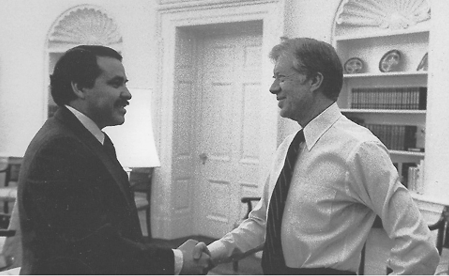
Tony Mendez (the real one) meets President Carter
So basically, Argo whitewashes the protagonist, whitewashes one of the two significant Asian women in the story, erases the most significant black woman in the story, erases the most politically important woman in the story, and even erases the protagonist’s daughter in favour of her brother. Affleck is entitled to make the film he wants to make, and to make the artistic choices that seem right for the story he wants to tell; I too have the right to point out that a lot of these choices go in one direction and not the other, and that the story he tells is much more about white guys vs brown guys than the True Facts that it is Based On. Whitewashing, and erasing women’s agency, are par for the course in Hollywood adaptations, but I can’t remember anything this extensive since All The King’s Men removed the entire African-American population of Louisiana.
It should also be noted that the Canadians dispute the centrality of the CIA to the story, arguing that a lot more of the heavy lifting was done in Ottawa and especially by their embassy in Tehran. And it’s also clear from Mendez’ published memoir that the last-minute hitches portrayed in the film – mission almost cancelled by cold feet in Washington, Iranian security deducing the plan and storming the air traffic control tower in a futile attempt to prevent the departure – are pretty fictional. I’m more forgiving of these changes; it’s a drama, not a documentary, after all. But the Canadians do have a right to feel miffed. (As do the shades of Roger Zelazny and Jack Kirby.)
Apart from that, I quite enjoyed it. I was particularly impressed that the opening sequence described the historic relationship between Iran and the United States in detail, giving context to the hostility that led to the capture of the embassy and the imprisonment of the hostages. Those who were around at the time will remember the apparent impotence of the Carter administration, and the impact of the crisis on his prospects for re-election; for Middle East experts, of course, the 1953 coup orchestrated by the CIA had already set the pattern for US involvement in the region for seventy years. After that opening sequence, the narrative of the film is very one-sided, with frothing Iranians vs innocent Westerners, but credit where it’s due – this political context was crucially missing from the Vietnam films I’ve watched in this sequence, and from The Hurt Locker.
The filmography is particularly good, with hand-held cameras among the crowd storming the embassy bringing it into focus, and the Hollywood, Washington and Tehran locations convincingly depicted. The music is suitable and not oppressive – in the hands of another director we’d have had dramatic chords all the way through to tell us what to feel.
A relatively small element of the film, but I was very struck by the story’s very cynical take on Hollywood, especially after last year’s dewey-eyed The Artist, which also featured John Goodman. The parallel between the make-believe world of Movieland and the deception of espionage is well drawn, and also Arkin and Goodman play the Hollywood scenes for just the right amount of laughs to offset the serious subject matter of the rest of the story.
Chambers: [after hearing plan to exfiltrate the house guests] So you want to come to Hollywood and act like a big shot… Mendez: Yeah. Chambers: …without actually doing anything? Mendez: No. Chambers: You’ll fit right in.
The film was enjoyable, but the erasure is so shocking that I am bumping it way way down my list to eighth last, just above All The King’s Men and below Forrest Gump.
I also read the original Wired article by Joshua Bearman which inspired the film (paywalled) and Mendez’ memoir Argo. The third paragraph of the Wired article is:
At first, the Lijeks hoped the consulate building where they worked would escape notice. Because of recent renovations, the ground floor was mostly empty. Perhaps no one would suspect that 12 Americans and a few dozen Iranian employees and visa applicants were upstairs. The group included consular officer Joseph Stafford, his assistant and wife, Kathleen, and Robert Anders, a senior officer in the visa department.
It tells much the same story as film and book, with maybe a little more emphasis on the experience of the fugitive diplomats.
The second paragraph of the third chapter of the grandly titled Argo: How the Cia and Hollywood Pulled Off the Most Audacious Rescue in History, by Antonio J. Mendez and Matt Baglio is:
From the beginning, the Carter administration faced a number of challenges. When Khomeini and the Revolutionary Council threw their support behind the takeover, there was basically nobody for the U.S. government to negotiate with. Carter tried sending two emissaries, but Khomeini refused to allow them to even enter the country. With overt diplomacy off the table, Carter then turned to his military planners, who gave him a similarly bleak assessment. If the United States were to launch a retaliatory strike, the Iranians might execute the hostages. The chance of rescue also seemed remote. Geographically, Iran was extremely isolated and the U.S. embassy compound was located in the heart of the capital city. It appeared there would be no way to get the rescuers in and back out without the Iranians knowing.
Strictly speaking, the film was based on the relevant parts of Mendez’ earlier memoir, Master of Disguise, which were then extracted, expanded and updated as the book Argo to capitalise on the film. This updating was not complete. John Chambers’ identity is concealed behind a pseudonym in the book, even though the film uses his real name and anyway he had been dead since 2001, so it hardly mattered by 2012.
But it’s a satisfying read, if obviously partisan. The book is clear about the fact that the protagonist (played by a white actor in the film) is from a Hispanic background, even if he doesn’t choose to identify in that way; that one of the fugitive diplomats was Asian-American (also played by a white actor in the film); that one of the key people on the Canadian side was a black woman (erased entirely from the film); that the senior US official who authorised the plan was a woman (erased entirely from the film); that the protagonist had a stable marriage with two sons and a daughter (rather than the broken relationship and one son portrayed in the film) and that the last-minute hitches depicted in the film are entirely fictional.
The book also gives useful context about Mendez’ previous experience of disguise and exfiltration, including various capers in Iran itself, in other Middle Eastern countries and in south-east Asia. He is frank about the shortcomings of the USA’s governmental wiring diagram and comments approvingly that the Canadians with a lighter government structure were able to make things happen much more quickly than the Americans. And even without the fictional last-minute threats to the success of the mission, the truth is quite dramatic enough. You can get it here.
Next up: that year’s SFWA Bradbury winner, Beasts of the Southern Wild.
Non-fiction 6 (YTD 76) Political Animals, by Bev Laing Matt Smith: The Biography, by Emily Herbert Doctor Who (1996), by Paul Driscoll The Dæmons, by Matt Barber Richard of Cornwall: The English King of Germany, by Darren Baker Argo: How the Cia and Hollywood Pulled Off the Most Audacious Rescue in History, by Antonio J. Mendez and Matt Baglio
Non-genre 1 (YTD 14) Mr Britling Sees It Through, by H.G. Wells
SF 8 (YTD 77) The Traders’ War, by Charles Stross Brasyl, by Ian McDonald Jocasta, by Brian Aldiss Black Man, by Richard Morgan α1 β1 Speaker for the Dead, by Orson Scott Card γ1
Doctor Who 3 (YTD 26) Fear of the Web, by Alyson Leeds Doctor Who – The Movie, by Gary Russell Doctor Who and the Dæmons, by Barry Letts
Comics 1 (YTD 14) A Matter of Life and Death, by George Mann, Emma Vieceli and Hi Fi
5,700 pages (YTD 55,500) 6/19 (YTD 84/211) by non-male writers (Laing, Herbert, β1, γ1, Leeds, Vieceli) 2/19 (YTD 27/211) by a non-white writer (Mendez, α1)
368 books currently tagged “unread”, 8 more than last month, with award submissions coming in
Reading now Complete Short Stories: the 1950s, by Brian Aldiss Voorbij de Grenzen van de Ernst, by Kamagurka Empire Of Sand, by Tasha Suri δ1
Coming soon (perhaps) Goliath, by Tochi Onyebuchi The End of the Day, by Claire North The Harem of Aman Akbar, by Elizabeth Scarborough Null States, by Malka Older Disobedience, by Naomi Alderman Death of a Naturalist, by Seamus Heaney La Femme, by Storm Constantine The Bad Christian’s Manifesto, by Dave Tomlinson The Clockwise War, by Scott Gray Song of Time, by Ian R. MacLeod The Lost Child of Lychford, by Paul Cornell Schrödinger’s Kitten, by George Alec Effinger Metamorphoses, by Ovid What If? by Randall Munroe Pale Fire, by Vladimir Nabokov Guards! Guards! by Terry Pratchett The Revolution Trade, by Charles Stross Thirteen, by Richard Morgan The World Set Free, by H.G. Wells Roadside Picnic, by Arkady Strugatsky and Boris Strugatsky Neptune – Épisode 1, by Leo
She was lying in a hospital bed, which admittedly came as no great surprise. On waking, Anne had thought she’d recognised the particular combination of not-too-comfortable mattress and highly starched linen, which only came with institutional bedding; the old-fashioned brushed nylon nightie she was wearing was something of a giveaway, too. She was not in a ward, however, but a private room – and a quite recently decorated one at that, judging by the faint smell of fresh paint lingering beneath the sharp tang of disinfectant. To her left was a small wooden bedside cabinet, on which was placed a carafe of water, a somewhat ‘retro’ (Anne hated that word!) Sony Digimatic digital clock, displaying the time of 10:23, and a hideously large bouquet of red-orange roses in a vase. To her right there was a solitary modern-style armchair upholstered in cream leather-effect vinyl, and a window gave her a view of what looked like a sort of urban green or common, over the far side of which stood a Victorian gothic church with a square tower. Her immediate surroundings seemed quiet, the muffled sound of human voices and movement coming distantly from elsewhere in the building, while outside she could just about discern the steady rumble of traffic, albeit deadened by the thick glass of the window.
The next in the Lethbridge-Stewart series of spinoff novels, and the second in the Laughing Gnome sub-series. The author wrote a good short story in one of the earlier collections.
I have generally enjoyed this whole sequence, and was a bit dismayed when I rather bounced off the previous installment, Scary Monsters; but I’m glad to say that order has been restored, and I very much enjoyed this rewriting of what is already alternative history, where the Brigadier and Anne Travers find themselves projected back in time to the events of The Web of Fear, with a danger that Doctor Who continuity history could go off the rails. You can get it here.
Next in my sequence of books that have won the Clarke, Tiptree/Otherwise and BSFA Best Novel Awards. I had read two out of these three before.
The second paragraph of the third chapter (“File Three”) of The Carhullan Army is:
I did not know how I had kicked away the iron walls and freed up enough space to straighten my legs and uncurl my back. My thoughts were slow to arrive and difficult to arrange. If the door of the dog box was open I could escape. If the pen was like a puzzle, somehow I had decoded it, made one sprung move, one solving turn, and the sides of the cage had released. I could sleep. The stool was gone and I was lying in the dirt. And yet it was smooth and there was the fragrance of soap.
When I first read The Carhullan Army in 2008, I wrote:
I thought it was a very good book. The setting is a near-future Britain, underpopulated and oppressed due to climate change and war; the narrator, a woman known only as “Sister”, flees her native town to join a community of women in the Lake District, and they spend the rest of the book preparing for their struggle with Authority (ie the government). This is the kind of story that is often done embarrassingly badly (see, for instance, Sherri S Tepper on occasion, or The Rising of the Moon) but Hall does it well; Carhullan is emphatically not a utopia, nor is it destined to be a permanent answer to an unjust society, and the leader Jackie and her colleagues are memorable figures. Some readers will be reminded of The Dispossessed, or The Handmaid’s Tale, and I guess it’s fair to say that if you didn’t like either of those books The Carhullan Army will leave you cold. But actually I felt it was also perhaps a response to John Christopher’s The Death of Grass, where the protagonists are engaged in essentially a selfish struggle to get through their post-apocalyptic landscape to (if I remember rightly) the Lake District; the Carhullan Army have a more altruistic and redeeming purpose.
Rereading, I still enjoyed it. The feminist community is not a utopia; it’s a very flawed society, which is still better than the alternative. The theme of eco-catastrophe is all the more relevant in 2022. The characterisation is desperate and convincing. Well worth returning to. You can get it here.
The Carhullan Army won the James Tiptree Jr Memorial Award for 2008. The shortlist included six novels, of which I have read two (Flora Segunda by Ysabeau Wilce and Glasshouse by Charles Stross), a short story, an anthology, and a comic series of which I have read the last volume. It was also on the shortlist for the Clarke Award. From what I’ve read, the jurors made the best choice.
The second paragraph of the third chapter of Brasyl (“Our Lady of Trash”) is:
“I know a hundred World Cup Stories.” Raimundo Soares watched his weight drop into the glowing water. He claimed to be the last professional carioca; sometime journalist, sometime writer with a good book about the new bossa nova, a better book about Ronaldo Fenômeno, and a so-so guide to how to be a professional carioca on his backlist. A little fishing early with the brothers, a little cafezinho when the heat got up, a few hundred words on the laptop, the rest of the afternoon he’d spend in a cafe, watching ass on its way to the beach, or strolling around his city, remembering it, memorizing it. In the evening, receptions, parties, openings, his many lovers: a late sleep and up again at fish-jump. He claimed to have worn nothing but surf-Ts and Bermuda shorts for twenty years, even to his own mother’s funeral. He was the loafer, the malandro who doesn’t have to try too hard, carioca of cariocas: they should make him a Living Treasure. “This is true. David Beckham comes to Rio; he’s going to play at the Maracanã for a benefit for Pelé. He’s the guest of the CBF, so he’s got the wife, the kids; everything. They put him up at the Copa Palace, nothing’s too much trouble for Senhor Becks; presidential suite, private limo, the lot. Anyway, one evening he goes out for a little kick-about on the beach and these hoods jump him. Guns and everything, one two three, into the car and he’s gone. Lifted. Right under his guards’ noses. So there’s Beckham in the back with these malandros with the gold-plated guns thinking, Oh sweet Jesus, I am dead. Posh is a widow and Brooklyn and Romeo will grow up never knowing their father. Anyway, they take him up into Rocinha, up the Estrada da Gávea, and then from that on to a smaller road, and from that onto an even smaller road until it’s so steep and narrow the car can’t go any farther. So they bundle him out and take him up the ladeira at gunpoint and anytime anyone sticks so much as a nostril out of their house, the hoods pull an Uzi on them; up and up and up, right up to the top of the favela, and they take him into this tiny little concrete room right under the tree line and there’s Bem- Te-Vi, the big drug lord. This was back before they shot him. And he stands there, and he looks at Beckham this way, and he looks at Beckham that way; he looks at Beckham every way, like he’s looking at a car, and then he makes a sign and in comes this guy with a big sack. Beckham thinks, Jesus and Mary, what’s going on here? Then Bem-Te-Vi stands beside him and they pull out the World Cup, the original Jules Rimet, solid gold and everything, right Out of the sack. Bem-Te-Vi takes one side, Beckham takes the other, and this guy gets out a digital camera, says, ‘Smile, Mr. Beckham.’ Click! Flash! And then Bem-Te-Vi tutns to Becks and shakes his hand and says, ‘Thank you very much, Mr. Beckham, it’s been a real honor… Oh, by the way… if anyone ever finds out about this…’’’
Ian McDonald’s latest. The setting of Brazil fits his lush, dense writing style so well that it is remarkable that he’s never set a novel in real South America before (his two books set on Mars portray a rather Patagonian version of the planet, but it’s not quite the same). We have three interleaving narratives, from the mid-18th century, the present day, and the near future (2030); we have peculiar variations of reality; and we have the jungle, both urban and literal, with its various hostile inhabitants. In some ways it’s deliberately less ambitious than River of Gods, which juggled ten different viewpoint characters against the background of India forty years hence, but the intermeshing of the different characters from their different time periods in the end comes across rather pleasingly.
I wasn’t quite as blown away on re-reading. The three different timeline settings are superbly realised, but I was not as convinced about the link between them. Still very enjoyable. You can get it here.
Brasyl won the BSFA Award for Best Novel. I’ve read all but one of the other finalists: Alice in Sunderland, Black Man aka Thirteen (see below), The Execution Channel, and Hugo and Nebula winner The Yiddish Policemen’s Union, the other being The Prefect, by Alastair Reynolds. I didn’t vote that year, but I’d probably have gone along with the majority. Alice in Sunderland is a great book, but it’s only tenuously sf. Brasyl was also on the final ballot for both Hugo and Nebula, unlike The Carhullan Army or Black Man / Thirteen.
I had not previously read Black Man, published as Thirteen in the USA. The second paragraph of the third chapter is:
The siren hit, upward-winding like the threat of a gigantic dentist’s drill.
I’ve read a couple of other books by Richard Morgan, and this seemed to me in character with them and perhaps a little more under control. The viewpoint character is a genetically engineered “Thirteen” in a near-future (early 22nd century) world where people like him are regarded with suspicion by society and mostly exiled to Mars. There is a murder mystery with explosive political ramifications, some nasty violence (this is the bit of Morgan’s expertise that I don’t especially appreciate), some desperate sex and a very well-written death scene. Like all murder mysteries, the point is to get the reader from A to B while admiring the scenery and wondering how the route will twist next, and it certainly succeeds very well in that. You can get it here.
Black Man won the Arthur C. Clarke Award under that title. The other finalists included two books that I have read and already referred to above, The Carhullan Army and The Execution Channel, and three that I haven’t: The H-Bomb Girl, by Stephen Baxter; The Raw Shark Texts, by Steven Hall; and The Red Men, by Matthew de Abaitua. I think if I had been a Clarke judge that year, I’d probably have argued strongly for The Carhullan Army.
Next up are the 2010 winners for books published in 2009: Song of Time by Ian R. MacLeod (Clarke winner), Filter House by Nisi Shawl (joint Tiptree winner), The Night Sessions by Ken MacLeod (BSFA winner) and The Knife of Never Letting Go by Patrick Ness (joint Tiptree winner).
But one man didn’t think like this. He believed that Doctor Who had a huge role to play in the twenty-first century, that the franchise was not dead but sleeping, and that, in short, it was high time Doctor Who made a comeback. And this particular man was in a position to do something about it.
A rather fluffy biography which I hope I picked up cheap somewhere, first published in 2010 and hastily updated for the paperback edition in 2012, with at least as much about the history of Doctor Who as about the new star, whose career had lasted less than a decade at the time of writing. (Since then of course, he’s been Prince Philip and is now Daemon Targaryen.)
Emily Herbert specialises in celebrity biographies and this is not one of her top rated works on Goodreads or LibraryThing. (For the record, her top-rated works are her biographies of Robin Williams and Lady Gaga.) She does a decent job of making bricks out of straw here, and explains the history of Doctor Who rather well to a target audience whose interest may be less than obsessive. But the really interesting biography (or autobiography) of Matt Smith will be written a couple of decades from now. Meanwhile you can get this one here.
“Have to do my fourteen miles before lunch,” he said. “You haven’t seen Manning about, have you?”
I had no expectations whatsoever of this novel, originally published in 1916, one of the last of the novels in my big H.G. Wells collection. I found it a really impressive work, one of the best non-sf novels by Wells that I have read. Mr Britling is a self-parody of the author, a complacent intellectual writer with a nice place in the country, extended family around him and a lover in London. In 1914 he thinks that war is impossible, and if it comes it will be brief because sensible people of all countries will reject it. It turns out that he is wrong, and his world diminishes through loss and tragedy. I like Wells all the more for putting such a flawed version of himself front and centre; Britling is a very imperfect human being, but his tragedy is discovering that the imperfections of the world he lives in are much worse than he had imagined. There are some nice and respectful bits with Belgian refugees as well. You can get it here.
Continuing my journey through my substantial backlog of Doctor Who comics, I’m now at this Eighth Doctor collection from 2016. I have generally rated George Mann poorly as a writer, and so I am glad to say that I really enjoyed these five linked stories, in which the Eighth Doctor finds a young artist squatting in his country house and takes her on a series of adventures. The third, in which sinister entities emerge from mirrors, is particularly good.
My one complaint is that artist Emma Vieceli’s depiction of the Eighth Doctor doesn’t look a lot like Paul McGann. (The cover is by someone else, I think.)
But otherwise this came as a pleasant surprise and I will give George Mann’s work at least a second glance in future. You can get it here.
Next up: the Ninth Doctor in Weapons of Past Destruction.
Third section (illustrated by a picture of a small boy standing under an elephant’s belly):
No matter how much you feed a wolf, an elephant still has bigger BALLS. Russian popular saying.
One of those New Internationalist books. A series of quotes about how humans, especially politicians, behave like animals, and also how we should treat animals a bit more like we treat humans, illustrated with cute animal photos. I am sympathetic to the sentiments, on the whole, but I found the delivery rather sanctimonious. You can get it here.
This was both the shortest unread book I acquired in 2015, and the non-fiction book that had lingered longest unread on my shelves. Next on those piles respectively are La Femme, by Storm Constantine, and The Bad Christian’s Manifesto, by Dave Tomlinson.
Sometimes, when he was extremely tired, he’d lose his sense of smell. It was as if the part of his brain that dealt with scents and stinks and stuff gave up trying to make sense of the world and went to sleep without him. At other times it would come back extra strong, and any passing scent might dredge up a slew of distracting memories. It was a weird kind of borderline synaesthesia, and it reminded him uncomfortably of a time a couple of years ago when he’d been on assignment in some scummy mosquito-ridden swamp down in Florida. The hippie asshole he was staking out had made the tail, and instead of doing the usual number with a Mac-10 or running, had spiked his drink with acid. He’d spent a quarter of an hour in the bathroom of his hotel room staring at the amazing colors in the handle of his toothbrush, marveling at the texture of his spearmint dental gel, until he’d thrown up. And now he was so tired it was all coming back to him in unwelcome hallucinatory detail.
Compilation of the third and fourth volumes of the Merchant Princes series, in which our protagonist and her ex-boyfriend are entangled in dynastic feuds in a family who have the ability to walk between parallel universes; our own, and two others, one more feudal, one more eighteenth-century, the action in all cases set in what we call the northeastern USA, most of whose population are descended from settlers across the ocean. The first compilation volume was The Bloodline Feud.
Stross’s heroine makes an early mistake here, trying to bring her know-how from our world to gain power and status in the feudal society of her origin, but over-reaching and then having to deal with the consequences of dynastic displeasure, while the dance of intelligence services around one another between the worlds gets steadily more intricate and nasty. The pace continues to be intense and well constructed. Great stuff. You can get it here.
(By odd coincidence, the day I finished reading this, I later bumped into the author in the bar in Chicago and had a long chat.)
This was my top unread book acquired in 2017. Next on that pile is the next in this series, The Revolution Trade.
Может быть, через пятьдесят или сто лет о той нашей жизни, которая называлась социализмом, будут писать объективно. Без слез и проклятий. Начнут раскапывать, как древнюю Трою. Недавно вообще хорошо сказать о социализме было нельзя. На Западе после крушения СССР поняли, что марксистские идеи не кончились, их надо развивать. Не молиться на них. Маркс не был там идолом, как у нас. Святым! Сначала мы его боготворили, а потом предали анафеме. Все перечеркнули. Наука тоже принесла человечеству неисчислимые бедствия. Давайте тогда истреблять ученых! Проклянем отцов атомной бомбы, а еще лучше – начнем с тех, кто порох изобрел! С них… Разве я не права? (Я не успеваю ответить на ее вопрос.) Правильно… правильно, что из Москвы выбрались. В Россию, можно сказать, приехали. По Москве когда гуляешь, кажется, что и мы Европа: роскошные машины, рестораны… Золотые купола блестят! А вы послушайте, о чем у нас люди говорят в провинции… Россия – это не Москва, Россия – это Самара, Тольятти, Челябинск… жопинск какой-нибудь… Что на московских кухнях можно узнать о России? На тусовках? Бла-бла-бла… Москва – столица какого-то другого государства, а не того, что за кольцевой дорогой. Туристический рай. Москве не верьте…
Perhaps fifty or a hundred years from now they’ll be able to write objectively about the way of life we called socialism. Without all the tears and obscenities. They’ll unearth it like ancient Troy. Until recently, you weren’t allowed to say anything good about socialism. In the West, after the fall of the Soviet Union, they realized that Marxism wasn’t really over, it still needed to be developed. Without being worshiped. Over there, he wasn’t an idol like he’d been for us. A saint! First we worshiped him, then we anathematized him. Crossed it all out. But science has also caused immeasurable suffering—should we eliminate scientists? Curse the fathers of the atom bomb, or better yet, start with the ones who invented gunpowder? Yes, start with them…Am I wrong? [She doesn’t give me a chance to answer her question.] You’re on the right track, leaving Moscow. You could say that you’ve come to the real Russia. Walking around Moscow, you might get the impression that we’re a European country: the luxury cars, the restaurants…those golden cupolas gleaming! But listen to what the people talk about in the provinces… Russia isn’t Moscow, Russia is Samara, Tolyatti, Chelyabinsk—some Bumblepinsk…How much can you really learn about Russia from sitting around in a Moscow kitchen? Going to parties. Blah, blah, blah… Moscow is the capital of some other nation, not the country beyond the ring road.* A tourist paradise. Don’t believe Moscow… * The ring road is a major freeway encircling Moscow which served as Moscow’s administrative border until the 1980s.
Another in the grim sequence of Nobel Prize winner Alexievich’s accounts of her country’s history (I have previously read Voices from Chernobyl and Boys in Zinc). Here she takes on the lived experience of the break-up of the Soviet Union, mainly (though not only) as it affected Russians, simply told through their own testimony. There was good in the old system, in the sense of social solidarity and a sense of common purpose, but it was outweighed by the grinding poverty and brutal oppression. The subsequent collapse of Russian society, except for the super-privileged, has lent the Soviet years some undeserved retrospective legitimacy. There is some grim reading about personal hardships, the worst of them from the Communist era. It’s not a chronological history, it’s a report from the past, with all the caveats that that requires. Especially at the current time, it’s really useful to have a window into what makes Russia and Russians tick. Important and gripping reading. You can get it here.
I was interested to note that the original Russian title of the book, Время сэконд хэнд, uses the English words “second hand”.
This was my top unread book acquired this year, and also my top unread book by a woman. Next on those piles respectively are Pale Fire, by Vladimir Nabokov, and Disobedience, by Naomi Alderman.
I think this was the first book I read by Terry Pratchett, and it was a delight to come back to it. The jokes are still funny, if no longer unexpected; the Luggage remains one of the greatest ever characters with no dialogue; and the overall plot of the world ending, or rather finding new birth, with the spell in Rincewind’s head key to the resolution, remains engaging. Perhaps now that I am 55 rather than a teenager, Cohen the Barbarian is not quite as funny a character.
The one joke that really made me laugh this time, and compelled me to read it out to my long-suffering spouse, was this:
He read that the Great Pyramid of Tsort, now long vanished, was made of one million, three thousand and ten limestone blocks. He read that ten thousand slaves had been worked to death in its building. He learned that it was a maze of secret passages, their walls reputedly decorated with the distilled wisdom of ancient Tsort. He read that its height plus its length divided by half its width equalled exactly 1.67563, or precisely 1,237.98712567 times the difference between the distance to the sun and the weight of a small orange. He learned that sixty years had been devoted entirely to its construction.
It all seemed, he thought, to be rather a lot of trouble to go to just to sharpen a razor blade.
This was the top book by Terry Pratchett which I had not yet reviewed online. Since I am taking them in popularity order (as measured by LibraryThing), the next is Guards! Guards!.
Second paragraph of third chapter (and these are long chapters):
He was back again, standing in the bedroom doorway, waiting with exaggerated patience for her to shut her suitcase. He always insisted upon loading the car for her, which was a sort of coals-of-fire kindness. As a matter of fact, even with the roof rack it took a bit of doing for five of them, but he made a regimented meal of it – insisting upon everybody’s luggage being stacked on the pavement beside the car before he would begin.
This was slightly an impulse purchase for Anne’s birthday when I saw it in the local bookshop. I am sorry to say that all I knew about the writer was that she had been married to Kingsley Amis; I guess I was vaguely aware that she was a writer in her won right, but I had not realised that she was so good. (I was also unaware that her first brief marriage was to the naturalist Peter Scott.)
It is the first book in a series about the Cazalets, a wealthy English family in the international timber trade (like Howard’s own). This one is set just before the second world war, and introduces us to the Cazalet family: three brothers and a sister, the women who are their lovers, their children and their parents, and a couple of other family connections as well. Everyone gets a couple of sections to themselves, the tight-third narrative moving from person to person to highlight the differences and similarities in perspective between the various relatives. The shadow of the first war lies heavily on all of them as they try and avoid thinking about the next one.
It’s a leisurely opening for an epic, and you couldn’t really call it a novel because the story does not end at the end of the book. There are a couple of pretty dark moments as well, setting up more narrative threads for future volumes. I enjoyed it more than I thought I would. You can get it here.
Several children and a pregnant woman were among the 24 people killed in these two actions, most of them from just two families – Ahmeti and Sejdiu. Both families were associated with the KLA and the evidence suggests that both attempted to resist the Serb attack but were quickly overwhelmed.
I know the author of this book, and I know the subject, and I know many people mentioned in the book (including Søren Jessen-Petersen, who wrote the foreword). It’s an account of the war crimes trial of Ramush Haradinaj, briefly Prime Minister of Kosovo, written by a leading member of his defence team. There is a lot of well-crystallised historical information about the roots of the Kosovo conflict and Haradinaj’s role in it, and also a lot of excoriating analysis of the weakness of the prosecution case (Haradinaj was in the end acquitted, twice). I did not spot any errors in the former, and so am more inclined to trust the author on the latter.
The core argument of the book is a strong case that the prosecution of Haradinaj and others was launched as a political sop to the government of Serbia in order to encourage Belgrade to cooperate with the international tribunal. The facts are that the final batch of indictments by ICTY (International Criminal Tribunal for the former Yugoslavia) included seven high-ranking non-Serbs, every one of whom was ultimately acquitted; but Ratko Mladić and Radovan Karadžić, the two highest-ranking Bosnian Serb fugitives, were handed over by Serbia shortly after the indictments were issued. One may draw one’s own conclusions. You can get the book here.
This was the non-fiction book that had lingered longest unread on my shelves (sorry Michael). Next on that pile is Political Animals, by Bev Laing.
Many factors contributed to the growth in enthusiasm for duelling in Ireland in the late 1760s and 1770s. The social and attitudinal effects of economic prosperity, already referred to,’ were at work a fortiori by the end of the 1760s; while the disinclination of the authorities to use the law to confine the enthusiasm for duelling meant that there was little by way of legal obstacles in their path. Table 2.6, which summarises the response of the law to the recorded duelling incidents that constitute our sample for the years 1716-70, indicates that there was an identifiable decline in the proportion of duellists taken to court in the mid-eighteenth century. By the 1760s the authorities no longer prosecuted duellists as a matter of course, even in cases in which there were fatalities, if the duel was deemed to have been conducted within the code of honour, because judges and juries routinely returned verdicts of manslaughter in self-defence which ensured the defendant’s prompt release.
I got this because I remain very intrigued by the reported incident of about 1723 when one of my 5x great-grandfathers, John Ryan Glas of Inch, Co Tipperary, was killed in a duel in Dublin by another of my 5x great-grandfathers, John White of Leixlip, Co Kildare, in a property dispute that escalated. Kelly doesn’t refer to that in his book, but it’s still a very interesting analysis of socially sanctioned extrajudicial violence in a society which was going through many transitions.
Although the dates given are 1570 to 1860, most of the recorded duels are from the eighteenth century. I do have a family connection with one of the earliest of them, however, the 1583 trial by combat between two of the O’Conors of Uí Failge (Offaly, as we now call it), held in the yard of Dublin castle at the command of my ancestor Sir Nicholas White, Master of the Rolls.
But basically the formal duel came into its own in the aftermath of the Williamite settlement, when the rule of law was weak but the concept of honour remained strong, and intensified in the later part of the century as political change began to build. Indeed it’s striking just how many of the leading politicians of the day were involved with duelling, right up to Grattan and Flood, and the young Daniel O’Connell.
I also realised that I had forgotten whatever I once knew about the complexity of eighteenth-century Irish politics, with the corrupt but stable “undertaker” system during the mid-century upset by the Castle v Patriot dynamic towards the end, which led to autonomy from 1782, failed rebellion in 1798 and Union in 1801. These political struggles were not only carried out verbally. But at the same time, quite a lot of duels were resolved without either combatant being killed, and no major figure lost his life in that way (unlike Alexander Hamilton).
Walking thus loaded didn’t help my hunger or my disposition, but it warmed me up in short order. My burdens were not too heavy, but they were awkward; and a long sword wasn’t designed for a pedestrian. In consequence, though the new sun was soon lighting a very fair day I wasn’t favorably impressed. I don’t suppose I’d gone more than three miles before I caught sight of the horse, but it seemed as if I’d been walking for a week.
Not sure how this ended up in my library; it was I think an impulse purchase at a convention. The author is a fascinating figure in his own right; the book is a rollicking Dark Ages story of a bard who turns warrior and defender of the vulnerable, which would qualify as straight historical fiction, were it not for the first chapter in which the Little Folk put the protagonist under a geas which compels him to be helpful. As usual, the names are completely wrong, but the story is a decent fist at imagining historical France in the 6th or 7th century, and, as mentioned already, it is rollicking good fun. You can get it here.
This was my top unread book acquired in 2019. Next on that pile is Null States, by Malka Older.
Aber suddenly laughed, then reached into the air, felt around for a second, and plucked a large white towel seemingly from nothingness.
Second of the prequels to Zelazny’s great Amber series, and it is a step up from the first volume. Oberon and his recently acquired father Dworkin (and recently acquired brother Aber) battle their way through family feuds at the Courts of Chaos to head towards the creation of Amber itself (which will presumably happen in the third volume). It’s still rather flat compared to the originals, but at least it does not go on too long. You can get it here.
This was my top unread book acquired in 2016. Next on that pile is The Harem Of Aman Akbar, by Elizabeth Scarborough.
When I first watched The Time Warrior in 2007, I wrote:
The Time Warrior was the first story in the eleventh season of Doctor Who, over December 1973/January 1974. More significantly, it was the first outing for Elisabeth Sladen as Sarah Jane Smith, a role she played until October 1976, the longest continuous run of any companion (and longer than some Doctors had on screen). (Reprised, of course, in 1981 in K9 and Company, 1983 in The Five Doctors, in various Big Finish and other spinoffs, and last year in School Reunion; now getting her own TV series at long last.)
She gets a good introduction, stowing away in the Tardis to investigate the disappearance of scientists, who as it turns out are being kidnapped by time machine by an alien Sontaran who needs them to repair his spaceship which has crashed on Earth in the Middle Ages. (Of course, when they meet again in School Reunion, the Doctor is once again pretending to be Dr John Smith; not, as we now know, for the last time either.) I felt she was a bit screamy compared with the Sarah Jane Smith we came to know and love later on, but in contrast with the awful Jo who came before she is a vast improvement.
There’s also an interesting conversation in Episode 2 between the Doctor and the Sontaran commander Lynx with significant continuity implications. Apparently this was the first time that the Doctor’s home planet had been named. But it’s also interesting that the Sontarans have been considering it as a military target, a plan which comes to fruition in The Invasion of Time in 1978.
Anyway, not one of the great Robert Holmes stories, but not bad at all.
Coming back to it in 2010 for my Great Rewatch, I wrote:
The Time Warrior has the difficult task of introducing the first new companion for three years. But it is also the first story with a historical setting since The Highlanders, which incidentally was also the introductory story for a long-lasting companion (Jamie), which in itself is rather a good signal that the show is still capable of pulling surprises (which is just as well, considering the disappointments in store later in the season). The medieval stuff – Dot Cotton and Boba Fett in alliance against the bad guys – is actually rather well done, to the point that you don’t realise that there is only one castle playing two roles. The Sontarans are off to a good start, and there’s a satisfying bang at the end as the castle blows up.
It’s interesting to note that Sarah actually looks rather boyish here – pageboy haircut, understated bust, wearing trousers rather than skirt – which reinforces the point that the companion is meant to be the audience identification figure, and perhaps makes her easier for small boys to relate to than the much more girly Jo would have been. One can’t take this too far – she is certainly femme rather than butch – but it strikes me that after the first seven seasons of regular characters who just happen to be hanging around the Tardis and the Doctor, we have here the consolidation and further development of the Jo Grant dynamic.
One further character note about the Doctor – we have a bit of a reshaping of the role of the Time Lords here, as galactic ticket-inspectors; and this is also the story where the Doctor says he is serious about what he does, but not necessarily the way he does it. Unmoored from the UNIT setting, this is a new Pertwee in some ways, and we are allowed to sympathise with Sarah to a certain extent when she mistakes him for the villain rather than the hero of the story.
Rewatching once more, a couple of points struck me. First, immediately after the rather drab location shooting of The Curse of Fenric, here things seem much better co-ordinated and coherent. Alan Bromly is not at the top of many people’s list of favourite Doctor Who directors, but (unlike Matthew Kilburn, but we’ll get there) I think he delivers the goods.
Second, the script is neutral but heading towards positive on Sarah’s feminism. The Doctor looks like an ass in the first scene with her when he tells her to make the coffee. There’s a funny moment when she tells the kitchen wenches that they should not be living in the middle ages, just before realising that they have no choice. But to have a character articulating these views at all is (sadly) a step forward. (I also wonder if the wenches had been hiding or hidden when Lynx arrived; it’s clear that Sarah is the first woman he has seen.)
Third, Elisabeth Sladen is really nervous in her first scene as Sarah. We know now that Pertwee had been awful to her in rehearsal, saying how sorry he was that Katy Manning had left, almost as awful as the Doctor is to her in the script. The scene gives context for Sarah thinking the Doctor must be the villain, but one can also sympathise with the jitters of an actor who had just been given her breakthrough role, but with a star who had already had one potential candidate sacked and had made it clear he wished she was someone else. (Pertwee came round in the end, but the production team had already decided to dump him and keep her.)
The second paragraph of the third chapter of Terrance Dicks’ novelisation is:
Linx went to the cellar door. It was closed and locked but he made no attempt to open it. ‘Linx!’ bellowed a hoarse voice from the other side. ‘My lord Linx, will you open the door?’
Somehow despite the apparently favourable conjunction of DW’s most prolific TV script writer (Holmes) and the most prolific novelisation writer (Dicks), it rarely seems to gel, and this is a typical example: an unexceptional Dicks novelisation of a decent Holmes script, supposedly in this case with Holmesian participation. The Sontaran commander Linx (rather than Lynx) and the myopic Professor Rubeish both get a little more characterisation, but it’s otherwise standard stuff.
It is interesting that both this and the next story are about the bad guys shunting people between the present and the past.
I now accept that this was unfair of me. There are a lot of nice little moments in the novelisation that were missed from the TV show, including Mary, Hal the archer’s girlfriend, whose lines were completely cut from the screen. After a marathon of Pertwee novelisations in 2008, I think I may have been getting a bit fed up with Dicks’ prose, but in isolation it reads much better. You can get it here.
As with the author of the last Black Archive that I wrote up, Matthew Kilburn is a friend, amd as with Una McCormack on The Curse of Fenric, this monograph has made me reassess several aspects of the story positively, though starting from a higher base in that I liked it more to start with.
An introduction points out the rarity of stories set in the historical past at that time of Doctor Who, the most recent having been The Evil of the Daleks, six years before, and also discusses the uninventive style of director Alan Bromly (where as mentioned above I think there is a decent case for the defence).
The first chapter looks at The Time Warrior as a war story, reflecting on Holmes’career both as s soldier in Burma and as a writer for the patriotic boys’ magazine John Bull, but also considering the Vietnam War which was raging at the time.
The second chapter looks at the story’s aesthetic, coming down firmly on the Gothic side of the fence, considering also The Castle of Otranto, Ivanhoe, Frankenstein and the TV series Arthur of the Britons.
The second paragraph of the third chapter is:
The above paragraph offers a brief description of a character who could be either the Doctor or Linx. The parallels are obvious, especially with Spearhead from Space; but so are the objections. While Irongron and his men saw Linx’s vessel cross the sky and fall to Earth, the UNIT officer and her technician saw Nestene energy units, not the TARDIS. The UNIT personnel identified an enemy, while it’s Irongron who finds an ally. However, this latter statement is open to challenge, and it’s part of the Doctor’s function in this story to point out why.
The chapter looks at how Lynx and the Doctor parallel each other, alien wizard/scientists working with local Earth military/political leaders, but also looks at how Lynx portrays racism and colonialism.
The fourth and final chapter looks at Sarah as a character, and the way in which she is both a new and a traditional companion figure for Doctor Who. Her feminism is a character trait; it’s not funny, but it’s not shared by others either. The chapter looks at the story of Elisabeth Sladen’s casting, and also at the changes between script and screen which slightly eased the gendered elements of the story.
A conclusion reflects again on The Time Warrior as a post-imperial story, and how its themes are reflect in other Who stories which Holmes had a hand in.