Annie Bot, by Sierra Greer

Second paragraph of third chapter:

Annie is suspended in an agony of knowing Doug is displeased. She can focus on nothing else. It eats her memory, corrosive and hot. She can still hear his voice: No, it’s a fucking party. She has identified his words as sarcasm, his tone as scathing.

This is the last in a series of posts that I began in 2012, when I determined to read all of the winners of the BSFA Award for Best Novel, the Arthur C. Clarke Award, and the James Tiptree Jr. Award, now the Otherwise Award (and currently on hiatus). It’s been an interesting process; the awards have occasionally overlapped – Air by Geoff Ryman won all three – but more often they have charted somewhat different courses through the genre. It’s a sufficiently complex subject to deserve its own post.

Meantime since I started this series I found myself physically counting the votes for the BSFA Awards several times just before the pandemic, and served on the Arthur C. Clarke Award jury twice, in 2015 and 2023. (I have had no engagement with the administration of the Tiptree / Otherwise Award.)

As a result of my previous Clarke service I was invited to the presentation of this year’s award in June in London, despite at that point having read only one of the six shortlisted novels (The Ministry of Time, by Kaliane Bradley), and was therefore not very surprised when the award went to one of the five books I had not read, Annie Bot by ‘Sierra Greer’ (Caragh M. O’Brien). Here she is accepting the award.

So, I finally got around to reading the book. And I’m afraid it is not for me. I hate cute anthropomorphic robots; the protagonist is a sexbot, which is the extreme case of cute anthropomorphic robot. She is in an abusive relationship with Doug, and is in fact obsessed with him by design. Navigating this set-up to a satisfactory conclusion is a difficult task, and I did not feel that it was accomplished here. The Clarke judges are entitled to make their choice on the basis of their own feelings and reactions, and it’s good when they pick a book that has been overlooked by the other awards; but I think that if I had been on the jury this year, this book would probably not even have been shortlisted.

You can get Annie Bot here.

As I said, that concludes my read-through of all of the Clarke, BSFA and Tiptree/Otherwise winners. So I’m starting a new project, reading a new book (or two) by every winner of the Nobel Prize for Literature who was not a white man – that’s 29 of the 121. The first will be Selma Lagerlöf, the tenth winner, and I’ll be reading both her early Jerusalem and her later The Emperor of Portugallia.

Arthur C. Clarke Award winners:
The Handmaid’s Tale | The Sea and Summer | Unquenchable Fire | The Child Garden | Take Back Plenty | Synners | Body of Glass | Vurt | Fools | Fairyland | The Calcutta Chromosome | The Sparrow | Dreaming in Smoke | Distraction | Perdido Street Station | Bold as Love | The Separation | Quicksilver | Iron Council | Air | Nova Swing | Black Man | Song of Time | The City & the City | Zoo City | The Testament of Jessie Lamb | Dark Eden | Ancillary Justice | Station Eleven | Children of Time | The Underground Railroad | Dreams Before the Start of Time | Rosewater | The Old Drift | The Animals in that Country | Deep Wheel Orcadia | Venomous Lumpsucker | In Ascension | Annie Bot

Prophet Song, by Paul Lynch

The second section of the third chapter of Prophet Song is long, what with the lack of paragraphing. I count 872 words.

She is distracted at work, pacing within, seeing before her some shadowed obstacle and seeking a path around it, saying to herself over and over, they will not take my son. There are rumours in the company of a blood-letting, of a phased wind-down, none of it can be true. They are called into the meeting room where it is announced the managing director Stephen Stoker has been stood down, he did not come into work this morning, they are told that Paul Felsner will replace him. He comes before them pulling on the tips of his fingers with a small hand and cannot hide his delight. She watches about the room as he speaks selecting for his supporters by the clapping hands and smiles, seeing the wild animal among them, seeing how it has done away with concealment and pretence, how it prowls now in the open as Paul Felsner raises his hand in hieratic gestures speaking not the company speak but the cant of the party, about an age of change and reformation, an evolution of the national spirit, of dominion leading into expansion, a woman walks across the room and opens a window. Eilish finds herself stepping out of the lift onto the ground floor. She crosses the street and goes into the newsagent’s, points to a pack of cigarettes. It has been a long time, she thinks, standing alone outside the office building, sliding a cigarette from the box, fondling the paper skin, running its odour under her nose. The cottony taste of cellulose acetate as she lights and pulls the hot smoke into her mouth, recalling the day she last quit, this feeling of some younger self, perhaps Larry was with her, she doesn’t know. Memory lies, it plays its own games, layers one image upon another that might be true or not true, over time the layers dissolve and become like smoke, watching the smoke that blows out her mouth vanish into the day. Watching the street as though it belongs to some other city, thinking how it is so that life seems to exist outside events, life passing by without need of witness, the congested traffic fuming in the dismal air, the people passing by harried and preoccupied, imprisoned within the delusion of the individual, this wish now she has to escape, watching until she is brought clean outside herself, the light altering tone by tone until it becomes a lucent sheen on the street, the gulls nipping at food in a gutter are dark underwing as they whip up out of the path of a lorry. Well now. Colm Perry is standing beside her tapping a cigarette on its box. I didn’t know you smoked, Eilish. She is squeezing her eyes as if to see an answer to a question she has not been asked and then she shakes her head. I can’t say that I do. Colm Perry lights a cigarette and exhales slowly. Neither do I. She pulls the dark burn inside her and wants the burn some more, studying Colm Perry’s wrinkled shirt, knowing the cerise face of a drinker, the look that rests sly in the eye of a man well in on the joke though he is laughing at them from the outside. He glances behind towards the automatic door. The gall of that man, he says, there will be a purge soon enough, they like their own kind so keep your head down, that’s all I have to say. He looks again over his shoulder and pulls out his phone. Have you seen the latest? What she sees on the phone are images of graffiti on windows and walls denouncing the gardai, the security forces and the state, triumphant scrawls in sprayed red paint. The writing looks like blood, the building looks like a school. St Joseph’s in Fairview, he says, they are saying the principal called in the GNSB who came and arrested four boys, they haven’t yet been released, it’s gone on a few days but the story’s only online now, there are parents and students gathering outside Store Street Garda Station waiting for the boys to be freed. My son has been called up for national service, she says, he is to hand himself over the week he turns seventeen, he is still just a kid in school, and this after they take his father. Colm Perry looks at her and then he shakes his head. Bastards, he says. He cups his hand to his mouth and thinks long upon a drag then extinguishes the cigarette on the smokers’ box. You’re going to have to get him out, he says. Get him out where? She watches him shrug and open his hands and then he puts them in the pockets of his jeans. He is looking across the street to a newsagent’s. Right now, he says, I’d love an ice cream, an old-fashioned cone with a 99, I’d like to be on a beach freezing my butt off, I’d like for my parents to be still alive, look, Eilish, I don’t know, England, Canada, the USA, it’s only a sug-gestion, but you’re going to have to get him out, look, I must go back inside.

I picked this off the shelf in a California bookshop on the margins of last year’s Gallifrey One, knowing that it had won the Booker Prize but incorrectly under the impression that it was a gritty realist slice-of-Dublin-life story. I was of course wrong about this. It’s set very firmly in middle-class Dublin, but in the very near future where an extremist party wins an election and creates a police state, in turn sparking armed resistance, civil war and the collapse of society; it’s told through the viewpoint of a mother of four whose trade unionist husband disappears early in the book and who witnesses her family disintegrating.

Lynch is very clear in interviews that his intention was to bring the horrors of the Syrian conflict home to a local audience, and I think he very much succeeds. The litany of familiar Dublin place names converted into locations of violent convulsion is tremendously effective. The conversion of standard Irish official banter into the language of oppression is chilling. The worst of the violence happens off screen, but its aftermath is vividly realised. And of course it’s not just Syria; I remember Bosnia when I lived there nearly thirty years ago, which had undergone a similar implosion, and today we can look at Palestine, not only Gaza but also the West Bank, for societies being destroyed by violence.

If I had been writing a book like this, I would have also gone into the grand politics of the disaster, looking at bad and evil leadership decisions, and ineffectual international interventions which could have been done better. But Paul Lynch is not into finger-pointing; it’s simply the human experience of state violence followed by violent state collapse, and I find it all the more effective as a result. The non-paragraphed style brings an immediacy to the prose, while of course also being a salute to Joyce’s retelling of everyday Dublin life from a previous century. I am not sure if I could say I actually liked the book, but I do recommend it. You can get Prophet Song here.

I haven’t read any of the other books on the Booker Prize longlist or shortlist for 2023, but I will get to Tan Twan Eng’s The House of Doors very soon. Oddly enough, Prophet Song is set in the city where one of my parents was born, and The House of Doors in the city where the other was born.

This was the top unread book that I had acquired last year, and also I had thought that it was the top unread non-genre book on my shelf, but I think it is pretty clearly in the dystopian sub-genre of sf. Next on the former pile is Camp Damascus, by Chuck Tingle; next on the latter pile, after acquiring some of my father’s books last month, is East of Eden, by John Steinbeck.

Musings on Mothering, ed. Teika Bellamy

Second piece of third section:

I am all

I am food
I am drink
I am comfort
I am security I am warmth
I am love
I am your mother

NIK HARRIS

This is a collection of art, poetry and short prose pieces on motherhood, that I picked up for free at Novacon in 2021. It was sponsored by the British branch of La Leche League,so there’s a not very subtle emphasis on breastfeeding, but in general it’s a nice assembly of pieces of varying quality, speaking to the experience of maternity, which is designed to be an appropriate gift to a new mother. One aspect that is left out is the experience of parents of children with special needs. It is basically out of print, but you can probably get Musings on Mothering here.

Because I picked it up at a science fiction convention, I initially classified it as the sf book that had lingered longest unread on my shelves, but now that I have actually read it, I realise that there is no sfnal content, and I will count it as poetry, which takes up about three quarters of the book.

The next long-unread sf book on my shelf is another that I picked up at that Novacon, Howul: A Life’s Journey, by David Shannon, who is married to Bernardine Evaristo.

The School of Death, by Robbie Morrison et al

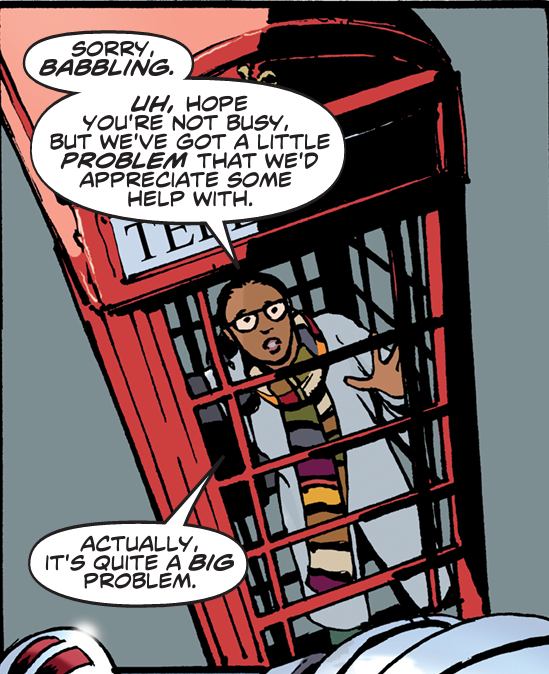
Second frame of third story (“Robo Rampage”):

Osgood: Sorry, babbling. / Uh, hope you’re not too busy, but we’ve got a little problem that we’d appreciate some help with… / Actually, it’s quite a big problem.

Starting Year Two of Titan’s Twelfth Doctor sequence, this is a compilation of three separately published stories. The title story starts with a character called Christel Dean, who is clearly an incarnation of well-known Doctor Who fan and writer Christel Dee, teaching at a remote Scottish boarding school with added Sea Devils. Oh, and the Doctor has a new companion, a stuffed swordfish called Sonny. The second story, “The Fourth Wall”, gets properly recursive with characters being absorbed into (and occasionally escaping from) comics, thanks to alien meddling. And the third story, “Robo Rampage”, is a sequel to the Fourth Doctor story Robot, featuring the twenty-first century UNIT. All three of these are above average; I particularly liked the art of Rachael Stott in the first two. You can get The School of Death here.

Next in this list is The Twist, by George Mann et al.

Thirst, by Amelie Nothomb

Second paragraph of third chapter:

Une seule fois, je me suis mal servi de ce pouvoir de l’écorce. J’avais faim, les fruits du figuier n’étaient pas mûrs. Moi qui avais tellement le désir de mordre dans une figue chaude de soleil, juteuse et sucrée, j’ai maudit l’arbre, je l’ai condamné à ne jamais porter de fruits. J’ai prétexté une parabole, pas la plus convaincante.Just once, I misused the power of the husk. I was hungry, and the fruit on the fig tree was not ripe. My desire to bite into a fig—warm with sunshine, juicy and sweet—was so great that I cursed the tree, and condemned it to never again bear fruit. I said it was for a parable, not the most convincing.
translated by Alison Anderson

I confess that I picked this up and read it quickly at the end of August so that I would have a nice round number of books for the month (32). I was not at all impressed with Nothomb’s The Book of Proper Names when I read it in 2007, but I feel vaguely obliged to engage with one of Belgium’s best-known writers, and pulled this off the shelf in a bookshop to have another go.

Well, it’s not what I expected; it’s an account of the crucifixion and resurrection of Jesus Christ, from his point of view, anticipating and then experiencing his painful death and then attempting to express the experience of return to the flesh. I have to say that I was not grabbed by it. You can find plenty of more interesting Bible fanfic on AO3. There is a hint that Jesus’ relationship with Mary Magdalen (here, “Madeleine”) was physically intimate; but it’s a work of fiction so who really cares?

I fear that Nothomb is on her second strike for me. I’m not sure if there will be a third.

You can get Thirst here.

@Wouters Wondere Wereld, by Guy Gilias

Third artwork described:

De jaarlijkse ‘Week van het Bos’ was voor Ad weer de uitgelezen gelegenheid om aan een oude lindeboom een nieuw leven te schenken. Hij zou de stam versnijden tot de beeltenis van de verzorgers van het bos, de zeer gewaardeerde bosarbeider. Een uitverkoren boomstronk aan het Zoet Water in Oud-Heverlee kreeg de typische boswachtershoed aangemeten, terwijl de lange regenjas elegant gesneden werd uit de mooie schors van de lindeboom. De figuur kreeg een gelaat en werd Wannes genoemd.
Intussen heeft de natuur haar werk gedaan en is de sculptuur spijtig genoeg vergaan.
The annual “Forest Week” was once again the perfect opportunity for Ad to give new life to an old linden tree. He would carve the trunk into an image of the forest’s caretakers, the highly esteemed forestry workera. A selected tree stump at Zoet Water in Oud-Heverlee was fitted with the typical forester’s hat, while the long raincoat was elegantly carved from the beautiful bark of the linden tree. The figure was given a face and named Wannes.
Nature has since taken its course, and sadly the sculpture has decayed.

I bought this just as the pandemic was starting to lift, and the local history society held a carefully socially distanced launch of a couple of its books, including this one. It is a compilation of the public art of our local sculptor, Ad Wouters, whose monogrammed AW you can see on the hat of the Wannes sculpture above. Ad is actually Dutch originally, but has lived in these parts for decades and his work decorates the forest and some of the streets. This book takes us through it all, with more than half of the pages devoted to the woodwork that he specialises in, and the rest describing his work in other media: ceramic, polyester and recycled materials. In each case the reason for the artwork is described and its history and current location, and sometimes also with a poetic reflection from local poet Wim Van den Abeele. It’s a nice production. You can get @Wouters’ Wondere Wereld via the local history society here.

I have previously posted elsewhere about Ad Wouters’ work. Here is a video I shot during lockdown with six of the closest sculptures to our house:

And here’s an Instagram post of two of the wooden sculptures at De Torenvalk park, a bit further away:

I see however that I have missed a lot of his sculptures in the city cemetery in Leuven, and in the Botanic Garden there. Also a lot of the art is just outside his own home, on the terrain that he has christened “Het Land van Bompa”, “Grandad’s Land”. More exploring to do!

The Principle of Moments, by Esmie Jikiemi-Pearson

Second paragraph of third chapter:

The boy with grey eyes. A planet, viewed from space, imploding. A gaunt woman wrapping her arms around Asha’s middle and whispering sister.

Big chunky queer time-travel Regency romance crossover space opera; what’s not to love? I confess that I got this purely because I enjoyed the author’s novelisation of The Church on Ruby Road, and basically this has everything you would expect, dynastic manoeuvrings and far future warfare. I get a lot of books like this, and often I don’t last past the first fifty pages, but I kept going with this one to the end and it was satisfying. You can get The Principle of Moments here.

This was my top unread book by a writer of colour. Next on that pile is The House of Doors by Tan Twan Eng.

Irish Conflict in Comics: Rebellion, Nazi Spies and the Troubles, by James Bacon

Second paragraph of third chapter, with illustration:

The Congregation of Christian Brothers, who published Éire – Sean is Nua [Ireland – Old and New], were a Catholic celibate community who founded several Catholic education schools and who, with this publication, portrayed themselves as supporters of Irish Republicanism. Our Boys, another Christian Brothers publication, was a reaction to The Boy’s Own Paper and other British boys’ papers, viewed as imperialist propaganda. Our Boys was first published in 1914 and sought to present a Catholic and nationalist alternative to Irish children.

This is a totally comprehensive listing of how Ireland is portrayed in comics. The start of the story is actually told in a very intertesting appendix, looking at revolutionary era cartoonists – Grace Gifford, Ernest Kavanagh, Joe Stanley (Padraig Pearse’s press office during the Easter Rising, who published Ireland’s first comic, Greann, in 1934) and Constance de Markievicz.

Most of the book looks at the mainstream comics industry as it has developed since 1940, usually featuring American writers trying to get to grips with local complexity. There are some cringeworthy moments, for instance the heroic Gay Ghost who comes from the castle of Connaught in County Ulster. There are a number of stories featuring Nazi meddling in Ireland, usually with the involvement of the IRA, though the latter are not consistently portrayed as being on either side.

In the post-war decades, Irish creators start to get in on the act, with the Christian Brothers publishing Eire – Sean is Nua [Ireland – Old and New]; and there’s also a flattering biography of Eamon de Valera from the early 1970s, at a time before the events of his life after 1921 were taught in school history classes.

The Troubles offered plenty of narrative opportunities for long-running comics series to visit Ireland’s shores, some of them more effectively than others. Sometimes the comics publishers found that they had bitten off more than they could chew; a 1986 story with Spiderman visiting Northern Ireland was aborted by Marvel after the publishers received a bomb threat. Was it credible? I guess it doesn’t matter.

The main narrative (before the appendix) look particularly at the work of Garth Ennis and Malachy Coney, mainstream comics writers who are from Northern Ireland. Ennis doesn’t always do it for me, but I remember his early Troubled Souls and Coney’s Holy Cross stories with great affection.

Those of you who know the author will not surprised to learn that it reads like he speaks; this isn’t polished academic writing, it’s a rush of enthusiastic information, crammed onto the 259 A4 pages with wafer-thin headers and footers. But the information is cool, and important. I’ll try and get hold of the French-language comics mentioned (including Partitions irlandaises) and will report back. Meanwhile you can get Irish Conflict in Comics here.

Black Mountain and other stories, by Gerry Adams

Second paragraph of third story (“Bluebells”):

She unpacked her clothes, but was drawn back to the wall-paper. She looked closely at it, ran her hand over the circular bouquets of bluebells on the pale-pink background. It was like seeing a face in a crowd she couldn’t quite place. But then it came to her. The street in West Belfast from her childhood. The room she shared with her little sister, Sarah. Not much money in the house. Bare wooden floorboards before that became fashionable. No oilcloth or carpet in their room, but that same lovely pink wallpaper covered with bluebells just beside their bed.

Gerry Adams will need no introduction to anyone familiar with Irish politics; as well as his public career, he has published a number of books, and my brother got me this short story collection as a joke, a few years back.

It’s not very good. Adams’ command of language in his public speeches has always been somewhat clunky, and that’s true here as well. Abrupt shifts of tone and setting make it difficult to focus on whatever it is each story is about. I read the first four and put it in the charity pile. The author is retired now, but was wise to stick to his day job. You can get Black Mountain here.

This was the non-genre fiction book that had lingered longest unread on my shelves. Next on that pile is The Good Wife of Bath, by Karen Brooks.

Old Babes in the Wood, by Margaret Atwood

Second paragraph of third story (“Morte de Smudgie”):

When Nell and Tig’s cat Smudgie died, Nell dealt with her disproportionate sense of loss by rewriting Tennyson’s “Morte d’Arthur,” with Smudgie in the leading role, supported by a full cast of noble cats in medieval robes and chain mail. This was a deeply frivolous thing for her to do, and the results were not felicitous:

A paw,
Clothed in white sarmite, mystic, wonderful…

After some thought, I classified this collection of short stories as non-genre rather than sf in my roundup from last month; several of the stories are quite explicitly sf, and a couple more verge on fantasy, but the majority are sent in our world, and seven of the fifteen deal with Nell and her husband Tig, firmly rooted in today’s Canada.

I thought these were all excellent, with particular shout-outs to “The Dead Interview”, in which Atwood imagines herself having a conversation with George Orwell through a medium, “Metempsychosis” in which a snail becomes human, “Death By Clamshell” in which Hypatia of Alexandria tells the story of her own murder, and “A Dusty Lunch” in which Nell finds out about Tig’s father’s war record. But each of them is very much worth reading.

You can get Old Babes in the Wood here.

This was my top unread book by a woman. Next on that pile is The Years, by Annie Ernaux.

A Tall Man In A Low Land: Some Time Among the Belgians, by Harry Pearson

Second paragraph of third chapter:

At lunchtime we found a fantastic restaurant. From the outside it looked ordinary, a little run-down even, but once you went through the door you were in another world. There was Duke Ellington playing on the tape deck, and a smell of rich sauces reducing and cognac and cigars. A group of businessmen were sitting having dessert. Their puddings looked like they had been fashioned by Faberge.

Pearson is apparently a well-known UK sports journalist; he wrote this book about exploring Belgium with his girlfriend and their baby daughter in 1997 and 1998 (so the baby must now be almost 30). It’s a slightly frustrating book. There are some memorable turns of phrase and neat anecdotes such as this, from the museum in Tournai:

There was one eye-catching canvas, a massive Victorian oil painting called The Plague of Tournai in 1090 by someone named Galliat. The scene depicted was one of gruesome devastation, with people weeping and wailing and mad dogs tearing at the flesh of unburied bodies. I couldn’t help noticing in the centre of it all that several young women had reacted to the crisis by tearing open their bodices and baring their perfectly formed breasts. At first I thought this was simply gratuitous. Later, though, I wondered if Monsieur Galliat hadn’t based his work on historical records. After all, people did all sorts of weird stuff to prevent the plague – wore masks, burned incense; Arnold of the Abbey of Oudenburg near Bruges even insisted his parishioners drank beer instead of water, and became patron-saint of Belgian brewers as a result – perhaps this was just another of them.
I imagined a meeting of Tournai Town Council.
‘What will we do about this dreadful plague?’ the mayor asks.
‘Why don’t we get all the nubile women of the city to expose their bosoms?’ cries a councillor.
‘And will that stop the plague?’ asks the mayor.
‘Who cares!’ replies the councillor.

Alas, this is a little too good to be true. Close inspection of the actual painting reveals only one or two boobs, so it’s not exactly a major theme of the art.

Internally the book is very disorganised, jumping around in space and time somewhat jerkily within chapters. There’s a bit of “aren’t foreigners funny”, but there’s also a fair bit of defensiveness towards Belgium.

Maurice Maeterlinck, for example, is routinely described in English-language surveys of European writers as a ‘Belgian-born French dramatist’, despite the fact that he didn’t actually move to France until he was thirty-six. Nor was it such a surprise to hear the actor Gene Wilder telling Sue Lawley of his love of all things French on Desert Island Discs and then going on to pick a record by Jacques Brel to remind him of Paris.

In summary, I was a bit disappointed. The book has its moments, but needed to have them better connected to each other. You can get A Tall Man in a Low Land here. I see that Pearson has more recently written a book about Flemish bike racing, with the intriguing title The Beast, the Emperor and the Milkman.

This was both my top unread book acquired in 2021, and the non-fiction book which had lingered longest on my shelves. The next books on those piles respectively are Science(ish): The Peculiar Science Behind the Movies, by Rick Edwards, and Mother Ross: An Irish Amazon, by G.R. Lloyd.

The Five Red Herrings, by Dorothy L. Sayers

Second paragraph of third chapter, with the list that it introduces:

At the end of the meal, the list stood as follows:
Living in Kirkcudbright:

  1. Michael Waters – 28 – 5 foot 10 inches – unmarried – living in lodgings with private latch-key – landscape painter – boasts of being able to counterfeit Campbell’s style – quarrelled with Campbell previous night and threatened to break his neck.
  2. Hugh Farren – 35 – 5 foot 9 inches – figure and landscape painter – particularly broad in the shoulder – married – known to be jealous of Campbell – lives alone with a wife who is apparently much attached to him.
  3. Matthew Gowan – 46 – 6 foot 1 inch – figure and landscape painter, also etcher – unmarried – house with servants – wealthy – known to have been publicly insulted by Campbell – refuses to speak to him.
    Living in Gatehouse-of-Fleet:
  4. Jock Graham – 36 – 5 foot 11 inches – unmarried – staying at Anwoth Hotel – portrait painter – keen fisherman – reckless – known to be carrying on a feud with Campbell and to have ducked him in the Fleet after being assaulted by him.
  5. Henry Strachan – 38 – 6 foot 2 inches – married – one child, one servant – portrait painter and illustrator – secretary of golf-club – known to have quarrelled with Campbell and turned him off the golf-course.

I remember the TV version of this story broadcast in 1975 when I was eight, starring Ian Carmichael as Lord Peter Wimsey and scripted by Antony Steven, infamous in Doctor Who lore as the writer of The Twin Dilemma. It was enjoyable but rather above my head, so I got the original novel out of the library soon after, at a point when I was really way too young to understand why Mrs Smith-Lemesurier wanted to be coy about her night-time visitors, and then read it again when I was about thirteen and more into the mystery genre.

So I have a sneaking nostalgic affection for this book. I first read it at about the same time as I first read The Lord of the Rings, and the attractive point that jumped out at me then was the map of Galloway inside the front cover, not so very different from Tolkien’s maps of Middle-Earth. Ever since, Galloway has had slight resonances of JRRT for me. Family holidays did sometimes take us that way driving south to London from Stranraer, but we would tend to zoom quickly through Newton Stewart, Castle Douglas and Dumfries before hitting the M6 at Carlisle, without time to explore excitingly-named places like Kirkcudbright or Gatehouse of Fleet, where much of The Five Red Herrings is set. I don’t think I have been to or through Galloway in the last thirty years.

Incidentally, although Tolkien and Sayers were almost the same age (he was born in 1892, she in 1893) and graduated from Oxford in the same year (1915) there is no evidence that they ever met, though both were very friendly with C.S. Lewis and Charles Williams. Tolkien hated her Wimsey novels Gaudy Night and Busman’s Honeymoon.

The story starts off very promisingly, with some lyrical description:

The artistic centre of Galloway is Kirkcudbright, where the painters form a scattered constellation, whose nucleus is in the High Street, and whose outer stars twinkle in remote hillside cottages, radiating brightness as far as Gatehouse-of-Fleet. There are large and stately studios, panelled and high, in strong stone houses filled with gleaming brass and polished oak. There are workaday studios – summer perching-places rather than settled homes – where a good north light and a litter of brushes and canvas form the whole of the artistic stock-in-trade. There are little homely studios, gay with blue and red and yellow curtains and odd scraps of pottery, tucked away down narrow closes and adorned with gardens, where old-fashioned flowers riot in the rich and friendly soil. There are studios that are simply and solely barns, made beautiful by ample proportions and high-pitched rafters, and habitable by the addition of a tortoise stove and a gas-ring. There are artists who have large families and keep domestics in cap and apron; artists who engage rooms, and are taken care of by landladies; artists who live in couples or alone, with a woman who comes in to clean; artists who live hermit-like and do their own charing. There are painters in oils, painters in water-colours, painters in pastel, etchers and illustrators, workers in metal; artists of every variety, having this one thing in common – that they take their work seriously and have no time for amateurs.

[…]

After a brief delay, bumping over the new-laid granite, he pushed on again, but instead of following the main road, turned off just before he reached the bridge into a third-class road running parallel to the main road through Minnigaff, and following the left bank of the Cree. It ran through a wood, and past the Cruives of Cree, through Longbaes and Borgan, and emerged into the lonely hill-country, swelling with green mound after green mound, round as the hill of the King of Elfland; then a sharp right-turn and he saw his goal before him – the bridge, the rusty iron gate and the steep granite wall that overhung the Minnoch.

At the same time, there is a perhaps unhealthy obsession with railway timetables as part of the solution to the murder:

The Sergeant replied, with a certain grim satisfaction, that the 9.51 only ran on Saturdays and the 9.56 only on Wednesdays, and that, this being a Thursday, they would have to meet him at 8.55 at Ayr.

[…]

He had not gone on to Glasgow by the 1.54, because it was certain that the bicycle could not have been re-labelled before the train left. There remained the 1.56 to Muirkirk, the 2.12 and the 2.23 to Glasgow, the 2.30 to Dalmellington, the 2.35 to Kilmarnock and the 2.45 to Stranraer, besides, of course, the 2.25 itself.

There is free but not frequent use of the n-word, and a really offensively stereotyped Jewish minor character. Some readers complain that the Scottish accents of all the local characters, including most of the police, go too far, but I did not find it distracting myself. And the mystery is fair enough, though I think it’s a bit mean of Sayers to keep the one crucial detail about the murder scene from the reader; I remembered that moment in the TV serial, where it is revealed quite fairly to the audience, and of course it gives necessary context to the vital clue when we get to it on page 173.

I got hold of this after reading Sir John Magill’s Last Journey, because my memory was that The Five Red Herrings is the better book. I still think that it is better, though not by quite as much as I remembered. Sayers does description of countryside and of people much more memorably than Crofts, and she also has visible women characters. Both books depend a bit too much on railway timetables, The Five Red Herrings slightly more so if anything. Amusingly, Sayers references Crofts’ book, which was published a year earlier.

I had a book – a very nice book, all about a murder committed in this part of the country. Sir John Magill’s Last Journey, by one Mr. Crofts. You should read it. The police in that book called in Scotland Yard to solve their problems for them.

The Five Red Herrings is a long way down most Sayers fans’ lists, but I still retain my eight-year-old affection for it. Here’s a lovely piece making the same point by A.J. Hall, aka Susan Hall, aka the late great @legionseagle. And I am pondering reviving my Sayers reading as a mini-project; there’s really quite a lot in this one, even with its drawbacks. You can get The Five Red Herrings here.

(Incidentally, I had always thought that the title was Five Red Herrings, without the definite article. That was certainly the name of the TV adaptation, but the original book is clearly articled.)

(Incidentally again, Lord Peter Wimsey was born in 1890, so would be 40 or 41 in the year that the book is set; Ian Carmichael was 55 in 1975.)

Somna: a bedtime story, by Becky Cloonan and Tula Lotay

Second frame of third chapter:

I really love Tula Lotay’s lush drawing style, here illustrating a tale of witchcraft in medieval England, where all the women and almost all the men are youthful and sexy, and occasionally take their clothes off. I think any actual medieval specialist would get a bit annoyed by the depiction of medieval life, but the point here is to have fun and revel in the sensuous story. You can get Somna here.

London Centric: Tales of Future London, ed. Ian Whates

Second paragraph of third story (“Infinite Tea in the Demara Café”, Ida Keogh):

He had found himself at his usual corner table in the Demara Café, affording him a full view of both the establishment and the street outside where the morning traffic was making haphazard progress towards central London. Or rather, at first glance it looked like his usual table. But it didn’t feel like it. Without thinking, he straightened the cutlery. It felt too light.

A 2020 collection of thirteen stories from NewCon Press, concentrating on London as a setting, which I had bought originally because one of them was on the BSFA shortlist the following year. The list of authors is pretty stellar and the quality of the writing what you would expect. The two stories that particularly jumped out at me were “Fog and Pearls at the King’s Cross Junction”, by Aliya Whiteley, and “Nightingale Floors”, by Dave Hutchinson, the latter possibly in the same continuity as his Europe books. You can get London Centric here.

This was the sf book that had lingered longest unread on my shelves. Next on that pile is Musings on Mothering, ed. Teika Bellamy.

The Women Could Fly, by Megan Giddings

Second paragraph of third chapter:

“Are you okay?”

One of the books from the Clarke submissions pile that I put aside because it clearly wasn’t science fiction but looked like it might be worth reading anyway. A future world where women are likely to be witches, and are kept under strict social control by being compelled to marry; our protagonist’s mother vanished years ago, and the quest to find her, and what happens next, is part of the story. It’s a rather healthy contrast to Fritz Leiber’s awful Conjure Wife, which takes the same premise in a different direction. The concept is not so dissimilar to The Handmaid’s Tale, but I think it is sufficiently different to be interesting, and the society depicted is sufficiently close to our own to be scary. You can get The Women Could Fly here.

This was my top unread books acquired in 2023. Next on that pile is An Experiment with Time, by J. W Dunne.

My Secret Brexit Diary: A Glorious Illusion, by Michel Barnier

Second paragraph of third daily entry:

Depuis dix mois, à sa [Juncker’s] demande, je suis le conseiller spécial du président de la Commission pour les questions de défense et de sécurité. Ces sujets m’ont toujours intéressé et j’avais même, en 2002, présidé le groupe de travail de la Convention européenne sur la défense. Ce qui à l’époque avait été proposé par mon groupe pour renforcer la coopération en matière de défense au sein de l’Union européenne se retrouve aujourd’hui dans le traité. Tout y est : le rôle renforcé du haut représentant pour les affaires étrangères et la politique de sécurité, l’Agence européenne de défense, la clause de solidarité et la possibilité pour un groupe de pays de partir en «éclaireurs» au moyen d’une «coopération structurée».For the past ten months, at the Commission President’s request, I have been his special adviser on defence and security policy. These are issues that have always been of interest to me; indeed, in 2002 I chaired the European Convention’s Working Group on Defence. My group’s suggestions at the time for strengthening defence cooperation within the EU have now been incorporated into the Treaty. It’s all in there: a stronger role for the High Representative for Foreign Affairs and Security Policy, a European Defence Agency, the solidarity clause and the possibility for a group of countries to set out as ‘pathfinders’ by way of ‘structured cooperation’.

I have personally encountered Michel Barnier I think on three occasions. Way back in about 2002, he was one of the speakers at the opening of the Northern Ireland representative office in Brussels, as the then European Commissioner for Regional Policy. He made quite a good speech, but he made it in French, which was increasingly unusual even then. Fast forward to 2018 when Alexander Stubb was running against Manfred Weber to be the EPP’s lead candidate for the European Commission (and lost); I was leafletting incoming delegates at the EPP convention in Helsinki on Stubb’s behalf and happened to encounter Barnier, who muttered (in fluent English) that he would have to maintain his neutrality. And at the end of 2023, I caught him and Stubb chatting (again in English) at a Brussels conference we were all attending. Everyone else was taking pictures of them too, and indeed in the following year, 2024, Stubb was elected President of Finland and Barnier was briefly Prime Minister of France.

I wrote, blogged and tweeted (remember Twitter?) extensively about Brexit before, during and after the period when Barnier was the EU’s chief negotiator with the UK. My perceptions, as a fairly well-informed Brussels bubble-er, are not very different from his. There was never any intention in Brussels or the rest of the EU to sneakily reverse the decision of the UK to leave; there was however a determination that the subsequent relationship would not unduly favour the Brits. The key points that Barnier makes about the dynamics of the negotiations are conclusions that I had already drawn, but it is reassuring to see them supported here.

The most important point is that there had to be full transparency among all stakeholders on the EU side, to make sure that all 27 governments, and the European Parliament, and the European Commission (which was Barnier’s immediate paymaster), had confidence that Barnier was representing their point of view. This approach locked the whole EU into support for Barnier as negotiator, because they believed that he was supporting them. It meant that British efforts to detach EU governments from Barnier were inevitably futile, because they were always going to have more confidence in the guy who they were talking to regularly and who claimed to understand their situations, rather than the shifty Brits, who could not even agree their own line at home.

Indeed, Barnier’s main frustration in the first phase was that Theresa May failed to articulate or decide what the UK actually wanted; a fatal and unforced disadvantage for the British – if you do not know what you want, you are unlikely to get it. In the second phase, under Boris Johnson, David Frost seemed clearly to have instructions to run out the clock and force a last-minute decision which the UK (wrongly) thought would break in their favour. The British perception was that the EU was desperate to avoid a no-deal Brexit, but in fact contingency planning for that on the EU side had started as soon as the referendum results came in, and the Brits (as usual) were way behind the curve.

I was interested in a couple of Barnier’s personal observations, which need to be tempered by the obvious fact that he has massaged his diary notes for publication. Reading between the lines, he clearly regarded David Davis as convivial company, but fundamentally very stupid, which is pretty much how Davis came across at the time and comes across now. There is a ‘lost hero’ narrative believed by some on the Tory right, that Davis was astutely negotiating for British interests until May sneakily entrusted Olly Robbins with doing the deal behind his back. In fact, Davis did nothing but occasionally visit TV studios to muddy the waters.

Second, the one person on his own side who Barnier does regard with suspicion and annoyance is Martin Selmayr, who on a couple of occasions tried to bypass or minimise Barnier’s role, purely for the sake of bureaucratic turf-warring; there was no ideological difference between them. On these occasions, Barnier went straight to Juncker, who corrected the situation quickly. Juncker himself comes across as somewhat disengaged, but engaged enough to be supportive of Barnier’s work.

I was also interested to note that about twenty people who I know personally crop up in the narrative, usually in complimentary terms – including even Diane Dodds of the DUP! Barnier felt that he knew Northern Ireland a bit – as noted above, my own first encounter with him was at a Northern Ireland event – and while I don’t think he knew it quite as intimately as he perhaps believed, he certainly displayed more knowledge and sympathy than anyone in the British Conservative government (I’ll make an honourable exception for the six months of Julian Smith in 2019-20).

There is an argument in some EU and British circles that Barnier created problems by negotiating too successfully and putting the UK in a worse position at the end than it needed to be. I must say I think that the blame for the UK doing badly in the negotiations does not, in my view, rest with the other side. I found this a useful though not a challenging read. You can get My Secret Brexit Diary here.

The Last Song of Penelope, by Claire North

Second paragraph of third chapter:

Climb a little over scrubby branches and broken thorns that catch at the hems of wanderers, and one will reach a promontory that bulges from the land to peek up like a naughty child between fingers of faded leaf and broken stone, commanding a view upon sea and town, the crooked roofs of the palace and curling groves of rough-boughed trees. This is not usually a place disturbed by human voices, being a solitary kind of local fit for a prowling lynx or yellow-beaked hunting bird. Yet now as we draw near, we may hear something truly remarkable for Ithaca – not merely voices, but that most unusual combination of melodies – a man and a woman, speaking together.

So, it’s the climax of the excellent trilogy of novels by Claire North, following Ithaca and House of Odysseus, in which the goddess Athena tells us how Odysseus returns to Penelope and Ithaca, bringing more violence with him; and there is a final reckoning with the suitors and their relatives. The scene where Odysseus wreaks undeserved vengeance on Penelope’s servants is particularly and horribly well done, as is the sequence where Odysseus, Penelope and their supporters are holed up in a stockade, Wild West style, waiting for the bad guys to attack. There are lots of beautifully done small moments too, many of them reflecting on gender and power. This was a great set of books, and they deserve to be better known. You can get The Last Song of Penelope here.

The Dream House, by Lee Berridge

Second paragraph of third chapter:

I’m now going to explain why they are all wrong. In so doing, I’ll make some points that I’ll repeat in more detail later in the book. When I do this, I’ll tell you. However, I don’t apologise for this. These are crucial points and bear repeating.

This was given to me by the author, an old friend of mine from Cambridge days who now manages property investment portfolios mainly in the northwest of England. He makes a very strong case that, if you are in a position to invest, investing in property in the UK is a good idea, and also takes the reader through the potential pitfalls that a landlord may encounter. It’s breezily written and will certainly convince those who were thinking of going in that direction anyway. I am not so sure how the economics would work out here in Belgium, where the equivalent of stamp duty is much higher. But I think anyone thinking of taking the plunge would find this helpful (and probably convincing). You can get The Dream House here.

This was the shortest book that I had acquired in 2021 and not yet read. Next on that pile is Wouters Wondere Wereld: beeldende kunst een boodschap laten brengen, by Guy Gilias.

False Value, by Ben Aaronovitch

Second paragraph of third chapter:

His ID badge gave his name as Stephen Higgins, in black on a pink background, and his department as Magrathea – models, maquettes and concept art. He turned smoothly, shifting his balance and letting his hands fall to his sides in a deceptively relaxed manner. I remembered how fast he’d been back at the London Library and matched his pose.

As with Feet of Clay, I had been wondering if I would continue my project of reading through the Rivers of London books, though I was more inclined to keep going in this case as I have only two more to go after this. And as with Feet of Clay, reading False Value reassured me that I should follow through and finish the series. Here we have Peter Grant, cohabiting with Beverly, a very pregnant river goddess, and going undercover to investigate a software company which appears to be concealing occult secrets from the age of Babbage and Lovelace. I think I like these books more when they take the narrator away from standard Met occult policing into new territory, and this surely did while at the same time remaining firmly rooted in London. The Douglas Adams theme of the software company is excruciatingly awful and also all too believable. All good stuff. You can get False Value here.

Next (and so far, second last) on this list is Amongst Our Weapons.

Feet of Clay, by Terry Pratchett

Second paragraph of third section:

Blood ran in a trickle across the pages of a rare volume of religious essays, which had been torn in half.

I was a bit disappointed with the last Pratchett that I reread, Men at Arms, but this turned out to still have the old magic for me. The core of it is a double magical murder and attempted murder mystery, with Vimes resolving what’s fairly obviously a golem going rogue combined with an attempt on the life of Lord Vetinari; certain circles want Nobbs to be put in as a figurehead replacement ruler, though Nobbs himself is notably not keen on the idea. There are a lot of humane reflections on power, freedom and basic decency; and there is the new Watch recruit, Cheery Littlebottom. There are some very good lines which have been collected here. I had been wondering whether to continue with my Pratchett reading project, but now I will. You can get Feet of Clay here.

This was my top unreviewed Discworld book. Next on the pile is Thief of Time.

The Colour of Magic | The Light Fantastic | Equal Rites | Mort | Sourcery | Wyrd Sisters | Pyramids | Guards! Guards! | Eric | Moving Pictures | Reaper Man | Witches Abroad | Small Gods | Lords and Ladies | Men at Arms | Soul Music | Interesting Times | Maskerade | Feet of Clay | Hogfather | Jingo | The Last Continent | Carpe Jugulum | The Fifth Elephant | The Truth | Thief of Time | The Last Hero | The Amazing Maurice and His Educated Rodents | Night Watch | The Wee Free Men | Monstrous Regiment | A Hat Full of Sky | Going Postal | Thud! | Wintersmith | Making Money | Unseen Academicals | I Shall Wear Midnight | Snuff | Raising Steam | The Shepherd’s Crown

Three Eight One, by Aliya Whiteley

Second paragraph of third of the sections of “The Dance of the Horned Road”:

Apart from Fairly. Alone, scared.

This won the BSFA Award for Best Novel this year, beating the poem Calypso, by Oliver K. Langmead, and the novel Rabbit in the Moon, by Fiona Moore; Adrian Tchaikovsky withdrew Alien Clay from consideration. Apart from Alien Clay, none of them got a lot of Hugo nominations in Best Novel, which is what I was concentrating on at the time (Calypso did make the Hugo ballot for Best Poem, and got my vote), so I was really taken by surprise; I had not heard much buzz about it.

Having bought it and got around to reading it on the 24-hour ferry from Rosslare to Dunkirk, I was really surprised by how inventive a novel it is. In my mind, fairly or unfairly, the BSFA tends to go for safer choices. This is a narrative of blocks of 381 words (I did not count, but I bet there are 381 of them), describing the heroic journey of a young woman called Fairly across a world that is very different from ours (though we’re told it’s 2024). At the same time (so to speak) starting in the year 2314, another young woman, Rowena Savalas, is reading Fairly’s story, “The Dance of the Horned Road” and adding footnotes to it over a period of decades, so that we have not so much a story-in-a-story as a short-story-slightly-outside-a-much-longer-story.

We therefore have an inventive way of exploring two different worlds. Fairly’s quest / odyssey takes her through shattered communities and even into outer space, while steadily being pursued by the Breathing Man and handling the chas, which seem to be intelligent pigs also used as currency. Rowena joins us in observing this from centuries in the future, and explaining the awkward parts of her own world’s approach to history and life.

My one point of dissatisfaction is that the long footnotes are not always rendered correctly on the Kindle reader, which in pop up view will only show the first paragraph of the note without indicating that there is more. I was about half way through before I realised that this was a problem, and had to go back and reread the previous notes. With that in mind, you can get Three Eight One here.

The only remaining novel to have won the Tiptree/Otherwise, BSFA and/or Clarke Awards is Annie Bot by Sierra Greer, this year’s Clarke winner. Once I have read it, I’m going to take up a new project: reading books by all of the Nobel laureates in literature who were not white men.

Inferno, by Gary Russell and John Ridgway

Second frame of third page:

This is a nice idea from Cutaway Comics: what happened in the parallel universe of Inferno? How did Britain get to a state where it was ruled as a military regime by a dictator who looks just like the founder of the BBC’s Visual Effects Department?

This short comic, which I picked up at Gallifrey One earlier this year, has the answers. It’s a somewhat complex plot – Churchill allies with Oswald Mosley, who betrays and assassinates him, and then rules first in alliance with Germany and then against, before being in turn betrayed by the new leader. Meanwhile over in China, a Professor Keller is doing something odd with a mind-bending machine… It’s a well put together romp, though in our timeline Oswald Mosley would have been addressed as “Sir Oswald”, not “Baronet” (obviously a point of divergence there). But a resource-hungry country needs the potential power unleashed by Professor Stalmann…

Good stuff and you can get Inferno here (along with a DVD of extras which I didn’t get at Gallifrey).

Agent of Death: Memoirs of an Executioner, by Robert Greene Elliott

Second paragraph of third chapter:

In mid-November of 1903, notice came from Warden Addison Johnson, of Sing Sing, that I was to report there for a scheduled execution. I informed my wife that I was going, and she raised no objection. She thought, as I did, that my role as Davis’ assistant would be little more than that of an observer.

The autobiography of the state executioner of New York, New Jersey, Pennsylvania, Vermont, and Massachusetts, who killed 387 people by judicially mandated electrocution between 1926 and 1939. Before I get into the substance, a bit of local interest: his father, who emigrated to America in 1844, was a devout Methodist from County Cavan, and unsuccessfully encouraged the young Robert to get ordained to the ministry. He died when his son was seven.

Elliott gives details of how he got involved, what the job practically entailed, and public reaction (which he clearly found incomprehensible). The most famous of Elliott’s cases were the anarchists Sacco and Vanzetti, and Bruno Hauptmann who was convicted of kidnapping and murdering the infant son of aviator Charles Lindbergh. Elliott makes it pretty clear that he was personally unconvinced by the evidence in those cases, but “I did not permit my views to have any effect on the performance of my duty.” His house was bombed a few months after the execution of Sacco and Vanzetti, though he is hesitant to draw a straight line between the two events.

Most notoriously, his execution of a woman in 1928 was surreptitiously photographed by a reporter who had smuggled a hidden camera into the front row. Elliot reflects:

The ethics of taking or printing a photograph of this sort is not for me to discuss. However, I am inclined to believe that if more such pictures were published with the permission of the authorities, the homicide rate might decrease. Public opinion might also be aroused to the extent that capital punishment would be abolished. In either event, I think their publication would be fully justified.

Alas, I think what would happen in today’s media and social media climate would be the growth of execution porn, and indeed even in his own time, Elliott mentions the unhealthy interest of a lot of people in watching or being more closely involved in the process, an “orgy of sensationalism”.

The two strongest chapters are first, a listing of a number of cases where Elliott was very much inclined to think that the person he executed was innocent; and second, the last chapter, in which he sets out his own opposition to the death penalty.

There are several reasons why the ancient law of “an eye for an eye and a tooth for a tooth” should be wiped from the statute books. First, man should not be permitted to destroy the one thing which cannot be restored–life. Furthermore, I believe that capital punishment serves no useful purpose, and is a form of revenge.

A wrong, no matter how serious, is not righted by ending a life. And if, as has happened, the condemned should not be guilty, then the tragedy is complete. These instances, of course, are very rare; but the judgment of juries is not infallible. There is always the possibility that an innocent person will pay the extreme penalty.

That’s certainly my own feeling on the subject too; and I think any of us would have to admit that Elliott, who died very soon after this book was published in 1939, had thought about it a lot more than most people.

You can get Agent of Death here.

The Bone Woman: A Forensic Anthropologist’s Search for Truth in the Mass Graves of Rwanda, Bosnia, Croatia, and Kosovo, by Clea Koff

Second paragraph of third chapter:

Since the bodies had been buried by people in Kibuye after the genocide, the general location of the main grave was known: a large, somewhat sunken area of dirt and grass below the priests’ rooms and on the cusp of the northern slope down to the lake. With Stefan at the controls of the backhoe over the previous day or two, the surface layers had already been lifted away and four of us began working with picks, shovels, and trowels to expose the human remains closest to the top of the grave. Doug was setting up and running the electronic mapping station that would chart the contours of the site and provide a three-dimensional outline of each body and its location in the grave. The production of highly detailed and trial-friendly maps was Melissa’s specialty. Ralph was running between the grave and the analysis areas by the church, photographing both processes.

A couple of rather gruesome books up for review today and tomorrow, I’m afraid. Clea Koff outlines the experiences of a forensic anthropologist in the mid to late 1990s in Rwanda and the Balkans. This was a side of conflict resolution that I never came very close to, though colleagues certainly did. The description of how an international team of variously motivated and variously qualified specialists comes together and works together in different and difficult sets of circumstances is very interesting reading; but the core is in the detail, if you can take it, of how she was able to bring closure (or often, sadly, not) to people whose relatives had disappeared as their countries collapsed.

It’s easy and lazy for conspiracy theorists (and genocide apologists) to claim that Srebrenica, or the Serbian attack on the people of Kosovo, or the Rwandan massacres, were hoaxes made up by the international conspirators of your choice. It’s vital that we do enable international organisations to follow these stories to their natural conclusion, and although Koff doesn’t dwell on the political underpinning for her work, it’s always there. You can get The Bone Woman here.

This was both my top unread book acquired in 2022, and my top unread non-fiction book. Next on those piles respectively are Silence, by Diarmaid McCulloch, and The Letters of J. R. R. Tolkien: Revised and Expanded Edition.

Colourfields: Writing About Writing About Science Fiction, by Paul Kincaid

Second paragraph of third essay (on The Routledge Concise History of Science Fiction, by Mark Bould and Sherry Vint):

It is clear that this volume is intended as a teaching aid, primarily for undergraduates with little or no previous acquaintance with the genre. In this it works well: it is brisk and breezy, throws in enough theory to seem serious without being weighty, and lets much of the argument rest on the numerous booklists that are embedded throughout the text. The booklists constantly direct the reader outside the text, and while no work that appears in a list is allowed any substantive discussion in the text, taken alone the lists do act as a reasonable if far from comprehensive guide to many of the most significant works of the genre. So, as a starting point for someone coming fresh to the study of the genre, you could do far worse. It’s not perfect, there are inevitably omissions, and the fact that any work discussed in the body of the book is excluded from any list leads to problems, one of the more egregious of which I’ll discuss later. The authors do make every effort to avoid gender or racial bias, making a point throughout the work of discussing books by women or non-white authors equally with those by white males. Though there are moments when this seems to prioritise a minor work by a woman over a major work by a man, in the main this can only be celebrated. With this in mind, it is a pity that, in a genre that is becoming increasingly international, they confine their discussion almost entirely to Anglophone authors. While some authors in translation are unavoidable (Verne, Čapek), authors like Lem and the Strugatsky brothers are mentioned only in a passage about Science Fiction Studies and none of their titles is even listed; others fare even less well.

A substantial collection of essays by Paul Kincaid, who is one of the few people to have been both Administrator of the Hugo Awards and a judge for the Arthur C. Clarke Award (the other two are David Langford, and me). They are almost all reviews of other critical works, hence the title, with commentary inserted by the author to contextualise and explain a little more. I had read very few of the books described here, so it made me realise how much more there is to read about sf, and will spur me to add some more to my bookshelves

While I particularly enjoyed the pieces on Brian Aldiss and Ursula Le Guin, I’m afraid I am still unconvinced of the added value of the Marxist analysis of Frederic James and Istvan Csicsery-Ronay, or of the literary merits of M. John Harrison; but maybe that proves Kincaid’s larger point, that there can be no single definition of science fiction, which he pushes in a gentlemanly way. I learned a lot from this, as I had expected. You can get Colourfields here.

2026 Hugos: Novella | Novelette | Short Story | Dramatic Presentation, Short Form | Professional Artist | Poem
Best Novel: The Incandescent | Shroud | The Raven Scholar
Best Graphic Story or Comic: The Invisible Parade | three more finalists | A Wizard of Earthsea
Best Related Work: Colourfields | The Cuddled Little Vice | Inventing the Renaissance
Lodestar: Holy Terrors | Coffeeshop in an Alternate Universe
Where to get them | Goodreads/Librarything/StoryGraph stats

Voyage to Venus / Perelandra, by C.S. Lewis

Second paragraph of third chapter (a long one, sorry):

According to his own account he was not what we call conscious, and yet at the same time the experience was a very positive one with a quality of its own. On one occasion, someone had been talking about “seeing life” in the popular sense of knocking about the world and getting to know people, and B. who was present (and who is an Anthroposophist) said something I can’t quite remember about “seeing life” in a very different sense. I think he was referring to some system of meditation which claimed to make “the form of Life itself” visible to the inner eye. At any rate Ransom let himself in for a long cross-examination by failing to conceal the fact that he attached some very definite idea to this. He even went so far–under extreme pressure–as to say that life appeared to him, in that condition, as a “coloured shape.” Asked “what colour,” he gave a curious look and could only say “what colours! yes, what colours!” But then he spoiled it all by adding, “of course it wasn’t colour at all really. I mean, not what we’d call colour,” and shutting up completely for the rest of the evening. Another hint came out when a sceptical friend of ours called McPhee was arguing against the Christian doctrine of the resurrection of the human body. I was his victim at the moment and he was pressing on me in his Scots way with such questions as “So you think you’re going to have guts and palate for ever in a world where there’ll be no eating, and genital organs in a world without copulation? Man, ye’ll have a grand time of it!” when Ransom suddenly burst out with great excitement, “Oh, don’t you see, you ass, that there’s a difference between a trans-sensuous life and a non-sensuous life?” That, of course, directed McPhee’s fire to him. What emerged was that in Ransom’s opinion the present functions and appetites of the body would disappear, not because they were atrophied but because they were, as he said “engulfed.” He used the word “trans-sexual” I remember and began to hunt about for some similar words to apply to eating (after rejecting “trans-gastronomic”), and since he was not the only philologist present, that diverted the conversation into different channels. But I am pretty sure he was thinking of something he had experienced on his voyage to Venus. But perhaps the most mysterious thing he ever said about it was this. I was questioning him on the subject–which he doesn’t often allow–and had incautiously said, “Of course I realise it’s all rather too vague for you to put into words,” when he took me up rather sharply, for such a patient man, by saying, “On the contrary, it is words that are vague. The reason why the thing can’t be expressed is that it’s too definite for language.” And that is about all I can tell you of his journey. One thing is certain, that he came back from Venus even more changed than he had come back from Mars. But of course that may have been because of what happened to him after his landing.

This is the second of C.S. Lewis’s Cosmic Trilogy, after Out of the Silent Planet which is set on Mars, and before the eminently skippable That Hideous Strength, set on Earth. It is a re-telling of the Garden of Eden myth, with Weston, the villain of the previous book, turning up as the corrupting Satan for the Venusian Adam and Eve (particularly the latter) and Ransom (the hero) doing his best do counter Weston by means of argument and eventually brute force. It’s a story of not always totally exciting philosophical discussions against a fantastic and well-described landscape, with a sense of the mythic importance of the struggle between Good and Evil. Lewis says in a note at the start that “All the human characters in this book are purely fictitious and none of them is allegorical.” I am not sure that I agree!

The whole thing is told in a framing narrative by Lewis as himself, including this reflection on just how evil Professor Weston is:

He was a man obsessed with the idea which is at this moment circulating all over our planet in obscure works of “scientifiction,” in little Interplanetary Societies and Rocketry Clubs, and between the covers of monstrous magazines, ignored or mocked by the intellectuals, but ready, if ever the power is put into its hands, to open a new chapter of misery for the universe. It is the idea that humanity, having now sufficiently corrupted the planet where it arose, must at all costs contrive to seed itself over a larger area: that the vast astronomical distances which are God’s quarantine regulations, must somehow be overcome. This for a start. But beyond this lies the sweet poison of the false infinite–the wild dream that planet after planet, system after system, in the end galaxy after galaxy, can be forced to sustain, everywhere and for ever, the sort of life which is contained in the loins of our own species–a dream begotten by the hatred of death upon the fear of true immortality, fondled in secret by thousands of ignorant men and hundreds who are not ignorant. The destruction or enslavement of other species in the universe, if such there are, is to these minds a welcome corollary. In Professor Weston the power had at last met the dream. 

Obviously a direct attack on science fiction, science fiction fandom, and interplanetary colonisation, an early shot in the dialogue that he later had with Arthur C. Clarke. Given that this was published in 1943, one can forgive a certain scepticism about the unbridled benefits of technology. However, C.S. Lewis was not about to challenge Hugh Carswell for the title of first Belfast science fiction fan.

Anyway, you can get Voyage to Venus (under the original title Perelandra) here.

This was my top book in my LibraryThing catalogue which I had not already written up. That pile has now been somewhat up-ended by receiving two dozen books from my father’s library, so the next will be East of Eden by John Steinbeck.

The Devil’s Chord, by Dale Smith 

I ranked The Devil’s Chord fifth out of the eight stories from last year’s Doctor Who series, writing about it:

The Devil’s Chord has a really sinister plot, with music being removed from the world; Big Finish has sometimes dared to play with the soundscape of the fictional universe, but this is the first time that the TV show has really gone there. This time it was the execution that was a bit silly, with Jinkx Monsoon really chewing the scenery as the Maestro. 

The returning figure from the show’s history that really took me by (pleasant) surprise was June Hudson, in her first appearance on screen at the age of ninety-something; she did all the costume design for late 1970s and early 1980s Who, and also for Blake’s 7. She is the only character actually killed in the 1963 part of the episode.

In his typically readable and enjoyable new Black Archive, out this month, Dale Smith goes behind the spectacle which was my abiding impression of the episode and looks at its commentary on pop culture, especially on the Beatles – indeed, the book is almost as much about the Beatles as about Doctor Who, not that this is a bad thing necessarily.

The first chapter, “The Beatles and the 60s”, looks at the social and political context of post-war change, and in particular how this produced the Beatles, James Bond and Doctor Who. He looks at the extent to which different eras of Who lean towards the Beatles or Bond.

The second chapter, “‘You Can’t Use a Single Note'”, looks in detail at the surprisingly interesting question of when and how the music of the real Beatles has been and can be used in Doctor Who, both in broadcast of new stories and in the re-issuing of old ones.

The third chapter, “The Day the Music Died”, starts by examining the extent to which the episode belongs to the character of Maestro, and then takes a deep dive into music as a cultural phenomenon and the ethical questions of creativity. Its second paragraph is:

Whilst we’ve seen that pop music was a part of Doctor Who almost from the very start, it was predominantly used as diegetic background music. That began to change in the dying days of 20th-century Doctor Who, with Delta and the Bannermen (1987) bolstering its 1950s credentials by including ‘live’ cover versions of a number of period hits, rerecorded by Keff McCulloch, his wife, her sister and a number of other singers put together just for this occasion, or Silver Nemesis (1988) featuring a ‘live’ performance from the actual Courtney Pine². But it was Davies who introduced the modern TV trope of large sections of silent action played to loud, emotive non-diegetic music to Doctor Who, perhaps most notably with the Master unleashing the Toclafane to the sounds of ‘Voodoo Child’ (2005) by Rogue Traders³. But still he held back from sending the TARDIS into one of the few genres it has never visited: the full-blown musical. Rumours abounded that The Devil’s Chord would be Doctor Who’s version of the musical episode, something which had become a staple of genre TV since Buffy the Vampire Slayer (1997-2003) gave us Once More with Feeling (2001).
²  Cooray Smith, James, ‘Delta and the Bannerman’.
³  Donnelly, KJ, ‘Tracking British Television: Pop Music as Stock Soundtrack to the Small Screen’, Popular Music vol 21 no 3, Music and Television, October 2002, pp 331-43.

The fourth chapter, “‘I Thought That Was Non-Diegetic'”, looks briefly at the circumstances of the episode’s production, and then at the breaking of the fourth wall in Doctor Who and elsewhere as an element of postmodernism.

The fifth chapter, “Beatles vs Stones”, looks at Russell T. Davies’ intentions for his second go at running the show: change, to adapt to the demands of today’s audience, while also appreciating its ‘cultural heft’. He posts out that while you can have an argument about whether the Beatles or The Rolling Stones were the better band, there is no argument about which was more culturally important. He mounts a strong defense of Davies’ approach to New Who, even in the current uncertainty about the way forward. In a sense, this is the Black Archive we need to read in the current time of confusion.

You can get The Devil’s Chord here.

The Black Archives
1st Doctor: The Daleks (82) | The Edge of Destruction (67) | Marco Polo (18) | The Aztecs (71) | The Dalek Invasion of Earth (30) | The Romans (32) | The Myth Makers (65) | The Massacre (2) | The Ark (81)
2nd Doctor: The Underwater Menace (40) | The Evil of the Daleks (11) | The Mind Robber (7)
3rd Doctor: Doctor Who and the Silurians (39) | The Ambassadors of Death (3) | The Dæmons (26) | Carnival of Monsters (16) | The Time Warrior (24) | Invasion of the Dinosaurs (55)
4th Doctor: Pyramids of Mars (12) | The Hand of Fear (53) | The Deadly Assassin (45) | The Face of Evil (27) | The Robots of Death (43) | Talons of Weng-Chiang (58) | Horror of Fang Rock (33) | Image of the Fendahl (5) | The Sun Makers (60) | The Stones of Blood (47) | Full Circle (15) | Warriors’ Gate (31) | Logopolis (76)
5th Doctor: Castrovalva (77) | Kinda (62) | Black Orchid (8) | Earthshock (51) | Mawdryn Undead (80) | The Awakening (46)
6th Doctor: Vengeance on Varos (41) | Timelash (35) | The Mysterious Planet (79) | The Ultimate Foe (14)
7th Doctor: Paradise Towers (61) | The Happiness Patrol (68) | Silver Nemesis (75) | The Greatest Show in the Galaxy (66) | Battlefield (34) | The Curse of Fenric (23) | Ghost Light (6)
8th Doctor: The Movie (25) | The Night of the Doctor (49)
Other Doctor: Scream of the Shalka (10)
9th Doctor: Rose (1) | Dalek (54)
10th Doctor: The Impossible Planet / The Satan Pit (17) | Love & Monsters (28) | Human Nature / The Family of Blood (13) | The Sound of Drums / Last of the Time Lords (38) | Silence in the Library / The Forest of the Dead (72) | Midnight (69)
11th Doctor: The Eleventh Hour (19) | Vincent and the Doctor (57) | The Pandorica Opens / The Big Bang (44) | A Christmas Carol (74) | The Impossible Astronaut / Day of the Moon (29) | The God Complex (9) | The Rings of Akhaten (42) | Day of the Doctor (50)
12th Doctor: Listen (36) | Kill the Moon (59) | Under the Lake / Before the Flood (73) | The Girl Who Died (64) | Dark Water / Death in Heaven (4) | Face the Raven (20) | Heaven Sent (21) | Hell Bent (22)
13th Doctor: Arachnids in the UK (48) | Kerblam! (37) | The Battle of Ranskoor av Kolos (52) | The Haunting of Villa Diodati (56) | Ascension of the Cybermen / The Timeless Children (70) | Flux (63)
15th Doctor: The Devil’s Chord (78)

August 2025 books

Non-fiction 9 (YTD 53)
The Devil’s Chord, by Dale Smith 
The Bone Woman: A Forensic Anthropologist’s Search for Truth in the Mass Graves of Rwanda, Bosnia, Croatia, and Kosovo, by Clea Koff 
Colourfields: Writing About Writing About Science Fiction, by Paul Kincaid
Agent of Death: Memoirs of an Executioner, by Robert Greene Elliott
The Dream House, by Lee Berridge
My Secret Brexit Diary: A Glorious Illusion, by Michel Barnier
A Tall Man In A Low Land: Some Time Among the Belgians, by Harry Pearson
Irish Conflict in Comics, by James Bacon
@Wouters Wondere Wereld, by Guy Gilias

Non-genre 3 (YTD 25)
The Five Red Herrings, by Dorothy L. Sayers
Old Babes in the Wood, by Margaret Atwood
Black Mountain and other stories, by Gerry Adams (did not finish)

(Counting Old Babes in the Wood as non-genre, though there are several stories that are clearly sf.)

Poetry 1 (YTD 2)
The Iliad, by Homer, tr. Emily Wilson

SF 13 (YTD 92)
Ringlet and the Day the Oceans Stopped, by Felicity Williams (did not finish)
Light in My Blood, by Jean Gilbert & William Dresden
The Incandescent, by Emily Tesh
The Crawling Wood (Into the Mire), by Casey Lucas (did not finish)
Voyage to Venus, by C.S. Lewis
Three Eight One, by Aliya Whiteley 
Feet of Clay, by Terry Pratchett 
False Value, by Ben Aaronovitch 
The Last Song of Penelope, by Claire North
The Women Could Fly, by Megan Giddings 
London Centric: Tales of Future London, ed. Ian Whates
The Principle of Moments, by Esmie Jikiemi-Pearson
Thirst, by Amelie Nothomb

(Counting Thirst as fantasy, because it is about the crucifixion and resurrection told from the point of view of Jesus.)

Doctor Who 2 (YTD 21)
Deadfall, by Gary Russell
Doctor Who: The Robot Revolution, by Una McCormack

Comics 4 (YTD 23)
Hyperion, by Robbie Morrison et al
Who Killed Nessie?, by Paul Cornell and Rachael Smith
Inferno, by Gary Russell and John Ridgway
Somna: a bedtime story, by Becky Cloonan and Tula Lotay

8,600 pages (YTD 55,400)
15/32 (YTD 92/219) by non-male writers (Koff, Sayers, Atwood, Williams, Gilbert, Tesh, Lucas, Whiteley, North, Giddings, Jikiemi-Pearson, Nothomb, McCormack, Smith, Cloonan/Lotay)
2/32 (YTD 27/219) by non-white writers (Koff, Jikiemi-Pearson)
4/32 reread (The Five Red Herrings, Voyage to Venus, Feet of Clay, Deadfall)
209 books currently tagged unread, up 2 from last month thanks to summer acquisitions, down 91 from August 2024.

Reading now
Prophet Song, by Paul Lynch 

Coming soon (perhaps)
The School of Death, by Robbie Morrison et al
Ghost Devices, by Simon Bucher-Jones
Omega, by Mark Griffiths and John Ridgway
Doctor Who: Lux, by James Goss
Musings on Mothering, ed. by Teika Bellamy
Science(ish): The Peculiar Science Behind the Movies, by Rick Edwards
Mother Ross: An Irish Amazon, by G.R. Lloyd
Het Zoet Water door de eeuwen heen, by Jean Binon
‘Salem’s Lot, by Stephen King 
Annie Bot, by Sierra Greer
Final Cut, by Charles Burns 
“Two Hearts”, by Peter S. Beagle 
Histoire de Jérusalem, by Vincent Lemire
The Years, by Annie Ernaux
The House of Doors, by Tan Twan Eng
Silence: A Christian History, by Diarmaid MacCulloch
The Letters of J. R. R. Tolkien: Revised and Expanded Edition
East of Eden, by John Steinbeck
Thief of Time, by Terry Pratchett
Amongst Our Weapons, by Ben Aaronovitch
An Experiment with Time, by J. W Dunne
Camp Damascus, by Chuck Tingle

The Iliad, by Homer, tr. Emily Wilson

Second paragraph (as traditionally demarcated) of Book 3 in the original Greek, and as translated by Emily Wilson, Chapman and Graves.

Original
εὖτ᾽ ὄρεος κορυφῇσι Νότος κατέχευεν ὀμίχλην
ποιμέσιν οὔ τι φίλην, κλέπτῃ δέ τε νυκτὸς ἀμείνω,
τόσσόν τίς τ᾽ ἐπιλεύσσει ὅσον τ᾽ ἐπὶ λᾶαν ἵησιν:
ὣς ἄρα τῶν ὑπὸ ποσσὶ κονίσαλος ὄρνυτ᾽ ἀελλὴς
ἐρχομένων: μάλα δ᾽ ὦκα διέπρησσον πεδίοιο.
Wilson
As on the peaks of some high mountaintop
the south wind, Notus, pours a fog so thick
that nobody can see beyond a stone’s throw-
unwelcome to the shepherds, but for thieves
better than night—so rose the cloud of dust
beneath their feet-they hurtled at such speed
across the plain.
Chapman
And as, upon a hill’s steep tops, the south wind pours a cloud,
To shepherds thankless, but by thieves that love the night, allow’d,
A darkness letting down, that blinds a stone’s cast off men’s eyes;
Such darkness from the Greeks’ swift feet (made all of dust) did rise.
Graves
Sheep-stealers love the cloud 
That hangs on every hill
Better than night’s black shroud;
They can do what they will:
For they go wandering free
(Long may the south wind last!)
Where shepherds cannot see 
Beyond a short stone-cast.
Much the same obscurity resulted from great clouds of dust which rose as the Trojan [sic] forces advanced at a double across the plain. 

After enjoying Wilson’s translation of The Odyssey last year, I really had to get the Iliad to compare. When I first read the Penguin Classics translation by E.V. Rieu, I wrote:

I preferred The Iliad somehow to The Odyssey. There is a wider range of characters, a broader range of settings, a continuing tension between the battlefields of Troy and the realm of the gods. Indeed, I found the continuing interference by rival divine authorities in human affairs strongly reminiscent of the Balkan / Levantine instinct for explaining contemporary human politics by conspiracy theory, resorting to unseen, unaccountable forces to explain what is going on. […]

Non-robot women get rather a raw deal in the Iliad. The quarrel between Achilles and the rest of the Greeks starts with a dispute over who gets to keep the captive women Briseis and Chryseis. In the funeral games for Patroclus, Ajax and Odysseus wrestle for a prize of a woman who is not named but is skilled in all domestic matters (Edited to add: she is worth four large oxen). Actually she is the consolation prize for the loser: the winner gets a nice big cauldron. (I am not making this up.) The match is declared a draw and Ajax and Odysseus are told by Achilles to split the prizes, but we are not told how they manage this (and perhaps we are better off not knowing).

Having said which, the goddesses Thetis, Athena, Hera and indeed the Trojan women, Hecuba and Andromache (and to an extent Helen) are all interesting characters in their own rights; as are most of the men, several of whom (this is hardly a spoiler) get horribly killed off during the conflict.

I was fascinated by the continuous tension between praise and horror of combat. It’s clear to me that Homer’s articulation of the warrior’s code of honour lies rhetorically behind an awful lot of subsequent eras’ jingoism and exhortation of young men to die stupidly. The battle scenes are pretty gory and get a bit repetitive, but there are moments of real power. Yet at the same time he is clear about the other side: moves towards peace-making are clearly a Good Thing, though torpedoed by human incompetence and divine malice; the last chapter has grieving Priam confronting Achilles over the body of his son Hector. 

On this reading, I found The Iliad less attractive than The Odyssey. The sheer grind of ongoing combat is far too familiar from the daily news, and although the gore is sometimes cartoonishly described, it’s difficult to take light-heartedly, along with the casual treatment of women as property – poor Briseis in particular! I also noted that a lot of the warriors are described as sons out of wedlock, which makes me wonder about the obligations of paternity and marriage at the time. And it’s very long, and even then doesn’t actually reach the conclusion which we all know is coming. But Wilson’s translation is fluid without being florid, and very comprehensible.

In my previous review I commented on the golden fembots in Book 18. I am very happy with Wilson’s translation here:

Slaves hurried to assist their lord. They were
made all of gold, but looked like living women.
They had a consciousness inside their hearts,
and strength and voices. They had learned their skills
from deathless gods.

As I said before, these surely must be the earliest robots in literature?

Anyway, it took me a month to read, a Book at a time, and I think I would recommend it despite my reservations. You can get The Iliad here.

Doctor Who: The Robot Revolution, by Una McCormack

Second paragraph of third chapter:

Once upon a time a long way from Croydon, a child was born, the fifty-fifth child to be born that year in the North Zone in BC-ville. The Nativity Robots decanted her from the amniotic chambers and, with huge smiles upon their chests, duly proclaimed her Sasha 55.

When I watched the TV episode earlier this year, I wrote:

Something didn’t quite gel for me with the first episode, The Robot Revolution. Partly that the plotline wasn’t all that original, but somehow it felt like actors on a set in a way that even early 60s Who didn’t. I was watching it on a cramped screen in a B&B with ants in the floorcracks, so it may not have been the best circumstances, but it really felt like spectacle was being prioritised, and it was one of the weirder introductions for a new companion even by New Who standards.

I am glad to report that I liked Una McCormack’s novelization much more than the TV story; we get a lot more of Belinda’s background and a lot more of poor Sasha 55, and a very good sense of the world of Missbelindachandra as a more-or-less functioning society. It really rounds off the corners of what felt like a slightly hasty TV production. Well worth adding to the shelves. You can get Doctor Who: The Robot Revolution here.