Current Doctor Who: A British Alien?, by Danny Nicol Goliath, by Tochi Onyebuchi ζ1 La Femme, ed. Ian Whates
Last books finished δ1 Voorbij de Grenzen van de Ernst, by Kamagurka Weapons of Past Destruction, by Cavan Scott, Blair Shedd, Rachel Stott and Anand Setyawan Empire Of Sand, by Tasha Suri Juicy and Delicious, by Lucy Alibar Complete Short Stories: the 1950s, by Brian Aldiss ε1
Next books The End of the Day, by Claire North The Bad Christian’s Manifesto, by Dave Tomlinson
Beasts of the Southern Wild won SFWA’s Ray Bradbury Award for Best Script in 2013, beating The Avengers, The Cabin in the Woods, The Hunger Games, John Carter and Looper. It was also nominated for the Oscar for Best Picture, but beaten by Argo. IMDB users rate it 95th on one ranking and 174th on the other, by far the lowest for any of the films I have been watching in this sequence.
It is about a little girl living on an island off the Mississippi delta, whose world is ending. Her mother is absent, her father is dying, the sea levels are rising to swamp her home, and ancient aurochs thawed from the melting glaciers are on their way.
I loved it. The other films that I have seen from that year are Argo and The Avengers, as noted above, and The Hobbit part 1, The Dark Knight Rises, Les Miserables, Brave, Wreck it Ralph and Total Recall. I actually think I liked Beasts of the Southern Wild most of all of them. Well done, SFWA voters.
None of the actors had been in previous Oscar, Hugo or Nebula/Bradbury winners, or Doctor Who for that matter; few have them had acted before. Indeed, the father is played by Dwight Henry who ran the bakery across the road from the studio and was co-opted by the producers. They made a wise choice. They made an even wiser choice with Quvenzhané Wallis, the youngest ever nominee for an acting Oscar, who is totally believable as Hushpuppy. I had seen her later performance as Annie, so was not completely surprised.
It’s a film with a lot to say about poverty, family, community, the environment and the end of the world. It’s beautifully filmed and the cast, few of whom had much experience, are very strong just being themselves. I’m not going to go on at great length – neither does the film, at only 93 minutes. You should just go and watch it if you haven’t already. I’m putting it tenth overall in my list of Hugo/Nebula/Bradbury winners, just below Galaxy Quest and above Crouching Tiger, Hidden Dragon.
It’s based loosedly on a play, Juicy and Delicious, by Lucy Alibar who then co-wrote the screenplay with Benh Zeitlin. The third of the many short scenes, in its entirety, is:
IT’S THE END OF THE WORLD, Y’ALL
Hushpuppy at school.
A bunch of scrappy kids who are bottom of the food chain.
MISS BATHSHEBA stands before a picture of an AUROCHS.
We hear the sound of ice cracking—a glacier coming loose and falling into the sea.
MISS BATHSHEBA
Welcome to Miss Bathsheba’s Finishing School!
Welcome to the End of the World.
A lemon hits the window. Then several more.
MISS BATHSHEBA
Don’t pay attention to that. Pay attention to me.
Lesson One: Aurochs. Long, long ago, when we all lived in caves, the world was swarming with aurochs. Aurochs were big and hungry and ate babies.
For an aurochs, the perfect breakfast was a sweet, juicy little cave baby. They would gobble cave babies down right in front of their cave parents. And the cavemen couldn’t do nothing about it, because they were too poor, too stupid, too small. To defy the aurochs would mean a long, painful death.
But even cavemen love their children, in their own, stupid, caveman way; and in their own, stupid, caveman way, they were going to do something about it. The cavemen took whatever weapons they could find—numchucks, or blowtorches, or just their teeth. They fell upon the aurochs, screaming, “Toro! Toro! Toro!”
Blood, and eyeballs, and intestines flew everywhere! And when the war was over, most of the cavemen lay dead. But all of the aurochs lay deader.
And now, two million years later, here y’all are. Proof that someone was taking care of you before they even knew you.
Because they loved you with their whole, huge, breaking, stupid little hearts, even way back then.
(The sound of ice cracking. Outside, grits fall from the sky. It’s kind of scary.)
MISS BATHSHEBA
Don’t pay attention to that. Pay attention to me.
The universe is coming unrendered.
Things are dying ain’t supposed to die.
The fabric of the universe is coming all undone.
Don’t be scairt. Miss Bathsheba’s gonna teach y’all how to live through it.
I think this would be unstageable. Flying lemons aren’t the half of it. Also it’s very different from the film – Hushpuppy is a boy, and he and his father live in Georgia and (I think) are coded as white. It’s been turned into a thing of wonder in the cinematic process – a rare example where the film is infinitely better than the material it is based on (cf. Casablanca, also based on an unperformed stage play). But if you are curious you can get it here.
Next up are 12 Years a Slave, which features some of the same cast, and Gravity.
I missed the broadcast of Doctor Who: The Movie (as we now call it) in 1996, because I was fighting an election campaign at the time. I ought to feel grateful to the 95.9% of voters who supported other candidates in the election and liberated me to follow my subsequent career; but for some reason I hold the 4.1% who did vote for me a little closer to my heart. I did not see it until ten and a half years later, when I wrote:
It really did take me until last night to get around to watching, for the first time, the 1996 Doctor Who TV movie. I think it looks fantastic. The inside of the Tardis, especially, but also the other scenes, hospital, party, city, the policeman riding his motorbike into the Tardis, the lot. The final scenes with the Master, the Doctor and the Eye of Harmony are impossible to look away from. I think it sounds good as well. The arrangement of the theme tune is the only one to take serious liberties with the original and get away with it. (Apart from the original 1963 version, the only good opening music for the TV series is the present one. Though the opening titles for the Tom Baker era are the best of the classic series.)
There is, of course huge violence to continuity which can only really be dealt with by assuming that the post-regeneration Doctor and body-transferring Master were deluded in their statements. There is really no way the Doctor can be half-human. We suspect that Gallifreyans and humans can mate (see Leela’s departure, and the follow-up in Lungbarrow), but the Doctor has made so many remarks over the years about his own separateness and difference from humanity that I must assume he doesn’t mean what his eighth incarnation says. Also the Eye of Harmony was on Gallifrey on the Tardis as far as I remember. (Though Wikipedia has some heroic retconning on this topic.)
But in general I come down in favour. I think McGann, Ashbrook and Roberts are great. I also liked the links to continuity both forward and back – McCoy’s appearance for the first twenty minutes, McGann’s fondling a scarf as he decides what to wear; but also of course (a point that was new to me) the Doctor looking through Grace’s letterbox, a scene repeated by the Ninth Doctor and Rose in the very next episode (nine years later). Sure, the plot was just a bit threadbare, and the revival of the dead companions at the end a bit silly (if repeated for Captain Jack in The Parting of the Ways); and I can see why this did not lead to a revival of the series’ fortunes. But it is far from embarrassing.
When I came to it again at the very end of my 2009-2011 rewatch, I wrote:
And last but not quite least, forward another three years to The TV Movie. It actually has a lot of good points – the repeated motif of eyes, a lot of the business of the Doctor explaining himself to himself as well as to the rest of the world, the comedy moments mixed with SFnal horror. Daphne Ashbrook is channelling all of the female Classic Who companions, with added snogging (and in fairness a much more complicated love life than most companions arrive with); Eric Roberts is I think rather good with the somewhat two-dimensional character he is given, though of course it’s difficult for Old Who fans to accept a Master without either a beard or poached-egg eyes. The script tears big holes in continuity about the Doctor’s genetic heritage and the location of the Eye of Harmony, but I think it does make sense in its own terms (apart from the reset button that allows the dead companions to be resurrected); however, it just doesn’t lead on to great things in the way that An Unearthly Child did thirty-three years before.
Knowing what we do now about Who since 2005, The TV Movie feels like a dead end in continuity, though I was surprised by the number of elements have been first properly seen here and carried through to New Who – including some of the musical themes, which are very close to some of Murray Gold’s work. But of course that is the narrow TV viewer’s perspective; the Eighth Doctor continuity goes on in comics, books and audios, in three separate streams, all rooted in these 85 minutes of movie.
McGann, once he has regained his memory and before he gets tied up, is a rather good Doctor; he combines a wizardly young fogey with a bit of an air of surprise and almost annoyance that the world is not quite as he would wish it to be. He is at his best with Daphne Ashbrook, and fans of McGann’s audio performances will remember that the high points there tend to come with interaction with India Fisher’s Charley Pollard and Sheridan Smith’s Lucie Miller. Whereas the more alien Doctors of Old Who were alien because they were hiding their nature from us, the Eighth Doctor doesn’t even fully know himself. It would have been nice to have had more of him.
Watching it again, it annoyed me a bit more. The pacing is generally off, and it’s difficult to imagine how this could have developed into a successful TV series (as indeed it didn’t). All power to McGann, however, a very nice chap in real life.
The second paragraph of The-Book-Of-The-Movie, by Gary Russell, is:
For Dr Grace Holloway, still dressed in her now crumpled ballgown, it began drearily. She woke up and heaved her face up off her desk and tried to massage some life into her right cheek. It had taken the full weight of her sleeping head all night, and she imagined that someone could jab a needle right through it and she would still not feel a thing.
This was the novel of the TV movie, written by Gary Russell (two of whose other Who novels I have read; I liked one of them). Not really a lot to say about this; he has stuck fairly closely to the script, padding out the introduction a bit more, wisely not expanding on the Doctor’s demi-humanity. I see that I found the visuals and the acting particularly attractive in the broadcast version of the story, and inevitably those get lost in the transfer to the printed page. But it’s basically OK.
Actually I liked it a bit more this time around, perhaps because I re-read it so close to re-watching the original version of the story. A lot of the incidental characters are given significantly more back-story. The Doctor himself comes over as a bit more of an enigma, which was possibly wise. I’ve also read enough Who spinoff fiction now to realise that Russell is among the best of the writers in the stable. You can get it here.
Paul Driscoll’s monograph on The Movie is one of the longest so far in the Black Archive series, featuring an introduction by Matthew Jacobs and a long interview with him as an appendix. Jacobs loves it.
I am compelled and intrigued by patterns Paul can see that were never intended, and delighted by the patterns he has seen that so few people have ever spotted that were absolutely intended. / Intended or not, his observations are always valid and entertaining. This is without doubt the most thorough and complete analysis of the TV movie I have ever read – and there have been quite a few. If I had any idea what I was writing in 1995-6 was going to be analysed this deeply, I might never have started!
The introductory chapter, “Anxious Voices in the Wilderness”, frames the TV movie in the context of the times, not just the hiatus in Doctor Who production but the uncertain international situation.
The second chapter, “He’s Back, But It’s About How”, looks at the extent to which the TV movie does (and doesn’t) rely on Doctor Who continuity,
The third chapter, “Coming to America: Refining the Britishness of Doctor Who”, looks in depth at the extent to which the Doctor’s Britishness, and the show’s British roots, shaped the story. The BBC were much more involved in the scripting process than I had realised. The second paragraph of the third chapter is:
As the most extreme example of the two cultures combining in Doctor Who, The Movie sheds much light on how Britishness is defined and mediated through the programme, as well as the effects of globalisation and Americanisation on the character of the show. Yet despite the movie’s explicit privileging of Britishness, Danny Nicol’s 2018 dissertation on Britishness in Doctor Who as a whole lacks any notable references to the production or story2. One possible explanation for this odd omission is that Nicol excludes from his study any elements of British culture that he considers to be non-political, such as the emotional restraint conveyed by the term ‘stiff British upper lip’3. The Movie prioritises the personal over the social. Structural or societal evils such as repressive governments or greedy multinational corporations, so often the focus of the Doctor’s ire, are entirely absent from the story. However, by Nicol’s own admission, ‘Britishness’ as a term is intrinsically political and the lack of political and social engagement in the script of The Movie is in itself a political act. Besides which, as we shall argue, the Britishness of the Doctor in the movie runs far deeper than his English accent and fondness for tea. 2 Nicol, Danny, Doctor Who: A British Alien? (2018). 3 Nicol, A British Alien, p31.
The fourth chapter, “Who Am I? Reimagining the Doctor for a New Audience” looks at the McGann Doctor’s literary roots in Frankenstein, Christ, superheroes including Batman, the Beast of Beauty and the Beast, Byronic heroes, Wild Bill Hickock and the operas Turandot and Madame Butterfly.
The fifth chapter, “The Doctor’s Nemesis”, looks not only at the Roberts Master but at the character before and since in terms of various villainous literary archetypes.
The sixth chapter, “How Well Do These Shoes Really Fit?”, looks at the continuities and discontinuities between The Movie and both old and new televised Who, starting with a strong comparison of the plot with that of The Deadly Assassin.
An appendix looks at audience reception of the movie as revealed from an online survey, and another appendix, as mentioned previously, interviews the writer Matthew Jacobs.
It’s a book that focuses very much on the script rather than on the production (except where the latter affected the former), but I still enjoyed it a lot. You can get it here.
A bit light on blogging in the last couple of days – a weekend on the road, plus reading award submissions has slowed down the number of books I can write up here. But anyway…
This is the latest post in a series I started in late 2019, anticipating the twentieth anniversary of my bookblogging at the end of October 2023. Every six-ish days, I’ve been revisiting a month from my recent past, noting work and family developments as well as the books I read in that month. I’ve found it a pleasantly cathartic process, especially in recent circumstances. If you want to look back at previous entries, they are all tagged under bookblog nostalgia.
A fair bit of travel that month, going straight from Sofia…
…to Bratislava:
…with trips to London later in the month and the Netherlands earlier in the month.
Anne had a significant birthday and we swung from the trees in celebration:
Very sadly, we lost our dear friend Andy Carling, and the European Commission spokesman who is now himself a European Commissioner) paid tribute to him.
We offer our deepest condolences after the passing of journalist Andy Carling. Our thoughts go to his family and friends. His kindness of heart and sharpness of wit will live long in our memories. pic.twitter.com/fNhJ8YaKmq
— European Commission (@EU_Commission) May 7, 2018
It’s actually our wedding anniversary today, but we’re celebrating next weekend and so instead I’m bringing you an update on our daughters.
We sometimes take B on an excursion to the Chapel of the Holy Cross at Neerwinden, the next village to where she lives. It’s a small 18th century building, on the site of the two bloody battles of Neerwinden (in 1693 and 1793), which is open for visitors most of the time.
B generally lives in her own world, and while she doesn’t often refuse to engage with the rest of us, she doesn’t rush for opportunities to do so either. However, I got her to light a candle in the Chapel of the Holy Cross last weekend – it took three goes, but she got there in the end.
Meanwhile U continues to come to us for about a third of the time. She has recently decided that she no longer wishes to attend school; she is 19 so that’s fair enough really. She is always accompanied by a green Google Android and a spoon. Her vocabulary is limited but she knows many parts of the body.
Our family is not very much like other families. But we get by, thanks to support from a decently funded welfare state.
Current Complete Short Stories: the 1950s, by Brian Aldiss Voorbij de Grenzen van de Ernst, by Kamagurka Empire Of Sand, by Tasha Suri δ1 Weapons of Past Destruction, by Cavan Scott, Blair Shedd, Rachel Stott and Anand Setyawan
Last books finished β1 Richard of Cornwall: The English King of Germany, by Darren Baker Speaker for the Dead, by Orson Scott Card Argo: How the Cia and Hollywood Pulled Off the Most Audacious Rescue in History, by Antonio J. Mendez and Matt Baglio γ1
Next books Goliath, by Tochi Onyebuchi The End of the Day, by Claire North
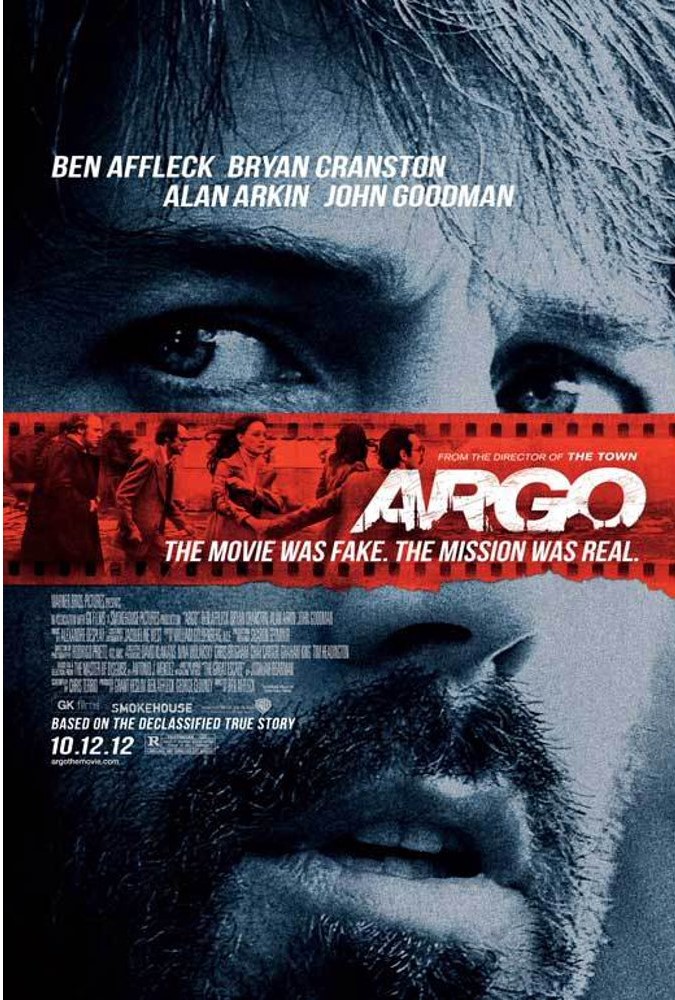
Argo won the Oscar for Best Picture of 2011 and only two others, Best Adapted Screenplay and Best Film editing; Life of Pi got four Oscars, the most for that year. There were eight other films in contention for Best Picture; I have seen Les Miserables, but not Amour, Beasts of the Southern Wild, Django Unchained, Life of Pi, Lincoln, Silver Linings Playbook or Zero Dark Thirty.
The Hugo that year went to The Avengers, and SFWA’s Ray Bradbury Award to Beasts of the Southern Wild. The other films that I have seen from that year are The Hobbit part 1, The Avengers, The Dark Knight Rises, Les Miserables, Brave, Wreck it Ralph and Total Recall. Also, I haven’t yet sat down and watched the whole film, but the Bollywood dance scene set in Dublin from Ek Tha Tiger is a classic.
Sorry about that. I’m just obsessed.
Anyway, back to Argo. IMDB users rate it 10th and 20th film of the year on the different rankings, which is not brilliant but not as bad as last year’s The Artist. Ahead of it on both rankings are Django Unchained, The Dark Knight Rises, The Hobbit 1, The Hunger Games, The Avengers, Skyfall and The Amazing Spider-Man. I would also have put it middle of the pack, but some serious issues came up that bump it to a much lower position in my ranking.
Here’s a trailer.
Returning from previous Oscar winners (and one Hugo winner): first and foremost, Ben Affleck, the star and director here, was Ned Alleyn in Shakespeare in Love.
John Goodman, who is prosthetics expert John Chambers here (the man who invented Spock’s ears, received a special Oscar for Planet of the Apes, and also did Richard Harris’s chest for that scene in A Man Called Horse), was producer Al Zimmer in The Artist last year.
From a previous Hugo winner, Alan Arkin is Hollywood producer Lester Siegel here, and was paterfamilias Bill in Edward Scissorhands back in 1990. (Like many of us, he had more hair then.)
Finally, the Canadian ambassador is played by Victor Garber, who is genuinely Canadian, but I flagged him up previously for his role as the only identifiably Northern Irish character in an Oscar-winning film – Thomas Andrews, the designer of Titanic.
This is the fairly incredible story, Based On True Facts, of how the CIA with help from Canada exfiltrated six American diplomats from Tehran shortly after the seizure of the US Embassy in 1979, by posing as a Canadian film crew looking for locations to make a film version of Roger Zelazny’s great novel Lord of Light.
There are lots of things to like here. But I was dismayed to discover from the memoir by Tony Mendez, the CIA guy behind it all, that the film is significantly more white and male than the real events on which it is based. One of the trapped diplomats, Cora Lijek (who prefers Cora Amburn-Lijek) is a Japanese-American in real life; here she is with the very non-Japanese Clea DuVall who portrays her in the film. (Not that the role is very demanding; the trapped diplomats are basically peril monkeys.)
The film has only one Canadian diplomat, Ambassador Ken Taylor, and his wife Pat, who is also Asian and at least is portrayed by Chinese-Australian actor Page Leong. But in real life, the chief immigration officer and deputy Canadian ambassador, John Sheardown, played a crucial role, along with his wife Zena who is from Guyana. Here she is hosting the fugitives in her house, including Cora Amburn-Lijek on the left.
Almost everyone involved in the story on the US government side was, of course, a white man. But in the book, Mendez is very clear that one memorable meeting – where he made a remark about abortion that is preserved in the screenplay – was chaired by “an undersecretary of state, a dignified woman who was very much in charge.” It took very little research to work out that this must have been Lucy W. Benson, the first woman appointed as US Undersecretary of State; she had left office before the diplomats were successfully extracted from Iran, but would have necessarily been involved with the initial approval process. In his book, Mendez refers respectfully several times to her interventions in the crucial meeting. But on screen, everyone in the room at that meeting is male.
According to Wikipedia, when asked how he felt about being portrayed by Ben Affleck, who is non-Hispanic, Mendez (who was born in Nevada) noted that losing his father when he was young meant he did not learn Spanish nor much of his father’s culture. He said, “I don’t think of myself as a Hispanic. I think of myself as a person who grew up in the desert.” Which is fine; but Affleck did not grow up in the desert either, and his character in the film tells us that he is from New York (Affleck is from Boston), rather than Nevada. A smaller point, but Mendez in real life has three children, a daughter and two sons. In the film he has only one child. Would you like to guess… Yep.
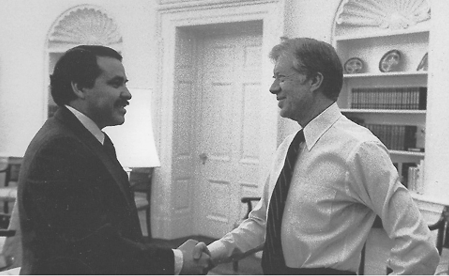
Tony Mendez (the real one) meets President Carter
So basically, Argo whitewashes the protagonist, whitewashes one of the two significant Asian women in the story, erases the most significant black woman in the story, erases the most politically important woman in the story, and even erases the protagonist’s daughter in favour of her brother. Affleck is entitled to make the film he wants to make, and to make the artistic choices that seem right for the story he wants to tell; I too have the right to point out that a lot of these choices go in one direction and not the other, and that the story he tells is much more about white guys vs brown guys than the True Facts that it is Based On. Whitewashing, and erasing women’s agency, are par for the course in Hollywood adaptations, but I can’t remember anything this extensive since All The King’s Men removed the entire African-American population of Louisiana.
It should also be noted that the Canadians dispute the centrality of the CIA to the story, arguing that a lot more of the heavy lifting was done in Ottawa and especially by their embassy in Tehran. And it’s also clear from Mendez’ published memoir that the last-minute hitches portrayed in the film – mission almost cancelled by cold feet in Washington, Iranian security deducing the plan and storming the air traffic control tower in a futile attempt to prevent the departure – are pretty fictional. I’m more forgiving of these changes; it’s a drama, not a documentary, after all. But the Canadians do have a right to feel miffed. (As do the shades of Roger Zelazny and Jack Kirby.)
Apart from that, I quite enjoyed it. I was particularly impressed that the opening sequence described the historic relationship between Iran and the United States in detail, giving context to the hostility that led to the capture of the embassy and the imprisonment of the hostages. Those who were around at the time will remember the apparent impotence of the Carter administration, and the impact of the crisis on his prospects for re-election; for Middle East experts, of course, the 1953 coup orchestrated by the CIA had already set the pattern for US involvement in the region for seventy years. After that opening sequence, the narrative of the film is very one-sided, with frothing Iranians vs innocent Westerners, but credit where it’s due – this political context was crucially missing from the Vietnam films I’ve watched in this sequence, and from The Hurt Locker.
The filmography is particularly good, with hand-held cameras among the crowd storming the embassy bringing it into focus, and the Hollywood, Washington and Tehran locations convincingly depicted. The music is suitable and not oppressive – in the hands of another director we’d have had dramatic chords all the way through to tell us what to feel.
A relatively small element of the film, but I was very struck by the story’s very cynical take on Hollywood, especially after last year’s dewey-eyed The Artist, which also featured John Goodman. The parallel between the make-believe world of Movieland and the deception of espionage is well drawn, and also Arkin and Goodman play the Hollywood scenes for just the right amount of laughs to offset the serious subject matter of the rest of the story.
Chambers: [after hearing plan to exfiltrate the house guests] So you want to come to Hollywood and act like a big shot… Mendez: Yeah. Chambers: …without actually doing anything? Mendez: No. Chambers: You’ll fit right in.
The film was enjoyable, but the erasure is so shocking that I am bumping it way way down my list to eighth last, just above All The King’s Men and below Forrest Gump.
I also read the original Wired article by Joshua Bearman which inspired the film (paywalled) and Mendez’ memoir Argo. The third paragraph of the Wired article is:
At first, the Lijeks hoped the consulate building where they worked would escape notice. Because of recent renovations, the ground floor was mostly empty. Perhaps no one would suspect that 12 Americans and a few dozen Iranian employees and visa applicants were upstairs. The group included consular officer Joseph Stafford, his assistant and wife, Kathleen, and Robert Anders, a senior officer in the visa department.
It tells much the same story as film and book, with maybe a little more emphasis on the experience of the fugitive diplomats.
The second paragraph of the third chapter of the grandly titled Argo: How the Cia and Hollywood Pulled Off the Most Audacious Rescue in History, by Antonio J. Mendez and Matt Baglio is:
From the beginning, the Carter administration faced a number of challenges. When Khomeini and the Revolutionary Council threw their support behind the takeover, there was basically nobody for the U.S. government to negotiate with. Carter tried sending two emissaries, but Khomeini refused to allow them to even enter the country. With overt diplomacy off the table, Carter then turned to his military planners, who gave him a similarly bleak assessment. If the United States were to launch a retaliatory strike, the Iranians might execute the hostages. The chance of rescue also seemed remote. Geographically, Iran was extremely isolated and the U.S. embassy compound was located in the heart of the capital city. It appeared there would be no way to get the rescuers in and back out without the Iranians knowing.
Strictly speaking, the film was based on the relevant parts of Mendez’ earlier memoir, Master of Disguise, which were then extracted, expanded and updated as the book Argo to capitalise on the film. This updating was not complete. John Chambers’ identity is concealed behind a pseudonym in the book, even though the film uses his real name and anyway he had been dead since 2001, so it hardly mattered by 2012.
But it’s a satisfying read, if obviously partisan. The book is clear about the fact that the protagonist (played by a white actor in the film) is from a Hispanic background, even if he doesn’t choose to identify in that way; that one of the fugitive diplomats was Asian-American (also played by a white actor in the film); that one of the key people on the Canadian side was a black woman (erased entirely from the film); that the senior US official who authorised the plan was a woman (erased entirely from the film); that the protagonist had a stable marriage with two sons and a daughter (rather than the broken relationship and one son portrayed in the film) and that the last-minute hitches depicted in the film are entirely fictional.
The book also gives useful context about Mendez’ previous experience of disguise and exfiltration, including various capers in Iran itself, in other Middle Eastern countries and in south-east Asia. He is frank about the shortcomings of the USA’s governmental wiring diagram and comments approvingly that the Canadians with a lighter government structure were able to make things happen much more quickly than the Americans. And even without the fictional last-minute threats to the success of the mission, the truth is quite dramatic enough. You can get it here.
Next up: that year’s SFWA Bradbury winner, Beasts of the Southern Wild.
Non-fiction 6 (YTD 76) Political Animals, by Bev Laing Matt Smith: The Biography, by Emily Herbert Doctor Who (1996), by Paul Driscoll The Dæmons, by Matt Barber Richard of Cornwall: The English King of Germany, by Darren Baker Argo: How the Cia and Hollywood Pulled Off the Most Audacious Rescue in History, by Antonio J. Mendez and Matt Baglio
Non-genre 1 (YTD 14) Mr Britling Sees It Through, by H.G. Wells
SF 8 (YTD 77) The Traders’ War, by Charles Stross Brasyl, by Ian McDonald Jocasta, by Brian Aldiss Black Man, by Richard Morgan α1 β1 Speaker for the Dead, by Orson Scott Card γ1
Doctor Who 3 (YTD 26) Fear of the Web, by Alyson Leeds Doctor Who – The Movie, by Gary Russell Doctor Who and the Dæmons, by Barry Letts
Comics 1 (YTD 14) A Matter of Life and Death, by George Mann, Emma Vieceli and Hi Fi
5,700 pages (YTD 55,500) 6/19 (YTD 84/211) by non-male writers (Laing, Herbert, β1, γ1, Leeds, Vieceli) 2/19 (YTD 27/211) by a non-white writer (Mendez, α1)
368 books currently tagged “unread”, 8 more than last month, with award submissions coming in
Reading now Complete Short Stories: the 1950s, by Brian Aldiss Voorbij de Grenzen van de Ernst, by Kamagurka Empire Of Sand, by Tasha Suri δ1
Coming soon (perhaps) Goliath, by Tochi Onyebuchi The End of the Day, by Claire North The Harem of Aman Akbar, by Elizabeth Scarborough Null States, by Malka Older Disobedience, by Naomi Alderman Death of a Naturalist, by Seamus Heaney La Femme, by Storm Constantine The Bad Christian’s Manifesto, by Dave Tomlinson The Clockwise War, by Scott Gray Song of Time, by Ian R. MacLeod The Lost Child of Lychford, by Paul Cornell Schrödinger’s Kitten, by George Alec Effinger Metamorphoses, by Ovid What If? by Randall Munroe Pale Fire, by Vladimir Nabokov Guards! Guards! by Terry Pratchett The Revolution Trade, by Charles Stross Thirteen, by Richard Morgan The World Set Free, by H.G. Wells Roadside Picnic, by Arkady Strugatsky and Boris Strugatsky Neptune – Épisode 1, by Leo
This is the latest post in a series I started in late 2019, anticipating the twentieth anniversary of my bookblogging at the end of October 2023. Every six-ish days, I’ve been revisiting a month from my recent past, noting work and family developments as well as the books I read in that month. I’ve found it a pleasantly cathartic process, especially in recent circumstances. If you want to look back at previous entries, they are all tagged under bookblog nostalgia.
We had a fantastic family trip to (North) Macedonia over Easter weekend:
It was a busy month. I also saw Gillian Anderson at FACTS in Gent:
I met Senator George Mitchell, the broker of the Nothern Ireland peace process, in Oxford:
Went to Albania again, with my colleague E:
And also went to Dublin for a Worldcon planning weekend, arriving on my birthday (oddly enough, I am doing exactly the same this coming weekend, but not arriving on my birthday which is in April).
She was lying in a hospital bed, which admittedly came as no great surprise. On waking, Anne had thought she’d recognised the particular combination of not-too-comfortable mattress and highly starched linen, which only came with institutional bedding; the old-fashioned brushed nylon nightie she was wearing was something of a giveaway, too. She was not in a ward, however, but a private room – and a quite recently decorated one at that, judging by the faint smell of fresh paint lingering beneath the sharp tang of disinfectant. To her left was a small wooden bedside cabinet, on which was placed a carafe of water, a somewhat ‘retro’ (Anne hated that word!) Sony Digimatic digital clock, displaying the time of 10:23, and a hideously large bouquet of red-orange roses in a vase. To her right there was a solitary modern-style armchair upholstered in cream leather-effect vinyl, and a window gave her a view of what looked like a sort of urban green or common, over the far side of which stood a Victorian gothic church with a square tower. Her immediate surroundings seemed quiet, the muffled sound of human voices and movement coming distantly from elsewhere in the building, while outside she could just about discern the steady rumble of traffic, albeit deadened by the thick glass of the window.
The next in the Lethbridge-Stewart series of spinoff novels, and the second in the Laughing Gnome sub-series. The author wrote a good short story in one of the earlier collections.
I have generally enjoyed this whole sequence, and was a bit dismayed when I rather bounced off the previous installment, Scary Monsters; but I’m glad to say that order has been restored, and I very much enjoyed this rewriting of what is already alternative history, where the Brigadier and Anne Travers find themselves projected back in time to the events of The Web of Fear, with a danger that Doctor Who continuity history could go off the rails. You can get it here.
Next in my sequence of books that have won the Clarke, Tiptree/Otherwise and BSFA Best Novel Awards. I had read two out of these three before.
The second paragraph of the third chapter (“File Three”) of The Carhullan Army is:
I did not know how I had kicked away the iron walls and freed up enough space to straighten my legs and uncurl my back. My thoughts were slow to arrive and difficult to arrange. If the door of the dog box was open I could escape. If the pen was like a puzzle, somehow I had decoded it, made one sprung move, one solving turn, and the sides of the cage had released. I could sleep. The stool was gone and I was lying in the dirt. And yet it was smooth and there was the fragrance of soap.
When I first read The Carhullan Army in 2008, I wrote:
I thought it was a very good book. The setting is a near-future Britain, underpopulated and oppressed due to climate change and war; the narrator, a woman known only as “Sister”, flees her native town to join a community of women in the Lake District, and they spend the rest of the book preparing for their struggle with Authority (ie the government). This is the kind of story that is often done embarrassingly badly (see, for instance, Sherri S Tepper on occasion, or The Rising of the Moon) but Hall does it well; Carhullan is emphatically not a utopia, nor is it destined to be a permanent answer to an unjust society, and the leader Jackie and her colleagues are memorable figures. Some readers will be reminded of The Dispossessed, or The Handmaid’s Tale, and I guess it’s fair to say that if you didn’t like either of those books The Carhullan Army will leave you cold. But actually I felt it was also perhaps a response to John Christopher’s The Death of Grass, where the protagonists are engaged in essentially a selfish struggle to get through their post-apocalyptic landscape to (if I remember rightly) the Lake District; the Carhullan Army have a more altruistic and redeeming purpose.
Rereading, I still enjoyed it. The feminist community is not a utopia; it’s a very flawed society, which is still better than the alternative. The theme of eco-catastrophe is all the more relevant in 2022. The characterisation is desperate and convincing. Well worth returning to. You can get it here.
The Carhullan Army won the James Tiptree Jr Memorial Award for 2008. The shortlist included six novels, of which I have read two (Flora Segunda by Ysabeau Wilce and Glasshouse by Charles Stross), a short story, an anthology, and a comic series of which I have read the last volume. It was also on the shortlist for the Clarke Award. From what I’ve read, the jurors made the best choice.
The second paragraph of the third chapter of Brasyl (“Our Lady of Trash”) is:
“I know a hundred World Cup Stories.” Raimundo Soares watched his weight drop into the glowing water. He claimed to be the last professional carioca; sometime journalist, sometime writer with a good book about the new bossa nova, a better book about Ronaldo Fenômeno, and a so-so guide to how to be a professional carioca on his backlist. A little fishing early with the brothers, a little cafezinho when the heat got up, a few hundred words on the laptop, the rest of the afternoon he’d spend in a cafe, watching ass on its way to the beach, or strolling around his city, remembering it, memorizing it. In the evening, receptions, parties, openings, his many lovers: a late sleep and up again at fish-jump. He claimed to have worn nothing but surf-Ts and Bermuda shorts for twenty years, even to his own mother’s funeral. He was the loafer, the malandro who doesn’t have to try too hard, carioca of cariocas: they should make him a Living Treasure. “This is true. David Beckham comes to Rio; he’s going to play at the Maracanã for a benefit for Pelé. He’s the guest of the CBF, so he’s got the wife, the kids; everything. They put him up at the Copa Palace, nothing’s too much trouble for Senhor Becks; presidential suite, private limo, the lot. Anyway, one evening he goes out for a little kick-about on the beach and these hoods jump him. Guns and everything, one two three, into the car and he’s gone. Lifted. Right under his guards’ noses. So there’s Beckham in the back with these malandros with the gold-plated guns thinking, Oh sweet Jesus, I am dead. Posh is a widow and Brooklyn and Romeo will grow up never knowing their father. Anyway, they take him up into Rocinha, up the Estrada da Gávea, and then from that on to a smaller road, and from that onto an even smaller road until it’s so steep and narrow the car can’t go any farther. So they bundle him out and take him up the ladeira at gunpoint and anytime anyone sticks so much as a nostril out of their house, the hoods pull an Uzi on them; up and up and up, right up to the top of the favela, and they take him into this tiny little concrete room right under the tree line and there’s Bem- Te-Vi, the big drug lord. This was back before they shot him. And he stands there, and he looks at Beckham this way, and he looks at Beckham that way; he looks at Beckham every way, like he’s looking at a car, and then he makes a sign and in comes this guy with a big sack. Beckham thinks, Jesus and Mary, what’s going on here? Then Bem-Te-Vi stands beside him and they pull out the World Cup, the original Jules Rimet, solid gold and everything, right Out of the sack. Bem-Te-Vi takes one side, Beckham takes the other, and this guy gets out a digital camera, says, ‘Smile, Mr. Beckham.’ Click! Flash! And then Bem-Te-Vi tutns to Becks and shakes his hand and says, ‘Thank you very much, Mr. Beckham, it’s been a real honor… Oh, by the way… if anyone ever finds out about this…’’’
Ian McDonald’s latest. The setting of Brazil fits his lush, dense writing style so well that it is remarkable that he’s never set a novel in real South America before (his two books set on Mars portray a rather Patagonian version of the planet, but it’s not quite the same). We have three interleaving narratives, from the mid-18th century, the present day, and the near future (2030); we have peculiar variations of reality; and we have the jungle, both urban and literal, with its various hostile inhabitants. In some ways it’s deliberately less ambitious than River of Gods, which juggled ten different viewpoint characters against the background of India forty years hence, but the intermeshing of the different characters from their different time periods in the end comes across rather pleasingly.
I wasn’t quite as blown away on re-reading. The three different timeline settings are superbly realised, but I was not as convinced about the link between them. Still very enjoyable. You can get it here.
Brasyl won the BSFA Award for Best Novel. I’ve read all but one of the other finalists: Alice in Sunderland, Black Man aka Thirteen (see below), The Execution Channel, and Hugo and Nebula winner The Yiddish Policemen’s Union, the other being The Prefect, by Alastair Reynolds. I didn’t vote that year, but I’d probably have gone along with the majority. Alice in Sunderland is a great book, but it’s only tenuously sf. Brasyl was also on the final ballot for both Hugo and Nebula, unlike The Carhullan Army or Black Man / Thirteen.
I had not previously read Black Man, published as Thirteen in the USA. The second paragraph of the third chapter is:
The siren hit, upward-winding like the threat of a gigantic dentist’s drill.
I’ve read a couple of other books by Richard Morgan, and this seemed to me in character with them and perhaps a little more under control. The viewpoint character is a genetically engineered “Thirteen” in a near-future (early 22nd century) world where people like him are regarded with suspicion by society and mostly exiled to Mars. There is a murder mystery with explosive political ramifications, some nasty violence (this is the bit of Morgan’s expertise that I don’t especially appreciate), some desperate sex and a very well-written death scene. Like all murder mysteries, the point is to get the reader from A to B while admiring the scenery and wondering how the route will twist next, and it certainly succeeds very well in that. You can get it here.
Black Man won the Arthur C. Clarke Award under that title. The other finalists included two books that I have read and already referred to above, The Carhullan Army and The Execution Channel, and three that I haven’t: The H-Bomb Girl, by Stephen Baxter; The Raw Shark Texts, by Steven Hall; and The Red Men, by Matthew de Abaitua. I think if I had been a Clarke judge that year, I’d probably have argued strongly for The Carhullan Army.
Next up are the 2010 winners for books published in 2009: Song of Time by Ian R. MacLeod (Clarke winner), Filter House by Nisi Shawl (joint Tiptree winner), The Night Sessions by Ken MacLeod (BSFA winner) and The Knife of Never Letting Go by Patrick Ness (joint Tiptree winner).
But one man didn’t think like this. He believed that Doctor Who had a huge role to play in the twenty-first century, that the franchise was not dead but sleeping, and that, in short, it was high time Doctor Who made a comeback. And this particular man was in a position to do something about it.
A rather fluffy biography which I hope I picked up cheap somewhere, first published in 2010 and hastily updated for the paperback edition in 2012, with at least as much about the history of Doctor Who as about the new star, whose career had lasted less than a decade at the time of writing. (Since then of course, he’s been Prince Philip and is now Daemon Targaryen.)
Emily Herbert specialises in celebrity biographies and this is not one of her top rated works on Goodreads or LibraryThing. (For the record, her top-rated works are her biographies of Robin Williams and Lady Gaga.) She does a decent job of making bricks out of straw here, and explains the history of Doctor Who rather well to a target audience whose interest may be less than obsessive. But the really interesting biography (or autobiography) of Matt Smith will be written a couple of decades from now. Meanwhile you can get this one here.
As mentioned previously, I got elected earlier this month to the World Science Fiction Society’s Mark Protection Committee, which works to preserve the intellectual property of the terms WSFS, Hugo, Lodestar, etc. It’s a three year term, with three people elected every year by those who turn up to the Business Meeting (and a number of other members appointed in various ways).
This was actually my second attempt; I had put my name forward at the previous election in December 2021, when unusually six members were elected due to the peculiar circumstances of 2020. I was not elected, probably due to not being at the meeting itself (which made a number of other bad decisions). I did find this a bit surprising; I’m not exactly invisible in these discussions, and a number of people told me that they had voted for me. But we move on, and I got in this time.
I had not realised that the MPC is elected in the same way as Hugo final ballot places are determined. A separate single-seat STV election is held for each seat, with candidates elected in previous rounds excluded and their votes redistributed to the next preference. This is a pretty crazy way to run a multi-seat election. For the Hugo ballot, we want to ascertain the collective will of the majority at every stage, and don’t particularly care about representing minority views. But applied to a committee election, you are basically allowing a majority of voters to determine every one of the seats, and excluding minority views entirely. The result will represent the strongest faction and nobody else.
All public elections which use the Single Transferable Vote to elect more than one candidate (both parts of Ireland, Malta, most of Australia for Senate and state assembly elections, municipal elections in Scotland, New Zealand and some US cities) instead establish a quota of votes that a candidate must exceed to get elected. If you get more votes than the quota, the surplus is redistributed to the next available preferences. It seems to me to get the best balance possible between voter impact on the result, proportionality of outcome between different political groups, and encouraging accountability from elected representatives.
If the election had been a standard multi-member STV election, my 9 first preferences would have taken me to just below the quota (which would have been 10 or 9.3 or 9.29 or 9.286, depending on the precise system) and I would probably have picked up a transfer from somewhere and got in. It’s not just about me: the candidate with the second highest number of first preferences came fourth, and would not have been elected in a normal three-seat year.
WSFS moves slowly, so I don’t expect that this ridiculous situation will be fixed any time soon. But it has implications if WSFS were ever to move to a more manageable system of electing a standing Council of some kind, with executive powers, rather than the archaic Business Meeting, as has been proposed by Kevin Standlee. There would definitely need to be provisions for such a committee to have broad representation engineered into it, and the current system used for the Hugo final ballot and the MPC will not deliver that.
Current Complete Short Stories: the 1950s, by Brian Aldiss Speaker for the Dead, by Orson Scott Card Richard of Cornwall: The English King of Germany, by Darren Baker β1
Last books finished Black Man aka Thirteen, by Richard Morgan Doctor Who and the Dæmons, by Barry Letts The Dæmons, by Matt Barber α1
Next books Empire Of Sand, by Tasha Suri Goliath, by Tochi Onyebuchi
The Avengers won the 2013 Hugo for Best Dramatic Presentation, Long Form. It had a pretty thumping victory at both stages.
It beat The Hobbit: An Unexpected Journey, which I have seen, and The Cabin in the Woods, The Hunger Games and Looper, which I haven’t. IMDB users rate it 3rd and 8th film of the year on the two rankings. In both cases it is behind The Dark Knight Rises, which I’m really surprised to see came as low as eleventh in the Hugo nomination rankings. (Beasts of the Southern Wild, which won the Ray Bradbury Award, came twelfth.) From the long list I also saw and enjoyed Brave and Wreck-It Ralph. I didn’t vote in that Hugo category that year.
Despite the star-studded cast, just one actor who’d been in previous Hugo winners and one who had been in an Oscar-winning film. Samuel L. Jackson presides here as Nick Fury; in 1993 he was the scientist Arnold in Jurassic Park, and also the voice of Frozone in The Incredibles in 2004.
And Gwyneth Paltrow gets one scene here as Pepper Potts, having won an Oscar as Viola in Shakespeare in Love a decade ago.
This is a film about a bunch of superheroes, the Avengers, getting together and biffing Loki, the god of Asgard, who wants to take over the world. (Or destroy it, I got a little lost.) I think it looks great but I’m not terribly invested in the Marvel mythology, so I’m putting it quite a long way down my rankings, in 40th place out of 53, below The Princess Bride but above The Incredibles.
I had my fourth COVID jab yesterday morning and am feeling under the weather today, so I’ll be brief. The performances are good, but I actually found the script a bit disappointing. My heart lifted when I saw Joss Whedon’s name on the credits; surely we can expect the same crackling humour that he often delivered for Buffy? But there’s not a lot of it.
Thor: Have a care how you speak! Loki is beyond reason, but he is of Asgard and he is my brother! Natasha Romanoff: He killed eighty people in two days. Thor: He’s adopted.
The fight scenes are well choreographed and the effects are superb.
But basically it’s a film that is intended to set up and develop the Marvel mythos, and I’m just not terribly interested in that even though it does the job well.
Next up will be that year’s Oscar winner, Argo, the closest that the late great Roger Zelazny ever got to a cinematic award. (If you don’t know, I’ll explain…)
This is the latest post in a series I started in late 2019, anticipating the twentieth anniversary of my bookblogging which will fall in 2023. Every six-ish days, I’ve been revisiting a month from my recent past, noting work and family developments as well as the books I read in that month. I’ve found it a pleasantly cathartic process, especially in recent circumstances. If you want to look back at previous entries, they are all tagged under bookblog nostalgia.
As usual a busy month, with two work trips to London and one to Albania; I finished the month in Skopje, on my first ever non-work trip to North Macedonia, dining with my family and my friend Stevo Pendarovski (who is in a different job now). To my delight, when boarding my plane home from Tirana, I saw the planet Mercury for the first time in my life.
They also have public art in Tirana, as my colleague M and I discovered.
“Have to do my fourteen miles before lunch,” he said. “You haven’t seen Manning about, have you?”
I had no expectations whatsoever of this novel, originally published in 1916, one of the last of the novels in my big H.G. Wells collection. I found it a really impressive work, one of the best non-sf novels by Wells that I have read. Mr Britling is a self-parody of the author, a complacent intellectual writer with a nice place in the country, extended family around him and a lover in London. In 1914 he thinks that war is impossible, and if it comes it will be brief because sensible people of all countries will reject it. It turns out that he is wrong, and his world diminishes through loss and tragedy. I like Wells all the more for putting such a flawed version of himself front and centre; Britling is a very imperfect human being, but his tragedy is discovering that the imperfections of the world he lives in are much worse than he had imagined. There are some nice and respectful bits with Belgian refugees as well. You can get it here.
Continuing my journey through my substantial backlog of Doctor Who comics, I’m now at this Eighth Doctor collection from 2016. I have generally rated George Mann poorly as a writer, and so I am glad to say that I really enjoyed these five linked stories, in which the Eighth Doctor finds a young artist squatting in his country house and takes her on a series of adventures. The third, in which sinister entities emerge from mirrors, is particularly good.
My one complaint is that artist Emma Vieceli’s depiction of the Eighth Doctor doesn’t look a lot like Paul McGann. (The cover is by someone else, I think.)
But otherwise this came as a pleasant surprise and I will give George Mann’s work at least a second glance in future. You can get it here.
Next up: the Ninth Doctor in Weapons of Past Destruction.
Third section (illustrated by a picture of a small boy standing under an elephant’s belly):
No matter how much you feed a wolf, an elephant still has bigger BALLS. Russian popular saying.
One of those New Internationalist books. A series of quotes about how humans, especially politicians, behave like animals, and also how we should treat animals a bit more like we treat humans, illustrated with cute animal photos. I am sympathetic to the sentiments, on the whole, but I found the delivery rather sanctimonious. You can get it here.
This was both the shortest unread book I acquired in 2015, and the non-fiction book that had lingered longest unread on my shelves. Next on those piles respectively are La Femme, by Storm Constantine, and The Bad Christian’s Manifesto, by Dave Tomlinson.
So. My original plan when I booked today’s visit to London, two weeks ago, was to work from our London office today and tomorrow before getting the last Eurostar on Tuesday. But it turned out that for some reason the office would be closed today. Fine, I said to myself, I’ll work from my hotel room for the day, and fulfill a long-standing Monday evening social commitment.
Then, to my dismay, I found on arrival that the hotel’s rooms are completely unsuitable for work – no desk, no comfortable chair, and worst of all, no coffee. Entirely my own fault for not reading the small print when booking, but my plans of today being a normal remote working day disintegrated. I tossed and turned in bed last night, wondering what to do. My mood shifted from frustration to sorrow with the news that we have lost Maureen Kincaid Speller, just one day after she was given a lifetime achievement award by the British Fantasy Society.
And then it all came together. The first funeral I remember attending was my grandmother’s, in 1979, when I was twelve; she was born in Philadelphia in 1899, died after a period of ill health in a nursing home near Hook in Hampshire, and is buried in Brookwood Cemetery, the largest graveyard in Europe, southwest of London. I have not been there since. Given what else has been happening today, and also given that I tracked down her grandparents last month, it felt appropriate to try and find her.
In parenthesis – some people have been asking me for my take on the transition in the British monarchy, as some are euphemistically putting it. I decided not to renew my British passport in 2017, and in general I think it is better to elect your head of state, preferably by qualified majority in Parliament or a electoral college, though I’ll take a popular vote if that’s what’s on offer. Liz Truss was right in 1994 (I was in the room when this happened).
But of course it is a massive crunch to lose a physical link with the past. Very few people can remember a time before the late Queen’s reign. Without really knowing much about her, everyone felt connected to her. Monarchy is bad for the royals, but she managed to persuade her subjects that it is good for the country, without ever having to say so directly.
I watched the ceremony this morning and then walked from Trafalgar Square over the Golden Jubilee Bridge to Waterloo station. Lots of people were standing silently, staring in the direction of Westminster. You can see the massed crowds in the distance in the photo I took of Parliament with its flag at half mast.
It takes 45 minutes to get to Brookwood from Waterloo by train. Today being (of course) a public holiday, the cemetery offices were closed, but I had done a bit of research. My grandmother rests with two of her aunts, her uncle by marriage, and her maternal grandmother. (Her uncle and aunt had no children of their own, but informally adopted my grandmother after her own mother’s early death.) Her uncle, Sir Robert Hadfield, was rich and famous, so I guessed that he might be in one of the posher parts of the cemetery according to a map I found in an academic paper on the social stratification of burials at Brookwood.
But before I get there, I have to say that I was really impressed by the way that Brookwood was designed as, and has remained, a resting place for those of many faiths from the start – Muslims, Zoroastrians, Ismailis, all have space reserved. (I guess that Jews and Hindus have their own arrangements?) It was a bit of a contrast with the very Christian ceremony that I had watched before catching the train, and seemed to me more reflective of England as it really is.
I wandered around the three poshest sections of the southern (Anglican) part of the cemetery, but found no Hadfields. The weather was pleasant this afternoon, fortunately, and I detoured over to the Orthodox shrine of St Edward the Martyr, King of England, who was murdered in 978, a thousand and one years before my grandmother died. After a series of improbable events, he now rests in Brookwood, the longest dead of anyone known to be there, the earliest ruler of England with an identified resting place.
Father Niphon is camera shy, but gave me a tour of the shrine and then a cup of tea. The monks have a sense of humour.
Father Niphon then unearthed a book by John Clark listing famous graves in Brookwood. (On the wall he has a photograph of John Clark presenting him with the book.) To my delight, Sir Robert Hadfield, my great-great-uncle, is among those listed. So I headed straight off to Plot 34, the D-shaped plot east of the small circular plot that is the focus of the southern part of the cemetery, to look for him, his wife, his mother-in-law, his sister-in-law and his niece. I felt a bit like Tuco at the end of The Good, The Bad And The Ugly, and I confess that I was whistling “The Ecstasy of Gold”, startling a young deer which was the only other large living animal around.
Plot 34 is quite big, and I was (unwisely, as it transpired) guided by a four-decades-ago memory of a gravesite near the path, with arch-shaped headstones. I toured Plot 34 twice looking for such graves with Wickersham / Hadfield / Whyte inscriptions, and was on the point of giving up when I returned to John Clark’s book, and realised that he had left an important clue in the description.
There are really not a lot of conifer-hedged allotments in Brookwood at all, never mind in Plot 34.
And at the entrance to the enclosure I found her, with the others close by.
My memory was completely wrong; it is about as far from the path as you can get in Plot 34, and there are no headstones at all – the memorials are all at ground level. It’s in pretty good shape, though several hours later I am still brushing conifer twiglets out of my hair and clothes.
I remember my grandmother best when she was already frail, but it has been good to renew my acquaintance with her from her memoirs. Here she tells of how her grandmother died when they were on holiday in Italy together at Lake Como. My grandmother had just turned thirteen, a little older than I was when she in turn died.
Triumphantly I returned to the metropolis. As I crossed back north of the river towards Charing Cross, a busker was playing a tuba which belched flames in tune with an Abba recording. Which Abba song? Which do you think!
I had a very good morning of research in the Massachusetts Historical Society at the end of last month. My grandmother’s cousin Henry Seaver (a noted architect, probably named after my great-grandfather Henry Hibbard, and the father of writer Elizabeth Helfman) had carried out a lot of research of his own, including interviewing several of his surviving relatives; his daughter then lodged his papers with the MHS in the late 1960s and early 1970s.
I’m going to salute the approachability of the Massachusetts Historical Society. They were very helpful in how best to deal with archival material (I have handled twelfth-century manuscripts in the past, but they could not have known that), and crucially they allow photography of everything, provided that you do not use a flash. This basically meant that rather than spend hours copying someone else’s unreadable handwriting into my own unreadable handwriting, as I have done in my previous archival work decades ago, I was able to instantly capture everything for later analysis.
The most glorious find was in fact an 1889 letter from Henry Seaver’s uncle, my great-great-uncle Thomas Hibbard, to Henry’s mother, my great-great-aunt Susan Seaver, saying that he had been doing research in the Massachusetts Historical Society and the New England Genealogical Society on the origins of the Hibbard family. I failed to leave a message at the MHS for my own great-great-nephew or -niece to find in the year 2145.
Last Tuesday I visited the rooms of the Mass[achusetts] Historical Society, and the N[ew] E[ngland] Genealogical Society to try to find out something about this Rob[er]t Hibbard of Salem. I only found that he was a salt maker in S[alem] 1639 and afterwards removed to Windham Conn[ecticut]. Could not find his name in the emigration list to tell what vessel he came in or when. Perhaps the genealogy will tell and I am anxious to see it completed.
There was plenty more. I have writtenbefore about the mysterious origins of my great-great-grandmother. She was Henry Seaver’s grandmother, and he wrote a memo in his notebooks which totally contradicts my speculations about her maternal ancestry:
On Mar 2 1908 my mother [Susan Seaver, my g-g-aunt, who died the following year] wrote me as follows about her mother’s family: “On my mother’s side, her father died when she was 11 yrs. old. He was a sailor and was impressed about 1812, imprisoned at Dartmoor, and there contracted the consumption from which he finally died. His name was John Smith and hailed from Portsmouth, N.H. I think, or Dover, N.H. as my mother was born there. My mother knew very little about her ancestors as no one cared much about such things in her day. I tried once to hunt up Judith Locke my mother’s grandmother. She was born at Barnstead N.H.. I found out by her burial certificate that her father’s name was James and mother’s was Sarah but no last name was given. She died in 1852 at the age of 91 (I think, haven’t time now to look it up in the Bible). She wa a little girl at the time of the Revolution and held me in her arms when I as an infant. She died out here in the old house, then a new one.” (West Roxbury)
Other notes on Smith family written by my mother told her by her mother: “Dr Smith was a Scotch physician who came to this country with his son John Smith, but not liking the country he returned. That is all she knew of her family on her father’s side.:
John Smith b. Scotland Nov 14 1784 died Dec 6 1827 married Jan 23 1812 Sally Lock they had 3rd child Sarah Ann Smith my [Henry Seaver’s] grandmother [my great-great-grandmother]
I am tremendously grateful to Patrick Nielsen Hayden for leading me to the genealogical trail which connects me through the original Cleveland settler, Moses Cleveland, to my sixth cousin three times removed President Grover Cleveland, to my ninth cousin, sf writer Fritz Leiber, to Leiber’s third cousin, also my ninth cousin, Shirley Temple, and to my Worldcon colleague and seventh cousin twice removed Jesi Lipp.
Having sorted out Sarah’s paternity to my own satisfaction, her mother’s lineage is the biggest trailing thread of my American ancestry. Henry Seaver wrote another note summarising what he knew, which was not much.
Judith Lock born Barnstead N.H. Jan 1 1762 d. West Roxbury Mass Nov 30 1852 married (not known) Lock her maiden name not known, her father was James, mother Sarah ? [children] Sally Lock b. July 27 1793 d. Jan 28 1870 Ann Burbank Lock b. May 18 1796 d. Nov 29 1845 m. Jos. Akarman
Sally Lock married John Smith Jan 23 1810 [children] John Smith, Dover family Sarah Ann Smith b Ap 3 1815 d Nov 18 1891 Susan Watkins Smith Heath whose oil portrait we have [what happened to it?] (4 other children) Sarah Ann Smith married William C Hibbard Apr 3 1849 and the descendants are the Seaver ancestors in this book. [later note] and Mary J. who married John Deming of St Louis a Union pilot on the Mississippi River in the War.
I took the opportunity to meet up with the descendants of Sarah Ann Smith and her husband William Charlton Hibbard. The day before I met in Plymouth with W, one of my third cousins through my great-grandfather’s older brother Thomas (who wrote the letter quoted at the top of this post); we had met in February but failed to take photos.
The following day I met for the first time with a bunch of third cousins, and the younger of the two surviving members of the generation above us, and we paid our respects at the graves of our great-great-grandparents in West Roxbury.
Left to right: L1, the younger of the two surviving great-grandchildren of Sarah and William Hibbard J, L’s nephew, my third cousin L2, L1’s niece and J’s brother, also my third cousin P, daughter of the baby in the park, also my third cousin, second cousin of J and L2, first cousin of W Me
This came after a great fish lunch in Dedham – can you call it a family reunion when many of those present had never met before? My brother WW came to the lunch, but was not able to come to the graveyard; the other W, who I had seen two days before, was not able to come at all, but sent his wife and mother-in-law to represent his part of the family.
Left to right: R, W’s mother-in-law WW, my brother J L1 N, W’s wife L2 P Me
This was not the first such family excursion. In 1934, my great-grandfather Henry Hibbard together with his brother Thomas Hibbard, great-grandfather of J, L2, P and W, and grandfather of L1 in the photos above, led a family gathering to New Hampshire to the home of their great-grandfather. There were 23 of them on that occasion, 88 years ago. We only had eight attendees; maybe we’ll have more next time.
Current Black Man, by Richard Morgan Complete Short Stories: the 1950s, by Brian Aldiss
Last books finished Jocasta, by Brian Aldiss Fear of the Web, by Alyson Leeds Doctor Who – The Movie, by Gary Russell Doctor Who (1996), by Paul Driscoll
Next books Speaker for the Dead, by Orson Scott Card Empire Of Sand, by Tasha Suri
The Artist won the Oscar for Best Picture of 2011 and four others, Best Director (Michel Hazanavicius), Best Actor (Jean Dujardin), Best Costume Design, and Best Original Score. There were eight other films in contention for Best Picture; I have seen Hugo, which was also confusingly a Hugo finalist, but not The Descendants, Extremely Loud & Incredibly Close, The Help, Midnight in Paris, Moneyball, The Tree of Life or War Horse.
IMDB users rate The Artist a lowly 43rd on one system and a dismal 125th on the other, compared against other 2011 films. We’ve had several others that were in the low 40’s on one ranking, but were much higher on the other – Cavalcade, Shakespeare in Love, Million Dollar Baby and Crash, I think. The 125th place ranking is by far the lowest we have had on either metric, and it’s not even like 2011 was a remarkably good year for films. I too was not hugely impressed by it.
Here’s a trailer.
I counted a couple of actors who had been in Hugo-winning films, and one who had been in a previous Oscar-winner (no crossovers with Doctor Who). The first is Malcolm McDowell, credited here as “the butler” (though his role is actually someone waiting for an audition) and the star of A Clockwork Orange 39 years ago.
Missy Pyle is the mistreated co-star Constance here, and eleven years ago was Lailari the Thermian in Galaxy Quest.
Finally, Beth Grant, Peppy’s unnamed maid here, was the equally unnamed Woman At The Farm House in Rain Man in 1988.
The Artist is entirely in black and white, and almost entirely “silent”, ie the sound track is mostly incidental music, becoming diegetic briefly about 31 minutes in and then for a longer spell at the very end. The last largely black and white film to win the Oscar was Schindler’s List (1993), and the last entirely black and white film to do so was The Apartment (1960, more than fifty years earlier). The only other silent film to win was the very first, Wings, way back in 1927.
The Artist is also generally cited as the only French film to have won an Oscar, but as a patriotic Belgian, I have to point out that the Belgian company uFilm were one of the co-producing companies, utilising a Belgian tax scheme, and the music was recorded in Flagey by the Brussels Philharmonic and the Brussels Jazz Orchestra. French Wikipedia calls it “une comédie romantique muette et en noir et blanc franco-belgo-américain” (surely “-américaine”?).
It is about two actors in the early days of sound in the movies; Paul Valentin, who is on his way down because (as we discover at the end) he can’t get hired for the talkies because of his French accent and because he’s generally an asshole, and Peppy Miller, on her way up as she catches the Zeitgeist. He falls on hard times, and she rescues him and finds him some redemption. He also has a cute dog.
I was not very impressed. Before I get to the specifics of plot and cinematography, it’s the most shockingly racist Oscar winner for years. Everyone is white, even in the crowd scenes, apart from some African warriors who turn up on a film set and later in Paul’s delusions. This really is not representative for Hollywood in 1930, or even for France in 2011 when the film was made.
Most of the plot elements have been done before and better (most notably in Singin’ in the Rain and All About Eve). I found it derivative and pastiche rather than integrated. The good bits were not new and the new bits were not very good. Paul is such an unpleasant person at the beginning that it’s difficult to be very pleased by his redemption at the end.
Another point that really grated is that although a lot of attention was paid to make-up for Jean Dujardin as Paul, and for the main women actresses, it wasn’t really done for the extras and it looks like what it is, a lot of twenty-first century people pretending that they are in the late 1920s and early 1930s. Two of the first five Oscar winners in the list below (The Broadway Melody and The Grand Hotel) are actually set in that time period because it was when they were made, and The Artist just sits wrong.
A further complaint is that Bérénice Bejo as Peppi is frankly too old for the part. As written, Peppy is clearly in her mid-20s at most; Bejo was 35 when the film was made. For the record, I have complained on this score in the past about men as well as women playing roles that were the wrong age (Laurence Olivier in Rebecca, Leslie Howard in Gone with the Wind; also Mary McDonnell in Dances with Wolves.) Bejo is a good performer in the role, but again it just sits wrong.
Despite not feeling attracted to the character, I did think that Dujardin gave a convincing portrayal of Paul.
And the dog is very cute.
Finally, as a patriotic Belgian, I did like the music.
I’m putting this a long way down my list of Oscar-winners, just outside the bottom ten, below No Country for Old Men, whose protagonist was more awful but more compelling, and above American Beauty which was much more skeevy.
Next up, from 2012: The Avengers (Hugo winner), Argo (Oscar winner), Beasts of the Southern Wild (Bradbury winner).
This is the latest post in a series I started in late 2019, anticipating the twentieth anniversary of my bookblogging which will fall in 2023. Every six-ish days, I’ve been revisiting a month from my recent past, noting work and family developments as well as the books I read in that month. I’ve found it a pleasantly cathartic process, especially in recent circumstances. If you want to look back at previous entries, they are all tagged under bookblog nostalgia.
I started the month with a trip to Istanbul to give a lecture on Brexit, and also had work trips to London and Sofia.
Sometimes, when he was extremely tired, he’d lose his sense of smell. It was as if the part of his brain that dealt with scents and stinks and stuff gave up trying to make sense of the world and went to sleep without him. At other times it would come back extra strong, and any passing scent might dredge up a slew of distracting memories. It was a weird kind of borderline synaesthesia, and it reminded him uncomfortably of a time a couple of years ago when he’d been on assignment in some scummy mosquito-ridden swamp down in Florida. The hippie asshole he was staking out had made the tail, and instead of doing the usual number with a Mac-10 or running, had spiked his drink with acid. He’d spent a quarter of an hour in the bathroom of his hotel room staring at the amazing colors in the handle of his toothbrush, marveling at the texture of his spearmint dental gel, until he’d thrown up. And now he was so tired it was all coming back to him in unwelcome hallucinatory detail.
Compilation of the third and fourth volumes of the Merchant Princes series, in which our protagonist and her ex-boyfriend are entangled in dynastic feuds in a family who have the ability to walk between parallel universes; our own, and two others, one more feudal, one more eighteenth-century, the action in all cases set in what we call the northeastern USA, most of whose population are descended from settlers across the ocean. The first compilation volume was The Bloodline Feud.
Stross’s heroine makes an early mistake here, trying to bring her know-how from our world to gain power and status in the feudal society of her origin, but over-reaching and then having to deal with the consequences of dynastic displeasure, while the dance of intelligence services around one another between the worlds gets steadily more intricate and nasty. The pace continues to be intense and well constructed. Great stuff. You can get it here.
(By odd coincidence, the day I finished reading this, I later bumped into the author in the bar in Chicago and had a long chat.)
This was my top unread book acquired in 2017. Next on that pile is the next in this series, The Revolution Trade.
Может быть, через пятьдесят или сто лет о той нашей жизни, которая называлась социализмом, будут писать объективно. Без слез и проклятий. Начнут раскапывать, как древнюю Трою. Недавно вообще хорошо сказать о социализме было нельзя. На Западе после крушения СССР поняли, что марксистские идеи не кончились, их надо развивать. Не молиться на них. Маркс не был там идолом, как у нас. Святым! Сначала мы его боготворили, а потом предали анафеме. Все перечеркнули. Наука тоже принесла человечеству неисчислимые бедствия. Давайте тогда истреблять ученых! Проклянем отцов атомной бомбы, а еще лучше – начнем с тех, кто порох изобрел! С них… Разве я не права? (Я не успеваю ответить на ее вопрос.) Правильно… правильно, что из Москвы выбрались. В Россию, можно сказать, приехали. По Москве когда гуляешь, кажется, что и мы Европа: роскошные машины, рестораны… Золотые купола блестят! А вы послушайте, о чем у нас люди говорят в провинции… Россия – это не Москва, Россия – это Самара, Тольятти, Челябинск… жопинск какой-нибудь… Что на московских кухнях можно узнать о России? На тусовках? Бла-бла-бла… Москва – столица какого-то другого государства, а не того, что за кольцевой дорогой. Туристический рай. Москве не верьте…
Perhaps fifty or a hundred years from now they’ll be able to write objectively about the way of life we called socialism. Without all the tears and obscenities. They’ll unearth it like ancient Troy. Until recently, you weren’t allowed to say anything good about socialism. In the West, after the fall of the Soviet Union, they realized that Marxism wasn’t really over, it still needed to be developed. Without being worshiped. Over there, he wasn’t an idol like he’d been for us. A saint! First we worshiped him, then we anathematized him. Crossed it all out. But science has also caused immeasurable suffering—should we eliminate scientists? Curse the fathers of the atom bomb, or better yet, start with the ones who invented gunpowder? Yes, start with them…Am I wrong? [She doesn’t give me a chance to answer her question.] You’re on the right track, leaving Moscow. You could say that you’ve come to the real Russia. Walking around Moscow, you might get the impression that we’re a European country: the luxury cars, the restaurants…those golden cupolas gleaming! But listen to what the people talk about in the provinces… Russia isn’t Moscow, Russia is Samara, Tolyatti, Chelyabinsk—some Bumblepinsk…How much can you really learn about Russia from sitting around in a Moscow kitchen? Going to parties. Blah, blah, blah… Moscow is the capital of some other nation, not the country beyond the ring road.* A tourist paradise. Don’t believe Moscow… * The ring road is a major freeway encircling Moscow which served as Moscow’s administrative border until the 1980s.
Another in the grim sequence of Nobel Prize winner Alexievich’s accounts of her country’s history (I have previously read Voices from Chernobyl and Boys in Zinc). Here she takes on the lived experience of the break-up of the Soviet Union, mainly (though not only) as it affected Russians, simply told through their own testimony. There was good in the old system, in the sense of social solidarity and a sense of common purpose, but it was outweighed by the grinding poverty and brutal oppression. The subsequent collapse of Russian society, except for the super-privileged, has lent the Soviet years some undeserved retrospective legitimacy. There is some grim reading about personal hardships, the worst of them from the Communist era. It’s not a chronological history, it’s a report from the past, with all the caveats that that requires. Especially at the current time, it’s really useful to have a window into what makes Russia and Russians tick. Important and gripping reading. You can get it here.
I was interested to note that the original Russian title of the book, Время сэконд хэнд, uses the English words “second hand”.
This was my top unread book acquired this year, and also my top unread book by a woman. Next on those piles respectively are Pale Fire, by Vladimir Nabokov, and Disobedience, by Naomi Alderman.
I think this was the first book I read by Terry Pratchett, and it was a delight to come back to it. The jokes are still funny, if no longer unexpected; the Luggage remains one of the greatest ever characters with no dialogue; and the overall plot of the world ending, or rather finding new birth, with the spell in Rincewind’s head key to the resolution, remains engaging. Perhaps now that I am 55 rather than a teenager, Cohen the Barbarian is not quite as funny a character.
The one joke that really made me laugh this time, and compelled me to read it out to my long-suffering spouse, was this:
He read that the Great Pyramid of Tsort, now long vanished, was made of one million, three thousand and ten limestone blocks. He read that ten thousand slaves had been worked to death in its building. He learned that it was a maze of secret passages, their walls reputedly decorated with the distilled wisdom of ancient Tsort. He read that its height plus its length divided by half its width equalled exactly 1.67563, or precisely 1,237.98712567 times the difference between the distance to the sun and the weight of a small orange. He learned that sixty years had been devoted entirely to its construction.
It all seemed, he thought, to be rather a lot of trouble to go to just to sharpen a razor blade.
This was the top book by Terry Pratchett which I had not yet reviewed online. Since I am taking them in popularity order (as measured by LibraryThing), the next is Guards! Guards!.
This is the latest post in a series I started in late 2019, anticipating the twentieth anniversary of my bookblogging which will fall in 2023. Every six-ish days, I’ve been revisiting a month from my recent past, noting work and family developments as well as the books I read in that month. I’ve found it a pleasantly cathartic process, especially in recent circumstances. If you want to look back at previous entries, they are all tagged under bookblog nostalgia.
A very busy month. I went to Sofia twice to work with Bulgaria’s EU Presidency, and also to Strasbourg for the same reason; at the end of the month, Anne and I went to London to see Hamilton, and emerged to discover that Ursula Le Guin had died. I was also really captivated by the National Gallery portrait of Lord John Stuart and his Brother, Lord Bernard Stuart:
Chicago was the first city in the USA that I ever set foot in, aged 5 in 1972, on a family visit to my father’s old friend Emmet Larkin. My only previous visit as an adult was in 2016 for SMOFCon, when I also saw Hamilton. In 2016 we were out by the airport for most of the time; this year we were in the Hyatt Regency, right beside the meeting of the Chicago River and Lake Michigan.
This is actually an extraordinary feat of engineering. In the late nineteenth century, the river channel was re-shaped and a connecting canal built with the Des Plaines River, leading to the Illinois River and the Mississippi River basin, so that the Chicago River now flows out of the lake rather than into it. Most of the water in the picture will go all the way to New Orleans and the Gulf of Mexico, 1500 km to the south. Though I suppose some of it will go the other way, through Lake Huron and Lake Erie, over Niagara Falls, through Lake Ontario and into the Atlantic via Canada, which is 1600 km as the crow flies but a little further as the river flows.
Back in March 2020, as the pandemic was closing in and I was one of the Deputy Hugo Administrators wrestling with that year’s Hugo nominations, I reached out to Kat Jones, who was also on the Hugo team that year, and said that, if Glasgow were to win the 2024 Worldcon bid, I would likely become the WSFS Division Head, and if so, would she consider being that year’s Hugo Administrator? Kat replied with a provisional yes, much to my relief.
A few months later, in October 2020, Kat reached out to me in turn. She had just been appointed the Hugo Administrator for 2022, and wondered if I would consider joining the team as her deputy? At this stage of course we had no guarantee that there would be an in-person Worldcon ever again – CoNZealand had had their disastrous virtual ceremony two months before. But I agreed anyway, in hope that we would be able to attend, and so it proved.
We had a great team this year, with the committee also including WSFS Division Heads Jesi Lipp and Brian Nisbet. I have known Brian for twenty years, but this was the first time I had really worked with Jesi. We discovered that we are actually seventh cousins twice removed, sharing ancestry with Grover Cleveland, Fritz Leiber and Shirley Temple. It’s a small world.
All in all, this was definitely the smoothest of the four and a half Hugo processes that I have been involved with. (2017, 2019, 2020, part of 2021, and this year; not having a global pandemic does help). We now have robust software solutions for tallying nomination votes and counting the final ballot; we have a good eligibility verification process; we generally (with inevitable glitches) had good communications with the rest of the convention and with finalists; and there was no big screw-up on the events side. Many small screw-ups on many smaller things, of course, but that is normal.
BK Ellison’s trophy was the first time I had been involved with a base design which includes a stand. (The others were all more plinth-ish, if that is a word.) We all fell in love with it as soon as he presented his initial design: it nicely captures the Chicago flag and the convention theme, “Take To The Stars”.
The Sekrit Hugo Cupboard was very close to the main hall where the ceremony was taking place, which made things a lot easier, though it was also right beside Registration, which made us a lot more cautious. Walking between the two on ceremony day with the envelopes containing the winners, I happened to bump into a bunch of finalists who turned a little pale when they realised what I was holding. I was very pleased to meet Arkady Martine at the reception beforehand, knowing (though she did not) that she had won Best Novel for A Desolation Called Peace (the only one of the three winners who I had voted for who was actually present). Concealing the awards from curious eyes backstage before the ceremony took a little McGyver-style ingenuity, but we managed it.
The ceremony, conducted by Charlie Jane Anders and Annalee Newitz, was efficient, funny and professional. (As James Nicoll put it, “almost as [if] the the ghost of a ceremony neither fast-paced nor entertaining was on people’s minds”.) It was slightly awkward that the presenters themselves won in two categories, but of course they had been selected long before the nominations opened, and other presenters were brought in for the relevant bits. (And they did not know in advance that they had won.)
I’ve written up my take on the results already, so just to repeat, this worked out very well; credit to the entire team, most of all Kat Jones, also Jesi Lipp and Brian Nisbet; Cassidy and their deputy Theresa Hahn for finalist liaison; David Matthewman and Chris Rose (and ultimately Eemeli Aro) for software and tech; Terry Neill on Help Desk and much else; Chris Ragan and Jed Hartman on the Voter Packet; Alissa Wales on eligibility; BK Ellison for the Hugo base and Sara Felix for the Lodestar trophy; John Brown and team for the ceremony, and Helen Montgomery for running the convention.
One other point. Best Editor, Long Form looks like the weakest of the current categories, with the highest vote for No Award and with no less than five nominees either turning out to be ineligible or withdrawing for other reasons. I will have more to say on this in due course.
The Business Meeting
Most of this post is going to be about the 2022 WSFS Business Meeting, because after the Hugos that was my biggest concern. I do not love the Business Meeting. It is tremendously demanding of participants’ time, especially when you have other commitments (like, for instance, running the Hugo Awards). There are some participants who appear to delight in finding procedural devices to simply use up time without achieving anything, which frustrates those of us less familiar with the rules who actually do want to achieve things. In a professional environment, the Business Meeting’s persistent failure to keep to its own time commitments would not be tolerated. I do not know if it is the fault of Roberts’ Rules of Order, or of the particular sub-culture of the WSFS Business Meeting, or both, that such behaviour is rewarded and not deterred, but surely there is a better way. For now, we are stuck with it.
Having said that, I personally had a good Business Meeting in 2022. Jared Dashoff and Jesi Lipp as presiding officers did their best to keep things on track, despite the difficulties imposed by structure and culture, and succeeded as often as not. And mostly the things I wanted to happen (or not) did happen (or didn’t).
Before the convention I had published some commentary on the Hugo Awards Study Committee and its proposals (here on File 770, mirrored from here) starting with the proposition that the Committee itself should be abolished. This took up half an hour of the preliminary business meeting on the Friday (from 1:17 on the video). The outgoing Chair of the Committee made his report; I made my speech opposing the renewal of the committee; and rather surprisingly, there were no more speeches in favour of either continuation or abolition – the remaining time was filled with procedural wrangles which I found difficult to follow, including a proposal that the cameras should be turned off. (Why? I had already said my piece. Were they planning to say Dark Things about me? Did they think that my non-existent allies and minions were primed to say Dark Things about them?) As the vote was called, I accepted that I would probably lose by a small margin. To my surprise, I won by about three to one, and the Committee was dissolved. (For more detail on the Friday see Alex Acks and Kevin Standlee.)
Much less to say about Saturday (more from Alex Acks and Kevin Standlee). In my absence (I had an actual program item to go to) the Business Meeting passed resolutions condemning Russia’s war in Ukraine and the GoH status of writer Sergei Lukanienko at next year’s Worldcon. The most important thing for me personally was getting elected to the Mark Protection Committee, which works to preserve the intellectual property of the terms WSFS, Hugo, Lodestar, etc. Several years ago I helped the MPC in a dispute with the Flemish broadcaster which planned to set up its own Hugo Awards in memory of the great writer Hugo Claus. In the end VRT backed down and decided to call the awards the “Hugo Claus Awards”. I am not sure if they ever got around to awarding them. I’ve also had my differences with the MPC over some recent issues, and felt it would be better to be on the inside. Also, the E Pluribus Hugo voting system, which faced a potential sunset clause, was reratified with permanent effect.
Sunday started very happily with the declaration of the Site Selection vote for 2024. Glasgow won by a huge margin (as the only candidate). Here’s the promotion video – I am briefly visible at 3:06, but the whole thing is a joy.
An attempt to suspend standing orders in order to yell at Chengdu 2023 was rapidly quashed. Then, at last, we were onto constitutional amendments. The first of these dealt with the conditions under which a Hugo category might be won by “No Award” if the number of votes for finalists is less than 25% of the Hugo total. The Study Committee had proposed a further refinement, but Olav Rokne and others very sensibly had proposed instead simply to abolish that provision of the constitution, and after a half hour of debate they won, as I had hoped. There are still two remaining ways in which a category can be No Awarded, but I hope that they will be rare.
At this point I had to leave to do Hugo wrangling, just as the bit I cared most about hit the agenda: the amendment to clarify the definitions of the Best Professional Artist and Best Fan Artist Hugos, which is the single most urgent issue facing Hugo administrators. The wording put to the meeting was largely mine, but I am happy to admit that it was not perfect, and it was referred to a new committee chaired by actual artists, exactly the sort of specialist consultation which helped the Best Game category over the line. As long as we end up with definitions which are more inclusive and less work for administrators, I will be happy, but it will take at least another year. The proposed new Best Game category was passed with nine minutes of debate and a large majority; of course those nine minutes were the culmination of years of intense discussion in the wider community. It now needs to be ratified in Chengdu. (Fuller reports, again, from Alex Acks and Kevin Standlee.)
The final session of the Business Meeting on the Monday considered the last three amendments proposed by the Hugo Awards Study Committee. All of these were bad ideas; one was kicked to a committee and the other two defeated. The first was the attempt to hardwire definitions of Fan and Pro into the Constitution, a proposal which the HASC leadership themselves admitted was not really ready for ratification and which had been proposed to the Business Meeting without the knowledge of most of the Committee members. To my frustration, this was referred to the same committee which had been set up the previous day to refine the Artist categories; they may or may not choose to do anything with it, but I felt shades of 2017, when my proposal to set up a committee to look at the Artist categories was transformed into the Hugo Awards Study Committee as it came to be. (It seemed like a good idea at the time.)
I stood up and proposed that the Business Meeting’s recommendations to the Artist committee on this point should include consideration of whether a global change is necessary at all, or whether a category-by-category approach might be better.
To my surprise there was a passionate but incomprehensible speech against my proposal, followed equally surprisingly by Dave McCarty (at 42:32): “Everybody note the time! I am about to say that, in general, I agree [on this issue] with Nicholas Whyte, and that’s really freaking rare.” The meeting included a fair amount of sensible stuff in its recommendations to the committee, and one or two silly things, so that’s that. (They are detailed by Kevin Standlee; Alex Acks had gone home by now.)
Finally came the Hugo Awards Study Committee proposals to further restrict eligibility for Best Series by over-riding the wishes of voters and making administrators’ lives more difficult. I spoke against the second of these (at 1:14:14), but it was clear from an early stage that the Business Meeting as a whole had lost patience with the HASC, and both proposals were defeated by substantial margins.
Apart from getting itself abolished, the HASC overall managed to get only two amendments passed (Best Game, which had originated elsewhere, and another very technical one on low-participation Hugo categories), with three rejected outright and another two referred to committee. The HASC had lost internal support from its own members, including me, and then failed to move the Business Meeting. As I said above, it had seemed like a good idea at the time, but it did not work out.
Other stuff
I spoke at one panel, and attended another and a couple of Table Talks (Kaffeeklatsches without the coffee). The panel which I spoke at became somewhat chaotic – we had received mixed messages as to whether it was meant to be in hybrid format, tried that out and failed, ultimately splitting into a virtual and a physical panel. I very much enjoyed talking to Olav Rokne and L.D. Lewis about award culture, but wished we could have had more from Farah Mendlesohn and especially Mame Bougouma Diene. I am not impressed with Airmeet, and would have preferred to stick to Zoom, which we are all familiar with. The Table Talks that I attended (virtually with Neon Yang, physically with Fiona Moore and Jason Aukerman) were great fun but a bit sparse; I was 50% of the audience for the first two, and 100% for the last. I very much enjoyed the panel discussion of Titus Groan where I said a few things from the audience.
The space for hanging out was generally fine, and I enjoyed the parties that I went to. I found the background noise in the Big Bar generally too much for my middle-aged ears, but there were alternatives, and Dell Magazines kindly took Kat and me outside for a drink one evening to discuss the Astounding Award and other matters. Kat and I also dined on the north side of the river and got thoroughly lost in the scary northshore car parks on our way back, eventually reaching safety by way of the Sheraton Hotel basement. To be honest, most of my time was spent dealing with the Hugos, and after all that’s what I had signed up for, but I had many chats and a few meals with old friends (and some new friends).
I had originally planned to participate in Chengdu next year as a senior adviser, but something else has come up which will absorb most of my fannish energy (announcement soon) and I’ve stepped back from Chengdu and do not expect to attend. So I’ll hope to see you in Glasgow in 2024, where I will be WSFS Division Head and Kat Jones will again be the Hugo Administrator. Join up, if you haven’t already.
Current Black Man, by Richard Morgan Jocasta, by Brian Aldiss
Last books finished A Matter of Life and Death, by George Mann, Emma Vieceli and Hi Fi Brasyl, by Ian McDonald Mr Britling Sees It Through, by H.G. Wells Matt Smith: The Biography, by Emily Herbert
Next books Speaker for the Dead,by Orson Scott Card Empire Of Sand, by Tasha Suri